

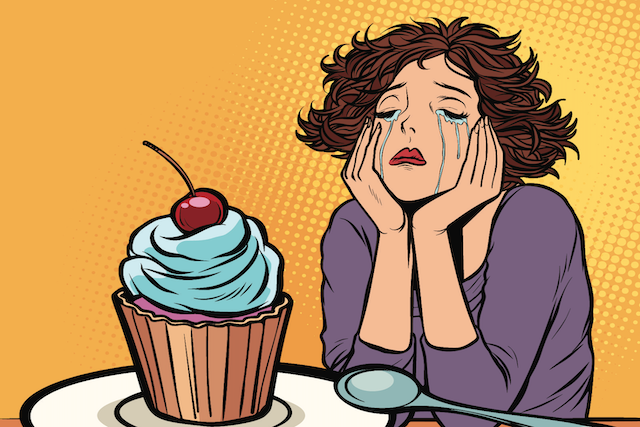
“When you no longer believe that eating will save your life when you feel exhausted or overwhelmed or lonely, you will stop. When you believe in yourself more than you believe in food, you will stop using food as if it were your only chance at not falling apart.” ~Geneen Roth
I used to eat because I was lonely.
Lunch hour at school would last nine billion years. I’d have no one to sit with—I was spotty and mega bossy, and my hobby was copying pages from anthropology books.
Everyone would put a sweater on the chair next to them, so I’d have to sit further away. Then, just as I’d pick up my fork, they’d up and leave anyway! “Oh well,” I’d think, “If I eat slowly I can make my fries last till the bell goes.”
I switched to packed lunches to avoid the dining hall. But I didn’t want to be spotted alone on a windowsill, so I’d eat my sandwiches in a toilet cubicle.
After, I’d feel full, but unsatisfied. And still have time to kill! So I’d go to the dinner hall and buy a meat pie. I felt sad and gross.
The truth was, I didn’t know how to be a friend, let alone make one. I was full of resentment toward other kids.
I acted superior but felt inferior. I was needy, or tried to impress them.
I didn’t think friendship was something people learned—I thought there was something wrong with me. That I’d be this way forever.
I also hated that I couldn’t resist overeating. Since my family was big on brown rice and organic vegetables, I felt guilty for buying junk food.
When I hit my teens, I became body-conscious. I panicked that comfort food would make me fat. I wasn’t! But I thought my thighs were big, and clenched my stomach in all day. All day!
I felt too embarrassed to ask anyone—especially my parents—for help. I thought they’d say I was greedy. Or lecture me about eating crap. Or take me to a doctor—humiliating!
I didn’t know it was called “emotional eating,” but I was pretty sure it was bad. So I kept quiet.
I thought: “I can fix this myself. I just need the self-discipline to eat less!”
Going on improvised diets made things a whole new level of worse: binge eating, bulimia, and feeling utterly obsessed and depressed about food.
It took seven years before I found a way to recover.
I wish I’d known how to deal with lonely emotional eating in the first place, instead of going off on an eating disorder tangent!
So if you’re dealing with a double-whammy of eating and loneliness yourself, here are eight simple steps. They will guide you through solving your emotional eating, and your loneliness, from the inside out.
1. Imagine your life without emotional eating, and shift focus away from guilt and shame.
You’re not greedy. You’re not gross. You’re not ill. You’re just trying to cope with a fear: abandonment.
It’s the emotional fear we’re born with. Outside the tribal circle, a baby would die. The primitive part of your brain thinks, “I’m alone—I’ll starve!”
It’s how you’re wired, so give yourself a break.
If you waste your energy wrestling with guilt and shame over eating, you’ll never tackle the real emotional challenge—loneliness.
So when guilt and shame come up, shift your focus.
Imagine a peaceful relationship with food. Imagine eating when you’re actually hungry. Visualize slowly nourishing yourself.
2. Loneliness is a self-worth issue, so become willing to work on your self-worth.
It’s like this: You’re by yourself. That’s not loneliness, that’s solitude.
Sometimes it’s nice, but sometimes you don’t have a choice. Uh-oh!
Mind games start: you imagine it’s because you’re unlovable.
That’s loneliness. Low self-worth, in disguise.
If you’re lonely, it’s easy to think you could earn your self-worth back by changing something external.
You think, “If I found a great partner, then I’d know I was lovable.”
Or you think, “I’ll be worth loving once I get a grip on my emotional eating and lose weight.”
But that’s not how it works! Self-worth isn’t something you earn. Or that drops in your lap either.
You choose to create it.
So ask yourself: How can I work on my self-worth?
(Don’t worry if you don’t know yet. Some ideas are coming up…)
3. Spend some quality time with yourself.
Are you enjoying your time by yourself? Or just watching TV?
Imagine you treated a child the way you treat yourself on a too-tired evening.
Browsing Facebook when they say, “Play with me.” Sending them to the fridge to scavenge instead of cooking dinner. Binge-watching Netflix instead of putting them to bed when they’re tired.
They’d feel hurt, and start believing they weren’t worth spending time with. They’d also start misbehaving wildly to get your attention!
The same is true for how you feel about yourself. When we ignore our inner selves, we start to believe we are worthless, and an emotional eating crisis is a great way for our heart and soul to grab our attention.
Spend some quality time with yourself.
Take yourself on a date, just you and you.
Play (build a go-cart, paint your room), be in your body (move, bathe, meditate), or relax (read, whistle, sit in nature).
Self-worth grows as you self-connect, so every little counts.
4. Create thoughts that give an inkling of self-worth.
When I was rock bottom with food and loneliness, my thoughts were dominated by failure, being a victim, and believing change was impossible.
Stuff like “I’m gonna be lonely forever,” and “I hate my body, I hate myself for eating, and I’m too pathetic to stop.”
Three positive thoughts in particular helped me out of my pit.
They didn’t tell me directly I was worthy or fabulous—saying anything saccharine about my life would have felt like gloss painting a turd.
They just implied a basic level of self-worth.
They were: “I’m part of life unfolding.” (I’m not in a vacuum. Even though I feel totally dissociated and alone, I’m still participating in life on the planet.)
“I really care about my body.” (I’m upset I overate again. But I couldn’t get upset if I were indifferent… So on some level, I must care!)
And: “Things are already changing.” (Repeating this phrase is a positive action… So maybe I won’t always be like this).
Find one thought that implies you aren’t your worst fears. That makes you feel worthy-ish. Then repeat it like you’re being paid a piece rate to do so.
5. Explore how you’ve created loneliness.
Try this: It’s funny!
Imagine someone wants to master the art of loneliness. Lucky for them, you’ve honed the perfect system!
Write down what you’d teach them.
My own Perfect System for Staying Lonely says: “Don’t have a calendar for friends’ birthdays. Tell yourself that you’re too broke to buy gifts, cards, or book a babysitter.”
And: “Get hired for shift work, and rehearse theatre shows every weekend.” I disconnected from my relationship like that that for the first five years of my marriage! (Thankfully, the guy’s a legend.)
The point is, I thought loneliness happened to me.
But I make myself lonely, when I don’t need to be. Years after my schooldays are behind me, I lead myself back to that painful-yet-familiar place. It’s called a comfort zone.
It doesn’t mean it’s your fault you’re lonely—this isn’t about blame. This is actually good news: If you’re doing it, you can undo it.
6. List everything that your loneliness buys you.
An excuse not to face trust issues?
A reason to avoid intimacy?
A cover for social anxiety?
I know it’s not obvious that loneliness has advantages, but sometimes it’s a way to avoid something even more scary or painful.
Me? Loneliness excuses me from owning my introvert personality. Intimacy makes me feel vulnerable, and rejection scares the crap outta me.
These hidden benefits to your loneliness are called “payoffs.” It pays off to explore them!
Because they’re the reason you’re creating loneliness, even though it hurts.
7. Explore the ripple effect of loneliness in your life.
You’d expect loneliness to make you shy at parties, or reluctant to date.
But has it changed you in other ways?
Unhealthy self-reliance has made me a nightmare to cook with. And low self-worth has taken its toll on my financial outlook.
Clean out your worldview.
Defy your loneliness-inspired beliefs about what you can and can’t do (like, ask someone to chop the mushrooms while you stir the risotto, or ask your boss for a raise).
It’s a great way to un-victim yourself.
8. Finally, when you’ve done all that inner work, break up your emotional eating habit.
Habits weld to each other! Drinking and smoking. Driving and talking to yourself in a variety of accents. Lonely emotional eating and—?
Break the links.
Don’t just say to yourself “Stop eating toast.” Don’t make any rules about what you eat.
Instead, change how you eat. If you don’t know how you eat, slow down.
Notice what you do at each stage of your emotional eating habit—beforehand, during, after, where, when, with what planning.
Do any part of your habit differently.
Say you eat ten slices of buttered toast and jam in front of the TV each evening. Buy different butter that you don’t like so much. Put the TV (or the toaster) in the cellar. Create an eating area, keep the sofa for relaxing. Shop differently. Go out.
Keep disrupting your habit, and it will eventually dissipate.
Habit change takes patience, and sometimes repeated attempts too.
But break up your habit from enough angles, and you’ll eventually find you’ve replaced it with a way to enjoy food again.
—
The way I think of it, addressing loneliness is 88% of the solution for emotional eating from loneliness.
When I solved my eating struggles, I spent a couple of years of journaling and becoming aware of my beliefs, thoughts, and feelings. Then, only a month or two of habit change.
I know a couple of years sounds really long! Perhaps it will take less time for you. The point is, this isn’t a quick fix. Quick fixes rarely address the underlying issues.
It’s tempting to rush. To try to skip straight to solving the eating—out-of-control eating feels unbearable and you want it to stop, like, yesterday—but if that hasn’t been working for you, or you’ve even ended up binge eating like I did, give yourself permission and time to go deeper.
Trust me, changing an emotional eating habit is much easier when it’s just eating, and the compulsion part has had your loving attention.
So good luck, and don’t rush.

About Laura Lloyd
Laura Lloyd is an Eating Psychology Coach and Cognitive-Behavioural Hypnotherapist, helping people un-addict from everything, including bingeing and overeating. You can access her FREE illustrated ebook, How To Unlearn Overeating, here.









 Though I run this site, it is not mine. It's ours. It's not about me. It's about us. Your stories and your wisdom are just as meaningful as mine.
This is beautiful, thanks for sharing.
Emotional overeating and binge eating are behavioral reactions to unresolved core emotions based on feelings of low self esteem, low self-worth and an inner hunger for love. We try to heal this pain through eating, but it is not enough. Like drinking sea water to quell our thirst. What I find most effective for healing these inner wounds is to make them the focus of your mindfulness meditation. Hold them in the embrace of your conscious awareness, learn to relate to them as a part of yourself that is in pain and respond to these emotions with compassion. This creates the right psychological conditions for healing. It takes some training and guidance, but this is the sure path to healing.
Sorry, I didn’t understand what you said about meditation and wounds. I feel that you are trying yo give advice and I’m interested in one, but I don’t get it.
I really can resonate with the article. It gives a lot of practical advice with examples. I find real life examples the most helpfull. It’s really hard to understand yourself when you are lonley.
The best analogy here is to see your painful emotions as being like a child in pain. How would you respond to a child in pain? That response is innate compassion combined with consciousness. This is mindfulness. When we meditate in this way on our emotions with mindfulness it promotes healing, just as it would for the child.
The real problem is that we don’t do this but get distracted into patterns of avoidance and self-hatred which have the opposite effect of reinforcing emotional pain and prevent inner healing.
Even meditation, when not properly understood, can have the undesired effect of promoting avoidance (ignorance) and self-criticism (aversion).
Hope this helps.
thanks for this! As i have read in the Consumer Health Digest that in the US a lot of young adults is suffering with depression! thanks I need to get my life in line! I think I am just drowning with all of this
This post is very very awesome. I enjoyed reading it a lot, and the points to overcome loneliness.
Awesome post. I am feeling happy to read this post.
It’s a coping mechanism. We have to convince ourselves that it saved our life in the past so we have to be grateful. But now we don’t need it anymore! We have to let it go!
Awesome article! I, too, have wondered about my feelings of lonelines since I was a kid. I also sat in the bathroom when I didn’t have any friends to sit with, feeling unloveable. And I have wondered for so long why I compulsively eat junk food and STILL convince myself to avoid making new friends, and I’m almost 30! Thank you so so much for your article, I now see that choosing to avoid “putting yourself out there” is a choice that leads to self imposed feeling of isolation and bad habits. Humans need social connections to thrive!
I love it so much.. usually I find articles on here a bit too out there but this one is so beautiful and practical too. Thanks for sharing.
Very nice . It is a very useful article measuring different points of helping mind problems that drove to physical diseases as obesity , metabolic disease ,etc.