Tag: wisdom

  • How I Learned to Stop Pushing So Hard and Enjoy the Moment

    How I Learned to Stop Pushing So Hard and Enjoy the Moment

    “Life is a balance between what we can control and what we cannot. I am learning to live between effort and surrender.” ~Danielle Orner

    Over a year ago, I boarded a plane and found myself on the beautiful beaches of southeast Asia. My dream was to travel the world, indefinitely, while working independently and living out of a suitcase. I had worked hard in my life to come to this place, and there couldn’t have been a moment that was more positive for me.

    However, as I enjoyed sunbathing on the beautiful beaches, I started to feel weary. It’s hard to describe really, but I slowly started to slip into a deep apathy and restlessness. Everything was perfect, or at least it should have been, and yet I was becoming unsatisfied.

    In a day I would travel to unknown waterfalls, go hiking, and explore mysterious secret beaches, but I was stagnating on the inside and I couldn’t understand why.

    In time, I realized the problem: Before, when I had fought so hard to get to this place, that had been my purpose, and now that I was here in this beautiful paradise I felt purposeless. I had nothing to push for, only something to enjoy, and that wasn’t something I knew how to do.

    To combat the monotony I tried to change things up. One trip found me driving through an Indonesian island weaving in and out of mountain passes with my girlfriend, who I’d met there, on a scooter. It was a complete rush, and I should have been lost in the moment, yet I felt nothing.

    During that day I remember her being completely full of passion. She was exuberant and full of energy. We arrived at the extravagant water temple in the middle of a lake. I was calm and distracted trying to find how things could feel right for me, trying to understand how I could find that purpose again.

    Times before, when I had been deeply challenged, taught me that to overcome such obstacles I just needed to put forth more effort and try harder. Staying true to that pattern, even with all signs telling me not to, I made the decision to drive us back through the mountain pass with the ever dark grey skies clearly delineated.

    Sure enough it started raining lightly on the way back as I drove the scooter through the cliffs. Staying on the same course, I kept driving and pushing forward no matter the obstacles telling me clearly to stop and regain balance. Even the sweet girl’s cough in the rain couldn’t get me to pause for a moment.

    I was a jerk. Arriving back at my home, I knew something was out of place. My beautiful girlfriend’s sneezing and coughing made me feel even worse, though I still didn’t quite get what was right in front of me.

    You see, most things were never easy for me, and what I had learned to be an exceptional strategy was to always push forward. No matter what was standing in my way, I had learned over and over again that I could overcome those obstacles through pure willpower and force.

    I had a lot to learn, and it would be a painful lesson.

    In the following weeks instead of pacing myself, I pushed myself even harder. I went to work earlier, I worked harder, and I exhausted myself. Out of my awareness, my girlfriend started to distance herself from me. She was taking trips by herself, relaxing on beaches and enjoying her time, while I felt like I was running through quicksand.

    At first, it was difficult for me to notice when she was gone completely, but it came hard and fast. I tried to block it out entirely by doing more, but I couldn’t. I recall a half hug one evening that left me feeling empty, but everything else seemed vague and blurry, as I had managed to shut out those feelings.

    As you may have guessed, I continued my same pattern of trying even harder in life; whether that was in my relationships or my work, I believed that was the solution. I increased my working hours, and when that didn’t work, I did the complete opposite and didn’t work at all. Instead, I tried harder in my love life, going on too many dates and exhausting myself.

    Soon I came to look for healing with all my force. I read articles and tried to take better care of myself. I saw a therapist and tried to force the problems to go away with all my will, but it was all too elusive.

    I felt broken down and completely lost when a good friend offered to take me out for a surfing lesson.

    It was a fine day with beautiful weather, and we had just finished applying sunscreen when I looked out and saw all the surfers, young and old, having success on the waves. One that stood out to me and warmed my heart was a child, about eight years old, gliding along the waves so effortlessly.

    On the first run, I paddled out and got ready for the wave to come. I could see the white ripples coming, and excitement filled my untired chest, as I knew this moment was coming for me and I would be ready for it.

    I propelled myself as hard as I could; viciously, I accelerated as the wave came up behind me, and I knew that this was my moment. Looking up and with perfect form, I did exactly as my instructor had taught me. I put my leg in a star against my other leg, kept my arms firm, and pulled up to stand.

    I got on one leg and, with waves all around me, I was doing it. I started to bring my other leg up so I could stand, and just like that, another wave came out of nowhere and knocked me off my board and into the roar of the current. I flailed around just as if I had been a floundering fish.

    I’d almost had it. I was so close. All I had to do was get off of my one knee and onto my other foot, and I would have been standing there, firmly surfing this beautiful wave on this gorgeous day in Southeast Asia.

    You can probably imagine what I did after this. I tried even harder, over and over again, yet it felt like the waves kept hitting me harder and harder.

    I didn’t take the rejection easily either. I kept getting back up and throwing myself into the rough water. The same result kept happening. Over and over I got thrashed by the ocean, beaten down by a bully that I couldn’t defeat.

    After a while, my friend and instructor looked over at me knowing that I had probably had enough, but I wasn’t ready to quit. He watched on as we both saw the biggest wave coming that had been there the whole day. Again, I used the form he had taught me and again I got bombarded by the waves and thrown violently into the dark blue ocean.

    That one hurt. Feeling beat and exhausted, I looked up just in time to see my surfboard smack me squarely in the face, to the point of almost knocking me unconscious. This was the first time the lesson would finally hit me hard enough for me to recognize it.

    Meekly, I found my surfboard and paddled back to the shore. On the way I saw the younger children gliding along the friendly waves and enjoying the thrill of winning. Me, I felt complete exhaustion and utter defeat.

    Collapsing onto my surfboard on the shore of the sandy beach, I took a moment, actually probably many moments, to collect my breath. It would take me even longer to collect my thoughts, but I had taken away something significant from the moment that had came, bombarded me, and left me to think about things.

    Over and over again, I had tried to will myself to victory in every area of my life. My solution was always to try even harder, to be more, and to do more. I had finally realized that the key to life is balance—which means learning when to surrender.

    This same drive that had helped me become so successful in life was the thing that was causing me the most pain and preventing me from appreciating life. Always in a hurry to accomplish the next thing or make the next goal, I had adopted a sense of inadequacy that caused constant misery for me on a paradise island that was full of beauty I couldn’t see.

    This being out of balance and trying harder at everything finally made me have a complete breakdown. Most of the time when we lose our balance it’s too late, and we’re already on the floor before we notice it. This is what happened to me.

    I finally got to see through the illusions that I had been putting up all around me. I understood that I had been hiding my feelings of inadequacy with the hope that they would go away if I just tried harder. I realized that I had shut everyone else out, and most importantly all of these realizations opened me up to feeling again.

    A week later on the plane ride back home I put very black sunglasses on. It was a bright morning, but for the first time in a long while I let myself go and allowed myself to feel again. Most likely no one except for me truly knows how painful that airplane ride was, but after you lose your balance and fall it often hurts.

    My next challenge would be to restore my balance and regain a firmer foundation. This time, however, I would not have to try harder, because often life isn’t even about how hard you try.

    On that sunny day in the ocean surfing, it wouldn’t have mattered how hard I was trying to surf. Nearby an eight-year-old was hardly trying at all, and he was having the time of his life coasting on the waves. Ultimately, we were both going to end up eating water—just as we all fall in life at times—but he was going to be fulfilled and laughing while I was trying to force an outcome and causing myself to be unbalanced.

    Floating is natural, just as the waves in the ocean, and the chaos in life. I now have the ability to let go and find stillness so that I can regain my balance and move forward in life. This all came from having that complete breakdown and teaching myself that it was okay to go slow and take care of myself. I had to.

    I haven’t yet made it back out to the ocean or traveled since then, but I know that when I do I will be able to let go and relax into balance.

    Whatever challenges you are facing, consider that you still have the room to pause, relax, and take care of yourself. You don’t always have to be pushing, achieving, and succeeding. Sometimes it’s just as important to reflect, recharge, and simply be in the moment. With nothing to do or prove.

    When I feel myself trying harder or pushing too much, this is what I do now. Instead of stuffing my feelings down, I slow down, let myself feel them, and learn from them what I need.

    I also remind myself that I don’t have to fight the current so hard to force things to happen. Sometimes it’s far wiser to surrender, relax, and enjoy the ride. When we embrace peace and balance we still move forward in life—just with far less stress and a greater appreciation for everything around us.

  • Escape Isn’t Self-Care: What We Really Need to Feel at Peace

    Escape Isn’t Self-Care: What We Really Need to Feel at Peace

    “A pause gives you breathing space so listen to the whispers of the real you waiting to happen.” ~Tara Estacaan

    You and I, we’re much too busy. We’re doing too much. We’re stressed. We’re overscheduled and overwhelmed. And we’re not doing enough self-care.

    The good thing is there’s help. There are headlines, hacks, and half-baked gurus who promise to bring us to the less-stressed light. And there’s a vast supply of products to help too. Bath salts, wine, essential oils, yoga classes, massages, chocolate cake, books, life coach packages, etc. But sometimes I wonder, are all the articles and products about becoming less busy actually helpful? Does the practice of self-care actually take care of yourself?

    For the last few weeks I’ve been dosing myself regularly with the things prescribed as self-care. Bath soaks. Chocolate cupcakes. Mantras. Spa music. I’m doing it and I feel like if I fake it till I make it, maybe I’ll soon feel like my life is better managed. I’ll feel less stressed. I’ll run to social media and post a bunch of cloying hashtags: #blessed #metime #nofilter.

    I’m somewhat inclined to think that most of the snake oil being peddled as self-care is feel good fluff. It’s not bad. Baths are lovely. Chocolate cupcakes are really lovely. But, it’s not self-care in and of itself. It’s escapism that that has often been packaged and sold to us.

    Escape is a completely necessary and wonderful practice. One I enjoy with some frequency. Escape practices allow for quiet, space, pampering, indulgence. Do it. Enjoy your escape.

    But the reality is all these practices aren’t bringing me even a slice of peace. I am sitting in the bathtub with billions of thoughts swarming my head. I don’t know how to turn off. My life moves faster than I can. My daily existence exceeds my ability to process it all. Things have to change.

    This here is the crux of actual self-care. Self-care is parenting yourself. It’s cleaning your room by the time your family returns home. Not having candy for dinner. Getting lessons in how to make a solid pasta with bolognese. Kissing booboos. It’s going to your room and thinking about what you’ve done and continue to do; not as a practice of shaming or punishment, but as a practice of self-awareness and understanding the consequences of your actions.

    Self-care means pausing and paying attention. It’s asking yourself a lot of questions: How am I? What’s working? What’s not working? Why am I stressed, sad, mad, overwhelmed, feeling ashamed, etc.? What can I change? If I can’t change it, how can I cope? If I can change it, what do I do first? Self-care can…suck.

    Sometimes I pause, check in with myself, and realize the thing I need right now to relieve some pressure from my life is a hot bath and a glass of wine. Perfect. Escape can be self-care. But sometimes I pause, check in with myself, and when I really pay attention I am forced to recognize that the way I am living right now isn’t cutting it.

    My habits, jobs, or relationships have become cycles that bring frustration, stress, sadness, or other crappy feelings. I can throw all the yoga classes and massages at those feelings, but I won’t actually feel better until I change something.

    When you come to the point where you need to take care of yourself, it means your current way of being isn’t working and you need to guide yourself back to a good course.

    It’s saying no to something. Sometimes it’s saying no to something deeply ingrained in you or in our culture. It will feel like parts of yourself go missing. It will feel like you are doing it all wrong. You will have to keep reminding yourself our materialistic and accomplishment-obsessed culture got it wrong, and you have a right to sanity.

    Here are some of things I have done out of self-care that have sucked: reduced my eating out budget, quit a job, put a goal on hold, taken a six-month break from drinking, disappointed my daughter, disappointed my wife, let myself feel pain rather than seeking distraction from it, and opened my heart knowing it will break over and over again.

    Self-care can be gritty, treacherous stuff. It’s like a scramble up a steep incline. Rocks are loose under your feet. It’s hard to find stable footholds and grips. But, eventually, you get to the summit and take in a windy, clear view.

    About a year ago I made a list of things that make me feel most human. At the time of making the list I didn’t realize it, but looking back I realize this was a list of things I do to pause. The practices that work for me to connect to myself and check in. A walk in the woods. Time alone. A soak in a hot bath. Yoga.

    None of these things are necessarily self-care in and of themselves, though they can be. But, they are practices that allow me to listen to myself. They make room for self-awareness.

    Your self-care will be varied, inconsistent, and dependent on your current circumstances. But, the practices you use to pause, pay attention, ask yourself a bunch of questions, and listen to the answers can be consistent, regular practices. Schedule them into your life. Make yourself accountable. Ensure you are pausing. Give yourself the opportunity to listen.

    Self-care is what enables me to go to a lovely massage and return to a life I like. I’m not just waiting for the next time I can get away. The neverending chase for bliss and ease doesn’t provide me substance or solidity. So instead I work to craft a good daily life. A life with rhythms and cycles that I can sustain while maintaining a feeling of wholeness.

    This simplicity is exactly what has brought me the most happiness. This life that is wholly boring, introspective, questioned, and arranged with intention.

  • 10 Ways to Give the Gift of Your Presence (The Best Gift You Can Give)

    10 Ways to Give the Gift of Your Presence (The Best Gift You Can Give)

    A couple weeks back I shared a quote on Facebook that really spoke to me:

    “A child is going to remember who was there, not what you spent on them. Kids outgrow toys and outfits, but they never outgrow time and love.”

    I love this quote because it puts things in perspective, and it’s true not only for kids but for all of us. Sure, shiny things are nice and appreciated, but what we all really want is love, and time with the people who mean most to us.

    For those of us who are fortunate, the holidays are all about connecting with family—whether that means the family we were born into, the one we married (or chose not to marry) into, or the one we pieced together with a ragtag group of misfits just like us.

    But being with the people we love isn’t the same as being present with the people we love. Especially if we see these people all the time, it’s easy to be there but not.

    I know, because I’ve fallen into this trap myself. I’ve listened to my boyfriend talk while wondering about completely random, inconsequential things, like when my favorite show will start up again or whether I should cut my bangs.

    Or, on my worst days, I’ve held a full conversation with someone while rehashing painful memories in my head or worrying about the many things I can’t control.

    It’s human nature to sometimes do these things, but there’s no denying it can make a huge difference for the people we love when we’re fully present with them, and that presence is the best gift we can give. How can we do that? Read on…

    1. Take care of your own needs.

    This may seem like an odd start to this list, since the point is to be present with other people. But it’s much more difficult to be present when we’re exhausted, overwhelmed, or deprived of the things we need to function at our best.

    I know this from recent experience. For a number of personal reasons, I haven’t been sleeping well lately, and I haven’t been getting as much exercise as usual because I’ve felt so drained.

    As a result, every time I talk to someone I have to consciously repeat what they said in my head, because my tired brain often interprets their words as something sounding like the teacher from Peanuts. I also have to resist the urge to be short with them, which, I’m embarrassed to admit, I sometimes do when I feel tired and sluggish.

    Especially if you have kids, it might be tough to get a good night’s sleep, tonight in particular. But do what you can to take care of your needs. Eat a healthy breakfast. Get out for a solo walk to clear your head. Set boundaries with people who drain you. As the saying goes, “You can’t give from an empty cup.”

    2. Fully listen—even if it’s a story you heard a million times before.

    Everyone wants to feel important, seen, and heard. Give your full attention instead of just waiting to talk, even if it’s a story you could repeat verbatim because you’ve heard it many times before.

    We often retell the stories that bring us the most joy—or alternatively, rehash the situations that have brought us the most pain.

    You don’t have to be an all-day sounding board for repetitive complaints (boundaries, remember?), but it could make a huge difference to lend your ear, your compassion, and your support, even if just for a while.

    3. Drop the judgmental story and accept people for exactly how they are in the moment.

    I shared a Winnie the Pooh-related meme on Facebook the other day that really resonated with me. The quote reads:

    “One awesome thing about Eeyore is that even though he’s basically clinically depressed, he still gets invited to participate in adventures and shenanigans with all his friends. And they never expect him to pretend to feel happy, they just love him anyway, and they never leave him behind or ask him to change.”

    Accept the people you love who are depressed. Accept the people you love who struggle with anxiety. Accept the people who can’t seem to get into the holiday spirit, maybe because they’re grieving or coping with a pain they never discuss.

    I don’t know about you, but I’ve been all of these people before. And I appreciated the people who didn’t expect anything more than I could be and give.

    It’s such a massive weight off our shoulders to know we can simply show up as we are, without pretending or having to justify why we feel how we feel.

    4. Talk first, tech later.

    These days we’re all essentially living double lives—the one where our feet take us from place to place and the one we’re our hands swipe from dopamine hit to dopamine hit. (For those who are unfamiliar, dopamine is essentially the “feel good” chemical that gets activated when we experience some type of reward—e.g.: social praise.)

    I know how seductive tech connection and social media can be, but try to be fully available to the person right in front of you—even if you’re tempted to text other people “Happy holidays!” during a real-life conversation, or post your ugly Christmas sweater pic on Instagram.

    As I’ve said before, your texts will be there later, but the person in front of you will not.

    5. Don’t be the Ghost of Christmas Past.

    If you’re reliving happy Christmas memories, then sure, go for it. But if you’re comparing this year to years past unfavorably, try to let it all go. Especially if you’re feeling bad about what you did last year versus what you did this year.

    So what if you gave more expensive gifts last year? No one reflects with a calculator in hand; they remember the love and thoughtfulness. So what if more people showed up last Christmas? Time with anyone you love is precious, whether it’s one, ten, or more.

    This is something I’ve had to work on this year. I’ve only missed one Christmas with my family in my entire life, but for personal reasons, I wasn’t able to fly back this year.

    Given that this is my favorite annual tradition, I’ve resisted, at times, that I won’t get to join “the ginzo convention,” as our gatherings have been called. (My apologies to any Italians who are offended; we actually find this more endearing than derogatory.)

    But this year I’ll be with my boyfriend and his parents. And it will be different but no less wonderful. There will be other Christmases with my family, but this is the only opportunity to appreciate and enjoy this year’s plan.

    6. Notice the little things.

    When we’re caught up in our heads, dwelling on the past or anticipating the future, or otherwise distracting ourselves from the moment, we miss the details.

    You can only compliment your sister’s taste in holiday décor if you look up, look around, and take it all in.

    You can only notice your grandmother’s new brooch (or is it only mine who had an impressive gaudy Christmas pin collection?) if you’re not just looking at her but really seeing her too.

    We all love compliments, and the best ones come from people who pay enough attention to notice the little things.

    7. Let people know their presence matters.

    Okay, so this one isn’t really about giving presence but rather appreciating someone else’s. Because really, that’s what this all comes down to—showing people they’re important to us.

    As I mentioned, I didn’t go home this year, and my family knows this has weighed on me. So each of them sent me Christmas cards with gift cards inside. My brother sent his with a Disney gift card, because he knows my boyfriend and I are annual pass holders. But that’s not what touched me most.

    Inside the card, he wrote, “Not home, but not forgotten.” Cue the waterworks.

    Not that I didn’t already know this, but this reinforced that I’m an important part of my family. My presence matters. I matter. I can’t think of a better gift than that.

    8. Sing a song, play a game, watch a home video, or do something that becomes a tradition.

    I don’t know about you, but I look forward to certain holiday traditions every year, and because these are things that only happen once a year, it’s instinctive to be fully present.

    For example, my brother and I watch A Very Brady Christmas—an incredibly cheesy movie that we enjoy nonetheless. And, though this one isn’t an annual tradition, my family and I regularly re-watch one specific home video from my grandmother’s house, from when I was about five.

    My sister, cousins, and I all sang songs (mine being Wudolph the Wed-nosed Weindeer—I was five, remember), and my grandmother had us reenact the story of Jesus’ birth, which she narrated.

    Though I no longer hold the same religious beliefs, it still touches me to watch this, especially since my grandmother’s now gone.

    If you don’t have a holiday tradition, start one now—something everyone will love and look forward to, or love to mock but fully show up for nonetheless.

    9. Get people talking about their passions.

    While it’s a beautiful thing to give people the gift of your presence, it can be equally beneficial to give them the gift of their presence—and most people find it much easier to be in the moment when they’re talking about something they love.

    When someone’s passionate about something, it’s like everything else falls away, kind of like in the movies when the spotlight turns on, the background noise fades, and it’s just the star, the light in their eyes, and they story they can’t not tell.

    One of my cousins is really into theater, and she’s in her early twenties, so she’s just coming into her own and figuring out who she wants to be. Whenever she talks about plays or auditions or the many impressive things she’s doing to give this a go, her enthusiasm is magnetic.

    And not only does this get her excited, it reminds me to keep pursuing what sets my heart on fire—to keep dreaming, keep trying, and keep filling my life with possibilities. So really, this is a gift we give and a gift we get.

    10. If you have trouble being present, just be present with yourself.

    Sometimes, despite our best intentions, we struggle to do all the ‘right’ things. I’ve often been hard on myself when I struggle because I want to do everything perfectly. I want to be perfectly considerate. Perfectly open-minded. Perfectly compassionate. Perfectly present.

    But we’re only human. Sometimes all these great practices are just plain hard to apply. Sometimes we’re tired, or sick, or overwhelmed, or anxious. Sometimes we can’t let go of the pain someone once caused, or can’t stop thinking about pain that might come.

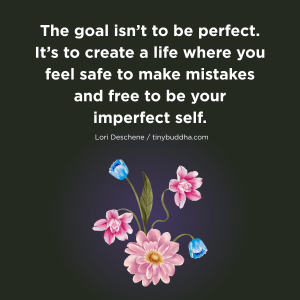
    And I’ve decided that’s okay. It’s okay to not be perfect. It’s okay to briefly be present and then get lost in our head for a bit. It’s okay to accept someone in front of us then judge someone else—so long as we eventually recognize what we’re doing.

    All we can really do in these human moments is be aware, accept ourselves as we are, and give ourselves permission to be perfectly imperfect. The best way to get present again is to accept that we sometimes won’t be, let go when we struggle, and then try again.

    Happy holidays everyone—and thank you for your presence here on Tiny Buddha! You make a difference, and you’re appreciated.

  • How Gratitude Journaling Can Boost Your Mood and Change Your Life

    How Gratitude Journaling Can Boost Your Mood and Change Your Life

    “Gratitude unlocks the fullness of life. It turns what we have into enough, and more. It turns denial into acceptance, chaos to order, confusion to clarity. It can turn a meal into a feast, a house into a home, a stranger into a friend.” ~Melody Beattie

    A few years ago I had an ulcer and I would get dizzy after almost every meal. There was a point when I was afraid to eat. I lost twenty pounds when I didn’t need to lose weight.

    I wasn’t sleeping well.

    I was a complete wreck inside.

    It took me two and half years to get my stomach back on track. I tried one thing at a time until I found what worked well for me. I can no longer drink coffee or eat tomatoes or other acidic foods. And man, did I did love a good cup of coffee to help get my morning going.

    Still, I’m actually grateful for my ulcer. It was one of the best illnesses to ever happen to me because it helped me become a healthier person.

    I was only able to overcome it because of my gratitude journal. Each day, I thanked the foods that didn’t cause me to feel dizzy. As I journaled more and more about these foods, I began to see patterns, which helped me ascertain which foods to eliminate.

    I put my energy into appreciating the foods that helped me feel good instead of complaining about the foods that made me feel sick to my stomach. And that helped me both heal and keep a positive attitude.

    This is why I suggest everyone keeps a gratitude journal. It helps you see things that you missed before. It encourages you to focus your attention on things that are making your life better.

    The best part is gratitude not only helps you live longer because it helps reduce stress, it also helps you build stronger relationships because you are more likely to share your appreciation with others. And when you regularly practice gratitude, you’re generally more empathetic and less prone to envy—great for your mental health and your relationships.

    The Power of Gratitude Journaling

    It took me some time to turn gratitude journaling into a daily habit. When I first started, I would miss days at a time. It took almost a year to get a consistent habit going. Once I made gratitude a regular practice, it helped keep me sane since I was focusing on the things I had in life instead of wanting a situation to be different. This was a huge mindset shift for me.

    As I got busier I started getting away from my journal again. Then, as my father was passing, I leaned back into it, but I wanted to go a little deeper. I started writing stories in my gratitude journal, which helped me uncover details I hadn’t really processed before.

    I noticed him getting grumpier as he got older. My journal helped me see that I didn’t want myself to fall into the same bad habits. And I didn’t have to. I had a path to build a better attitude.

    I quickly noticed my new attitude changed how people responded to me. For example, coworkers started gravitating toward me because I was letting them know that I appreciated them. Who knew that a little appreciation would help you build friendships?

    I also noticed that the migraines that used to start at the base of my neck weren’t as intense. Gratitude was not only improving my attitude and my relationships, but also my health.

    I felt like I’d stumbled upon a magic formula for life. I know that people have been talking about gratitude for thousands of years, but it felt so refreshing to me.

    I did some research on gratitude and found some amazing studies.

    In one book, Why We Do What We Do, researcher Edward Deci explains that when someone has six positive interactions to one negative, they are 31% more productive.

    When you have positive thoughts and interactions, it’s easier to focus on what matters. That may be spending time with your family, traveling, or writing. Positive interactions free you up to have the energy to do what matters to you.

    Start Small

    The intense focus of finding some small bit of gratitude in every situation really changed me.

    When I was stuck in traffic, I thought about how I could appreciate the situation and write about it. When I was stuck in another meeting, I thought about how lucky I was to be in the situation and asked myself, “What is one important lesson that I can take away from this meeting?”

    Sometimes the lesson was to breathe into my belly more. Other times it was learning from a really smart coworker who handled the meeting very well, kept us all on track, and helped us get a lot accomplished.

    Because I started small, I planted seeds to be able to go deeper into gratitude.

    If you too would like to create more positive feelings and interactions, I highly recommend starting a gratitude journal. And it can actually be really simple.

    Each day this upcoming month, just write a few things you are grateful for and why, for example:

    • I’m grateful for my coworker because she is always willing to listen and help.
    • I’m grateful for my ability to dance in my car seat when I’m stuck at a traffic light, because it allows me to release my stress.
    • I’m grateful for my pets because they make me feel loved and needed.

    The key component here is your why. This is important because it helps you actually feel grateful, as opposed to just listing things you think you should appreciate. Soon you’ll likely start to feel a lot better about your work, your relationships, and even yourself. And before you know it, you’ll probably notice an improvement in your attitude—and major changes in your life.

  • How to Tackle Fear and Anxiety Cognitively, Behaviorally, and Spiritually

    How to Tackle Fear and Anxiety Cognitively, Behaviorally, and Spiritually

    “The beautiful thing about fear is that when you run to it, it runs away.” ~Robin Sharma

    During my first-grade choir concert, my classmate, Meg, fainted from the top row of the bleachers, and in a subconscious gesture of empathy, I went down right after her, breaking my glasses and flailing on the gymnasium floor.

    It’s possible that this triggered some kind of coping mechanism in my brain, because I started fainting again and again.

    One time I fainted at the dentist’s office—immediately after the dentist injected me with my first round of Novocain—then months later in a hospital parking lot after a small medical procedure.

    I also fainted a few days after getting my ears pierced. I was showing my grandmother my new gold studs, and I happened to look toward the TV just as Nellie Olsen fainted during a Little House on the Prairie rerun, and that was enough, over I went.

    What affected me the most during those early years of growing up was not the tangible act of fainting, but my anxiety anticipating when and where I would faint next. Whenever I wasn’t moving, whenever I tried to be still, my thoughts traveled to the fear of fainting. And because of that, I tried to keep my mind constantly active.

    I had several tests, and the doctors found nothing medically wrong with me. I literally scared myself to the point of fainting. Though I never let fear prevent me from doing things, inner struggles and cautious dread were always present. It made living in the moment very difficult.

    Going to church became a major source of stress for me. I had time to think, worry, and become anxious. These were ideal fainting conditions for me.

    I’d have panic attacks during Sunday mass without anyone knowing. Moments of pulling my hair, pinching my skin, feeling my heart pounding out of my chest were common, all while trying to will myself from fainting.

    This continued for years.

    I seemed to outgrow my anxiety attacks after high school, and I continued through college and beyond, without thinking much about my prior angst. I got married and had three children. Then, during my late thirties, my anxiety returned with a vengeance, escalating to a fear of driving on the highway.

    Things got worse in my early forties when I developed major health concerns. Again, there was nothing physically wrong with me; I was purely manifesting physical symptoms from worrying about a certain disease or medical condition. It was quite a skill—one that I was not proud of, but one that certainly awakened me to the power of my mind.

    My fear ran deep and was so powerful that it physically controlled me.

    The more I tried to ignore my anxiety, the more it escalated until it gradually controlled the person I was becoming. I didn’t like “me” anymore.

    I was afraid of everything. I talked to my doctor, read every Louise Hay book, went to biofeedback, performed EFT, and saw a few therapists. I would do anything to remember who I was before the fear of living got in my way.

    The funny thing was, no one else noticed because this overwhelming anxiety never stopped me from doing anything. It just sucked the spirit out of me. No one knew that, to me, life felt really scary.

    I wanted to crawl up in a ball with my kids. I wanted to control every waking move I made and make sure we were all safe.

    I remember a profound moment one fall day after finishing a run. Out of breath and standing there with my hands on my knees, I looked up at the trees and saw a leaf floating from a tree. I stood and prayed that I’d learn how to let go and release my inner struggles and be as light and free as that leaf.

    That was when I decided I would not consume my every waking moment with this fear. I would be the person who chose to live life fully.

    So this is what I know now.

    To let go of something, you need to lean in.

    This is counterintuitive. We all have a built-in “fight, flight or freeze” response to stress, which is a physiological reaction that occurs in the presence of fear and is exhibited by the urge to flee, run, or freeze and do nothing.

    In many ways, anxiety can protect us from harmful situations. In other ways, when the threat is not harmful, it can prevent us from functioning at our fullest capacity and experiencing all that life has to offer.

    I spent many years of my life trying to push fear away and running as fast as I could from it. But what I needed to do was to allow myself to lean into fear, to work through it, to face it head on. I needed to show my anxiety and fear that I wasn’t afraid anymore.

    This was a frightening act. But the alternative was to continue to run—and this was even more terrifying.

    So I began to allow, to surrender, to trust. I stopped fighting and made a conscious choice to choose love over fear—again and again. Battling and rejecting a part of myself had only caused feelings of isolation and anguish.

    I searched to understand the power of my subconscious and began to process fainting as my defense mechanism. I realized that if I was going to move through this fear, I’d have to love and accept myself, including the anxiety within me.

    I stood firmly anchored in the ground of acceptance. Of all of me. And the result was a newer, more powerful version of myself—one that no longer was afraid to live.

    If you’re struggling with anxiety and/or fear, here are eight ways to move forward. In more severe instances, you may need the help of a medical professional.

    Cognitively

    Acknowledge your fear.

    This is a major first step. We often ignore our fears and anxiety for so long that they progress into a part of us.

    Compartmentalize your fear, separating it from yourself. Then peel back the layers and find out what it is that you fear. Is it disappointing others? Rejection? Failing? Something else? Recognize that it’s holding you back from becoming your true self.

    Fear is sneaky. It can be quite obvious, presenting as physiological symptoms, or it can be much more obscure. Procrastination, perfectionism, and overwhelm can all be forms of fear.

    Explore if any of these are showing up for you and consider how they may be contributing to your lack of progress.  When you pinpoint the underlying fear and how it is presenting itself, you diminish the power it has over you.

    Initially, I believed I was afraid of fainting. After much reflection with my coach and therapist, and as my thoughts evolved, I was able to identify my underlying fear—the fear of dying. Every time I fainted, my blood pressure would drop and I’d lose consciousness, essentially looking death in the eyes over and over again.

    Once I recognized this, even though it was still scary, the awareness allowed me to use coping skills to move forward.

    Lean into your fear.

    When you feel like running or fleeing, it’s time to face your fear with courage. Although our automatic response is often to run away, numb our feelings, or somehow distract ourselves, escaping only temporarily relieves anxiety. Fear will return, possibly in a different form, until you choose to confront it with kindness.

    Bring yourself into the present moment by noticing the sensations in your body. Where Is fear showing up as discomfort for you? In your chest? Your stomach? Your throat? Fully experience it.

    Befriend your fear.

    Let fear know that you’re not afraid of it. Ask it: What are you trying to tell me? What do you want me to know?

    What I learned from asking these questions was that fear was trying to keep me safe from harm. A part of my past needed to be acknowledged and fear was whispering, “You can’t move on and become your most powerful self until you work through this, my friend.”

    Then thank it for trying to protect you in the only way it knew how.

    Behaviorally

    Exercise.

    For me, running has always been a huge stress reliever. Whether it’s running or yoga or something in between, movement calms you down by releasing chemicals called endorphins.

    Make healthy choices.

    When I feel stressed, I limit my sugar and caffeine intake, since sugar crashes can cause irritability and tension, and stimulants like caffeine can worsen anxiety and even trigger panic attacks. A well-balanced diet full of healthy, whole foods will help also alleviate anxiety. Be sure to eat breakfast to keep your blood sugar steady, and stay hydrated to help your mind and body perform at their best.

    Breathe.

    Since I have made yoga and meditation a part of my daily routine, I’ve noticed a difference in how I react to stressful situations. Slotting this time into my morning ensures I get it done before the day gets busy. When you’re in the middle of a panic attack, it’s harder to move into meditation and deep breathing, so it’s helpful to make this an everyday practice.

    Spiritually

    Trust.

    Fear and anxiety can stem from self-doubt and insecurities. If you regularly work on accessing your inner wisdom, and acting on what you learn, you’ll develop more trust in your ability to do what’s best for you and handle whatever comes at you. You can begin to strengthen your relationship to your inner wisdom by journaling, meditating, and sitting in silence. This is an ongoing process that requires exploration.

    One of the most effective ways to build self-trust is to take small steps forward. Know that it can (and most likely will) be scary, but once you step out of your comfort zone, you’ll see that much of what you were afraid of was in your imagination. To make this easier, I often recall a time when I trusted myself, despite my self-doubt, and things turned out positively.

    Surrender

    When you have done all you can, let go. Discern what is outside of your control and find the courage to release all expectations of it. You may just find a sense of relief in allowing life to unfold naturally.

    I still have moments when I get anxious and overly worried. In these moments, I think about the influence my mind has over my body. Perhaps it’s not about resisting my mind’s ability to control me, but rather redirecting its incredible power to work in my favor.

    And with that, I can move mountains.

  • Lessons from a Life Lost Too Soon: Don’t Let Your Inner Critic Destroy You

    Lessons from a Life Lost Too Soon: Don’t Let Your Inner Critic Destroy You

    “What you tell yourself every day will lift you up or tear you down. Choose wisely.” ~Unknown

    It was a story I just couldn’t get out of my head. A young teen had died in a town not far from where I live, a town where I used to live. I knew people who had kids who knew this girl.

    I heard she was a swimmer, bright and popular. At first the talk was about how she’d died. I heard someone surmise that she was killed. Someone else said it was a horrible accident, and of course, there were murmurings that maybe she had done it herself. And then, I heard nothing.

    Months passed and I eventually put the whole incident out of my mind, until I came across an article in our major metro newspaper. The girl’s parents had come forward to share the terrible truth about their beautiful teenage daughter who threw herself off an overpass.

    What could make a girl who seemingly had it all make that terrible choice? Her grades were good, she had friends, she was an athlete, and she had mad robotics skills. No one knew the depth of her suffering, and that’s just how she wanted it.

    At one point, the girl vaguely confessed to a teacher that she was stressed, and the teacher immediately shared this information with her parents. They in turn brought her to therapy, but the therapist never learned the truth or depth of this girl’s suffering. No one did, until it was too late. Not surprisingly, the girl’s parents were completely blindsided when they learned what their daughter had done.

    So how did her parents come to understand what led to this terrible tragedy? And what did they hope to achieve by sharing their daughter’s painful story with the reporter? The answer was in the girl’s journal, excerpts of which were featured in the article.

    The parents had not even been aware that their daughter had kept a journal until after her passing. What they learned upon finding her journal was that for one year prior to her suicide she had written a daily diatribe of the worst, most hateful insults directed at herself. This is something she allowed no one to see—not her closest friends, not her parents, not her therapist, no one.

    As I read through the excerpts, one word kept coming to my mind over and over again. The word was “indoctrination.”

    This girl had utterly been indoctrinating herself as if she had joined a cult, hell bent on getting her to feel nothing but utter contempt for herself.

    The reporter even pointed out that one of the many cruel, self-demeaning excerpts was written on a day when the girl and her robotics team had experienced a triumph at a competition, yet not one utterance of this victory was reflected in her writing. She had convinced herself that she was worthless, and she was not going to allow any evidence to the contrary to challenge that perception.

    Why am I telling you this story? First, let me ask you a question. Do you have a voice inside your head that tells you that you are unworthy, undeserving, ugly, stupid, or any number of other similarly hateful messages? I do. It’s harsh and it’s painful and it’s shameful. It’s the voice of self-abuse, and it can prevent us from enjoying life by shaming us for even our most minor imperfections.

    Those of us who live with this voice, tolerate it. While we know it’s not pleasant, we don’t typically see it as deleterious to our health. We don’t challenge it; we endure it. We sometimes try to drown it out with food or sex or alcohol.

    This girl however, took it to another level. She gave that voice power, she wrote down the toxic words in her head every day and drank them in even as they slowly poisoned her mind into believing that she didn’t deserve to live. That thought, that realization, hit me like a sledge hammer.

    It was at that moment that I asked myself a question. If the words she wrote down, reinforcing every ill-conceived, misguided, self-negating thought she had about herself, had the power to kill her, what would the opposite have done?

    What if every day she’d come home and filled her journal with thoughts of self-compassion, self-forgiveness, and unconditional love and respect? Could the power of those words have saved her life? Could they have defeated her cancerous self-hate such that she’d be alive today to share her amazing journey back from hell with the world? I believe the answer to that question is, yes!

    I can’t bear the thought of this precious girl dying in vain, so in a way, I write this article on her behalf even though I never had the pleasure of meeting her. I feel I owe her a debt of gratitude. She helped me understand the immense power we have to either convince ourselves that we are worthy or that we are worthless.

    We can choose to let self-hatred breed and grow in silence, or we can notice it and challenge it. The funny thing is, I agree with her initial action. I believe that writing down or at least saying our self-deprecating thoughts out loud is a necessary first step for exposing the lies we mistake as truths. We can’t stop there though; we then need to move to self-compassion and take on the difficult task of writing a different narrative.

    Let me just say up front that this will not be easy. In fact, this may seem like a Herculean task. It’s essentially forcing a runaway train to change direction. Reflecting on my own experience of trying to turn the train around, I find that I often fall back into old habits, drifting toward the familiar path of self-hate, but I now understand it is imperative that I stay the course and continue my efforts to change. If I don’t, I will ultimately be consumed by my self-destructive inner dialogue.

    Most of us who grapple with our inner critic never choose to end our life physically, but make no mistake when we allow that voice to take over, we are killing ourselves. What this girl’s story did for me, and what I hope it will do for you, is stop the complacency around self-denigrating self-talk.

    While I still hear my negative thoughts, I don’t feed them. Instead, I spend time every day intentionally focusing on the positive, and when life is hard and I don’t do as well as I’d hoped I would, I do my best to meet myself with love and compassion.

    So, what would happen if you committed to indoctrinating yourself daily with nothing but self-love, self-praise, self-compassion, and gratitude? How might your experience, your outlook, your world change? Your words are powerful. Your choices are powerful. Choose self-kindness. After all, you deserve it.

  • Creating Calm in the Chaos: How I Found My Peace in NYC

    Creating Calm in the Chaos: How I Found My Peace in NYC

    “In the midst of movement and chaos, keep stillness inside of you.” ~Deepak Chopra

    I found my peace in New York City, where I spent a year as a consultant on a temporary work assignment.

    It may seem counter-intuitive that living in a city targeted by terrorists, clogged with traffic, and punctuated by sirens and honking horns could instill a kind of tranquility unattainable in Minnesota, where I currently live. After all, Minnesota is home to over 10,000 lakes, comforting casseroles of tater tots and cheese, and generations of Scandinavians who make Minnesota “nice.”

    So, what is it about the chaos and madness of New York City, as experienced in my year of living and working there, that helped me slow down, tame my neuroses, and rediscover a quiet place not present in my Minnesota life?

    It turns out New York City is a pretty good teacher. It pushed me to my limits (and no, not just how long I’ll stay in a subway car with a puddle of piss) and taught me three big lessons along the way.

    Lesson #1: Let go.

    It seems simple, right? Who hasn’t received this advice at some point in her life? For me, letting go speaks to short-circuiting the wiring in my brain that causes me to spend far too much energy worrying about things that objectively don’t matter.

    Back in Minnesota, I get hung up on things like people taking the parking spots in front of my house or the peeling paint on my neighbor’s windows or the landscaping crew that fires up when I step outside for my morning coffee.

    I’m one of those people who adjusts the angling of picture frames and positioning of salt shakers and wipes the fingerprints off my phone screen with a persistent regularity. If I had lived in Victorian times, I certainly would have been treated for my “delicate sensibilities” and spent my days on a fainting couch or taking in the air on the Continent.

    But living in my pre-war rented apartment on 23rd street in a building with over 900 apartments, I somehow managed to not care about a lot of things that likely would have triggered me back in Minnesota. For New York makes palpable the sense that I am part of something much larger than myself and my petty preoccupations. It puts my sense of my own importance into perspective.

    My particular concern at a given moment is not more important than anyone else’s.

    You don’t like sirens at 3am? Too bad—someone’s probably fallen down a flight of stairs or needs his stomach pumped.

    You find it rude and annoying that the woman down the hall parks her cruiser bike in the hallway in a blatant disregard of apartment policy? Deal with it. It’s not worth the risk of months of awkward elevator encounters if you say something.

    In those moments, instead of giving in to my frustration, I chose to let go of my urge to control and settle into a space of acceptance, knowing that New York City will not bow to my will and neither will most New Yorkers.

    Lesson #2: Be present.

    I know, this is another lesson that is boorishly common and desperately close to being trite. And it’s a lesson I’ve been trying to ace for a long time with fleeting success.

    My mind lures me into the future, pulling me along on a subtle but sustained undertow of discontent that prompts wonder about how things might be different if I found a new job or started doing yoga again or any number of “what if?” scenarios.

    It’s not uncommon for me to read or watch something or sit in a meeting and realize that I haven’t really absorbed anything—my mind was too busy thinking of other things. Sometimes it is serious stuff, like whether I’m saving enough for retirement, but more often than not, it’s random thoughts that could certainly wait, like what if dogs could whistle?

    The city demands a certain degree of presence to avoid being hit by a cab or taken down by a commuter on a Citibike.

    For me, the splendor of being in one of the world’s greatest cities inspired me to take in all the sights and sounds (but definitely not the smells) and feel truly alive.

    I remember sitting precariously on the ledge of my 16th floor window on a warm October night with only the faintest whisper of winter in the air. I watched dogs come home from their nightly walks, saw the specks of other humans in windows across the way, listened to the hum of the bus as it let people on and off. Above us all and our millions of anonymous lives, a harvest moon shone bright, lending an intimacy to a night alone balancing on the edge.

    In those moments I became more of an observer, experiencing the world as it was in that moment, divorced from any of my misplaced notions about how I think things should be.

    New York City rewards those who pay attention, whether it is those beautiful moments of feeling connected to humanity and grateful to be alive or the ridiculously absurd things you can overhear walking down the street that will have you laughing for days.

    Lesson #3: Simplify.

    This lesson gets to my inclination toward accumulation and the sense of satisfaction I get from filling my house with beautiful things. Being married to a general contractor who likes projects, I live in a big turn-of-the-century house built for a family with servants, yet currently home to only my husband, dog, and me.

    Despite acknowledging when we bought the house that it was far more space than we needed, I found myself becoming more and more attached to my house and cultivating an unconscious belief that I need a big house and lots of pretty things to be happy and feel successful.

    Living in my little rented apartment in New York City, with its sliver of a kitchen, I learned that not only can I be happy with much less, but the weight of those possessions and responsibilities creates a not insignificant amount of stress and anxiety.

    While NYC real estate certainly brings its own burdens, I discovered the value of scaling down and living a simpler life that is focused on how I live, not where I live and what I have.

    As my project comes to an end and it is time to return to Minnesota, I’m challenging myself to bring these lessons home and maintain my New York state of mind. In my own version of “What Would Jesus Do?” I need to ask myself: “’Would NY-me care?” If the answer is no, then I’m just going to breathe and let it go.

  • Life Is Far Less Painful When We Drop the Story in Our Head

    Life Is Far Less Painful When We Drop the Story in Our Head

    “You will never be free until you free yourself from the prison of your own false thoughts.” ~Philip Arnold

    Every meditator knows the dilemma of trying to find that perfectly quiet place to meditate, where silence is the golden rule and voices hush to a whisper.

    Oh how perfect our meditation would be if only everyone would be quiet.

    As wonderful as it sounds, we know it just doesn’t always work out that way.

    And that’s what made this particular meditation experience so insightful. It gave me an opportunity to see how my judgmental thoughts can make life far more painful.

    The setting was a camping trip in Northern California. Even though I was in this beautiful place and it’s generally quite peaceful, not everyone was there to commune with nature.

    On the day in question, I was heading back to my campsite after taking a leisurely stroll with my dog. I was relaxed and content as I started preparing for my afternoon meditation.

    Before any sitting I start with some stretching. I don’t know if it’s old age or just tight hips, but I cannot sit without some movement first.

    So as I was preparing my body to sit, my neighbors were preparing for a party.

    I could hear the preparations going on but didn’t give it much thought—that is, until I heard the music.

    Led Zeppelin at full throttle!

    I am a fan under most circumstances, but not at full volume and definitely not when I’m about to meditate.

    So in came the thoughts…

    How can I meditate with such loud music?

    What kind of horrible person would do this?

    The whole park should be quiet right now—I need to meditate!!!

    My initial thought was to forget about my afternoon sitting, as there was no way I was going to be able to meditate through this.

    So, instead of meditating, I just sat there, becoming more irritated and frustrated over the loudness of the music, my anger toward my neighbors increasing.

    At this point I was painting them as serial killers who should be arrested for being so inconsiderate. I imagined all the things I would say to them and how I would get the park ranger to shut this clearly unlawful gathering down.

    Because doesn’t everyone know this is the hour we meditate? Everyone should be quiet!

    The noise that was coming from the music was nothing in comparison to the noise in my head.

    By this time I was furious.

    After mentally torturing myself for about thirty minutes, having my neighbors arrested and convicted multiple times, I finally had a flash of mindfulness and asked myself, what’s really bothering me?

    Is it the music?

    Is it my neighbors?

    Or is it the story I’m telling myself about why they shouldn’t be playing the music?

    The music, in fact, was not painful; as I said, I like Led Zeppelin.

    And my neighbors, whom I had met earlier in the day, did seem like very nice people—highly unlikely there were any dead bodies lying in their trunk.

    What was upsetting me was the story of why they shouldn’t be playing the music and how this made me a victim.

    So I decided at that moment I would meditate, but I would also be on guard for what the real disturbance was. Not the music, not my neighbors, but the story of why they shouldn’t be playing the music.

    Because I was so prepared for the disturbing thoughts, the moment they started to arise, the moment those first few words would creep out: “But they shouldn’t…” “How inconsiderate…” “Why does it…” I dropped them like a hot potato.

    The link between the thoughts and the pain was crystal clear; their seductive power crippled. And as long as I didn’t give the story any fuel it couldn’t sustain itself, so there was nothing to bother me.

    As I sat my concentration got deeper, even as the music blared on.

    When the meditation was over I could hardly believe what had happened.

    I finally understood this teaching I had heard thousands of times: It’s not the situation but what I’m telling myself that’s causing me to be unhappy.

    But why did it have to take so long?

    Our thoughts have enormous power over us, and we tend to underestimate just how much control they really have. How sneaky and insidious they are, how they sweep in and take over before we even know what’s happened.

    At that point it’s too late; we’re so justified in our anger, our rightness, our pain that we can’t let the thoughts go.

    As I reflected on the music, the meditation, and what I could learn from it, I realized what made it so much easier was that I was on the lookout for the thoughts.

    I was expecting them.

    So I started making a list of other recurring thoughts that disturbed me. The same thoughts I had been rehashing my whole life, allowing them to sneak in and steal my happiness over and over again.

    That’s when I came up with my Top 10 Playlist.

    My Top 10 most recurring thoughts that just drove me nuts and had no benefit.

    After writing them out and staring at them in black and white I recognized my theme immediately. It was aversion.

    We all have two main modes of thinking (everything else is a subtext of these two modes). They are wanting/chasing/desire and aversion/not wanting/resisting. We all spend time in both modes, but often we have a preference for one over the other.

    For me, it looked like this:

    I wish I hadn’t said that.

    I don’t want to be disturbed.

    I don’t want to go to this event.

    How many times had I walked away from a conversation and immediately replayed it in my head, to find that one thing I shouldn’t have said? Nothing mean or unkind—just that I would agonize over that one stupid sentence, imagining the other person thinking about me disparagingly because of one measly sentence! Meanwhile, the other person was probably agonizing over the one silly thing they said!

    Or maybe I’d want to be alone and then spend hours disturbing myself (while I was alone) with the thought of not wanting to be disturbed.

    Or I’d dread some upcoming event, spending hours torturing myself ahead of time, only to say afterward, “That really wasn’t so bad.”

    Now that these were added to my Top 10 Playlist, I was on the lookout.

    Just like in the meditation, every time I started to see the familiar thought wanting to arise—“I wish I hadn’t said that,” “What if someone disturbs me,” “I really don’t want to go”—I would say to myself, “Oh that’s a Top 10,” and drop it right away.

    To be clear, I wasn’t suppressing any thoughts; that’s a bad and ineffective strategy.

    I dropped them because I had done the work already. I looked at these thoughts on paper in the light of day, and I couldn’t deny the pattern.

    I knew how long I had been dragging them around with me—my whole life. But what I also knew was that the thoughts were making me unhappy—not the other person, not the situation, not the upcoming event. ME! I was the one causing the pain by always being ready to fuel the story.

    When I’m asked, “How do you let go of negative thoughts,” my answer is always the same: it’s easy to drop them when you see the pain those thoughts are causing you.

    And that’s the problem: We don’t see the pain, or at least we don’t see that we are the ones causing the pain.

    Once we are caught up in a thought-stream, once we’ve created the story where we are once again the victim in this tragedy of our life, it’s too late. So we stay with the thoughts and the pain until we exhaust ourselves and then repeat.

    Keep in mind I’m referring to situations where we haven’t actually been victimized—when life may seem annoying or even unfair, but no one has literally violated us.

    That’s why creating my Top 10 Playlist was such a game changer. It helped immensely to see them all written down and reflect on how many times I’d been caught in these stories, how many endless hours I’d tortured myself, and nothing ever changed.

    But something did change. I brought them to the surface, I wrote them down, and there is enormous power in that exercise.

    For the first few weeks I would look at my list daily, typically before I would meditate and right after. This was when my mind was the most clear, and allowed a great deal of separation between me and the thoughts, because there was no emotion tied to the thought.

    As each day went by I felt more and more space and peace in my mind. Nothing changed, except that I wasn’t thinking these thoughts anymore. These thoughts that had tormented me for as long as I can remember.

    If I was alone and someone did interrupt me, it really did only last a few minutes because there was no story around it.

    As soon as my mind wanted to start replaying a conversation I just had, I’d drop it. I knew the pattern; I knew where the thought would take me.

    For every recurring thought on my Top 10 Playlist, I was prepared. They didn’t have the same emotional trapdoor they had before because I was expecting them.

    Are We Really Free?

    A prisoner isn’t free to choose even the simplest of things—to go outside, to look at the sky, the trees, the birds, the flowers, to feel the warmth of the sun or the breeze of the wind.

    But how free are we when we go about our days not seeing the world around us? Not appreciating even the simplest of things, not because they are not there but because we are always lost in our thoughts: worrying, fretting, constantly rehashing, and replanning our lives.

    We stay in this prison because we think we don’t have the keys.

    But we do.

    Do this exercise for one reason and one reason only—to free yourself. Step outside and see for yourself how much more beautiful life is when we experience it without a story.