Source: Positive Outlooks


“Man is only truly great when he acts from his passions.” ~Benjamin Disraeli
Like many of us, I had a difficult childhood. My parents’ relationship was unhappy and unhealthy, and their misery left me feeling alone, afraid, and anxious most of the time.
My environment was so unpredictable that I often withdrew from family and friends, losing myself in the comfort of my own creativity.
I fell in deep and indescribable love with music at a very young age. The radio became my confidant, my protector, my therapist, my escape. I would sing and preen and pose like a rock star, imagining thousands of frenzied fans singing my songs back to me with tears in their eyes.
Music inspired me to do everything. Create art. Write songs. Sing. Dance. Act.
By the time I was a teenager, I knew exactly who I was and what I wanted to be. I was a good writer—infinitely curious about people and what made them tick. And music was my passion.
I wanted to travel the world as a rock journalist, follow my favorite bands, write about their lives and music, and live like a rock star. And one day I would start my own band, get onstage, and be a rock star. Those things would be my “gift” to the world.
But it never happened.
I listened to people who told me my dreams were too big. That jobs for rock journalists were few and far between. That I wasn’t being realistic and would never make a good living that way.
So I did what I thought I should. I found a stable corporate writing job that offered health benefits and a nice retirement plan. And eventually, I lost touch with the creative, spontaneous, audacious girl with gigantic rock-star dreams.
I shifted my focus to a more responsible, practical life. I had no time for frivolous hobbies or daydreams. And very soon, I was restless, bored, angry, and miserable.
I changed jobs often and with every new job, my misery deepened. My anger escalated. I wasn’t sure why.
I blamed the work. I blamed the environment. I even blamed the people I worked with.
It was only through an extended bout with depression that I uncovered the greatest source of my anger and unhappiness. During a therapy session, my counselor encouraged me to think back to when I was happy in my life.
“What were you doing that made you happy, Angela?” she asked. “How did you spend your time then? How did it make you feel?”
I realized that I was happiest when I was using my creative gifts: music, writing, art, and performance. Using my gifts made me feel like me. And hiding them away was making me miserable.
So I committed to re-discovering my creative self and honoring my gifts. It was scary for me, so I started small. I committed to one hip-hop dance class.
And suddenly the damn was broken. Before I knew it, I was singing again, designing jewelry, taking photographs, teaching myself to play the guitar. Anything and everything that sparked a creative fire in me was fair game.
And very soon after, I felt happy! Like me. Like I had taken in a huge breath and finally let go. I became more positive, more optimistic, more joyful than ever.
This journey has taught me so many things about the gifts we’ve all been given and why it’s so important to honor them:
They’re not just things we “do” with our time. Our gifts reflect who we are at our very core, and who the world needs us to be. When we deny that, we deny our true nature and cause ourselves great pain.
Our gifts point us in the right direction, help us focus, and show us a clear path to joy. When we discover our gifts and learn how to use them, we no longer worry about who we are and why we’re here.
Many of us have to push past a great deal of fear and resistance to use our gifts. Every time we do that, we feel more confident about pushing even further, and more certain that everything we’re doing is a step in the right direction.
Using our gifts make us feel whole and deeply fulfilled. Having that measure of happiness in our lives keep us from seeking fulfillment and validation in empty vices, material attachments, addictions, and unhealthy relationships.
When we do what we’re good at—what we truly love to do—and we share it with the world, it helps other people find their way, too.
I’ve started writing again and getting back in touch with that audacious girl with huge rock-and-roll dreams—the one who still jumps up and down and screams out loud when her favorite band comes to town. I think the world really needs her.
I’m also working with a mentor who encourages, guides, and supports me with an incredible amount of patience, compassion, and humor.
This journey has been tough. I’ve spent a lot of time questioning and second-guessing myself and my gifts. But I’m thrilled to report that I’ve finally surrendered. In fact, should I ever backslide into questions and self-doubt again, I’ve asked my mentor to reply as follows:
“Shhhhhhh. Faith, Angela. Keep writing.”


“If you concentrate on what you don’t have, you will never, ever have enough.” ~Oprah Winfrey
Seven years ago I discovered a world of healing, energy, and spirituality. It came at a particularly hard time in my life. Everything that could go wrong seemed to have.
First, I picked up a bug while travelling, which left me unable to hold down food for over eight weeks, and doctors told me there was nothing more they could do.
Then, there were secondary infections, which I learned I might have to live with for life.
I was being bullied at work and then walked away from my friends. Both of these experiences were extremely stressful and a great source of pain. Then, two weeks after moving to a new country to start afresh, one of my best friends died suddenly.
The first twenty-five carefree years of my life exploded in my face, and confusion set in.
In a desperate quest to find answers, happiness, and peace again I went searching, and what an awesome world I found!
It started with discovering kinesiology and developed into a learning of healing foods, chakras, and energy healing. Yoga and meditation followed, along with personal development seminars and stacks of self-development books.
And all for a good reason—each of these disciplines was quite literally changing my life.
One by one, they helped me unravel subconscious layers from the past and release old stagnant energy, emotions, and beliefs that were no longer needed.
For example, if I felt angry and frustrated from work, I would pop in for a kinesiology session and walk away upbeat and happy. If I got upset after an argument with my husband, I’d run off to heal the part of me that was causing this to arise, and skip home loving and free.
To say these quick fixes became addictive would be an understatement.
Then, over the last year I kept getting the same lines repeated to me over and over again. Healers telling me my work with them “was done,” my kinesiologist telling me I’d “got it” a while ago now, and friends reflecting left, right, and center that “I’m there.”
The problem was that I could not see it. Surely there is no final destination, and besides, there were still so many things to fix. I didn’t feel “there.”
My addiction to fixing myself had kicked in. Even though I know we are all human and will never be perfect, I felt the need to keep on clearing as much of the imperfect away until I got “there.”
But “there” was not coming, at least not in my eyes, and frustration started building. I believe this addiction formed due to a deeply hidden belief that I was not fundamentally good enough.
I thought that if I healed enough, sooner or later I would be “fixed.” I would be good enough—but I was missing the truth, the truth that we are always good enough exactly as we are.
We will all encounter lessons as we walk through life and, of course, healing can help us move through these, but fundamentally, we are always already good enough. This part I was slow to grasp.
Along this journey I had walked away from a career in advertising to follow my passion for nutrition, leveraging all I had learned to become a coach. What I didn’t see coming was the second cousin to “healing” and the old pattern formed under the guise of “business development.”
All of a sudden I would never be a success unless I had mastered a zillion courses on marketing, sales, coaching, webinars, and list building.
No matter what I did I couldn’t hold on to the money I was making—so I looped back into the healing world looking for answers to my money blocks.
Then came the clincher: My income dramatically increased—and, you guessed it, I still spent every cent each month on the next skill I needed to learn or block I needed to clear.
At the same time I noticed I was getting angry with healers and “experts,” as they repeatedly told me what I already knew.
Something wasn’t adding up any longer. Luckily, the person I turned to for advice supported me to process the most amazing realization for myself:
I discovered that I had been through an intense period of learning, that over the last seven years I had been absorbing “universe lessons.”
It was time to step out of the Universe-ity classroom and start truly living all that I had learned. And with so much knowledge under my belt, it was also time to pass it on to others.
It’s not that we will ever stop learning—it’s just that we have to start using the tools in our everyday lives, as opposed to conducting an ongoing search to fix ourselves.
Through my journey, I have learned that it is common for us to get these lessons in the spiritual realm, but not bring them to life in the physical world.
At some stage along the path I had started focusing on what was still “broken” instead of how amazing things had become.
I was so blinded by this thought pattern that I was unable to receive the joy and pleasure already surrounding me.
By shifting from the energy of “not enough yet” to realizing I already am, I’ve found the peace to step forward and apply all that I’ve learned, and inspire others to do the same.
I now know that I am already so much more than “enough,” and it’s now time to graduate from Universe-ity!
So I invite you to check in on your own motive for healing. Are you desperately trying to fix a part of you that you deem wrong, shameful, or bad? Or, can you accept that you are already perfect exactly as you are now, shadow and all, even if you still have room to grow?
Are you ready to relax and let your journey unfold exactly as it is supposed to?
Photo here


“Never confuse a single defeat with a final defeat.” ~F. Scott Fitzgerald
I spent years training as a psychologist, waiting for the day I would graduate and finally have time to explore my second passion—writing.
When I opened a private practice I left my mornings free, and over the next fourteen years I wrote six screenplays, two novels, and a children’s book. But mostly I wrote letters, thousands of them, to agents, editors, and producers, asking them to read my work.
They rejected every manuscript I sent them.
After fourteen years of rejection, my mood, my confidence, my motivation, and my hope of ever being published or produced were fading. I felt too drained, too wounded to continue writing. I knew I needed to heal.
Since I was a psychologist, my first move was to check out the latest research on rejection. I was especially curious to see if anything was known about why rejections cause such strong emotional pain. (As we all know, social and romantic rejections can be excruciating.)
What I found was rather surprising. Functional MRI studies have revealed that the same areas of the brain become activated when we experience rejection as when we experience physical pain. In other words, rejections hurt because they literally mimic physical pain in our brain.
I also discovered there are five things we can do to soothe the emotional pain rejections elicit, as well as to speed our psychological recovery:
One of the most common reactions people have to a rejection is to become self-critical. We list all our faults, lament all our shortcomings, and chastise ourselves endlessly. Romantic rejections cause some of us to employ an inner dialogue so harsh that it verges on abusive. We then convince ourselves we somehow deserve it.
Yet, by kicking our self-esteem when it’s already down, we are only making our psychological injury worse, deepening our emotional wounds, and significantly delaying our recovery.
The best way to restore confidence, motivation, and especially self-esteem after a bruising rejection is to use a self-affirmation exercise. Self-affirmations remind us of our actual skills and abilities and by doing so, affirm our value in the domain in which we experienced the rejection.
The exercise has two steps. First, make a list of qualities you have you know have value, and second, write a brief essay about one of them. (I wrote about what I believed was my strongest attribute as a writer—my perseverance.) By writing a couple of paragraphs about one of our strengths, we remind ourselves of what we have to offer and revive our self-esteem.
Getting rejected also destabilizes our ‘need to belong,’ which is why we often feel so unsettled and restless after a romantic or social rejection. Our need to ‘belong’ dates back to our days of living in small nomadic tribes, when being away from our tribe was always dangerous and sitting among them was a source of comfort.
One way to settle ourselves after a rejection is to reach out to our core group—be they friends, colleagues, or family members—to get emotional support from them and remind ourselves we’re valued, loved, and wanted.
At times we might need to reassess our strategy, especially after multiple rejections (or in my case, many hundreds).
Perhaps the friends who’ve fixed us up with romantic prospects who are never interested aren’t the best matchmakers. Maybe our online profile or pictures need to be updated, or it’s possible we’re getting rejected from potential jobs because we need to brush up our interview skills.
My own aha moment (an insight that was obvious to everyone except me) came when a writer friend said to me, “Fourteen years, huh? Have you thought maybe you should skip the novels and write about psychology, since you know, that’s what you do…?”
Another common reaction to rejection is to avoid any situation that might expose us to additional pain. We might not want to date for a while, or go on new job interviews, or make new friends, or in my case, start another writing project.
But that’s an impulse we have to fight.
Avoiding situations only makes us more fearful of them. Hesitant as I was to start writing again, I decided to heed my friend’s advice. I did a few months of research and started writing again. This time, it was a non-fiction proposal for a psychology/self-help book.
I held my breath and sent it to an agent. She liked it and submitted it to several publishing houses.
They did not reject it.
Rejection is a form of psychological injury, one that can and should be treated. The next time your feelings hurt after a rejection, take action, treat your emotional wounds, and heal.
Photo by Tanya Little


“When you try to control everything, you enjoy nothing. Sometimes you just need to relax, breathe, let go and live in the moment.” ~Unknown
Recently I went to an annual fall retreat for my graduate program. This was exactly what my heart was longing for up until this point. I felt overworked by school and overwhelmed by the busyness of the city and suburban life. I needed something different, something that would help me feel more grounded and at ease.
We went out to Middle-of-no-where-on-top-a-mountain, California, where the only sign of civilization was the four-way highway down below. I’m originally from Middle-of-no-where, Illinois, so being in nature felt like home to me.
I’m very familiar and comfortable with nature, and I felt I had been greatly neglecting that deep desire to connect with nature once again.
This was not the first time I felt disconnected. During my eighteen months living abroad in Korea, I hardly spent time in nature. With so many buildings, cars, and people, I felt easily overwhelmed with other people’s energy and completely out of balance.
Many of us feel this way in our modern day technology and go-go-go lifestyles. We tend to feel drained, tired, easily irritated, and stressed.
Because of this imbalance, I noticed it was common to have fleeting thoughts like:
“Agh, why the heck can’t I find a parking spot?!”
“Darnit, I’m going to be late. People, get out of my way!”
“Why on earth does this line have to be so long?”
Though I noticed that many of these thoughts come and go rather quickly, the energy produced from them would “stick” and make it harder to be present.
These types of thoughts are very common because our habitual minds (or egos) want things done now rather than to simply be during the experience and get things done in our own time.
Our ego is the part of us that likes to reject the moment and focus on the future rather than accept what is in the present so we can experience joy.
So rather than being anxious and frustrated about not finding a parking place, we accept the moment and trust that, regardless of this minor obstacle, everything is wonderful and as it should be.
Although my intention for the retreat was to feel relaxed, rejuvenated, and refreshed, by the end of the day I didn’t quite feel this way. I felt my time there wasn’t long enough. I wanted to spend time being present with the sound of the crickets and to marvel over the smells of nature so much more.
Despite my inner longing for more time to connect with nature, I felt my responsibilities were forcing me to go back.
However, once I returned to suburban life, I didn’t fall into typical morning and day routine. I kept feeling my body pushing me to do something else. I woke up and went for an early morning walk. This time, without my phone—just my keys.
As I walked, I noticed and marveled over the large evergreens outside of my apartment. I noticed the maple leaves on the ground with beautiful fall colors. I listened closely to the sound of water fountains and allowed myself to feel peace from the sounds.
This peaceful feeling carried into the afternoon, when I avoided watching television or doing any work. Rather, I simply did yoga—and not in a structured, routine video kind of way but simply a “do the move I feel I need to do right now” kind of way.
I realized I didn’t need an escape from the city; all I needed was an escape from myself—my own mind. All I needed was to just sit back, relax, and just be without any motive or push to do things.
In our society we are hardwired to always be doing something. We tell ourselves that we have to go grocery shopping, do laundry, take out the trash, exercise, work, study, watch TV, and so on. How often do we do things without the pressure to do but rather to be?
Why don’t we simply be when we take out the trash? Why don’t we simply be when we exercise? Why don’t we simply be when we clean our house or apartment?
To “simply be” means to be connected. Ultimately, it doesn’t matter what we are doing but rather the feeling behind the action. In other words, what thoughts are you having during the activity?
Are you in your mind, rejecting the moment, or accepting what is? Are you complaining about having to do the activity or are you making the most of it? Are you all preoccupied with all the other things you need to do today or are you simply being present with what you are currently doing?
When we reject, complain, or are preoccupied with thoughts about the past or future, we create this inner pressure within ourselves that causes the symptoms of stress. However, if we simply accept what is and choose to enjoy and really take in what life has to offer, at that moment, then we can be stress-free.
When we let go of the need to push and “get things done now,” we can actually enjoy ourselves. When we choose to accept the present moment, we can then experience a sense of peace, calm, and joy of life. We can enjoy the moment for what it truly is.
Think of all the various things you need to do today, tomorrow, or this week. What tasks can you shift yourself from “pushing to get it done” into simply allowing yourself to be so you can simply enjoy the moment?
Perhaps you can focus on the present while…
When we choose to let go and just be in the moment, we can fully enjoy what life has to offer us right now, with no formal nature retreat required!
I challenge you to choose a daily task this week where you are going to try to simply be while doing it. What can you start doing today to help you be more present?
Photo by Hartwig HKD


“Your daily life is your temple and your religion. Whenever you enter into it take with you your all.” ~Kahlil Gibran
I had to learn the hard way that you don’t have to walk across hot coals or move to the desert and eat locusts and honey in order to have a mystical, life-changing experience.
As a young man I was anxious and driven, always looking ahead to another goal, always hoping to find some ultimate experience. I believed that life was a challenge that needed to be constantly tackled. Often, this meant feeling overworked and pulled-apart, and I failed to enjoy the journey of life.
I joined the Peace Corps with the naïve goal of saving the world and finding some kind of grand purpose. Instead, the complexity of our world’s problems befuddled me.
I went abroad to help people and they ended up helping me.
Growing up surrounded by wealth, I didn’t understand true kindness until my poor neighbors shared their simple meals with me. Raised in a culture where we are encouraged to hoard our wealth, I did not understand generosity until strangers welcomed me into their crumbling homes and offered me gifts right off their shelves.
As I’ve gotten older, had kids, and experienced successes and failures, I’m still learning that the true measure of our lives is the way we enjoy the simplest experiences.
Perhaps the gap between rich and poor does not matter as much as the gap between those who can enjoy the moment and those who can’t. And this is what the great mystics have always said.
After trying to climb mountains, I learned that sometimes the simplest, most down-to-earth things, like how you eat an orange or enjoy the smile of a child, are the moments that make life amazing.
A mystical experience is any experience where you pause and touch the perfect, wonderful present moment in a tangible and fresh way. Life is full of great opportunities. Be an instant mystic. Here are ten simple ways (nudity and drums optional).
Children are the ultimate Zen masters. They come out of the womb fully enlightened, completely living in the moment, taking every experience in without all the extra layers of thought and worry we pile on. Then, sadly, they become adults.
But you can get some of this back by dropping the rake, the bills, and the dishes in order to push toy cars, throw leaves, and make snow angels. Lose yourself in the moment. Act silly. Make a fool of yourself.
Mystics often are mistaken for idiots. No kids available? I can loan you three, or I’m sure you have a friend or neighbor who would oblige as well.
Humor is a great way to shake off painful emotions and transcend the everyday.
After a tough day, my wife and I will hit the internet and watch a few Saturday Night Live skits or some of the Colbert Report just to loosen us up and remind our heads that life should not be taken too seriously. A family tickle fest never hurts either.
Historically, church functioned as a weekly stopping point for people to reflect and connect. That’s great. But church can become a rut, especially if you go every week to hear the same book read by the same person who usually says the same stuff.
Try a new service. Unitarian. Wiccan. Buddhist. Catholic. I recently tried out a Quaker service. We sat in complete silence for an hour. At first, I was petrified. I wanted to run out screaming. But then I settled into this beautiful state of relaxed peace.
There are so many great spiritual books out there that can help you step out of your frantic, everyday life and get you to look into to the soul. Eckhart Tolle is a current best-selling author with lots of good stuff. Fr. Anthony DeMello’s Awareness is wonderful and challenging. I love reading Allan Watts as a way to stretch my spiritual imagination.
Pick up a Zen book, like Zen Flesh, Zen Bones, and puzzle over some of the classic riddles (called Koans). Or grab a classic in mystical living by the likes of Brother Lawrence, Meister Eckhart, Rumi, or Lao Tzu.
No headphones. No talking. Walk slowly. You’re not working out your body; you’re working out your soul. Use a simple mantra or mindful phrase, like “In-Out, Deep-Slow, Calm-Ease, Smile-Release,” to stop your incessant thinking.
Spiritual master Krishnamurti once summarized the essence of all mystical practices in two words: “don’t think.” When you’re alone in nature, your ego falls away, leaving you with yourself.
Head to the country at night and lay out under the sky. Stargazing is a great way to remember the vastness of the universe. Inside us is that same vastness. We are made from atoms that were once part of the cosmos.
Being mystical is not about floating away on a cloud of euphoria. It’s about fully being in the perfect moment. The stars are there every night. Are we?
A mystical experience can be any experience that forces you to slow down and activate new parts of your brain, triggering insight and expansive thinking. I love indie-rock, but after a long day of work, music without words gives space for my spinning brain to slow down.
Fasting has been used as a mystical practice for centuries by nearly every tradition out there, and that was back when food was hard to come by! It’s a great way to test your self-control, learn to deal with difficult feelings, let go of ingrained habits, and commune with those less fortunate in the world. And it’s free. (Of course, with eating disorders on the rise, please make sure this practice is right for you by consulting with your doctor.)
Get outside of your life, literally, and wrap yourselves up in someone else’s. I recommend spending time with the elderly, people who were alive before iPhones and Google (hard to believe). Consider not telling anybody what you’re doing; otherwise, volunteering just becomes another way to strengthen the ego.
Meditation is the mystical practice used for millennia by countless great spiritual thinkers. It’s been proven by scientists to extend life and increase happiness. Isn’t it worth giving a try?
Stop your mind for a few moments. Look for the one inside you who knows you know. Count your breathing. Use one of Thich Nhat Hanh’s simple mindful meditations: “Breathing in, I smile; breathing out, I relax.”
By meditating, you change yourself and the world. You transform your soul with silence and transform the planet by creating a small, but powerful, pocket of peace.
If you really struggle with sitting still and calming your mind, use some light yoga. There are many great instructors out there who combine meditation techniques with yoga. Try ten or twenty minutes for a few days in a row. Notice the changes. You’ll be surprised.
A mystical moment is simply any moment when you are fully alive, in the present, embracing what is happening. Doing dishes can be a mystical experience! But if all else fails, there’s always sitting naked in a cave beating a drum.
Photo by Cornelia Kopp


“You’re imperfect, and you’re wired for struggle, but you are worthy of love and belonging.” ~Brené Brown
I believe that it is part of the human condition to want love and connection with others. For some of us this comes much more naturally and abundantly than it does for others.
The universal thing we all share is that at some point along our life journey, there will come a time when our self-worth is on the table for questioning.
I can clearly recall the first time my self-confidence was rocked. I was seven years old and full of energy, life, and good old-fashioned cheer.
I spent endless summer hours skipping rope, riding bikes, playing tag with the neighborhood kids, and had recently discovered the art of performing cartwheels on the back lawn—what a rush!
At the time we lived in a duplex. My mom was a single mom. My dad passed away when I was only six months old, leaving my older brother Eric and I behind.
Of course I didn’t realize it at the time, but while my mom was the most amazing mom around, I didn’t have a male role model in my life and must have really felt that loss.
My mom and I still share a giggle over a story from when I was two years old. I very eagerly staggered out into the street during a holiday parade to profess my love or “wuv” for the policemen and firemen as they passed by.
It just so happened we had a police officer living next door to us. It was a warm summer evening and he had guests out on his deck enjoying a barbeque. I also just so happened to be outside once again, perfecting my cartwheel.
I remember gearing up to showcase them my newly honed skill. I composed myself and very deliberately set off down our bumpy, sloped lawn toward their deck.
I gave them one impeccable cartwheel after the other, without any break in between, until I reached the end of the lawn and the start of the blackberry bush.
I turned to face them with a victory smile and a silent “ta-da!” but instead of receiving anticipated applause and approval, I was met with roars of laughter and a snicker: “Wow, what a showoff this one is!”
I was instantly deflated and utterly crushed.
I clearly remember feeling the heavy pit in my stomach, and the accompanying sting of tears and hurt I fought back as the heat rose from my belly to my cheeks. At seven years old I stood there with my heart wide open, looking for approval only to feel squashed and ashamed.
Fast-forward another twenty-eight years and it all sounds a bit silly to me now, yet somehow the hurt is still quick for me to recall.
This was, of course, not the experience that taught me the great life lesson of expressing and honoring my worth as a human being.
That came much later with far more extensive bruises, bumps, and lessons, but this memory is one that stands out to me because it was the first time I ever thought to myself “Maybe I am not good enough, and maybe I never will be.”
I don’t believe there is a human out there that doesn’t have this inner child in them that yearns for the reassurance that they are okay. Most of us have had at least one experience somewhere along the line that has left the lingering question of whether or not we are good enough.
I think we all carry these wounds around with us. Some of us face unthinkable things and suffer from much deeper wounds and fears than others.
I guess the point is, at any given time we are surrounded by others that have felt insecure and unloved, that worry about being worthy of belonging and can relate to what may be one of our biggest fears.
I just can’t help but think if we all gave ourselves permission to not be so hard on ourselves, or to each other, the ride could be a little gentler. When we come back to that place in life where our hearts are open, we are less likely to be so critical of others and of ourselves.
The simple act of sharing a heartfelt smile with a stranger on the street, or praising a young child for being completely amazing by just being who they are, is empowering and contagious.
When we loosen our grip on our fear of looking foolish or not measuring up, and instead share our light and love with others, the magic of life seems to naturally unfold.
The best part is, we help give others the courage to do the same, to find their way back to remembering how totally awesome and worthy they are right now as they are.
I should add that while I never did become a gifted gymnast, I will on occasion bust out my best cartwheel moves on the back lawn with my kids, or on the beach just because. Now I always follow it up with a “ta-da” and a pat on the back I deserve for purely being human.
Photo by Louise Palanker


“Serenity comes when you trade expectations for acceptance.” ~Unknown
How many of us have caught ourselves feeling as though we’re imposters when we’re trying to talk about a difficult situation in a positive light? We’re often fed the idea that how we feel is in how we decide to see life, which, I agree with; however, sometimes I think that idea gets taken to a deceptive extreme.
In the midst of one of my mini-meltdowns the other day, I called my friend and told her what had been going on in my head the last few months.
“It’s sounds as though you have some shame issues with your experience. It’s okay to admit that you’re disappointed and angry. You need to allow yourself to accept it. It’s the first step in healing…” my friend asserted as I was invalidating myself while I attempted to explain how I felt about the last year of my life.
“What a relief,” I thought to myself as she went back and validated every one of my thoughts and feelings.
Have you ever known something in the back of your mind, but you needed someone else to bring it to the front?
Any time I talked about my experience, I would always do my best to portray it in the best light possible. We’re supposed to be optimistic about how we see life and our experiences, right? The problem was that I was doing it at the cost of compromising the authenticity of my story.
I moved halfway across the nation, leaving behind my well paying (but miserable) job, friends, and family in search of finding work that filled instead of drained me. I accepted a one-year position as an intern counselor at a residential boarding school, working with adolescents coming from particularly challenging backgrounds.
I loved working with the students and learned invaluable lessons from them and their stories.
I hated constantly feeling as though I wasn’t (good) enough.
I poured everything I had into that year, and admittedly, there were definitely times I failed because I struggled to find the support I needed while carrying the weight of a massive life upheaval, trying to be “present” for my friends and family back home, and balancing helping to guide the students through their issues while trying to not retrigger my own.
Additionally, I couldn’t meet all the expectations coming from so many different people and places, so I did the best I could but it didn’t cover everything.
Though I would tell a friend that is all you can do and that is good enough, like so many others, I am my own worst enemy and consistently felt like a failure.
I returned to my home state feeling defeated not only regarding my performance at the school, but about returning without having found what I set out looking for.
I felt even more clueless and lost than before I left, and it was embarrassing. Who leaves everything behind looking for something, and then returns without it?
My friend continued to gently remind me that not everything is within my control when I’d protest saying things like, “but isn’t how we see life all about our perceptions? Aren’t we supposed to be able to go out and fix things if they aren’t filling our needs or change how we look at them?”
“So, it wasn’t what you were hoping it would be. That’s not your fault. You need to admit and accept that you feel the way you do, and it’s okay. Trying to cover up what’s really going on might be what’s holding you back from moving forward.”
Oh. Right.
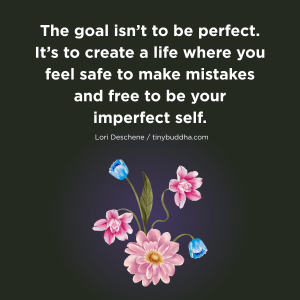
When she said that it seemed like the most obvious thing in the world. It’s okay to say that there were some flaws with the program that had nothing to do with me. It’s okay that the experience wasn’t perfect. It’s okay that I wasn’t perfect.
I was trying so hard to always put a positive spin on my story that I wasn’t really telling my story anymore, and that subtle lie was corroding my own sense of self-worth.
All that said, I do believe in doing our best to “look at the bright side,” so to speak, but not before we can honestly assess our experience and accept how we really feel.
It’s only when we can be truly honest with ourselves about how we feel that we will be able to find the positive lesson, heal, and move on.


“Letting go gives us freedom and freedom is the only condition for happiness.” ~Thich Nhat Hanh
First, let’s be clear about something…
Surrender is not about giving up, handing power over, or failing. It is not waving the white flag of defeat.
We are so used to striving and trying so hard for an outcome that anything outside of that formula seems like self-sabotage.
It isn’t. In fact, surrender is the pinnacle of evolved and enlightened behavior.
Surrender is the beautiful soft space of acceptance. It is an allowing—allowing life to unfold and to be what it is, irrespective of your agendas, expectations, and judgments.
It’s that arms-wide-open energy that is deeply rooted in trust. Relaxing and trusting that, even though things might not seem perfect or they might not be according to your plan, that everything will turn out just the way its meant to for your highest good.
Why do we want to embrace surrender? Because this is how we get out of our own way.
This is how we experience a life of real freedom. Free from our limiting self-beliefs, emotional blocks, and negative self-talk—all the stuff that prevents real growth and transformation. Ultimately, preventing you from an extraordinary life—a limitless life.
At first, the journey into surrender can be very destabilizing. Be assured, you will question it, resist, and try to force stuff to happen, but eventually, when you completely let go, you’ll discover that surrender is the space where everything starts to shift.
Surrender allows us to step into our lives ready to receive, completely able to manifest, and willing to embrace everything—the good, the bad, and the ugly—with an open heart. It’s from this place that real magic happens.
To really understand surrender we need to look at its opposite.
Can you relate to any of these scenarios?
Are you comfortable with moving on quickly? Or, do you get stuck on how you believed a situation should have played out?
Notice if you notoriously hold a grudge or can’t handle it when things don’t go to plan. The only person that suffers in this situation is you. Turning an annoying situation into a crisis doesn’t help or do anything to change it.
Do you see that as a clear sign you need to back off? Or, do you grip the reins tighter and try even harder?
This one’s for you if you insist on doing more, going further, pushing through, even when it’s time for a breather. This type of behavior will send you straight to Stuck-ville, a place devoid of creativity and joy!
Or, is it your way or no way at all?
Take note, self-confessed control freaks and know-it-alls! This type of attitude is a direct route to self-sabotage. This narrow-minded behavior will block you from experiencing different perspectives and detaching from limiting ideas.
Wouldn’t it be so incredible to be free from this energy of control, attachment, resistance, and fear? What kind of life could you live if you were limitless? Free? Wholehearted?
In hindsight, I see that the universe has been coaxing me to let go from a very young age. I think maybe I was born holding on. To what, I’m not sure—my place in the world?
But I do know my grip was tight. I’ve always been light-hearted and happy, but underneath that lived a layer of effort, so structured and controlled that in the end I did nothing. At a standstill, road blocking myself. Life was unnecessarily exhausting.
Ten years ago surrender wasn’t even a concept I was familiar with, let alone one I could fathom embracing. I had no idea that I was about to embark on a master-class in surrender.
There are three distinct ways that we can come to a place of surrender.
Sometimes you look at your life and ask yourself if you can change or leave a negative situation. When the answer you get back is a resounding no, it’s in that moment that the only thing left is acceptance.
Honestly, that’s most of the time. We often have no control over the situation, but we do have control over what we choose to do, what we think, and how we feel—that’s surrender.
All hell has broken loose. Crisis in its many forms, death by fire, stuff is going down. Surrender, whether you realize it or not, has come knocking on your door.
If you don’t listen you are just going to go down in flames, figuratively speaking. Instead of armoring up, ready to fight, perhaps a deep breath and a reminder to trust will throw you safely into the arms of surrender. A more peaceful response.
Through awareness, personal growth, and intuition we can invite surrender in when it comes knocking. It’s a choice made in the present moment. Seeing reality for what it is and opening up to it wholeheartedly.
Over the last thirty-one years, I’ve been tripped up by many moments, but it’s only been in the last ten that I could almost hear the words “Surrender! Surrender!” chiming in my ears with each stumble.
It sounds like the message had fallen on deaf ears, right? I mean, why else would it keep coming my way?
Well, we are creatures of habit and habits are hard to break. It’s not a rip-it-off-quick type scenario. We may have to fall down a few times before the message gets through and we realize that the path we are walking is leading to a dead end.
It wasn’t that long ago that I fell down a few times before I heard the call to surrender. I had a back injury that was preventing me from moving forward in my yoga practice. I tried to manage the injury, but really, I wasn’t listening to its call. I resisted and, of course, the injury persisted.
Energy flows where attention goes. And my attention was certainly stuck in the limitations of my back. All I could think about was how to fix it. I was so frustrated with my body.
Surrender finally came to me four weeks before my wedding day when I put my back out, again. I emailed my teacher to let her know I would be back soon. She replied, “Take three months off, practice at home, and break the cycle.”
As I read her words I could feel my grip tighten on my routine, my practice, my yoga. Even then, a year after I first sustained this injury, I was still resisting and controlling.
Bizarrely, within days, I realized her email was a divine message. So I listened. The four weeks leading up to my wedding day were the most incredible days. I practiced without rhyme or reason, I went to random yoga classes, practiced outside, or didn’t practice at all.
The irony was, I felt stronger, more balanced, and more connected than I had in a long time. She was right. I had to surrender to break the cycle
Today, I know that surrender is part of my divine journey. I am still on the surrender train. I don’t think I will ever stop learning, nor will you.
The beauty, though, is that now I know what surrender looks like, how it feels and fits in my body, what size and shape I can wear comfortably.
I now know that letting go—right in those moments when I really don’t want to—is always right for me, so I respond faster when I hear the call. I know that the life I truly want—limitless, free, and abundant—comes from that space of pure, openhearted surrender.
It’s from that rich territory of surrender that we finally let go of the limiting energy of control and force.
And when we aren’t controlling, we have completely stepped out of our own way. We are ready to receive, to tap into the abundant possibilities available to us, and to manifest a life free from restraint and restrictions.


“The heart is like a garden: it can grow compassion or fear, resentment or love. What seeds will you plant there?” ~ Jack Kornfield
My whole life has been a story of discipline. I started exercising and eating healthier in eighth grade. I planned out my studies meticulously so I would finish school assignments exactly on time. I always arrived five minutes early for any appointment or meeting. Disciplined.
When I began my yoga studies in earnest at the age of twenty-two, I applied the same disciplined nature to my yoga practice. I had extensive practice plans and had scheduled in all the parts I should be doing: pranayama and meditation at dawn, asana practice after work with standing poses on Monday, hip openers on Tuesday, etc.
People would comment about how disciplined I was. I just smiled, knowingly, because I knew what I was doing was “good” and they could learn something from my organized way of living. Yep, a little self-righteousness, too!
Then one day, about fifteen years ago, while I was contemplating the yogic term tapas (self-discipline), I had an awakening: my discipline, everything, all that I did (including exercise, eating well, rigidity around how I used my time), came from fear, not love.
It wasn’t focused on all the wonderful benefits I received through discipline but what I would lose if I didn’t do it.
If I didn’t exercise, I wouldn’t have my exercise high all day. If I didn’t eat perfectly, I would gain weight. If I didn’t do my practice, I would lose my state of consciousness.
So much fear! I knew I wanted it to change. I didn’t want this level of fear in my life, especially around my spiritual life whose very essence was love.
I was planting seeds with my practice, as Jack Kornfield’s quote said: “The heart is like a garden: it can grow compassion or fear, resentment or love. What seeds will you plant there?”
I wanted to be planting seeds of love.
While choosing to make a change in our life because we are afraid of something at least gets us going (quitting smoking because of the fear of dying, working on being on time at work because of the fear of being fired, beginning meditation after a heart attack), we ultimately want to shift from fear to love, from what we don’t want to what we do want.
Focusing on what we don’t want simply continues to plant fear in our hearts. Focusing on what we do want, and that we deserve what we want, plants seed of compassion and love.
So, what did I do? I quit everything. I quit my entire practice—including eating well, exercising, being rigid with my schedule—and entered into a study of discipline. Two discoveries would forever change my perspective.
The first reflection came from the word tapas, itself. Roughly translated, it means “inner fire” and refers to the inner fire to know ourselves, the desire; and we learn about ourselves through our yoga practice, our study of life, and everything we do for ourselves.
I like to also think of it as the inner fire to feel good, to be doing what we really want to be doing, to love our life.
We can use this “inner fire” to inspire us to be disciplined with whatever we want to do, to continue our actions even when we feel resistance. (You know, the preference to sleep in rather than get up to exercise, to eat junk food rather than prepare something healthy, to grab for a cigarette rather than not.)
The desire drives us to want to learn more and is stronger than the resistance when we stroke it. And we stroke it by focusing on what we want, getting excited about what our action will help us feel.
The second transformational nugget was the word “discipline” itself. The word comes from the Latin root “disciplina” and means “instruction given, teaching, learning, knowledge.” Think in terms of a disciple learning at the foot of a master.
Again, our discipline to do our own practice helps us to learn about ourselves, it is a teacher for us, our master, so to speak.
Knowing I wanted my practice to be based on love, not fear, to be planting seeds of love from it, I continued to hold myself back from practicing.
The fear bubbled to the surface. I feared I would lose “everything” for quite some time. But then, a deeper desire began to percolate up. A curiosity about a certain pose and how it would feel, a curiosity about a breath, a new meditation I felt a niggling to try.
I felt an inner excitement to get to my mat, and I finally did.
Self-discipline is tricky for many of us. In my work, I rarely come upon anyone who says that what they do for themselves is deeply satisfying and they feel they do enough. Most of us feel we need to do more, we aren’t disciplined enough.
The judgment itself comes from fear. Let me say that another way, if you are judging yourself for not having enough self-discipline, you are basing your practice on fear.
So how do you change the focus?
Instead, return to why you do what you do. Why do you do yoga, exercise, eat well, or do anything else you feel you would like to be more disciplined around? What brought you to it in the first place? Sometimes along the way, we lose site of our deeper purpose.
Bring your attention back to that deeper purpose. Put your love into it.
While I wish I could say the fear was eradicated for me, never to return, I must admit it does return. I can say that when it surfaces I now have new tools to handle it. I am better able to see it for what it is and return to the state of love quickly.
Ironically, I realize that my fear-based discipline did teach me something about myself and led me to a life with more love.


“Thinking will not overcome fear, but action will.” ~W. Clement Stone
I made it all the way to my thirtieth birthday without learning how to drive. After I turned twenty-one, people often asked me why I hadn’t learned yet. My go-to story was that I lived in a place with abundant public transportation options and never had any intention of buying a car.
The truth is that I wanted to learn, but I was terrified, and the fear grew with each year.
What if I got in an accident? What if people laughed at me for learning so late or honked angrily at me? What if I chose a bad driving school with unforgiving teachers?
I used these fearful questions and the fear responses that came along with them as obstacles to stop me from taking any action toward learning. I felt as though their presence meant that I couldn’t take an action. I wanted them to go away before I took any steps.
The one thing I was avoiding was the key to me overcoming my fear. It sounds so obvious, but how many of us have wanted to do something, felt afraid, and then spent more time thinking and talking about it than actually taking action?
I put “learn how to drive” on my New Year’s resolution list for the last time and decided to find a way to make it happen, despite my fear.
When you think of taking action, you might have some big, scary idea of what I’m talking about. I’m not talking about deciding one day that you want to jump out of a plane and then an hour later booking your flight. Or in my case, deciding that I wanted to learn how to drive and then getting right in the driver’s seat.
None of this is necessary.
I’ve learned five helpful things about taking action that helped me move from thinking about learning how to drive to getting behind the driver’s wheel and actually driving confidently.
If you already know how to drive, which I’m assuming most of you do, these things can easily apply to anything else you’ve wanted to do but haven’t yet tried out of fear.
One reason that we hesitate when we have something we are afraid to do is because we are thinking only of the end result and likely feel incapable of getting to that point from where we are now.
Forget about the end result, or at least take your laser focus off of it long enough to determine what the first step might be. In my case, the first step was visiting my state’s Registry of Motor Vehicles website to find the process for getting a learner’s permit.
The more you focus on all of the actions you have to take to get to the end result, the less likely you are to actually take any steps. So just focus on the first step and start there.
Each action step doesn’t have to be big.
Your brain, ego, or that limiting, fearful part within will try to convince you that your steps are too small. They couldn’t possibly count, it says, so better to just not try. It’s lying to you.
Every accomplishment, like baking a cake, publishing a book, or learning to drive, is made up of small steps made over and over and over again.
Learning about the learner’s permit process led to picking up a driver’s manual, which led to spending time every day studying the manual, which led to scheduling the permit test. All these small steps built up to me ultimately learning how to drive.
One of my obstacles was thinking that the presence of physical fear symptoms meant I couldn’t take action. You can be terrified, with a quick pulse or shaky hands or shallow breaths, and still take action.
It’s the steps that count, not how you feel when you take them.
When I had my first driver’s lesson, my hands shook so badly that I wasn’t sure I would be able to hold the steering wheel. But I got through the lesson, one step further in my journey to learn, and decided that I would celebrate the fact that I showed up, in spite of fear, rather than judging myself as a failure for how nervous I felt physically.
There is this magically wonderful high that occurs after you’ve taken action that you were afraid to take. I’m not sure how many of you have experienced it, but talking to other people who have done things that terrified them, I found that I’m not alone in noticing this.
Use that high to your advantage. Make it an incentive that leads you, especially in moments when you are doubtful, that you can handle the fear of taking another step.
After my first lesson, I wrote down how I felt (excited, proud, happy) and I referred to it again before my next couple of lessons when I forgot how good I felt and needed a reminder to help tone down my fear.
Deciding to take action to overcome my fear of learning to drive has not only meant a new skill, it has also brought me confidence in my ability to learn new things, handle mistakes, work toward and achieve a goal, meet new people, and much more.
Action has many unintended opportunities for growth beyond the specific area we decide to work on.
It’s in the action that we test our hypothesis about life and about ourselves. It’s in the action that we grow confident about ourselves and our abilities. It’s in the action that we find out what mistakes are experientially and how much stronger we are by learning from them as we go.
So today I can say I know how to drive. I even look forward to it. I couldn’t have said that though had I just continued to wait to take action until I no longer felt afraid.
What action can you take to overcome your fear today?


“When we can no longer change a situation, we must change ourselves.” ~Victor Frankl
There are a million reasons why a friendship may change over time. You grow older, relocate for a job, have a fight, or start having kids.
It is an inevitable fact that life takes people in new directions; growing apart from old friends becomes a part of our lives. But, somehow I thought that I was immune, that this was someone else’s story.
My friends would be there with me forever.
We celebrated every single New Year’s together. We survived college, breakups—you name it. Our bond was unbreakable, and we had loads of photo albums to prove it.
But after all these years I found myself feeling disconnected, and discovering that my best girlfriends did not really know me at all.
As we made summer plans and played catch up during our routine get-togethers, I had run out of things to share. I was irritated by the same old conversations. I felt like we couldn’t relate.
A few years earlier, I relocated for a job in a city away from home and found a new rhythm for myself. With a fresh interest in yoga and spiritual practice, I was the best version of myself, but I spent my time on hobbies and in places that were unfamiliar for them. Our passions were no longer the same.
I waited it out for a while. “Maybe it’s just me,” I thought. I needed to try harder, call more often, and be more available.
It was on a vacation to the Grand Canyon that I knew I wouldn’t shake this feeling. Amidst the giant open landscapes in front of me, I felt a deep loneliness and sense of obligation about these important relationships.
My best girlfriends, the ones who had known me deeply and longer than anyone else, couldn’t relate to me anymore. Our lives were too different. We had grown apart and I felt incredibly sad.
It was hard for me to accept that we might move forward, planning our weddings and living our lives without the bond we had as teenagers. It kept me up at night with anxiety, and I did not want to let go so easily. I found it difficult to understand how I had let this happen to my friendships.
This was not our first road bump. Of course, there had been fights and disagreements along the way, but we’d always hugged, made up, and moved on. I worked hard to find a solution. I contemplated talking it out over wine or writing long letters.
I found it hard to move on for months. I thought about my old friendships with a great sense of loss, and spent a lot of time consulting family and friends. I could not just forget about all we had shared for the decades before, could I?
My mind was heavy with anxiety. One evening after a busy week at work, I turned to my yoga practice for some much needed clarity.
During the class my instructor repeated a phrase she had said often, but it hit me with a deep profoundness, providing me with a completely new perspective on my situation.
“Take what you need, give what you can, and forgive the rest.” For the first time in six months, I realized that our friendship was not over. I didn’t have to feel a loss at all.
I loved my friends and all we had shared. I could take something from those memories and forgive the natural ebbs and flows of life that had moved us apart. Foremost, I could forgive myself.
There was a new view that I could adopt in order to make sense of the changes and loss I experienced in seeing my old friendships fade.
I realized that there were three basic understandings that could guide me toward acceptance and happiness for all my relationships.
Sometimes we expect individuals to be all things to us at once or know exactly how we feel. Each of us faces challenges, all of which are not apparent, even to the best of friends.
I learned to see each friendship for the unique quality it offered me. Some friends were great for deep conversations, some were great for a night on the town, and others offered a funny banter.
My situation taught me to value what people had to give, even when it wasn’t all encompassing, and seek out anything else I needed in other places. We have to forgive one another and seek fullness from within.
If a friendship starts to feel like an obligation, or if you feel guilt, you may be trying to give too much. We all need to be realistic about the ways we can engage with others and remember that friendships are best when they’re mutually beneficial.
You have amazing things to give, and your best friends should want what you are able to share, and not expect more.
The good times you shared with a friend don’t have to fade if your connection does. Think of your friend often, laugh about old times, and share great stories.
Moving on doesn’t mean forgetting all of the meaningful ways you and your friend connected in the past. You can continue to love your friend and experience your friendship long beyond the times of late night phone calls and regular get-togethers.
This new perspective offered me a whole new way of looking at all my relationships. I discovered that I could find a deeper fullness and quality in others by putting things into this view.
People come into our lives for particular reasons, and things are likely to change.
If we can give to those around us, and take from them only what we’re able, then we have a much better chance of looking back fondly, and with gratitude.
Photo by Yarns


“If you get up one more time than you fall, you will make it through.” ~Chinese Proverb
I remember clearly the day in March 2003 when I would receive the kind of news that no aspiring musician wants to hear.
“Sorry, but you aren’t currently at the level needed to enter our school.”
Five years of blood, sweat, and tears for what? To be told that I sucked? I sat there, lost in my own thoughts. Was I having a bad day? Was I simply not as good as my ego led me to believe?
There I was, face to face with my assessor in a strange city on a damp and dreary Saturday afternoon. It could at least have been sunny! A bit of warmth and energy to brighten up this horrible feeling, but alas, as with many things that day, it just wasn’t to be.
I wandered around these unfamiliar surroundings for almost an hour before catching the train home. This was to be one of the longest journeys of my life, not because of the mileage, but because I felt utterly dejected.
Unfortunately, this wasn’t to be the only type of rejection I would face during my twenties.
I have genuinely lost count of the number of women who have turned me down. Every “no” was like a hammer blow to my confidence and sense of self-worth. Why doesn’t anybody like me? What am I doing wrong? Am I destined to be alone?
Yet more questions I didn’t have the answer to.
The hardest part to take was the fact that a lot of these women were people that I actually knew, not just random strangers in a nightclub but friends, colleagues, and acquaintances.
I was not some drunken guy that could be easily shaken off when surrounded by a group of friends, fuelled by alcohol and peer pressure. I was a part of their everyday lives, but held at arm’s length, never to get any closer.
Miss P was one of these women. I had chased her for two years. We had a mutual feeling of affection that was only hindered by a toxic relationship on her part.
I waited; it was all I could do. There were the occasions when our eyes would meet as we crossed paths, the hugs that lasted a few seconds too long, and the sense of belonging that hinted at what was possible.
But when my chance came and the universe conspired to bring us together, it was to only be a fleeting moment. Life drove a wedge between us and I felt powerless as I watched her slip away.
Situations like these are hard to take, but you know what? It toughens you up. There are only so many beat downs that one can receive before something must change, it has to. Eventually the brain will find a solution. When faced with adversity, we can all rise up and meet the challenge head on.
I returned to that music school a few weeks later, and I had taken on board everything that was said to me. I practiced intently. I refused to allow this person to tell me that I wasn’t good enough. I refused to walk out of there having failed again. This was my time, and it was going to happen.
It did.
The audition was a success. I had adapted to the situation by accepting my faults and working tirelessly to correct them, and thus began a period of huge improvement in my day-to-day life.
I was now ready to adapt this mentality to my faltering love life.
After being rejected by nine women in a row, it was time to change things up. I would no longer focus on the outcome; instead it was all about the process. I taught myself to just enjoy the interactions and focus on making these women smile instead of my own selfish desires.
A funny thing happened: The less I chased, the more success I had. I worked on my personality, not so much the core of who I was but in how I expressed the real me. These people weren’t seeing a nervous, needy guy but someone who was happier being who he wanted to be.
Once I figured out that I held the key to my happiness, nothing would stand in my way.
I started going on more dates. I had more meaningful relationships and even though I still don’t know what the future will hold for me, I believe 100% that by opening up and sharing the true essence of who I am, the right person will somehow find a way into my world.
Throughout life we will receive bad news and criticism that will attempt to strip our confidence to the bone, but we can never allow that to happen.
Failure, or as I like to say, the path to success, is a necessary part of our growth as human beings.
Some people won’t see how amazing you really are and some people may not agree with your principles, but that’s okay. We just have to figure out how best to display our true selves, regardless of the situation.
Whether you’re going on a date, attending an audition or an interview, or simply doing something that stretches your comfort zone, it is important to trust yourself and believe that you have what it takes to succeed.
Mistakes happen. Failure occurs. Things don’t always go to plan but that’s okay, that’s life, and it’s necessary for personal growth. As long as we keep improving and moving forward without compromising our core values and therefore, our integrity, we can achieve almost anything.
Keep putting one foot in front of the other. Don’t allow anyone to knock you off from the goal that you see in your mind’s eye. This journey is yours and nobody has the right to change your destination.
Learn from the feedback that you receive, both good and bad, but don’t take it to heart.
Everything can be improved and modified to fit any situation. People’s opinions can be changed, as can yours.
Who you currently are, who you want to be, and who you want the world to see are entirely in your hands.
Perseverance—it’s how we can all keep moving toward success, one failure at a time.
Photo by Drewski Mac

I love when people send me inspiring videos that include their own thoughts, voice, and illustrations. It’s like gaining access to a piece of their soul in one entertaining, thought-provoking work of art.
This short film by Mike Biagiotti really spoke to me. In his own words, it’s “a meditative journey about one man’s escape to his back country cabin.”
What does you inner child need today?


“Silence is a source of great strength.” ~Lao Tzu
For over two years I spent one out of every four weeks in silence. At the time I was living at a Zen Monastery and every month we would have a week-long silent retreat.
During this retreat we sat meditation in silence, ate in silence, worked in silence, and only communicated through hand gestures and written notes.
At first living like this was hard, but over time I learned to grow to appreciate silence. By the time I left I learned that silence was my friend and teacher.
What did silence teach me?
I used to think I needed to watch TV every night. But at monastery I went without and discovered I didn’t need it.
Silence taught me to be happy with less. Pick something that’s weighing you down and let it go. Your life will thank you.
When you can only talk by writing a note, you only say what’s important. Before the monastery I talked a lot but said little.
Silence taught me that a few simple words well spoken have more power than hours of chatter. Think of one simple thing you can say that would help someone feel better and say it.
Being able to speak makes life easy, but when I couldn’t talk I learned how much I relied on others.
Silence taught me to appreciate the value of relating to others. The next time you see your friends or family, try to really listen. Deep listening expresses deep appreciation.
Several times at my first retreat I thought my phone was vibrating. But then I would remember I didn’t have my phone. It showed me how my phone divided my attention.
Silence taught me how important it is to let go of distractions. The next time you are with someone you care about, try turning off your phone and putting it away. It will make paying attention easier.
I once sat a retreat next door to a construction project. What amazed me was how easily my thoughts drowned out the noise. I realized if my thoughts were this loud, I’d better make them as wise as possible.
Silence taught me the importance of shaping my thinking. Take time each day to notice your thoughts and let go of thoughts that don’t serve you.
Because I sat retreat in every season, I know that the sound of wind in fall is different than it is in winter.
Silence taught me to notice nature. Take a short walk outside in silence and you’ll discover the wisdom and peace that nature has to offer.
During retreat I noticed that whenever I got lost in thought, I lost track of my body. And when I focused on my body, my thoughts would calm down.
Silence taught me to be in my body. Close your eyes and ask, “What sensations do I feel in my hand?” Learning to feel your body can calm your troubled mind.
Whenever I went into town after retreat, the world seemed so loud and fast. I came to realize how much our senses have to process most of the time.
Silence taught me the importance of reducing the stimulation. Enjoy some quiet time everyday. The less you see and hear, the more settled your mind can become.
People would come to the monastery and remark how quiet it was. But living at the monastery I knew all the noises, from frogs, to owls, to the sound of sandals on the sidewalk.
Silence taught me that the world is a rich texture of sounds. Sit in front of your house and close your eyes. You’ll be amazed at what you hear if you listen long enough.
During retreat I was surrounded by imperfect people who were doing their best. Some were happy, some were sad, but all were wonderfully human.
Silence taught me that people display great beauty. Find a good spot to people watch with an open heart. What you see may inspire you.
For a long time anytime something difficult came up, I would just distract myself. But retreat taught me that if I avoided something it would never go away.
Silence taught me that space helps me face hard times. The next time you face something difficult, pause and honor whatever’s arising.
I used to think love was this big thing. But in retreat I found that I felt love for so many things.
Silence taught me that love can be simple. Think of someone you haven’t said I love you to recently and tell them.
I used to think courage was about facing danger, but during retreat I realized that real courage is about facing yourself.
Silence taught me the courage it takes to be still. When we stop moving everything we’re running from catches up. The next time you are afraid, stop and wait for it to pass. There is immense courage inside your heart.
Every retreat reminded me that speaking is easy, but staying quiet is hard.
Silence isn’t flashy, but it has an immense power to endure. The next time someone doubts you, instead of disagreeing, silently vow not to give up. Action speaks volumes.
I often ask for reassurance or feedback. But living in silence meant I had to trust my instincts.
Silence taught me to have faith in myself. The next time you begin to feel anxious, sit in silence and see if you can find the space of deep faith that lives in your heart.
I used to lie so I wouldn’t have to explain myself. But when I couldn’t talk I began to notice this impulse and how much it degraded my integrity.
Silence taught me the importance of telling the truth. Notice times where you tell little lies and try telling the truth instead. It isn’t always easy but it’s the first step to trusting ourselves and others.
During retreat I didn’t have a lot of comforts. It helped me see how much I took for granted and how much I had to be grateful for.
At the end of every day sit in silence and ask yourself what am I grateful for. You’ll be amazed at the blessings you discover.
I used to love drama and conflict. But at retreat I found I was happier when I kept it simple.
Silence taught me that simplicity and joy are close companions. Pick one space in your home you could simplify. Keep it simple for one month and enjoy the ease it offers your life.
I used to think I had to talk in order to feel connected. I realized during retreat that I can feel connected just by being near people I care about.
Silence taught me that words can get in the way. Do something in silence with someone you love. It will be awkward at first but eventually you will see what it means just to be in someone’s presence.
I studied philosophy in college and I thought I could read about truth. But retreat taught me that truth is found in silence.
Silence has taught me a deeper truth than words ever could. Sit in silence once a week and feel the truth in your heart. It’s there whether you can express it in words or not.