Tag: wisdom
-

5 Things to Remember When You Feel Disgusted by How You Look

“Your face will change. Your body will change. The only kind of beauty that endures is the kind that lives in your heart.” ~Lori Deschene
How many times have you hidden away from the world when you felt ashamed by your appearance?
How many invitations have you turned down because you felt disgusted by the way you look?
And how many times have you gazed into the bathroom mirror and thought, “Why, in my brief existence on this planet, does it have to be me?”
Seeing your reflection in the mirror is like a physical pain. It’s not just one part of your life. It’s obsessive. It consumes your every waking moment.
Then you start feeling envy toward beautiful people. Wrath at whatever higher being there is for not making you one of them. Pride in your strengths whenever you see someone who looks worse than you. Self-loathing and blaming your treacherous genes for giving you an odd face, an imperfect shape, a visible health condition.
For me, it was my skin.
I was cursed by a chronic illness that regularly causes rashes all over my body, and sometimes even on my face.
I can’t count how many times I cried over it. Sometimes from the pain. Sometimes from the itch. Too many times from people’s looks of revulsion or their unkind words.
The borderline shallowness of many people who never bothered to open a book whose cover they didn’t like was painful and grating.
My insecurity was like an open wound and my self-esteem was at rock bottom. I felt like a target, a second-class citizen with few rights to have dreams, hopes, or success.
I perfected the art of avoiding mirrors and cameras, bought extra clothes to cover my skin, and learned how to keep my head down to avoid eye contact. I was terrified of social situations and worried that people would look at me in disgust.
Every single comment could shatter my fragile confidence.
The hopelessness and soul-crushing feeling of not looking pretty enough made me want to roll the duvet over my head in the mornings and not come out.
Thinking that you’ll never be happy because of your looks is the most gut-wrenching thing. It’s isolating. It’s maddening. It’s frustrating and a thousand other things.
We’re living in an appearance-saturated society that tells us that our likeability is dependent on being attractive. The diet culture, beauty industry, media—they all convey that beauty equals perfection.
In today’s digital age, it’s easy to create a façade with carefully chosen photos and posts that lie through omission.
But deep down, you know the truth.
You can’t ignore it.
The world doesn’t let you.
Advertisements and magazine covers all remind you of how imperfect you are. Beauticians love to point out your flaws to sell you more products.
It’s not until you decide to wear your imperfect look as a form of armor that you become comfortable in your own skin. People’s looks no longer intimidate you. Hurtful words don’t steal your sleep. You fall in love with yourself.
It’s a journey toward acceptance. And the journey is liberating.
We all face challenges in accepting who we are and how we look. But the truth is that, cliché as it may sound, beauty is in the eye of the beholder.
It’s not what’s on the surface. It’s what’s inside you.
Here are some of the things that helped me on my journey toward self-acceptance.
1. You can make peace with the parts of you that you hate.
Accepting that you don’t like everything about your body is the first step toward having a more positive frame of mind. It’s about acknowledging that you may feel “meh” about some parts of your body, but not letting that stop you from doing things you want to do.
You’re probably thinking, “Yeah, right, but what about my stomach pooch?”
Well, what about it? It’s there. You’re not perfect, and that’s okay.
Often we forgo pleasure because we feel we don’t deserve it. Somehow simple parts of living become unobtainable “rewards.” Maybe you won’t let yourself hit the beach unless you get into a certain shape, or you can’t get married unless you drop the weight, or maybe you can’t buy new clothes until you’re a few pounds lighter.
It sounds crazy when you say it out loud, but that’s how a lot of us think.
So be kind to yourself. Be gentle and remind yourself of all the other things that you love about yourself.
Give yourself permission to accept that some parts of your body may not be your favorite thing. You won’t always love every part of your body. However, you can still love your life even on the days you can’t love your belly.
You’re certainly not alone in your struggle toward body acceptance. I could give you a laundry list of things I don’t like about my body.
However, this is the body you were given. It’s the only body you were given. So it might be time to make peace with it.
2. Everyone feels unattractive at times.
We all have moments of weakness when we view everything through a negative filter, and the voice in our head becomes critical and unloving. Times when we feel ugly and unattractive. All of us. You. Me. Your best friend.
Days when you look at yourself in the mirror and don’t see anything positive. You don’t see the loving spouse, the caring mother, the wonderful son, the understanding friend. You don’t see the wisdom in old age wrinkles, the power in stretch marks, and the beauty in your body curves.
Instead, you just see . . . blah. Gross. Unlovable. Disgusting.
In those moments of self-doubt, pause and ask yourself these questions: Is my mood affecting the way I’m feeling about my looks? Have I been getting enough sleep and fresh air? Have I been eating well and moving my body frequently? Self-care is so important because your mirror image is simply a manifestation of your positive energy.
3. Media-defined ideals of beauty aren’t real.
For years, the world of media has been trying to construct a sparkling image of what an ideal man and an ideal woman should look like. From television shows to commercials to magazine advertisements to celebrity culture, mainstream media has been reinforcing the notion that you only look beautiful if you have a toned body, perfect hair, and flawless skin.
But the reality is that you just don’t.
Why? Because the image of perfection doesn’t exist. It’s superficial. It’s unattainable. Even models themselves don’t look like their photoshopped, heavily edited images. No wonder you come up short whenever you compare yourself to celebrities and models on magazine covers.
The pressure of looking perfect weighs you down. You begin to think that you aren’t beautiful enough, are too fat, too small, too whatever. All that to say that you’re not good enough.
That’s, at least, what the beauty industry wants you to believe. If you feel inadequate about your looks, you’re more likely to buy whatever fix the ads are selling. Making you uncomfortable with your body sells – whether it’s a weight loss plan, fashion, or a beauty product.
Are you going to change society’s definition of beauty? No. However, you can change your own. Don’t focus on the beauty you see in ads; focus on the beauty you see in the real-life people you admire.
4. Your reflection doesn’t define you.
The sum of who you are—your thoughts, beliefs, hopes, dreams, feelings—is much greater than what meets the eye of an observer who doesn’t know you. All those things about you are the force that draws others to you.
You might have heard the saying that an ugly personality destroys the face. Well, I happen to agree with that 100%.
Sometimes you hear somebody speak with kindness and compassion, and you perceive them as beautiful. However, it’s not their outer appearance you’re drawn to. It’s their inner depth, a kind of beauty that can’t be inherited, photoshopped, or surgically attained.
I know many people who aren’t the most attractive, but their energy, joy, and positivity is so contagious that it’s hard not to have them around.
So think about what brings you joy. Do things you like. Make your self-esteem contingent on inner, not outer, qualities. After all, a positive attitude brings more friendships than looks do.
5. Your perception becomes your reality.
If you feel beautiful, it will transcend your physical attributes.
Think about the story you’re living right now. Did you consciously decide to create it, or was it shaped by your parents, your friends, or perhaps even the media?
From the time you were born, you’ve received both positive and negative messages from your surroundings. All those messages create your belief system. You act on those messages as if they’re true until you believe them to be true. They become your reality. They give you your identity.
Every time you say “I am,” you are telling a story about yourself. When your story takes on a life of its own, you become it. But who wrote that story? And why is there so much criticism and low self-esteem in there?
Rewrite it. Take control of the pen and write the story you want.
Let Yourself Be You
Next time you notice that inner critic of yours attacking your appearance, catch it.
Take a deep breath and ask yourself if you can release it.
I’m not talking about making it spit out positive, self-loving affirmations that don’t feel authentic and real to you. I’m talking about the soft, embracing energy of acceptance.
I’ve learned to cultivate self-worth apart from my appearance. I take pride in my talents, skills, intelligence, and caring heart. When my perfectionist self wants to critique not only my appearance, but also everything I do, I remind myself of those qualities.
When you open up to all parts of yourself, you will feel lighter. As you rewrite your story and let yourself be you, the many facets of your beautiful self will shine.
It’s a practice of making peace with what is. And you can make it happen within yourself.
It’s an ongoing journey that feels liberating.
-

Having Doubts Doesn’t Mean Your Relationship Is Doomed

“When we can talk about our feelings, they become less overwhelming, less upsetting, and less scary.” ~Fred Rogers
There aren’t many clichés I resent more than this old chestnut about finding true love: “When you know, you know.”
As a late bloomer and skeptic who took her sweet time to get into a relationship, after decades of singleness and observation, nothing made me feel more like an outsider than the idea that love is an unexplainable phenomenon reserved for people who “know.”
In my early years of singledom, I believed I “knew” things. I had unwavering faith in a myriad of beliefs, and when doubts cropped up in my mind, I dismissed them or stuffed them back down into my subconscious.
The most liberating day of my life was the day I embraced doubt as a friend. Confronted with an idea that conflicted with one of my beliefs, I said to myself, “I do not know the answer, and I will not pretend to.”
Everything changed then, but life didn’t become scarier without “knowing” the answers. On the contrary, a world of possibilities opened up, along with the appearance of many fellow voyagers who were on the same path as me. I hadn’t noticed them before because my “knowing” had scared them off.
Years later, I’ve turned my gaze to the phenomenon of love and the myth of “knowing” as it relates to relationships.
This message is everywhere. Pop culture makes doubts synonymous with warning signs, red flags. “If you have cold feet on your wedding day, then it’s probably because you shouldn’t be getting married in the first place.”
That’s not to say that doubts are never red flags. Of course they can be and often are. If you chose someone you’re not compatible with to avoid being alone, or you’ve had to compromise yourself, your morals, or your needs, then your doubts likely are red flags.
But it’s important to set a distinction between a gut feeling that says, “This is not the right person” and one that says, “I didn’t fall in love at first sight, so I must be wrong.”
In movies, doubts are presented as indicators that our partners are irretrievably flawed and do not deserve our love. Rarely do we see a tale where doubt is an invitation to look more closely at our complex feelings, or a natural consequence of comparing our relationship to someone else’s.
If our doubts make us cut and run, then the message remains that we must “know” and not doubt. If a question arises, you must leave, so therefore you must not question.
This breeds a vicious cycle of ignoring our feelings and pretending not to feel them. “If other people don’t have doubts, then there must be something wrong with me. I can’t let them see that!”
The cycle begets a lonely existence. And it’s unnecessarily lonely. Everyone has doubts and fears, and the most meaningful connections we can make with each other come from being brave enough to share them.
I can still feel the way my heart starts to race before saying something out loud that I’ve only thought silently in my head. It could be something as simple as, “You know, I’m not really sure that everything happens for a reason,” which, in some circles could be considered a scandalous belief.
You say the words, heart and tongue racing, fear of judgment impending, and then that trusted friend reassures you. “Oh my goodness, I thought it was just me! I feel the same way!”
This is where the gold is. We find people we feel brave enough to be real with, and when we open up, they embrace us. They don’t judge us, and we discover that we aren’t alone.
An unexamined, untested life does not interest me. The same is true of love.
When my relationship began, neither one of us knew what we were doing. Beginners that we were, we shared our thoughts with each other in a way that was unmarred by years of dating and learning how to “play the game.”
We did not “know” the moment we first saw each other that we would be anything more than coworkers or friends. We did not experience love at first sight, and even as our relationship began, we weren’t sure what to call our feelings for each other.
And we did not pretend to “know” or understand those feelings. We said, “I’m not sure what this is, but we’ll figure it out.” And it took some time, but we did just that, with honesty and grace helping us along the way.
Together, we learned that true love isn’t an instant or constant feeling. It may sound romantic, but real love is something you build and have to work at.
When my nieces ask me on my wedding day how I knew that I wanted to marry my fiancé, I will see it as an opportunity. I won’t say, “Oh, I just knew. Someday you will too.” I will tell them that he is good and kind, and that together we have grown and overcome, and that we make each other feel safe, loved, and supported.
That’s the message I want them to take to heart as their own concept of love takes shape. “Just knowing” might sound pretty, but it’s dangerous. The myth encourages us to chase a feeling rather than seeing ourselves, our partners, and our relationships in a clear light.
People may feel inexplicably warm feelings for someone who treats them terribly or is physically abusive, and that feeling might seem like “just knowing.” Having been told so many times that that is what love is, who could question that feeling or choose to leave it behind?
The people (especially the children) around us see and hear the way we define love, and it shapes their own definitions. We are all a patchwork quilt of the various influences around us, and I try to take that role seriously. If I can set an example that helps the next generation seek out love that helps them grow safely, doubts, fears, warts and all, then I will have done my small part.
-

How Losing My Father Helped Me Become A Happier (and Better) Person

“In every loss there is a gain, as in every gain there is a loss, and with each ending comes a new beginning.” ~Buddhist Proverb
Four years ago, on a typically cold and overcast day in upstate NY, I found myself scurrying around preparing for a two-week trip to Kenya and Tanzania, which left the next day.
My father, a strong and soft-spoken sixty-two year old, had aspired to experience the great plains and animals of east Africa since childhood, and was deeply proud that he was able to pay for me to accompany him on his bucket-list adventure.
Though I had been looking forward to the trip for months, I felt stressed, as I hadn’t yet packed and was struggling to ensure that everything was in place at work and at my new home before venturing off to seek adventure.
After tying up loose ends with my boss and direct reports, I hurried home to double-check that my new sump pump was working before finally turning my attention to packing. At this point I was rushing, as I was trying to beat traffic en route to my uncle’s house, where I was staying in preparation for an early flight.
I packed as fast and as thoroughly as I could and, as I finished, received a phone call from my girlfriend (now wife).
“Babe… have you talked to your mom? I think something’s wrong.”
Kerrin informed me that she had received two vague texts indicating something happened, though she wasn’t able to get a hold of my mother to get details. I thought nothing of it, but decided to check-in with my parents just to be sure.
I tried calling my father, who always picked-up his phone, and got his voicemail twice before trying my mother, whose line was busy. On my third try, I got through and asked her what was going on.
“Honey, there’s no easy way to say this. Your father just died.”
She explained that he had passed out in the shower, that she had found him in a pool of blood, and that neither she, nor a team of paramedics, were able to resuscitate him. We later found out it was a heart attack.
That night, after shedding many tears and conversing with a few family members, something profound happened: I experienced a deep feeling of gratitude for having had such a great father, a feeling that trumped my grief in a way I never could have imagined.
In the days to come, I found myself dealing with powerful emotions in highly constructive ways (a personal first). I also focused on celebrating my father’s fabulous life rather than cursing his untimely death, as my family hosted two wakes, a funeral, and two separate receptions that were surprisingly celebratory in nature.
Though everyone was grieving the sudden loss of a healthy and happy family man, the ceremonies were peppered with a sense of gratitude and hopefulness that were inspiring.
As strange as it sounds, no singular experience in my life has shaped or informed my ever-optimistic outlook more than my father dying. The experience completely reoriented my worldview and helped me appreciate the importance of gratitude, mindfulness, and my own emotional capacity at deeper levels.
Interestingly enough, it also set me on a path toward balancing some of my worst tendencies—particularly impatience, self-doubt, and the need to always be “right”—and endowed me with more gratitude, more present-moment awareness, and a more Zen-like appreciation for life’s ups and downs.
Here are a few takeaways from my loss and resulting growth, which have helped me become a happier, all around better human being. Perhaps something from my experience will help you become happier too.
Mindfulness: More Than Just Meditation
I still remember how busy I felt that day, and how insignificant each detail of my work, home, and packed suitcase came to be minutes later when I learned my father had passed.
Like many, I’ve long struggled with managing my own inner-dialogue and negative self-talk, and would all too often let those negative scripts run unchecked.
Going through the loss of my father forced me to live in the moment for the weeks and months to come, as it required me to be strong, supportive, and empathetic for the hundreds of people who were shocked and mourning the loss of Big Ed.
Although I still don’t meditate as much as I could (something I’m working on), I’ve found that being more mindful has helped me stay sharper in meetings, more time consciousness, and even more focused and effective in my work.
More importantly, though, it’s helped me feel happier. So many of us rush through our days, stressing out about getting everything done. But it’s impossible to be happy when we’re not fully present because you have to live in the moment to enjoy it.
To cultivate a greater sense of mindfulness, all I did was start paying attention to my thoughts, feelings, and bodily sensations. I eventually added meditative practices to reinforce my present-state focus.
I’ve also taken the time to integrate a minimum of one mindfulness practice into my daily routine. Sometimes, it’s as simple as repeating a single word or phrase while working out, or actively listening to a podcast on my drive home; redirecting my focus to the author’s voice every time my mind wanders.
This simple trick has helped me become more aware and accepting of my thoughts, feelings, and emotional triggers, and less reactionary. It’s also helped me become less hurried and more conscious of the activities I say “yes” to, while cultivating a deeper appreciation for life’s little moments.
Never Stop Growing: Your Abilities Are Not Fixed
Right before my father died, I had hit a wall both professionally and personally. At the time, I was managing a team of eight people on two separate job sites—a great gig given my field and age.
My staff and I had worked really hard the previous two years to build out our programs, services, and resources, though I started to feel our efforts weren’t being replicated elsewhere in the organization. I felt slightly resentful, and had a hard time selling my staff on working hard and continually improving, as our efforts seemed to go unnoticed and underappreciated.
On a personal level, I felt that I was running myself ragged. In addition to our busy work schedules, my wife and I were fostering dogs, volunteering in different capacities, and regularly commuting between upstate NY and Long Island to attend family functions.
Despite how busy I was, I stopped growing personally and professionally, and found myself becoming more quick-tempered and close-minded. I was angry, frustrated, and depressed at work, and unknowingly developed a fixed mindset—thinking that my intelligence, abilities, and even station in life were stagnant rather than fluid.
When my father died, every good deed I’d ever done, and then some, were repaid in the form of countless hugs, flower arrangements, meals, warm messages, and unexpected visits from people I hadn’t talked to in years. The support was incredible. It helped me detach me from my own self-pity, get out of my own head, and resolve to live a fuller and happier life.
I began challenging and bettering myself in every aspect of my life. I started eating healthier, drinking less, and working out with a new vigor. I also resolved to be a more emotionally available friend and romantic partner, and completely changed my attitude on the job, knowing that my staff and I could improve.
Six months later, Kerrin and I eloped in Hawaii and I received an offer from one of the best college’s in the country—direct bi-products of my new attitude and outlook.
I’ve learned that no matter what is happening in life, we always have room to grow. And I’ve learned to ask those around me how I can get better—as an employee, a husband, father, and friend. This practice has helped make me become more self-aware and humble, while strengthening relationships with those closest to me.
Gratitude: Practice May Not Make Perfect, But It Does a Lot of Good
While I certainly wouldn’t characterize myself as “ungrateful” prior to my father’s death, the experience of losing him reinforced the importance of appreciating what you have while you have it.
The night he died, I was hit with a wave of emotions and the deep sense of loss you’d expect from a surprise death. The feeling of immense gratitude came shortly thereafter, though, and helped carry me through the challenges of the weeks and months ahead, while putting me on a trajectory toward cultivating a deeper appreciation for everything positive in my life.
Since then, I’ve made gratitude a daily practice. Every day, I find and name a few specific things or memories I’m thankful for.
I’ve found that practicing gratitude during challenging times has helped me build my resiliency because no matter what happens, I can find things to take solace in. I now see happiness as something I control rather than a byproduct of life circumstances.
Regardless of what’s going on in life, we can always name a few things we’re grateful for. If starting a gratitude journal is too blasé for you, do what my wife and I did and start your own “Jar of Awesome.”
Every few days, write down one or two specific memories that you’re grateful for and place them in the jar. In just a few weeks, the jar will be filled. When you’re feeling down, pull out a few memories, read through them, and see how you feel. I’d be surprised if it didn’t help you reframe whatever setback you’re experiencing.
Comfort with Your Own Emotions
I used to be really uncomfortable with my emotions, and had a really hard time showing vulnerability. Going through the experience of having my best friends, former neighbors, and family members watch me cry in a semi-public setting humbled me, and set me on a path to being more aware of and comfortable with my own emotional range.
What I realize now is that there’s strength in showing vulnerability. I’ve also learned that mindfully acknowledging and embracing my emotions has made me a much happier person.
Four years removed from that experience, I default to hugs over handshakes, warm smiles to cautious head nods, and vulnerability to apprehension. In doing so, I’ve forged deeper bonds with friends and family members and have created more meaningful relationships with many of my colleagues.
—
I still think about my father every day. As much as I miss him, though, I’m deeply grateful for the time I had with him, and appreciative of the personal growth I’ve experienced as a byproduct of his death. I like the current day version of myself better than any previous iteration, and have him to thank for it.
-

It Could Always Be Worse: The Power of Gratitude and Perspective

“When you arise in the morning, think of what a precious privilege it is to be alive—to breathe, to think, to enjoy, to love.” ~Marcus Aurelius
So, yesterday wasn’t the best day. I backed up into my husband’s car in the dark, on my way to a meeting. I didn’t see it in the mirrors. It was dark. (Did I mention that?) Well, it left a healthy size dent in the front, and needless to say, the tension began.
I felt bad. I honestly didn’t see it. Whenever I put my car into reverse, the mirrors automatically adjust and seem to point down, which makes it difficult to see out of them. Then, I have to look on this little screen when I back up, and in the dark, it’s hard to distinguish obstacles in the way. I just can’t get used to it.
So I tried. I put the car in reverse, slowly backed up, and then… crunch. I heard it. Ouch.
Afraid of the destruction I had caused, I reluctantly opened the door, looked back, and assessed the damage. Instantly, I knew he wouldn’t be happy.
I imagined steam pouring out of his ears after I gently broke the news to him.
Throughout the rest of the evening, a giant rift began forming between us. Worries about finding money for the deductible, battling higher insurance rates, and paying for repairs spiraled into distress. We went to bed without speaking, which sent me into a fit of self-pity accompanied by tears of guilt and sorrow.
How much worse can things get? First the septic problems, then the furnace, then the electric problem, now the car. Wow, when it rains, it pours. Why can’t things just be easy for us for once? Is that too much to ask?
Our thoughts are powerful things. They can instantly set off a chain reaction of overflowing, overwhelming emotions.
And then this morning, I learned of a friend—a dear woman, wife, and mother in our community—whose young adult child had just passed away in a car accident.
Rapidly, all my worries about denting the car seemed ridiculous.
Perspective came rushing back to me in a moment’s notice, bringing me back to reality.
I had been there. I had been that mom whose child died. I had made that dreaded phone call, as I lay helpless in our mangled and demolished car.
It has been eight years now since she was flown from the accident scene to the trauma center, and I, transported in an ambulance, was rushed to a local hospital. The last day we had hugged, talked, and touched each other. Sometimes, it seems just like yesterday.
My eyes welled up with tears, as I knew exactly how this newly bereaved mother was feeling. I swallowed that forming lump in my throat as memories of the accident with my children came surging back, bringing me back to that life-altering day.
After a few moments, I caught myself holding my breath as I abruptly stopped in my tracks to say a prayer for her and her family.
To be told your beloved child has died is the worst pain. It’s a paralyzing and debilitating state that leaves you feeling like you are suffocating, making you scream in terror and disbelief.
And this can last for months, even years, as you desperately try to wake up from such a horrifying dream.
My heart is heavy. It’s not fair, this arduous, frightening journey that was forced upon this mother this snowy winter morning.
Today it was her child, tomorrow it will be someone else’s father, mother, brother, sister, son, or daughter.
It knows no discrimination. No one is exempt. Loss. Grief. They will find us at some point in our lives when we least expect it, pulling us into an abyss of heartbreak and despair. And then what?
My point: Among the daily stress, tension, and challenges of life, stop and search for gratitude. What a gift it is to even be alive.
For that car that is broken, give thanks that you have a car to fix.
For that necessary and expensive home repair, give thanks and realize what a gift it is to even have a home.
For that taxing job, give thanks that it pays the bills.
For that exhausting child, give thanks for their strong personality and recall how wonderful it was the day they were born.
Find perspective. Embrace it. Look with eyes of wonder and hope for tomorrow.
Take time to enjoy the rainbow of colors in that sunset; appreciate being able to hear those birds singing or see the wildlife out your window. Smile with joy when you’re able to build that snowman with your child.
Unfortunately, many of us are clouded in our judgment until we experience a rock bottom tragedy. Our daily challenges can be upsetting, but we’re fortunate to not be standing where someone else is standing right now. Someone who is grieving, for they have lost a part of themselves and are struggling with a gaping hole deep in their soul. An unforgettable void that can never be filled, nor replaced.
So try it with me.
Stop what you’re doing. Take a step back and try to imagine walking in someone else’s shoes. Someone you may know who has suffered the loss of a loved one. While you may not understand, acknowledge their loss and the road of profound sorrow they must now travel. It’s not easy.
Inhale deeply, absorb some sunshine, and remember, there are many others who would be incredibly thankful to be where you are today. Despite it all, you are blessed.
Let us all find perspective when facing struggles that are minuscule in the grand scheme of things and recognize the gifts we have been given. Let’s not take this beautiful life for granted.
-

7 Simple Ways to Give Back to the World When You Have Little Time or Money

“I’ve learned that you shouldn’t go through life with a catchers mitt on both hands. You need to be able to throw something back.” ~Maya Angelou
Being charitable is often seen as a zero sum game, giving away our time or money for the benefit of others. As uplifting as it may be to give to a cause you care about, most of us feel we lack the authority to truly make things happen.
I discovered the transformative power of helping others when I was eight years old. My friends and I had imaginations like other children, but in the summer of 1989 our ideas became action—we organized an event to raise money for a local leukemia charity.
Every day, on a patch of grass by the river, in the shadow of a 10th century abbey, my friends and I would play soccer. As it was the summer holiday and we had never stayed up all night, we conceived of a marvelous plan to organize a sponsored, all-night soccer match.
What we lacked in official charity affiliation, we made up for in enthusiasm. We walked for miles, knocking on every single door to obtain sponsors for our unconventional soccer match. We asked anyone that sponsored us how many goals we’d score during the night. The person who came closest would win a signed ball from the local professional soccer club.
Within two days we managed to collect over 100 pounds in sponsor funds. More importantly, we had planted a seed in ourselves, a raison d’etre.
People arrived to show their support, cheering with each goal that we scored well into the balmy summer evening. As the sun set, only we kids were left, with my dad as the sole spectator. Our motivation never waned as we played into the early hours of Sunday morning.
The pride and sense of achievement we gained from helping that leukemia charity led me to a profound realization: Positively impacting others is far more meaningful than the satisfaction of a personal goal that wears off after a day.
Time after time I hear people say that either a lack of time or money prevents them from volunteering or donating to a cause. It isn’t that they don’t care; it’s just that they don’t feel empowered to actually do anything. After hearing this collective frustration from so many people who wished they could do more, I decided to compile this list.
What if there were various ways you could help others without sacrificing your already-tight budget or precious free time? Below are six small changes you can make in your daily life that have a stunning social impact over time.
1. Amazon Smile
As the light of the laptop glows upon my face and the dopamine rush of retail therapy hits, my late night Amazon shopping spree is an unexpected source of social good. With their low prices and free two-day Prime shipping, Amazon is my go-to source when shopping online.
Over 250 million people use Amazon, but only a fraction use Amazon Smile, a simple and automatic way to support your favorite charity. When you shop through smile.amazon.com, you’ll find the same selection and low prices with an added bonus: Amazon will donate 0.5% of the price of your purchases to your favorite charity. The donation is automatic after checkout.
Over the past twelve months I have spent an embarrassing $2,800 at Amazon, and often, when buying impulsively, I would forget to visit smile.amazon.com. But since installing a Google Chrome extension, I am automatically redirected to smile.amazon.com when I click on any Amazon link or navigate to amazon.com in my browser.
Annual Impact: $2,800 x 0.05 = $14
2. Charity Miles
Most of us walk, some of us run, while others prefer to cycle. What if we could not only improve our health from daily exercise, but also do social good as we sweat? Over the past few years I have been on a quest to run a marathon on every continent to help raise awareness and funds for refugees, and the Charity Miles app has helped to multiply my fundraising efforts.
Charity Miles sends money to a charity of your choosing for each mile that you walk, hike, run, or cycle. Simply download the app for your Android or iOS device, select a charity, and then perform your exercise as you normally would.
The charity that you select earns money for every mile completed. Walkers, hikers, and runners earn $.25 per mile; bikers earn $.10 per mile. The app even has an indoor mode if you prefer to use the treadmill.
Total Effect = 1,200 miles of running = $300
600 miles of walking = $155
600 miles of cycling = $60Annual Impact: $515
3. GoodSearch.com
The most common online activity besides browsing social media is searching. We use search engines to help us at work, with our personal lives, when shopping, and in just about every scenario imaginable. Search engines are how we find information.
GoodSearch is touted as a philanthropic search engine. Instead of instinctively heading to Google, start using GoodSearch instead and contribute to the millions of dollars already raised for charity. To remember to do this, just replace Google as your browser’s default homepage. In addition, shopping through GoodShop allows you to donate to charity just like Amazon Smile does.
Annual Impact= 5 searches a day x 365 = $18.25
4. FreeRice.com
Brain-training games have become a big business over the past few years with companies such as Lumosity and Elevate dominating the niche. But rather than paying money to exercise your brain, flex your neurons and help a charity at the same time with FreeRice.com.
For each question you answer correctly, Freerice.com donates ten grains of rice to the World Food Programme. The game is surprisingly therapeutic. It helps me to decompress after a long day, and it allows me to multitask: learning new information while effortlessly donating to charity. After just five minutes of game-time I earned 750 grains of rice for the World Food Programme.
Annual Impact: 750 x 365 = 273,750 grains of rice or 9.4lbs
5. The Hunger Site
The Hunger Site allows users to donate food by simply clicking a button! No actual donation is required. Simply click the yellow button on the main page and repeat daily. After clicking you can see the results for that day – including how many people clicked and how much food was donated in kilograms, tons, and pounds.
Annual Impact: 0.14 lb x 365 =51lbs of Food
6. Satorio.org
The growing body of evidence supporting meditation has already been widely publicized by mainstream media outlets. Not only can meditation reduce stress, anxiety, and blood pressure, but it can also boost creativity, focus, and the immune system.
Using Satorio.org, you can obtain these benefits while simultaneously helping to end world hunger—no effort or money is required.
When you start hitting the gym, you observe small improvements and gradual changes along the way. The same is true with meditation. It is a workout for your mind that can have ripple effects on your life and the people around you. The idea behind Satorio is to show, in a more tangible way, the beneficial impact that your meditation can have on others.
By meditating for twenty minutes a day, you give 73,000 grains of rice to Oxfam annually:
Annual Impact: 20 x 10 x 365 = 73,000 grains of rice or 2.5lbs
7. Forest
As you are reading TinyBuddha, you no doubt appreciate the art of being mindful with your time. Forest, an app I started using recently, not only helps me be more mindful, but also increases my productivity massively.
Forest encourages you to resist the temptation of leaving the app to check Facebook, text, or to play a game, by making your virtual tree wither away when you do. The Tamagotchi sense of achievement I get from nurturing my forest, motivates me to stay away from the distracting element of my phone when I am supposed to be working.
I would gladly pay the $1.99 for the app’s productivity boost alone; however, the added social benefit are the real trees that are planted after achieving certain milestones.
Total Effect:
2 x 25 minutes sessions per day = 2 trees planted a year
—
Over the course of a year, using these websites can provide $547 and over sixty pounds of food. Imagine how many millions of people would be fed and helped if even 1% of the world did this.
So if you’ve been stuck in a defeatist mindset, assuming there is nothing you can do, think again. These incredibly simple efforts can fuel positive change and support programs that save lives around the world.
-

Being Happy Doesn’t Mean That Everything Is Perfect

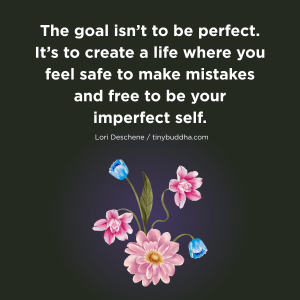
“Being happy doesn’t mean that everything is perfect. It means you’ve decided to look beyond the imperfections.” ~Unknown
We are all on a mission to be the best we can be, to be happy, to have the perfect house, family, partner, and job. To complete our to-do list, to complete out bucket list, to make our parents proud, to get promoted, earn more money, and be successful.
Life can often feel like a never-ending treadmill, going quickly in the wrong direction. As we run faster to try to progress down this path, the goal becomes more elusive.
Are we setting ourselves up to fail in this quest for the perfect life? And will it even result in our one main aim: happiness?
I’m beginning to think that our quest for success and happiness is, in fact, the main reason we are unhappy.
We place such high expectations on ourselves—to progress at work and be successful, to meet the same pressure to be perfect at home—and we feel we have to conform to the media ideals we see every day in terms of our health, our looks, our weight.
As if that’s not hard enough, we then look at everyone around us feeling like they’ve got it mastered and we’re falling short.
We often don’t realize that what we see in others and the media is only the best side. It’s not a full picture, so it’s unrealistic to expect ourselves to achieve this. We’re setting ourselves up to fail.
I spent years doing all of the above, climbing the corporate ladder, trying to conform in a bid to please people, and it made me unhappy and unfulfilled. The perfect life always seemed just out of reach, and yet my life on the outside might have looked ideal to everyone else.
I thought there must be another way, so one day I gave it all up and set on a journey to rebuild my life around my passions and restore my happiness.
I learned a lot about myself and learned, from others, how people become happy and how we can live an authentic, perfectly imperfect life. I’ve learned that:
- Things won’t always go according to your plan
- The to-do list will never be complete
- You’re doing the best you can with what you’ve got, and that is as perfect as it can be
- No one has a perfect life (despite what it may look like on Facebook or in a magazine)
- Happiness is not a point you arrive at in the distant future when you resolve all your problems and achieve perfection.
So often it’s our quest for perfection that stops us from being happy.
We plan our weekend and then get upset when it rains, disrupting our plans. This prevents us from enjoying the fact that it’s the weekend, and we get to spend time with those we love, doing what we enjoy (even if it rains).
We want our to-do list to be complete, and of course it never will be, because as fast as we cross things off, more stuff will appear on it. We never quite have the right amount of money saved, so we work harder to get there, that perfect point in the future, with enough money to be comfortable, which of course never exists because we always want more.
We look for a partner with no faults, when being human means we’re always going to have some.
We expect for things to turn out the way we’d like them to, but life isn’t like that. It’s full of ups and downs. Even for the happiest of people, the storms will always come.
We search for the perfect job, one we will enjoy every day. Yet every job will have its highs and lows. Even the rich and famous, who get to play sports or music and make a living from their passion, complain about the travel, the schedule, the media, and the pressures of fame. Every silver lining has a cloud, and the reverse is also true, because true perfection is always imperfect.
It’s because of our desire to achieve perfection that we worry about making the wrong choice. We come to a fork in the road and we want to make sure we go in the right direction, but how can we know, since we can never see the end of the path at the beginning?
I regretted not having the courage to leave my corporate job when I was offered the chance of redundancy money. Instead, I hung on for another year in a job I didn’t enjoy and delayed my dreams.
It took me a while to realize that there are no wrong choices; every choice has ups and downs, and there is no such thing as a perfect outcome.
When we chase an unrealistic expectation of perfection for our life and expect happiness to follow, we’re missing the point. Happiness is available all along in those imperfect moments scattered throughout our everyday life.
A recent party I threw springs to mind. It was supposed to be a barbecue, but the weather didn’t cooperate; my outfit got torn just before the guests arrived, so I had to change; and the recipes I’d planned were seeming harder to pull together than I thought. Then there was the fact that I’d woken up that morning with the start of a cold.
As we sat inside drinking wine and laughing together with the few dishes I had managed to prepare, I realized that while it was far from the perfect evening I’d planned, it was still lovely. We were surrounded by friends, everyone was having fun, and it was perfectly imperfect.
It’s all too easy in today’s society to get caught up in the cycle of always wanting more. Our house, car, and partner were once new, and we thought they were perfect, everything we wanted. Then the novelty wore off and it became apparent that this was not the case, so we began searching again, back on a quest for perfection.
When I’d ticked off the things I thought I wanted, when I had it all—my corporate career and all the things I’d bought with it—I sat on the deck of my dream beach house and felt empty inside. I knew this wasn’t the recipe for happiness; after all, I had everything I’d ever wanted yet felt unfulfilled. I’d clearly been missing the point along the way.
Happiness is about loving what we have rather than chasing down the things we think we want. If we can focus on what’s good in every imperfect moment, we’ll all feel a lot more fulfilled.