Category: Blog

  • How I Learned to Treat Myself Like Someone I Love

    How I Learned to Treat Myself Like Someone I Love

    “Rock bottom became the solid foundation on which I built my life.” ~J.K. Rowling

    Most people who know me will say I am incredibly kind, loving, and empathetic. They know me as a safe person that they can share anything with and that I won’t judge. What they may not know is I am incredibly judgmental and unkind to myself.

    When it comes to others, I see light and love. I see confusion and fear behind their misguided actions. I see mistakes as learning opportunities. For myself, I used to see…if I dare say it, a stupid girl who should know better and do better and be better.

    That felt mean even to write. It is an odd combination to love and accept others so deeply but to not love myself in the same way. Sometimes I wonder if my ability to truly see others’ greatness, potential, and beauty is linked to the fact that I didn’t see my own—like perhaps I put all my energy into valuing others instead of directing some of it toward myself.

    I’ve always wished I could treat myself with the same love I’ve extended to others, but instead, I set myself a different set of standards—ones that cannot be reached because they’re unrealistic. The path of no mistakes, no pain, and no suffering. The path where everything works out according to plan. My plan was always simple: try to do the right thing and follow the rules so I can stay in control.

    So that’s what I did—played it safe and small in many life areas to avoid mistakes, conflict, and my own harsh judgment.

    With friends, I kept quiet when I had different opinions. In romance, I tried to be easy and straightforward. At work, I took the most cautious route, determined to prove my worth before reaching for more. I did it “the right way”—thoughtful, careful, and safe.

    So everything worked out according to plan, right? Wrongthat is not what happened. Because life never goes “to plan” for any of us.

    Case in point: When a discussion with one of my closest friends ended in a disagreement, I felt a stab in my heart that led to a free fall of tears. It wasn’t the disagreement that hurt but the realization that I wasn’t being my true self with her and that, perhaps, she didn’t accept my true self.

    This brought up feelings of abandonment. Was it safe to have a different opinion? Would I be pushed aside, or could I share what I believed to be true and still be loved?

    I now know the pain I felt after her abandonment wasn’t just about our friendship ending; it was about all the times I’d abandoned myself. The times when I’d chosen someone else’s approval over my own and blamed myself when things didn’t work out instead of accepting that pain is inevitable in life—and it doesn’t mean I’m doing anything wrong.

    When my dream job went to someone else, I felt the sting of rejection and replayed everything I might have said or done wrong. I thought of all the reasons I wasn’t qualified and didn’t belong. Being such a harsh judge, I could see all the reasons they hadn’t chosen me, but not the reasons I was still worth choosing. Before I knew it, I agreed with their choice.

    I chose to put other people’s feelings first—empathetically considering their perspective without considering my own.

    This realization hit me hard during a therapy session. I was speaking about a time growing up when my family had to suddenly move and how hard this was for everyone, but I struggled to express how hard it was for me, quickly transitioning to the bigger picture.

    I realized then that I needed to slow down and reflect on my own experiences and feelings in order to show myself the same compassion I so easily extended to others. It was no longer one or the other but both, and this wasn’t easy because it meant I had to sit with the pain of being my true self instead of covering it up.

    I’d always blamed myself for everything that had gone wrong in my life because it gave me a sense of control. If I was the problem, I didn’t have to sit with the pain of life’s unpredictability.

    In truth, I hated parts of myself and didn’t know why until recently. The quality I most despised was my insecurity. It led me to over-analyze my choices and compare myself to others instead of celebrating my own accomplishments. For example, when I was invited to teach a class in college, I turned it down, pretending to be sick, because I didn’t believe I was good enough.

    Many of my struggles stemmed from my sensitive and creative nature. I was a sponge, soaking up every detail, seeing things from all perspectives. This gave me the gift to empathize and support others on a deep level, but it also led to overthinking and self-recrimination.

    For example, in my twenties, I stayed in a relationship that didn’t feel right because I was scared and unsure of myself. When it ended badly, I blamed myself for not knowing better instead of recognizing that I couldn’t have known until I learned through experience.

    The inability to love my true, whole self—including my faults and past experiences—was at its core an unwillingness to accept pain. It stunted my growth and led to suffering. It kept me small and stuck in repeating negative cycles of overthinking, comparison, and insecurity.  

    In therapy, in coaching groups, and in my writing, I began sharing the stories I’d once hidden in shame, and my inner hatred slowly disappeared.

    I shared the many times I was confused about my own emotions and struggled to be kind to myself. With time, I began to see my own mistakes from a different lens—as the witness of my younger self rather than the judge. I felt different—like a closed door in my heart opened.

    I was finally able to have compassion for myself when I started seeing myself as deserving of love and allowed to make mistakes—when I allowed myself to be human just like everyone else. I also began to understand that not everything that goes wrong is my fault, and I don’t have to beat myself up just because things don’t go “to plan.”

    My friend shared a metaphor about turning a big rock upside down and how, underneath that rock, you’d find darkness, mud, and bugs scurrying around as they are exposed from their hiding place. That’s exactly what it feels like to me. Every time I share honestly and expose my heart, my fears, and the things I am ashamed of, I am left with the warm sun shining down, and those little pesky bugs disappearing.

    I now know that I deserve love too, even though I am imperfect. I am still worthy—but I have to believe it. It took a lot of tears to get there. A lot of embarrassment and confusion. A lot of willingness and courage.

    Reflecting on this reminded me of my strength and capacity to overcome hardships. Then another powerful realization occurred to me—I am powerful enough to get through any storm, and I wouldn’t trade this particular storm for anything in the world.

    I wouldn’t trade the pain, the hardship, or the dark nights of learning to embrace myself for the perfect plan I originally wanted—because this is what connects our hearts to each other, and that means more to me than anything.

    Recently, I received an email from a reader saying, “Thank you, and keep writing.” I sat in silence and cried.

    I have always dreamed of someone saying that to me, but this time it was different. It was like I truly felt it in my heart. In that moment, I believed my words had value. I believed that I have value. My own heart finally had room for me too.

  • How I Got Free from the Trap of Resentment

    How I Got Free from the Trap of Resentment

    “Jerry, there is some bad in the best of people and some good in the worst of people. Look for the good!” ~George Chaky, my grandfather

    I was seven when he said that to me. It would later become a guiding principle in my life.

    My grandfather was twenty-one when he came to the US with his older brother, Andrew. Shortly afterward, he married Maria, my grandmother, and they had five children. William, the second youngest, died at the age of seven from an illness.

    One year later they lost all of their savings during the Great Depression of 1929 when many banks closed. Two years afterward, my grandmother died from a stroke at the age of thirty-six.

    As I grew older and learned about the many hardships my grandfather and family of origin had endured, his encouragement to look for the good in people would have a profound impact on me. It fueled a keen interest in trying to understand why people acted the way they did. In retrospect, it also had a lot to do with my becoming a therapist and author.

    Easier Said Than Done

    As a professional, I am able to objectively listen to my therapy clients’ stories with compassion and without judgment. However, in my personal life, I’ve often struggled to see the good in certain people, especially some elementary school teachers who physically and emotionally abused me and male peers who made fun of my small size.

    In my youth I often felt humiliated, but not ashamed. I knew that for them to treat me that way, there must have been something wrong with them. But it still hurt.

    I struggled with anger and resentment for many years. In my youth, I was taught that anger was a negative emotion. When I expressed it, certain teachers and my parents punished me. So, I stuffed the anger.

    I Didn’t Know What I Didn’t Know

    When I was twelve, I made a conscious decision to build walls to protect myself from being emotionally hurt. At the time, it was the best that I could do. Walls can give one a sense of safety, but walls also trap the pain inside and make it harder to trust and truly connect with others.

    About that same time, I made a vow to myself that I frequently revisited: “When I get the hell out of this house and I am fortunate to have my own family, I will never talk to them the way my parents talked to each other and my sister and me.” I knew how I didn’t want to express my emotions, but I didn’t know how to do so in a positive and healthy manner.

    Stuffing emotions is like squeezing a long, slender balloon and having the air, or anger, bulge in another place. In my late twenties, individual and couples counseling slowly helped me begin to recognize how much anger and resentment I had been carrying inside. They would occasionally leak out in the tone of my voice, often with those I wasn’t angry with, and a few times the anger came out in a frightening eruption.

    “Resentment is the poison we pour for others that we drink ourselves.” ~Anonymous

    I heard that phrase at a self-help group for families of alcoholics. After the meeting, I approached the person who shared it and said to her, “I never heard that before.” She smiled and replied, “I’ve shared that a number of times at meetings where you were present.” I responded, “I don’t doubt that, but I never heard it until tonight!”

    The word “resentment” comes from the Latin re, meaning “again,” and sentire, meaning “to feel.” When we hold onto resentment, we continue to “feel again” or “re-feel” painful emotions. It’s like picking at a scab until it bleeds, reopening a wound.

    Nowhere have I ever read that we should like being treated or spoken to unfairly. However, when we hold on to resentment, self-righteous indignation, or other uncomfortable emotions, it ties us to the past.

    Holding onto resentment and grudges can also increase feelings of helplessness. Waiting for or expecting others to change gives them power over my thoughts and feelings. Many of those who I have held long-standing resentment for have died and yet can still have a hold on me.

    When we let go of resentment, it frees us from much of the pain and discomfort. As author John E. Southard said, “The only people with whom you should try to get even with are those who have helped you.”

    I’ve continued to learn how to set healthier and clearer boundaries without building walls. I’ve learned that I don’t have to accept unacceptable behavior from anyone, and I don’t have to go to every argument I am invited to, even if the argument is only inside my head.

    Still, for a long time, despite making significant progress, periodically the anger and resentment would come flooding back. And the thought of forgiving certain people stuck in my craw.

    When people would try to excuse others’ behavior with statements like “They were doing the best they knew how,” I’d say or think, “But they should never have become teachers” or “My sister and I had to grow up emotionally on our own!”

    Forgiving Frees the Forgiver

    For a long time now, I have started my day with the Serenity Prayer: (God) Grant me serenity to accept the things I cannot change, courage to change the things I can, and the wisdom to know the difference. It has helped me try to focus on today and what I can control—how I think, feel, and act. Sometimes I get stuck, and all I can say is, “Help me let go of this anger.”

    “When we forgive, we heal. When we let go, we grow.” ~Dalai Lama

    I frequently hear the voices of many people who have helped, supported, and nourished me. I hear my wife’s late sister, MaryEllen, a Venerini nun, saying, “Jerry, the nuns treated you that way because that was the way they were probably treated by their superiors.” She validated my pain and planted another seed that slowly grew.

    I’ve also heard that “hurt people hurt people.” At times, I would still lash out at innocent people when I was hurting. I desperately wanted to break this generational cycle. I’ve learned that I don’t have to wait for other people to change in order to feel better.

    I am learning that everyone has a story, and I can practice forgiveness without excusing what they did or said.

    Forgiving is not forgetting. Forgiving liberates me from the burden of resentment, helping me focus on connecting with supportive people and continuing to heal. Letting go of resentment cuts the ties that bind me to the past hurts. It helps me be present today where I can direct my time and energy toward living in the present instead of replaying old pain.

    For the past year I have made a conscious effort to start each day by asking my Higher Power, whom I choose to call God, “Help me be grateful, kind, and compassionate to myself and others today and remember that everyone has their own struggles.” This has become one of the biggest turning points in my travels through life.

    You Can’t Pour from an Empty Cup

    I have learned that taking care of myself is one of the most effective ways to stop resentment from building up. When I neglect one or more of my needs over time, I’m quicker to snap, less patient, and more likely to take things personally. Who benefits from my self-neglect? Not me, and certainly not my spouse, children, coworkers, or others. When I am H.A.L.T. (hungry, angry, lonely or tired) or S.O.S. (stressed out severely), I usually don’t like being around me either.

    Self-compassion also weakens resentment’s hold, making it easier to be compassionate with others. Remembering that we’re all works in progress helps me treat myself and others more gently.

    I often think about my grandfather’s words, “Look for the good.” Self-care and self-compassion help me to see the good in myself as well as in others. I can dislike someone’s actions or tone of voice and also recognize they’re not really about me.

    I actually have a Q-tip (representing “quit taking it personally”) taped on my desk to remind me that someone else’s actions or words are likely the result of their own struggles. It helps me to “catch myself,” and instead of taking things personally, I try to remember that everyone has a story.

    Gratitude Puts Everything in Perspective

    There are days when I am faced with great or even overwhelming challenges, when it would be easy to default to anger—with other people or with life itself. On those days, I might notice a beautiful sunrise or feel touched by the love and kindness of others. Practicing gratefulness helps me to see life as both difficult and good. It is like an emotional and spiritual savings account, building reserves that help me to be more resilient during the rough patches in life, even when I feel wronged.

    Specifically focusing on what I am grateful for each day also helps me heal and gives me periods of serenity. It empowers me to try to approach my interactions with others in a warm and caring manner while respecting my and their personal boundaries, which keeps small misunderstandings from growing into resentment.

    Gratefulness and compassion toward myself and others take practice. It’s not a one-and-done thing. It’s like learning any new skill—the more I practice, the more it becomes a positive habit and feels more like second nature.

    Without repeated practice, old, undesirable thoughts and patterns can come back. When I neglect self-care, I am most vulnerable to quickly regress.

    I also need to be vigilant when things seem to be going well within and around me. I can become overly confident, trying to coast along and slack off from practicing gratitude and compassion.

    I have been unlearning many things that no longer work for me. I have unlearned “Practice makes perfect,” replacing it with “Practice makes progress, and I will do my best to continue to learn, grow, and be grateful, one day at a time.”

    I don’t always get it right, but every time I choose compassion, understanding, or gratitude over resentment, I am more at peace and more connected to everyone around me.

  • Pay What You Can for 21 Days of Laughs and Light

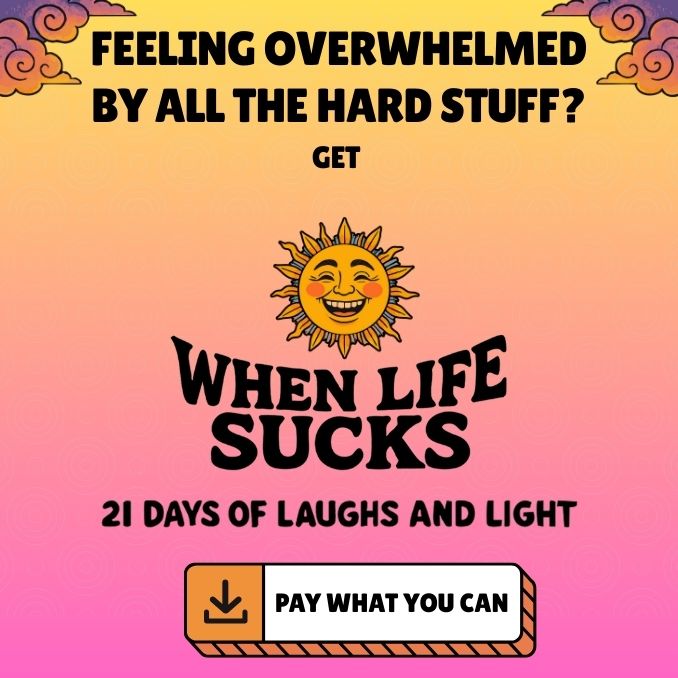
    Pay What You Can for 21 Days of Laughs and Light

    My electric toothbrush has seen it all.

    I usually look in the mirror when I’m brushing my teeth, and for a while last fall, I often cried when I stared into my own eyes.

    I did my best to hold it together in front of my sons—most of the time, anyway. But the mask often cracked when I met my own gaze. Deep sobs set to the gentle hum of my sonic. Life was just that overwhelming—with medical issues, a loved one’s shock diagnosis, and countless other challenges too numerous to list.

    Then one day, after months of carrying more emotional weight than I had in decades, I decided to start looking for little ways to make myself smile again. And that toothbrush became a microphone.

    First it was dramatic, cathartic songs like Fix You by Coldplay.

    Then more hopeful ones, like Hey Jude—tears turning to chuckles with “Jude Jude Judy Judy Judy Judy!”

    Eventually, completely ridiculous ones, like Bohemian Rhapsody, complete with head banging.

    And suddenly life started feeling a little lighter. I still had problems. I still lacked solutions. But those laughs between the tears got longer and more genuine with every small moment of levity.

    That’s what my When Life Sucks: 21 Days of Laughs and Light series is all about. (Spoiler alert: it’s pay-what-you-can—because I know what it’s like when money’s tight!)

    I started writing these emails because it can be incredibly hard to find a little relief when life feels like a nonstop barrage of punches from the universe. I also know that sometimes laughter can come with a side of guilt if someone you love has a lot less to smile about.

    But small flashes of light really can help us get through the darkness, and they don’t always appear on their own, which is why we have to create them.

    These three weeks of emails outline my path to sparking joy, with a little insight and a gentle nudge for you each day.

    And though the suggested payment is $19, you can sign up for as little as $1. (Or more if you just love Tiny Buddha and want to give a little more to balance out the $1 signups!)

    If you’re ready for a little break from life’s relentless struggles, you can sign up here.

    I hope the emails are helpful to you!

  • I Spent Years Chasing Love Until I Finally Chose Myself

    I Spent Years Chasing Love Until I Finally Chose Myself

    “The only people who get upset when you set boundaries are the ones who benefited from you having none.” ~Unknown

    For most of my life, I lived with a quiet ache, a longing I couldn’t quite name but always felt. I wanted to be chosen. Not just liked or tolerated, but fully seen, wanted, and loved.

    That longing shaped so many of my choices. I over-gave in relationships, staying in situations far longer than I should have, and shrank myself to be accepted.

    I didn’t know it at the time, but I was trying to fill an emptiness that had started years before, an emptiness born in silence and absence, in words left unsaid and emotions left unacknowledged.

    You see, I grew up in a household that looked stable from the outside when, in reality, the opposite was the case.

    My father was a brilliant and accomplished professor but emotionally unreachable. He was a provider, but not someone I could run to, laugh with, or open to. Our conversations rarely went beyond school and grades—never “How are you feeling?” or “What’s on your heart?”

    Affection wasn’t part of the language we spoke at home. I learned early that performance was prized, but vulnerability was not. That I had to know things without asking, succeed without stumbling, and carry weight without complaint.

    As a child, you don’t have the language for the emotional neglect that comes as a result of this, but you feel it in your body. You sense the void.

    Even before I could articulate words, I felt more comfortable with paper than with people. I didn’t speak until I was four and carried a piece of paper everywhere I went, using it to express what I couldn’t say out loud.

    Writing became my voice before I had one. But even that was dismissed. My father didn’t see value in it. And so, the message was reinforced again: What I loved didn’t matter. Who I was wasn’t enough.

    And over time, I internalized that belief. I carried it into my teenage years and well into adulthood, thinking love had to be earned through sacrifice or silence.

    I struggled with setting boundaries because I didn’t want to be “too much” and drive people away. I mistook people-pleasing for kindness, over-accommodation for loyalty, and emotional exhaustion for love.

    My longing for connection often led me into relationships where I gave more than I received. I wanted so badly to be seen, to feel chosen, to matter to someone in the ways I never felt I did growing up.

    But the more I sought love externally, the more disconnected I became from myself. My self-worth was tangled in how others treated me, how well I performed, how little I complained, and how much I could endure.

    One of the most defining relationships of my life culminated in an engagement. At the time, it felt like a dream come true. Here was this successful, handsome man who made six figures and stood over six feet tall. And he chose me. He was also spiritual and into meditation, something I had been exploring with the Buddhists, so I felt this deep alignment with him. It felt like a sign that maybe I was finally enough to be loved fully.

    But in hindsight, that relationship mirrored all the unresolved wounds I hadn’t yet faced. Without realizing it, I had found someone who was essentially my father, an engineer, emotionally unavailable, with a temper and narcissistic tendencies. I was literally about to marry my father. When it ended in 2014, it left me feeling like I had failed, not just in love, but in my identity.

    I didn’t realize it then, but the engagement wasn’t just a romantic loss; it was the collapse of the illusion I had built to protect myself.

    Prior to the engagement, I had already spent years performing at work, in friendships, and in love. The little girl who once ached to be seen had grown into a woman who poured herself into everything and everyone, just to feel worthy of being chosen.

    At work, I became a relentless overachiever. I tied my value to performance, convinced that if I exceeded expectations, my bosses, my colleagues, anyone would have no choice but to love me. I wasn’t just doing my job; I was doing the most, all the time. Not from ambition, but from a quiet desperation.

    But overgiving didn’t bring admiration; it brought disrespect. I ended up with bosses who were bullies. I remember one vividly. I had worked hard on a project with a team, believing it would finally earn his approval. He looked at it once, then threw it in the trash right in front of me.

    Still, I stayed. Still, I tried harder. Still, I chased the validation that never came. Because deep down, I thought I had to earn love. That if I just proved myself enough, someone would finally say, “You’re worth it.”

    It wasn’t just at work. In friendships, I bent myself backwards to belong. I mirrored the habits of others just to stay close. If they drank, I drank. If they were into something I didn’t enjoy, I pretended to love it.

    I mistook blending in for bonding. I didn’t know that a healthy connection doesn’t require self-erasure.

    And in romantic relationships? The pattern deepened.

    The first guy I dated was vulnerable, open, willing to truly see me. But I couldn’t handle it. His tenderness felt foreign, uncomfortable even.

    Because I’d never known that kind of love. I didn’t think I deserved it. I told myself I wanted someone “edgier,” but the truth was, I was more familiar with emotional unavailability than emotional safety.

    And so, I gravitated toward men who couldn’t love me well. Men who ignored me, mistreated me, made me feel small. I shrank to fit their needs.

    I became who I thought they wanted—changing my interests, compromising my values, giving all of myself just to be chosen. And I settled. I accepted crumbs and called it a connection.

    There was Matt, someone I’d known in college as a friend. When we started dating later, I thought maybe this was it. But he’d spend time talking about the women he found attractive right in front of me.

    And Dustin, I paid for his flight to come see me when I lived in Texas. Even paid for a coach to help him find a better job. Not because I had to, but because somewhere inside, I believed that love could be bought.

    After all, that’s what I had learned. My father gave gifts, not affection. Money, not presence. So I repeated the pattern, hoping financial sacrifice would lead to emotional intimacy.

    I slept with men who didn’t care for me. I stayed with partners who didn’t choose me. I even cheated, sometimes with men who were already in other relationships because if they were willing to risk what they had for me, then maybe I mattered. Maybe I was special.

    But the truth is, I was still that little girl with the paper in her hand, trying to speak a language no one around her understood. Still aching to be seen. Still hoping someone would say, “You are enough.”

    These pains would then become the very ground where the seeds of transformation would be planted.

    But healing didn’t come all at once. It came quietly, slowly.

    At first, I didn’t know where to start. All I knew was that something had to change. I was tired of feeling stuck in the same cycle, repeating the same patterns, and finding myself in relationships that only brought more hurt.

    I knew I needed space to figure out why I kept choosing unhealthy relationships and why I was drawn to people who couldn’t truly love me.

    In early April of 2015, I made one of the hardest phone calls of my life. I called my mom to tell her I needed a break. None of us were familiar with boundaries back then, but I knew I had to find myself outside of my family’s influence. We both cried on that call. I couldn’t give her a timeframe as I had no idea how long this would take.

    My dad didn’t take it well. Shortly after, he left me a voicemail, convinced I’d joined some kind of cult. He felt like I was turning my back on him. For almost two years, I kept my distance. I’d send cards on holidays, but I didn’t call or text. I needed that space to heal.

    The first move I made was joining a twelve-step program aimed at breaking free from addiction. That’s where I met Gina. She became more than just a mentor, a guide.

    She helped me dig deeper into the underlying issues I hadn’t acknowledged before. I also cut ties with people I thought were my friends because I realized they didn’t genuinely care about me. Instead, I slowly started building healthier relationships.

    A big part of my journey was introspection. I started asking myself the hard questions:

    Why do I keep picking unavailable men?

    Why do I keep repeating the same toxic patterns?

    What does a healthy relationship even look like?

    It was uncomfortable, but I knew I had to figure out why I was drawn to those situations and how I could change. I wanted to understand my own behaviors and patterns so I could break free from the cycle.

    I went to therapy, tried acupuncture to help me sleep, and even explored Buddhism to find some inner peace. I attended a Methodist church, hoping to reconnect with a sense of faith and community.

    Showing up to these places on my own without the crutch of a friend or a partner was a huge step for me. I began to realize the strength in simply being present and curious on my own.

    I also started exploring concepts that would change my perspective on relationships entirely.  Someone introduced me to attachment theory and trauma bonding, and it was like a light bulb went off. Suddenly, I had names for the patterns I was trapped in.

    I learned that I was “avoidant”—someone so terrified of being truly known because deep down, I didn’t believe I had anything worthwhile to offer. Yet I kept gravitating toward people who were emotionally withdrawn, just like my father. I had to chase them for any scrap of affection or attention. Later, I discovered this was called trauma bonding, where you develop feelings and loyalty toward someone who’s treating you poorly. It was a revelation that both devastated and freed me.

    I read books by Brené Brown, went on retreats, and soaked up as much knowledge as I could. I was desperate to understand myself, so I kept asking questions, taking notes, and allowing myself to be vulnerable in safe spaces.

    One of the biggest breakthroughs came when I realized how much anger I was holding onto. I remember a conversation with my mom. I was so angry that she kept trying to fix me or give me advice when all I needed was to just be. She’d send me books on anger management, text me inspirational quotes, or tell me what she thought was best for me. Every gesture felt like another reminder that who I was wasn’t enough.

    That’s when it hit me: I didn’t just hate the advice. I was angry at myself, at my own patterns, at feeling stuck. I knew I couldn’t keep living like that, so I chose to take a two-year break from my family to sort through those emotions.

    I wanted to connect with people not out of guilt or obligation, but because I genuinely wanted to be around them.

    The shift was gradual, but I started to see progress when I could attend community events alone, like the Buddhism gatherings or church services. Those first few times, I felt terrified and hesitant, questioning whether I belonged there. But once I actually showed up, something shifted. I felt empowered in a way I’d never experienced before.

    I was finally showing up as myself, not performing or trying to be what I thought others wanted. I was vulnerable and honest about when I wasn’t okay, and that honesty was freeing.

    I came to terms with my relationship with my dad by forgiving him. I used to carry so much resentment, but I learned to see him for who he was, not who I wished he would be.

    The full forgiveness came years later when I started my own relationship coaching business. I realized that without his emotional unavailability, without all that pain he caused, I wouldn’t have been driven to dig so deeply into my own wounds. In a strange way, he helped me find my calling and ironically, he hates that I’m a relationship coach now. There’s something deeply satisfying about finally being my own person. Since I’ve learned to accept myself, I can accept and forgive him fully. Acceptance didn’t mean agreeing or condoning his behavior, but it allowed me to let go of the hurt.

    I could be around him without the weight of past pain.

    Healing didn’t mean I stopped making mistakes, but I’ve learned to choose myself, to honor my feelings without needing validation from others.

    And if you’re reading this, I want you to know: Healing is messy and nonlinear, but it’s worth it. You don’t have to perform for love.  You don’t have to prove your worth. You just have to start slowly, with the smallest act of truth.

    For me, that act of truth—what Martha Beck calls “the way to integrity” was the simple but profound realization that I didn’t have to earn love from my dad, my teachers, my bosses, or anyone else. I was worthy of love just by being me. What a relief that was.

  • The Lie of Packaged Healing and the Truth About Feeling

    The Lie of Packaged Healing and the Truth About Feeling

    “Emotions are not problems to be solved. They are signals to be felt.” ~Vironika Tugaleva

    We’ve been taught to package our emotions like fast food—served quick, tidy, and with a smile. Americanized feelings. Digestible. Non-threatening. Always paired with productivity.

    If you’re sad, journal it. If you’re angry, regulate it. If you’re overwhelmed, fix it with a three-step plan and a green juice. And if that doesn’t work? Try again. You probably missed a step.

    This is how we sell emotional healing in the West—marketed like a self-improvement product. Seven-minute abs. Seven habits. Five love languages. Follow the formula. Find the peace.

    But what if the formula is the lie?

    As a mental health therapist, I’ve lived it on both sides. I’ve sat in the client chair, feeling broken because my sadness didn’t resolve after enough gratitude lists. And I’ve sat across from clients who whisper their grief like a confession, wondering what they did wrong because they still feel something.

    They aren’t doing it wrong. They’re just human.

    Healing isn’t about “doing” our feelings. It’s about learning how to actually feel them—without the compulsion to justify them or translate them into something useful.

    You owe no explanation for your feelings.

    And still, even knowing that, I get caught in it too.

    I, too, am a product of this culture—a place where feelings are only tolerated when packaged properly. Not too loud. Not too long. Preferably resolved by morning.

    Because of that, there are days I feel a deep aloneness. But I’ve come to realize the aloneness isn’t a flaw—it’s a longing. A longing to be witnessed in the fullness of my humanity. Not fixed. Not analyzed. Just seen.

    I don’t need validation. I don’t want to defend how I feel. I just want space. Presence. Room to let the feeling pass through me.

    The loneliness reminds me how deeply I’ve been shaped by a culture that fears emotions unless they come with an action plan.

    So I’ve learned to hide mine from most people—not because I’m ashamed, but because they’re afraid. People are afraid of their own feelings, so of course they’ll fear the vulnerability of mine. Most people in this country don’t know what to do with real feelings. And the doing has become the problem.

    That fear of being too much or too messy is rooted deep not only in American culture but also me.

    That part inside me judges the part of me that feels sadness at times. She calls it weakness. Not out of cruelty, but out of fear. She believes that if she can shame that part, a much younger, more authentic part that lives inside me, she won’t risk being shamed by others.

    I’m sure many other Americans have this exact same part inside them as well.

    We have to be tough, suck it up—whatever that even means.

    The part of me that gets sad. The part that gets afraid. The part that feels lonely. These are parts I exiled long ago. But I am beginning to bring them home to me. The parts that are terrified of taking up space. They don’t know yet how precious they are.

    They’re not just tender. They’re wise. They’re the intuitive, empathetic, deeply alive parts of me. The parts our culture has spent countless centuries trying to forget.

    But I won’t forget those parts. Not anymore.

    I speak to them now, with clarity and compassion. I tell them: You are allowed to feel without defending it. You are allowed to take up space without apologizing for the weight of your truth. Expand. Don’t shrink.

    The sad one. The scared one. The one who wants to hide. The one who’s learning to stay. Even the critic. They can all exist inside me—side by side—without contradiction. Without shame. Without needing to explain themselves to anyone.

    I will no longer betray them because others betray their own parts and project their self-betrayal onto me.

    There’s a whole galaxy inside me, and there’s a whole galaxy inside of you. Of course no one else will fully understand it.

    What matters is that I do.

    And I’m learning… I’m not here to be understood. I’m here to simply be me—and to allow all that resides in me to be, too.

    And maybe you are, too.

  • The Hidden Link Between Self-Rejection and Social Anxiety

    The Hidden Link Between Self-Rejection and Social Anxiety

    “True belonging only happens when we present our authentic, imperfect selves to the world. Our sense of belonging can never be greater than our level of self-acceptance.” ~Brené Brown

    Last year over lunch, my friend, Jess, confessed something to me that hit me right in my gut because I’d been there too—that exact same lie, that exact same fear.

    Out of nowhere, she blurted out, “I need to cancel.”

    “Cancel what?” I asked.

    She burst into tears. “I RSVPed yes to Jen’s wedding months ago, but it’s this weekend, and I just… I can’t do it.”

    As she sobbed, she confessed she’d already crafted a text message claiming food poisoning. The wedding was for her best friend since college, and she was bailing—not because of an emergency, but because she was terrified of being judged by the other guests.

    My stomach dropped. Not because I was shocked, but because I saw myself in her confession.

    Back in 2012, I’d done exactly the same thing. My cousin, who I’d grown up with—shared a bedroom with during family vacations, passed notes with during boring family dinners—was getting married. And I…just couldn’t make myself go.

    I still get a sick feeling remembering it. Me, twenty-nine years old, sitting fully dressed on my bed at 3:42 p.m., staring at the invitation that had been on my fridge for months. The wedding started at 4:30. It was a twenty-five-minute drive. And I was frozen, literally nauseous with anxiety.

    What if the small talk was unbearable? What if my ex was there with his new girlfriend? What if people noticed I’d put on weight since Christmas? What if, what if, what if…

    I texted my cousin claiming a 102-degree fever. Then I ordered pizza, watched Netflix, and tried to ignore the hollow feeling in my chest.

    Yeah. Easier to stay home where it felt “safe.”

    The Painful Paradox

    Working through my own social anxiety mess, plus helping others with the same struggle over the years, has taught me something that blew my mind when I first realized it:

    We reject ourselves BEFORE anyone else gets the chance.

    Let me explain.

    We think our social anxiety comes from being afraid of other people’s judgment. But that’s not quite it. We’re actually afraid they’ll confirm the crappy things we already think about ourselves.

    When I bailed on that wedding, I wasn’t really worried about what my family would think. I was worried they’d see the “truth” I already believed: that I wasn’t interesting enough, put-together enough, or worthy enough to belong there.

    So instead of risking that pain, I chose a different pain—isolation. I projected my own harsh self-judgment onto everyone else, assuming they’d see me the same way.

    Talk about a messed-up strategy! By “protecting” myself from potential rejection, I guaranteed rejection by rejecting myself first. And worse, I created real-world “evidence” that I didn’t belong, which only fed my insecurities.

    My friend was caught in the same trap. She didn’t actually know she’d be judged at the wedding. But she was so convinced of her own unworthiness that she assumed everyone else would see it too.

    The Lightbulb Moment That Changed Everything

    For most of my life, I brushed off my social anxiety as “just being an introvert.” Convenient label, right? Helped me avoid admitting I was actually terrified.

    Then my friend Kayla—who has zero filter—called me out over coffee.

    “Sandy,” she said, eyeing me over her mug, “you realize you spend like 90% of your energy imagining what people think about you and maybe 10% actually finding out?”

    I almost choked on my latte. Ouch.

    That night, I grabbed an old journal and started tracking my thoughts before social events. Holy crap. I was spending HOURS in mental gymnastics:

    • Rehearsing conversations that might never happen
    • Coming up with witty responses to imagined criticisms
    • Planning defenses to judgments nobody had actually made
    • Obsessing over outfit choices to avoid potential comments

    I’d exhausted myself before even leaving the house! And the worst part? I was playing both roles in these imaginary scenarios—both the harsh judge AND the person being judged.

    Talk about a rigged game.

    So I decided to try something radical. My neighbor was having a dinner party that weekend. Instead of my usual mental prep work, I made myself a promise: just show up as-is. Not as the “entertaining Sandy” or the “impressive Sandy” or any other version. Just… me.

    I won’t lie—I almost bailed three times that day. But I went. And without all the usual self-judgment noise in my head, something weird happened. I actually listened when people talked instead of planning my next clever comment. Conversations felt easier. I laughed more.

    Afterward, my neighbor texted, “Thanks for coming! Loved our talk about your trip to Maine—we should grab coffee sometime.”

    Wait, what? I hadn’t rehearsed the Maine story. That was just me rambling about something I loved. And she… liked it?

    This tiny experience punched a hole in my belief system. Maybe, just maybe, people could like the actual me—not some carefully curated version I thought I needed to be.

    Getting to Know the Real You

    So here’s what I’ve figured out: the way through social anxiety isn’t becoming better at small talk or forcing yourself into uncomfortable situations. It’s about getting to know yourself—the real you under all that fear and protective armor.

    When you actually know and like yourself, other people’s opinions just don’t matter as much. You develop a kind of internal anchor that keeps you steady even when social waters get choppy.

    This journey toward knowing yourself isn’t always Instagram-worthy. It’s messy. But here’s what’s worked for me.

    1. Catch yourself in self-rejection mode.

    Start noticing when you back out of things because you’re afraid of judgment. Ask yourself, “Am I rejecting myself before even giving others a chance to accept me?”

    Last month, I almost skipped a reunion with friends from high school because “no one would remember me anyway.” Classic self-rejection! Naming it helped me pause and reconsider.

    2. Question your core beliefs.

    Where did you get the idea that you’re not enough? Most of us are carrying around beliefs we formed as awkward thirteen-year-olds! Some of mine were:

    • “I’m boring unless I’m entertaining people.”
    • “People only like me when I help them with something.”
    • “If I show my real feelings, people will think I’m too much.”

    Once you identify these beliefs, you can start collecting evidence that challenges them. My friend who missed the wedding realized her core belief was “I don’t belong in celebrations.” We traced it back to an eighth-grade birthday party disaster!

    3. Talk to yourself like you’re not a jerk.

    I used to have a running commentary in my head that I would NEVER say to another human being. “You’re so awkward. Why did you say that? Everyone’s just tolerating you.”

    Learning to speak to myself with basic decency was life-changing. When I feel anxious now, I’ll literally put my hand on my heart and say, “This is hard. Lots of people feel this way. How can I support myself right now?”

    Cheesy? Maybe. But it works.

    4. Baby steps, not cliff jumps.

    Recovery doesn’t mean immediately diving into your scariest social situation. That’s like trying to run a marathon when you’ve never jogged around the block.

    Start small. Maybe it’s:

    • Coffee with one friend instead of a group
    • A thirty-minute appearance at a party with permission to leave
    • A class where the focus isn’t on socializing but on a shared interest

    Each small win builds evidence against your “I don’t belong” belief system.

    5. Create a self-connection practice.

    You need regular check-ins with yourself to quiet the noise of imagined expectations and reconnect with who you really are.

    For me, it’s morning journaling with coffee before anyone else is awake. For my friend, it’s painting terrible watercolors that no one will ever see. Find what helps you hear your own voice clearly.

    Even four minutes of intentional self-connection can begin rebuilding your relationship with yourself. (Trust me, I’ve timed it!)

    My Cousin’s Do-Over

    Life can be weirdly generous sometimes. Three years after I missed my cousin’s first wedding, she got remarried (to the same guy—they’d eloped after family drama with the first ceremony, then decided to have a proper celebration later).

    When the invitation arrived, my palms instantly got sweaty. Here was my chance to do things differently, but the old fear came roaring back.

    This time though, I had new tools. Instead of spiraling into “what-ifs,” I asked myself, “What if I just showed up as myself? What’s the worst that could happen? What’s the best?”

    I felt the fear—it didn’t magically disappear—but I didn’t let it make my decision. I focused on how much I loved my cousin and how I’d regretted missing her first celebration.

    Was the wedding perfect? Nope. I spilled red wine on my dress within the first hour. I got stuck in an awkward conversation about politics with my uncle. I still felt twinges of “I don’t belong here” at times.

    But I stayed. I danced badly to the Cha-Cha Slide. I ate cake.

    And at one point, my cousin grabbed my hands and said, “I’m so glad you made it this time, Sandy.” The genuine joy in her eyes hit me harder than any anxiety ever could.

    Sometimes showing up is enough.

    The Gift of Just Being You

    For most of my life, I thought social anxiety was just “how I was wired”—some unchangeable part of my personality. But turns out, it wasn’t about who I am. It was about how I’d learned to treat myself.

    When I began treating myself with a fraction of the kindness I’d show to a friend, things shifted. Not overnight. Not perfectly. But genuinely.

    The less I needed external validation, the more comfortable I became in my own skin. And weirdly, the more authentic connections I started making.

    Look, I still get nervous before big social events. I still sometimes catch myself falling into the old mental prep work. But now I can laugh at it and gently redirect.

    If you’re someone who tends to hide rather than show up, please hear this:

    • The judgment you’re so afraid of is often coming from YOU first.
    • By rejecting yourself, you deny others the chance to know the real you (and trust me, the real you is actually pretty great).
    • The more you practice showing up authentically, the easier it gets.

    Your presence—your real, unfiltered, sometimes-awkward presence—is worth sharing. Don’t let your harsh inner critic rob the world of your unique perspective and energy.

    Maybe the greatest plot twist in this whole story is this: When I stopped trying so hard to be someone I thought others would accept and started accepting myself instead, I finally found the belonging I’d been searching for all along.

    Funny how that works.

  • The Small, Simple Acts That Shifted Me Out of Survival Mode

    The Small, Simple Acts That Shifted Me Out of Survival Mode

    “True healing is not a straight line. It is a spiral. You come back to things you thought you understood and see deeper truths.” ~Barry H. Gillespie

    I used to believe healing would be obvious. Like a movie montage of breakthroughs… laughter through tears, epiphanies in therapy, and early morning jogs that end with a sunrise and a changed life. But that’s not what healing looked like for me.

    It looked like dragging myself out of bed with puffy eyes after staying up too late crying. It looked like brushing my teeth when everything in me whispered, “Why bother?” It looked like answering a text when I didn’t feel lovable or worth responding to.

    Healing, I’ve learned, is quieter than I expected. It’s not a climax. It’s a practice.

    Three years ago, I hit what I can only describe as emotional gridlock. I wasn’t in crisis, at least not the kind that gets dramatic music. I was in the kind that feels like cement. I was tired all the time. My fuse was short. I wasn’t sleeping, wasn’t eating regularly, and the woman in the mirror didn’t look like someone I recognized anymore.

    If you had asked me what was wrong, I wouldn’t have had an answer. It wasn’t a single event. It was a slow erosion of self, life chipping away piece by piece until I felt like a ghost of who I used to be.

    One night, after snapping at my kids over something insignificant and crying in the shower, I sat on the edge of my bed and thought: I don’t want to live like this anymore.

    Not “I want to disappear.” Not “I want to run away.” But this version of life, the one that felt like survival mode on loop, had to change.

    So, I did something radical:

    I took one deep breath. I unclenched my jaw. I drank a glass of water.

    And that was day one.

    There was no fanfare. No overnight shift. Just a decision to start with what I could reach: my breath, my body, the next kind choice.

    The next morning, I made breakfast. Not for anyone else, just for me. Eggs and spinach. It sounds small, but it felt like reclaiming something. I was so used to skipping meals or eating standing up like my needs were interruptions.

    That day, I walked around the block after lunch instead of scrolling. It wasn’t even a workout. I didn’t track it. But the sun hit my shoulders, and for the first time in a long time, I felt here.

    That walk was healing.

    So was every moment I chose presence over performance.

    I started keeping a mental list of all the tiny things I did in a day that felt like medicine. A bath instead of another task. A journal entry that made no sense but helped me feel less like I might explode. Drinking water before coffee. Asking myself “What do I need?” and then actually listening for the answer.

    Sometimes the answer was a nap. Sometimes it was a good cry with no rush to wipe my face. Sometimes it was texting a friend and saying, “I’m not okay right now,” even when I worried I might sound dramatic.

    And sometimes, the answer was just silence.

    Letting myself be… without the need to improve, perform, or explain.

    Over the next year, healing became a practice of showing up differently.

    Not dramatically.

    Consistently.

    I started listening to my body instead of overriding it. I rested when I needed to instead of proving I could push through. I said no even when my people-pleasing screamed at me to just say yes and make it easier for everyone else.

    And the thing about consistency? It’s boring. It doesn’t get applause. But it works.

    Healing is in the repetition of small kindnesses to yourself. The boring, brave acts of resistance against self-neglect.

    It wasn’t linear, either. I fell back into old patterns. I had days where I numbed out with my phone, skipped meals, and snapped at everyone in the house. But I stopped making those days mean that I was back at square one.

    You can fall down and still be healing.

    You can feel stuck and still be progressing.

    One of the most freeing things I ever learned was that healing isn’t a destination you arrive at. It’s a relationship you build with yourself. One rooted in trust.

    And trust is earned in the small, quiet moments.

    What I didn’t know then, but deeply understand now, is that our nervous systems aren’t waiting for one massive overhaul. They’re waiting for safety, predictability, and care. You rebuild your sense of self the same way you build trust with another person: One consistent action at a time.

    It’s brushing your hair instead of pulling it up in frustration. It’s putting your phone down and drinking tea. It’s crying when the tears come instead of swallowing them down.

    These things don’t look revolutionary. But they are. Because every small act of care tells your body and mind, “You matter. I’m here. I’ve got you now.”

    I remember one day vividly.

    It was pouring rain. My toddler had just thrown oatmeal across the room. I was already touched out, overstimulated, and dangerously close to tears. My instinct was to throw the day away, to turn on cartoons and pour coffee over my anxiety and call it survival.

    But instead, I sat on the floor. I scooped my screaming child into my lap, pressed my forehead to his, and whispered, “We’re okay. We’re safe.”

    I took a breath. Then another. And something in me softened.

    That moment didn’t fix my life. But it reminded me of my power. That was healing, too.

    If you’re in a season where everything feels off, where you feel numb or exhausted or like the spark you used to have is buried under obligation, I want you to know this:

    You don’t need a ten-step plan. You need one small thing you can do today that feels like care.

    A breath. A meal. A walk. A text to someone safe. A cry you’ve been holding in.

    That is healing. Not a dramatic rebirth, but a quiet reweaving of yourself, thread by sacred thread.

    A Few Things That Helped Me

    • Lower the bar. Healing isn’t about being your best self every day. Some days it’s just about not abandoning yourself. Start there.
    • Romanticize the boring. Light the candle. Make the tea. Put on the cozy socks. Small rituals matter. They remind you that your life is worth living even when it’s messy.
    • Give yourself credit. Every time you choose presence over autopilot, you’re rewiring something. That’s no small thing.
    • Befriend your body. It’s not broken. It’s responding to years of survival. Treat it like a loyal companion, not a machine that’s malfunctioning.
    • Talk to yourself like someone you love. When you mess up. When you overreact. When you don’t meet your own expectations. Especially then.
    • Keep showing up. Even if it’s not glamorous. Especially when it’s not.

    You won’t always feel the shift. But you’ll wake up one day and realize: you’re softer. Kinder. Less reactive. More you.

    That’s what healing does.

    Quietly. Faithfully. Cell by cell.

  • Planning Without Panic and Learning to Live in the Now

    Planning Without Panic and Learning to Live in the Now

    “You can plan for a hundred years. But you don’t know what will happen the next moment.” ~Tibetan proverb

    Some days it feels like a fog I can’t shake—this underlying fear that something painful or uncertain is just around the corner.

    I try to be responsible. I try to prepare, make good choices, take care of things now so the future won’t unravel later. But beneath that effort is something harder to face: I feel helpless. I can’t control what’s coming, and that terrifies me.

    Maybe you’ve felt this too—that tension between doing your best and still fearing it’s not enough. Worry becomes a habit, like you’re rehearsing bad outcomes in your head just in case they happen.

    That’s where I found myself when I turned to Buddhist teachings—not for comfort exactly, but for a different relationship with uncertainty.

    What Buddhism Taught Me About the Future

    One of the first things I learned is that Buddhism doesn’t tell us to stop caring about the future. It teaches us to stop living in it.

    The Buddha spoke of suffering as arising from two core causes: craving (wanting things to go a certain way) and aversion (pushing away what we don’t want). When I spin into worry or try to predict everything, I’m doing both—I’m grasping for control and resisting what I fear.

    But the future is always uncertain. That’s the part I don’t want to admit. I used to believe that if I thought hard enough, planned carefully enough, I could outmaneuver risk. But I’ve learned that worry isn’t preparation—it’s just suffering in advance. It doesn’t protect me. It only pulls me out of the life I’m actually living.

    The Real Conflict: Planning vs. Presence

    Here’s the real tension I struggle with—and maybe you do too: I believe in the power of presence. But I also know I have to plan.

    As a filmmaker, planning isn’t optional. Without preparation, things fall apart. A well-structured plan doesn’t just prevent chaos—it makes room for creativity. It allows me to focus, explore, and respond to the moment without losing direction. In that way, planning is part of my art.

    So when I first encountered teachings about letting go and trusting the moment, it felt contradictory. How could I live in the now when my work, and life, require thinking ahead?

    This was the real conflict—the push and pull between control and surrender, between structure and flow. One is necessary for functioning in the world. The other is necessary for actually feeling alive in it.

    A Real-Life Lesson in Letting Go

    Years ago, I received grants to make a 16mm documentary about Emanuel Wood, a traditional Ozarks fiddler with a rich musical heritage and a colorful presence. I had high-quality gear lined up—Nagra 4.2 audio, film stock, the works—and the project felt blessed. Emanuel was eager. I was hopeful. The plan was solid.

    It felt like everything was finally coming together.

    But over the years I’ve learned something the hard way: sometimes, when I feel euphoric about a plan, it’s also a signal—a subtle warning that life might have something else in mind.

    Sure enough, Emanuel died unexpectedly just a few months before I was scheduled to begin filming. Just like that, the film I had meticulously envisioned, built support for, and shaped my year around was gone.

    I was devastated. I couldn’t give the grant money back, and I didn’t want to abandon the deeper spirit of the project. So I did what I didn’t expect to do: I stayed present, and I listened.

    I made a different film. A new one. Something just as honest and grounded in the world Emanuel represented. It was shaped by the same love of music, the same longing to preserve meaning, and it emerged only because I stayed with the discomfort and uncertainty of not knowing what to do next.

    Planning had given me the structure. But presence—and trust—allowed the story to live on in a different form.

    The Middle Path: Flexible Readiness

    I think about that lesson often. The same conflict plays out across many fields. The military trains obsessively for what can’t be predicted. A jazz musician rehearses scales for hours, only to let them go once the song begins.

    We don’t have to abandon planning. We just have to make space for improvisation.

    This is how I’ve come to understand the Buddhist path in a practical world: Planning is necessary. But clinging is optional.

    Now, I try to plan the way a musician tunes their instrument. Prepare with care. Show up with intention. But when the moment comes, play—not from control, but from connection.

    What Helps Me Now

    These days, when fear about the future rises, I pause. I breathe. I ask myself: Am I trying to control something I can’t? Can I still act responsibly without gripping so tightly? Can I trust this moment, even briefly?

    I still make plans. I still take responsibility. But I no longer pretend I can outthink uncertainty. I try to meet it with curiosity, flexibility, and a little kindness toward myself.

    Sometimes I quietly repeat:

    May I be safe. May I meet whatever comes with courage and care. May I trust this moment.

    That doesn’t solve everything. But it brings me back to the only place I actually have any power: here.

    You don’t have to give up planning. Just stop making it your emotional insurance policy.

    You can build the structure, take the next right step, and still leave space for life to surprise you.

    Let your plans serve your life—not replace it.

  • From Burnout to Bliss: The Beauty of Therapeutic Art

    From Burnout to Bliss: The Beauty of Therapeutic Art

    “It takes courage to say yes to rest and play in a culture where exhaustion is seen as a status symbol.” ~Brené Brown

    “You have burnout.” I listened to these three words in a trance, said thank you, and got off the call with the doctor.

    Part of me had known.

    The endless days I spent in bed staring at the ceiling with no motivation to do anything. The inability to focus on my screen. And the sudden bursts of tears when I saw yet another meeting pop up in my calendar.

    I knew all of this wasn’t normal. That something was going wrong.

    But another part of me was in disbelief. Burnout?! How can I be burned out if I’m doing what I love?

    Just three years ago, I co-founded a company to help chronic disease patients. I was here to change the world, to help others, to build something meaningful.

    How is it possible to burn out following your own dream? That’s something that just happens to miserable people in their nine-to-five jobs.

    As I dove deeper, I learned how wrong I was.

    It’s actually much more common to burn out when you’re running your own company than when you’re an employee.

    The financial rollercoaster, the rejections along the way, the countless weekends spent working without ever really taking a break—we are not made for that.

    No matter if we’re following our own dream or someone else’s.

    So, like the perfectionist and hustler I was, I thought: Let’s fix this fast so I can get back to feeling joy for what I’m building.

    I read the self-help books, did talk therapy, started mindset coaching, tried different productivity techniques, but the void inside me, the demotivation, the inability to feel joy—none of it went away.

    And underneath all of this was a crippling fear: What if I’ll only get healthy if I leave everything I’ve built behind?

    The turning point came one day, out of the blue.

    I was sitting at the beach watching the sunset, and as I watched the sun setting in its glamorous colors, I heard a voice inside my head say, “Go and buy paint.” At first, I dismissed it, but it got louder and louder until it was practically screaming: “GO AND BUY PAINT.”

    And so, I did. I went to the nearest dollar store, bought cheap acrylics, a small canvas, and a few brushes.

    At home, I put a plastic bag on my bed, and without much thought, I started painting.

    The first brushstroke hit me deeply. I felt my body and heart exhale: finally, you have come home!

    I painted for hours. And when I finished, I was exhausted, but it was a good exhaustion, like after a long hike, when you’re filled with a quiet love inside.

    For the first time in months, I fell into a deep, long sleep. When I woke up the next afternoon, the void didn’t feel so big anymore.

    I felt… I couldn’t quite describe it at first. Until I realized: I felt happy.

    I spent the next months painting every single day.

    I learned different techniques, invented my own, and with each drawing, I left behind traces of overworking, criticism, judgment, perfectionism, and self-pressure.

    After a while, I got curious. I wanted to understand what the art had actually done to me. Was it possible to heal burnout “just” by painting?

    So I went down the rabbit hole: studying, learning, experimenting. The deeper I went, the more I realized it wasn’t really about the art at all.

    The art was just the tool. A tool to create space to feel, to process, to change the internal narrative.

    Maybe you know what I mean. Maybe you’re completely drained and exhausted by your work, whether in a demanding job or in your own business, and you’re questioning why this is happening to you. Maybe you already know it can’t go on like this, but you feel trapped in the situation you’re in.

    If so, here are a few things that helped me in my process using art and that might help you, too.

    And no, you don’t need fancy materials or specific techniques.

    The type of art I found most healing is called therapeutic art. It’s not about the outcome; it’s about the process. The paintings don’t have to be pretty. Sometimes they’re just black scribbles, circles, undefined shapes. It’s all about expressing yourself onto the paper.

    So here they are—the five lessons that helped me in my quest to heal from burnout.

    1. Connect to your creator self.

    Your creator self is the part of you that exists beyond the roles, responsibilities, and pressure of your work. The part of you that’s here simply to create and express.

    Burnout disconnects us from that part of ourselves. Through mindful painting, we can make space to turn inward, explore freely, and reclaim a sense of agency over our own experience.

    When you use art therapeutically, there’s no need to prove anything or achieve a result. It’s about being present in the moment, feeling your hands move across the paper, and letting yourself just be.

    That’s what helps reconnect you to your sense of aliveness and to the real you beneath all the noise.

    2. Release stress from your body.

    Burnout and overworking aren’t just mindset problems. All the stress, all the emotions you chose not to feel along the way, get stored in your body.

    Your body literally goes into survival mode, and no amount of thinking or talking will fix what’s happening in your system.

    Therapeutic art is a mind-body practice that helps process tension, emotions, traumas, and stress that have been stored for years.

    The act of painting, moving your hands, and letting emotions flow through color onto the paper allows your body to exhale and relax. It gives your system the break it has been screaming for.

    3. Rewrite the success story running in your subconscious.

    Most of what drives our actions doesn’t come from conscious thought, it comes from the subconscious, which shapes 90–95% of how we think, feel, and act.

    This is where all the hidden beliefs live that drive us into overwork and burnout: “Rest is lazy,” “If I slow down, I’ll fail,” “Success has to be hard.”

    Even if you logically know these aren’t true, your subconscious doesn’t. It keeps running on these old programs.

    Through painting freely and intuitively, you can project these thought patterns onto the paper. You may catch yourself wanting to control the outcome, judging the process, or feeling anxious when things get messy.

    And in those moments, you have the chance to soften, challenge the old stories, and show your system that there’s another way to live and create.

    4. Let go of what’s no longer working.

    Burnout is a sign that something you’ve been carrying—a habit, a role, a belief, an idea—is no longer aligned with your highest self.

    Art gives you a safe space to practice letting go. On the canvas, you can release control, let things get messy, and allow what wants to emerge to show up without needing to fix or force it.

    This mirrors what we need to do in life: loosen the grip, experiment, and trust the process. When you practice surrender in small ways through art, it becomes easier to loosen your grip on the bigger things draining you.

    5. Rediscover your joy again.

    One of the most painful things about burnout is losing your sense of joy. Everything becomes dull, gray, and heavy.

    Therapeutic art invites you back to joy without a goal. It’s not about making something pretty or useful. It’s about playing with colors, being fully present, and simply observing yourself.

    When you paint just for the experience, you remind your system what it feels like to have fun and be here without needing to earn anything.

    And that, in itself, is a powerful way to heal.

    Burnout doesn’t mean you’ve failed or are broken. It’s often a sign that something in your life or in you is ready to change. For me, painting became the safe and joyful space back to myself.

    The best thing is that you don’t need to be an artist to use painting in your healing process.

    What matters is making space to listen inward, to let your body exhale, and to soften the old stories you’ve been carrying.

    And when you do, you might be surprised at what’s still alive inside you, just waiting to come home.

  • How I Broke Free from a Narcissistic Family System

    How I Broke Free from a Narcissistic Family System

    “Your vision will become clear only when you can look into your own heart. Who looks outside, dreams; who looks inside, awakes.”~ Carl Jung

    My mom had always been invested in real estate. I remember snacking on open house charcuterie years before we finally purchased a house to flip—the first of four. By the time I was eighteen, we’d moved five times.

    I knew our family was falling apart by renovation number three.

    I had spent the previous few years experiencing suicidal ideation and was now on a strict cocktail of seven or so psychiatric and neurological medications.

    My brother was in his sophomore year of college, on academic probation, and coping by mixing alcohol with benzodiazepines.

    My mother was expanding a highly ranked vocational services program while struggling with hyperthyroidism and unidentifiable gut health issues.

    My father was often missing, either executing his latest scam (upcharging my friends’ parents on cases of local wine) or pursuing the buyer of our latest fixer-upper, who eventually became his second wife.

    I couldn’t see the difference between a faulty house and my faulty family. There were constant leaks (tears), water damage (resentment), and cracks in the foundation (domestic violence), and yet there was character, familiarity, and history worth saving.

    My family would have rather remained in denial of our structural instabilities, but the increasing severity of my suicidal ideations left me no choice. If I were to survive, I had to dig through the walls of our house and remove whatever was making me sick.

    The Inspection

    The first step in the renovation process is identifying the problem areas: what can be saved and what must be removed.

    Growing up in a narcissistic family system leaves a child with no baseline to compare to. Narcissistic abuse often isolates physical violence to certain people or excludes it entirely, so traditional models of domestic abuse are not comparable.

    Identifying narcissistic abuse is an act of decoding a series of games and behaviors that mimic that of an infant. Pathological narcissists are psychologically frozen in the primordial mind, exclusively concerned with getting their needs met without concern for their effect on others.

    My father’s unpredictable conduct was like a mold that had spread into every room of the house: insidious, nearly undetectable. He was rarely physically violent but constantly psychologically toying with us.

    Common behaviors included hiding necessities, like keys and wallets; ignoring calls, texts, or even our physical existence; triangulating arguments between family members; and harshly punishing mistakes while finding serious offences humorous. The effects of his volatility appeared in a variety of health issues amongst the rest of us. My brother developed a chronic stomach illness, my mom started losing circulation in her hands, and I began experiencing pseudoseizures.

    For the sake of my health, I could not continue living in a mold-infested home; both my physical and psychological well-being were compromised. By the end of my inspection, it had become clear that exterminating my father from the home was integral to my recovery. Too much damage had been done. Gutting the house was the only chance I had at saving it.

    Demolition Day

    There is no clean or precious way to demolish a house. Ripping out vinyl flooring and knocking down drywall is a messy process. Dust scatters everywhere, glass breaks, and rodent feces are found within walls. If one wishes to undergo such a renovation, they must accept that a mess will be made and cleaned up later.

    Identifying my father as a narcissistic abuser released me of the narrative that I was mystifyingly crazy, but it also made him crazier. He became firmly unapologetic, insults and neglect were more pointed, and the physical violence amplified. I was rebelling—as normal teenagers do—but my dad responded with harassment, physical intimidation, and complete emotional abandonment.

    My compulsive self-loathing morphed into rage. The harm I had been inflicting inward began unfolding outward in bouts of verbal assault, criticism, and bullying. I remember once screaming profanities and threatening suicide to my ex-boyfriend after I had found out he had been hanging out with a group of our friends without telling me. No one was safe from my wrath.

    The threads of my father’s personality that were embedded within me had to be explored in their entirety. They had to be acted out and mirrored back at him for the illusion to be shattered.

    In defense of my autonomy, I weaponized his insecurities, verbally recognized him as an abuser, and learned to play his game. I was not the character he had made of me: the cowardly, mentally tortured weakling. I could be volatile, ferocious, and wicked. I could be like him.

    By the last renovation, my father’s mental illness had become undeniable. The fighting was constant and precisely unveiled his intemperate nature. After we sold the house, my mom filed for divorce from my dad, and I cut all contact with him. This August, it will be ten years since I’ve spoken to him.

    When I finally finished tearing through every wall, counter, and cabinet, I discovered the mold was not the only issue; the foundation was rotten too. Cutting contact with my father did not cure my depression or anxiety because he was only one cog in a faulty machine.

    Weak Bones

    To properly inspect the foundation of a house, one must calculate how each pillar supports the others. For a house to be stable, the materials must be solid, the architecture perfectly calculated, and the ground level.

    In systems of abuse, the abuser is not simply a bug that infiltrates and poisons what would be a normally functioning software; the players within these systems are puzzle pieces, all equally contributing to a complete picture. Identifying the role each member plays is integral to deconstructing the family system and potentially saving it from collapse.

    After four or five years of therapy and self-study, I accurately identified each family member’s role in the system: The Narcissist, The Enabler, The Golden Child, and The Scapegoat.

    One of the burdens of the Scapegoat in the family system is they’re the only participant living in the shared reality yet surrounded by people motivated to remain in a delusion.

    The Narcissist trains each member of the group to deny their reality in favor of his or her perception, which makes it difficult for all parties to differentiate reality from fantasy.

    The Scapegoat’s ego strength is usually underdeveloped, making it difficult to maintain the position that they can see through the familial matrix. But the pain of abuse makes reality less deniable for them than, say, the Enabler, who believes they can escape the abuse by remaining in denial, or the Golden Child, who is championed and protected for validating the Narcissist’s perception.

    Whether they adhere to the delusion or not, the Scapegoat is never rewarded by the Narcissist, nor allied by the other family members.

    This is also the best part about being the Scapegoat. They are the most overtly abused and yet the most likely to recover. There is no value in pleasing or maintaining a connection to the Narcissist nor upholding the false narrative they’ve crafted.

    There is no motivation to remain in the fantasy, therefore they have nothing to lose in destroying it. If the Scapegoat can deconstruct the self-loathing, victimized role they’ve been cast in, they can escape the system.

    Removing the Narcissist does not necessarily unbind each character from their role. Just as my self-identification with mental illness had assisted my father in creating a Scapegoat of me, my mother’s martyrdom made an Enabler of her, and my brother’s mirroring of the behavior made a Golden Child of him. Once the Narcissist is excavated from the system, each member has to deconstruct their relational patterns and personal identity to properly engage in healthy relationships.

    For years, my role as the Scapegoat exempted my family from embracing their own responsibility in fostering my father’s verbal and psychological abuses. Even after my father was ostracized, my identification with “mental illness” made me an easy patsy for my family member’s own dysfunction.

    They didn’t need to look within themselves to find a leaky pipe; they could point to my hospitalizations, failing grades, and diagnoses. In order to save myself from the dysfunction, I had to become healthy, so undeniably healthy that the damage could not possibly be coming from me.

    Starting from Scratch

    Tearing down the residual structure is quicker but just as messy as the demolition process. Every trace of the familial programming within the child must be broken down and examined. Homogenous relationships coined by codependency and self-destruction must be excavated from their life.

    The child has to accurately differentiate appropriate and inappropriate behavior from both themselves and those around them before walls can be built to protect them from compulsively engaging in more unhealthy behavior.

    Building the frame of oneself is an act of identifying core values and beliefs: “What matters most to me? How do I expect to be treated? What will I not stand for?”

    I had to swing to the other end of the pendulum to discover which bits of my upbringing were authentic. Every trace of my upbringing had to be removed from my sense of self: politics, humor, religious beliefs. I became artistic where my family was business-minded, empathetic towards those they would have laughed at, and honest when they would have lied.

    I became unrecognizable; the preppy, conservative, private school girl morphed into an edgy leftist with a theater degree. I moved from coast to coast, desperate to escape any identification with my past self. I successfully removed an array of self-destructive habits: boundaryless friendships, hypersexuality, and self-identification with mental illness. The house I had built was sturdy and spotless.

    In the end, I discovered that my family members and I don’t entirely share the same values, we do not follow the same moral code, and we are not driven by the same aims, but we are not total opposites. New builds are stable but sterile. I needed to sift through the parts of myself I had thrown away in order to feel complete.

    Scavenging the Rubble 

    After the construction is finalized, the few remaining remnants of the previous house are piled in the lawn, waiting to be sorted. Some of it is junk, but other bits are sentimental relics of the old home, too precious to leave behind. Beams of original hardwood, vintage furniture, and iron bookends are saved and repurposed as charming decor.

    Children of narcissistic family systems grow up not as themselves but as a projection of the narcissist’s experience of the child. The child’s honest self isn’t just neglected; it is punished and suffocated. Even identifying preferences is a difficult task.

    When I first began searching for my true self beneath the programming, I would have preferred to have found I have nothing in common with my family or the holographic self that had been projected onto me. It’s tempting to order everything new. It can feel clean and picturesque, but truthfully, I couldn’t decorate myself from scratch. If I were to live authentically, I would need to integrate the parts of myself I would have rather abandoned.

    In order to determine which remains could be repurposed, I had to ask myself, “Is this piece mine or something that was instilled in me?”

    It’s been almost a year since I moved back to my hometown, and I’ve found that these streets that contain my childhood are also beacons leading me back to my missing parts. My charm, my humor, and even my storytelling abilities are all traces of my family members. The timid, morose young girl formed by my upbringing is a character that contributes to my depth. To remove either from my personality would be a denial of my own complexity.

    I am still in the process of completing my home, and there is comfort in knowing that it will never end. I may shut a door too hard, causing a frame to fall and need replacing. I may inherit silver from my grandmother that needs polishing. A house needs constant updating and maintenance; we are always renovating ourselves with new experiences, information, and outlooks.

    What’s important now is that I have a place of my own. I am not a living projection created by my upbringing, and I can recognize what is mine and what has been given to me. I am a stable, individual structure with my own design and shape, all of which come from within me and nowhere else.

  • How to Enjoy Food and Feel Good in Your Skin

    How to Enjoy Food and Feel Good in Your Skin

    Have you ever felt like fat and food were your enemies? Like everything would be better if you could just lose weight—and eat whatever you want without consequence?

    I felt that way for much of my childhood and teens, when unresolved trauma and low self-esteem led to a long battle with food and my body.

    I struggled with bulimia for over a decade, starting at twelve. And though I technically “recovered” in my early twenties, I spent years after trapped in rigid food rules and a lingering fear of eating the “wrong” thing.

    It wasn’t until my thirties that I finally felt free with food and truly comfortable in my own skin.

    So many of us struggle with food in ways that profoundly affect our lives.

    We eat to numb, then restrict to “make up” for it. We obsess over every bite, or we check out entirely. We feel ashamed of our habits, uncomfortable in our bodies, and unsure how to break the cycle.

    And the worst part? It can completely consume our lives.

    When food feels like a source of stress, it’s hard to be fully present. It’s hard to feel confident. It’s hard to enjoy much of anything.

    But when you change your relationship with food—when eating feels enjoyable, your body feels like home, and you’re not constantly judging yourself—everything gets better. Your energy, your self-esteem, your day-to-day happiness.

    Since I’ve lived both sides of this struggle, I’m passionate about sharing tools and teachers who help people find that same freedom. And it’s why I’m excited to introduce (or reintroduce) you to Jules Clancy, one of Tiny Buddha’s earliest contributors (from 2011) and this month’s sponsor.

    Jules is a former food scientist turned health coach who’s dealt with binge eating herself, so she understands both the biology and the emotional side of food struggles. She’s offering a free 31-minute training called:

    The Secret to Eating What You Want AND Feeling Good in Your Clothes

    In this short but powerful workshop, Jules shares:

    • The 3 essential skills for a naturally healthy relationship with food
    • 6 sneaky reasons past efforts haven’t worked (so you can do things differently now)
    • The 3 phases of healthy eating (so you know what you’re working toward)
    • A surprisingly simple, non-restrictive approach to nutrition
    • And a small, doable first step to help you eat with more ease and enjoyment

    Jules’ approach is warm, down-to-earth, and backed by both science and experience. And while she offers a paid program as well, the free training alone is incredibly insightful and actionable.

    If food has been a source of guilt or stress and you’re ready to feel calm and confident instead, I highly recommend checking out the free webinar.

    You can sign up for instant access here.

    I hope it’s helpful to you!

  • I Lost My Father—and the Illusion of My Mother

    I Lost My Father—and the Illusion of My Mother

    “Sometimes letting things go is an act of far greater power than defending or hanging on.” ~Eckhart Tolle

    In July 2023, my father died in a tragic accident. We were devastated—my sisters, my mother, and I. Or so I thought.

    What followed in the months after his death forced me to confront the truth of my mother’s emotional disconnection, a truth I had sensed but never fully allowed myself to see. In losing my father, I also lost the illusion of the mother I thought I had.

    A Sudden Exit

    By September, just two months after my father’s death, my mother packed up and left the home we had just helped her settle into. She moved from Florida to Alabama to be with a man she had secretly loved for years—her high school crush. A man she had long referred to as her “co-author.” I will call him Roy.

    He had been a nightly fixture in her life for a while. She would stay on the phone with him late into the evening, even while my dad slept in the next room. She always claimed it didn’t bother my father. But looking back, I wonder if he just swallowed the discomfort, like so many other things.

    Let’s take a step back. In 2022, my sister and I bought a home for our parents to retire in comfortably. We thought we were giving them a safe and loving space to grow old together. But before my father even passed away, my mother had already planned her escape. The house we bought wasn’t her sanctuary. It was a stopover.

    She didn’t ask us for help moving. She didn’t even warn us. She bought new luggage, made quiet arrangements, and disappeared. We were suddenly bombarded with text messages filled with excitement: stories of her “new life,” her “adventures,” and her rediscovered love. She glowed with freedom while the rest of us were still gasping for air.

    A New Life, A New Name

    By January—six months after my father died—she was married to Roy. She changed her last name. She discarded decades of shared identity with my father like she was shedding an old coat. She left behind his ashes. She left the framed photos that we had prepared for his memorial. It was as if he had never existed.

    But it wasn’t just him she left behind. She also abandoned her daughters. Her grandchildren. Her great-grandchildren. A family many would cherish, tossed aside like clutter.

    Her new story was one of long-suffering redemption. She recast herself as the woman who had endured a marriage with a difficult man and had finally, after decades, found joy. The truth? She had slowly detached from the rest of us for years—investing more time in writing projects and Facebook groups aligned with Roy’s interests, and less in her own family.

    Her new husband had also just lost his spouse, only days after my dad died. The narrative practically wrote itself: two grieving souls who found each other through fate. But those of us watching from the outside knew the foundation had been laid long before the funerals.

    The Pain of Rewriting the Past

    Eventually, my sisters and I had to step away. We had asked for space to grieve our father—kindly, repeatedly. But every boundary was met with denial, deflection, or emotional manipulation. There was no recognition of our pain, only excitement about her “next chapter.”

    Sometimes I wrestle with the urge to correct her version of events. In her telling, she’s the eternal victim: a woman finally liberated, only to be judged by ungrateful daughters who refused to be happy for her. But I’ve learned that arguing with someone’s internal mythology rarely leads to healing. It only deepens the divide.

    So, I let go. Not of the truth, but of the need for her to see it.

    I grieved deeply—not only for my father, but for the mother I thought I had. I began to wonder: Had she ever wanted children? Had she ever truly been emotionally available? Was it all performative?

    Those are hard questions to ask. But once I allowed myself to see her clearly—not as the mother I hoped she was, but as the woman she actually is—I began to feel something surprising: relief. And eventually, acceptance. Accepting that a parent is incapable of giving you the love you needed is one of the hardest emotional tasks we face. But it’s also one of the most liberating.

    Breaking the Cycle

    There were red flags in childhood. My mom wasn’t nurturing. She often complained of pain, stayed stuck on the couch, irritable and disconnected from the rest of the family. I walked on eggshells around her. I can’t recall warm, playful memories. That emotional void quietly shaped me in ways I didn’t fully understand until recently.

    I developed an attachment style that drew me to avoidant relationships, repeating old patterns. I didn’t know how to ask for what I needed because I had never learned to recognize my needs in the first place.

    Through therapy, reflection, and support, I began to break the cycle. But it required giving up the fantasy. It required grieving not just the loss of my parents, but the loss of the childhood I wished I had. This is not a story of blaming parents, but rather one of gaining a deeper understanding of my mother to better understand myself.

    I want to be clear: I have compassion for my mother. She grew up with mental illness in her home. She wasn’t nurtured either. She didn’t learn how to attune, connect, or show up. She may have done the best she could with what she had.

    But compassion doesn’t mean ignoring harm. I can hold both truths: her pain was real, and so is the pain she inflicted.

    The Freedom of Letting Go

    I’ve stopped hoping for an apology. I’ve stopped trying to explain myself. And I’ve stopped trying to earn her love.

    Instead, I’m investing in the relationships that nourish me. I’m giving myself the emotional safety I never had. I’m allowing myself to feel it all—the grief, the clarity, the compassion, the peace. Letting go of a parent doesn’t make you cold-hearted. It means you’ve decided to stop betraying yourself.

    Because here’s the truth I’ve come to accept: we can love our parents and still recognize that the relationship isn’t healthy. We can give grace for their pain without sacrificing our own healing. And in some cases, we can—and must—walk away.

    There is freedom in seeing our parents as they really are—not as idealized figures, but as complex, flawed humans. When we hold onto illusions, we gaslight ourselves. We call ourselves too sensitive or too needy when in reality, we’re responding to unmet needs that have been there all along.

    To me, that doesn’t mean sitting in resentment about what you didn’t get from your parents; it means figuring out how to provide that for yourself as an adult. If we don’t examine those early wounds, we carry them forward. We struggle to trust. We tolerate toxic dynamics. We confuse love with emotional labor.

    Understanding where it all began leads to healthy change. We can choose different relationships. We can choose ourselves.

    And that, I’ve learned, is where healing begins.

  • Left-Side Pain: A Powerful Messenger for My Abandoned Parts

    Left-Side Pain: A Powerful Messenger for My Abandoned Parts

    “The body always leads us home… if we’re willing to listen.”

    For over a decade, I lived in a body that tried to tell me something I wasn’t ready to hear. But eventually, it got louder—loud enough that I could no longer ignore the message.

    It started with migraines—always on the left side.

    Then came a string of sinus infections and dental issues—again, always on the left.

    Lumps formed in my left breast. Then pain in my left ribs. Then a left-sided numbness that made doctors run MRIs for multiple sclerosis. Every test came back normal. And yet my body felt anything but.

    At one point, I even developed pain in my left ovary and numbness in my left arm that made everyday tasks difficult. My body was functioning, technically. But it felt like one side of me was shutting down. Whispering. Protesting. Holding something I wasn’t acknowledging.

    I joked for years that the left side of my body was trying to stage a revolt. But beneath the joke, there was a persistent unease. A question I didn’t want to ask out loud: What if my body is grieving something I haven’t let myself feel?

    The Side I Abandoned

    At the time, I had just left an emotionally abusive relationship. I moved to a new town where I knew no one. I had three young kids and a car that barely worked. My sister had died of breast cancer not long before—at just twenty-eight years old. It was a lot. Too much. But there was no time to fall apart.

    So I stayed in motion. I hardened. I became high-functioning, resilient, always “fine.” I made sure the bills were paid and the kids were fed and my ex didn’t find us. But the cost of staying “strong” was that I stopped being real.

    I didn’t have time for softness. I didn’t have space for grief. I didn’t have energy to ask for help, or even admit I needed it.

    Looking back, I realize I didn’t just leave a relationship. I left myself.

    Especially the softer, slower, more intuitive parts. The parts that cried easily. The parts that curled up under warm blankets and asked for hugs. The parts that allowed joy, or creativity, or even rest.

    Those parts felt dangerous in a life where survival was the only priority.

    And so I shut them down.

    The Feminine Side—Ignored and Inflamed

    In many spiritual and energetic traditions, the left side of the body is associated with the feminine. With receptivity, emotion, intuition, nurturance, the moon, and the mother. The right side is often associated with the masculine—doing, pushing, controlling, achieving.

    I lived almost entirely on my right side. Doing everything. Controlling what I could. Shoving every feeling down so deep I couldn’t even find it anymore.

    My left side? The part of me that received, softened, surrendered, and felt? She was abandoned.

    And slowly, painfully, she began to break down.

    How My Body Spoke When I Couldn’t

    Looking back now, I see that the symptoms weren’t random. They were brilliant. My body was communicating in the only way I was willing to listen—through physical discomfort. Through pain. Through pattern.

    It mirrored the exact parts of me I’d been taught—by trauma, by culture, by survival—to suppress.

    The part of me that needed softness. The part that longed to grieve. The part that wanted to be held, not just hold everything together.

    My body wasn’t malfunctioning—it was mourning.

    She was grieving the years I spent in silence. She was exhausted from pretending everything was fine. She was desperate for me to come back to her.

    Coming Home, Slowly

    There was no single “aha” moment. No diagnosis. No major spiritual breakthrough. Just slow remembering. Tiny rebellions against the numbness.

    I started walking every morning in silence—no music, no podcast. Just me, the trees, and the sound of my breath.

    I sat outside with my tea and watched the steam rise instead of scrolling. I held my gaze in the mirror and whispered, “I miss you. Let’s try again.”

    I cried when I needed to. And sometimes when I didn’t.

    I laid my hand on my chest—on the left side—and said, “I see you. I hear you. I’m here.” Some days that was all I could do. Some days, that was enough.

    There were setbacks. There were moments I judged myself for not doing more. But I kept showing up with softness, even when shame tried to drag me back into survival mode.

    I stopped forcing joy. I stopped apologizing for being tired. I stopped pretending that “holding it all together” was some kind of virtue. Instead, I made a quiet commitment to hold myself.

    The Invisible Work of Healing

    Healing wasn’t dramatic. It didn’t look impressive from the outside. It was the kind of work no one sees: turning down invitations when you need rest. Letting a load of laundry sit in the dryer while you sit with your feelings instead. Choosing softness when your old patterns scream for control.

    I read about nervous system regulation and the vagus nerve. I learned how trauma isn’t just psychological—it’s physical. It lives in the tissues, the fascia, the breath. It hides in clenched jaws and tight hips and shallow breathing.

    I began doing slow, gentle movements that made me feel safe in my body again—not “fit,” not “productive”—just safe. I allowed myself to stretch like I was worthy of space. I let go of the voice in my head that told me I needed to earn rest, joy, or ease.

    I took salt baths and made art for no reason. I danced barefoot in the kitchen with no audience. I let myself want things again—connection, affection, softness, stillness, beauty.

    And little by little, my body responded.

    The pain in my ribs faded. The left-side migraines stopped. The numbness disappeared. Not all at once—but piece by piece. As if my body was slowly exhaling after holding her breath for years.

    The Lesson I Needed to Learn

    I used to think healing meant “fixing” myself. That the goal was to return to the woman I was before everything fell apart.

    Now I know: the woman I was before never felt safe. She was praised for being strong because no one knew how scared she was. She needed to break down.

    What I was really doing wasn’t fixing—I was reclaiming. Reclaiming my softness. Reclaiming my truth. Reclaiming the right to be a human being—not a machine of performance and perfection.

    And now? I’m still learning. Still learning that healing isn’t linear. Still learning to trust the wisdom of my body. Still learning that when something aches, it’s not always a sign of brokenness—it may be a signal for attention. For love.

    So if you’re reading this and you’ve been in pain—emotionally, physically, energetically—I want you to know this:

    You are not broken. You are not failing. And you are not alone.

    Sometimes our pain is simply asking us to slow down and feel what we’ve been too afraid to feel. Sometimes our symptoms are sacred messages: Come home to yourself. Not as you were. But as you are now. Whole. Worthy. And ready.

  • Raised on Their Best Intentions—Healed on My Own Terms

    Raised on Their Best Intentions—Healed on My Own Terms

    “Out of suffering have emerged the strongest souls; the most massive characters are seared with scars.” ~Kahlil Gibran

    There are two versions of me.

    There’s the one I am now—the grounded, present woman who holds space for others, who guides people toward healing, who walks barefoot through the grass and whispers affirmations while sipping her coffee.

    And then there’s the other version. The one who barely made it. The one who used to stare into her fridge not out of hunger but as a distraction from the ache in her chest. The one who didn’t feel at home in her body. The one who was certain no one could ever understand the weight she carried, let alone help lift it.

    If you’ve ever felt pain that rewired your entire being, you know:

    Trauma doesn’t just live in the mind.

    It takes root in the bones, in the pauses between conversations, in the way you flinch when someone raises their voice—even slightly.

    For years, I was operating on autopilot. From the outside, I seemed fine. But internally, I was haunted by invisible wounds and unspoken memories.

    Then came the moment I will never forget—when I confronted the very people who gave me life.

    I was in my twenties. I’d been carrying years of resentment, confusion, and heartache. Every harsh word, every time I felt small—it all built up inside me.

    And I finally let it spill out during an emotionally charged conversation. I brought up a pattern that had deeply impacted me, hoping to be heard.

    I expected remorse, maybe even repair.

    But instead, I heard: “We did the best we could.” It was calm, maybe even resigned. It wasn’t unkind, but it felt like a door closing instead of opening. In that moment, I felt both understanding and a quiet ache, realizing we weren’t going to meet in the middle.

    Those six words didn’t offer relief. They didn’t soften the years of damage. Because understanding your parents’ limitations doesn’t erase your pain. But it does offer you a choice:

    To carry it forward. Or to finally put it down.

    That was the turning point.

    I realized I didn’t want to live stuck anymore—stuck in old stories, like believing I had to suppress my emotions to keep the peace, or that loyalty meant silence; stuck in shame and in patterns I didn’t choose. I wanted to heal. Not just for myself, but for every version of me that had felt unseen.

    So I started to write.

    Not for anyone else, but for me.

    When I couldn’t speak the truth out loud, I wrote it down. My journals became confessionals. My pen, a lifeline. My pain, my teacher.

    Eventually, I found tools that helped me dig even deeper—meditation, somatic work, subconscious reprogramming, hypnotherapy.

    I learned that the subconscious mind is like a computer. It stores everything you’ve ever believed about yourself—especially the painful parts. If you don’t update the programming, you’ll keep replaying the same loop:

    I’m not enough. It’s my fault. Love has to be earned. I must stay small to be safe.

    And when you realize that you can change that inner script? That’s when everything shifts.

    In 2020, I became a certified hypnotherapist. But truthfully, that was just the official title. My real training began the day I stopped running from myself.

    Through that work, I began to rewire old beliefs, release trauma stored in my body, and speak to my younger self with compassion instead of criticism.

    I finally started to feel free. Not perfect. Not enlightened. But freer.

    Free to cry and not apologize for it. Free to take up space. Free to stop fixing everyone else so I could finally tend to myself.

    Today, I help others do the same.

    Not because I have all the answers, but because I remember what it felt like to not even know which questions to ask.

    And if you’re reading this right now, I want to say something I wish someone had said to me: You are not broken. You are not behind. You are not unworthy. You are a soul who has walked through fire—and you’re still here.

    Healing is not linear.

    You will have days where you feel like you’ve regressed, where the sadness feels fresh, where you question everything. That’s okay.

    Progress isn’t perfection. It’s presence. And your presence—your willingness to look at your pain instead of running from it—is what will change your life.

    You don’t need to hustle your way to healing. You just need to return to yourself.

    So here’s what I’ve learned, in case it helps you:

    1. Triggers are teachers in disguise. They point to wounds that need tending. For me, being interrupted or talked over would trigger an intense emotional response—one rooted in earlier experiences where my voice didn’t feel valued. I also noticed that certain tones of voice, especially condescending ones, could instantly make me feel small.

    2. You are allowed to feel anger at those who hurt you and compassion for the fact they didn’t know better.

    3. The body holds trauma, but it also holds the key to release. Pay attention to your breath. Your posture. Your gut feelings.

    4. You can forgive and still hold boundaries, like saying no without over-explaining or stepping away from emotionally unsafe conversations. I’ve also created space by recognizing when it’s not my role to carry someone else’s emotional process—especially if it comes at the cost of my well-being.

    5. You can grieve and still grow.

    And most of all: You can rewrite your story at any time. Because you are not your past.  You are the author of your next chapter.

    So let it be one of reclamation.

    Let it be the moment you stop shrinking and start rising. Let it be the chapter where you stop surviving and start living.

    You are the light you’ve been looking for.

  • The Truth About Why I’ve Ghosted People (and What I’ve Learned)

    The Truth About Why I’ve Ghosted People (and What I’ve Learned)

    “Ghosting is cruel because it denies a person the chance to process, to ask questions, or to get closure. It’s emotional abandonment, masquerading as protection.” ~Dr. Jennice Vilhauer

    I never set out to ghost anyone.

    In fact, I used to hate ghosting with the burning fury of a thousand unread dating app notifications. I told myself I’d never be that person—the one who disappears mid-conversation, fails to reply after a good date (or sends a very bland thank you message), or silently vanishes like a breadcrumb trail to nowhere.

    And yet… here I am. Writing a post about how I’ve ghosted people.

    Not because I’m proud of it. Not because I think it’s defensible. But because I’ve come to understand why I’ve done it—and what that says about dating culture, emotional patterns, and my own very human flaws.

    So, if you’ve ever been ghosted and wondered what was going through the other person’s head—or if you’ve ghosted and don’t quite understand your own behavior—this is for you.

    Because behind every silence is a story.

    A Pattern Primed by the Past

    Let’s start with this: I didn’t begin my dating journey with cynicism. I started like many people— hopeful, curious, wide-eyed.

    But after a few rounds of being ghosted myself, misled, or strung along by people who said all the right things but meant none of them, my hope began to erode. Slowly, subtly, like a stone smoothed down by constant friction.

    Over time, the pattern looked like this:

    • Match with someone promising.
    • Exchange funny, thoughtful messages.
    • Maybe go on a date or two.
    • Then, suddenly… nothing. Silence. A flatline.

    It wasn’t always dramatic. Sometimes the conversations just faded. Other times, it was abrupt. I’d be mid-conversation and—boom—gone. No explanation, no closure. Just another digital ghost in the machine.

    And while I knew intellectually that this was “part of online dating,” it still landed. It primed me to expect disappointment. To approach each new match not with optimism, but with quiet dread.

    Eventually, I started thinking:

    What’s the point? They’ll probably flake anyway.

    Ghosting as a Defense Mechanism

    So, where does my ghosting come in?

    At first, it was subtle. Maybe I’d take a little longer to reply. Or I’d go silent on someone who seemed nice but who I didn’t feel an immediate spark with.

    I’d tell myself:

    • “I don’t owe them anything.”
    • “They probably don’t care.”
    • “It’s better to fade than force it.”

    But the truth is, my ghosting wasn’t about them. It was about me.

    It was a reflection of my fear of disappointing someone, my lack of emotional bandwidth to explain myself, and my protective instinct kicking in when I sensed something familiar—and not in a good way.

    I had been ghosted so many times that I began to preemptively disengage before anyone could do it to me.

    If you leave first, at least you’re not the one being left.

    It’s a faulty logic, but when you’ve been conditioned by repeated negative experiences, you start to default to protection over connection. And ghosting—silent and sudden—is the ultimate form of emotional self-preservation.

    Cynicism in the Profile Scroll

    Online dating is like a mental rollercoaster of judgments, hope, disappointment, and the occasional serotonin spike when someone has a dog and knows how to use punctuation.

    But over time, I noticed something about how I was engaging with profiles:

    I wasn’t curious—I was critical. I wasn’t open—I was braced for disappointment. I’d read bios looking for reasons to notengage, rather than to connect.

    Somewhere along the line, dating apps stopped being exciting and started feeling like a parade of micro-rejections—even when I was the one doing the rejecting.

    I became a dating cynic in a world that rewards detachment. I looked at profiles and thought:

    “This guy probably lives with his ex and/or is married.”

    “He looks like a player and lacks authenticity—even though I was going on very little evidence.”

    “He’ll definitely tell me he’s ‘not looking for anything serious’ but still want attention and the accompanying ego boost.”

    And even if someone seemed genuinely kind, I’d think: What’s the catch?

    That mindset doesn’t just hurt others. It corrodes your ability to be present, vulnerable, or sincere.

    Ghosting as Avoidance, Not Malice

    Here’s what I’ve realized through self-reflection and a few too many red wines while watching reruns of “Love at First Sight”: ghosting is not about cruelty. It’s about avoidance.

    Ghosting feels easier than:

    • Crafting a rejection message
    • Sitting in the discomfort of someone else’s disappointment
    • Risking an awkward reply, or worse, an argument

    It’s quick. It’s clean. It’s also emotionally lazy.

    But when your emotional reserves are running low—especially from repeated rejection, indifference, or burnout—ghosting can feel like the only viable exit strategy.

    That doesn’t make it right. But it makes it understandable.

    And often, people ghost not because they don’t care but because they’re overwhelmed by the possibility of caring and not knowing what to do with it.

    The Cycle of Ghosting

    When ghosting becomes the norm, we all lose. It creates a culture where:

    • We dehumanize the people we talk to.
    • We second-guess our self-worth.
    • We become afraid of emotional exposure.
    • We settle into half-hearted connections because we don’t expect real ones to last.

    It breeds mutual distrust, and that, ironically, makes ghosting more likely.

    I started to see it like a self-perpetuating loop:

    Get ghosted → become jaded → ghost others → deepen the culture of avoidance.

    And yet, I also realized something else: If I wanted to break the loop, someone had to go first.

    What I’ve Learned (That Might Help You Too)

    Here’s what’s shifted for me over time:

    1. Avoidance doesn’t spare feelings. It just delays discomfort.

    Telling someone you’re not feeling a connection is awkward. But not telling them leaves them confused, maybe even hurt. And it leaves you carrying emotional clutter.

    2. Emotional boundaries are not the same as emotional withdrawal.

    It’s okay to not continue a conversation. It’s okay to end things after a date. But doing so with clarity and kindness (even a single line) is far more respectful than silence.

    3. Ghosting devalues human connection, even in small ways.

    When you ghost someone, you’re subtly reinforcing the idea that people are disposable. And in doing so, you chip away at your own sense of connection.

    4. Cynicism protects, but it also prevents.

    Expecting the worst can be a shield, but it also blocks the good. Staying open, curious, and kind—even after heartbreak—is the bravest thing you can do.

    What I Try to Do Now

    These days, I approach online dating differently. Not perfectly. But more intentionally.

    If I’m not interested, I’ll say something like:

    “Thanks for the chat. I don’t think this is a match, but I wish you well!”

    Simple. Kind. Closure. Done.

    And if I’m feeling overwhelmed and don’t have the bandwidth to connect, I pause. I take a break. I don’t keep conversations going just for the dopamine or out of obligation.

    Because being honest and respectful, even online, feels a lot better than the lingering guilt of another message left unanswered.

    Final Thoughts: Honesty and Authenticity Over Evasion, Always

    Ghosting may be common, but it’s not benign. And while I’ve done it (more than once), I’ve also learned that it’s often a reflection of internal burnout, fear, or cynicism—not cruelty.

    But we can do better. We can date better.

    Not by being perfect, but by being aware. By choosing clarity over comfort. By remembering that every profile we swipe on is a real person with hopes, fears, and a heart that deserves kindness. Ultimately, we are looking for love, appreciation and a sense of connection.

    So, to everyone I’ve ghosted, I’m sorry. Not just for the silence, but for assuming you wouldn’t care. For using detachment as protection. For forgetting the humanity behind the screen.

    And to anyone struggling with the messy world of online dating: you’re not alone. And you’re not broken. You’re just trying to find something real in a world that often rewards pretending and external validation.

    Keep showing up. Keep being honest. Keep being you.

    Even when it’s awkward.

    Even when it’s scary.

    Especially then.

  • How Two Simple Lists Completely Transformed My Life

    How Two Simple Lists Completely Transformed My Life

    “Happiness turned to me and said, ‘It is time. It is time to forgive yourself for all of the things you did not become… Above all else, it is time to believe, with reckless abandon, that you are worthy of me, for I have been waiting for years.” ~Bianca Sparacino

    I didn’t know who I was.

    That realization hit me like a punch to the chest after I ended a decade-long relationship and canceled my wedding six weeks before it was supposed to happen.

    I remember standing in my kitchen one morning, staring at the floor, and thinking, I have no idea what kind of music I actually like.

    That might sound small, but it was the beginning of everything unraveling.

    Because when you don’t know what kind of music you like… you probably don’t know what your values are. Or your opinions. Or your boundaries. Or your identity.

    And in my case, I didn’t.

    My identity had been shaped entirely by other people. I had become an expert in sensing what people wanted me to be—and then being it.

    I did it with romantic partners, with friends, with coworkers. It was like I had this superpower: I could walk into a room, assess the energy, and morph myself into whoever I thought would be the most likable version of me in that context.

    Great for my acting career. Not so great for real life.

    When the relationship ended and I finally found myself alone, I didn’t just feel lost. I felt hollow. I didn’t have a self to come home to. And the loneliness? It was unbearable.

    I entered what I now call my “summer of sadness.”

    At the time, I called it freedom. I drank more than usual. Partied more than usual. I told myself I was finally living. But behind all of it was a deep, silent ache. A confusion. An emotional fog that wouldn’t lift.

    Eventually, the fog turned into something darker: I spiraled into a rock-bottom moment I never saw coming. It was like my soul said, Enough.

    And somewhere in that mess, I grabbed a pen.

    I didn’t know what else to do. I had so much swirling inside me, and nothing made sense. So I sat down with my journal and wrote two lists.

    List One: Who I Am

    This list was hard to write. It wasn’t self-love-y or positive. It was honest.

    I wrote things like:

    • I’m anxious and overthinking constantly.
    • I say yes when I want to say no.
    • I try to be what I think others want me to be.
    • I interrupt people when they are speaking because I want to feel relatable.
    • I feel guilty all the time, and I don’t know why.
    • I don’t trust myself.

    There was no sugarcoating. No judgment either. Just observation.

    I looked at the page and thought, Okay. This is where I’m at.

    Then I flipped the page.

    List Two: Who I Want to Be

    This list felt different. Not dreamy or abstract, but clear.

    I wrote things like:

    • I want to be grounded and calm.
    • I want to be kind, patient, and generous.
    • I want to listen more than I speak.
    • I want to say no without guilt.
    • I want to show up more in love and less in fear.
    • I want to move through the world not feeling like I always need to prove myself.

    Reading them back, I could feel how wildly different those two versions of me were—not just in how I showed up for the world, but in how I treated myself.

    One list was full of fear, defensiveness, and guilt. The other was rooted in confidence, calm, and choice.

    It wasn’t about becoming a brand-new person. It was about becoming more me—the version of me that had been buried under layers of people-pleasing, perfectionism, and performance for years.

    You can’t become who you want to be if you’re not honest about who you are right now. That’s exactly what those two lists gave me—an unfiltered look at both sides of the mirror.

    As I looked at both lists side by side, I didn’t feel shame. I felt clarity.

    The gap between them wasn’t a flaw. It was a direction.

    And I had a choice to make. Keep going as I was—or finally do the work to change.

    Not just for a month. Not just until I felt better. But for real this time.

    The kind of change that’s uncomfortable. The kind that reworks your patterns, rewires your reflexes,
    and asks you to let go of everything that no longer fits.

    That moment became the foundation of my healing journey.

    Awareness First, Then Change

    Let me be clear: I didn’t wake up the next day and magically become that second list.

    What I did was start noticing. I’d walk away from conversations and think, Ah… I interrupted people a lot again. I tried to be funny instead of real. I said yes when I meant no.

    At first, that awareness was frustrating. I wanted to be further along. But eventually, I realized the win is in noticing.

    What helped me most in this part of the process was journaling.

    I began tracking my thoughts, my actions—even entire conversations. I’d ask myself: Was I present today? Or was I in my head? Did I try to prove something? Where did that pattern show up?

    Sometimes I’d set one small focus, like “interrupt less,” and observe that for weeks. I started noticing who I felt the need to impress, when I lost presence, and what kind of people triggered those old habits. I wasn’t trying to fix it all at once—I was learning myself in real time. That awareness, day by day, became the bridge.

    That’s the starting point for every real shift.

    Over time, those small moments of noticing turned into different choices. I started speaking up. Setting boundaries. Sitting with my emotions instead of numbing them. Choosing presence over performance.

    And little by little, I began becoming the person on the second list.

    Not perfectly. Not quickly. But honestly.

    What I Learned from Writing Two Lists

    1. Change starts with radical honesty. You can’t grow if you’re not willing to name where you are.

    2. Self-awareness is a skill, not a switch. It builds slowly. Be patient.

    3. You don’t need to know the whole path. Just the direction is enough.

    4. The goal isn’t perfection. It’s alignment. It’s feeling proud of who you are becoming.

    If you’re in a season of unraveling, I see you. It’s disorienting. It’s uncomfortable. But it might also be the doorway to everything real.

    So grab a pen. Write your lists.

    Not to shame yourself, but to meet yourself.

    That moment of truth might just be the moment that changes everything.

    You don’t have to write your lists perfectly. You don’t even have to know what to do with them right away. Just be honest. Start where you are. Let clarity come before change—and let that be enough for now.

  • Rebuilding Myself After Divorce: How I Found Healing and Hope

    Rebuilding Myself After Divorce: How I Found Healing and Hope

    “The wound is the place where the Light enters you.” ~Rumi

    I never imagined I’d be here at forty-nine—divorced, disoriented, and drowning in an identity crisis. I had met him just before my sixteenth birthday. He was all I knew. We built an entire life together—nearly three decades of marriage, raising children, shared memories, traditions, routines. And then, one day, it all collapsed with five haunting words: “I need some space, Heather.”

    At first, I thought it was a phase. But the space became silence, the silence became separation, and soon after, I was signing divorce papers. The man I had built my entire adult life around was gone—and I was left looking in the mirror, asking, who am I without him?

    I wasn’t just grieving a relationship. I was grieving myself. The version of me that had given everything. The version that bent and adapted and compromised for the sake of “us.” And underneath the heartbreak was a heavy cocktail of blame and resentment—toward him, toward myself, and honestly, toward time.

    I blamed him for blindsiding me, for giving up, for not fighting for us. I resented him for having the freedom to walk away while I was left holding the pieces of a shattered dream. But deeper down, I blamed myself for not seeing the signs. For ignoring the subtle shifts. For losing myself in the process of trying to keep a marriage alive that had slowly stopped breathing.

    The truth is our marriage ended because we grew apart. I had started evolving—becoming more spiritual, more curious, more self-aware. He didn’t come with me. And after years of unspoken tension, emotional distance, and mismatched values, we were no longer on the same path. Still, even with that understanding, it didn’t make the grief easier.

    For months, I was in survival mode—smiling through social events, working, taking care of my responsibilities. Outwardly composed. But inside? I was crumbling. The nights were the hardest. That’s when the questions haunted me:

    What did I do wrong? Why wasn’t I enough? Will anyone ever love me again?

    Then, one quiet afternoon—nothing particularly special about it—I sat in my bedroom, surrounded by silence, sunlight pouring through the window, and I just… stopped. I was exhausted from my own thoughts. There was no dramatic trigger—just an overwhelming stillness that finally gave space for a new question to enter:

    What if this isn’t the end? What if this is the beginning of coming home to myself?

    That was the moment everything shifted. I decided I was no longer going to be the woman waiting to be rescued. I was going to become the woman who rescued herself.

    Heartbreak lives in the body. And mine was screaming.  Tight shoulders, restless sleep, a dull ache in my chest that never left. I had spent so long disassociating from my body—ignoring its cries while tending to everyone else’s needs.

    But healing demanded presence. So, I began walking the dogs daily—feeling my feet on the earth, breathing deeply again. I returned to gentle movement through Pilates. I swapped comfort food for nourishing meals that made me feel alive. Each small act of care was a message to myself: You matter. You’re worth tending to.

    The most toxic place I lived in wasn’t my house post-divorce—it was my own mind. The narrative was cruel: You failed. You’re too old. You’re fat. You’re unlovable. You’ll always be alone.

    But I started catching those thoughts and asking, Would I say this to my daughter or my best friend? Of course not. So why was I saying them to myself?

    I started journaling affirmations: I am enough. I am healing. I am lovable. I am whole. Slowly, my inner critic softened. I began rewriting my story—not as the woman who was left, but as the woman who rose

    The next chapter was the most magical—and the most confronting. When your life revolves around someone else for nearly thirty years, you forget who you are outside of that. I began to remember.

    I remembered I love writing.

    I remembered how healing it is to dance barefoot to music I adore.

    I remembered my curiosity, my dreams, my longing for meaning.

    I began meditating each morning, journaling. and going on solo nature walks. I talked to my guides, my angels. I cried. I created sacred space just for me.

    And slowly… the woman I was before him, and the woman I was becoming after him, started to meet. And they liked each other.

    Healing isn’t a straight line. Some days you feel fierce. Other days, fragile. But both are part of the process.

    Even now—with a wonderful new man in my life—grief still visits me from time to time. Milestones like our children’s weddings or the births of our grandchildren have stirred old emotions I thought I’d already processed. Moments where the “what was” collides with the “what is.”

    But now, instead of meeting that sadness with shame or self-judgment, I greet it with compassion. It’s okay to hold joy in one hand and grief in the other. That’s what healing really looks like.

    If you’re in the middle of your own heartbreak, here’s what I’ve learned that might help:

    Care for your body: Movement, nourishment, rest. Your nervous system needs it.

    Challenge your inner critic: Speak to yourself with the love you gave so freely to others.

    Rediscover your essence: You are more than someone’s partner. You are a soul, a fire, a force.

    Let go with love: Blame binds you to the past. Forgiveness sets you free.

    You are not broken. You are rebuilding. Every tear, every setback, every breakthrough is sculpting a more radiant, wiser version of you.

  • How to Speak from the Heart: Let Your First Word Be a Breath

    How to Speak from the Heart: Let Your First Word Be a Breath

    “Mindfulness is a pause—the space between stimulus and response: that’s where choice lies.” ~Tara Brach

    We’ve all been there.

    A sharp reply. A snide remark. A moment when we said something that didn’t come from our heart but from somewhere else entirely—a need to be right, to sound smart, to prove a point, to stay in control, or simply to defend ourselves.

    What follows is the spinning. The knowing that what was said didn’t align with our soul. The overthinking, the replaying of the moment, the rumination, the regret, the tightening in the chest, the wish we could take it back.

    We justify, we rationalize—but deep down, we know those words weren’t true to who we really are. They weren’t true to the part of us that longs to connect.

    For many years, I lived in that loop.

    I prided myself on being kind, thoughtful, intelligent, articulate, in control. I made every effort to be so. But I was operating from a place filled with expectations and invisible scripts—needing to prove, impress, or protect. I was filling roles: the composed professional, the high achiever, the witty and loyal friend, the perfect daughter and sister, the confident partner, and the ideal mother.

    And so, although my words were often considered, they lacked something deeper and essential: heart.

    I thought being thoughtful meant thinking more. Planning my responses. Winning debates. But what I didn’t realize was that thinking without presence can become a wall, not a bridge.

    It wasn’t until I learned to pause—to breathe—to allow space between stimulus and response, and to use that space to connect within, that I began to understand a different kind of thoughtfulness. A deeper kind: heartfulness.

    This is wisdom—not intellectual but embodied. It lives not in the mind, but in the body. In the breath. In the heart.

    The Journey Back to the Heart

    This shift didn’t happen overnight.

    It came slowly as I gave myself permission to pause, to reflect, to grow. I started noticing how my words were shaping my relationships and my experience of life overall. I wanted to feel better. Calmer. More connected. Ruminate less. Regret less. Suffer less. Feel happier, more relaxed, more authentic.

    Mindfulness opened that door.

    Through meditation, self-inquiry, and contemplative reading, I began to understand the power of being impeccable with my words.

    Books like The Four Agreements by Don Miguel Ruiz—and its core teaching: be impeccable with your word—resonated deeply. So did the Buddhist teaching on Right Speech, which invites us to ask before speaking: Is this kind? Is this honest? Is this timely? Does it add value?

    These questions became my framework.

    I would repeat them silently each morning during meditation. I would return to them during conversations, especially the difficult ones. Eventually, they became part of me.

    And here’s what I realized: being impeccable with our words isn’t just about avoiding gossip or negativity.

    It’s about creating love.

    It’s about adding to the world rather than taking from it.

    It’s about using words to build, not break.

    That meant pausing before I spoke. Feeling into my body. Listening for what was true beneath the surface.

    And slowly, my words began to change.

    I began to feel the quiet power of responding instead of reacting. I was no longer using my energy to defend or ruminate.  Instead, I was using it to create connection and kindness.

    This was a new kind of power—not the kind that makes us feel “in control,” but the kind that offers space. Space to connect with who I really am. Space to choose love.

    A Simple, Yet Powerful Phrase to Remember

    Just a few weeks ago, I came across a podcast where Jefferson Fisher, a Texas trial lawyer who speaks often about emotional regulation and grounded communication was being interviewed.

    He suggested:

    “May your first word be a breath.”

    And in that moment, I felt the wisdom of the years of practice, reflection, and self-inquiry come together in one clear, simple, and practical sentence, something I could share with others to help implement and integrate the power of pausing before speaking.

    This quote offered the simplest reminder for the wisdom I have spent years cultivating.

    If there is one thing that you take away from this article, let it be this: “Let a breath be your first response” and see what happens.

    This phrase has become a kind of shorthand for me.

    A phrase I carry into parenting, relationships, conversations, and teaching.

    Because when your first word is a breath…

    You create space. You reconnect with the part of you that knows who you want to be. You return to the heart—before habitual reactivity takes over.

    Why This Matters

    Our brains are wired for efficiency. Most of us live and act from a place of patterned reactivity, what neuroscience calls the default mode network. This is the brain’s autopilot, built from years of conditioning and past experiences. It’s like mental autopilot: fast, familiar, and often defensive.

    The brain does not distinguish from good or bad, from positive or negative, from happier or unhappy. It doesn’t filter for what’s kind, truthful, or wise—it simply scans for what’s familiar and safe. It’s designed for survival, not fulfilment.

    And when we’re triggered—by stress, conflict, or fear—our nervous system kicks into fight-or-flight mode. In this state, we’re primed to protect, defend, or escape. Our field of vision narrows. Our breath shortens. Our first words are often fast, defensive, sharp—not because we’re unkind, but because we’re unsafe.

    This is why we say things we regret.

    It’s why we speak without consideration, even when we know better.

    It’s why our words can feel out of sync with who we truly are.

    But mindfulness interrupts that cycle.

    It invites us to pause. To observe. To breathe.

    And in that pause, we return to ourselves. We reconnect with the part of us that knows. And we get to choose again.

    This matters because when we give ourselves permission to pause, to check in, and to bring more heart into our lives, we begin to create something more meaningful.

    We stop living in reaction.

    We stop creating pain for ourselves and others.

    And instead, we begin to cultivate an inner peace that radiates outward, into our relationships, our work, and our presence in the world.

    Let This Be Your Invitation

    “May my first word be a breath.”

    Not because you have to believe in it, but because you can experience its benefits immediately.

    Try it the next time you’re in a difficult moment—before replying to that message. Before responding to your child’s cry. Before defending yourself in an argument.

    Pause. Feel your feet on the ground. Feel your body.

    Breathe in for two seconds. Hold for two seconds. Breathe out for two seconds.

    And ask yourself: What would my heart want to say here?

    The Life That Becomes Possible

    Imagine a life where your words feel true. Where your voice comes from clarity, not chaos. Where you speak, not to prove, impress, or control, but to connect.

    A life where your presence calms the room, not because you’ve mastered perfection, but because you’ve learned to pause.

    This is the life I live now.

    Not perfectly, but intentionally.

    It’s the life that opened up when I stopped performing and started pausing. When I chose presence over reactivity. When I let my heart lead instead of habit.

    It’s available to all of us.

    And it begins not with a plan, a list, or a big transformation. It begins with something much simpler.

    A breath.

    So if you’re looking for one practice to change your life—one small shift that creates ripples in how you speak, relate, and live—let it be this:

    May your first word be a breath.

  • Can You Live a Meaningful Life Without Being Exceptional?

    Can You Live a Meaningful Life Without Being Exceptional?

    “The meaning of life is just to be alive. It is so plain and so obvious and so simple. And yet, everybody rushes around in a great panic as if it were necessary to achieve something beyond themselves.” ~Alan Watts

    As I enter the later stage of life, I find myself asking questions that are less about accomplishment and more about meaning. What matters now, when the need to prove myself has softened, but the old voices of expectation still echo in my mind?

    In a world that prizes novelty, speed, and success, I wonder what happens when we’re no longer chasing those things. What happens when our energy shifts from striving to listening? Can a life still be meaningful without the spotlight? Can we stop trying to be exceptional—and still feel like we belong?

    These questions have taken root in me—not just as passing thoughts, but as deep inquiries that color my mornings, my quiet moments, even my dreams. I don’t think they’re just my questions. I believe they reflect something many of us face as we grow older and begin to see life through a different lens—not the lens of ambition, but of attention.

    Some mornings, I wake up unsure of what I am going to do. There’s no urgent project at this time, no one needing my leadership, no schedule pulling me into motion. So I sit. I breathe. I try to listen—not to the noise of the world, but to something quieter: my own breath, my heartbeat, the faint hum of presence beneath it all.

    I’ve had a life full of meaningful work. I’ve been a filmmaker, a teacher, a musician, a writer, a nonprofit director. I’ve worked across cultures and disciplines, often off the beaten path. It was never glamorous, but it was sincere. Still, despite all of that, a voice used to whisper: not enough.

    I wasn’t the last one picked, but I was rarely the first. I wasn’t overlooked, but I wasn’t the standout. I didn’t collect awards or titles. I walked a different road—and somewhere along the way, I absorbed the belief that being “enough” meant being exceptional: chosen, praised, visible.

    Even when I claimed not to care about recognition, part of me still wanted it. And when it didn’t come, I quietly began to doubt the value of the path I’d chosen.

    Looking back, I see how early that need took hold. As a child, I often felt peripheral—not excluded, but not essential either. I had ideas, dreams, questions, but I can’t recall anyone asking what they were. The absence of real listening—from teachers, adults, systems—left a subtle wound. It taught me to measure worth by response. If no one asked, maybe it didn’t matter. Maybe I didn’t matter.

    That kind of message burrows deep. It doesn’t shout—it whispers. It tells you to prove yourself. To strive. To reach for validation instead of grounding in your own presence. And so, like many, I spent decades chasing a sense of meaning, hoping it would be confirmed by the world around me.

    When that confirmation didn’t come, I mistook my quiet path for failure. But now I see it more clearly: I was never failing—I was living. I just didn’t have the cultural mirror to see myself clearly.

    Because this isn’t just personal—it’s cultural.

    In American life, we talk about honoring our elders, but we rarely do. We celebrate youth, disruption, and innovation but forget continuity, reflection, and memory. Aging is framed as decline, rather than depth. Invisibility becomes a quiet fate.

    The workplace retires you. The culture tunes you out. Even family structures shift, often unintentionally, to prioritize the new.

    It’s not just individuals who feel this. It’s the society itself losing its anchor.

    In other cultures, aging is seen differently. The Stoics called wisdom the highest virtue. Indigenous communities treat elders as keepers of knowledge, not as relics. The Vikings entrusted decision-making to their gray-haired assemblies. The Clan Mothers of the Haudenosaunee and Queen Mothers of West Africa held respected leadership roles rooted in time-earned insight, not in youth.

    These cultures understand something we’ve forgotten: that perspective takes time. That wisdom isn’t the product of speed but of stillness. That life becomes more valuable—not less—when it’s been deeply lived.

    So the question shifts for me. It’s not just What’s the point of my life now? It becomes What kind of culture no longer sees the point of lives like mine? If we measure human value only by productivity, we end up discarding not just people—but the wisdom they carry.

    Still, I don’t want to just critique the culture. I want to live differently. If the world has lost its memory of how to honor elders, perhaps the first step is to remember myself—and live into that role, even if no one names it for me.

    In recent years, I’ve found grounding in Buddhist teachings—not as belief, but as a way to walk. The Four Noble Truths speak directly to my experience.

    Suffering exists. And one of its roots is tanhā—the craving for things to be other than they are.

    That craving once took the form of ambition, of perfectionism, of seeking approval. But now I see it more clearly. I suffered not because I lacked meaning—but because I believed meaning had to look a certain way.

    The Third Noble Truth offers something radical: the possibility of release. Not through accomplishment, but through letting go. And the Eightfold Path—Right View, Right Intention, Right Action, Right Livelihood, and so on—doesn’t prescribe a goal—it offers a rhythm. A way to return to the present.

    Letting go doesn’t mean retreat. It means softening the grip. Not grasping for certainty, but sitting with what is real. Not proving anything, but living with care.

    Carl Jung advised his patients to break a sweat and keep a journal. I try to do both.

    Writing is how I make sense of what I feel. It slows me down. It draws me into presence. I don’t write to be known. I write to know myself. Even if the words remain unseen, the process itself feels holy—because it is honest.

    I’ve stopped waiting for someone to give me a platform or role. I’ve begun to live as if what I offer matters, even if no one applauds.

    And on the best days, that feels like freedom.

    There are still mornings when doubt returns: Did I do enough? Did I miss my moment? But I come back to this:

    It matters because it’s true. Not because it’s remarkable. Not because it changed the world. But because I lived it sincerely. I stayed close to what mattered to me. I didn’t look away.

    That’s what trust feels like to me now—not certainty or success, but a quiet willingness to keep walking, to keep showing up, to keep listening. To live this final chapter not as a decline, but as a deepening.

    Maybe the point isn’t to be exceptional. Maybe it’s to be present, to be real, to be kind. Maybe it’s to pass on something quieter than legacy but more lasting than ego: attention, care, perspective.

    Maybe that’s what elders were always meant to do.

  • Mindful Parenting: How to Calm Our Kids and Heal Ourselves

    Mindful Parenting: How to Calm Our Kids and Heal Ourselves

    “When we show up for our kids in moments when no one showed up for us, we’re not just healing them. We’re healing ourselves.” ~Dr. Becky Kenedy

    I wasn’t taught to pause and breathe when I was overwhelmed.

    I was taught to push through. To be a “good girl.” To smile when something inside me was begging to be seen.

    I was told to toughen up. Not to cry. Not to feel too much.

    But how can we grow into resilient humans when we’re taught to hide the very feelings that make us human?

    I thought I was learning strength. But what I was really learning was how to disconnect.

    And I carried that disconnection into adulthood… into motherhood… into my work… until it begged to be healed.

    Becoming a Mother and Seeing Myself Again

    When I became a mother, the past resurfaced in ways I couldn’t ignore.

    As a school psychologist, I had spent years working with children, guiding them through emotional regulation, supporting teachers and families, and creating safe spaces in classrooms and therapy rooms. But nothing prepared me for what would rise when my own child began to feel deeply.

    At the same time, my soul sister, Sondra, was walking through a similar reckoning.

    She had spent years creating spaces for children to express themselves through story and imagination, yet still carried parts of her own childhood she hadn’t been taught how to hold.

    We were doing meaningful work in the world, but our children cracked something open. Their meltdowns, their restlessness, their big emotions… all of it held up a mirror.

    And instead of just reacting, I saw something deeper: myself.

    Because even with all my tools and knowledge, I was still learning how to sit with my own feelings too.

    When I Teach My Child, I Re-Teach Myself

    That’s when I truly understood: When I teach my child mindfulness, I’m not just raising them. I’m re-raising myself.

    I’m learning to do something I was never taught: To feel. To breathe. To stay present in the discomfort. To hold space without fixing or fleeing.

    And through that process, I’m healing parts of myself that had been quietly waiting for years.

    I remember this moment clearly:

    My child was on the floor, overwhelmed by emotion. The kind of meltdown that pulls something primal out of you. Every instinct in me wanted to yell. To leave the room. To shut it down.

    But instead, I paused. I sat down. I took a breath. And then another. I whispered, “I’m here.”

    That moment wasn’t about control. It was about connection. And that’s what changed everything.

    What Mindfulness Looks Like in Real Life

    I used to think mindfulness had to look calm and quiet, but it’s not perfect.

    • It’s not silent yoga flows and lavender oils (though we love those, too).
    • It’s pausing before reacting.
    • It’s whispering affirmations under your breath when you want to scream.
    • It’s sitting beside my child, breathing together, without trying to make the feeling go away.
    • It’s placing a hand on your heart and remembering that you are safe now.
    • It’s letting your child see you regulate, repair, and return to love.
    • It’s letting a tantrum pass, not because I stopped it, but because I stayed.
    • It’s about building homes and classrooms where children don’t have to unlearn their feelings later.

    It’s not about perfection. It’s about presence. It’s about co-regulation, what children truly need to feel safe.

    Because kids don’t calm down by being told to. They calm down when their nervous system is met with ours. With softness. With breath. With safety.

    That’s mindfulness.

    That’s the real work.

    Healing Myself, Healing My Lineage

    The more I practiced this way of parenting, the more I realized I wasn’t just helping my child feel. I was healing emotional patterns that had lived in my family for generations.

    I lived in a loving family, but trauma was hard on them. They didn’t know how to regulate their emotions. They didn’t know how to sit with discomfort, how to process instead of project.

    So they yelled. They shut down. They pushed through, just like they were taught. And that became the blueprint I inherited, too.

    I am part of the first generation trying to raise emotionally attuned children while still learning how to feel safe in my own body.

    And it’s not easy. It’s sacred work. It’s spiritual work. It’s lineage work.

    Because every time I whisper “I’m here” to my child, I whisper it to the younger version of me who needed it too.

    There are moments, gentle, almost sacred, when I hear my child hum softly while striking a chime, eyes closed, saying,“This sound makes my heart feel better.”

    No one explained resonance. No one showed them how.

    And in that moment, I remember: our children come into this world with a knowing we spend years trying to reclaim.

    We believe we’re the teachers. But in their stillness, their play, their pure presence, they become the ones guiding us home.

    Planting Seeds of Calm

    One day, my son looked up at me with tearful eyes and said, “Mommy, I just need you to sit with me.”

    And in that moment, I realized: so did I.

    That moment changed everything. It was the beginning of a softer way. A new rhythm rooted in breath, presence, and remembering that we’re not just here to teach our children how to regulate; we’re here to learn how to stay with ourselves, too.

    I began to notice the magic in slowing down. To listen. To honor what was happening inside of me so I could meet what was happening inside of them. Not with control but with connection.

    Every time a parent sits on the floor and breathes with their child, something ancient is rewritten.

    Every time we name emotions instead of shutting them down, we break a pattern.

    We don’t just raise mindful children. We raise ourselves.

    Because the truth is: Every breath we teach our children to take is one we were never taught to take ourselves.

    And now, we get to learn together.