Category: happiness & fun

  • When You Don’t Get What You Want Something Better May Be Coming

    When You Don’t Get What You Want Something Better May Be Coming

    “Remember that sometimes not getting what you want is a wonderful stroke of luck.” ~Dalai Lama

    While every adoption story is different, they all start with a loss. Our loss turned out to be the best thing that ever happened to us.

    I’ve had two migraines in my life. Both were when I was battling infertility and in a war with my body. My brain had had enough apparently.

    The first migraine was on my way to work one day (different story), and the second was before a dinner party. My friend was inviting her close friends over to make an announcement. I knew what the announcement was.

    She was going to tell us she was pregnant. I was as happy for her as an infertile friend can be, which is not very.

    My migraine saved me that night. I didn’t have to go and pretend. Instead, I was alone in a dark room crying, which is where I would have ended up anyway. Now I know I was grieving the loss of my non-existent biological child.

    In what turned out to be an oddly not-difficult decision to adopt, my husband and I were on the way to the adoption agency for the first informational meeting when we had the biggest fight we had ever had. Uncharacteristically, I was so emotional I told him to turn the car around. I knew this was not the time to begin our adoption journey.

    About a month later we tried again. We were in the car, having just merged onto the highway on the way to the adoption agency, when we were sandwiched between two other cars in a three-way wreck. We were fine, but missed the meeting.

    Our third try turned out to be a charm as we showed up at the agency relatively emotionally stable and in one piece.

    Those who have adopted can confirm that timing is everything, especially in foreign adoptions when often the two files on the top of the pile get matched and a family is formed.

    Was something cosmic happening so that we would show up at the right time to receive the right baby?

    Once the adoption was underway and we were awaiting our sweet baby to be approved for release to us, I would talk to her. We even had a song, Coldplay’s “Yellow.”

    I would sing, “Look at the stars; look how they shine for you,” because I thought we could see the same stars. I felt closer to her, knowing we were thousands of miles apart, but could see the same sky.

    “You were all yellllllooo,” I would sing alone in my car, again and again.

    I don’t know what it is like to give birth, but I cannot imagine it is any more terrifying or exciting than meeting your adopted child for the first time. We, along with the families we were traveling with, had taken over a hotel floor when the babies started arriving from the orphanage.

    “Swenson” we heard our interpreter yell as he held out a baby, our baby. I don’t remember stumbling forward, but my husband has it on video. When I watch it I see myself holding our daughter and instinctively cupping her head and holding her to me.

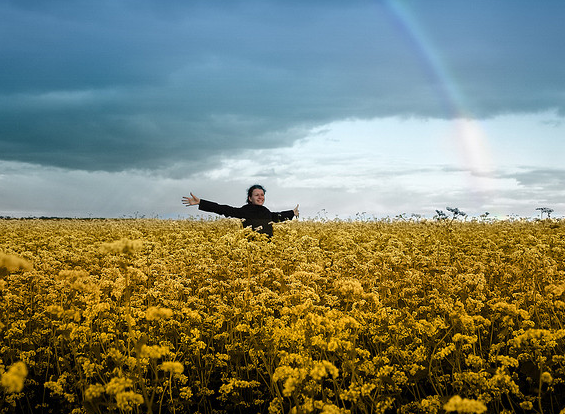
    She was dressed in head to toe yellow. Shirt, shorts, even yellow jelly sandals. This. was. my. daughter.

    She was all yellllllooo.

    I did not get what I wanted. I wanted to have a dinner party and announce that I was pregnant. I wanted to carry a child in my belly. I wanted to discover how the baby looked like me and how it looked like my husband.

    I didn’t have a dinner party. I didn’t carry her in my own belly. She doesn’t look a damn thing like us.

    But what I got? What I got was even better. I got a child that was meant to be ours.

    This baby was so meant to be ours that we couldn’t make it to the adoption agency until the third try because it wasn’t time yet. This baby was so meant to be ours she was wearing head-to-toe yellow when we met after I’d been singing “Yellow” to her for months.

    So yes, sometimes not getting what you want is a wonderful stroke of luck.

    I daresay when you don’t get what you want it is because there is something better on its way to you.

    Photo by egor.gribanov

  • 7 Steps to Prevent Getting Stuck in an Emotion

    7 Steps to Prevent Getting Stuck in an Emotion

    Stuck-In-Feelings

    “Life is a process of becoming. A combination of states we have to go through. Where people fail is that they wish to elect a state and remain in it. This is a kind of death.” ~Anais Nin

    I bought an ice cream cake for my family to thank them for giving me the time and space to write the first draft of my novel. My husband took photos. I selected my favorite shot as the wallpaper on my computer to remind me of this milestone.

    I was happy and joyous for a week. The second week I fell into despair—hard—and stayed there for months and months and months.

    I could not edit the novel I had completed and I could not start something new. I was stuck. A terminal sense of doom clouded my days and fogged over my nights.

    Eventually, I sought help from a counselor who specialized in treating creative people. Her diagnosis was grief. Some people go through the grief process when they complete a creative project, she explained.

    Apparently, I was one of those people.

    I had fallen into the trap of believing I could sustain the triumphant joy and deep satisfaction I had received upon completing the first draft of my novel and remain in those victorious feelings forever. When I couldn’t, I fell into depression and stayed there.

    I had experienced a kind of death.

    The counselor recommended that I allow the grieving to unfold naturally without force. That meant I had to give myself permission to be depressed. I had to sit with the feeling, day and night, and not wrestle with it.

    Weeks later, I finally emerged from the darkness of despair into the light of hope. I discovered the strength to edit my novel. When that was finished, I started looking for a publisher.

    I had experienced a kind of rebirth.

    Since that first bout of depression, I’ve written and published four books. Each time I finish the first draft, I grieve again. But over the years, I have learned how to process my feelings and create again.

    Here are seven simple steps to help you move through your emotions without getting stuck:

    1. Learn acceptance.

    Acknowledge what you are feeling without judgment. Offer yourself reassurance that it’s okay to feel whatever it is that you are feeling, no matter what anyone says or thinks.

    If you ignore what you’re feeling or pretend to feel something you don’t feel, the charade will prevent you from moving through the emotion. You will remain frozen in denial. The feeling will take hold and anchor you like a dead weight.

    By accepting what you feel when you feel it, you release the possibility of getting stuck.

    2. Practice patience.

    Some feelings last a few moments. Others last a few hours or a few days. Some feelings can last a whole year or longer.

    Let the feeling stay as long as it needs to; don’t force it to leave. It will only come back until it is done.

    3. Seek help early.

    It’s okay to seek help for dealing with a difficult emotion. If you find yourself overwhelmed, call a friend who can listen and offer advice or hire a professional who can provide expert insight.

    It’s better to get assistance as soon as you need it rather than waiting until you are stuck with an emotion you cannot release.

    4. Avoid self-medicating habits.

    Don’t try to mask the feeling. Drugs, alcohol, food, gambling, and shopping may temporarily relieve you from the pain of your emotion, but they will not solve your problem.

    Self-medicating habits create a labyrinth around your emotion. They offer the illusion of freedom while imprisoning you. Eventually, you’ll have to face what you are feeling head on without the benefit of an addiction to cushion the impact.

    By refusing to indulge in avenues of escape, you will learn the invaluable skill of self-reliance. You will grow confident in your ability to process your emotions quickly and efficiently no matter how joyful or painful they may be.

    5. Develop a routine.

    A consistent routine provides the foundation to build a life. Without it, chaos takes over. Feelings will either run rampant or hide in dormancy, both of which are unhealthy.

    Wake up at the same time every day. Schedule your meals. Go to sleep at the same time each night.

    Make sure you have quiet time for prayer, meditation, or reflection. Include hobbies on a regular basis. Spend time with your loved ones on a daily basis.

    The more structured your routine, the more likely your emotions will flow.

    6. Introduce something new.

    Once you have developed a routine, add something new. Boredom leads to apathy, which can encourage an emotion to take root and not let go.

    Variety leads to excitement. Trying something new keeps things fresh and alive.

    Take a class or join a club. Visit somewhere you have always wanted to go. Be adventurous.

    7. Honor the past, present, and future.

    Life is more than random moments. It’s a journey of self-discovery on a continuum of time. You can easily get stuck in an emotion by dwelling on the past or not paying attention to the present or worrying about the future.

    Embrace the whole spectrum of your life: the past with its history, the present with its immediacy, and the future with its potential.

    If you only think of the past, you’ll be stuck in the mire of what once was and miss out on what is going on all around you right now.

    If you focus only on the moment, you will neglect to remember the lessons you have learned through past experience and fail to pay attention to any future consequences. If you only dream of the future, you will become lost in fantasy without a compass to guide you there.

    By honoring the past, present, and future, you can truly live each moment to its fullest.

    Emotions are meant to come and go, not stay with you forever. By following these steps, you will train your mind and your body to process emotions in a healthy manner, leaving you free to explore the next chapter of your life.

    Photo by www.hansvink.nl

  • 3 Principles for Accepting Yourself and Being Authentically Happy

    3 Principles for Accepting Yourself and Being Authentically Happy

    Woman and the Sun

    “Happiness is really a deep harmonious inner satisfaction and approval.” ~Francis Wilshire

    It is only in the last few years of my life that I have felt genuinely happy and comfortable in my own skin.

    Until my early thirties the dominant feeling I carried around with me was one of extreme social awkwardness. Which is strange, because most people who knew me prior to that time would have described me as a confident guy who got on with just about everybody.

    I’m aware that outwardly I was very skilful at presenting a positive and socially pleasing demeanor, while on the inside feeling anxious and exhausted from keeping up the act.

    This wasn’t just at work or at parties, it was rife in my closest relationships too—with my friends, my family and, most bizarrely, with my fiancée.

    Perhaps the reason I was so well liked by so many is because I would agree with just about everything anyone said, so I was no bother to them. In disputes, I’d take both sides. I was always the first to offer a hand when someone needed help, but not because I felt charitable; I just wanted them to like me more.

    If I got angry or frustrated, which I did often, you would never have known it. You would have seen someone who appeared unflappable, regardless of the circumstances. If I was hurt, let down or disappointed, my lightening reflex was to smile and say, “That’s okay!”

    Somewhere along the line I had developed the philosophy that my happiness was dependent on the approval of others.

    This meant that my level of contentment was proportionate to how pleased I thought others were with me moment to moment. Of course, the problem was that I rarely thought they approved of me enough, so I was rarely happy.

    Now that I think about it, some of my earliest memories involve me trying extremely hard to be a “good boy,” to do what I was told, and how lonely it felt to fall out of favor with my parents.

    I never thought about what I wanted from life, only what would make others want to have me around.

    The ultimate price I paid was my authenticity, which I now know is fundamental to a truly satisfying and fulfilling life. Not only is authenticity vital for your relationships with others, but more importantly for your relationship with yourself.

    Isn’t it funny how the strategies we use to protect ourselves from our deepest fears are often the exact same strategies that manifest our fears into reality?

    One day my fiancée announced that our engagement was over. She said that she cared for me deeply but that she just didn’t know who I was; there was nothing real for her to connect to. I was devastated but not surprised. It was one of the worst and best days of my life.

    I walked away from our house taking nothing with me. I quit the job I hated with nothing else to go to. I was broke, lonely, and finally having to stare my exposed vulnerabilities in the face.

    Shortly afterward, I found myself walking along a beach contemplating suicide. Not because of the ending of the relationship, but because of the ending of my identity. I hated the mask I had been wearing and what it had cost me, but I didn’t know what to replace it with.

    Obviously, I didn’t take my life. Instead I moved to London. I was scared and confused but I was convinced that a new environment would be conducive to reinventing myself.

    I didn’t invent a new me. I found the real me.

    I read countless books on personal and spiritual growth, attended dozens of workshops, got coaching and training, and even began to write about and teach what I was learning. I started to feel more alive than I had ever felt before. For the first time in my life I was truly happy and being authentically me.

    I want to share with you three of the most important principles that I’ve learned about authentic happiness. I hope they inspired you.

    1. We live the feeling of our thinking.

    As William Shakespeare famously wrote, “Nothing is either good or bad but thinking makes it so.”

    Being authentically happy starts with the realization that you are both the source and the cause of your own well-being.

    We never get to experience the world as it really is; we only get to experience our thoughts about the world. It wasn’t actually other people’s disapproval that made me unhappy; it was my mistaken belief that happiness is something that comes from outside of me in the form of approval.

    Even when it looks as though your emotional state is being dictated by your circumstances, that is never true. Your thoughts are the root of your emotions. Just get curious and ask yourself, “If I weren’t thinking this way, how might I feel differently?”

    2. Everything good is inside.

    We each walk around with two versions of ourselves. One is our unconditioned self, which is innocent, flawless, and untouched by any trauma, criticism, or injustice we may have faced in life. The other is a learned self, more commonly known as the ego.

    The primary role of the ego is to separate you from the truth of who you really are—a human being who is already complete, whole, and mentally and spiritually healthy. The ego believes that happiness is attained through material success, achievement, striving, earning, and deserving. I’ve often heard it described as “everything good outside.”

    But your unconditioned self is the much bigger, wiser you. It already knows that you are what you seek; that real happiness is what naturally happens when you dare to show up unedited.

    All the happiness you have been looking for outside of you can finally be yours when you stop chasing and start choosing.

    3. Our relationship with ourselves determines our relationship with everything else.

    One of the standout moments on my journey of self-discovery was hearing Dr. Robert Holden say, “No amount of self-improvement can make up for any lack of self-acceptance.”

    Every time I had tried to improve the persona I was presenting to the world, I moved further away from the inner satisfaction I was seeking. As soon as I started treating myself with more kindness and compassion, everything in my life got better.

    The more we are willing to love ourselves, in all our messy glory, the less we go searching for happiness in the wrong places. When we are comforted by our own self-love, we no longer need to find comfort through external fixes.

    Forgiveness is key. Start by forgiving yourself for all the times you have allowed your ego block your joy. And understand that the only reason you need to forgive is to restore yourself to the authentically happy person you are here to be.

    Photo by Manuela

  • Two Lies We Learn as Kids That Keep Us Stuck and Unhappy

    Two Lies We Learn as Kids That Keep Us Stuck and Unhappy

    “You can only grow if you’re willing to feel awkward and uncomfortable when you try something new.” ~Brian Tracy

    With apologies to everyone who is from somewhere else or lived before 1776, we Americans want everyone to believe that we live in the greatest country in the history of humanity and that makes us the greatest humans beings ever.

    We even have data to back up our bravado: our GDP, the quantity of our millionaires and even billionaires, and our weapons power. We have more movie stars, more rock stars, and more celebrities who are celebrated for being celebrities than anybody. That’s right, by anything we choose to pay attention to, we’re the greatest.

    America certainly seems to be the land of achievement. So how did I get to be so lazy? It seems I have had an attraction to “low hanging fruit.”

    I am intrigued by solutions that come in the form of a pill. I want growth without the necessity of change. In short, I am a typical American.

    The fact is I am a product of my environment. I have spent my life being inundated by marketing messages telling me “you deserve it,” “do it the easy way,” and “lose weight while you sleep.”

    There seem to be such an abundance of easy solutions. Why on earth would I ever consider doing anything hard or time consuming?

    I had to turn lazy. I wasn’t born that way. Like everyone else, I came into this world with nothing but possibility. I had no notion of limitation. “Work” wasn’t a dirty word. In fact, I worked at everything with joy.

    Do you know I learned how to both walk and talk with no schooling whatsoever? True, Mom and Dad were encouraging. But I have a sneaking suspicion I would have figured it out anyway. I really wanted it.

    America, the Land of the Free

    As I got older, I formed a really bad habit: I began comparing myself to others. Were my grades as good as other kids my age or my siblings? Could I run as fast? Did I have as many friends? I developed an aching need for these things. I wanted this stuff and if I could get it on the cheap, so much the better. In fact, free was better yet.

    My world offered a lot of “free.” At least, they said it was free. But it wasn’t really. There was always an unspecified cost. I just started accumulating the debt of it.

    Since everyone else seemed to be amassing that same debt too it all felt normal. Normal was proclaimed by gifted marketers and copywriters as highly desirable. Who was I to argue?

    Being cool just came with drinking the right beer. Being refined came with wearing the right clothes. Being successful came with driving the right car. Never mind that I wasn’t even sure I liked beer. Fashion is such a moving target I secretly felt I would never grasp it. And cars, they just got more and more expensive.

    When did free become so hard and time consuming?

    Too Fast for My Own Good

    So I graduated from free to fast. Okay, I am now willing to pony up the bucks so long as it’s lickety-split. If a Porsche makes me instantly debonair, I’ll fork over the dough. Bring on the shortcuts!

    Years and years of this kind of reasoning saw millions of dollars run through my hands. But all of this stuff was consumable. It went away, washed down the drain, and wore out. Sure, I had fun. But what did I have to show for it?

    I will not discount the thrilling experiences, fond memories, and good times. But there was no permanence in this life of quick fixes.

    After many lessons (more than I care to admit) and much pondering, I started to turn the battleship that is my mind. Maybe counting the cost is a good idea. Maybe the purposeful expenditure of time is worthwhile. Those were the new theories anyway. So I determined to test them out.

    Something for Something and The Slow Fix

    What I discovered was that a mindful use of my time and resources created a new and bigger world. I built useful foundations that can take a beating and still stick around. I found that selfishness had too high of a price tag on it and that indolence just wasn’t worth it.

    These days I focus on abundance. The fact that there is a price for things makes them valuable. The requirement of time makes them precious. Abundance springs from a mindful investment in value.

    It is no longer about give and take; it is about giving and receiving. Taking requires no willing giver. In fact, it usually prods unwilling givers. But receiving requires cooperation, collaboration, and acceptance. It also draws these things. True giving cannot exist without true receiving and vice versa. It’s a package deal.

    All the money that washed over me and away is gone, but it wasn’t meant to stick. The money I encounter these days has a new adhesive quality unknown to me when I didn’t truly value it.

    I am older now. Arguably, I have less time left. But I don’t mind expending my shortening time for worthwhile things. After all, that is what time is built for.

    It turns out I can’t afford the phony promises of something for nothing and I don’t have time for quick fixes. From here on out it’s slow food, quality over discounts, and nothing free with strings attached. I am starting to suspect that this was the American Dream all along.

    Photo by Luz Adriana Villa A

  • 50 Ways to Open Your World to New Possibilities

    50 Ways to Open Your World to New Possibilities

    “To get something you never had, you have to do something you’ve never done.” ~Unknown

    Maybe you feel stuck. Or bored. Or frustrated. It’s not that you don’t like the life you live, it’s just that you suspect there’s something more. Some greater sense of meaning or excitement. New connections. New adventures. New possibilities.

    The truth is those possibilities are always within your reach. You may not be able to quit your job or develop new skills by osmosis, but every day contains within it countless opportunities, all dictated by the choices you make.

    Some of those choices may seem inconsequential when you face them. They’re the little things, after all. Why not do it how you usually do? Why not stay in your comfort zone when it’s just so comfortable there?

    Do it for the possibility. The possibility that if you make one minor change you may set the stage for major fulfillment. Sometimes even the smallest shift in thinking or doing can create the biggest opportunity. Here’s how to get started.

    Get Out of Your Head

    1. Challenge your beliefs about what you can and can’t do. Maybe you are a good leader. Maybe you can do hard things. Maybe you can change careers at your age.

    2. Challenge your ideas about how things should work. Sometimes when you decide how things should be you limit your ability to be effective in the world as it actually is.

    3. Have a vision session. Write in a journal, create a video, sketch—anything that lets you explore what excites you most.

    4. Look for opportunities in a tough situation. Avoid a victim mentality and opt instead for a “ready for new beginnings” attitude.

    5. Remove something from your life that doesn’t serve you to make room for something better and new. You never know what you might let in when you let something go.

    6. Commit to something you always say you’ll do but always fail to start—and then take the first step right now.

    7. Turn your focus from something don’t want to something you do want. This allows you to shift your energy from complaining to taking action.

    8. Replace negative thoughts with positive ones. Positive energy creates positive results.

    9. Identify the blocks that keep you from breaking a bad habit. Anytime you improve your habits, you pave the path for personal excellence.

    10. Forgive someone if you’ve been holding a grudge. Removing that block will open you up where previously you’d shut down.

    Get Out in the Open

    11. Walk to work and open your eyes. You may find a gym you want to join or an organization where you’d like to volunteer.

    12. Talk to someone while waiting in line and ask what they do. You don’t need to wait for a specified event to network.

    13. Make an effort to connect with people you pass—smile and make eye contact for a little longer than usual. Being even slightly more open can open up your world.

    14. Learn a new skill. Start taking piano lessons or karate classes.

    15. Say yes to something you always talk yourself out of—sing karaoke or take a kickboxing class, even if you’re afraid of you’ll feel embarrassed.

    16. Take a walking lunch. Walk around your neighborhood for a half-hour with no destination in mind, and then eat at your desk when you return. You never know what will happen when you get out without a plan.

    17. Volunteer at your local animal shelter or ASPCA chapter.

    18. Start something you always assumed it was too late to do. Take gymnastics, learn guitar. If it moves you, get started today. It’s never too late.

    19. Take up urban foraging—the act of foraging for “free” fruits and vegetables around your city (where harvesting is sanctioned). According to worldchanging.com, “It saves money (free food!), it reduces waste (all that fruit isn’t rotting on the ground) and it builds community (…by forcing interaction between strangers…).”

    20. Join an adventure club to try new activities, like white water rafting and rock climbing, and meet new people at the same time.

    Get in with People

    21. Offer to help someone else. Sometimes it’s the best way to help yourself, and not just for the warm fuzzy feeling it provides. You never know what you’ll learn through the process.

    22. Carpool to work. This gives you a chance to get to know coworkers better—good for socialization, and possibly good for your career.

    23. Compliment a stranger on something you notice. Everyone likes to be appreciated, and it’s a great way to start a conversation.

    24. Take pictures of things you find interesting that other people might not notice. When you’re trying to frame the smiley face of leftover food on your plate, people will naturally want to ask what you’re doing. (I know this from experience).

    25. Do something you enjoy alone. Go to a museum or read a book in the park. You’re more accessible when you’re not engulfed in a crowd, making it easier for new people to approach you.

    26. Wear an interesting T-shirt, something funny or nostalgic. You likely won’t get through a day wearing a Gem or Alf shirt with at least one conversation with someone new!

    27. Move one of your friends into a new pool. Take one from the “we keep things light and casual” pool into the “we share our dreams and confide each other” pool. Research shows people who have five or more close friends describe themselves as happy.

    28. Bring enough lunch to share with other people at work—particularly childhood favorites. Nothing bonds like shared nostalgia.

    29. Pay attention to other people’s body language and expressions so you can offer assistance when they seem to need it.

    30. Help someone else get out of their comfort zone. You just may set the precedent that you challenge each other in your friendship.

    Get Into Your Work

    31. Show up a half-hour early or leave thirty minutes late. You’ll get more done, you may impress your boss, and you might open yourself up to opportunities for growth, particularly if your coworkers aren’t around.

    32. Speak up in a meeting, even if you don’t feel confident or you’re afraid you’ll be embarrassed. Your ideas can only take shape if you put them out there.

    33. Hold your meeting outside. People work and engage differently in new environments, particularly when they can feel sunlight on their faces.

    34. Hold a meeting standing up. This will most likely make it shorter, meaning you’ll be more efficient and create more time to work on something else.

    35. Create a business card that speaks to what really matters to you, like Meng Tan’s “jolly good fellow” card.

    36. Start learning a new language. The more people you can communicate with, the more valuable you become, particularly for work that involves traveling abroad.

    37. If you don’t work in your dream industry, volunteer within it. This allows you to be your purpose now, even though you don’t have the job; gain experience; and make valuable connections.

    38. Find a mentor. Ask someone who does what you’d like to do for tips.

    39. Attend a networking event or conference that’s big in your industry. Collect at least ten business cards, and follow up with emails the next day.

    40. Consider one of these creative ways to turn everyday situations into opportunities.

    Get Caught in the Web

    41. Check the Craigslist Community section for activities, events, and classes—and then send at least three emails today. Don’t wait.

    42. Start a group at Meetup.com to connect with like-minded people, or join one that already exists.

    43. Ask on Twitter if anyone can offer you tips to move forward with your dream.

    44. Learn to cook one tweet at a time. @cookbook tweets entire recipes and instructions in 140 characters each.

    45. Learn how to do anything that interests you on eHow, Instructables, or wikiHow.

    46. Have a “friend trade” day on Facebook. Introduce your friends to one of yours, and ask them to do the same.

    47. If you blog, find other bloggers in your niche and email them to introduce yourself.

    48. Search WeFollow.com to find the most influential people in your niche, then initiate contact them through Twitter or email.

    49. Become a host on Airbnb if you have a room to rent; it’s a great way to meet new people and earn a little extra cash!

    50. Join the TinyBuddha forums to seek help and help others who need it. (Or subscribe to tinybuddha.com for more tips to live out loud!)

    There’s a lot of information here—way more than you can tackle all at once. But it’s more about quality than quantity. Even just one small change can have a ripple effect into every area of your life. Of course it’s up to you to decide what’s possible.

    How do you open your world to new possibilities?

  • The Hunger for More: What We Really Want and Need

    The Hunger for More: What We Really Want and Need

    Screen shot 2013-04-24 at 10.19.02 AM

    “Instead of complaining that the rose bush is full of thorns, be happy the thorn bush has roses.” ~Proverb

    As a child, I was obsessed with other worlds—reading about alien planets, writing fantasy stories, or just playing video games. As a teenager, I longed to know as much as possible— who we were, why we are here, the meaning of life.

    Later on, I started traveling. There was so much to see, so much to do, so many ways to look at the world. I wanted to see it all, touch it all, experience it all.

    This need for more has existed throughout my life in its many forms, and I can thank it for always driving me to do great, exciting things. But at the same time, it has never allowed me to stay still, to just enjoy myself the way so many people seem to.

    When I ignore this feeling, it starts gnawing away at me from the inside. It tells me that I am not doing enough, that I’m lazy, a time-waster. Some would call the feeling a feeling of becoming stir-crazy, cabin fever, ennui.

    I look at it as a hunger. When I ignore that hunger, when I stop traveling or learning or creating or just doing, the weight of the world piles up on me and life suddenly feels like a suffocating, restricting place.

    If I continue to ignore it, I tend to slip into depression or sadness; the smallest of stresses will bring me to tears.

    But what is that hunger? Do we all have it, to some degree? Without the human desire for knowledge and development, we might all still be living in caves.

    Without it, we wouldn’t have medical and technological developments, and we wouldn’t have art or poetry, perhaps. But on the other hand, we might not have war, hatred, and greed.

    That hunger takes different forms depending on how it is channelled.

    Given the right circumstances, we get creativity, ambition, and invention. Given the wrong ones, we get that dark, burning need to amass more and more money and power—that greed that can be seen in so many people throughout our history.

    We often try feeding that hunger with money, power, knowledge, creative output, food, sex, or drugs. We desperately try everything to fill that void, apart from what we really need.

    Four years ago, when I was on the verge of depression, a friend suggested that I try mindfulness. In short, the art of being in the here and now, of focusing on the senses instead of the thoughts, and of looking at thoughts objectively.

    It took a while, but what my most successful moments of mindfulness showed me is that it is possible to be still, to absorb a moment fully, without that restlessness, that hunger, starting to tap its foot and demand to know what on earth I think I’m doing.

    Quieting the nagging voice in my head has become an art of its own, now.

    The most powerful moments are found walking through nature, just listening to the variety of bird song, or feeling the ancient strength of a tree against my back.

    In those moments, another, older feeling comes to me. That feeling is of being one; one with myself, one with nature, one with everything. The flowers, the trees and the birds are just a part of it.

    In the heart of a forest I realize something so true, so powerful, that it brings tears to my eyes.

    We are animals. We are part of the earth, just as any animal or plant is. Somewhere along the line, we evolved to crave more, to be aware of our surroundings, and to think about ways to improve it. That craving brought us the modern comforts that we know now, but it also brought with it a world of suffering.

    In our haste to become more, to know and to create, we also felt that it was our destiny to conquer not only each other, but also nature. But this very act of cutting ourselves off from our roots has had disastrous consequences for many.

    Most of us crave companionship, whether we seek it by clinging to romantic partners or through a string of disconnected, drunken nights. We are addicted to social networking, perhaps not because of the technology itself but because it substitutes for that feeling of oneness, of connection, that we have lost.

    We, in the developing world, are starving ourselves. This fast-paced, technology-based life, focused only on the acquiring of money and status is a twisted manifestation of a hunger that exists deep down in every one of us.

    But what that hunger really is, what that calling inside us really is, is a call back to oneness, to our roots, which we ignore.

    One way to describe it is that we all have souls, and that our souls are connected to the earth and everything on it. Or, you could say, every atom in your body was once part of something else on this earth, and will be again.

    Without nature, we cannot eat or breathe, and yet we lock ourselves up in man-made cubicles and unquestioningly buy food from packets.

    We also need to connect to each other. We might seem to connect online, but it is at the cost of face-to-face interaction, which is far better for us.

    It worries me to see children glued to phones and games, ignoring the people around them. If we aren’t even teaching people to connect to each other and to their world, then there’s little wonder that so many people are unhappy.

    Ironically, people slave away unhappily so that, one day, they can relax in the countryside or on the beach. That retirement dream might be nothing more than recognition that we need to surround ourselves with a more natural environment, not in some distant future but right now.

    I’m not saying that we should abandon all human progress and go back to living in caves. Some inventions have saved lives and made it possible for us to live much longer and healthier lives. However, we need to look at the mental health problem we’re facing and consider all other possibilities before throwing drugs at people.

    Nature therapy and mindfulness are growing industries, and have been shown to treat everything from substance abuse to depression and anxiety.

    You can see the effects yourself; just sit in a park and close your eyes, listening to the birds or the running water. Turn off your phone and let yourself just BE.

    Recognize that you were created by nature; that you are part of it and it is part of you. I have been so much happier since I honoured this core part of myself, and I want to share it with everyone.

    I believe the hunger is a calling—a calling back to where we came from. We are each one tiny part of a massive picture, and when we disconnect ourselves from it we are denying ourselves the beautiful, meaningful feeling that comes from recognizing that we are all part of the same amazing world.

    Photo by notsogoodphotography

  • 3 Ways to Redesign Your Life by Shedding the Excess

    3 Ways to Redesign Your Life by Shedding the Excess

    “Don’t let your happiness depend on something you may lose.” ~C.S. Lewis

    For as long as I can remember, “more” has always been better, but the word “more” is no longer what it used to be.

    Five years ago, I started exercising for the first time in my life. At first, I counted down the minutes until my workout was over. As I got stronger, though, I started staying at the gym longer and longer.

    For a while, I burned more calories than I consumed during meals. It didn’t matter. I worked out as much as I could because I liked the effects it had on my body and mind. I felt healthy and vibrantly energetic.

    But I hardly had time for much more in my life.

    I was burnt out. Some of my other favorite activities—like reading or making plans with friends—took a backseat to putting in hours at the gym. But working out in less time scared me, as silly as that sounds now. Would less time in the gym slow down my health and energy level? Would I lose momentum?

    When my loved ones started complaining, I knew I had to make a change.

    I found I could do more with less at the gym. I found that my body appreciated the extra rest more than I ever expected. I found that, by finding a balance, my life felt more at ease.

    Over time, I discovered that in many areas of my life, less is more. Carrying the excess of my life felt like pulling around a parachute, making every step more strained.

    Focusing on the necessary, on the positive, on the essential may grant you the freedom you desire. Here are three areas in your life you can redesign:

    1. Your Relationships

    Growing up, my friends and I counted and compared how many toys we had, how many books we read, how many good grades we achieved. Only now, decades later, have I dropped that habit of thinking “more” is better.

    When I quit my job and started my own business, I never thought that my biggest obstacle would be the people I chose to accompany me on that path. Once I hit that roadblock, it took great courage to cut the ties that were holding me back.

    The people we come across and spend time with become a part of our lives. That doesn’t mean they necessarily should. It’s up to you to choose.

    Jim Rohn once said, “You are the average of the five people you spend the most time with.” If that is true, could your relationships serve you better? If you could choose, what kind of people would you surround yourself with?

    2. Your Material Goods

    Someone once told me, “The fastest way to get a pay raise is to spend less money.”

    Quitting my job last year meant watching how I spent money. This was a blessing in disguise.

    Every single time I browsed the web for a beautiful new handbag, I stopped myself, thinking: “What am I trying to find in this handbag? What am I looking to feel by buying this?”

    Over time, this spread to the material goods I already have, not just the ones I hoped to purchase. I gave away some things that would be more useful to people in need. Living in a third-world country made that process easier, giving me a chance to give back to the communities around me.

    The items we hold around us pile up over time, but the purpose of that is not always clear. What are you looking for within those items: happiness, status, or is it something else?

    If you are interested in living a life with less stress, try asking yourself why you hold dear the possessions around you.

    3. Your Expectations

    For much of my life, I gave in to my emotions. With a blindfold over my eyes, I stumbled through life at the whim of my mood swings.

    Very often, I spent my days feeling angry, jealous, or doubtful. I was unaware of the reason behind these emotions. I let them run free, untethered inside my heart and mind.

    Until someone introduced me to a book called Man’s Search For Meaning by Viktor E. Frankl.

    In his book, he writes:

    “A man’s suffering is similar to the behavior of gas. If a certain quantity of gas is pumped into an empty chamber, it will fill the chamber completely and evenly, no matter how big the chamber. Thus, suffering completely fills the human soul and conscious mind.”

    Whether the situation is big or small, every single person decides just how much to suffer for it. When faced with the same situation, each of us decides just how to frame and feel that situation.

    The biggest reason I let my emotions run wild was because I was not aware of my expectations. I imagined life to be a certain way, and I was torn when reality didn’t match up.

    Wiping my mind clean of how life should play out, I allow myself to accept each moment as it comes, for better or for worse. The calm I feel at shedding expectations is extraordinary.

    When I set out to redesign my life— quitting my job, starting my own mini-business, spending more time writing—I never thought I would also start a quest to shed many parts of my life.

    None of this is easy, but it is worth it. I grapple with it everyday, but that grappling makes all the difference.

    Are you looking to redesign your life? Share your stories in the comments.

    Photo by The Green Party

  • Dare to Live: 10 Unconventional Ways to Be True to Yourself

    Dare to Live: 10 Unconventional Ways to Be True to Yourself

    Smiling

    “It takes courage to grow up and become who you really are.” ~E.E.Cummings

    Have you ever had a clear sign of who you really are and then totally ignored it?

    Maybe it required too much change or taking a big risk. Maybe you were scared to have to convince a loved one how much you needed this. And so you rationalized that “it wasn’t the right time.” Convinced yourself to “be sensible and put it off for a while.” I know how this feels, because I did it too.

    I was twenty-one then, and in my third year of medical school. We were in one of our first psychiatry classes, and the professor was demonstrating to us a patient with conversion disorder.

    I was hooked. In no other class had I been so completely absorbed. I fell in love with a big thud, reading everything I could on neuroscience and the brain.

    Although exhilarating, in my mind, this was also a disaster.

    You see, my dad was (and still is) a prominent eye surgeon who owned several hospitals and had been waiting to hand over his empire to me. My falling in love with psychiatry wasn’t part of this plan.

    I was raised in a culture where kids obeyed their parents. No questions asked. Even more so if you are the first born; added points if you were female. Unluckily, I was both. And so I ignored the sign and buried my desires.

    Then, tragedy hit and my mother unexpectedly died. And just like that, life was turned topsy turvy.

    That’s when I realized that planning to fulfill obligations first and then chase dreams is an illusion. Even the heady immortality of youth is sobered by meeting death up close. I developed this urgent, almost desperate need to be fully alive and true to myself in the time I had left on this earth.

    It has been more than ten years now since I took the plunge. I have become a board certified psychiatrist in the U.S, my siblings have grown and my dad and I have made up.

    But I would not have changed this journey, difficult as it was in some ways, even if I had the chance. Because it taught me, through trial and lots of errors, how to become real.

    Everyone’s journey is unique. And so this is in no way a generic prescription. These things happened to work for me and I share them with the hope that some may help you in your travels as well.

    1. Cherish those special friendships.

    I had (and still have) friends who knew and loved me unconditionally. This is truly invaluable. Make and keep good friends and be honest with them. They can be your moral compass during stormy times. Not just psychologically, but literally, like in share-her-last-sandwich-while-reading-poetry-on-long-afternoons kind of support.

    2. Don’t hate those who stumble; we all do sometimes.

    It would have been so easy, and actually it was, to hate my dad for a while. But as time passed, I was able to see his side too. This guy was so poor while growing up that he had only one meal a day and wore torn rags to school.

    He had to sneak to elementary classes from his day job herding sheep. From there, he had risen to be one of the top surgeons in the country and built an empire. Me rejecting it felt personal, like I was rejecting him.

    We all make mistakes. It’s part of being human. If you can, forgive and allow compassion into your relationships. It makes the ride more beautiful.

    3. Take responsibility for your own life.

    This is the beginning of self-esteem. Although stuff happens, ultimately you are responsible for your actions.

    When we deeply and utterly understand that to be true, life takes on a whole new meaning. Whatever has happened until the past moment is gone. This present moment is again yours. And you have the power to do whatever you want with it.

    4. Have a big vision and keep your goals aligned with your vision.

    I struggled with this one for a while. First, I had no big vision. In fact, I didn’t even know what that meant. So my goals and actions went in circles for a while.

    Make sure to know what kind of person you want to be and what kind of job/life you would like to lead. Then shape your short-term goals so it is moving you in that direction (or at least not away from it).

    5. Remember that death makes life real.

    In the words of Steve Jobs, “Remembering that you are going to die is the best way I know to avoid the trap of thinking you have something to lose. You are already naked. There is no reason not to follow your heart.”

    Death can come at any moment, to any of us. We don’t have forever to be who we are. In fact, we owe it to ourselves and those we love to be truly alive and authentic in each moment. It is the only legacy we can be proud to leave behind.

    6. Don’t worry too much about making mistakes.

    It is better to have tried and failed than to not have tried at all. Think and analyze your decisions carefully, but once you feel reasonably sure you have made a good choice, just trust yourself. Be bold and go forth into the wilderness.

    Whatever happens, you will have gained an experience from it that only the courageous can boast of.

    7. Know your strengths.

    You are unique. There is only one you in this entire universe. No one has exactly your strange and magical mix of genes and experience. Learn what makes you tick. And keep building on that. You will make wonderful things happen.

    8. Be kind to yourself.

    We all mess up once in a while. When it happens and you finally catch on, drop your ego, admit your mistake fully, and make amends. Learn from it so you don’t repeat that same lesson again. Then forgive yourself and move on. Life is hard and we are not made to be perfect.

    9. Be in the moment.

    This present moment is alive and full of potential. Learning to be mindful has helped me tremendously by keeping me in my life, as it happens.

    Whether you are playing, sleeping, working, lazing, watching TV, or hanging out with someone you love, give your awareness to it 100%. I highly recommend a daily mindfulness practice. It has changed the way I relate to life.

    10. Don’t forget to laugh.

    It has gotten me through many a sticky situation. And created hours of pure fun. Include as much good humor in your day as legally possible. And that’s a doctor’s order. 🙂

    So dear readers and future friends, don’t wait to be who you are. You are special and there is a reason you are on this earth. No matter what your situation is, there is something you can do today to move toward your true self.

    Dare to live; your dreams are counting on you.

    Photo by Mourner

  • 3 Small Steps Toward Rebuilding Your Confidence

    3 Small Steps Toward Rebuilding Your Confidence

    jumping

     “Trust yourself. You know more than you think you do.” ~Benjamin Spock

    My confidence is a delicate thing. I’ve had more disturbances in my life than I’ve had reassurances, a handful of betrayals, and enough playground cruelty to last me until the day I die.

    I am still living with some difficult health conditions that I wake up and go to bed with every day, with no respite. I’m an introvert to the core, no matter how eloquent I am with the written word, or articulate with the spoken word.

    Some of us are more fragile than others, but that’s okay.

    I’ve been running on empty in the confidence department since some life events I’ve had no control over. I lost a friendship months ago, which still hurts. It was rejection in its most potent form, and being rejected is the main thing that makes me question myself, and doubt my thoughts and feelings.

    My mother died five years ago and I never got the chance to patch things up with her. It’s a real kick in the teeth, the guilt.

    It lowered my confidence in being able to manage difficult relationships, any relationships, effectively, and it could prevent me from developing relationships to begin with. I always think I could have done better in the past, which means what I did was insufficient. I am insufficient.

    I’ve been going it alone with my novel for nearly two years. Since finishing my studies, I’ve lost the intellectual connections that I thrived on. Self-depreciation runs wild, and I find myself struggling with my book and resenting the resources I no longer have access to.

    Without them, I am nothing. At least that’s how it sometimes feels. But I know it’s not true. 

    Life is all about the change–big and small; epic and unseen; incredible and horrific. Confidence crumbles when we start to reinforce feelings of uncertainty and insecurity.

    The more we believe those empty feelings in our guts, the harder it becomes to go through life with all systems running normal.

    And then our version of “normal” becomes undermined, we start questioning ourselves in everyday situations: Do I slouch? Maybe it’s better that I don’t bother my boss with a new idea I’ve had; I’ll take a different route on my jog today because the one I usually take involves jogging with other people who are pros.

    These may seem like little things but they’re symptoms of bigger issues—the lacking foundation of your confidence. Have you had enough yet?

    I have.

    I’m not super brave by the way. The thought of following through with the ideas I’m about to propose to you all is making my stomach turn. But I’m willing to work at it to increase my self-esteem.

    Three things. Three easy things that we can all do to start rebuilding our confidence and have that sense of belonging again, that feeling of “Yes. I am worthwhile and capable.” Ready? It’s okay to feel nervous; I’m feeling that and more. Here we go:

    1. Ask for help.

    I did this earlier today by emailing my mentor and telling her that I was struggling. I took a risk and expected to be rejected or ignored. Instead, I got an email back within hours (which is remarkable for full-time lecturers at the best of times) with exactly what I needed to hear to reassure me that I not only can I write, but also that I should be writing.

    Asking for someone’s help isn’t easy and it takes a lot of courage to reach out, but give it a try. If you’re finding a project at work more than a handful, get some fresh perspective from a colleague.

    Not everyone is going to reject you. 

    2. Educate yourself and share what you’ve learned. 

    I find that the root of my confidence is in my perception and knowledge of the world around me.

    Through reading, we come to know and understand so much: emotions, current events, culture, scientific developments, relationships; ourselves. By picking up a book, magazine, journal, or newspaper we absorb the world and are better equipped to engage with it. And after we’ve read about something, we may feel motivated to apply and share what we’ve learned.

    What can be more confidence-boosting than reading about a new recipe and then sharing it with a friend who’s bored to death with their evening meals? Or instead of sitting in silence as your mates discuss the intricacies of the financial problems we all face, you find yourself joining in and providing valuable perspectives.

    Through learning and applying your new ideas, you’re connecting with others and the world. 

    3. Take time to appreciate your successes.

    You need to develop a certain level of pig-headedness in order to make the feelings of assurance and satisfaction stick.

    Even though I am looking at material I have written for my novel so far and despairing at it, I have to sit back every twenty minutes or so and say to myself “Sam. Darling. You may be having structural issues, your ambition may be a bit much to handle all at once, but damn, have you read that last paragraph? That is sizzling. And it came naturally…”

    Whenever you have that “yes” moment, like landing that job you didn’t expect to have a shot at, don’t slip into old thinking patterns; don’t beat yourself up with old worries. Prepare for new opportunities in the knowledge that you have the skills you need, the capacity to learn, and the drive to seek out new and fulfilling things.

    It’s your confidence. Own it.

    Rebuilding your confidence isn’t easy. I don’t expect to have myself up and running again for a while but if I can put my own ideas into practice, even on a minimal scale, a couple of times a week, I will regain the things that I have lost through hard times and hurt feelings.

    Dare I say I’m confident that you will too?

    Photo by heather aitken

  • Motivate Yourself Without Pushing Yourself: Tips for Self-Compassion

    Motivate Yourself Without Pushing Yourself: Tips for Self-Compassion

    Happy

    “Our sorrows and wounds are only healed when we touch them with compassion.” ~Buddha

    I have always struggled with self-compassion. In fact, I’m not even sure I have been aware of it all that much throughout my life.

    I’ve always thought the only way to truly grow was to push myself, both physically and mentally, so without even realizing it, I set myself up for that.

    I would not study for my university exams until the night before. I would take it easy and not make enough money until it got to the stage that I had to almost create a miracle to pay my next credit card bill. I would push my partner until our relationship was at a breaking point so I could then save it.

    It was almost like I wanted to prove to myself that I was a hero in someway. As I reflect back now, it was so strange what I was doing, but the truth was I was not even aware I was doing it.

    Over the past few years I could see my patterns more and more. It shocked me that I would be that unconscious of my motivations.

    But as I dived into it, I could see that I actually had a fear that I’d somehow be less if I took that pressure off myself. It was the pressure that was keeping me motivated and more importantly keeping me growing.

    I wondered if I had to continue like that. What would happen if I let it go? Would I stop being as great as I could be?

    Then I became aware of self-compassion. It was a foreign concept to me, and one I remember fighting against for some time. My ego did not want to just give in that easy!

    At first I felt that I would become more self centered, and that was big no-no—after all, aren’t we all here to serve others, not ourselves?

    But then I started see what my lack of self-compassion was really doing to me. It was, in fact, the very thing that was isolating me from the world and making me self-centered.

    I was so caught up in my own struggles and issues that I had begun to feel that I was the only one on the planet going through what I was.

    I had forgotten that all my friends were feeling the same way as me; they too were struggling in life, and I had not seen it. My issues were not greater than everyone else’s, after all.

    As I saw this more clearly I felt myself soften to compassion for myself, and those around me. I started to “feel” compassion for the first time.

    I recall pondering one day, how I would feel in a relationship if I treated my partner or child in the same way I had been treating myself? Would I really be that motivated to keep going each day?

    The never-ending berating and judgments, constantly trying to fix, change, or improve myself, never being enough. How motivated can you stay under such conditions?

    I would have never expected anyone to respond positively to this, but yet I expected myself to. Something was very wrong with my perception of myself.

    It was at that moment that my belief structure started to collapse on itself, and I realized that I did not have to be that hard on myself for motivation. I could actually be kind and it would have an even greater effect.

    Bit by bit, I felt self-acceptance, and a love came over me like waves, like it had been wanting to come through for so many years, but I had blocked it.

    All I had been looking for was sweeping over me in one giant gush. It felt amazing and it felt true. I knew that I’m okay the way I am.

    I suddenly felt a common bond with humanity again. Like we are all perfect in our imperfect way, and that is actually what it’s meant to be like.

    I realized that I do not have to get everything right everytime. I do not have to be changed or improved; I just need to accept who I am right now.

    The pain and sorrow I had been feeling my whole life rose up, and I could clearly see what I had done to myself for decades. I was sorry for this, so very sorry.

    I broke down and cried and cried. I had been so mean to myself. The pain and struggles of the last few decades came pouring out of me like the dam gates had been opened.

    I felt relief for the first time. I could not do this any longer; there was simply no need. I had done nothing wrong by just being me.

    This was one of the most significant moments in my life—the acceptance of myself through self-compassion.

    My tips to create more self-compassion include:

    1. Be aware if you are being hard on yourself and recognize where this shows up for you.

    It can be subtle. Look at all life areas, including your health, finances, and relationships, at work and in your family.

    2. Challenge your beliefs and fears. 

    Do you have a belief that if you are gentle with yourself you will somehow not be motivated enough or not all you can be? Recognize that this doesn’t have to be true. Also, notice if you feel that being compassionate toward yourself will lead you to feel self-indulgent or selfish.

    3. Treat yourself kindly, without judgment.

    Picture your best friend and how you treat them. Now apply this same love and kindness to yourself. You should be your own best friend after all!

    4. Be mindful of when you slip out of compassion and start to treat yourself harshly again.

    Forgive yourself and understand that you are human and this is part of the human game.

    5. Feel the pain of others around you.

    Listen to their stories and feel what it must be like to be them. This will make you automatically feel compassion and be softer on yourself as you connect with their common humanity.

    We all have issues and problems that cause us pain, but suffering through them is optional. Self-compassion provides another option.

    Photo by JFXie

  • Reconnect with Your Authentic Self Instead of Denying Your Feelings

    Reconnect with Your Authentic Self Instead of Denying Your Feelings

    “I have just three things to teach: simplicity, patience, compassion. These three are your greatest treasures.” ~Lao Tzu

    I recently took seven weeks off of work and rented a place in Laguna Beach.

    The trip was meant to be a relaxing vacation and possibly a change of residence; it turned out to be a wakeup call.

    I started the trip out by going on my first date since 2010. The pollen count was high, and my sinuses were none too happy. I’m still not sure if it was being on a date or the medication that triggered so much anxiety; maybe it was a combination of both.

    Later that evening, as I replayed the day in my mind, old insecurities came to the surface. That feeling of not being good enough engulfed my being.

    I just smiled, shook my head, and thought to myself, “Really? Does this still ring true for you?”

    The answer was no. But it still came up, so I had to explore it further. So I spent the next two and a half weeks in a battle with the Southern California Pollen Count and my inner self-worth issues.

    Most of my life had been controlled by an underlying sense of anxiety.

    In my teen years and throughout most of my twenties, I numbed it with drugs and alcohol. In 2005, after I celebrated my first year of sobriety, I started to really explore this feeling. I signed up for hundreds of newsletters, spent many hours in the Dana Point Library, and purchased over 100 books that year alone.

    I read, listened, and put into practice anything that came across my path.

    The movie “The Secret” spoke to part of me, and books from Deepak Chopra, Ester and Jerry Hicks, and countless others made me temporarily feel as if it were going to be okay.

    I wanted so badly to just be happy, to be able to really look into the mirror and like what I saw.

    By April 2009, I thought I had it all figured out. My goal-setting exercises were bringing my desires to fruition, my body was as healthy as it has ever been, and my love life was what I had always dreamed it would be.

    A few months later it all fell apart. I found myself again back to square one. It didn’t make sense and all I wanted was to know was: What part of this equation was missing?

    My mission to figure it out was renewed, and the way my life has unfolded since has been a long, strange trip indeed.

    Looking back at my self-education is partially humorous and equally frustrating.

    I now find it humorous that I worked so hard to “fix” something that wasn’t actually broken.

    I find it a bit frustrating to have consumed so much information that perpetuated this seemingly endless cycle of self-help stupidity.

    Two very popular self-help ideals come to my mind.

    1. “You just have to be positive.”

    This may be worst thing you can say to someone who is depressed and sees no way out of it.

    You read books on “how to attract everything you ever want in life.” You understand that positive thinking leads to positive results. Just when you start making progress, something happens and you feel frustrated or angry.

    You find yourself upset at yourself for being upset. You think, “Why can’t I just be happy? What’s wrong with me?” The depression deepens.

    Listen, you don’t have to be positive all the time.

    It’s okay if you get upset or don’t feel happy every waking moment.

    Before you can cultivate a positive mindset, you must first honor where you are and the journey that brought you here. Our general outlook on life is a mixture of genetics and experience. Some reactions are very deeply engrained and will take a concentrated effort over time to change.

    You’re not broken if you can’t see the silver lining, which is why this next bit of wisdom needs another look.

    2. “Just fake it until you make it.”

    It’s a catchy saying, but horrible advice.

    The feelings you have present in your life are valid. The act of faking it is an act of denial, which can have some really negative effects on your psyche.

    You can’t fake your way out of sadness and depression.

    You can put on a happy face, and to some degree it will change your mood. But, during those times when you take away distractions and you have to sit alone with yourself, the act of faking it will make you feel like you’re crawling out of your own skin.

    I didn’t realize that faking it perpetuated anxiety.

    Being really comfortable with myself didn’t actually happen until I began to just sit still on a regular basis.

    At first it was overwhelming; anxiety turned to frustration, to anger and rage, and finally to shame. I felt cracked wide open, exposed and raw.

    The feeling really sucked and it lasted for almost six months.

    But I sat with it. I owned it, and in that space of raw vulnerability I stopped faking it. For the first time in my life it felt okay to be me.

    There is a real power in authenticity.

    It is an act of love to honor where you are right now.

    From my experience with sitting in my own stuff came my life as a writer. My first book followed and my newsletter audience grew.

    Yet, with all that I’ve studied and think I know I still found myself experiencing that old worn out feeling of “you’re just not ever going to be enough.”

    So, how did I find myself in Laguna Beach overwhelmed and feeling less than worthy of love and affection?

    Well, that was actually pretty easy for me to discover. You see, I’m an avid note taker and list maker. It only took a few hours to sort through my 2012 notes to see that I had only half been walking my talk.

    My practice of meditation had taken a backseat to my “trying to achieve things.”

    My practice of mindfulness had eroded; evening meals were consumed along with DVDs and Facebook noise-feeds.

    Three months of sunsets went unseen.

    My reverence for the present moment had once again been lost while my mind searched for fulfillment in the future; the result of which was the rise of my existential anxiety.

    A Simple Plan to Reconnect with Your Authentic Self

    • Still your body and mind. Commit to just five minutes of meditation and build your practice from there.
    • Maintain focused attention on your breathing and honor the task at hand.
    • Witness your reactions to get to the core reasons behind your emotional response.
    • Take time each evening to write down little moments of gratitude, love, and awe that happened throughout your day.
    • Remind yourself that you have nowhere else to be other than where you are right now.

    From my experience thus far the first part of the plan is the most powerful; science backs up that claim. That’s why I am building my daily sitting meditation.

    My dream is to see more authenticity in this world.

    My belief is that this will lead to more compassion, which in turn will lead to more change.

    How about you? Want to change the world too?

    Then please join me by spending just a little bit of time doing absolutely nothing, every day for the rest of your life.

    Who’s in!? Tell me you’re with me!

    Photo by sierragoddess

  • Letting Go of Your Past Suffering to Feel Peaceful and Free

    Letting Go of Your Past Suffering to Feel Peaceful and Free

    “Letting go give us freedom, and freedom is the only condition for happiness.” ~Thich Nhat Hanh

    I stood alone in what had been my childhood bedroom, staring at the dresser with a familiar discomfort. My fingers clutched at the handle of the second drawer from the top and pulled hard, straining from the weight of its contents.

    I reached in with both hands, the drawer with its quarter inch plywood base teetering dangerously on the edge of the frame, and lifted them out, one by one.

    Unicorns, fairies, rainbows, mystical maidens, all disappeared as I placed the journals into the cardboard box I’d asked my mother to bring to me.

    She watched wordlessly as I carried it through the house and to the front door, then said simply, “I have to say, I’m not sorry to see those go.”

    In that moment, my mother was keenly aware of something that had eluded me for most of my life. And now, at the age of 28, I was ready to let go of something I had always been attached to, something that had caused me so much pain throughout all of the years I had been writing in those journals: my former self.

    Writing has always come naturally to me. As an only child and a classic introvert, I found it far less intimidating to share my thoughts with a blank sheet of paper than with another human being. 

    I began to journal actively at the age of twelve, filling page after page each night with my tales of prepubescent woe.

    I continued this practice until I was halfway through college, dedicating over a dozen spiral-bound volumes to a verbose body of work seeking to prove my hypothesis that my existence was pointless and that nobody loved me.

    My writing habit was far more destructive than therapeutic. It was much easier to validate my own negative emotions than it was to challenge my perceptions, ask others for help, or work to make meaningful changes in my life.

    The more I wrote about my problems, the more I allowed them to consume me. My suffering became my identity, and I didn’t know who I was anymore without it. 

    During high school, I sunk into depression and surrounded myself with other deeply unhappy people. For four years, we alternated between bonding over how miserable we all were and turning against each other in predictable cycles of emotional manipulation and abuse.

    Every night, I sat alone in my room committing all of the day’s events to paper. I chose to not only relive these painful experiences, but to continually remind myself of them.

    Mercifully, high school is designed to end. When it finally did, I cut off connections to my high school friends, but the shame that had allowed me to form those friendships followed me to college.

    It graduated with me, accompanied me to work every morning, and multiplied exponentially after the end of my first long-term relationship at the age of 25.

    It would take three years of therapy and endless support from the loving souls I now choose to surround myself with for me to realize just how much of my own suffering I have caused.

    For the better part of my life, I have chosen to view the world through a negative lens. I have resigned myself to feeling like a victim of my circumstances, instead of applying that energy to changing my perception of them.

    That night, I carried the box of journals home with me, ripped the pages from their bindings, and fed them to my shredder in small digestible stacks. I forced myself to avoid the temptation of rereading what I had written, and returning to the past.

    Watching the brightly colored words slowly disappear between the blades, I felt no remorse, only a deep sense of freedom. Ten years of writing filled four garbage bags, and their last measurable impact on me was the trip I had to take to the dumpster.

    It took me 28 years to release the attachment I felt to my journals, but I’d like to share what I learned from the process:

    Release the judgment you feel toward who you were in the past. 

    I no longer judge the young girl who worked so hard to define herself on the pages of those journals. I wish I could write to her now and tell her that she is loved, and that she does not have to wait for things to get better—that she already has everything she needs to be happy.

    I wish I could show her all that she has to be grateful for, and tell her that I am proud of who she is, and who she will become.

    Know that you are not betraying yourself by moving on.

    I have often been afraid to stop talking or thinking about the past experiences that caused me suffering because I mistakenly believed that they were a part of me. I have to keep reminding myself now that my desire is to live in the present, not the past.

    While those experiences—along with the ones I remember more fondly—have helped to shape who I am today, they are not my identity.

    It is unnecessary for me to feel any more guilt releasing them than I do giving away a shirt that no longer fits me. Remember that you are more than the sum of your thoughts and experiences, and that while you do not need to judge them, these are things that often tie you down from being in the present moment.

    Share the experiences that cause you shame with people you love and trust.

    I have not always found it easy to trust other people, and in the past, when I was not burying my emotions in my journals, I was putting my trust in people who did not treat it with much care or compassion.

    However, I am grateful for those experiences because they allow me to recognize that I am truly fortunate for the loving and compassionate relationships I have today. I have become friends with people who encourage me to share myself with them, who do not judge me for the things I think and feel, and who support me through the process of release.

    In a world where it is all too easy to form superficial connections, I encourage you to take the time to cultivate your real-life relationships. Focus on sharing raw, human emotions with a friend or partner, and on listening to them with all the passion you desire when you are sharing.

    In addition to helping to build trust between you, the courage you show in being open and vulnerable may allow your friend or partner to release one of their own burdens. There are very few things that are more rewarding and life affirming than being present in that way for someone you love.

    Photo by @Rayabi

  • The Zen of Anger: 5 Tips to Overcome Negative Reactions

    The Zen of Anger: 5 Tips to Overcome Negative Reactions

    “When you blame others, you give up your power to change.” ~Anthony Robins

    I used to be an angry person. And I was happy about that. In fact, I prided myself on that identity during high school.

    So devoted to the young and vapid demographic, I would stand in front of the bathroom mirror and practice the eighties version of the mad dog stare. In the eleventh grade, I decided smiling wasn’t hip, so I stopped.

    I wore surly like the Goth kids take to all-black attire. My friends thought I was cool because I said what I felt and did what I wanted. “You’re so awesome, Linda—it’s like you don’t care what other people think of you.”

    Except that I did. I cared so much, in fact, that I buried the vulnerability and the emotional pain from feeling that I wasn’t in control of my life.

    The truth is that many teens don’t feel like they fit in during the tumultuous high school years.

    Most people mature and evolve as they get older. Except those who don’t. Those of us who carry the smirk and the swagger past the twelfth grade are in for an adulthood of pain and emotional suffering.

    True rebels without a cause.

    Luckily, in my twenties I had an epiphany, which led me to change my negative, brooding, fly-off-the-handle ways.

    One day during a phone conversation, my friend Rachel made a comment that has stuck with me to this day. I was blabbing on about how the car mechanic was overcharging me for a transmission repair.

    All of a sudden Rachel interrupted me and said, “Did you ever notice that you get into a lot of fights with people?”

    My stomach dropped and my cheeks were hot as I fought back tears.

    I’d like to say I heeded this message immediately. Unfortunately, it was a couple of years before I finally turned my back on angry outbursts.

    The irony is that I’ve made a career out of counseling adolescents. Many are referred to therapy because of anger management issues.

    Anger is a completely normal, usually healthy, human emotion. But when it gets out of control and turns destructive, it can lead to problems—problems at work, in your personal relationships, and in the overall quality of your life. And it can make you feel as though you’re at the mercy of an unpredictable and powerful emotion.”

    The good news is that, regardless of where your anger originated (DNA, angry parents or family members, childhood experiences, or lifestyle), there are practical tools available to manage your anger so it does not manage you.

    I’d be remiss if I said that you’ll wake up tomorrow and feel like Calm Callie or Stress-free Steve.

    Because anger has built up over many years, you’re probably good at projecting it (“throwing” it onto others as a defense against feeling it for yourself)—and it will take time to change.

    You’ve got to own your anger. Nobody made you into an angry person. Sure Mom and Dad, childhood events, past romantic relationships, and other situations may have contributed, but the past is gone forever.

    The beautiful thing is that you have today, and today you can feel calm, collected, and in control of your emotions.

    The following five tips, when practiced regularly, will replace negative reactions and lead to a more Zen-like you.

    1. Pay attention to your morning routine.

    How we start our day affects how the rest of our activities unfold. Set your alarm for fifteen minutes earlier (don’t worry—I’ll make it up on the backend in tip #5).

    Before you get out of bed, take a couple of breaths and say something positive. For example, “Another day. Another chance for a fresh start.” When you find yourself rushing throughout the day, remind yourself “there is enough time.”

    2. Get in touch with your anger.

    Do the following exercise when you have at least thirty minutes of uninterrupted time.

    Find a comfortable seated position. Close your eyes and think of what your anger looks like. What color or images do you see? Where in your body do you store anger? Pay attention to body temperature, clinched fists, heart rate, muscle tension, and butterflies in your stomach.

    Practice deep breaths throughout this exercise, and take a break if the feelings become too intense.

    When you’re ready, open your eyes and take a deep breath. Breathe in through your nose and out through your mouth. Pick up a notepad and jot down all your angry thoughts.

    Don’t overthink this—keep the stream of thoughts flowing without editing your responses. Spend at least five minutes recording what, where, when, and around whom you feel most angry.

    Read the list and decide what are your three biggest anger triggers and/or situations. Make a circle around the top three.

    On another sheet of paper, write three strategies for remedying each one.

    For example: Problem #1:

    I can’t stand my job.

    Strategies:

    • Update my resume by Friday at noon.
    • Contact two people and network about possible job openings by Thursday at 5:00 pm.
    • Call my mentor today and invite her to lunch in exchange for business ideas. (Pick up the tab).

    Repeat this exercise frequently, and don’t worry if some of the same issues show up. Problem-solving takes practice and patience.

    3. Unplug.

    Technology encourages us to react quickly. The minute we get that text or feel the phone vibration, we’re racing to respond. Reacting impulsively is a trigger for angry outbursts. Set aside time each day to be free from checking email, social media sites, and text messaging.

    4. Train your mind to respond slower.

    Think, speak, drive, text, listen, cook, eat, and walk slower. When you slow down, you’ll feel more in control of your options and your inner life.

    Leave post-it reminders on the computer, your car dashboard, and your front door. Our brains are not trained to remember many things, so write it down.

    5. Sleep on it!

    Honestly, if I had to choose just one option to manage anger, it would be getting sufficient sleep. Sleep deprivation is a huge culprit in negative moods, including anxiety and depression.

    Commit to going to bed earlier during the week. It’s nearly impossible to make calm, measured, responsible choices if you can barely keep your eyes open.

    Bottom line: You have everything you need to change. With daily commitment, practice, and patience, you’ll increase problem-solving abilities so you can manage your anger, rather than have your anger manage you.

    Remember, living in the past causes depression. Living in the future causes anxiety. Living in the here-and-now enables you to make healthy choices to increase emotional well-being.

    And the future begins now.

  • 4 Ways to Use Journaling to Calm Your Inner Critic

    4 Ways to Use Journaling to Calm Your Inner Critic

    Reflection

    “No one can make you feel inferior without your consent.” ~Eleanor Roosevelt

    It’s a voice we’re all familiar with, and one that we all find challenging. Yes, the inner critic is the part of our internal dialogue that can make or break our day.

    At its best, our inner critic helps us live in a way that’s true to our values, questioning decisions that we might regret later and keeping us on the straight and narrow. At it’s worst, however, an inner critic rampage can bring down our mood, self-esteem, and sense of self-worth.

    Much of my own self-work has focused on my internal dialogue. My inner critic can be mean. She has completely different standards for me than for anyone else, and she knows exactly what to say to make my self-confidence crumble.

    One aspect of my life my inner critic has been most vocal about is my work. After graduating, I started out as a freelancer, and then recently transitioned into running my own business.

    My critic dealt with these transitions by telling me I was getting too big for my boots to think I could make a living working for myself, trying to convince me other people wouldn’t take me seriously, and criticizing everything from my earnings to the fact that I didn’t have a “real” job.

    At a time when I was pushing myself outside my comfort zone, this was a painful experience that provoked all kinds of self-doubt and anxiety (plus many sleepless nights).

    Calming my inner critic is a work in progress, but there is one tool that I have found invaluable for entering into a more productive dialogue with it: Journaling.

    The inner critic only has power when we give it that power. Journaling has helped me learn how to not only keep the inner critic at bay in the short-term, but also to develop a more healthy and balanced relationship with this, and other parts of my internal dialogue, over the long-term.

    Here are four ways you can use journaling to calm your inner critic:

    1. Cheerleading

    Cheerleading is a simple journaling practice that takes a negative self-belief and turns it into an accepting and self-compassionate statement.

    Here’s an example:

    Negative statement: I hate my stomach. I hate the way it bulges when I sit down, and the way it hangs over my favorite jeans.

    Cheerleading statement: I accept my stomach, and accept that it looks the way it looks right now. Any desire to change it comes from wanting the best for my health, not from a sense of not being good enough.

    or

    I accept my stomach, and know that it is just a part of me; I am not defined as a person by how it looks.

    This exercise might feel unnatural at first. It’s easy to get caught up in the inner critic’s beliefs. Cheerleading not only provides us with an alternative perspective, but also helps us strengthen a more self-accepting voice. The more you practice it, the more natural this turnaround becomes and, consequently, the less powerful the critic’s statements become.

    2. Dialogue

    Our inner critics are capable of dishing out some seriously harsh criticism, but they’re there for a reason. Although it might not be immediately obvious, all of our internal voices are working in their own way to protect us—even the inner critic. When we are shamed and judged for things by other people, over time we internalize their beliefs and start shaming and judging ourselves.

    The inner critic works in this way to curb our behavior, and prevent other people from shaming and judging us in the future. Because it’s really trying to protect us, the more we try to ignore and repress our inner critic, the louder it becomes. One way we can calm this voice is to talk to it, and write out the conversation.

    When doing this, I find it helpful to bring forward a nurturing internal voice (also called the “adult” part or your “true self”) to act as a mediator.

    Start by asking your inner critic to tell you more about a particular statement it made recently, or with a more general dialogue about your feelings. The aim of this is to start a constructive conversation that helps you understand and even empathize with my inner critic’s motivations.

    When I realized that my inner critic was trying to protect me from the criticism of specific childhood figures—people I’m not around anymore—it was a lot easier to understand, accept, and reassure the critic. Consequently, the critic’s words became less powerful.

    Like cheerleading, this exercise might feel unnatural at first (after all, talking to “the voices in our head” carries a degree of cultural stigma). Keep persevering, and you’ll soon be able to hold a constructive and calmer dialogue with your critic.

    3. Retrospect

    “Retrospecting” involves reading back over past journaling notes and looking at patterns, language, themes, and underlying beliefs. This activity is best done weeks or months after writing an entry so enough time has passed that you can read with a more objective eye. Consider the following questions:

    Does your inner critic sound like anyone you know?

    This could be a parent, other relative, a mentor, or anyone who played a significant role in your life as a child.

    Does it have any recurring complaints?

    Perhaps your inner critic focuses on specific characteristics or attributes, such as your appearance, your work ethic, or your interactions with others. When we identify these patterns, we can look at where they might have come from. My inner critic’s recurring complaints involve my appearance and the idea that I’m “anti-social”—both of which I was criticized for while growing up.

    Is there any kind of truth in the critic’s complaints?

    We’ve already talked about how the critic is out to protect us, and although it might not communicate with us in manner that’s easy to hear, sometimes it has a point. It can be tempting to dismiss our inner critic’s criticisms as meaningless, but they can be a useful indicator of when we might be behaving out of line with our values.

    What do you think your critic is trying to protect you from?

    There is a method behind the madness, so take a step back and try to empathize with your inner critic’s motivations, as I described in tip two.

    4. Strengthen your other internal voices.

    Our inner critics are here to stay and (as much as we might want them to) will not disappear any time soon. One way to balance out our internal dialogue is to make the critic comparatively quieter by strengthening our nurturing internal dialogue.

    Beginning this process through journaling helps us strengthen this voice in writing, with the aim that one day we’ll be able to shift the process to real time and have a compassionate, empathic response counteracting the inner critic’s complaints.

    The cheerleading exercise above is helpful for this kind of strengthening. You can also use journaling to return to situations that roused the inner critic, and retrospectively respond in writing with the kind of dialogue that would come from a gentler nurturing voice.

    Having strengthened my own nurturing voice through journaling, it’s now a lot easier to access that voice internally when my critic appears.

    The parts of our internal dialogue are like muscles: the more we use them, the stronger they become. Developing a supportive, empathic dialogue comes with consistent practice over time. With conscious care and attention, however, it is possible to shift our internal dialogue from criticism and blame to empathy and acceptance.

    How do you calm your inner critic?

    Photo by Renata Diem

  • The Story So Far: Your Life Is How You Interpret It

    The Story So Far: Your Life Is How You Interpret It

    “Though no one can go back and make a brand new start, anyone can start from now and make a brand new ending.” ~Carl Bard

    My life has been a long string of failures.

    The earliest I can remember is having my teeth knocked out when my grandpa braked too hard at a stoplight on our way to a church Easter pageant. I was supposed to be singing a solo, the part of the “little gray lamb,” and I did it—performing while clutching a bloodstained washcloth wrapped around ice cubes to hold to my front gums in between verses.

    Dumb kid. Should’ve worn a seatbelt.

    In sixth grade I was chosen to represent my school at the Planet Bowl at the Zeigfield Theatre in New York. I came within one warning of disqualification and yet won the competition, earning a microscope for my school and getting my picture in the paper with former Mayor Abe Beam.

    Talk about a self-centered attention seeker.

    In high school I played leading roles in musicals, composed and arranged pieces performed with my fellow students, won state-level First honors in both drama and music. I also lettered in cross country and swimming, was a national merit semi-finalist, and won a rotary scholarship.

    What an unrealistic artsy-fartsy nerd.

    I was an honor student in college, before withdrawing to join the Marines. There I tied for top scores in the School of Infantry, getting a meritorious mast. I raised one, two, and then two more daughters, working every job I could find, from short-order cook to multimedia producer to feed them, house them, clothe them, and help them turn into the remarkable young women they are now.

    What a waste. A white guy during the dot-com boom couldn’t do better than flipping burgers and pancakes? Pathetic.

    That’s the story I’ve told myself, over and over.

    I could list more triumphs, more successes, more things that I attempted and achieved, but the number of things I didn’t achieve always vastly outnumbers them.

    Either in comparison to what others have accomplished or simply in comparison to that evil little voice of “you should’ve” in the back of my head, no matter what I pull up and show, there is always a version of the story of my life where even my failures could’ve been better.

    In some ways it could be argued that this has been beneficial. I am always trying to please that voice, and it leads me to try hard, try again, and try different approaches until I find something that works.

    I got inspired by Homer’s Odysseus, whose epithet “polyteknos” literally means “man of many ways.” That dissatisfaction with the things I’ve done has led to more and more varied and unusual accomplishments in various areas, taken me around the world teaching, learning, and connecting with remarkable people.

    But always accompanied by that voice in my head, saying: If yer so smart, why ain’t you rich? Or in better shape, or more prolific a writer, or more attentive a father, or, or, or.

    Forty-three years of this, give or take. And finally, in about the past year, I’m slowly coming to realize something about this epic tale of my life.

    The should’ve’s always seem bigger than the did’s because of the stories I’ve been telling myself about them. They have no more substance than the shadow of a cloud passing over a mountain, yet they change my entire perception of what happened.

    What if I could change that? What if I could set out to tell a different story? What happens then?

    Carl Bard is right: I can’t change what has happened, but I can look at it differently, a process popularly known as reframing.

    Suddenly my parents’ divorce is what gave me three half-sisters and a half-brother. My withdrawal from college took me out of an environment toxic to my young questioning mind. The injuries to my knees that led to a discharge from the Corps let me raise my kids without the trauma of Gulf War I.

    Every mishap, mistake, misunderstanding, and misspent moment led directly to the person I am now.

    Is that person a success? Is that person a failure? Like Schrodinger’s Cat, the fact is that I am both and neither until I choose the lens through which to look at myself. Between the reflection in the mirror and my brain, the filters of experience change the feelings attached to every event and deed.

    Sometimes the mountains are in sunlight, sometimes shadow. The mountains remain, nonetheless. They can be obstacles or they can be panoramic beauty. Either way, they will inspire the story within.

    You write about the mountain and the valley and the river and all the rest of your life’s metaphorical landscape. You also rewrite that story, every day. Not only how it ends, but also how you remember it.

    There is magic in hindsight, and there is forgiveness in perspective, if you choose to accept either.

    Best of all, there is inspiration in the knowledge that the path led you to now, where you have the power to decide what will happen next.

    If you asked me, right now, what the biggest accomplishment of my life has been, it’s a no-brainer. It’s a tie between making my three-year-old grandson Harvey laugh and making my other grandson, one-year-old Victor, smile. Nothing else in my entire life has felt as worthwhile. Not. One. Thing.

    There is no way the little gray lamb, the musician, the Marine, or any other me’s could have known or planned for that. And that’s okay; I am eternally grateful for the part they played in making my life’s great work possible.

    Slowly I’m learning not to worry about writing the ending of my story or editing the beginning. I’m learning to do what is most important, every day: The story, so far.

    Photo by Bev Goodwin

  • Helping Others Helps Us All: We’re All in This Together

    Helping Others Helps Us All: We’re All in This Together

    breaching

    “Pain is not a sign of weakness, but bearing it alone is a choice to grow weak.” ~Lori Deschene

    I, like many of you I’m guessing, am a wanderer. A student of the soul. At times it can be a bewildering path. Most days I give thanks for the adventure. Many others I wish for clarity and certainty.

    But though I am a wanderer, I am not aimless: I have a path as deep and true as any other. I simply have no map to guide me, only my intuition, and the myriad teachers that cross my path: people, places, books, ideas, synchronicities.

    I have learned to trust my inner senses. When I am on my path, my life feels good and right; off it, I am aware that I am scrambling through the undergrowth and finding my way at the edge of cliffs.

    For a long while I wondered what this path actually was. What was it that defined some actions as “right” for my soul direction, and others “wrong”? Especially when many of them seemed to appear synchronistically, out of the blue, and were counterintuitive.

    The idea of a “path,” or what Lao Tzu calls “the Way,” works for me.

    It’s as though there is a channel through life that is “right” for each of us to take. An invisible highway of least resistance in the midst of white noise, which resonates at the same frequency that we do and seems to draw us forward, exerting some sort of magnetic pull.

    When we are on it everything makes sense, we find flow better, we feel right in ourselves, we have a sense of something larger than our own small ambitions guiding us.

    I have begun to see that the path, this invisible pull to our souls, is in fact our own personal way to wholeness: our own unique healing prescription.

    Our path, I have learned, takes us through the experiences, thoughts, and meetings that will heal every aspect of our selves, even, and especially, those that are hidden from our conscious awareness.

    The words “whole” and “heal” come from the same root. To reach wholeness, we must heal from the wounds and distorted vision that life and our perceptions have wrought on us.

    Therefore, each healing path must be unique, as each of our woundings is unique. And yet they each share many similarities, because in the end we are all humans and our stories cross over.

    This is the part that many of us miss. We are so focused on “finding me,” on healing ourselves, that we walk on our individual paths looking down at our feet. We forget the fellow travellers around us. And this is where our ability to fully heal is lost, because we cannot do it alone.

    The emphasis in Western medicine, the self-help and personal development movements is very much on the individual. “You’re the most important thing in your life” messages have trumped the greater truth, which is that we are tribal creatures and herding mammals.

    We are only as strong as our weakest members. The fate of us all lies in all our hands.

    If you see a group of migrating birds, a shoal of fish, or a herd of wildebeest, there is a constant communication going on between them. They move as one, navigating canyons and predators.

    They listen for the calls of others, and they listen to the instinct within. Both guide and steer them. Both have equal weight. But the overriding aim is to find the path and stay on it together, to find the safe way, the yielding way together—to get through together.

    One day last week, feeling frustrated at myself and the seemingly disparate roles that I could not quite reconcile, I had a realization of immense clarity; I could not let go of any of them because they were all actually different facets of the same thing: healing.

    The internal guidance system that leads my work as a writer, teacher, editor, and artist; my roles as mother, daughter, partner, and friend, are all one big journey of healing myself, and sharing that process with others for their own healing.

    My instinct to heal and to help others heal are equally strong driving forces that determine my whole life.

    This is what I love about all of my heroes: their dedication to healing, and their willingness to reflect on their pain and share what they have learned.

    Then I zoomed out and saw it from a much larger perspective—that this is some human instinct, a basic herd instinctthe need to help to heal the herd, to keep us all together, all moving in the same direction. 

    Like the race that an African tribe does, the aim of which is not who wins or runs longest or fastest, but that everyone finishes together.

    Sue Monk Kidd reflects on this herd healing in her beautiful book, Dance of the Dissident Daughter.

    She recalls watching a nature program about whales and seeing these behemoths throwing themselves out of the water and crashing down on their backs.

    The narrator shared that naturalists believe that breaching, as it is called, might be their way of communicating when the seas get rough. A spectacular way of creating strong vibrations in the water, marking their route so that the others in their group would not get lost.

    She reflects on how women do this too, an example that I feel applies to all humans:

    “Women must have the whale’s instinct. When we set out on a woman’s journey we are often swimming in a high and unruly sea, and we seem to know that the important thing is to swim together—to send out our vibrations, our stories, so that no one gets lost.”

    So here we are, the waters are rising on this precious Earth of ours, the storm waves crashing. Many of our global population are tired, have lost our bearings. But the instinct is strong. Many of us who are aware of the need for healing are calling out, breaching: “This way, this way!” we call.

    We share our stories, show our healing, so that others might find their way onto the path of healing too. So that person by person, community by community, country by country we might find a better way to live. So that we can find healing for our whole herd, and a path, a way through.

    Sometimes I doubt myself. I wonder why I do my work. But now I know. I do it for me just as much as I do it for you.

    I speak or paint or write or dance with One Billion Rising, because I am adding my vibration, which is the most basic thing I can give. Because I yearn to the depths of my soul to be healed. To be free from suffering. To see those I love and those I don’t know free from suffering too.

    So I ask you, every time you feel the instinct rise, like a whale breaching in the center of your soul, with the urge to reach out and share words of love, gratitude, kindness, forgiveness, appreciation, hope, and healing, do it.

    Every time you feel the desire to give a stroke, kiss, hug, gift, or smile, but you think it makes no difference, or that you don’t have time, do it.

    It matters. More than you could ever know.

    In fact, it’s really the only thing that does.

    Photo by Nesbitt Photo

  • Introducing Tiny Buddha’s Community Forums!

    Introducing Tiny Buddha’s Community Forums!

    Tiny Buddha 2

    After much time and planning with Joshua Denney of Think Web Strategy, I’m thrilled to announce that Tiny Buddha now has a new responsive design and community forums!

    The new design enables for a better reading experience on mobile devices, and also gives you access to forum-related information right on the homepage.

    Why Join The Tiny Buddha Community Forums?

    The forums are a place to connect with the community, to share ideas, and to give and receive support. You’ll find topics related to:

    • Art
    • Crafts
    • Emotional Mastery
    • Fun
    • Health & Fitness
    • Parenting
    • Purpose
    • Relationships
    • Spirituality
    • Tough Times
    • Work

    Since site authors officially started using the forums two days ago, there are already quite a few conversations going on over there. I hope you’ll set up a free account to join one or start your own!

    To Set a Free Account on the Tiny Buddha Forums

    1. Click on the “Join the Forums” link at the top right-hand corner of the site.

    2. On the register page, enter a username, your name, your email address, and your password, and then hit “complete sign up.”

    3. You will receive a confirmation email to verify your account. Once you’ve done that…

    4. Login at http://www.tinybuddha.com/login

    Once you’re logged in, you can use the forum link in the main menu, at the top of the site, or check out on some of the popular forum conversations listed on the new homepage.

    Since this is a new site feature, there may be some bugs. If you notice any issues, please let us know in the technical support section, here: http://dev.tinybuddha.com/forum/site-feedback-support/technical-support/

    Thank you for being part of the Tiny Buddha community! 🙂

  • Finding What We’re Missing: Our Lives Are Already Complete

    Finding What We’re Missing: Our Lives Are Already Complete

    Searching

    “Each day is a journey, and the journey itself is home.” ~Basho

    What does family mean? Is it the people whose genes you share? Is it the people that you grew up with? Is it the people who love you unconditionally in spite of your faults and flaws?

    Family for me has been an evolving idea. I was adopted from Seoul, Korea when I was four months old. After a few months in an orphanage, family started off simply as the people I grew up with.

    Raised in South Central Pennsylvania with a Caucasian family in an area where diversity was lacking, to say the least, I remember receiving looks from some people when my older sister introduced me as her baby sister. They would tilt their heads to the side and say, “Are you sure?”

    Adding insult to injury, my adopted mother passed away when I was thirteen after years of complicated health issues. She was the most vocal about how much she loved me, wanted me, and protected me when she caught anyone directing their fearful insecurities my way.

    Losing her was one of the most difficult experiences I’ve ever had to deal with. Losing my best friend after a cliff diving accident in college was the next. The two people who embodied family and home for me were gone.

    I spent many years angry, bitter, and confused as to why my biological family gave me away only for me to land in a family where I would experience a death nearly every other year from the time I was five years old, along with many other traumas and heartbreaks. (more…)

  • How to Deal with Uncomfortable Feelings & Create Positive Ones

    How to Deal with Uncomfortable Feelings & Create Positive Ones

    “Hope is the feeling that the feeling you have isn’t permanent.” ~Jean Kerr

    For most of my life, I was a fugitive from my feelings.

    Psychologists suggest that we are driven by two connected motivations: to feel pleasure and avoid pain. Most of us devote more energy to the latter than the former.

    Instead of being proactive and making choices for our happiness, we react to things that happen in our lives and fight or flee to minimize our pain.

    Instead of deciding to end an unhealthy relationship and open up to a better one, we may stay and either avoid confrontation or initiate one to feel a sense of control. Instead of leaving a horrible job to find one we love, we may stay and complain about it all the time, trying to minimize the pain of accepting the situation as real—and enduring until we change it.

    From a very young age, I felt overwhelmed by pain. As a pre-teen, I ate my feelings. As a teen, I starved them away. In college, I drank and smoked them numb. And in my twenties, I felt and cried my eyes red and raw.

    I sobbed. I wailed. I shook and convulsed. And I wished I’d never chosen to feel them, but rather kept pushing them down, pretending everything was fine.

    Except when I did that, they didn’t just go away—they compounded on top of each other and built up until eventually I exploded, with no idea why I felt so bad. (more…)

  • 10 Tips to Help Relieve Depression and Heartache

    10 Tips to Help Relieve Depression and Heartache

    “As soon as you trust yourself, you will know how to live.” ~Johann Von Goethe

    Not long ago I was completely imprisoned within myself, feeling lost without any direction. Sleeping consumed most of my time. I had brief moments when I checked in on Facebook, only to get a glimpse of others’ seemingly perfect lives with holidays, parties, babies, and weddings.

    This made me more miserable, as I felt I had nothing going on in my own life.

    Frustration was building within me because somewhere deep inside, the dreams that I had hidden away wanted me to start pursuing them. Easier said than done of course, but I knew that hiding under my duvet cover wasn’t going to take me anywhere.

    I needed to change my negative outlook on life to a much more positive one. In this new process, I started to apply what I call the 10 “T”s to help with my feelings and fears.

    The 10 “T”s to help relieve depression and heartache:

    1. Trust yourself and the universe.

    Know that the universe has a greater plan for us than we can ever imagine. My first authentic feeling of surrender came by reading self-help books. This gave me the first push toward believing and trusting in the power of the universe. It’s the greatest comfort knowing that you are taken care of. (more…)