Category: happiness & fun

  • The 5 Happiness Zappers and What Helps Me Cope with Them

    The 5 Happiness Zappers and What Helps Me Cope with Them

    “Emotion in itself is not unhappiness. Only emotion plus an unhappy story is unhappiness.” ~Eckhart Tolle

    When my mother told me, “Honey, you don’t understand; you can’t,” initially I felt like she was being condescending.

    It was Mother’s Day and, unbeknownst to me, the last time I’d see her before her final hospital visit.

    We’d spent that Saturday updating her computer, watching waves at the beach, and picking up seashells, then eating dinner at a popular local restaurant frequented by travelers, including famous musicians on tour buses because of its location off of the interstate.

    By early evening, we were lying on her bed talking mostly about nothing important. However, when she mentioned that she was organizing all her pictures in zip lock bags for her two sisters, my brother, and me, it sounded strange yet significant.

    “Why?” I asked.

    “I’m not going to live forever,” she said.

    “But you’re doing fine right now,” I responded referring to her health at the moment. Her health challenges in the past few years had made it necessary for her to move to live closer to her older sister.

    The conversation segued to how much she missed her mother, my nanny, who’d passed away twenty-two years earlier. The emotional angst in her voice caught me off guard. I was close to my nanny and missed her too but could tell that my mom missed her at a deeper emotional level than I understood.

    I asked questions, trying to understand exactly what she missed. Did she miss talking to her? Her cooking? Her laugh? But she didn’t or couldn’t answer. Instead, she looked into my eyes with one of those motherly looks that said, “enough of the questions.” Then she said, “Honey, you don’t understand. You can’t.”

    I knew it was time to change the subject, so we watched TV and continued chatting about lighthearted nothings before going to sleep.

    Although the conversation felt unsettling, I did what most of us do when something rattles our gut—I ignored it.

    Three months later, I received a call from my aunt telling me that my brother and I needed to get there quickly because my mom was in the hospital. After two surgeries and almost three weeks in ICU on a ventilator, she passed.

    That’s when the journey started and I’d finally be able to understand the meaning of my mother’s haunting words.

    It’s been almost eighteen years since she passed. Even now, there are moments when grief shows up and her loss feels as painful as the day she left. When that happens, I replay the conversation we had on Mother’s Day in my head and realize how right she was. Then I cry more because I want to tell her how right she was but can’t.

    There are some things you can’t really understand until you experience them. You can imagine how you’d feel in a situation, how you’d react to it. That’s empathy. Or you can just know the experience would feel awful. That’s sympathy. However, you can’t really understand until you experience it.

    As the founder of the Society of Happy People, I’ve spent a lot of time understanding happiness. I even identified thirty-one types of happiness because I wanted people to recognize all of the happiness that they might not notice or take for granted.

    However, after losing my mom, I also realized what is really obvious yet not always acknowledged—all unhappiness isn’t the same. There’s a huge difference in grieving a loss and being stressed because you’re late for a lunch date due to traffic annoyances.

    Although both cause you to feel bad or unhappy in the moment, their lingering effects are vastly different. All experiences that make us feel unhappy are not equal. Yet we’ve been taught to think if we aren’t happy, we’re simply unhappy. It’s an oversimplification of our emotional experiences.

    I started thinking of experiences that took me away from feeling good as Happiness Zappers.

    Then I started categorizing them: unhappiness, stress, fear, chaos, and annoyances.

    Then, depending on the type of Happiness Zapper, I’d decide how to manage it. Some zappers simply didn’t have the same effects as others. However, in all cases if I didn’t acknowledge the zapper, it would manage me instead of me managing it.

    Each day, every single human being on the planet will experience different Happiness Zappers. How we choose to manage them significantly impacts how long they impact us and our lack of happiness.

    The five types of Happiness Zappers are:

    1. Unhappiness

    Unhappiness is most often connected to loss when we must create a new normal over time.

    Obviously, the death of someone or a pet we love is the ultimate loss.

    Yet other losses redefine our lives, too: unwanted career changes, health challenges, friend or family estrangements, and other normal, expected, or even unexpected life changes such as aging, empty-nesting, caretaking, or retiring.

    Unhappiness results from experiences that we rarely have control over and probably didn’t want to happen yet have to learn to live with. It takes time to adjust to life with the missing piece or changes we have to make due to circumstances beyond our control. And there may always be moments even after we think we’ve adjusted or healed from a loss when the void is triggered, and it can shoot a pang in our heart that makes us feel sad again.

    While the ongoing pangs of pain from loss usually reduce over time, the scars they leave can flare up without notice and we feel the sad, hurt, and loss all over again.

    2. Stress

    Stress is when we feel pressure or tension from things that require a response from us that can impact us mentally, emotionally, physically, and spiritually.

    Most of us feel stressed more than once most days. Although everyone has different stressors, some common ones include having too many tasks, facing too much uncertainty, making decisions, coping with difficult situations, or dealing with difficult people/events.

    Whatever the source of our stress, it’s important that we learn to manage it because it adversely impacts our overall health when we don’t. Of course, managing stress is different for everyone and every situation. Sometimes, a situation needs to change. Other times, it’s about utilizing tools that soothe our hearts, minds, and souls, such as meditation, exercise, aromatherapy, a thinking walk, a hot bath, or any fun activity.

    The situations that create stress are fluid—which means once one is gone, another one shows up. That’s why it’s important to understand your stress triggers and the tools that help you manage your stressors.

    3. Fear

    Fear creates a physiological change that influences our behavior when we are threatened by a dangerous situation or we believe something may threaten our physical or emotional safety in the future.

    While some fears are real—your home is in the path of a hurricane landing, or you’re being abused, for example—the majority of our fears pertain to “what could happen,” and they’re usually worst-case instead of best-case scenarios.

    When we don’t manage the fears in our mind, they often lead to regret. They stop us from trying new things, meeting new people, and doing things we’ve dreamed about. As Henry Wadsworth Longfellow said, “A man’s life is the history of his fears.”

    Sometimes, simply doing something that triggers a fear—like eating at a restaurant alone, applying for a job, or going to a party where you don’t know many people—regardless of the outcome, is our success. And successful is one of the Society of Happy People’s thirty-one types of happiness.

    4. Chaos

    Chaos happens when things are in disarray, unorganized, and confusing.

    Chaos could be anything from your alarm going off late, an unexpected guest showing up, or your boss changing your day’s to-do list, to dealing with an act of mother nature in your neighborhood.

    It’s in those moments when you really aren’t in control that you simply have to move into a triage mode of tasks and priorities based on the current situation.

    The best thing to remember when in the middle of a chaotic situation is that the actual chaotic moments are usually temporary. The chaos will subside. There may be lingering stressors after the actual chaos, but the heightened emotionally charged moments end.

    5. Annoyances

    Annoyances are when someone or something irritates or bothers us to the point that our mood is adversely affected.

    What annoys you one day may not annoy you another day. Annoyances are subjective to what’s going on around you at any given moment.

    However, they have a common theme—you probably won’t remember them a year from now. So you need to ask yourself, “Is this really worth taking away from my happiness now?”

    My mom’s death taught me many things. One of the most important lessons was that unhappiness isn’t everything that makes you feel bad. There are varying degrees of feeling bad. Real unhappiness is usually centered around loss and grieving, and not only deaths.

    Acknowledging loss and grief empowers us to manage it. It gives us permission to feel our myriad of feelings when our grief is triggered. It gives us permission to cry, to be angry, to feel numb, to mourn. Although unhappiness feels lonely, in most cases there are others who’ve been in similar places who can help us navigate our experience if we reach out.

    Our other happiness zapping experiences—stress, fear, chaos, and annoyances—rarely have lingering pains. In most cases we get to manage these Happiness Zappers and to a degree determine how long we will allow them to zap our happiness.

    Unhappiness comes from experiences that most likely changed us and our lives in a way we didn’t want changed. Then it becomes part of us and will revisit our heart from time to time. The more we understand what unhappiness actually is and how it works in our lives, the better we can manage it.

  • How Changing My Words Changed My Life for the Better

    How Changing My Words Changed My Life for the Better

    “Our words create our world.” ~Rich Litvin

    I remember when I was about seven years old, shouting spitefully at my mum, ‘’I wish you were dead, I hate you!” Her jaw dropped in disbelief, and I knew my words had hurt her, which made my young heart heavy.

    I remember being fourteen years old asking my first crush, “H-h-hey, do you fancy going to the cinema with me this weekend? To my surprise, she said yes, which taught me there’s never any harm in asking for what you want.

    Later this year, I’ll be standing proudly next to my beautiful almost-wife saying the words, “I do.” With those two simple little words, I’ll convey my love and commitment to her.

    Words are powerful.

    They have the potential to hurt and destroy and to enhance and create.

    Since embracing this truth a few years ago, I’ve become more mindful of the words I use. That is, the words I speak and the words I think.

    Here are four ways I’ve changed my words and as a result changed my life.

    1. Swapping “I’ll try” for “I can, and I will.”

    Back when I felt stuck in life, I was always trying.

    Trying to lose weight.

    Trying to get out of debt.

    Trying to get my life back together.

    It struck me that, in all the areas of my life I was trying to change, I wasn’t having much success.

    I then looked at an area of my life I felt fulfilled in: my social life.

    Partying all weekend every weekend was the perfect escapism I needed.

    Drinking and partying masked my anxiety, making me forget about my money woes temporarily, and gave me the self-confidence I lacked when sober.

    Interestingly, when friends asked me if I would be out at the weekend, I never replied, “I’ll try and make it.”

    No! It was always, “I’ll be there! See you in the club, the first round is on me!”

    Upon recognizing this pattern, I made a new rule for myself: to swap “I’ll try” with “I can or “I will.”

    To no surprise, I started seeing improvements in my life. By saying “I can, and I will,” I somehow felt stronger and in control of my destiny.

    My confidence grew too. I used to say to my gym buddy, “I’ll try to get to the gym on Thursday,” only to cancel last minute (having never really intended to go), and then beat myself up for it.

    Thinking in terms of “I can/I will” gently forced me to be more decisive. I would then say “I will see you there” or “I will let you know by Tuesday.” If Tuesday came around and another commitment was more of a priority, I could communicate this clearly and without feeling bad for cancelling last minute. Switching from “try” to “can/will” caused me to ask, “What do I want to be committed to?”

    The word “try” does still have a place in my vocabulary. I can call a restaurant on a Friday afternoon to try to get a reservation for the evening.

    My rule is simple: I’ll never try to do something that’s in my full control.

    It’s possible I could call the restaurant and they’re fully booked. The outcome is not in my control.

    For anything that is in my control—exercising, writing, waking up early—I now use “I can” or “I will.”

    2. Ask better questions.

    Why am I so stuck?

    When my anxiety, debt, and drinking were at their worst and I finally felt it was time for a change, this question stuck in my head for several days.

    The answers I got were less than helpful…

    Because you’re a loser.

    Because you’ve got no discipline.

    Because life is hard.

    After several days of soul-searching and fed up with my lousy answers, ironically, a better question came to me: What if I’m asking myself the wrong question?

    I closed my eyes and asked my mind to give me a better one.

    What can I do today to move forward a little?

    For the next few months, this became my question of choice. And each day, I moved forward just a little more, focusing on progress over perfection and solutions rather than the problem.

    As Tony Robbins says, “Quality questions create a quality life. Successful people ask better questions, and as a result, they get better answers.”

    3. Saying “I get to” instead of “I have to.”

    Two years ago, I was on a Skype call with a good friend from Canada.

    We connect every now and again and share what we’ve been working on, and it’s always very high-energy and inspiring!

    He shared with me the idea of “I have to” vs “I get to.”

    “Anytime you wish to feel grateful, change your ‘I have to’ statements into ‘I get to’,” he said.

    Like many new ideas I hear, it sounded good at the time but, to be honest, I soon forgot about it.

    A few days passed and I was leaving the house to go meet a student. At the time, I was teaching English to non-native speakers, and every Monday evening I would travel across town to where this guy lived.

    It was quite a hot day and leaving the house, I wasn’t looking forward to the sixty-minute walk. I became aware of the dialogue in my mind…

    “Urgh, I have to walk across town to go teach English.”

    Suddenly, the conversation with my friend came flooding back to me, so I decided to change my train of thought.

    “I get to walk across town to go and teach English.”

    Wow, gratitude hit me hard and in a way I’d never felt before.

    For the first time in a very long time, I felt gratitude for my legs, for the fact that I’m fit and healthy enough to walk!

    Not only that, I felt gratitude for my student, who I got to spend time with each week so I could help him improve his English—a privilege I had overlooked before.

    It’s always important to me to honor how I feel, meaning if I am feeling tired or unmotivated that’s okay. Often, though, changing my “have to” statements to “I get to” is the switch I need to change my perspective and my mood.

    4. Swapping the punisher for the cheerleader

    Perhaps the biggest change I’ve made is shifting my internal voice from a punisher to a cheerleader.

    Like a lot of people, I was painfully strict with myself and overly critical.

    I’d speak to myself harshly whenever I failed.

    When I felt weak I’d judge myself for feeling that way.

    I would beat myself up for always beating myself up!

    Self-compassion was at the heart of making this switch. Speaking to myself in a gentler, more supportive tone. Less dictator and more supportive grandparent.

    With some practice, I began to respond to failure with words of encouragement.

    When I felt weak, I’d offer myself understanding and empathy.

    If I beat myself up, I’d forgive myself and move on.

    I read somewhere that as important as what we say to ourselves inside our heads is how we speak to ourselves, the tone of voice we use. The author encouraged me to imagine the most understanding, compassionate, and gentle voice imaginable and talk to myself in this voice.

    This has been a real game-changer.

    Louise Hay said, “You’ve been criticizing yourself for years and it hasn’t worked. Try approving of yourself and see what happens.”

    I’ve been amazed by what’s happened. Since approving of myself, I’ve relied less on approval from others, which has been liberating, and I’ve given myself full permission to live how I want to live, since approving of myself also means approving of my wants and choices.

    Part of me wishes I had realized the power of my words long before I did.

    Part of me knows I discovered that our words create our world at exactly the right time I was supposed to.

    No matter what age we are or where we are on our journey, I believe, it’s never too late to change our words—and change our world.

  • The Secret to Eternal Youth: How to Feel Excited About Life Again

    The Secret to Eternal Youth: How to Feel Excited About Life Again

    “To be fully alive, fully human, and completely awake is to be continually thrown out of the nest. To live fully is to be always in no-man’s-land, to experience each moment as completely new and fresh. To live is to be willing to die over and over again. ” ~Pema Chödrön, When Things Fall Apart

    I am forty-nine years old, and I’ve never felt so young in my life. Many people my age feel old. Many people younger than I am feel old, while many people who are older than I am still feel young.

    What makes someone feel young? I can assure you it has nothing to do with how many wrinkles you have. It is something much deeper than that and yet something very simple.

    Most of us get serious about life around the time we are thirty. We devote ourselves to building our career, building our family, or both. From young people who care mostly about having fun, we become responsible adults. We need to prove ourselves, to make money, to buy a house, and to secure our future.

    “Along the way, I forgot to get excited about things. Everything became a project, something I had to deal with,” a friend told me when I asked her if she was thrilled about buying a new house.

    When we build our home, our career, our family, and our reputation, there is a part of us that we leave behind. When we enter the world of mortgages, insurance, and pension funds, fun goes out the window. And when that happens, we lose our fire.

    Fire is fun; it’s freedom, it’s joy. Fire is courage and boldness. Fire is passion and excitement. Fire is being spontaneous, taking risks, and saying your truth. Fire is exercising and moving energy.

    Fire is fighting for what you believe in. Fire is believing in yourself, believing in life, believing that you deserve to fulfill your wildest dreams. Fire is having wild dreams. Fire is learning new things and teaching them to others. It’s being inspired and inspiring.

    So often we are overwhelmed with life’s demands, and we forget to have fun; we forget to keep our fire alive, and we lose our mojo. Some of us got burnt by our fire when we were younger. Fun led to addictions and other destructive behaviors. We have learned to fear our fire and avoid it at all costs.

    During a few wild years when I lived in New York City, a friend once said to me, “In our twenties we have to do crazy things so that we have something to talk about in our thirties.”

    This is how we live, feeling that from this point onward, life is going downhill toward decay. We feel like our prime years were left behind. We try to reduce the signs of aging to feel better when we look in the mirror or at pictures of ourselves. But no matter what we do, we won’t look like we did in our twenties.

    About three years ago, I started feeling old. I’d always looked younger than my age, but I lost in the Botox race, as I did not do any. I lost my passion; I lost my desire to have fun and enjoy myself; everything was very serious.

    I hated looking at my pictures. All I saw was the lack of charm and beauty that I once possessed. I tried to convince myself that these were external, irrelevant, and unimportant concerns, but they were not; they reflected something deep that was going on in my life.

    Don’t get me wrong. During this time, I was already working at something I loved with all my heart. I loved mothering my son more than anything in the world. I loved my husband and was very grateful for our marriage. But except for my work and my family role, I didn’t care about anything. There was absolutely no time or ability to enjoy life.

    Then things got even worse. I got sick and was forced to constantly deal with my health and nutrition. My diet became more limited than it ever was; I could not enjoy food anymore. I thought I was going to die. I was already older than my mother when she passed away at the age of forty-four, and it just made sense that I would follow in her footsteps to heaven.

    But I was also lucky. I was lucky because there was something inside of me that was stronger than all of this. An inner voice told me that I was still alive and that I should not take it for granted. Every day I got to live was a gift. What was I going to do with this?

    Was I going to look back and cry for not being as beautiful as I once was? Or was I going to look forward and make my life the way I wanted it to be? I realized that it was all up to me. I could continue sinking down into my dietary limitations, my homework struggles, and my aging looks, or I could ignite my fire.

    I decided that it was time to make a big move, from Israel to the US, where I’ve always wanted to live. In order to be fully alive, I had to throw myself out of the nest.

    Even though my husband had no desire to make this move, I knew it was a matter of life and death for me and that I had to take the lead. It was my truth, and it required taking a huge risk.

    During the pandemic we could not even make a preliminary visit, nor could we know for sure if our son would be accepted to school, but we had to take our chances.

    Once we settled in Asheville, NC, I bought new colorful clothes. After years of wearing black bamboo jumpsuits, I added some flair to my wardrobe.

    I took some courses with great teachers who inspired me. I got back to practicing yoga and became a part of the local yoga community. I got back to listening to music that made me want to dance.

    I started writing and publishing my work. I started telling my truth more often. I had some big talks with important people in my life. I said some things I’d never dared say before. What did I have to lose? What does anyone have to lose?

    That’s the beauty of being older. You are wiser, more experienced, you know yourself, and you understand life better than ever before. You are mature enough to deal with your fire in a healthy way.

    You already know that there is no point in pretending or hiding. You can live your truth, you can be who you really are, and you can work toward the fulfillment of your dreams. And it’s rejuvenating, so rejuvenating, despite the wrinkles and the fact that your body is no longer in its prime.

    You can live like you’ve died and come back to life. What will you do differently? Do it. Do it today. Don’t wait.

    If your life does not excite you, make it exciting. If life is not fun, make it fun. Obviously, you can’t control everything. The human experience is not always fun, but no matter what your circumstances are, you can always make things better for yourself, even if it’s just a change of attitude.

    People, especially those on the spiritual path, dismiss fun, and I am the first one to admit that I do this. There are always more important things to do. It’s so hard to find time to mother, to be a partner, to work, to cook, to write, to meditate, to practice. Alcohol is bad, drugs are bad, and sugar is bad. All the things you used to have fun with in your twenties are bad.

    For years I prepared all of my family’s meals. When you eat out, the food does not have your loving energy and is not made with the same organic, local, and fresh ingredients. This is all true, but the pressure to constantly cook had a counterproductive effect on my health.

    Today, sometimes I eat out or order in, and it makes me so happy. I am more flexible, more open, and I am much healthier. It’s all about finding the middle path. If your path puts out your fire, it means that something is wrong.

    It’s not that igniting my fire has solved all my problems. The human experience is still hard. I am still facing many challenges, in some ways even more challenges. When you change, or say your truth, it’s usually not so easy for the people around you to deal with. But I am empowered to deal with my problems. I feel fully alive and beautiful.

    Today I love the way I look. I love the way inspiring aging women and men look. When you live out of passion, courage, and truth, you radiate beauty.

    If you are willing to look beyond the anti-aging ads, you can see that aging is a beautiful process. I’m excited to age. I want to get old. My mother did not have the chance to be old. I have so many dreams to fulfill, and I am grateful for every moment given to me to fulfill them.

    One thing is for sure: I will never lose my healthy fire again.

  • How I Stopped Carrying the Weight of the World and Started Enjoying Life

    How I Stopped Carrying the Weight of the World and Started Enjoying Life

    “These mountains that you are carrying, you were only supposed to climb.” ~Najwa Zebian

    During a personal development course, one of my first assignments was to reach out to three friends and ask them to list my top three qualities. It was to help me see myself the way others saw me.

    At the time, my confidence was low and I couldn’t truly see myself. I didn’t remember who I was or what I wanted. The assignment was a way to rebuild my self-esteem and see myself from a broader perspective.

    As I vulnerably asked and then received the responses, I immediately felt disappointed. All three lists shared commonalties, specifically around responsibility. The problem was, I didn’t see responsibility as a positive trait. In fact, I didn’t want to be responsible; I wanted to be light, fun, and joyful.

    Though I understood that my loved ones shared this trait in a positive light—as in I was trustworthy and caring—intuitively, I knew responsibility was my armor. I used it to protect and control while, deep down, I wanted to be free and true to myself.

    I didn’t trust life. I found myself unable to let go out of fear of what may or may not happen to myself and others. I let my imagination run loose in dark places and believed if I thought my way out of every bad scenario or was on guard, I could somehow be prepared to meet the challenges that arose.

    I thought that if I oversaw everything, it would get taken care of correctly and then I’d be safe from the pain of life. The pain in life was not only my own, but my family’s, the local community’s, and the world’s. I wanted to plan and plot a way to fix everything so that everything would be perfect.

    I saw myself as a doer—a person that takes actions and makes stuff happen. I relied heavily on pushing myself and coming up with solutions and, at times, took pride in my ability to work hard, multi-task, and be clever. With time, however, I felt resentful and exhausted.

    Over the years it became too heavy a burden. My shoulders could no longer carry the weight of the world, and I was incapable of juggling so many balls. I had to let go.

    There were so many things that were out of my control, including situations that had nothing to do with me, and yet there were so many people I loved and so many dangerous possibilities.

    Living in a state of constant responsibility meant I had to be alert; I had to be on guard. I was never present and thus unable to have fun. I didn’t understand how to enjoy life while being responsible. I saw these as competing desires and ended up avoiding joy totally.

    I believed I could save joy for a vacation or that wedding coming up next month. I always postponed joy until later so that I could resume being responsible.

    However, being a doer and taking responsibility for things that were not in my direct control had consequences. I was unhappy and drained, constantly wondering why I couldn’t just relax and enjoy life.

    Even when I went away on a vacation, I was unable to calm my mind and have fun. I told myself once x,y,z was taken care of, then I’d feel calm, but then something new would come up and I’d be thinking about that instead of enjoying my trip.

    This left me with a powerful realization: I felt safer feeling anxious and tense than I did feeling happy.

    In some twisted way, it served me. At the time, being happy was too vulnerable, while being on guard for the next catastrophe felt safer. This was not how I wanted to continue living life.

    I wanted to remove the armor. I wanted to trust and enjoy life, and I wanted to believe that whether or not I was on top of everything, things would work out.

    I knew that I could be responsible without carrying the weight of the world on my shoulders. That I could be dependable and caring without being stressed or serious. Those were expectations I had falsely placed on myself, and it was up to me to remove them.

    Once I realized that solving the world’s problems was harming my health and that I was choosing fear over joy out of a false sense of security, I decided to give myself permission to feel the discomfort and vulnerability of happiness. In doing so I found the courage to let go, trust, play, and love life.

    I began setting boundaries with myself. The person that had placed the badge of responsibility on my shoulders was me, and I had chosen to do it out of fear, not love. I had to let go of knowing everything that was going on in other people’s lives and the world and take space from social media, friends, and family to make space for me.

    I began to cultivate joy by practicing presence daily and taking the time to do things I enjoyed doing.

    I took yoga classes, watched comedy shows, went to the beach, and continued personal development courses.

    I learned that although I was great at multi-tasking and pushing through, it wasn’t what I wanted. I wanted to courageously follow my dreams and enjoy my precious life.

    That meant that I had to feel the uncertainty, sadness, and danger of life’s circumstances without jumping in to fix anything. I had to take a step back and bring awareness to my thoughts so I wouldn’t unconsciously join the merry-go-round of solving problems.

    I was a beginner at all these things, but the more I practiced, the more joy I experienced, and this spread onto others. Surprisingly, friends would tell me how I inspired and helped them—not by solving their problems but by being bold enough to enjoy my life.

    If you want to enjoy your life but stress yourself out trying to save everyone from pain, begin to set boundaries with yourself. Stay in your lane and focus on the areas you have direct control over—your attitude, your daily activities, and your perspectives.

    Try slowing down, investing time and energy into activities that light you up. You can’t protect anyone from what’s coming in the future, but you can enjoy your present by letting go and opening up to joy.

  • What Happiness Means and How I’m Boosting My Day-to-Day Joy

    What Happiness Means and How I’m Boosting My Day-to-Day Joy

    “Don’t let this silly world trick you into starving your soul for material things. Cause someday you’re gonna be sitting out under the sun and realize how little you actually need to be truly happy.” ~Brooke Hampton

    Three years ago, at the height of pandemic, I made many pitchers of lemonade from scratch. This newfound ritual was one of the better things about being on lockdown.

    I’d hand squeeze a big bag of lemons for about one-third cup of juice, and experiment by adding vanilla extract, mint, and tablespoons of honey. I’d bring my drink outside, where I sat for as long as I dared in a lawn chair, sipping the elixir and daydreaming. It made me oddly happy, and even after a return to normal, I still like to indulge myself this way.

    My family wanders outside to check on me when I burn up a Saturday—and sometimes dinner—doing this. I’m just as annoyed as they are by the intrusion, little decorated paper straw sticking out of my glass, open book from Target on my lap.

    Isn’t that kind of expensive, my mother asked me once, and I had to laugh because the answer to that question is both yes and no.

    Does self-care cost the same as going out to a really nice meal, a vacation, clothes shopping? No. Then again, sitting for long periods, with a cold drink in your hand and doing absolutely ‘f-ck all’ as my teenaged son would say, isn’t how you’re going to afford a full and active lifestyle.

    I began to wonder if having fun and happiness are the same thing.

    I interviewed about a half dozen people on the subject, from therapists to friends—most were of the opinion that having fun and being happy are not mutually exclusive.

    “We don’t talk about our happiness. When we’re happy we’re busy being happy, and the unimportant things fade away. I never could keep a journal outside of the bad periods, because I forgot to write it down when the good was happening,” wrote a friend on Twitter.

    Dr. Sigmund Freud boiled happiness down to instant gratification:

    “What we call happiness, in the strictest sense, comes from the (preferably sudden) satisfaction of needs which have been dammed up to a high degree.”

    I think when I was a kid, I embodied Freud’s words. At age ten, I was the proverbial lab rat, pressing again and again on the same bar, hoping instant gratification would come out.

    Benny’s Oyster Bar in 1983 was that pellet. My family didn’t have much money at the time, so it was a real treat when we ate out.

    A hole in the wall, Benny’s was about two blocks from my Dad’s office, yet I can’t remember if we walked there or drove. In my unsophisticated mind, that restaurant—now a bike repair shop—was the best place on earth for hotdogs and crinkle cut fries drenched in ketchup that you squeezed from a bottle, while listening to a jukebox that competed (and lost) to noisy air-conditioning.

    We always chose to go there on a whim, and it only happened about four out of every ten times we were dragged to my dad’s place of business.

    He sold insurance, relying on my mom for clerical help. If we went to Benny’s, it usually meant my dad was having a good day.

    Thinking back on Benny’s makes me see that one of the main components to happiness is feeling safe and loved in equal measure.

    It didn’t have to be a trip to Benny’s Oyster Bar to make me practically swoon with happiness as a kid. Sometimes it was pretending to be mermaids in my friend’s pool, binge watching The Smurfs, or spending time with my cat.

    As an adult, my happiest moments remain just as uncomplicated.

    I’m a good guinea pig for this happiness experiment since I’ve never actually been depressed. That being said, I’ve only been “truly happy” a handful of times—my it doesn’t get any better than this moments slipping through my fingers before I’m aware they ever happened.

    I asked a psychologist, who works for a Florida county school board, how he’d define happiness.

    “Happiness can be one of the four core emotions. It involves dopamine hits to your hypothalamus. Easy. Then you have the cerebral cortex interpreting that which makes humans more of a pain in the ass to understand,” he said.

    What I took from this is that human happiness can be as unique as our thumbprints. It’s difficult to define, no matter who you are or where you come from.

    An artist I know put it this way:

    “Personally, I believe happiness is fleeting. I’m trying on using the idea of contentment instead. Am I content? Are there ways I can work on aspects to be more content in my life?”

    She may be on to something.

    I’m sure we’ve all heard expectation is the root of suffering, so maybe instead of expecting anything to make us happy all the time, we just need to prioritize the things that bring us joy—even if they look like “wasting time” to everyone else. Then we could visit our happy places more often and stay as long as we like when we get there.

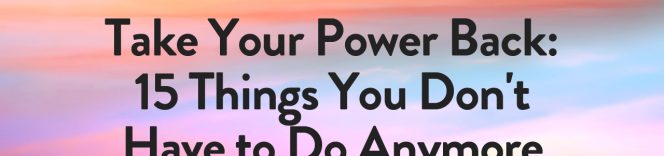
  • Take Your Power Back: 15 Things You Don’t Have to Do Anymore

    Take Your Power Back: 15 Things You Don’t Have to Do Anymore

    There’s little more frustrating than feeling stuck or trapped—like you have to accept things that aren’t good for you and can’t do the things you need to do to feel and be your best.

    I think we all feel this way at times, and sometimes we do have to accept things that aren’t ideal, at least in the short term while we figure out a plan to make things better. Until we address our health issues, or find a less stressful job, or slowly unravel layers of grief or trauma to find some modicum of peace and healing.

    But when life feels stressful, it’s often because we don’t recognize all the things that are within our power.

    As I sit exhausted in sweats, trying to focus during a short break from caring for two young kids, I know I need to accept the limitations of early parenthood, without a ‘village’ close by for regular support.

    But I don’t have to worry I’m not being a good enough parent when I know I’m doing my best. I don’t have to feel bad about asking for help so I can take a much-needed break. And I don’t have to feel guilty or weak for crying sometimes when it all feels like too much.

    I don’t know about you, but I find the words “You don’t have to…” incredibly comforting, especially when those words enable me to do more of what I need to do for myself.

    If you’re feeling powerless in any area of your life right now, today’s post is for you. If you’re at the end of your rope and tired of waiting for change, this post is for you.

    If you think you don’t have any options, this post might be the nudge you need to look a little deeper and discern what’s actually within your power. Odds are, it’s more than you think.

    If you’d like to print this list to hang or save for future reference, you can download a printable version here, along with a two-page worksheet to help you create change in any area of your life. (You’ll also find four other helpful printables that I created as companions to my upcoming Inner Strength Journal.)

    15 Things You Don’t Have to Do Anymore

    1. You don’t have to wait for change. If you’re not happy with the way things are, you can do something, no matter how small, to transform your life—starting now.

    2. You don’t have to accept anything you’re not comfortable with in your relationships. The people in your life might never change, but you can change how you engage with them.

    3. You don’t have to ask for permission to do what’s best for you. At any time, you can decide to prioritize your dreams and needs without having to defend yourself or justify your choices.

    4. You don’t have to follow anyone else’s advice or rule book. You can decide for yourself what you value most and what it means and looks like to honor it.

    5. You don’t have to be afraid of failing. Failing means you’re trying new things, which is essential if you want to learn, grow, and live a life of purpose and adventure.

    6. You don’t have to be the same as you were a year ago, a month ago, or even a day ago. Every morning you can start anew and show up in the world as the person you want to be.

    7. You don’t have to continue doing anything that no longer feels right for you. It’s okay to change directions at any time, and as many times as you need to.

    8. You don’t have to feel guilty about saying no or accomplishing less. Your peace and well-being are just as important as other people’s requests and more valuable than anything you could add to your to-do list.

    9. You don’t have to ignore or suppress your feelings and instincts. They are your compass toward the best possible decisions for you. Hear them. Trust them. Learn from them.

    10. You don’t have to hide your pain to make other people feel comfortable. Not everyone will be able to hold space for you, but some will—you just have to open up to find them.

    11. You don’t have to go it alone. There’s no shame in asking for help. It doesn’t mean you’re weak or incompetent. It means you love yourself enough to accept love from other people.

    12. You don’t have to fix anyone else or make them happy. And you can’t no matter how hard you try. Your job is to focus on taking care of yourself and love them while they learn to do the same.

    13. You don’t have to be ashamed of your past. You did the best you could, given what you’ve been through and what you knew at the time, and it helped you become the person you are today.

    14. You don’t have to worry about what’s coming in the future. You will anyways because you’re human. But when you catch yourself, remind yourself that whatever it is, you’re strong enough to handle it.

    15. You don’t have to stress about doing something big to change the world. You can do something big if you want, but even your smallest acts of kindness can make a massive difference.

    I hope these reminders help you find the strength and courage to change the things you can, even if you start with just one small step. Sometimes even the tiniest move in the right direction can completely change the trajectory of your life.

    You can access the printable version of this list and the companion worksheet here.

    Also, just a reminder: For a limited time, you can get a free 318-page eBook—Tiny Buddha’s Guide to Overcoming Hard Times—when you preorder Tiny Buddha’s Inner Strength Journal through one of the vendors listed here.

  • 10 Signs You’re Being True to Yourself

    10 Signs You’re Being True to Yourself

    “The most confused we ever get is when we try to convince our heads of something that we know in our hearts is a lie.” ~Karen Moning

    It’s painful and stressful to feel like you’re living a lie. Like you’re hiding how you really feel, saying what you think other people want to hear, and doing things you don’t actually want to do—just because you think you’re supposed to.

    But sometimes we don’t recognize we’re doing this. We just know we feel off, or something feels wrong, and we’re not sure how to change it.

    It makes sense that a lot of us struggle with being true to ourselves.

    From a young age, we’re taught to be good, fall in line, and avoid making any waves—to lower our voices, do as we’re told, and quit our crying (or they’ll give us something to cry about).

    And most of us don’t get the opportunity to foster or follow our curiosity. Instead, we learn all the same things as our peers, at the exact same time, and we live a life consumed by the mastery of these things, our bodies restless from long hours of seated study and our minds overwhelmed with memorized facts that leave very little room for free thinking.

    To make things even worse, we learn to compare our accomplishments and progress—often, at things we don’t even really care about—to those of everyone around us. So we learn it’s more important to appear successful in relation to others than to feel excited or fulfilled within ourselves.

    This was my experience both growing up and in my twenties. A people-pleaser who was always looking to prove that I mattered, I was like a chameleon, and I constantly felt paralyzed about which choices to make because all I knew was that they needed to be impressive.

    I never knew what I really thought or felt because I was too busy suffocating my mind with fears and numbing my emotions to develop even a modicum of self-awareness.

    This meant I had no idea what I needed. I only knew I didn’t feel seen or heard. I felt like no one really knew me. But how could they when I didn’t even know myself?

    I know I’ve made a lot of progress with this over the years, and I have a mile-long list of unconventional choices to back that up, as well as a number of authentic, fulfilling relationships. But I’ve recently recognized some areas where I’ve shape-shifted in an attempt to please others, and in some cases, without even realizing it.

    I don’t want to be the kind of person who panders to popular opinion or lets other people dictate my choices. I don’t want to waste even one minute trying to be good enough for others instead of doing what feels good to me.

    I want to make my own rules, live on my own terms, and be bold, wild, and free.

    This means peeling away the layers of fear and conditioning and being true to what I believe is right. But it’s hard to do this, because sometimes those layers are pretty heavy, or so transparent we don’t even realize they’re there.

    With this in mind, I decided to create this reminder of what it looks and feels like to be true to myself so I can refer back to it if ever I think I’ve lost my way.

    If you also value authenticity and freedom over conformity and approval, perhaps this will be useful to you too.

    You know you’re being true to yourself if….

    1. You’re honest with yourself about what you think, feel, want, and need.

    You understand that you have to be honest with yourself before you can be honest with anyone else. This means you make space in your life to connect with yourself, perhaps through meditation, journaling, or time in nature.

    This also means you face the harsh realities you may be tempted to avoid. You’re self-aware when faced with hard choices—like whether or not to leave a relationship that doesn’t feel right—so you can get to the root of your fear.

    You might not always do this right away, or easily, but you’re willing to ask yourself the tough questions most of us spend our lives avoiding: Why am I doing this? What am I getting from this? And what would serve me better?

    2. You freely share your thoughts and feelings.

    Even if you’re afraid of judgment or tempted to lie just to keep the peace, you push yourself to speak up when you have something that needs to be said.

    And you refuse to stuff your feelings down just to make other people feel comfortable. You’re willing to risk feeling vulnerable and embarrassed because you know that your feelings are valid, and that sharing them is the key to healing what’s hurting or fixing what isn’t working.

    3. You honor your needs and say no to requests that conflict with them.

    You know what you need to feel physically, mentally, and emotionally balanced, and you prioritize those things, even if this means saying no to other people.

    Sure, you might sometimes make sacrifices, but you understand it’s not selfish to honor your needs and make them a priority.

    You also know your needs don’t have to look like anyone else’s. It’s irrelevant to you if someone else can function on four hours of sleep, work around the clock, or pack their schedule with social engagements. You do what’s right for you and take good care of yourself because you recognize you’re the only one who can.

    4. Some people like you, some people don’t, and you’re okay with that.

    Though you may wish, at times, you could please everyone—because it feels a lot safer to receive validation than disapproval—you understand that being disliked by some is a natural byproduct of being genuine.

    This doesn’t mean you justify being rude and disrespectful, because hey, you’re just being yourself! It just means you know you’re not for everyone; you’d rather be disliked for who you are than liked for who you’re not; and you understand the only way to find “your tribe” is to weed out the ones who belong in someone else’s.

    5. You surround yourself with people who respect and support you just as you are.

    You understand that the people around you affect you, so you surround yourself with people who respect and support you, which motivates you to continue being true to yourself.

    You may have people in your life who don’t do these things, but if you do, you understand their issues with you are just that—their issues. And you set boundaries with them so that they don’t get in your head and convince you there’s something wrong with you or your choices.

    6. You focus more on your own values than what society deems acceptable.

    You’ve read the script for a socially acceptable life—climb the corporate ladder, have a lavish wedding, buy a big house, and make some babies—but you’ve seriously questioned whether this is right for you. Maybe it is, but if you go this route, it’s because this plan aligns with your own values, not because it’s what you’re supposed to do.

    You know your values are your compass in life, and that they change over time. So you check in with yourself regularly to be sure you’re living a life that doesn’t just look good on paper but also feels good in your heart.

    7. You listen to your intuition and trust that you know what’s best for yourself.

    You not only hear the voice inside that says, “Nope, not right for you,” you trust it. Because you’ve spent a lot of time learning to distinguish between the voice of truth and fear, you recognize the difference between holding yourself back and waiting for what feels right.

    You might not always make this distinction immediately, and you might sometimes be swayed by well-meaning people who want to protect you from the risks of thinking outside the box. But eventually, you tune out the noise and hone in on the only voice that truly knows what’s best for you.

    8. You do what feels right for you, even if that means risking disapproval from the people around you.

    Not only do you trust that you know what’s best for you, you do it. Even if it’s not a popular choice. Even if people question your judgment, vision, or sanity. You recognize that no one else is living your life, and no one else has to live with the consequences of your choices, so you make them for you and let the chips fall where they may when it comes to public perception.

    This doesn’t necessarily mean you have everything you want in life. It just means you hear the beat of your own drum, even if it’s silent like a dog whistle to everyone else, and you march to it—maybe slowly or awkwardly, but with your freak flag raised nice and high.

    9. You allow yourself to change your mind if you recognize you made a choice that wasn’t right for you.

    You may feel embarrassed to admit you’re changing directions, but you do it anyway because you’d rather risk being judged than accept a reality that just plain feels wrong for you.

    Whether it’s a move that you realize you made for the wrong reasons, a job that isn’t what you expected, or a commitment you know you can’t honor in good conscience, you find the courage to say, “This isn’t right, so I’m going to make another change.”

    10. You allow yourself to evolve and let go of what you’ve outgrown.

    This is probably the hardest one of all because it’s not just about being true to yourself; it’s also about letting go. It’s about recognizing when something has run its course and being brave enough to end the chapter, even if you don’t know yet what’s coming next. Even if the void feels dark and scary.

    But you, you recognize that the void can also feel light and thrilling. That empty space isn’t always a bad thing because it’s the breeding ground for new possibilities—for fulfillment, excitement, passion, and joy. And you’re more interested in seeing who else you can be and what else you can do than languishing forever in a comfortable life that now feels like someone else’s.

    As with all things in life, we each exist on a spectrum. Every last one of us lives in the grey area, so odds are you do some of these things some of the time, and probably never perfectly. And you may go through periods when you do few or none of these things, without even realizing you’ve slipped.

    That’s how it’s been for me. I’ve gone through phases when I’ve felt completely in alignment and other times when I’ve gotten lost. I’ve had times when I’ve felt so overwhelmed by conflicting wants, needs, and beliefs—my own and other people’s—that I’ve shut down and lost touch with myself.

    It happens to all of us. And that’s okay. The important thing is that we keep coming home to ourselves, and we eventually ask ourselves the hard questions that decide the kind of lives we lead: What am I hiding? What am I lying about? And what truth would set me free?

  • How to Be a Lot Happier: A Simple Solution

    How to Be a Lot Happier: A Simple Solution

    “Simplicity is the ultimate sophistication.” ~Leonardo da Vinci

    There’s a funny thing with us humans.

    We spend our lives trying desperately to find happiness, and yet we don’t even know what it is. We can’t explain, describe, or define it. We just know that we want it because it’ll make everything peachy. Time and time again, though, studies have shown that our never-ending quest for happiness is quite often the very thing that makes us miserable.

    Trying to find happiness is an exercise in futility. This is a truth I did not easily come to realize. It took a succession of major depressive episodes, the sudden death of my father, a cross-country move, a broken heart, and countless hours reading airy-fairy, self-help nonsense for me to understand that instead of trying to find happiness, I should consciously take steps that let happiness find me.

    Suffice it to say, you will no longer find me spinning my wheels, dejectedly searching for answers and chasing the abstract. You will no longer find me on a never-ending quest for happiness.

    But given my endless fascination with the subject, my work as a coach, and my ever-present desire for more street cred, I recently found myself immersed in a year-long Psychology of Happiness certification program created by best-selling author and former Harvard professor Dr. Tal Ben-Shahar.

    During the program, we were asked:

    What was one of the happiest periods of your life?
    What did you do during that period that made it so good?
    How can you generate more happiness in your life?

    I had a profoundly difficult time answering these questions, particularly the first two. But the more I scanned through my mental scrapbook, the more I kept thinking about the months between ninth and tenth grade—my last romp as a camper at the sleepaway camp I’d been going to for six consecutive summers.

    It wasn’t so much what I did—or what we­ did—that made it so good. I think, perhaps, it was what we didn’t do.

    There were no smartphones. So, there were no screens to stare at, no calls to make, no messages to check, no constant dinging notifications.

    There was no social media. There were no Facebook rants, no Twitter trolls, no outlandishly phony Instagram influencers to drum up our insecurities.

    We weren’t constantly comparing ourselves to others while looking at the carefully curated highlight reels from their lives.

    No, we were making our own highlight reels in the middle of nowhere—or, more accurately, in the middle of northern Wisconsin. We hadn’t the slightest idea what anyone else was doing, and we didn’t care.

    There were no dating apps, no heads to swipe on for hours at a time. There was no ghosting, no haunting, no orbiting, no zombieing, no submarining, no breadcrumbing, no roaching. These hyper-specific subtypes of appalling human behavior simply didn’t exist.

    And despite our raging hormones, there was no palpable desperation. You either “hooked up” with someone the night before or you didn’t. Then, you moved on with your life.

    Nobody gave a damn who was president, either. We just knew it was some old, white guy just like it was the year before, and the year before that, and the year before that. He sat in his office, and signed some papers, and maybe spoke to the country every few months and that was it.

    There was nobody on the far left trying to ruin the life of anyone who’s ever made a mildly offensive quip. There was nobody on the far right trying to accelerate conflict and build some kind of white ethnostate. There were no conspiracy theorists trying to convince the world that celebrities run pedophile rings out of pizza parlors or that Jewish folks crisscross the country to start wildfires with space lasers.

    Oh, but Tony, you might be saying to yourself. There were definitely people like that back then! And you get no argument from me.

    But we never heard from them. They didn’t have public platforms. There were no 24/7/365 news channels, there were no online news magazines, and there was no YouTube; so, they just kind of kept their crazy crap to themselves.

    It’s no wonder that one of the happiest periods of my life was the summer of 1997, in the middle of nowhere in northern Wisconsin. We spent all of our time in nature, laughing and singing and bonding and playing frisbee.

    One could theorize that we were happier purely because we were kids, but I’m not so sure. From what I can tell, kids today are lost, distracted, and isolated. They spend most of their time indoors, glued to their devices. They are overstimulated, oversensitive, and overprotected. They are riddled with anxiety and depression as they deal with the psychological trappings of growing up in a technological world.

    Twenty-five years ago, during the summer of 1997, life was just…simpler.

    That’s what made it so good.

    And I don’t think that life in general will ever be that simple again.

    But every time I simplify my own life, even just a little bit, I’m a little bit happier.

    Every time I de-clutter, I’m a little bit happier.

    Every time I delete a dating app, I’m a little bit happier.

    Every time I forgo watching the news or sign off social media, I’m a little bit happier.

    Every time I turn my phone on Do Not Disturb, I’m a little bit happier.

    Every time I have a real conversation in real life with a real person I really care about, I’m a little bit happier.

    Every time I go outside and walk around and do nothing but look at the sky, and the trees, and the architecture, I’m a little bit happier.

    Every time I sit in silence and meditate and let my thoughts pass by like the weather, I’m a little bit happier.

    So, how can you generate more happiness in your life?

    Well, I don’t have a whole lot of street cred. But if I had to take a stab at it: Stop doing the things that cause you unhappiness. Simplify, simplify, simplify. And maybe find a summer camp for adults.

  • How to Wake Up Smiling: 5 Daily Habits That Made Me a More Positive Person

    How to Wake Up Smiling: 5 Daily Habits That Made Me a More Positive Person

    “You create your future based on your energy in the present.” ~Unknown

    I’m usually a pretty happy person, but about a year ago—perhaps due to a lack of social connections and laughter—I experienced a few dark months. During those months, I spent most of my waking hours (and probably nights as well) consumed with negative thoughts.

    I woke up feeling angry in the morning, continued having negative thoughts most of the day, and went to bed in that same state of mind.

    Luckily, I didn’t have many opportunities to spread my negativity to others because we were in confinement.

    On one of those moody mornings, I played a video of a spiritual teacher that a friend had recommended listening to while getting ready for the day.

    Halfway through the video, he said, “Humanity is ascending into more loving and conscious states of being. You are becoming more of who you truly are, which is love.”

    At that moment, I caught my eyes in the mirror and stared at my unhappy face.

    “I’m not ascending. I’m descending further and further into the ‘hell’ in my own mind.”

    My negativity was eating me alive, but, strangely, it was so addictive.

    Since it had been escalating for some time (a few months by then) and had acquired a good bit of momentum, I really didn’t know if I’d be able to shift all that negativity into a more positive state of being. I knew that the longer I waited, though, the harder it would be.

    Still looking at my face in the mirror, I noticed the corners of my mouth pointing slightly downward.

    “If I continue like that, I’m going to get grumpy face wrinkles.”

    I made my bed and then went to the kitchen. As the coffee was brewing, I grabbed my laptop and Googled “how to be a more positive person,” and I scribbled down a few ideas that resonated with me.

    Later that day, after mixing and matching advice from different articles, I created what I called my “emotional hygiene routine.”

    It’s a series of simple habits that I committed to doing most days of the week for an entire month (and still continue to do today on most days) and that, over that month, took me out of my depressive state and made me wake up smiling in the morning again.

    I’d like to share them with you.

    1. Fall asleep in the “vortex.”

    One idea I came across in my research on being more positive came from Abraham Hicks:

    “If you go to sleep in the vortex, you wake up in the vortex. If you go to sleep not in the vortex, you wake up not in the vortex.”

    Being in the “vortex” refers to a state of pure positive energy. The idea in that quote is pretty straightforward: go to bed thinking positive thoughts and feeling happy feelings, and you’re more likely to wake up thinking and feeling positive in the morning.

    I knew this had to be true. I knew it because when I went to bed thinking angry thoughts, I usually dreamed that I was unhappy and then woke up grumpy (and exhausted) in the morning.

    So, I decided to try something. As I closed my eyes to sleep at night, I scanned the day from the moment I woke up until the present moment when I was lying in bed, and I tried to recall all the positive things (even tiny things) that had happened that day.

    I could have thought about the delicious mocha latte that I drank that morning, the fact there wasn’t snow on the ground and that I was able to run outside in the afternoon, or a nice comment someone left on one of my videos.

    I spent a few seconds remembering a happy moment before moving on to the next one. After scanning the entire day, I would do it again, trying to find even more subtle positive things, and I did this until I fell asleep.

    This exercise is probably the number one thing that helped me (and still continues to help me) wake up happier in the morning.

    2. Have something to look forward to on the following day.

    Something else that has helped me wake up happier is having something to look forward to every day, even if I have a busy day ahead and have minimal free time available.

    Still to this day, every evening, I schedule at least one activity that brings me joy for the following day. It can be going for a walk with a friend, baking cookies, or watching the sunset. It can also be as simple as wearing my favorite outfit.

    Scheduling one activity that brings me joy for the following day gives my mind something fun to anticipate and puts me in a good mood in the evening.

    And again, how the day ends is a good indicator of how the following day begins.

    3. Absorb uplifting ideas in the evening.

    We all know that what we feed our minds affects our mood. I don’t have a TV and don’t follow the news, but my Facebook feed is often enough to get me irritated. So, I decided to stop scrolling mindlessly on Facebook (or at least do so less often) and consume positive-only content instead.

    For the past few months, first thing in the morning and before going to bed, I’ve been reading a few pages of an inspiring book—usually something spiritual. I just finished reading the entire Earth Life book series by Sanaya Roman, and right now, I’m reading Wishes Fulfilled by Wayne Dyer.

    Reading those kinds of books brings me peace. I can notice a significant difference in my mood and stress level if I just take even fifteen minutes to consume uplifting content in the morning and evening.

    (If you have any book recommendations, you can share them in the comments.)

    4. Make a gratitude list—with a twist.

    After reading in the morning, I write down three to five things I’m grateful for—and why I appreciate each thing.

    I used to write gratitude lists of fifteen-plus items and do it very quickly—almost mindlessly—just to “get it done.” It made the practice sort of mechanical and not very effective.

    I’ve found that writing fewer items on my list and taking the time to dive into the reasons each thing makes me happy intensifies the feelings of gratitude and makes the exercise more profound. I try to do this daily, although I do forget sometimes. When I forget several days in a row, I can feel the difference in my general mood.

    Gratitude is perhaps the lowest-hanging fruit for cultivating a more positive attitude.

    5. Choose your state of being as you open your eyes.

    The last thing that has helped me is a piece of advice from Dr. Daniel Amen, one of the leading brain health experts. In an interview on The School of Greatness Podcast, he talked about the importance of setting a positive intention from the very start of the day to cultivate what he calls “a positivity bias.”

    An affirmation he uses himself and recommends using is: “Today is going to be a great day.”

    When we tell ourselves this in the morning, our unconscious mind then looks for things that are going right to prove that this is true. This isn’t toxic positivity—ignoring or denying the negative. It’s training our brains to see what’s positive instead of focusing on the negative by default.

    I’ve taken the habit of saying this affirmation (or a similar one) just after waking up and before opening my eyes in the morning. It’s a bit like choosing and declaring from the very start of the day what attitude you’ll adopt that day. It’s easy to do, and it sets the tone for the day.

    In the beginning, I didn’t always remember to declare my intention until later in the morning, but it didn’t take long before it became automatic. Now, just remembering to think about my intention (and then mentally saying it) makes me smile as I wake up.

    . . .

    Our lives don’t need to be perfect to wake up smiling in the morning; they just require a conscious effort to develop a positive attitude, which is what the five habits in this article have helped me accomplish.

    I hope they serve you well, too, if you choose to implement them.

  • Our Creative Genius Shows Us Possibilities the Rational Mind Can’t See

    Our Creative Genius Shows Us Possibilities the Rational Mind Can’t See

    “There are moments in our lives, there are moments in a day, when we seem to see beyond the usual. Such are the moments of our greatest happiness. Such are the moments of our greatest wisdom.”  ~Robert Henri, The Art Spirit

    In my twenties, I worked for a Fortune 500 company at 401 North Michigan Avenue in downtown Chicago. It was fun to work in the city, and my office overlooked Lake Michigan—I never got tired of the stunning view. Weekends were spent with friends eating at unique ethnic restaurants and visiting comedy clubs, blues bars, art galleries, museums, and theater.

    Chicago is a thriving city with a vibrant cultural life. I had a great time.

    I eventually went on to get a Ph.D. at the University of Chicago, and after I completed the degree, everything in my external world nudged me to “get out there and do great things.” Fellow students were receiving grants, fellowships, and prestigious tenure-track positions at major research universities. My advisor (Mihaly Csikszentmihalyi, the author of Flow) was excited about my dissertation research and wanted me to publish.

    Everywhere I went, freshly minted Ph.D.s were busily writing papers, interviewing, and speaking at important conferences. And if that wasn’t enough incentive, my department was being closed by the University, and administrators, faculty, and students were launching a massive fight to try to keep it open. The centerpiece of their argument was to show how their recent graduates (i.e., me…) were doing amazing, brilliant things in the world. Yikes.

    I pushed myself—secluding myself away at a quiet retreat center for a week to try to focus, write a research article, and finally get serious about my academic career. My writing was stiff, contrived, and boring.

    I was miserable.

    So, instead of launching an illustrious academic career, I moved to the wilderness of northeast Montana.

    Montana enchanted me. Everything was so different. I fell in love with the spectacular natural beauty, but also the people who were so different from anyone else I’d ever known.

    There were backwoods hippies living off the grid, musicians who played on homemade instruments, unique one-of-kind handmade houses, and artists of all kinds.

    I moved in with a longhaired hippy in a teepee. My dog and I could hear the wolves howl at night, and we crossed paths with bears during the day. I immersed myself in the beauty of the wild with its craggy mountains and deep dark winters.

    I was far, far away from the world of exalted professional accomplishments. Here’s what happened instead.

    1. I developed self-reliance.

    One day a bird flew in and got stuck between windowpanes when trying to get out. Another day, a neighbor’s stray dog got his eyelid hooked on barbed wire. (Ouch!)

    In the city, my go-to response was to get the nearest person to help. But here in this remote area, there were no neighbors to be called. I managed to successfully extricate both animals on my own and without harming them further.

    2. I developed a wide skill set.

    In rural and remote areas, by necessity, you become a generalist. I did things I never would have done had I remained in the city.

    I was asked to speak at a church service. I started leading creative writing workshops at the yoga center. I was asked by an artist to write a book about her work and the local paper invited me to participate in a community forum.

    3. I developed openness.

    In the city, I held staunch beliefs about issues such as the need for gun control. Living in the country, I developed a deeper and more fleshed out understanding of diverse views. In rural Montana, churchgoers, new-age hippies, and hunters all mix together at the post office, grocery store, and local cafe.

    My perspectives broadened. I was no longer automatically locked into a particular position. Whereas before I saw the world in stark black-and-white, I now saw shades of gray.

    4. I developed leadership skills.

    In the city, civic organizations can feel large and intimidating. In a rural setting, everyone pitches in.

    I was asked to organize a United Way meeting. I became involved in the Rotary club. The employment agency asked me to lead a staff meeting,

    5. I developed passions for different things.

    I became proficient at river rafting. I spent weekends contra dancing. A band needed a bass guitar player and there was no one else around, so I volunteered to give it a try. (I loved it.)

    I had no idea of the fun to be had in the country.

    6. I discovered a freedom of identity.

    I’d spent my life growing up in a conservative Midwestern family, then following corporate rules as a computer scientist before embarking on a rigorous Ph.D. program.

    In Montana, I let myself break the rules for a while, stepping out of everything I had known and trying on something completely new and different. I discovered what it felt like to be free of roles and expectations.

    A friend of mine, a massage therapist, absolutely loved her work. After several years, she decided she wanted to make more money and she made the rational decision to switch to a career in nursing. Since both professions involve healing work, she naturally believed nursing would be a good choice for her.

    Years and tens of thousands of dollars later, she admits that she hates nursing. Logic doesn’t help us find our next step.

    By the way, I also have a dear friend who loves being a nurse. This is not a story about nursing (or academia). It’s a story about uniqueness.

    What are the unique paths that inspire each of us? What are the unique places, people, and situations that help us grow?

    When we’re stuck, it’s often because our minds are dead-set focused on the direction that seems reasonable. It’s the only direction that our minds can see.

    Our creative genius has a much different approach. It offers us unique, peculiar possibilities that our rational mind can’t see.

    Your creative genius will take you in directions that you don’t expect and can’t predict ahead of time. Directions that aren’t a linear, incremental next step. Instead, they open up entire new worlds that you didn’t know existed.

    Here’s a tip…

    When you’d like to make a change, feel blocked, or frustrated that whatever you’re doing is no longer working, consciously step back and imagine opening space for possibilities you hadn’t considered. This can be a challenge—your mind may have a hard time letting go of the reins.

    You are more than your thinking mind. You have another, non-cognitive creative intelligence operating in your life as well. It’s your creative genius and it’s worth listening to.

    Opening space for it will give it a chance to express itself.

  • How to Live an Extraordinary Life, Starting Right Where You Are

    How to Live an Extraordinary Life, Starting Right Where You Are

    “Let the beauty we love be what we do. There are hundreds of ways to kneel and kiss the ground.” ~Rumi

    “Isn’t this a miracle?” I asked myself in the milk aisle at Whole Foods.

    It was a Wednesday night after work, and I was buying a few staples to get us through the week. It was a completely ordinary moment in a completely ordinary day, and it was miraculous.

    Rewind a few years, same Whole Foods, same shopping list, and you’d find me absentmindedly wandering the aisles, lost in a head full of worries. I couldn’t tell you now what I was worried about then—the house, the kids, money, probably.

    My body would be tense, with a hint of tears right behind my eyes.

    “Isn’t this supposed to be a miracle?” I might have asked if I had the words to describe that feeling.

    For as long as I can remember, I wanted to be one of those interesting people who did interesting things like paint murals or write books. I wanted to see every continent and learn as many languages as my brain could hold. I wanted to feel excited by my life.

    As a child, I had no doubt that this is what growing up would be like.

    But, for just as long as I can remember, I also lived under the assumption that I had something to prove. My intelligence, my worth, my place in this world.

    Somehow, these two ideas became intertwined.

    That part of me that felt so certain that her life would be extraordinary started to have doubts.

    Could I really pull it off?

    Had I really earned it?

    Was I being completely delusional?

    Over time, that vision of an extraordinary life felt like a silly childhood dream, and I stopped myself from following it. I worked hard and earned a good reputation, but that excitement, that fulfillment was always just out of my reach.

    I would let it go saying, it’ll come later, but as I checked off the boxes of life’s to-do list—degree, job, marriage, kids—I wasn’t feeling anything like I thought I would.

    The feeling that something was off fueled a restlessness that I mistook for motivation. I poured myself into school and then work, but not necessarily out of excitement. I think a part of me still believed that if you weren’t happy, you just weren’t working hard enough at it.

    What confused me about it all was that my life was good. I had a beautiful, growing family, a stable job, and a safe, comfortable house. I mean, I was buying organic milk to pour on my cereal. That’s a privilege.

    So, if nothing was “wrong,” why didn’t it feel right?

    I’d scold myself for not being more grateful, but I couldn’t shake the feeling that I didn’t feel the way I wanted.

    Then, one ordinary day, while squeezing in another email during my lunch hour, a little thought snapped me out of it.

    “You’re missing the point, Leslie.”

    Time stopped just long enough for me to notice my racing heart.

    Maybe you’ve had these epiphanies, where you’re amazed by your own wisdom and you feel so incredibly clear and awake. Maybe it was during a life-changing event, or maybe, like me, it was during an everyday moment, like buying toothpaste or feeding the cats.

    The immediate effect wasn’t anything extreme. There was no out of body experience, no inexplicable knowledge of the universe. Just an ordinary little thought that led to another ordinary little thought.

    What if living an extraordinary life isn’t about the details?

    Every now and then, I’d pull out a list I made that day and add a thought or two to it.

    The point is…

    Overflowing.

    Seeing more magic.

    Doing what you love.

    Being happy.

    Being present.

    Feeling bright, brave, and brilliant.

    Waking up and appreciating the mountains.

    My children knowing how much they are loved.

    Gratefully receiving everything I have.

    Letting myself unfold.

    Alignment, not approval.

    Trusting the wisdom of my own heart.

    A hundred percent up to me.

    And in a gradual, ordinary kind of way, I figured it out. That feeling I wanted wasn’t an outcome. It wasn’t something that would happen “when.” It wasn’t in the details at all. It’s your feelings, moment to moment, that make your life extraordinary.

    There is no committee keeping score and waiting to grant permission to begin. There’s just us, the people we care about, our corner of the world, and those little moments. And we have a choice in what we do with them.

    That feeling that something was wrong wasn’t about my reputation or my checklist. It was about my awareness of the miracles right in front of me and my willingness to take conscious, meaningful steps that felt extraordinary to take.

    Since that day, my life has changed dramatically.

    We live in the same house, we shop at the same store, I have the same job, but now, I’m also one of those people who is curious about everything. Who loses themselves in creative projects just because. Who creates art, writes poetry, and self-publishes books. I’ve become one of those people who sees even the most ordinary moment at Whole Foods on a Wednesday afternoon as extraordinary.

    How did I do it? I simply let myself begin right where I was.

    You may have a completely different version of extraordinary, and that’s what’s so perfect. How to live an extraordinary life is entirely up to you—it’s your life, after all. The action itself isn’t as important as the intent behind it.

    As long as your intent is to make something in your world just a little better, to learn something just a little deeper, to try something you’re just a little curious about, it’s foolproof. You could institute pizza Saturdays or travel the world, saving endangered species. Both are extraordinary.

    If you’re not sure where to begin, here are a few things to try. They changed the world for me.

    1. Be tenacious in your appreciation and optimism.

    First, slow down and look around. Then, appreciate anything and everything you possibly can. Thank the sun, thank the water, thank the air you breathe. Look out for the funny thing that happened on your way to work, beautiful sunsets, and acts of human kindness. Even when everyone around you wants to complain about the boss, be the one who notices that it’s such a nice day.

    When I talked about my day, I used to begin with something that went wrong. Then, I gave myself one tiny challenge: lead with gratitude. I made a point of starting conversations with something positive as often as I could, which meant I had to start looking for those positive things and remembering to bring them up. I discovered so much beauty around me with this one simple switch.

    2. Define your extraordinary.

    What do you want to see in this lifetime? What do you want to learn? How do you want to feel while you’re living your life?

    I’d thought about these things before, of course, but they would quickly get taken over by something more serious. I didn’t want to waste time. My attitude changed when I decided that feeling curious, engaged, and alive was more important than being productive.

    I began setting intentions for the week. I’d write down an idea that excited me, a feeling I wanted to nurture, and something I wanted to learn or create. Then, I gave myself small, meaningful challenges that fit with those intentions. Carrying a composition book with me quickly led to filling that composition book, and then another and another.

    3. Make friends with your body.

    Your body was made for living, so live in it. Use it in a life-affirming way. Don’t just feed it, nourish it. Let it move, let it sweat, let it pump its blood, laugh, cry, and feel. Stretch into it and savor its senses. Rest it when it’s tired, heal it when it’s hurting, love it even when you want to change it, and thank it. And when it has something to tell you, lean in and really listen.

    I used to treat my body like it had no purpose. I didn’t nourish it, I overworked its muscles, and I constantly tried to remodel it.

    It wasn’t until I started paying attention to how I feel now that I asked myself, is this how you would treat a child or an animal in your care?

    My answer was an emphatic NO.

    4. Lose yourself in curiosity and creativity.

    Follow the fun and let yourself overflow. Take on a ridiculous project just because it lights you up, even if it’s silly, you’re “too old,” or it’s “wasting time.” Let it be messy. Let it change directions. And let it fail spectacularly. The outcome isn’t as important as the process of it.

    I practice this by painting with my children. They are experts at following curiosity and creativity. While I’m painstakingly sketching a dog or a flower, they’re creating imaginary animals in underwater kingdoms and then covering the entire thing in handprints when the inspiration strikes.

    Every time, I shake my head with a smile—this is supposed to be fun, remember?

    5. Be of service in a way that’s meaningful to you.

    Share something. Create something. Teach something. Go where you are masterful and add value to the world in any way that’s accessible to you. Feed the hummingbirds, pick up litter, volunteer in your community. Big or small, it doesn’t matter; it’s the meaning behind it that makes all the difference.

    I started by cultivating the kind of presence I wanted to have in my own life. I wanted to feel present at home, for one, so I reduced the expectations I put on myself. The house may be messier, but our weekend adventures at the park are nothing short of extraordinary.

    If you’ve ever wanted to feel differently in your life, take one little, ordinary step. And then another. Let your feelings guide you. Your extraordinary life is waiting for you on the other side.

  • How to Enjoy Life Without Buying Lots of Stuff

    How to Enjoy Life Without Buying Lots of Stuff

    “Minimalism isn’t about removing the things you love. It’s about removing the things that distract you from the things you love.” ~Joshua Becker

    Over the recent few years of being a digital nomad, I got a chance to live in Spain, Sri Lanka, Mexico, and Canada for a month or longer. As I didn’t have a home base and only had one medium-sized suitcase with me (still do), I couldn’t really afford to buy new things.

    I mean, I would need to put them somewhere, and my suitcase is already over forty-five pounds while most airlines only allow up to fifty.

    Even when I had to go back to my home country and stay there for almost a year because of the pandemic, I knew I’d be on the road again as soon as possible. So I continued to not buy anything other than essential things.

    I was never a shopaholic before, but I still felt miserable wearing the same few-year-old clothes and watching my friends (not even mentioning social media influencers I follow) regularly enjoy new things.

    I didn’t realize that more often than not we only buy things to fill a void or to relieve stress, not necessarily because we actually need or even want them. As soon as I figured that out, I started looking for alternative ways to fill my days with joy that didn’t involve buying new stuff.

    Today I want to share four things that I’m buying now when I want to feel better, which don’t occupy any space in my suitcase!

    1. Online courses

    Maybe it’s just me, but courses that teach me new skills are my favorite things ever! Even my husband knows that giving me a course as a gift will always make me happy.

    I have a ton of hobbies and things that I’m interested in, and each of them could become a full-time thing if I wanted it to. So there is no lack of information to keep learning.

    For example, last year I was into photography and took a bunch of courses on the subject. I learned mobile photography, then normal photography, and even some videography. I studied lots of related things including photo and video editing and even dipped my toes into stock photography.

    This year I’m learning digital illustration. YouTube and Skillshare are my two best friends right now and would probably be the most visited websites in my free time if I were to track my web activity. It just makes me so happy to ace a new thing I couldn’t imagine creating before!

    Honestly, I could never understand people who get bored staying alone at home and don’t know what to do. I wish I had another twenty-four hours in my day just to fit in all the things I want to learn!

    Besides, investing in yourself is never a bad idea. You never know where your new skills might appear useful on your life journey.

    2. Experiences

    You might say that it’s easy to find new experiences when you are traveling, and that’s true. I often go on walking tours, participate in cooking classes, and find other interesting things that my next country has to offer.

    But if you think I didn’t invest in experiences when I wasn’t a nomad, you are wrong.

    My favorite kind was always visiting an escape room. If you aren’t familiar with the concept, it’s a quest where you go into a room full of hints and puzzles, solving which leads you to the next one, and so on until the final thing gives you a key or something to escape the room. Usually, there is a specific theme for the room, you have one hour to escape, and there can be more than one actual room involved.

    Over the years, with my friends and coworkers, I went to almost every room that existed in my city at the time (which is a lot). Some were very easy; some were so hard that we didn’t get out on time. I remember the one which was absolutely dark and another one where they put chains around your ankles and wrists at the beginning, which you have to get out of.

    The feeling of nailing another quest room can hardly compare to anything else; it’s like actually being in an adventurous book for an hour. If you happen to be a nerd and avid reader like me, you know what I mean.

    Meaningful experiences strengthen your relationships and create memories for years to come. Do you remember every shirt you buy or reminisce about it with friends? I doubt that!

    3. Little gifts for friends

    This one is a bit of a cheat, as you might actually get to buy a physical thing.

    But, instead of it piling up in your closet, you give it away and feel good about it. Your friend is happy, you are happy, and your home doesn’t get cluttered. Not bad, huh?

    Just make sure to only buy things your loved ones actually want so they don’t start hating you for cluttering their home. Especially if your friend happens to be a minimalist.

    Wanna know my approach to always giving really good gifts? I swear by wishlists!

    I have had one for many years, and I made each of my friends and family members make one. Not everyone likes the idea at first, but I promise you, everyone loves getting specific things they want as presents! And don’t worry, it can still be a surprise, especially if their wishlist is long enough.

    To support the idea of having less stuff, encourage your friends to add items to their wishlists that aren’t physical things. About two-thirds of my own wishlist consists of specific online courses I’d love to take, new experiences I wish to try one day, and gift cards for fun things like massages and yoga classes.

    When it comes to hobbies and lifestyle choices, people usually know exactly what they want, and you can never go wrong with a wishlist. Without it, unless you know for sure all the details, it’s easy to gift someone a book they already have or a course that is too beginner-oriented (or too advanced) for their level. If you have doubts, better buy them a gift card to their favorite store or learning platform, so they can choose a specific item themselves.

    If you think you need to wait for a holiday or a birthday to give someone a gift, think again!

    The best presents are unexpected ones. Try surprising your friend with something they want for no particular reason, and just see how excited they get! They will feel loved and valued, which is something we can all benefit from.

    And as for you, the process of finding a perfect gift and seeing your friend genuinely enjoying it releases dopamine and endorphins, which basically make you feel happier. Win-win!

    4. eBooks

    The last thing on the list of things I still buy is eBooks.

    I am the person who used to read 100+ books per year and had a full bookcase at home. Now I travel with my tiny Kindle and am more mindful about what I’m reading.

    With that said, I still love the smell of real books and the feeling of actually turning pages! I still have a few of my favorite bookmarks. But I only buy digital books as it would be impossible to travel with “real” ones. I wish I had Hermione’s handbag with an extension charm on it, but sadly I don’t.

    I know many people these days don’t read books. With so many kinds of easily digestible visual content options we have online now, books became something of an old era. However, the process of reading still has a ton of health benefits: from improving your concentration skills and vocabulary to releasing stress and anxiety that is a constant problem in most of our lives.

    Nothing else can take your mind off your routines and worries quite as an interesting book can. It may only weigh a few kilobytes, but it has a whole world inside.

    These were my four things to buy that won’t ever clutter your life! They might, however, make a big impact on your self-development, make you smarter, improve your skills and mental health, and make you happier. Not a bad deal, is it? Especially for things that don’t take up any space.

    I hope you can agree with me now that it’s possible to live happily without buying new stuff all the time. I am not exactly a minimalist, but I like the idea of surrounding yourself with things that bring you joy instead of cluttering your life with things that only bring you instant gratification and then get forgotten.

    Try to fill your days with fun experiences and learning new skills, as your memories and abilities are things you can always take with you, wherever you go.

  • How to Reclaim Your Joy After the Pandemic: 3 Things That Helped Me

    How to Reclaim Your Joy After the Pandemic: 3 Things That Helped Me

    DISCLAIMER: Though vaccines have allowed many of us to return to more normal activities, the pandemic isn’t over, and it’s still crucial that we all follow the evolving CDC guidelines to keep both ourselves and others safe.

    “Perfect happiness is a beautiful sunset, the giggle of a grandchild, the first snowfall. It’s the little things that make happy moments, not the grand events. Joy comes in sips, not gulps.” ~Sharon Draper

    It was a rainy, late Sunday afternoon. The sun was already going down, and it was getting dark outside.

    “How are you?”

    “Oh, good. Nothing special. It’s quiet,” my mom responded when I called her a couple of months ago.

    “It’s quiet” had been her response for the past two years, possibly before that. My mom is retired. Since the pandemic, her life became even more “quiet” than before—fewer friends, fewer activities, less fun.

    I’m not retired, but I work from home, and the same happened to me. To some degree, I let it happen.

    I got used to not seeing people, not laughing, and not dancing. I got used to being alone, and it became more comfortable to stay home on Saturdays than going out for social activities. Was I developing a mild form of social anxiety? Maybe.

    Two things were for certain: my social skills had atrophied, and I had forgotten how to have fun. What was joy like?

    “I feel like this must be what it’s like for the elderly; when no one visits them and they don’t have many friends and activities, they sort of start dying inside.”

    “That’s how I feel right now,” my mom responded.

    Have you experienced that too at some point? Not feeling like doing anything and seeing people because you forgot how to connect with them and what you even enjoy doing?

    “I think it’s a slippery slope. We should do something about it. We should make an effort to break the pattern and start socializing and doing activities again before we die inside,” I told my mom.

    After hanging up the phone, I reflected upon what I had just said. I knew that “shoulds” wouldn’t make the situation better; I had to be proactive and do something about it. I took out a pen and a notebook and started writing an action plan.

    Here are the three things I wrote down that day that have most helped me to reclaim a sense of joy in my life.

    1. Do one thing on your list of “joys.”

    A piece of advice that was very helpful came from a friend who lost his partner to cancer a couple of years ago, just a few months after she was diagnosed.

    It was a shock to him. They had projects together, like buying a campervan, traveling around North America, and building a house off-grid. Suddenly, those plans were gone, and my friend had to learn to live alone again while coping with grief.

    One thing that helped him get out of depression and slowly regain his spark for life was to make a list of things that made him happy (even just a little). Every day for the next three months, he did as many things on his list as he could.

    I took that advice and created my list of fifteen “little joys.”

    They’re not complicated. They include things like watching the sunset, reading a book while drinking a mocha latte in the morning, walking in nature, wearing my favorite outfit, dancing to progressive trance music in my living room, and watching funny dog videos.

    Every day, I picked at least three things on my list to do that day; if I could do more, great! But I did at least three. Over a few days, this simple practice started making me feel happier.

    Of course, you’ll first have to create your own list of “joys,” but once you have it, it’s a wonderful tool to bring more joy into your daily life.

    2. Do one thing to trigger the “helper’s high.”

    Another thing that significantly impacted my mood and energy was to do one act of kindness every day.

    I had read articles about the science of altruism and happiness, and I knew that helping or being kind to others makes us happy. There’s even a specific term for it: the “helper’s high.”

    I began asking myself every morning, “What’s one act of kindness I will do today?”

    Since I don’t always feel creative first thing in the morning, I made a list of fifteen acts of kindness ideas that I could choose from. Like my list of “joys,” they aren’t complicated. They include writing a nice comment on someone’s Tik Tok video, posting an uplifting quote on Facebook, and complimenting someone.

    Just doing this one thing, intentionally, every day made me feel more alive. But in case you don’t feel inspired to do one act of kindness a day, here’s another idea.

    Another thing I started doing recently, which I learned from Tim Ferriss’s book Tools of Titans, is a ten-second loving-kindness exercise created by Chade-Meng Tan, the man behind the popular mindfulness-based emotional intelligence course for employees at Google called Search Inside Yourself.

    The exercise is very simple: A few times a day, randomly choose two people you see and secretly wish for each of them to be happy. You don’t have to do or say anything—just think, “I wish you to be happy,” with a sincere intention from your heart.

    I find both the ten-second loving-kindness exercise and doing one act of kindness a day therapeutic. They take our focus away from our problems and increase our sense of connection to others, even when the act of kindness is anonymous, and we don’t physically interact with the person.

    3. Do one thing every day to nurture your social circle.

    It took me some time to realize that my mental health was being affected by a sense of isolation. I’m an introvert and enjoy my own company. It wasn’t obvious that my desire to eat more ice cream than usual and my lack of motivation to get out of bed in the morning had something to do with spending too much time alone.

    Some weeks during the height of the pandemic, I talked to no one except my clients on Zoom and the cashier at the grocery store. And the more time I spent alone, the less I wanted to see people. The idea of socializing began to feel daunting, and I chose to stay home (alone) more and more often.

    But it was killing me inside. I had to break the solitude pattern before the hole I was digging and putting myself in became too deep.

    I started small but did something every day to revive my social life.

    One day, I commented on an acquaintance’s Facebook post. Another day, I messaged a friend on Messenger. The following week, that friend suggested we go for lunch, and I went.

    Friendships must be nurtured to grow stronger and thrive; otherwise, they atrophy.

    So, perhaps you can ask yourself every day, “What’s one thing I can do today to nurture and expand my social circle?”

    Start small.

    I did a few other things to bring more joy into my life in the past few months as well, like taking on a new hobby (learning to play the djembe) and attending social events every other week. But the three actions I mentioned in this article are the ones that made the most significant difference in my well-being in the long run.

    What do you do to feel alive and inspired? Share with us in the comments so we can all benefit from each other’s wisdom.

  • How the Deathbed Meditation Can Bring You Clarity, Purpose, and Joy

    How the Deathbed Meditation Can Bring You Clarity, Purpose, and Joy

    “Death may be the greatest of all human blessings.” ~Socrates

    There’s a lot of beauty and value in positive, light-and-love approaches to mental, emotional, and spiritual well-being.

    But I challenge you to go a little deeper and to face something we’re all going to experience eventually:

    Death.

    I know this may sound macabre, bizarre, or downright unappealing. But hear me out!

    There is a certain power and beauty in consciously visualizing and meditating on one’s death.

    What could be more awakening and more revealing than putting your current self into the perspective of your dying self—into your last few moments?

    Such a precious practice helps to bring a stunning clarity and crystalline focus to everything going on in your life.

    Indeed, what is referred to as the “deathbed meditation” helps you to:

    • Figure out what is most important to you
    • Let go of old pains and hurts
    • Focus on what brings you joy
    • Find your true life path
    • Uncover your hidden gifts

    As humans, we tend to live our lives as though they will never end. From one day to the next we live in a kind of autopilot mode where we take everything (and everyone) for granted.

    The deathbed meditation is a powerful practice you can incorporate into your life whenever you feel lost, stranded, stuck, out of focus, or simply aimless.

    My Experience With the Deathbed Meditation

    I’ve always been someone who desperately needs a strong purpose in life.

    But something happened last year that tossed me into a dark existential crisis where I questioned (1) what my place in the world really was, (2) why old wounds were rising to the surface, and (3) why I felt so lost—despite having a strong self-care and spiritual practice.

    With the advent of COVID-19 and the retriggering of old traumas, I felt empty inside.

    You know that feeling of falling and not having anything to catch you? That’s how I felt.

    Witnessing the suffering in the world and in my own circle of family members, I realized something major: “I could die tomorrow.”

    I realized this isn’t a groundbreaking thought; we all have it at some point (I know I have). But in that moment it felt like a lightbulb went off in my head—I suddenly realized that the key to finding the answers to life was to contemplate something so few people dare to approach: death.

    The answers I received from that subsequent deathbed meditation have guided my life, reawoken my purpose, and fuelled me with vision ever since.

    How to Practice the Deathbed Meditation

    Doing the deathbed meditation is an act of radical self-love. There, I said it!

    Why radical? The deathbed meditation is radical because it’s rarely mentioned or practiced by anyone (that I’m aware of) due to its intimidating nature.

    But let me assure you that the answers you can potentially find are so soul-nourishing, so meaningful, so profound, that you will be overjoyed that you courageously took this step.

    Before you embark on this inner journey, please ensure you have a neutral mind—we don’t want minds that are feeling down or frazzled or unhappy for any reason (that will bias your discoveries).

    When you’re ready, let’s begin:

    1. Focus on feeling safe and relaxed.

    Before you begin your deathbed meditation, find a space in your house that feels cozy. You might like to place a blanket over you and a pillow behind your head for extra comfort. Draw the blinds or curtains and ensure the atmosphere is dark.

    It’s important that you feel safe and relaxed so that your heart and mind can open up and gain the most from the meditation.

    Place a blindfold, sleep mask, or cloth over your eyes so that you can’t see anything. Then take some gentle, natural, grounding breaths and settle yourself.

    2. Find some funereal music (optional).

    Some people prefer their meditations to be totally silent, but if you’d like to set the mood, find some funereal music (or music that would be played at a funeral) to prepare your mind for the scene.

    Again, do whatever makes you feel most safe and comfortable. If you prefer total silence, that’s okay too.

    3. Visualize yourself on your deathbed, surrounded by loved ones.

    In your mind’s eye, imagine that you only have a few minutes (or hours) left to live. You feel comforted and at peace with your loved ones surrounding you.

    What kind of room are you in? What kind of bed or seat supports you? Focus on some kinesthetic details to help enrich the visualization.

    4. Ask yourself, “What was I most happy to have done in life?”

    Take some moments to reflect on this crucial question: What were you most happy to have done in your life? Let images and scenes play out in your mind for as long as needed.

    This powerful question will help you to hone in on what truly matters in your current life. If you’re struggling with making an important decision or finding a life direction, this simple question could be the key to unlocking deep truths residing within you.

    5. Ask yourself, “What did I regret not doing?”

    Regret is a natural part of life, yet many of us shy away from it, trying to sweep it under the rug. To avoid accumulating too much regret, ask this simple question within your deathbed meditation: What did you regret not doing?

    Let any thoughts, images, memories, or scenes run through your mind’s eye. Take special note of them.

    6. Ask yourself, “What is the most important thing in life to me, above all else?”

    Values are what guide our lives, and yet we are often totally unaware of them. By asking the question, “What is the most important thing in life to me, above all else?” we come to understand, truly understand, what we value deep down.

    Take a few moments in your deathbed meditation to contemplate this question, letting it sink into the recesses of your mind, heart, and soul. The answer you discover can have the potential of shifting, expanding, and empowering your entire life.

    7. Thank your loved ones and end the meditation.

    Once you’re done asking all or some of the above questions, smile warmly to your loved ones and thank them for their presence in your life. Then, when you’re ready, return to the room you’re in, get up very slowly, and do a big stretch.

    You might also like to drink some water to ‘emotionally digest’ your experience.

    The deathbed meditation has been one of the most powerful tools in my life for getting straight to the heart of what I most love, cherish, value, and need.

    After all, what else can put things in perspective other than our own mortality?

    If you’re feeling confused, lost, or in need of direction, I highly recommend that you try this unique meditation at least once. You might be surprised by how intensely transformational such a practice can be!

  • 4 Simple, Heart-Opening Exercises to Fill You with Joy, Love, and Light

    4 Simple, Heart-Opening Exercises to Fill You with Joy, Love, and Light

    “Why are you so enchanted by this world, when a mine of gold lies within you?” ~Rumi

    Happiness, love, and joy—we spend our lives in search of them. We often look to external things to fulfill our desire to experience them. A relationship, a trip abroad, a career, or maybe that shiny new car. We can spend our lives chasing these desires and believing that once we check everything off our list of life accomplishments, we will experience them all.

    But what if I shared with you that all of this—happiness, love, and joy—exists in you right now? That you are the source, not the external items. What if I told you that living in a perpetual state of love and joy is your natural state of being?

    Would you think I’m full of BS? That I’m living in a hippie Never-Never Land?

    Please let me share with you a few simple exercises that showed me my true self.

    Exercise #1: The Love Wave

    Close your eyes and take a minute to connect in your heart with a person in your life that could use a little love. Feel yourself smiling into their eyes and embracing them in a giant, warm hug.

    Allow the love to flow. Sit in this love. Let it grow in strength and surround you both. Then send it out into the world, creating a wave of love. Know that you can come back to this place of flowing love at any time.

    Try this now and then read on.

    Hopefully, you just had a wonderful experience of love. Now I have a question for you. Where did the love originate from? The person you were thinking of, or you?

    It was from you. The person you pictured just helped you unlock the love. You are love. You can actually imagine many different things to unlock it. Try a smiling baby, or playtime with a pet, or a concept such as world peace. These things are just the keys that unlock the true love that is in your heart.

    You can access this love any time you want. You are just tapping into your true being. It is who you are.

    I like to start my day off with this exercise. I tend to do it in the peacefulness of the morning light, right after my morning meditation. Just open your front door or a window and feel the fresh air on your face, then close your eyes and start. It is a beautiful way to begin the day.

    Exercise #2: The Gift of Giving

    One day I was browsing in a bookstore when an old man approached me. He had snow white hair and was wearing a threadbare, beige sweater. He handed me a chocolate rose and said, “Have a beautiful day,” I was taken aback. Who was this man? Was he trying to poison me? Was he hitting on me? I reluctantly took the chocolate rose and said, “Thank you.”

    The clerk noticed my discomfort and told me that the man buys a dozen chocolate roses every day and hands them out to random strangers. I suddenly felt special.

    This incident happened many years ago. Even though my initial reaction was one of unease, I remember this man with fondness. When he finally passed away the entire town mourned. There was a glowing write up in the local newspaper about him. He had brightened the days of countless residents with his gift of a chocolate rose.

    I invite you to pick a day this week and give everyone you meet that day a gift. It doesn’t have to be a physical gift, though it can be. It could also be a compliment, your undivided attention, or a heartfelt smile.

    Don’t expect anything in return. Remember my reaction to the old man? You might not always be met with gratitude. Just practice the act of giving.

    At the end of the day, notice how you feel. You spent the day leaving heart prints everywhere you went. Did this bring you joy? Is the joy within you or did you take it from the people you met?

    Exercise #3: The Vulcan Mind Meld

    We all have goals and expectations. They are important. But what happens when we can’t fulfill them? If we don’t get that promotion or find our perfect mate? We can become disheartened and depressed. How do we prevent this?

    Close your eyes and imagine yourself ten years from now. Give your future self that thing you believe will bring you happiness. Maybe it’s kids, money, power, or something else entirely. Notice how you feel. You might feel confident and secure. Or perhaps loved and important. Whatever you feel, allow it to expand and grow. Sit in it. Enjoy it.

    Then, while keeping your attention on the way you feel, bring back the image of yourself today. Think about what you already have that fulfills you.

    Maybe you don’t have kids, but you have amazing friends. Maybe you wanted a better income, but you can afford things you enjoy already. Look for the abundance within you now. Keep going until your “present self” feels the same as your “future self.”

    It’s almost like a mind meld—make those two beings one. Again, sit in the wonderfulness of it all. When you are ready, open your eyes.

    Try this out before reading further.

    Do you feel happy?

    When we live our lives from a place of lack we experience suffering and discontentment. We are always searching for the external thing that will make us happy. Rather than focusing on the things you don’t have, try living from a place of fullness. You already have an abundance of things to enjoy and appreciate—you just have to change your perspective.

    All that security, love, confidence, happiness, and joy you saw in the vision of your “future self” is accessible right now. Everything you experienced is within you today. Recognizing the abundance or fullness of your life is the key to happiness. If you experience that abundance, not meeting a goal or expectation becomes a minor bump on the road.

    I refer to the belief that we need external things to be happy as “the big lie.” Because when we finally finish off our checklist of life’s “wants,” we often experience “the great disappointment.” The list doesn’t bring us the happiness we thought it would. It’s not the source. We are.

    This frequently happens when people become suddenly wealthy. They think that they will be happier. They are surprised when they aren’t. In fact, having a lot of money comes with its own set of problems.

    Exercise #4: A Gratitude Nap

    This exercise imprints you with the beauty of your life as it is now.

    Lie down and get comfortable. Use as many pillows and blankets as you like.

    Set a timer for three minutes.

    For those three minutes, state out loud things you are grateful for. It’s a bit difficult at first. Please know every item does not have to be deep. Be grateful for the couch you’re lying on, the length of your hair, sand on the beach. Anything goes.

    After the three minutes, set an intention to be open to whatever is there for you to receive. Surrender as much as you can.

    Rest for ten minutes. Notice at the end of the “nap” how you feel. I’m willing to bet you feel a lot lighter after basking in the glow of all your life’s goodness.

    We spend so much of our time dealing with the pressures of life that we forget to do the things that unlock our love and joy. Our true nature gets covered by layers of life experiences and traumas.

    There is an Ayurvedic concept that you can shine with so much light that the darkness has no place to take hold. That light is within you now. It is your true state of being. It just needs to be set free.

    Tips to help access the joy, love, and light of your true being:

    1. Start your day with the love wave exercise.
    2. Make it a priority to do one thing each day that unlocks your joy.
    3. Live life from a place of fullness and abundance rather than from a place of lack.
    4. Practice gratitude.

    I would like to thank all of my teachers who have shared these beautiful exercises with me. Please feel free to share them too.

    Namaste.

  • The Science of Happiness: 9 Feel-Good Tools to Boost Your Mood

    The Science of Happiness: 9 Feel-Good Tools to Boost Your Mood

    “Remember, being happy doesn’t mean you have it all. It simply means you’re thankful for all you have.” ~Unknown

    I remember sitting on the New York City subway, tears streaming down my face, armed with valium and lithium along with other antidepressants that my psych had just prescribed.

    I was desperate, in that cave I had come to know as depression. Dark, hopeless, fearful depression. The cold metal seat of the subway made me feel raw and exposed. I couldn’t function. I couldn’t stop crying. I was panicked that I would be like this forever.

    That was an example of one time in my life. Yeah, I got over it. And there were other episodes of this beast. I gradually became sick and tired of being sick and tired.

    I remember the day. I had been in depression again, and from what seemed like nowhere I started to feel the light of gratitude. I was actually feeling grateful! And it felt so very good! I knew I could start to think and feel differently.

    Then and there I finally vowed to find out how to bring happiness into my life on a consistent basis. Sure, there would be the hard times, but my goal became to live my life in the most positive way I could. I discovered that happiness is an inside job and a process. There is a science to being happier. And I’m here to tell you, it can be done.

    Maybe you’ve never been that down. I hope not. But if you’re feeling low or blue, there is help for you.

    So let’s look at the science of happiness.

    Sonia Lyubormirsky and colleagues have discovered that we can actually raise our happiness levels. According to their research, 50% of our happiness is genetic, hardwired, we are born with a happiness set point. This might explain why your sister is always happy, while you struggle to make it through a day at times. Unfortunately, this set point cannot be changed.

    The next thing to consider: 10% of our happiness is due to life circumstances—our gender, our age, where we grew up, our occupation, significant events in our lives, whether we are married or single, etc.

    For instance, you might think that having more money or having that new car would make you happier, but it only would make you happier up to a point. Then the effect of “hedonic adaptation” takes over. That is the tendency we all have to get used to what we have, causing our happiness levels to go back to the way they were before we got that “new thing.”

    If you’re worried about survival, then having enough money would be critical. But studies show that the rich aren’t any happier than the rest of us. In fact, it’s been reported that they claim they have more headaches and worries. Again, happiness is an inside job.

    Now the good news: 40% of our happiness is left for intentional activity. This is where we have choice. We can change and manage our state of mind. This 40% is where we have control over our happiness levels. We may not be able to change our set point, but we can change our happiness levels! It’s up to us.

    There are many things we can do as intentional habits. We can practice acts of kindness, learn to forgive, connect with others, take care of our bodies (through both physical activity and meditation)—and these are just a few.

    One of the best places to start is with a daily gratitude practice. Write down three things that make you grateful daily. Choose different things each day. Write down why they make you grateful. The why is very important.

    Studies done in corporations like Google have shown this practice increases positivity levels. Make this a daily intentional practice. It may seem corny at first but, hey, science has shown that it works. Guaranteed to change your mindset.

    There is a whole science to happiness, and it consists of daily, (what I like to call), “happiness hygiene habits.” You do these things like you brush your teeth. They keep your happiness levels higher. You choose what works best for you and you make it a daily practice.

    For instance, Harvard Health Publishing has reported that moving your body, be it exercising, walking, dancing, or practicing yoga, has in most cases been as effective as an antidepressant. Low intensity exercise sustained over time spurs the release of proteins called neurotrophic or growth factors, which cause nerve cells to grow and make new connections. The improvement in brain function makes us feel better.

    Back when I was so down, I had an insight and realized that if I wanted to have better days I was going to have to do for myself. I was going to have to understand what helps me change my mindset from negative to positive.

    Happiness isn’t something you go after and then once you get it, you have it for good. It’s an ongoing process of daily maintenance using the tools that the science of happiness has uncovered. 

    Some of these tools:

    1. Setting realistic, achievable, and personally significant goals has given me a purpose.

    My goals become projects that inspire and excite me. I set intrinsic goals versus extrinsic goals. These pursuits make me happier and keep me young. I no longer set goals about money, ego, or power. I value and truly “own” my goals; they are not handed down by what society dictates or what my parents, neighbors, or anyone else externally thinks are worthy

    2. Savoring positive moments has become a real source of joy.

    When I find a sunrise with a glowing moon that is awesome, I hold onto that awe and revel in it. Catch the beauty, savor the positive.

    3. Connecting with people can make a huge difference.

    Reaching out to good friends, (even when I don’t want to) has helped me stay more connected and therefore more content.

    4. Sharing with a close friend what’s going on in my life helps to take the weight off my shoulders and I get to share my secrets.

    You’re only as sick as your secrets. Sharing is caring. Listening to good friends is just as healing.

    5. Practicing random acts of kindness (letting someone go first in a line or writing a “thank you” letter) has shown me compassion.

    These small acts get me thinking along the lines of being of service. Being of service takes the focus off of me and onto others. Where can I make a difference in someone else’s life?

    6. Increasing my spiritual connection has become a source of hope and strength.

    Through meditation, prayer, and contemplation, I have found a connection with the universal source which I tap into daily.

    7. Catching my negative self-talk has been huge in helping me to stay positive.

    Catching negative talk such as: catastrophizing (“This is terrible”), all or nothing thinking (“It always turns out like this”), negative predictions (“My finances will be in ruins”), labeling (“I’m so stupid”) and so on has been a big turnaround.

    Catching these thoughts is not always easy, but I’m on the lookout for them now. I immediately stop myself and switch the thought to a positive, more accurate statement. Our negative thoughts aren’t the truth of the situation; they’re lies and distortions the ego tells us. It’s all in how we perceive it.

    8. Paying attention to the little things helps me maintain a healthy mental space.

    Even something as simple as listening to my music and getting up and dancing will almost always lift my mood.

    9. Finally, living in the moment as much as I can, without bringing the past into it or dooming and glooming about the future has allowed me to be free of torment.

    The “now” is where true peace lies. Present moment awareness is simple but not always easy.

    So all of these actions and more can make up our 40% choice point. We can raise our state of well-being through practice of the happiness hygiene habits. Science has proven that practicing these habits has helped in raising low-level pessimists into low-level optimists.

    Hey, if I can do it, anyone can. And that means you!

  • Not Happy with Your Life? I Changed the Rules and You Can Too

    Not Happy with Your Life? I Changed the Rules and You Can Too

    “I really believe in the philosophy that you create your own universe. I’m just trying to create a good one for myself.” ~Jim Carrey

    If someone had told me years ago I’d one day be serving mushroom mafalda to a former VIP client, I’d have laughed in their face. Not an “I wouldn’t be caught dead doing this” type of cackle; more with an “I haven’t waited tables in twenty-five years, why would I start now?” kind of incredulity.

    But it’s true. I’ve gone from defining myself as “Career Girl Sam”—toiling in an industry that was killing me—to a far simpler existence. Literally pulled from my laughable one-page resume: giving people a positive dining experience.

    Now this trope may seem overdone. People quit their highfalutin jobs every day. Maybe they’re sick of the rat race. Maybe they wake up and realize the lifestyle they’re trying to maintain is unnecessary. Or maybe their mental health is under attack (mine was). Whatever the reason, walking away from a pressure-cooker job is not a new thing.

    Since I walked away, however, I’ve been challenging the so-called “rules” of life. I’ve decided to re-write them. And I have the pandemic to thank for giving me the clarity I never even knew I needed.

    The First Shift

    I’ll start with how I saw myself. Like all of us, I had a different hat for every role. The one I wore as Sam, the mom. It was a practical hat, meant to keep my ears warm in the winter. The one for Sam, the career girl. More a signature, fashion piece netting plenty of compliments. And, of course, the ones I wore as Sam, the daughter… Sam, the friend… Sam, the sister… I could go on, and so can you.

    Over the course of twenty odd years, I’d worn and collected so many damn hats I’d forgotten who was underneath them.

    I’d forgotten about the Sam that I am.

    Well, you reach a certain age and suddenly you’re aware of time running out. I could hear the clock pounding in my head at night.

    Once I realized there was someone living inside me who had been buried underneath all those hats, I decided I needed to give her a chance. And the best way I knew was to figure out how to thrive in my own way, on my own time, and with my own set of ideals.

    I don’t hold any secret sauce to succeeding at this game called Life. But I can tell you, I’m happier these days. Changing up the rules has made a huge difference.

    Screw the Productivity Hustle

    I’ve been in a perpetual state of anxiety for most of adulthood. In the past, I was rarely in the moment. (Was I ever? Probably not.) Because it was a constant series of this, then that, then don’t forget about these 500 other things I was juggling. All of which could come toppling down at any moment.

    And here’s the deal: I’m not ashamed of my incessant quest to get sh*t done. It’s part of who I am. But I’ve learned some things that shocked me. Thank you, pandemic, for showing me that it’s okay to wake up and know your contribution to the world is simply being alive.

    The stripping away of so much from our regularly scheduled days has created space for… well, nothing, if I choose. Understand this is decidedly not how I roll. I will try to squeeze seven minutes out of every five whenever I can.

    But it’s unhealthy. And I saw myself projecting my constant hustle onto others. If my husband “sat around” on his day off, it would trigger me. “What did you get done today?” “Uhhh, I watched ‘Forged in Fire.’ Why?” The poor dude. He’s entitled to rest and restoration. Just because I didn’t allow myself the same luxury didn’t mean he had to operate under that hard-core philosophy.

    He said to me the other day, “Sam, I’m not you,” and then it hit me. Why am I driving myself so much?

    I fill every second with a TO-DO that, quite frankly, does not add much value to my life. So what if the house hasn’t been vacuumed in a month? So what if the laundry resembles a mountain of clothing chaos I summit only when necessary? (Like, hardly ever. Rummaging is more our style these days.)

    I’ve decided to stop chasing—and exalting—productivity. It’s exhausting! Here’s what I now do instead.

    Do you and forget about validation.

    Along the way, I’ve prided myself on being a woman who could pull amazing things out of thin air. Elaborate costumes made at the eleventh hour. Corporate events I’d swoop into and sprinkle my own “something something.” Need a little pick-me-up? Standby while I write you a rap song and perform it in front of all your peers.

    I believed in trying to nail everything I was involved in. Which meant operating at high intensity, twenty-four-seven.

    And I documented it all on social media.

    I wanted everyone to know how capable I was. I gobbled up their validation, morning, noon, and night. But unconsciously.

    In fact, I thought I was just being funny. In some ways, I was. Getting stuck in my red leather boots at airport security in Toronto proved highly entertaining for my Facebook peeps a number of years ago. Losing my keys in the snow. Smashing my phone for the umpteenth time. It was all part of my little show. Another persona—Sam, the relatable dumpster fire.

    For the last eight months, I’ve mostly been off social media. I was initially motivated to take a break by the same things that probably irk you. But when I felt an uncomfortable vacancy after completing something cool that nobody knew about, it hit me.

    Newsflash: I was desperate to be liked, and hungry to be lauded. I knew I needed to stop relying on this external validation.

    Now if I have a private moment to myself, I don’t feel any pressure to whip out my iPhone and snap a photo. I can, if I want to, but it’s for me. Or my family. These moments have become sacred.

    And I’m not pooh-poohing anyone who loves their daily scroll through the lives of others. Nor am I judging those who enjoy sharing things themselves. Have at ‘er.

    But I can tell you, I have more available real estate in my head, and I truly do not give a flying you-know-what on the opinions of followers. I’m doing me. On my terms. No permission needed.

    Prioritize joy.

    I’m not sure why, but I grew up attaching a sense of shame to the feeling of joy. Maybe it was because my mother suffered from crippling depression. We kind of tip-toed around, trying to keep the confusion at a minimum. Maybe it was the energy placed on productivity and success. I’m not sure. But what I now know is that joy is allowed. Joy matters. And I’m not going to dim my pursuit of it to make anyone else feel better.

    Because I’m choosing to find it in the smallest of things. Like my hot oatmeal this morning. How incredible was that first taste—the crunch of the green apple, the punch of the cinnamon I added. A small moment; just for me.

    How lovely is it to sit in that one sliver of sunshine that beams in your house first thing in the morning? Or to notice the squirrels chasing each other? These seemingly silly observations which at one point in my life would have gone completely unnoticed are now part of my ongoing quest.

    Where can I find joy? Is it in the smile of the barista who made my latte? Is it in this parking space I lucked out on? And I don’t just look for it, I want to dish it out. Because it matters. We all deserve joy.

    Get real with yourself. And calm the F down.

    My tendency in life is to live in the extremes. When things are bad, I assume the worst. When the going is good, my rose-tinted glasses convince me that only the best possible outcome is reserved for me.

    Well, I’ve spent the last year getting real with myself. This has involved challenging the absolute worst-case scenario that lives in my head.

    I quit my career to lead women on these gorgeous, global walking adventures. I’m oversimplifying, but it’s what I did. It seems so obviously like a pipedream, it’s not even funny. The truth is nothing is as simple as the idea. I’m learning this. (She says while popping a Tums!)

    With the pandemic stalling my plans for this new business, I’ve found myself twisted up in even more fear. But I’ve looked it square in the eye and decided I can live with the worst-case scenario: instead of getting this thing off the ground, what if it plummets into cold water like some sloppy cannonball?

    What will that mean? I’ll have spent time and money chasing a dream that didn’t work out. Will I say it was wasted? No way. Because I’ve always believed we can’t know until we try. Will we end up in the streets? I mean, I guess, that’s always a possibility. But unlikely. I have skills, and I’m fairly certain I can just go out and get another J-O-B.

    Which brings me to my next point.

    Stop asking people what they do for a living. Ask them what they’re about, instead.

    A part of me has had to face some ugly bits of my ego. I used to feel good about myself when I answered that famous question, “What do you do for a living?” I’d pretend to stammer around, but secretly would be full of pride that I owned a company and worked in finance. I thought (foolishly) this gave me credibility. I thought, somehow, I was worthy. Because I flat-out defined myself as Sam, the career woman.

    I’m here to tell you it’s all rubbish.

    Thanks in part to walking the Camino, I figured out that I am not that. The “Sam I Am” is not what I do for a living. Nor does anyone give a rat’s ass what I do for a living, unlike what we’re led to believe. I could be perfectly content living a simple life, under the radar, away from regulations and scrutiny and incessant pressure.

    Like my new part-time gig of waiting tables. I live in a small town with a handful of nice restaurants. I knew it would mean the inevitable bump into past clients. But it doesn’t faze me—not even a noodle. And it will happen one day. I imagine a conversation going like this: “Oh hello, Mr. Former VIP Client! Yes, I do work here now. Any questions about the pasta selection?”

    Let’s redefine that annoying question, “What do you do for a living?” Why do we feel the need to put people in boxes? Why does it matter how someone earns money these days? As though their job somehow defines them. Hypocrisy moment: it used to define me. Or so I thought, until it didn’t anymore.

    And I’m a little frustrated that we start as young as we do, even with kids. “What do you want to be when you grow up?” I’m all for having dreams and a path to work toward. But are we not setting ourselves up for a future that has far too much emphasis on what we do and how that relates to our worth in the world?

    I think it would be more interesting to answer the question, “What are you about these days?” or “What matters to you in life?” Next time you find yourself in that classic situation, why not switch things up?

    I’m just now figuring out what matters to me in life. It’s not the job. Not the house. The car. The clothes I wear. It’s not the likes. The comments. Or the number of holiday cards I receive. It’s not even the hikes I go on.

    What matters to me are the same things that truly matter to you. Your family. Your sense of self-worth. Trying to stay on a path that feels like your own.

    So throw out the rules that aren’t working for you. Nobody said you had to follow them anyways.

  • 5 Things to Do When You’re Tired of Pretending to Be Happy

    5 Things to Do When You’re Tired of Pretending to Be Happy

    “Happiness is like being cool, the harder you try, the less it is going to happen. So stop trying. Start living.” ~Mark Manson

    I am a lucky person. In this crazy pandemic, my entire family and I have made it through in one piece. My husband has been out of work for half of a year and my son’s school has been closed. But I still have a job that can support my family.

    I am grateful.

    Every day after dealing with crazy deadlines and pressure at work, I go home and see my son’s sweet, cute face.

    I am happy. Or at least, I should be happy. At least, around him so that he can see and feel it. So he will grow up to be a happy person too.

    But sometimes, I’m tired. I’m tired of trying or pretending to feel happy when the weight of the whole world is on my shoulders, and I have to push every single second in my life to make it.

    Sometimes when I wake up so early that it is still dark out to go to work, I feel lonely and depressed. Sometimes when making my coffee, I cry a little while drinking it.

    That’s when I feel the burden of feeling happy.

    It is ridiculous that feeling happy becomes a burden. But it does. And all day long we’re bombarded with ideas to be happier and reminders that other people already are.

    How often do you surf the internet or scroll down on your Facebook, TikTok, or whatever app and see all of the so-called tips and tricks for a better body, a better salary… a better life?

    These kinds of life hacks are like ten a penny. Some are golden, some are stupid. And most of the time, people just make them up.

    Even though we might already know many of them, if not all, if we don’t go through them, what do we feel?

    We feel uncomfortable. Like we should watch them so we can learn more, so we can do more. So we can be better. And happier.

    How about when you are sitting on your couch, watching TV while eating chocolate, and a commercial comes on for a new workout or diet program. Immediately, you feel guilty as hell.

    Or how about when you scroll through your high school friends’ social media pages, and they seem to “have it all.” They talk about their healthy lifestyle, their new business, all the travel they’re doing, and you just feel like a complete loser.

    The fear of missing out is the real deal. So is the invisible competition between you and everyone else.

    We are always afraid.

    Especially when the whole world is going one way and we are going the other. But we don’t have to be happy all the time. And we don’t need beat ourselves up for feeling down.

    If you’re also feeling the burden of happiness, these ideas might help. (More tips and tricks, I know—but hopefully these ones won’t leave you feeling bad or guilty!)

    5 Simple Tricks to Let Go of the Burden of Feeling Happy

    1. Stop setting unreasonable goals and holding ridiculously high standards for yourself.

    We often think we have to be doing things all the time so we can be there for other people and we can achieve and attain the things we think we need to be happy.

    Here’s the harsh truth…

    We are not some damn robots that are wired to be superheroes and rescue the world. We don’t have superpowers or special magic that can get things done in a snap of our fingers.

    There are some days when we feel like we can do it all, but there are other days when we get lazy and tired.

    And it is completely okay to say “f*ck it” for a day or two.

    We don’t have to “save the day” all the time, it is okay to be saved too.

    So stop setting unrealistic goals and holding yourself to crazy high standards. It’s okay to want to accomplish things, but when you lay down those SMART goals and create your daily to-do lists, remember to give yourself some space to breathe too.

    2. Rethink your daily to-do list.

    Not the one you use to remind yourself of the important things. I am talking about the to-do list that requires you to jump from one thing to the next without any time to relax or drink some coffee. There is no point keeping a list of things that you know you won’t be able to complete. But we do it because we think we should happily go, go, go—be it all, do it all, and do it with a smile.

    Call me crazy, but there are days I am so busy that I don’t have time to go to the restroom. And I don’t drink any water on those days.

    So if your boss is crazy enough to ask you at the end of the day to submit a report the next morning, tell them you need more time.

    Don’t say, “Whatever you need!” Ask yourself what you need instead, especially on days when you’re not feeling your best.

    3. Be honest with your true emotions

    I am always envious as hell when I see some of my high school friends’ Facebook pages. When they seem to have it all figured out, but I am still trying, and struggling, and trying again.

    I used to brush away those feelings, telling myself to focus on what I have. But the feelings were still there. They don’t go away. And you know what happens with buried feelings.

    I now comfortably and publicly admit my emotions. I get jealous of people. I get sad. I get scared before speaking at every meeting. I say it out loud and I feel better.

    Some days I go to meetings and I tell everyone that I am nervous. And surprisingly, those meetings often go well.

    If you don’t know how to be honest about your true emotions, I highly recommend journaling. It helps to gradually open up your mind and lower your defense system.

    4. Come back to your core.

    Sometimes we are so lost in finding happiness that we forget what it really means—to us personally.

    Think about it, why do you do what you do? Is it just about money and responsibility, or is it also about taking care of your loved ones and feeling like you’re making a difference?

    Answer those questions, and when you’re aware that you are going against your core, lovingly turn back. No judgment. Remind yourself that it’s okay if you don’t feel happy in your daily grind because there’s a greater purpose behind everything you do.

    5. Do not compare.

    Remember, you are yourself. You are doing the best you can at the moment. No one has gone through what you’ve gone through, no one has done what you’ve done, so no one will fully understand.

    And the good thing is, you don’t need anyone to understand because you don’t need their approval.

    Same thing to others. You don’t know what they’ve been through. So do not secretly wish to switch your life with theirs.

    And remember you don’t have to be the best at everything you do. If you are not a super mom, it’s fine. I’m not mother of the year, but my son is completely cool with it. He still needs to hug my blanket and smell my scent to take naps when I’m not home.

    It can be so unfashionable to admit that you don’t always feel complete, content, happy, and at peace. But it’s okay if you don’t.

    You are not a robot with wired emotions. You get scared, freaked out, worried, jealous, anxious, or whatever. And you are still an awesome you.

  • How I Stopped Worrying All the Time and Started Feeling Good About Life

    How I Stopped Worrying All the Time and Started Feeling Good About Life

    “We don’t see things as they are. We see things as we are.” ~Anais Nin

    When I was young, I used to stare out into the big, blue sky and ask, “Is this really the right place?” “Did they drop me off on the wrong planet?” I wondered.

    It felt like I didn’t fit in or belong. Things seemed so much easier for others. They moved forward with ease even when something was painful, while I felt an arrow pierce my heart every time a loved one was in pain, or a difficult situation arose.

    When I looked around, I saw so much suffering. Being incredibly sensitive, I did more than watch, I jumped right in the suffering. At the time, I judged myself vehemently for being emotional. I didn’t know that about 20% of the population is highly sensitive and that it’s a trait filled with gifts as well as deep feelings.

    Quietly observing my surroundings, I watched with teary eyes as my family struggled. I felt with deep-rooted sensitivity when my mom felt afraid. I watched the news and thought, “Look at all the horrible things happening out there.” Everything I saw and felt reflected back to me what I decided was true as a child: the world isn’t a safe or good place.

    It was during these early years that I developed a habit of worrying about my loved ones and the world. For me, life was a tornado of worst-case scenarios, and the what-ifs consumed me.

    I didn’t realize at the time that thinking was my way out of feeling my feelings. The pain felt so earth-shattering that I never let it touch me. Instead, I tried to control situations with my thoughts. I didn’t wait and see how things would unfold; I began making negative conclusions so that I could feel safe. If I already knew it was bad, I wouldn’t be shocked when horrible things happened.

    I took on the role of helper to save others. They were in so much pain. I believed that if they weren’t suffering, I wouldn’t suffer and could finally live. I believed I was more powerful because I could hold their pain, connect to it, and help them.

    Since I was in a constant state of overwhelm, my nervous system was on overdrive to protect me from all the thoughts and perceptions I’d adopted about life. Years later, I was diagnosed with Hashimoto’s Disease and saw firsthand the way years of stressing, living in my head, and avoiding my emotions impacted my health.

    A turning point came for me when I realized that all this suffering was my own doing. After receiving painful news about a family member, I had a breakthrough. My reaction to the news was filled with so much pain and fear that I sensed it wasn’t about the circumstances at all.

    It was about me. I had created a life that revolved around fixing others. Needing to help them so that I could feel safe. Believing that the pain I felt was because of them, their hardships, and this dark world we live in.

    The truth was, I was in a lot of pain that had nothing to do with them. I put on my super woman cape with the hope of saving others because it was easier than focusing on myself.

    At the time, I had no idea who I was or what I wanted. I’d been hiding behind the mask of “perfect helper” so I didn’t have to acknowledge that I was struggling with my identity and purpose and commit to the work of discovering and embracing my true self.

    With this sudden awareness, I realized there must be a different way of looking at life. I let my guard down enough to feel, and the emotion erupted through me like a volcano.

    I looked a little deeper and saw that beneath the murky, dark water of my emotions there was a golden door, and the only way into that door was swimming through the water. I used the deep-rooted love I felt for everyone around me and sent it inwards, to the one that needed it most, myself.

    I did this by hiring my first life coach. It was the first time I’d ever invested in myself for the sole purpose of loving and caring for myself. It wasn’t to change the way I looked, to earn more money, to gain a relationship; it was for my heart and soul. To speak up, to be heard, to receive love, and to shine a light on the tangled web I held inside of me.

    I knew that life could be filled with laughter, joy, and confidence if I started focusing more on my own issues and needs than everyone else’s. I was ready to take the weight of the world off my shoulders. I began imagining my life as exciting, filled with adventures, romance, and most of all peace of mind!

    When I turned on the light inside, I discovered I had a deep-rooted belief that my life was in my hands, I held the reins, and I knew wholeheartedly that anything I wanted was possible.

    I recognized that my worries and fears were within me too, and that meant I had the power to shift them.

    That golden door began to feel closer each day as I empowered myself with love and awareness, swam through the waters of pain, and challenged two limiting beliefs—that I needed approval from others to be safe and needed to appear perfect and strong to be worthy.

    I learned that my body was constantly on guard trying to protect me from my worries. Our bodies can’t tell the difference between actual danger and perceived danger. Since I was constantly thinking negative and fearful thoughts, my nervous system perceived danger and was ramped up in case I needed to fight. As I practiced breathwork, yoga, and physical exercise, my nervous system calmed and neutralized.

    Instead of fighting to give up my addictions to worry and anxiety, I began to add in self-love, compassion, and acceptance. I sat with my feelings and invited them to tea. It was scary and shaky but with time and support, I trusted that my life experiences were happening for me and not to me.

    There would always be unknowns in life. Rather than fear or control them, I began to embrace them and accept that whatever was happening was for the highest good. In fact, all the difficulties I encountered became the catalyst for reconnecting with my true self. Rather than see life as good or bad, I removed the label and saw it as all as part of one whole experience.

    The trust and love weren’t hard to find, they were within me. Just as everything is within you right now. The difference was my focus and perspective—instead of leaning on fear and worry and trying to fix and change the world, I began to slow down and let go of the illusion of control.

    Putting myself first and seeing myself meant looking at the broken pieces along with the whole and saying I love it all! I accept it all! I trust it all!

    When I think about life now and the planet my soul dropped onto, I am in awe and wonder of the beauty and magic I see all around me. It is in my daughter’s bright eyes, the warm hug of friend, the sound of the waves crashing on the beach. I now can see what was hidden from me when I was in constant fear.

    The boundless love I have given myself has created a sense of safety that enables me to experience life with far less fear and worry.

    I know that no matter what happens in life, I have my own back. I am listening to my needs and honoring what is present by loving myself through the difficulties that may arise instead of judging or hiding from myself.

    The first step to any great change is awareness. When you meet your awareness with loving arms, magic can happen.

    If you too feel overwhelmed by all the pain around you and think you need to control it to be safe, shift your focus back to yourself. Trust that both the dark and light serve a purpose—for all of us—so you don’t need to save or fix anyone else. You just need to take care of yourself, honor your own needs, and trust that no matter what happens, with the strength of your own self-love, you can handle it.

  • The Areas of Our Lives We Need to Balance to Find Peace and Contentment

    The Areas of Our Lives We Need to Balance to Find Peace and Contentment

    “Happiness is not a matter of intensity but of balance, order, rhythm and harmony.” ~Thomas Merton

    Balance is everything and is really what we are striving to find in life. Balancing work and play. Balancing food and exercise. Balancing a social life and solitude. Balancing being and doing. Finding balance is finding freedom.

    Once I was truly able to comprehend this it was a game changer on my healing journey. Any suffering you experience in life can be attributed to a lack of balance.

    What is balance? The ancient Chinese philosopher Lao Tzu speaks of The Dao, which means “the way.” It is essentially the balance of the yin and yang energies. The masculine and the feminine. The dark and the light.

    Everything has two extremes, and the Dao lies in the middle. It is where there is no energy pushing in either direction. It is where harmony lies. The only thing we are doing wrong in life is doing too much of one thing and not enough of something else. It takes all your energy to do the extremes.

    “The inefficiency of your actions is determined by how many degrees off center you are. You will be that much less able to use your energy for living life because you are using it to adjust to the pendulum swings.” ~Michael Singer

    Balance. That’s it. That is the key.

    Food, exercise, and relationships are core areas where I have spent many years living off balanced. You may be able to relate.

    Food. I’ve wasted an incredible amount of energy with my pendulum falling to the extremes when it comes to food. What to eat, when to eat, how much to eat… all comes back to balance.

    I spent years swinging to the extremes of excess or deprivation. Overeating and binging to starving and fasting. Eating a sh*t ton one day to eating nothing the next. Eating too much junk food to only eating healthy food. Neither of which are necessary.

    I wasted an exorbitant amount of energy living in these extremes.

    When I was overeating, my body was having to spend all its energy digesting large amounts of unnecessary food, robbing me of precious energy I could have used elsewhere like developing a passion and connecting deeper with others, which I came to realize were the underlying reasons as to why I was overeating. I was off balance with my personal connections and was using food as a replacement for the nourishment and love I really needed from other humans.

    Remember that every single thing we do takes energy, and we only have so many energy units in a day, so it’s imperative to become conscious of where you are using up energy in order to make sure you are using it wisely.

    Another predominant area that I found myself living purely in the extremes was with exercise. Unlike food, where I consciously knew that eating too much and starving myself wasn’t good for me or what I needed, it remained unconscious for quite some time that too much exercise is most definitely a thing.

    I spend many years chronically exercising with extreme HIIT workouts, running, intense vinyasa yoga classes, and weight training. The endorphin rushes I got post-workout felt too good to be bad for me, plus we are told again and again how important exercise is, so I sincerely didn’t see anything wrong with my relationship to exercise. However, I lived in a state of complete exhaustion unconsciously, not realizing the balance needed between exercise and rest.

    If you are doing extreme workouts, you must also create space for recovery.

    I was holding onto an extreme amount of stress in my body due to this lack of balance, which impacted my sleep. It took me many years to become conscious of this habit and realize that me not sleeping was directly correlated to me overexercising. I was addicted to exercise without realizing it.

    Once I stopped working out six days a week and started incorporating gentler exercises like yin yoga and walking instead of running, my body was able to let go of the chronic stress hormones it was addicted to, and I was finally able to find rest.

    So yes, exercise is a good thing, but you can definitely overdo it. Many people live in the other extreme of never exercising, which is equally as unhealthy and depleting of your energy. Balance, it’s all about balance.

    The last predominant area where balance is essential is in our relationships.

    Are you spending too much time with your boyfriend and not enough time with friends? Or maybe you have too many surface friendships and not enough deep connections with the same people. Maybe you don’t have enough relationships at all and it’s keeping you in a state of chronic loneliness. Or living in the other extreme and don’t have enough alone time to recollect your energy, as solitude is also essential to our health.

    Furthermore, you can lack balance inside relationships themselves. Too much sex, not enough sex. Too much giving, not enough receiving. Too much talking, not enough communication… Where do you lack balance in your relationships?

    The examples of where you can be off center can be applied to every single area of your life, the list is endless. Not spending enough time in nature vs. spending too much time in the sunshine and getting sun damage. Not spending enough time engaging in self-care vs. obsessing about self-care and not using your energy elsewhere. Not taking enough time off from work to relax and enjoy life vs. not working at all and giving back to humanity in some way, which leads to a lack of fulfilment and purpose in life.

    The tricky thing about balance is that it differs for everyone. There is no exact formula that everyone must follow in order to find the balance they need. It’s really just about tuning into your body and listening to what needs aren’t being met in your life and where you are hurting yourself by engaging in an extreme.

    So stop and ask yourself: Where in my life do I lack balance? How can I create more balance in order to find a place of beautiful harmony and flow in my life?

    Confucius said that balance feels like the perfect state of still water. Let’s settle our water and find a level of deep peace and contentment that will naturally arise as a result.