Tag: Happiness
-

Leaping into the Unknown: Why We Don’t Always Need a Plan

“You don’t always need a plan. Sometimes you just need to breathe, trust, let go, and see what happens.” ~Mandy Hale
Wake up.
Wish I could go back to sleep.
Get up and ready for work. Tell myself that today I’ll leave earlier but then leave the same time as usual.
Walk to work. Pass all the same people I did yesterday. At the same time.
Arrive at work. Listen to the same people complaining about the same things. Complain about the same things myself.
Teach my classes. Tell people off for being late—the same people as yesterday and the day before that.
Go home. Try to work toward my dream life. Collapse from exhaustion after about half an hour and wonder what the point is.
Go to bed. Cry lots. Hope that I don’t wake up in the morning.
Wake up again and repeat.
This was my routine for a good number of months before I finally couldn’t take it anymore.
Did I have the world’s worst job? No, not really. Did I live in a hell hole? Not at all. In fact, you could probably say that I didn’t have any problems, yet I was possibly more miserable than I’d ever been.
I couldn’t believe it. How had I ended up like this? I’d tried so hard to change my life. I’d meditated, done yoga, followed my dreams, made a vision board, and bought lots of self-help books. I’d even read them, too!
What more was a girl supposed to do? Why wasn’t my life changing?
I desperately wanted to leave my job, but couldn’t. I wouldn’t have the money to pay the rent. I wanted to leave my apartment but I had nowhere to go. Not unless I went to stay with my mother and, I couldn’t do that—not at my age!
So I plodded on, I tried to be a good ‘spiritual’ person and accept my life as it was. I tried to make the best of things. And sometimes, it worked, but not for long.
Eventually the feelings of dissatisfaction would return. The feeling of helplessness. Feeling stuck. Wanting to escape.
But there was no way out. I’d be repeating this day forever. And ever.
Let It Go
Around this time, I was reading a lot about how we need to close one door before another can open. I was also seeing colleagues leave work to pursue a life of their dreams.
Rather than giving me hope, this made me feel more downhearted. It was all right for them; they had money, a partner, a new job, or an already-up-and-running business.
I was all alone. I was broke. I had no husband to support me. No rich relatives to bail me out.
Everything I’d done to try to make a living out of work that I loved had already failed. I didn’t even know what I wanted anymore. I just knew I didn’t want what I had.
I’d get irritated when I’d read about how I had to simply quit my job, how I had to follow my heart. What if my heart was only telling me what I didn’t want? What if it was refusing to tell me what was next?
What if I closed one door and the other one got stuck?
What then?
I was so afraid of what would happen, I held on for months, hoping for an answer to drop out of the sky.
Until the pain of staying where I was suddenly became too much to bear. I couldn’t take it anymore. Suddenly, what happened next didn’t matter.
I didn’t care.
I saw the madness of what I was doing: staying in a job I didn’t want to do, to live in an apartment that I didn’t want to live in, to stay in an area that I didn’t particularly like. Just to survive. And even surviving wasn’t much fun.
So I surrendered. I did what I’d felt called to do all along: I said goodbye to the security I’d been clinging to. With no idea of what was coming next. With no income and little money. And no idea where I was going to live.
But as soon as I made my decision, I felt a huge sense of relief. I wondered what had taken me so long.
Of course, it wasn’t long until the fear crept back in. I had moments when I wondered what I was doing and how I would survive.
But even in those moments of doubt, there was a knowing that leaving my present situation was the right thing to do.
All my life, I’d put survival first. Now it was time to put myself first.
My happiness. My sanity. My peace of mind.
The worst-case scenario may not be so bad. In fact, it might be quite good.
I was lucky. I was never going to be out on the streets. I knew I had the option of returning to stay with my mother until I sorted myself out. But I really didn’t want to do that. I was far too old for that now.
Besides, that would mean living in a town far away from anywhere, with no transport of my own. I’d be so lonely. I’d have even less chance of finding work I loved. I’d be even more stuck!
Despite my best hopes that something else would magically turn up, I indeed ended up returning home. I tried telling myself it would be fine, but the scary thoughts were still lurking.
However, within a couple of weeks of the move, I saw the new path begin to emerge—chance meetings with like-minded people, work opportunities in unexpected places, community events where I thought there’d be none.
And for the first time in months, I actually felt happy. Because for the first time in my life, I was truly putting myself first. And I was truly living in the present. Survival was no longer the name of the game. My own peace of mind and happiness was.
When the pain of being where you are is too much to handle, when life is shoving you in the direction of the unknown, dare to trust it.
As I said, I was lucky. I know not everybody can do exactly as I did. Not everyone has someone who can help them out while they make a drastic life change.
I also know how annoying it can be to be told to change your life when you simply don’t see how. But the point here isn’t to do what I did, but to let go where you can even if you have to face your own worst-case scenario.
When you begin to take care of yourself, when you follow what feels good for you and put your own physical and mental health first, you’ll find the path will begin to open up. You’ll find support from unexpected places.
You may even find that your worst-case scenario turns out to be the best thing you could have hoped for.
What I’ve learned is that having a plan is overrated. Sometimes we really do need to let go and see what happens next.
-

My Proactive 8-Part Plan for Beating Anxiety and Negativity

“Nothing can bring you peace but yourself.” ~Ralph Waldo Emerson
I’m on a much needed and looked forward to vacation with family whom I love dearly, and yet I’m entering the belly of the whale. Perhaps it was triggered by my habit of making sure everyone is okay and having a good time. Perhaps it’s because the act of preparing for and traveling to Baja was exhausting and now I’m just tired.
Whatever the cause, my anxiety starts as an uncertainty, an insecurity tickling the back of my skull. Then it attacks my ego, assigning me responsible for the self-created and the mostly non-existent negative body language that whoever is sitting next to me is giving off. The way you picked up your fork makes me think you’re angry. The look you flashed when I coughed causes me to cower.
From there the insecurity spreads like a plague until it’s part of every thought, every action. At some point, it doesn’t even seem to originate in the brain anymore. It becomes a vibration within. A simmering under my skin that makes me jump at the smallest of noises. A discomfort that makes eggshells appear under my feet.
Once here, it’s like I can’t do anything right. Every action is disappointing. Every thought is wrong thinking. The big picture comes crashing down making it hard to breathe. It settles onto my shoulders and around my throat, like an over-zealous travel pillow. Tears usually follow accompanied with sides of hopelessness and embarrassment.
Anxiety attacks. No really. It attacks. It’s calculated, methodical, and unforgiving. It makes me think that it’s All. My. Fault. It’s exhausting and it can happen anytime, even on vacation.
I’ve been dealing with anxiety since I was a kid, although I didn’t know what it was until I was well into my thirties, at which point I had to make a decision: to be a stressed-out, anxiety-ridden person, which also meant living with the idea that there was something wrong with me; or to accept the fact that I’m a person and all people have struggles.
Anxiety and negative thinking are my struggles, and I choose to handle them in the same way I handle having seasonal allergies or a bad back.
Let me explain. I live in a state of sleepy sneezes when things start blooming. In the months before spring arrives, I begin taking bee pollen daily so I’m less prone to lethargy and allergy attacks. I injured my back last week surfing, so I’m not going to lift heavy things and after a period of rest, I’ll start doing stretches and exercises to strengthen myself so I can get back in the water.
I’m not going to wait to get to the point where I’m laid out and feeling sorry for myself, and I’m not going to jump into an activity that will exacerbate the situation. I am being proactive about my well-being.
When I was about thirty-five, my anxiety got so bad that it led to a depressive state. I was panicked all of the time and I began to realize that the life choices I habitually made were feeding my negative state of mind.
I wasn’t living a healthy life style. I didn’t find my job fulfilling. I was angry that I didn’t have what “you” had. Something was always missing and I was constantly reaching outward to fill the empty space.
The problem was that nothing from outside myself was helping. I realized that drinking alcohol and eating poorly (i.e. binging on sugar), sitting in front of social media, smoking cigarettes. and watching hours of television were all the same type of abuse.
I had been using all of these things to dull myself to, well, myself. I had been living un-happily for the majority of my life and so unhappy had become my default.
I also had to admit that my discontented state was a direct product of living dishonestly. I hadn’t been communicating about the things that I knew would make me unhappy because I was only worried about what would make me look good to others.
So, I acted based on the assumptions of what others thought I should do (without asking them, of course). Then I got pissed off when others didn’t act the way I wanted them to. The result was that I pushed away the people I loved and in turn, felt isolated and angry.
When I started seeing all of these things that were making me unhappy, the natural question to ask myself was “Well, then, what the heck makes me happy?” The shocking answer was that I didn’t know. Something had to change.
Drinking alcohol was the first thing to go. It was a raging red flag that had been waving for a few years. I finally decided to pay attention.
Once I had a few months of sobriety, an odd thing happened: I started painting. It wasn’t a huge stretch for me, as art had always been in my life in some way, but painting had never been my favorite medium.
But there it was, in all of its colors and shapes. Abstract painting. I didn’t really care what the painting looked like. That wasn’t the point. The point was the present state of mind that creating art brought me to. I didn’t think about my to do list, my sadness, or my insecurities. I was just painting.
When I was a kid, I loved to make art. The art studio in my high school was where I was most comfortable. I loved getting my hands dirty in clay. I left spatterings of paint and ink on my clothes because I liked them there. I felt at home when I was doing art.
At thirty-six years old, immersing myself in abstract painting reminded me of what it was like to actually feel like myself again.
I had to come to terms with the fact that since I was thirteen years old, I had been living the life of a person that I thought I should be, not who I really was. I had to let go of all aspects of that person that wasn’t authentic to me and remove all of my masks in order to follow the life I want to live.
I felt relieved to finally be exposed. I didn’t have to hide anymore. I admitted that sometimes I am more of an introvert than extrovert. That if all I’m doing is chasing a paycheck, I’m never going to be okay with a nine-to-five job, even if it comes with an impressive title. That I am not ever going to be like anyone else but me.
I recently had a discussion with a friend regarding how to be the best and most useful person to the world. She was given the advice to follow her authentic passion, as following passion leads to happiness and a happy person is more useful to themselves and everyone around them.
I don’t really remember how old I was when I started making art, but I’m pretty sure that it’s the first thing I found that felt good to my soul, and it was life-saving to be reminded of that. Now, having come full circle, I have four years of my authentic work under my belt. I have quit my day job and I’m pursuing my passion of being a professional artist (which is something that I deemed not possible very early on).
I don’t know what prompted me to pick up a paintbrush four years ago, but I believe it was a gift from my Self to myself. The really cool thing is that I don’t want to be anyone but me anymore. I’m so interested in giving attention to this person that has always been there, but I ignored because I didn’t think she was good enough.
It was difficult to grasp that the only one judging and bullying me was me, but I have to remain compassionate to that misguided part of myself as well. She was only doing the best she could.
Anxiety is still a part of my life. I am not “cured.” But just like I treat allergies or an injured back, I have decided to be proactive in dealing with my anxiety.
When I’m actively practicing the below, I’m better rested and less reactive. I am able to clearly see my options leading to less confusion and better decisions. Most importantly, I can feel when anxiety is welling up and I have the tools to tamper it down before it is out of control.
When I am active in the following, my anxiety is manageable:
1. Choose to live authentically. What moves me? What do I feel I am here to do? What is going to make me happy? Whatever it is, don’t judge it. Do it.
2. Practice acceptance. We all have hard things to deal with. Every last one of us. That’s life.
3. Meditation in the mornings sets my base line for the day and helps me sleep at night.
4. Painting every day keeps my hands busy and creates an outlet for the mental energy that cannot be released otherwise.
5. Exercising outside in nature, particularly surfing in the ocean every chance I get, allows me to see that the world is sooooo much bigger than me and all decisions are not mine for the making (see the above mentioned back injury).
6. Reciting my gratitude list regularly, and telling the people I love that I’m grateful for them, helps me to see the positive side of life instead of focusing on the negative.
7. Eating right and treating my body with respect keeps me feeling whole, healthy, and balanced.
8. Reminding myself that this is a practice. I am not perfect. It’s okay not to be.
It’s not always easy. When I started writing this, I was entering the belly of the whale. Now that I’m many paragraphs in, I already feel more at ease.
By identifying and accepting this particular whale, I don’t have to be swallowed. Just by writing this, I have taken the unknown out of the scenario by calling the anxiety out for what it is. Once I have given it a name, it’s not quite so scary. It just is what it is. Some people have diabetes. I have anxiety.
We cannot choose whether or not we have problems like anxiety. We all have our issues and that’s just part of being human. Rather than be at odds with anxiety all the time, we can choose to learn more about it and actually co-exist. We have a choice about how much say we allow anxiety to have in our lives.
I find that I prefer to swim along-side my whale and learn more about it rather than being engulfed by it. Frankly, more and more, I’m finding that I’m just grateful to be able to go for a swim, and so I dive in. Deeper and deeper. Excited to find what else is beneath.
-

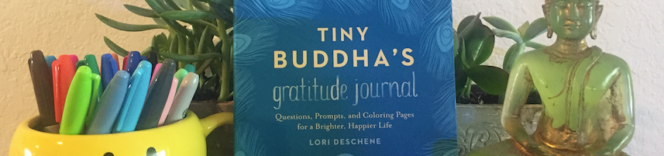
Tiny Buddha’s Gratitude Journal Giveaway

UPDATE: The winners for this giveaway have been chosen. They are:
- Keri Olson
- Your Computer
- Kelly Hawkins
- Jadice-Teal N Momz
- Maryrose
Hi friends! Last week I launched Tiny Buddha’s Gratitude Journal, after sharing some of the book’s fifteen coloring pages over the past several weeks. I’ve received some wonderful feedback so far, and I’m thrilled to know that so many of you are finding the book fun and helpful!
Along with today’s coloring page, I’m running a giveaway, offering five free copies. If you’ve already purchased one for yourself, you may want to enter the giveaway for a chance to gift one to a friend.
About the Journal
Including questions and prompts pertaining to both your past and present, the journal will help you see your life through a new, more positive lens.
The book also includes fifteen coloring pages, depicting awesome things we often take for granted, like nature and music.
With space for written reflection, these pages provide all the benefits of coloring—including mindfulness and stress relief—and also guide you to recognize the beauty in the ordinary.
Whether you’ve been gratitude journaling for years or you’re just giving it a try for the first time, Tiny Buddha’s Gratitude Journal will help you access a state of inner peace, contentment, and joy.

The Giveaway
- To enter to win one of five free copies, leave a comment below answering the question in the coloring page above.
- For a second entry, share this post on one of your social media pages and include the link in a second comment.
You can enter until midnight, PST, on Monday, June 26th.
If you’ve already received your copy, I would appreciate if you’d leave a review on Amazon here. It doesn’t need to be long—even a tiny review can make a big difference!
And if you’ve already colored a page or two, I’d love to see it! Please share it on social media using the hashtag #tinybuddhagratitude
Thanks so much, everyone. I am grateful for you!
-

10 Things I Wish Someone Would Have Told Me When I Was 18

“Do the best you can until you know better. Then when you know better, do better.” ~Maya Angelou
Can you remember what it was like?
Becoming an adult. Having to take responsibility for your life. Having the world opening up to you. Having to suddenly start making decisions and setting a clear direction for your life.
Exciting, yet terrifying and confusing all at the same time.
Looking back, there are things you wish you’d known, right? Here are some things I’ve learned that I wish someone would have told me when I was eighteen.
1. You don’t find meaning; you create meaning.
For a long time, I was constantly looking for what I was “meant to do” in life. Doing so can feel overwhelming, confusing, and shame-indulging. But here’s what I discovered: Finding is passive; it means that something or someone has to show up in order to get what we want. It’s outside our control.
So, instead of finding meaning, it’s better to create meaning. To indulge ourselves in projects and activities that feel meaningful to us. When we do this, we go from passive to active. From lacking control to gaining control.
2. You’re not fixed; you’re always growing.
I used to think that I was given a set of talents, skills, and behaviors. That was until I realized that I wasn’t wired fixed, but changeable.
If I want to be happier, I just have to shift my focus. Maybe that means writing a gratitude journal, expressing my appreciation toward others, and practicing seeing things from a positive perspective.
Since you’re always in growth, you don’t need to be scared of failing, as everything is a stepping stone to a new talent, skill, or behavior.
The same applies for what we’re good at. If you want to be a writer, then start writing. If you want to be a successful entrepreneur, then start reading, acting, and thinking like one. That’s the beauty of it all—you’re the creator of you.
3. Carefully choose who you take advice from.
People love giving advice. But here’s the thing: People don’t give advice based on who you are, but on who they are. If someone had a great experience starting a business, they’re likely to encourage you to do the same. However, if someone had a horrible experience with the same thing, they’re likely to, perhaps not discourage you, but at least point out things that can go wrong.
Here’s what I’ve found to be useful: Take advice only from those who have made the same journey (or a similar one) that you want to undertake.
4. You don’t need to know your passion.
“Follow your passion.” How many times have you heard this message and thought to yourself, “Argh, but I don’t know what my passion is!” Or, “I have too many passions and I don’t know which one to choose.” In general, I think this is rather crappy advice. For me, it caused more harm than good, because frankly, it stressed me out.
If you know your passion, that’s great. If not, don’t worry. Instead of focusing your attention on finding your passion, start following your curiosity. Just like a scavenger hunt, what pokes your curiosity is the next clue. And like Elizabeth Gilbert perfectly laid it out: “If you can let go of ‘passion’ and follow your curiosity, your curiosity just might lead you to your passion.”
5. Buy experiences, not things.
I used to spend a lot of time thinking about what type of designer bag I’d purchase. Don’t get me wrong, I love beautiful things and have no problem buying them. But I’ve learned not to put my happiness in them.
When I think back on my life, what I remember are the beach parties in the Dominican Republic, the soirées I spent with friends in Paris, and the walks with my sister in Central Park.
Experiences are what change us. They help us open up doors to new people, cultures, perspectives, and potentially a whole new world. So, invest your money well.
6. Life is always now, not tomorrow or next week.
Oh gosh, if I had a nickel for every minute I’ve spent either worrying about the future or contemplating my past. It would probably make up more time than what I’ve spent in the present. Pretty bizarre, no? And I know I’m not alone when I say that.
Our mind loves pulling our attention from the present moment. But this is where life is taking place.
We can’t have a full experience when our body is in one place and our mind is somewhere else (like sitting in a meeting thinking about what to eat for dinner). And that’s why we’re here, right? To experience life fully. So be present, allow those thoughts about the past and future pass by, just like clouds in the sky.
7. Don’t confuse means goals with end goals.
Vishen Lakhiani did an amazing video where he explained what I didn’t get for so long: end goals and means goals.
End goals define an outcome that describes exactly what you want. This can be seeing your children grow up, being truly happy, and traveling around the world. Means goals can be about getting into a specific university or company or making a certain amount of money. They are there simply to support your end goals.
When I became uncomfortable in my “dream job” in Paris I couldn’t understand why. It included everything I’d ever dreamed of: a good paycheck, travel, and fun colleagues. But I had confused a means goal with an end goal. What I truly wanted was to start a business where I could create, contribute, and connect with other people.
8. Connections, not grades, are the key to success.
Growing up, I was really focused on getting good grades. I thought that good grades would be the key to a successful life. They’ve helped me to open up doors, but the game-changer hasn’t been my grades, it’s been my connections.
Knowing the right people and connecting on a deeper lever is much more powerful than anything written on a piece of paper. Mind you, this, of course, depends on what kind of opportunity you’re after. But, for me, looking back, what served me during my years at university wasn’t the grades I got; it was the connections I made.
That’s how I’ve landed jobs, speaking opportunities, and have been featured on podcasts–things I otherwise never would have heard of or been considered for.
9. Everyone is doing the best they can.
I truly believe this. Everyone, no matter how annoying, self-destructive, or provoking they might seem, is always doing the best they can based on their mood, experience, and level of consciousness.
I used to get angry or upset if someone was rude, pessimistic, or didn’t deliver projects on time. Today, I know that I’m not in the position to judge. I don’t know what they battle. I don’t know what’s really going on in their life. All I can trust is that if I was in their shoes, I might do the same thing. This perspective has saved me a lot of energy that I previously used to waste.
10. Know your “why.”
Often, we place a lot of focus on what we do or how we do it. Seldom we ask why we do it. If I would have dug deeper in my “why’s” when I was eighteen, I would have connected more to my desires. Like this:
Question: Why do I want to get this education?
Reply: Because I want to get a good job.Question: Why do I want to get a good job?
Reply: So that I can earn good money, work on something I enjoy, and get a nice title.Question: Why do I want that?
Reply: Because I want to feel secure and free, to explore the world, to create things, to feel respected, and to connect with myself and others.”When I got clear about my “why” it became obvious to me that I wanted to work with people, have my own business, and to be able to work from anywhere in the world.
Digging into the “why” really narrows down what’s important. Not having a clear “why” proves that what we’re aiming at isn’t worth pursuing.
Eventually, Everything Will Make Sense
Sometimes we stumble and fall. Sometimes the road is rocky. Sometimes we question if everything will make sense in the end.
Looking back at your eighteen-year-old self, what would you tell them?
To be easier on yourself?
To stop worrying and have more fun?
To trust that everything happens for a reason and that things will work out?
From this perspective, what do you think an older version of yourself would have told you today?
To be easier on yourself?
To stop worrying and have more fun?
To trust that everything happens for a reason and that things will work out?
You get the point.
As Steve Jobs said, “You can’t connect the dots looking forward; you can only connect them looking backwards. So you have to trust that the dots will somehow connect in your future. You have to trust in something – your gut, destiny, life, karma, whatever. This approach has never let me down, and it has made all the difference in my life.”
-

Think You’re Not Good Enough? How to Stop Holding Yourself Back

“Stop holding yourself back. If you aren’t happy, make a change.” ~Unknown
Growing up in a culture where physical beauty determines how successful you are in finding a job, a suitable husband, and a promising career, and most importantly, bringing honor to your family reputation, I was a disappointment to my family, especially to my mother.
She was the definition of a perfect beauty—5’6″, slim, big eyes, high-bridged nose, perfect skin, and gifted with charisma. I was the opposite.
As I got older, my mother’s negative words got louder and louder. They were a constant reminder that I wasn’t good enough; I was useless and ugly, and nobody would love me because of the way I looked. I was excluded from all of our family trips and left alone in the house for days with my grandmother. Because of how I was treated, I started to believe that I would be a loser for life.
At twenty-nine I thought I was healed, until one phone call changed everything and forced me to re-evaluate what I believed about myself.
I got a job offer to oversee one of the biggest commercial real estate investors in North America. The job consisted of creating twenty-two financial budget packages in three months, while convincing the client to sign a two-year deal with the company and restructuring the entire accounting department.
I was convinced that I could not do this job, despite all the encouragement I received from my husband and best friend. I knew it would be a great opportunity for me to advance in my career, but I wanted to turn it down because I believed wasn’t smart enough and thought there were better candidates out there.
We all grow up with both positive and negative memory banks, with one being larger than the other, thanks to our parents and the environment we were raised in. As we get older we add to our memories through our life experiences. Every time we encounter situations we’re not prepared for, we refer to our memories to support our decision making.
Mine was full of “You cannot do well in this position,” “You don’t have enough knowledge,” “Other candidates are smarter than you,” “You cannot wear these clothes since you don’t have the body for it,” “You need to wear more make-up,” and the list goes on. So it was hard for me to seriously consider seizing this opportunity.
After much consideration, I decided to sleep on it. The next day, I looked back at everything I’d done so far in my life and realized that if I kept holding myself back, I’d never get to where I wanted to be. Happiness would never become a reality for me. I knew I didn’t want to live a life of “what if.”
I decided to accept the job, and three months later, I submitted twenty-two financial budgets on time, got that two-year agreement signed, and completed the restructuring three months after.
Here’s what I learned along the way. If you’re holding yourself back, like I formerly did, this may help.
1. Change your attitude to reflect what you want to become.
Your attitude will either move you forward or backward. It’s greatly affected by what you believe, since what you believe determines the decisions you make. Your beliefs largely stem from your past—what people said and did to you and what you concluded those experiences meant about you.
Become aware of what people told you when you were a child and ask yourself if those statements were actually true. Study your accomplishments and your environment, go over what you have done so far and see if they align with the accused statements.
Here’s what I discovered when I did this exercise:
Untrue fact number one: I was ugly. And yet people outside my family have complimented me on my looks. At first it was hard for me to believe the compliments were genuine. However, as I observed and listened to the actions and words that followed, I realized that I am not ugly, as my mother led me to believe. We’re all beautiful in our own way, and the beauty on the inside is more valuable than what’s on the outside.
Untrue fact number two: I was stupid and not good enough, unlike my siblings. And yet I graduated with a business degree from a reputable school, went on to get an accounting designation, and now work as a Manager of Business Solutions for one of the biggest commercial real estate companies in North America.
Untrue fact number three: I was useless. And yet every two years, I would travel back to my home country and help the elderly, who were abandoned by their families, with the essentials they need to survive. I also donated money to rebuild old temples so monks and nuns can continue their studies and have a safe haven away from home—all with my own money.
These are just some of my personal experiences. Write yours down and use them to shed any negative beliefs that don’t fit into your present situation. You don’t necessarily need to get rid of every belief right away, but start with something, no matter how small it may seem, so you can start letting go of your past traumas.
2. You know more than you think.
Stop selling yourself short by saying, “I don’t know” and instead say, “I will figure it out,” and ask yourself “How can I do this better?”
You have the ability to ask for help and connect yourself to the right resources as part of your self-development journey so you can become more, know more, and prepare for the challenges ahead.
The moment I decided to accept the job, I knew that I didn’t know everything, but I also knew I had the ability to reach out and get all the tools I needed to complete the project.
3. Let people in.
I started to believe in myself when I decided to surround myself with the right friends and mentors, both from work and at home. I opened up to them about how I felt, what I wanted to improve, and how I wanted to move forward from there.
I believe that having the right people behind you is one of the most critical parts of forming self-belief. That may seem counter-intuitive, since self-belief comes from inside, but it’s easier to develop confidence when we have people in our lives who believe in us and motivate us to go after the things that will make us happy.
Don’t be afraid to reach out to those you feel comfortable with and let them in on what you’re going through. When you believe in yourself enough to reach out to others, trusting that you’re worthy of their support, you will become a magnet for opportunities that you never thought were possible for you. Take a chance, be honest, and life will surprise you.
4. See obstacles as opportunities.
Life will never stop throwing obstacles at you, no matter how much you try to avoid them. Instead of running from them, learn to see them as opportunities to make what you currently have better.
I used to throw in the towel the moment there was a problem or a glitch in my life and my job. These days, I ask myself, “What are these problems going to teach me? What is life trying to tell me? What are the lessons I’m about to discover?”
Obstacles are there to show you new lessons. The message behind them will only be revealed to those who work hard to overcome them.
What I have learned after successfully completing the project for my new job is that I can do practically anything if I give myself a chance and time to learn and grow. By giving myself a chance in this job, I learned how to approach people better and how to get things done faster, more effectively, and more efficiently.
5. Do not allow defeat to win over triumph.
Remember in the beginning when I said we all have a memory bank? There are two kinds of memory banks. One is “Defeat” and the other is “Triumph.” In the first you store all your memories of things you believe you haven’t done well; in the second, memories of times when you’ve succeeded.
Everything you’ve ever experienced lives in one of these memory banks, which you will withdraw from in the future to inform your decisions. Your choice will inform your habits and behavior, which ultimately dictate your success and happiness.
Be mindful and guard your mind carefully so you don’t allow yourself to withdraw from your “defeat bank account.” I didn’t, and that was what saved me at the end.
6. Embrace mistakes as teachers.
Don’t be too hard on yourself. Mistakes are part of life. I have learned to love them. Though I don’t look to make mistakes often, they are my teachers in growth and self-improvement.
During my first job after graduation, I was friendly with a few people. We would have lunch together and share our thoughts on the company and our jobs.
Later on, they used the information I shared against me later. Thankfully, I didn’t lose my job, but it definitely hurt my chances for future promotions within the company.
Looking back, I’m glad I went through that early in my career, as it set a strong foundation for how I now interact with colleagues, which helps with my professional achievement7. Don’t give up just because things get hard.
If you really want something, you have to be prepared to seize opportunities, work hard for it, and never give up.
There were many times during my new job when I wanted to walk over to my boss’ office and give my resignation because every day it was a struggle to get just one thing done. However, deep down I knew that if I quit and went back to my old job, I would live an unhappy, unsatisfying, and regretful life.
Of course, that doesn’t mean you should never quit anything. You need to set goals that align with your values. If your values change along the way, as we all know may happen as we get older, it is okay to give them up and embark on a new journey. Knowing what you really want will help you determine when to give up and move forward, and when to stick to your guns.
—
You have the power to overcome the limiting beliefs that stop you from realizing your full potential and creating happiness. It starts with the choice to stop giving them power and start seizing new opportunities.
-

What Helps Me When I’m Tempted to Compare Myself to Others

“A flower does not think of competing with the flower next to it. It just blooms.” ~Zen Shen
Wow, you’re a bit of a loser compared to this guy, aren’t you, Will?
He’s winning at life—great job, great house, obviously making better money than you.
I sigh deeply and continue scrolling.
He takes care of himself, no Buddha belly, unlike you.
It’s true. I begin to feel like a useless lump. I keep scrolling.
No yellow and crooked teeth, either.
“His teeth are pretty straight,” I think to myself, staring at the guy’s mouth on the screen.
Damn right, they’re straight, like tic-tacs coming out of his gums. Perfect and white, not like yours.
I sigh once again and continue to scroll on Facebook.
—
Above is a typical dialogue between what I refer to as my Gremlin and me.
Does this voice sound familiar to you?
I’m talking about the troublesome terror that pops up like an unwelcome guest at the front door.
This nasty voice that loves to commentate and condemn—the voice that leaves us feeling unworthy and inferior, if we listen long enough. This, my friends, is the Gremlin of Self-Comparison.
I Imagine how different an exchange would unfold if it were another person (outside of my head) giving me the bashing.
If, for example, I was sitting on a park bench and a complete stranger walked up to me and said, ”Hey loser,” before pointing out how those around were superior to me. I imagine I’d walk off confused and leave this stranger alone after his unprovoked attack.
”Who is he to talk about me like that? He doesn’t even know me!” I would say to myself as I walk off.
I’d tell myself he must be deeply unhappy to treat other people this way, and I certainly wouldn’t take his comments to heart.
Most of us wouldn’t. We’d either ignore such criticism or defend ourselves.
So, here is the million-dollar question: Why do we accept talking to ourselves like this?
My belief is this: because it feels real, and we believe we are the voice. The truth is, however, we’re the listener, not the speaker.
But the voice of the Gremlin seems like a credible source. I mean, the voice comes from inside of us, why wouldn’t we trust it?
It helps to understand why we compare in the first place.
We are programmed that way. Comparing ourselves to others is a natural and inherent instinct. In prehistoric times this innate ability allowed us to swiftly analyze others and identify possible threats, yet in today’s society these quick critiques could be causing harm rather than preventing it.
Let’s face it: Facebook and Instagram newsfeeds are perfect catalysts for those episodes of self-pity and dissatisfaction, when we’re staring at our phone screens alone late at night, admiring how well everyone else seems to be doing.
We have to wonder, who are the newsfeeds feeding?
Could it be our Gremlins? Our insecurities? Our ego?
It dawned on me a while ago that I will never win playing the game of self-comparison.
No matter how much money I make, there will always be someone richer.
Even if I get in better shape, there will always be someone fitter and stronger.
But just knowing these things doesn’t mean I am able to stop comparing myself to others. I’ve had to accept my Gremlin is here to stay.
So what’s the alternative to trying to win against the Self-Comparison Gremlin?
I do my best to live by the following three mantras, as they serve me well in living with my Gremlin. Not “beating” or “silencing” my Gremlin. Living with him.
1. If I’m going to compare, I will compare who I am today with who I was in the past.
We’re forever growing, learning, and achieving. However, we fail to recognize and celebrate this when we’re listening to the Gremlin and concentrating on other people’s lives. Compared to who I was in the past, today I’m happier, wiser, and stronger. I’ve overcome anxiety, debt, disappointments, and heartbreak, and you know what? I’m still here.
We’ve all had challenges and we’re all still here. When we rate ourselves by the accomplishments of others, we overlook our own successes.
There’s one risk in comparing our current selves to our past selves: When revisiting the past, I may recognize that some areas of my life were better previously than they are now. I then have a choice. If I want to improve this area, I’ll set a goal. If right now I don’t wish to change, I’ll accept where I am. But what I won’t do is focus on everyone else’s progress and feel bad about myself as a result.
2. The people I’m comparing myself to are not flawless.
No matter how infallible and perfect others may seem, I’ll bet good money they have their Gremlins too. We are all equal in life. I’m no better than anybody else but I’m certainly not any worse. It’s important to remember that social media is only a highlight reel.
We all know real life is far more messy, raw, and flawed.
This is the beauty of being human.
3. I love and accept myself as I am right now (including my Gremlin).
Our Gremlins mean us well. Really, they’re trying to protect us by identifying areas where we may be “falling behind.” They’re only cruel because they’re scared—that we’ll somehow miss out if we don’t keep up with other people.
I named mine Colin. What I find helpful about naming the voice is I’m able to check in and ask, “Okay, who is talking up there? Is this my trail of thought or is Colin going off on one?” The more I learn to love Colin and appreciate his good intentions, the less he pops up. When he does, I thank him and send him a little love for being a part of me. I let him know I hear him, although I may not choose to listen.
I do my best to accept myself as I am, with my Buddha belly and less than perfect teeth. Because our imperfections make us who we are. My new favorite word currently is flawsome—meaning we are all awesome despite our flaws. Cool, right?
Wouldn’t life be boring if we were all exactly the same? Plus, if we were all exactly the same, perhaps there wouldn’t be any more Gremlins, and to be honest, I kind of like mine now.
-

The Delusion of Separation: We Don’t Need to Feel So Lonely

“The fundamental delusion of humanity is to suppose that I am here and you are out there.” ~Yasutani Roshi
You know those moments? Those brief, fleeting moments that shine through the grey of everyday life like motes of glitter caught in a sunbeam. The moments when you suddenly feel a connection to the world around you, when the quotidian alienation of modern life falls away and color pulses back in.
Walking through the torpor of another generic day, the background static of depression distorting the colors of the world, I often don’t realize I’m on a downward spiral until I look up and realize the sun seems a long, long way away.
The spiral staircase in my mind has steps that aren’t just worn smooth from use, but more often than not seem to be lubricated, too. At the bottom, the door marked “suicide” is always standing there, waiting… and how much easier it would be to push it open and walk through, rather than trying to climb back up those endless, slippery steps.
And then, out of nowhere, I lock eyes with another person and, unplanned and unplannable, we see each other.
I don’t mean we just notice one another, or that we look and immediately glance away before continuing our automaton stomping along the street. No, I mean we actually share a moment of mutual recognition: we see each other and share, for a long second or two, something fundamentally human. A connection.
Stereotypes and defence mechanisms flicker, before revealing themselves to be the smokescreen of fear they really are—a hazy distortion field which blurs our vision of what’s right in front of us. A barrier that we hide behind, but which has no more substance than fog.
The mind loves shorthand and shortcuts, but nobody can be accurately reduced to these crude symbols, and nobody really fits into the boxes that we’ve learnt to shove them into to make the complexity of the world more manageable.
“Manageable” is the spreadsheet, not the thing itself. It’s a lens, but like reading glasses, it helps us see something at one level, but distorts everything else if we look up and try to see anything more.
If stereotyping reduces, then these moments of connection distill. The essence rises and we can taste the purity of it. In these moments, looks aren’t deceiving, but revealing.
Recently I was walking across a narrow footbridge over a stream, heading back to the flat I was staying in. Just a few paces ahead of me, a couple of young men in tracksuits are leaning on a railing, chatting quietly. They hear me coming, and one of them looks around, a little tense as his instincts alert him to my approach.
We lock eyes. We don’t smile; we don’t exchange reflex pleasantries. But we both nod slightly and in that small moment wordlessly exchange several deeply human things.
A greeting; an acknowledgement that we see each other going about our day without need to intrude, question, or interfere; that we’re both enjoying the bright, beautiful morning; that there might theoretically be cultural and class divisions between us, but we are not bringing them into this simple interpersonal moment; that, in some ephemeral but weighty sense, we respect each other.
But even that sounds too cold. Because this, like all such moments, is definitely warm. The stranger on the terrace raising a glass to you in silent toast; the knowing look you exchange with a parent trying to control their young children; holding a door for a stranger and sharing a smile, or waving to someone on a distant ship and seeing them raise a hand in return.
These aren’t rituals, politeness, or other rehearsed and mechanical behavior. This is what all the meditation teachers are talking about when they exhort us to be present with what is, rather than the stories we impose on ourselves and the world around us.
It’s a brief mutual knowing, a wink around the corner of the matrix, when you both silently acknowledge the absurdity of the conventions that we live inside.
It’s the barista who doesn’t reel off the heavily scripted line when they pass you your coffee, because in the moment before they do, you see each other and smile, acknowledging in no words at all that the artifice is all pretty silly and you don’t need those lines to appreciate the exchange that’s taking place.
I’m not saying that we’d all become great friends and enjoy each other’s company if we actually got talking. But beyond those layers of accreted cultural, social, and personal compost, there’s a core of shared humanity, which, in these brief moments, we instinctively recognize and feel heartened by. When the zombie apocalypse breaks out, perhaps we will, after all, be able to rely on our fellow humans.
Zombies aside, I’m not being flippant. Disaster movies and the mass media love to scare us with visions of society and basic humanity rapidly collapsing in the face of major disasters.
After Hurricane Katrina, New Orleans was soon portrayed as a terrifying regression to a Hobbesian world of man-as-wolf-to-man, but this was simply untrue. The fears of the government, police, and media became the lenses through which they and then we perceived and approached the situation. The reality was altogether different.
As Rebecca Solnit describes in her fascinating book A Paradise Built in Hell, not only do the vast majority of people not turn savage in the face of disaster, they rapidly begin helping complete strangers, setting up ad hoc shelters, kitchens, search parties, and hospitals.
And the survivors of the natural and manmade disasters Solnit describes, even if they experienced terrible personal losses, they frequently look back on these periods as some of the best in their lives. In large part, this is because they felt that rarest of things in the modern industrialised world: that they had meaningful and consequential things to do.
Why? Because they were suddenly talking and cooperating with other people in the same boat as them, from complete strangers to neighbours they’d never spoken to in twenty years, despite living next door.
It was as though external circumstances triggered a different human mode of operation, back to something more fundamental and less complex.
Studying the same phenomenon, Sebastian Junger calls this a return to tribal existence, but this isn’t a story of reversion to an idealized pre-modern existence. It’s simply the rediscovery of what’s already there: it’s the collapse of the fiction Yastunai Roshi described—the delusion “that I am here and you are out there.”
Don’t get me wrong – there are plenty of times when I find myself actively avoiding any connection with the people around me. When I’m standing on the street, some part of my mind often starts whirring away hoping no one strikes up a conversation with me. What if they want something from me and make me feel bad for not giving it to them? Why can’t I just be left alone to my thoughts?
And yet being closed off to those external inputs isn’t much of a way to think or to live. It is, after all, based on fear. Fear of change, fear of disruption, and fear of a loss of control.
Those fears are simultaneously completely valid and entirely foolish: change is the only constant in life, so there’s no benefit in fearing it. And control is always an illusion and a constraint.
We imagine the moment of interruption as inherently negative, and yet we’ve got no idea what might happen next. Maybe this person simply wants to know the time, or they’re lost, and when we can help them out we end up feeling really good about it.
So far, so nice. And perhaps familiar. But why highlight these little moments, if we all know them?
Because each one seems to come as a surprise, or a slight relief. Because until they do, at least for those of us in big cities, we’re surrounding ourselves with countless Schrödinger’s boxes of uncertainty regarding the people around us. And so we cast our eyes downward, or keep our gaze frictionless when we look at the people around us, avoiding contact for fear of rejection or accusation.
It can feel so much easier not to open the boxes and keep things unknown, but the vertigo of what Pema Chödrön calls “groundlessness”—of leaning into the unknown with heart and mind open—is precisely where life happens.
We must learn to relax with groundlessness—of having no certainties, nothing solid to which we can cling, and no promise our smile will be returned. As Chödrön explains, Buddhism encourages us “to remain open to the present groundless moment, to a direct, unarmored participation with our experience,” with no guarantees at all that everything will work out the way we might want it to.
The trick is not to look for a reaction. Not to expect anything at all (and thereby avoid the ego’s spluttering outrage that this or that person was so damn rude for not returning our smile or greeting). That’s just giving with strings attached.
Instead, moments of connection happen when something is given freely, without the higher functions of the brain coming into play. In the same way we smile at a cute animal or a child laughing, we can remain open to everyone around us, because they are also us, living a different life. There’s no need for “why”; we can just do.
When we act without expectation, there’s no disappointment. Which isn’t to say something nice will definitely happen, but whatever does happen will simply be data—not something weighed in the scales of our prior expectations and found wanting.
For me and many others, depression creates a sense of desperate isolation; it seems to close us off from all connection. But while the sun can seem so far away—a pinprick of light at the top of that spiral staircase—this is just another distortion.
In truth, that light of Bodhichitta—the “awakened heart”—is still inside us and always accessible. Like the idea that we are separate from other people, it’s another delusion to think that we can ever be separated from the heart of Bodhichitta within us.
Being alone isn’t the same as being lonely, and in those fleeting glances and connections we can be both alone and yet deeply connected with the people and the world around us. We just have to be present enough to be open to them.
-

9 Things Grateful People Believe About Life

*This post was originally published at the end of 2015. Since this was around the time I decided to create my newly launched gratitude journal, it seemed fitting to share it again today!
“Gratitude unlocks the fullness of life. It turns what we have into enough, and more.” ~Melody Beattie
My title was a little misleading, at least based on my personal beliefs.
I don’t believe the world fits neatly into some massive yin yang with grateful people on one side and ungrateful people on the other; but rather, we all go through times when we feel high and low degrees of gratitude, and that’s only human nature.
It’s okay to feel angry, despondent, and disappointed. It’s okay to wish things were different—that we were healthier, or happier, or generally less lost in the world.
There’s nothing evolved about ignoring reality or repressing our emotions. But there’s a difference between embracing our feelings and stewing in them.
It might not be possible to be feel grateful all the time, but it is possible to be grateful more often than not.
The opposite was true for me for years, but I’ve shifted my ratio of grateful to ungrateful moments by adopting and reinforcing the following beliefs.
1. Everyone has something to teach or offer me.
That person who cut you off in traffic—she’s likely not a selfish jerk, but rather someone who’s having a stressful day and rushing. Annoying, yes, but thankfully this is an opportunity to practice patience.
That person who broke your heart—he’s likely not a sadistic bastard who took pleasure in your pain, but rather someone who was human and hurting, just like you, and did the best he could. Distressing, yes, but thankfully this taught you a great deal about yourself and what a healthy relationship entails.
This mindset was difficult for me to adopt. For a long time I felt convinced that some people were beyond understanding. And, I thought, like Miley Cyrus, some of them came into my life like a wrecking ball and provided absolutely no value.
I now see that I’ve learned something from every broken heart, broken hope, and broken promise. It’s all helped me become a stronger, wiser, more compassionate person, and the same is true for anyone who chooses to see it that way.
2. There’s something valuable in every challenge.
Just like every person can offer us something valuable, every challenge can contain an opportunity as well.
To be clear, I don’t think we need to see everything as a blessing in disguise. In her book Bright-Sided, author Barbara Ehrenreich shared her resentment for the implication she should see her cancer as a gift. I understand why she felt that way.
This goes back to what I wrote in the beginning—there’s nothing worthwhile about pretending we’re not shocked, saddened, and disappointed by the hardships that come our way. It doesn’t benefit anyone to ignore our natural feelings in the face of trauma and tragedy.
But it is possible to acknowledge that, while some things just plain suck, good things can come from them.
When my grandmother passed away several years back, we all wished we had more time with her. But that began a new tradition for my extended family. Once a week, on the day when my mother previously took my grandmother out to dinner, my aunt, uncle, cousins, parents, and siblings get together for “family night.”
It was a tradition born from tragedy, but one that’s brought everyone closer.
On the other side of loss there’s an opportunity for gain, if we’re willing to seek or create it.
3. Even if I don’t have what I want, I’m fortunate to have what I need.
Very few people have everything they want. True, some may have a lot more than others, but the vast majority of us have hopes that have yet to be fulfilled.
We have dreams and goals and ambitions. We want things and experiences and opportunities. We want to be a little richer, for life to feel a little fuller, and to generally get the sense that we’re moving forward, not backward.
Still, amid all the ups and downs and highs and lows, many of us have everything we need, or at least most of it. We have somewhere to live, food to eat, people to turn to, and the ability to pursue whatever it is we’d like to achieve in life.
Those things are not givens. Many people—and you may be one of them—do not have their basic needs met.
I didn’t always appreciate this, because it didn’t seem to make my challenges any easier. But if I didn’t have those needs met, my challenges would certainly be harder.
4. The “little things” are the big things.
If you keep a gratitude journal, you’ve likely recognized just how many touching, fortunate, or fun little things happen every day.
Recently I’ve listed the following in my gratitude journal:
- My new adult coloring books, which provide stress-relief and joy
- Getting to see the Christmas tree lighting at The Grove with my fiancé and an old friend (it happened before Thanksgiving—which annoys some people, I know, but not me!)
- Realizing the new season of Arrow started, and there were five episodes to watch
- Taking a hot bath with a mindless (okay, trashy) magazine
- Getting a cheap but awesome burrito for lunch
- Anticipating a fun family visit for Thanksgiving
- The smell of meatballs cooking in my parents’ kitchen
It’s not every day we get a new job, marry the love our life, or bring a child or passion project into the world. Most smiles in life stem from little things, appreciated.
5. I don’t have to have it all or do it all to be happy.
In the US especially, many of us hold the belief that we need to do it all, have it all, and be it all. We can’t miss out. We can’t fall short. We have to keep up, and keep accumulating.
Sure, it’s nice to cross an experience off our life to-do list, and we all love when we’re able to provide ourselves with something that’s caught our eye.
But grateful people realize that happiness comes from accepting and appreciating what is—and knowing that even if we never have or do more, we can live a full and fabulous life.
This doesn’t mean we need to forsake all our goals and desires and grow stagnant. Though I love the movie It’s a Wonderful Life, as I wrote previously, I don’t believe we need to sacrifice all our wants and dreams to be good people.
I do believe, however, there’s something to be said for putting in the effort, surrendering to the outcome, and recognizing that whatever happens, life can be beautiful.
6. Everyone’s blessings are different, and that’s okay.
When you’re caught up in that race to do more and be more, it’s all too easy to look around at who seems to be “ahead” and feel resentful. Grateful people realize that life isn’t a competition, and there’s no such thing as “behind.”
We’re all different people; we all have different talents, interests, priorities, and values; and we’re all on our own path.
What’s meaningful to me might not be meaningful to you. What’s valuable to me might not be valuable to you.
You might feel blessed to have four healthy kids. I feel blessed to be getting a fish tank soon. You might feel blessed to have just bought a new home in the country. I feel blessed to live in a vibrant apartment community in a city.
And you may have things I wish I had (I actually wouldn’t mind a healthy kid or two), but there may be things I have that you want. And that’s totally okay.
We’re all fortunate in our own way, for different reasons. All that really matters is that we recognize, focus on, and appreciate our own.
7. Things can, and will, change.
Every now and then, I look deeply at someone I love and remind myself that they won’t always be here. And I won’t be either.
It sounds morbid, I know, and it sometimes chokes me up to think about it. But recognizing that nothing and no one will be around forever makes it so much easier to focus on the good things and appreciate what we have.
And this doesn’t just apply to people. It’s not a given that any of us will do the same job until we retire, or that we’ll make the same salary, or that we’ll have the health we have now to enjoy the same hobbies.
Try as we may to insure things won’t change—with contracts and policies and commitments—things can, and will, change. Nothing nurtures a grateful heart like recognizing this, and acting like it.
8. It could always be worse.
Yes, it’s a cliché, and not something we want to hear when we’re going through a hard time.
I recently found an anonymous quote that reads, “Saying someone can’t be sad because someone else may have it worse is like saying someone can’t be happy because someone else may have it better.”
Knowing that it could be worse does not have to mean denying our feelings. But it does put things in perspective and make it easier to move through them.
After losing both of his legs, my grandfather could have been bitter. Clearly, many people had it “better” than him—they could walk. But he still had his sense of humor, his values, and the people he loved, and that was all he needed.
9. Life itself is a gift.
We live in a world full of teachers—both people and experiences—that enable us to learn, grow, and continually evolve into the people we want to be.
We have many, if not all, of our basic needs met, providing a foundation that allows us to comfortably enjoy life’s abundant simple pleasures.
We may not have it all, or the same things other people have, but we each have countless things, people, and opportunities to appreciate and enjoy.
This moment will never come again, and there’s no guarantee the moments that follow will look anything like this. Knowing this somehow makes the present more precious—even if things aren’t perfect.
And that brings us to this final belief: life itself is a gift.
It isn’t always easy, or happy, but it’s one hell of a ride—and it wouldn’t be without the bumps and turns. At least, that’s what I believe, and because of this, I’m grateful.
What do you believe?
-

Why We Procrastinate and How to Finally Do What You’ve Been Putting Off

“Low key change helps the human mind circumnavigate the fear that blocks success and creativity.” ~Robert Maurer
I’m currently working on my doctoral dissertation. It’s something I’ve been working on for many years. It’s something that I deeply believe in and want to complete, but I’m also the mom of two small kids and I run my own business.
Making time for to work on my thesis is low down on my priorities.
And for years I’ve been able to justify it to myself that I don’t work on it as much as I should because I don’t have the time.
That may well have been partly true while my children were younger.
But now as they’re getting a bit older, I realize that my procrastination is also about something else.
It’s about all the stories in my head that make working on this project unpleasant.
It’s about the fear, the self-doubt, the worry about not being good enough, the doubt about whether I’ll ever be able to finish, and the expectation that it’s going to be a really hard and frustrating process.
Because I do have time.
I have time to read and work on other projects that interest me. In fact, I make sure I create the time because I enjoy working on them.
This is something that I’ve only recently realized. Recognizing it has been so empowering.
Because I do want to finish it. I’ve dedicated so much time and energy to it, it would feel really good to complete.
Since recognizing this and recommitting to the project, I’ve been experimenting with an idea that so far has been really helpful, and I’m excited about its potential.
Sneaking Past Fear the Kaizen Way
The idea comes from the Japanese art of Kaizen. In his great book One Small Step Can Change Your Life: The Kaizen Way, Robert Maurer describes it as a gentle and elegant strategy to maintain excellence and realize dreams.
He explains how when we try to do big things and make big changes, it triggers our stress response and makes us avoid. So the solution is to make tiny, incremental changes, so imperceptibly small that you don’t activate your stress response.
All kaizen asks is that you take small steps for continual improvement.
As I was reading this I could immediately see where I was going wrong.
Each time I sat down to work on a paper I’m writing I was thinking about how I could make this a brilliant paper that would make the biggest impact and so do justice to the participants of my research.
Wow, the weight of the pressure. No wonder that felt like a big ask and made me avoid it.
The two strategies I have been working with involve asking small questions and thinking small thoughts.
1. Ask small questions to dispel fear and inspire creativity.
Big questions, such as “How can I quit my job and find my purpose?” tend to overwhelm us. Small questions help us get around our fear and start making progress, especially when we ask them regularly.
Maurer illustrates this point by asking you to imagine coming to work and having a colleague ask you to remember the color of the car parked next to you. You probably wouldn’t remember. If they asked you the same question the next day you probably also wouldn’t remember. But by the third day, as you arrived at work, you would probably pay attention to the car parked next to you.
Asking yourself tiny questions consistently helps you teach your mind what to pay attention to.
He recommends asking yourself your question a few time throughout the day for a number of days in a row.
I’ve been using this by combining two questions: “If I was guaranteed to succeed, what would I be doing differently?” and “What small step can I take today to move me forward?”
One idea that came to me today was to reach out to a colleague who I know was also working on her PhD while working fulltime. I shared my experience with her and her response: “Ali, I feel like you’re completely describing my experience. Let’s speak more and find out how we can support each other.”
We’re now going to support each other as accountability partners which I can already feel will make a significant difference.
Some other questions you could consider asking yourself daily:
How could I make working toward my goal more fun?
Who can I ask for help today?
What’s the simplest thing I can do with the time I have available?
2. Think small thoughts to develop new skills and habits.
The second strategy involves a kind of mental rehearsal called mind sculpting, which helps you develop new social, mental, and even physical skills just by imagining yourself performing them. Here you identify the task you want to achieve from your questioning process and then begin to imagine yourself doing it.
But instead of seeing yourself on a moving screen, as is the traditional visualization technique, you are advised to feel yourself doing the task and incorporate all your senses.
So I see myself sitting down, feeling my fingers on my keyboard, hearing the sounds of the birds outside, and seeing the screen in front of me.
And the important part—seeing yourself enjoying the process. Because we avoid what we imagine will be unpleasant and painful.
What I’m doing with that is giving myself the next two weeks while my children are on school holidays to spend a few minutes a day imagining myself working on it and enjoying it.
The idea here is that by doing this for a period of time, you start to rewire your association to the task, which makes it easier to then take small actions.
So choose a task that you’re afraid to do or something that makes you uncomfortable and decide how long you’ll practice for each day. Make the time commitment so little that you’re going to do it consistently, as repetition is important. Maurer recommends starting with a few seconds a day!
So what have you been putting off that you would love to accomplish? I’d love to hear in the comments below.
-

How My Drive to Succeed Led to Crippling Anxiety (And How I Got My Life Back)

“The only way out is through.” ~Robert Frost
The suffocating pressure from being obsessively focused on achievement and improvement led to escalating stress and anxiety over the years, but I ignored my feelings and kept attacking my goals.
Over time it became darker and heavier. It became crippling. It forced me to put a stop to almost everything in my life.
I’m a type A personality driven by a need for accomplishment. When I was in elementary school, I did my homework immediately after getting home even though my mom begged me to take a break. In high school, I regularly stayed up past midnight working on homework and scholarship applications.
This need to succeed brought many gifts. I succeeded in school, work, and sports. My methods to achieve my goals were consistently reinforced by positive results.
But this “success” came with a price that took a toll on my mental health. The only way I knew to succeed was through uncompromisingly high expectations and an unrelenting work ethic. When things didn’t go right, I was hard on myself and doubled down on my efforts.
The journey to reclaim my life from anxiety took six months that felt like six years. Along the way, I learned how to manage my anxiety (there is no defeating it) so that I could live my life again: accept everything as it is, try to succeed without attaching to the outcome, and let thoughts come and go.
Crippling Anxiety
Over the years, as I pursued one goal after another with laser focus, the anxiety grew. I didn’t understand what it was. I didn’t want to deal with it.
I felt ashamed of the emotions my anxiety created. I felt like I shouldn’t be having the thoughts that raced and spiraled through my head.
I tried to stop them through sheer willpower. That created more anxiety. I didn’t utter a word about anxiety to anyone, even myself.
About nine months ago, the anxiety I had been pushing down for years exploded like a volcano. It didn’t give me the option to continue ignoring it.
It forced me to stop almost everything in my life: writing, running errands, hanging out with friends, and taking part in any social activities. During this time, I only left my house to go to work. Commuting to work and making it through the day took up every ounce of energy and willpower I had.
I worried on a mental loop. I worried about worrying. I couldn’t stop the seemingly endless dark thoughts, fears, and mental distortions that surfaced.
My mental loops and panic attacks could last for six hours before I got a second of relief. I had an overwhelming fear of losing it all. The anxiety manifested itself physically through shortness of breath and elevated heart rate.
I twisted and turned in bed for hours because it was so painful. The anxiety came in unrelenting waves. It came with the force of a hurricane.
Days and weeks were swallowed by an endless loop of anxious and fearful thoughts that felt like they would never release their grip on me. Surviving each day became an all-consuming task.
Road to Recovery
Getting better was the toughest challenge of my life, even though I directed my will to succeed and work ethic to healing. Freedom from the prison of anxiety felt so far away that I couldn’t imagine what it would feel like to live my normal life again.
The recovery was painfully slow for my driven personality. At the beginning of the process, panic attacks and racing thoughts dominated my days. But I kept working at it, regardless of how dark and hopeless I felt.
I tried my best each day. I took it one day at a time. I went to therapy twice a week, exercised every day, meditated three times a day, and played Mario every day to relax myself and quiet my mind.
I tried to practice acceptance. I tried to not resist or dive into the dark thoughts. I say “tried” because most of the time I failed at successfully executing these habits.
I had the highest urgency to improve. My life depended on it. Every action I took was centered around managing and decreasing the anxiety.
Every day felt like an epic battle with my mind. I learned the hard way that there are no quick fixes for anxiety. There’s no strategy or seven-step program that eliminates anxiety from your life.
Slowly but surely, I made progress. It felt like three steps forward, two steps back. Yet, most weeks were better than the prior week.
Over time, I gained tools and skills that helped me cope with the anxiety. I learned new lessons every day about dealing and living with anxiety. I uncovered important truths about what had led me to this painful reality.
The anxiety forced me to examine my actions, priorities, and values, and where my life was headed. At the time, I wished there were easier ways to learn those lessons. Your greatest teachers are your failures. That’s the way life works.
I’d like to say it’s been a storybook ending. That I’ve conquered anxiety. That the racing thoughts and fear have vanished from my life. Anxiety doesn’t work that way, though.
That being said, I’m back to living my normal life. I’ve discovered a new definition of success. I’ve improved my ability to manage the anxiety.
Mindsets to Manage Anxiety
Anxiety still shows up unannounced. I can’t control the intensity or nature of my anxiety. However, I can manage it if I’m mindful of how I go about my days and how I react to it when it shows up.
Everyone’s anxiety is unique. If you’re battling anxiety, you’ll have to experiment to find out what works best for you. But you’re not alone.
Although people don’t tend to talk about their struggles with anxiety, more people than you can imagine deal with intense anxiety: an estimated 40 million Americans suffer from anxiety disorders.
Here are behaviors and mindsets that generally decrease my anxiety levels:
- Accepting everything in my life as it is
- Not worrying about things I can’t control or change
- Observing my thoughts from the sidelines instead of engaging with them
- Questioning thoughts: Do I have to go into this thought? Is this fear-based thought true?
- Allowing anxiety to spend time with me; riding the wave instead of going against the current and fighting anxiety
- Being okay with my flaws and weaknesses
- Letting go of the need to succeed and accepting the outcome of my actions, good or bad
These behaviors and mindsets cause my anxiety to spike:
- Replaying past experiences on a mental loop
- Being hard on myself when I don’t meet my standards
- Blaming myself for actions or thoughts that caused me more anxiety
- Resisting fearful thoughts or anxiety
- Engaging with and reacting to every thought; being in the middle of the storm of my thoughts
- Trying to deconstruct why I had a thought or feeling
- Trying to control my thoughts instead of my reactions to them
- Obsessing over what other people may think about things I did or said
- Needing to and having to succeed
Acceptance is the Key Ingredient
I resisted the concept of acceptance when my therapist introduced it to me. I thought if I practiced acceptance, I would lower my standards and give up my commitment to excellence.
I thought acceptance represented being okay with mediocre effort and average results. I thought it would lead me to lose the drive to succeed that has been one of the key ingredients to my accomplishments in life.
I was wrong. Acceptance can (and should) be paired with a drive to succeed. An engine to produce at a high level leads you to put in the hard work that’s necessary to achieve your goals.
Acceptance allows you to let go of the result once the hard work is complete. It frees you from worrying and being attached to the outcome, because that’s out of your control. Acceptance is living in the world of what is, instead of what should be, what could be, or what you want it to be.
Acceptance is a simple idea yet it’s difficult to put it into practice for a perfectionist with a tendency to overanalyze. Although it’s been a struggle to increase acceptance in my life, I’ve discovered a few tools that have been effective: meditation and reframing my mindset during and after anxious episodes.
Meditation has vastly improved my awareness of thoughts, feelings, and emotions. Awareness is crucial for managing anxiety effectively. When I’m anxious, step one of acceptance is to feel and acknowledge my emotions.
The next step is to ask myself some version of this question: “Is there anything that I’m not accepting in this moment that’s causing or increasing my anxiety?” Once I pinpoint what I’m resisting and choose to accept it, I know the anxiety will subside.
Many times, I can reframe my mindset in the middle of the anxiety. I can mentally shift from fighting the present circumstances to accepting them as they are. Other times, the anxiety takes over and I have to brace myself until the clouds clear. Once I’m out of the storm, I can dissect that situation and identify the lack of acceptance and the friction that led to the high levels of anxiety.
For example, an argument with my wife can trigger anxiety because I wish that the disagreement never happened. I can’t accept where I am in that moment until I accept that I didn’t act like my ideal self in that situation, and that I can’t go back to change the past. Once I accept the argument and the anxiety it caused me, the friction disappears and my anxiety levels start to drop almost immediately.
My performance can also be a trigger. I can get intense anxiety from mentally replaying the mistakes I made on a work project that didn’t go as well as I expected. I also experience anxiety when I fail to accept the way decisions are made in a large corporation. Or I don’t accept that people often behave in ways that are different than what I expect or value.
If I’m trying to control things that I can’t change or affect, I’m not accepting my current situation. Trying to act outside of my sphere of control is resisting the way the world works. It’s like not accepting that I can’t change the laws of gravity.
Once I accept my past mistakes or that I can’t control how others act and what their priorities are, I can fully accept my present circumstances. When I accept that I experience high levels of anxiety frequently and that my reactions to anxiety sometimes cause more anxiety, I can live without bracing myself for the next attack.
I can let go because I’ve accepted that I will have high levels of anxiety again and that I will make mistakes in how I handle the anxiety again. It doesn’t mean I like being anxious. It just means I’ve accepted where I am at this time in my life. I can take action from there instead of where I wish I was. I can take action within my zone of control.
I’ve experienced the deepest moments of tranquility that I’ve had in my life in the last couple of months. These magical moments happen during the brief windows when I’ve accepted everything in my life as it is.
My mind quiets because there is no friction or turbulence. I lose myself in the sounds and sights of my environment. I hear the birds chirp. I see all the different colors of the leaves.
Redefining Success and Anxiety
I used to be afraid of my anxiety because it felt so intense, emotionally and physically. Although I still experience intense anxiety on a daily basis, I’m now thankful for the anxiety I’ve experienced (sometimes even while I’m caught up in that crushing anxiety).
This is a perspective that only comes after being through the eye of the storm of anxiety. If you’re in the middle of that storm, your only job is to get through it so you can get to a place where you feel safe.
I’m thankful for anxiety because it has brought many gifts. Because of it, I quit relentlessly pursuing success at any cost. I started meditating. I began exercising regularly again. I prioritized balance in my life.
The most important lesson anxiety has taught me is that a successful life isn’t defined by how many achievements I’ve collected. Instead, success is building and nurturing relationships, being present to the little things in life, being grateful for the gift of life, exercising the mind and body, and living the life I want without looking over my shoulder to see what others are chasing.
I don’t always follow the formula I discovered for my new definition of success. But when I adhere to my success formula, my days are significantly better than when I fall back to my habitual ways.
-

Overcoming Envy: How to Stop Feeling Inferior and Insecure

“Comparison is the thief of joy.” ~Theodore Roosevelt
If you are suffering from the painful sting of envy, know that you are not alone. I was there too, for a very long time. Envy can be a crippling emotion. For me it has been connected to my depression, anxiety, and obsessive-compulsive disorder.
It has been a very painful twenty years since my attachment to envy began, involving comparison, competition, judgment, harsh criticism of myself and others, in a never-ending, futile attempt to soothe my wounded ego.
I was constantly, obsessively, relentlessly afraid of being inadequate and inferior—to a classmate, to a boyfriend’s ex, to a fellow singer. “She’s prettier, happier, more successful, she’s married, she’s a mother…”
As we come to learn, the comparison game never ends. Sometimes you might win, sometimes you will lose, but ultimately it is always self-destructive.
My mind would constantly compare myself to other women, and whether I fell short or came out on top, it hurt. I was deeply insecure. I hated myself. At my lowest points I was suicidal, drowning in feelings of worthlessness and shame.
With some soul searching, I discovered exactly how this envy-obsession originated: It began with deep-rooted fears of inadequacy and of being abandoned and replaced, stemming from my parents’ separation when I was three years old, and then from my father’s starting a new family when I was twelve.
Even though I knew I wasn’t at fault for the breakdown of my family, I subconsciously believed that it meant I somehow wasn’t good enough. I was innately unworthy.
These fears morphed into deep recurring depressions, intense anxiety and panic, insomnia, and the obsessive thought patterns of envy and competition.
The mental grooves I had been digging for twenty years were very deep. They were painful, draining, and exhausting.
There were days I was afraid I would never have peace, that I would always be suffering from the mental torture of OCD. Deep down I was terrified of being abandoned and unloved. My fears manifested as an obsession with my perceived inadequacy and inferiority to other women.
It has taken a lot of hard work to undo the damage these thought addictions have done to my soul and psyche.
Our subconscious mind, which normally works to help keep us safe by alerting us to threats, has a way of becoming twisted after trauma. Instead of being my own best friend, I was my harshest critic, always convincing myself that I wasn’t good enough, and that someone else was better.
Attempting to run away from my emotional turmoil created this monster of a neurosis. It was a self-harming coping mechanism to distract myself from my deep inner pain. It had become easier to obsess about whether or not someone else was “better than me” than to do the hard work of finding my own self-worth and unconditional self-love.
Envy (and the comparison and competition that went along with it) was my obsession, and social media stalking was my compulsion. If only I had spent as much time songwriting as I spent on Facebook!
The suggestions I make for releasing yourself from envy are all things I personally do consistently. I now have a newfound freedom and confidence, in myself, in my place in this world, and in my connections to others.
Now that I’ve done this very important inner work, nothing would make me happier than to help others spare themselves some of the self-induced misery I subjected myself to for so long. Here are a few of the things that have helped me immeasurably.
1. Stop comparing and competing.
We know how harmful it is to compare and compete, we know we shouldn’t do it, but for those of us who have been engaging in this destructive habit for years, how do we actually stop? It comes down to changing the inner narrative—how we speak to and about ourselves and others.
I began to tell myself, “I am different, unique, and special, not better or worse.” We are all on completely different paths, with unique journeys, qualities, experiences, perspectives. Logically you can’t possibly compare one person to another, but we know fear doesn’t always operate logically, so we have to retrain our minds. “I love myself. I am beautiful. She is beautiful. I am blessed. She is blessed.”
Over time I stopped wanting to judge. I stopped wanting to compare and compete. I stopped bashing other women, in what had been my attempt to make myself feel better by putting them down. It didn’t feel good that I had been so negative, mean-spirited, and critical. It hurt that my fear had morphed into hate. I was embarrassed and ashamed that I had blatantly become a mean girl.
It felt so much better to appreciate people’s positive qualities, to see their light and focus on that light.
I started saying simply “she is beautiful” about everyone I saw, whether outside on the street, or online on social media. It wasn’t long before it felt true, because it is true! Everyone is beautiful—uniquely, beautifully special in his or her own way.
I stopped critiquing people’s physical characteristics, their lives, their success, their happiness. I stopped trying to measure them against me, and vice versa.
I began seeing us all as beings of light, beloved children of the Universe, with unique, incredible gifts and talents to share with the world.
I saw other women as potential friends and allies instead of threats. I no longer feared people; instead, I welcomed them and saw us all as extensions of one another—human beings doing their best at this thing we call life, all of us divinely connected, all of us struggling with very similar, common, messy challenges.
2. Embrace sharing and learning.
Instead of trying to one-up the next person, let’s change how we view one another. How can we learn from, and be a resource for, one another? How can we offer help, guidance, and support? Instead of being in competition with one another, we could be a network of people eager to celebrate each other, share in each other’s successes, and help each other heal and grow.
I began to ask myself new questions about the people in my extended network, and the new people I met:
What can I learn from them, from their journeys, from their successes and mistakes? What can I teach them? How can I be inspired by them rather than feel threatened? How can I better be of service to others? How can I give of myself? How can I support and be supported? How can we share our strengths and build each other up?
Where once I saw division and competition, I started to see our commonalities: We had similar fears, goals, and life experiences. I realized we all have so much to give one another. I started to appreciate people more and to see all the beautiful things they were offering the world. I began to see our healing journeys as linked. I felt layers of fear begin to fall away.
3. Focus on healing.
I got down to business and worked on my overall mental, emotional, and spiritual health; my self-love, self-focus, and self-esteem. I began daily meditation and gratitude practices. I tackle the OCD with EFT (Emotional Freedom Technique, also known as tapping), self-hypnosis, and ERP (Exposure and Response Prevention) Therapy.
I listen to meditation music designed to help balance the chakras. I repeat affirmations such as “I am at peace within myself,” as well as ancient mantras. Two of my favorites include Sa Ta Na Ma—helpful for breaking negative thought patterns and healing the mind’s chemical imbalances that lead to depression—and Om Namah Shivayah, which helps access your truest, highest self and guides your divine transformation.
I use writing, especially songwriting, to explore and to dig deep. I journal, and then I journal some more! I make lists: lists of the things I love about myself, lists of the factors contributing to my depressions, lists of ongoing challenges I’m working on. I routinely go on social media detoxes. I practice celibacy.
All of these things help me to turn the focus inward, when for years I had defaulted to focusing on other people, namely with this inadequacy complex, but also with dating and unhealthy relationships.
The more I focused on myself and my happiness, the easier it became. I rediscovered Aisling in the simplicity of comfort and candlelight, in the wind in the trees, in cooking, in music. It was liberating to love myself in a real way, and to finally feel worthy.
We live in a culture that normalizes and encourages competition. We tear each other down, we judge, we are downright mean. We allow our traumas, wounds, and fears, not to mention our cultural conditioning, to make us hate ourselves, thereby hating others.
With time and concerted effort, though, I do believe we can heal our spiritual afflictions, even the very persistent, very destructive penchant for envy, self-deprecation, and sabotage.
-

Tiny Buddha’s Gratitude Journal Launches Today – Last Day for 3 Free Gifts
Today’s the day! I’m thrilled to announce that Tiny Buddha’s Gratitude Journal is now available for purchase, and if you order today, you can still get the three free bonus gifts.
I decided to create this gratitude journal/coloring book, with the help of the talented illustrator Rose Hwang, because gratitude and coloring have both greatly enhanced my life.
Coloring is not just for kids. It’s calming, creative, and meditative, and best of all, it’s easily accessible. You don’t need fancy equipment or an art class, just some markers or colored pencils and a little time and space to get lost in the colors.
As for gratitude journaling, it traditionally involves jotting down a few things you appreciated throughout your day, and I’ve done that for years.
I’ve taken a few moments in the morning or night to appreciate the small things (that I slept well, the sun was out, or someone hugged me when I needed it) and the bigger things (that my relatives are healthy, that I’m currently in good physical and mental shape, and I have a comfortable apartment in an area I enjoy).It’s amazing how much you can come up with when you consciously choose to look for everything that’s going right, and how much it can boost your mood.
I’ve taken this concept and given it more structure with Tiny Buddha’s Gratitude Journal. Each page includes a question or prompt to help you focus on a specific area of your life, including your past, your relationships, your work, your passions, and more.
The coloring pages depict common things we enjoy but may take for granted—such as nature and music—and space to reflect on what you appreciate about that thing.
If you use this journal regularly, I believe you’ll feel better about life, more optimistic, and less stressed and anxious.
It will help you shift your focus from everything you think should be happening to everything that’s already wonderful in your world. And armed with a new sense of presence and satisfaction, you’ll be more effective in creating positive change for the future.
Order your copy of Tiny Buddha’s Gratitude Journal now and receive the following three free gifts:
- Tiny Buddha’s Handbook for Peace and Happiness (an eBook not currently available for purchase)
- Gratitude Discovery, a Guided Meditation Experience from One Live Mind
- Three printable, colorable thank-you cards
Get your copy here:
To claim the free bonus items, forward your purchase confirmation email to bookbonus@tinybuddha.com.
Whether you’ve been gratitude journaling for years or you’re just giving it a try for the first time, Tiny Buddha’s Gratitude Journal will help you access a state of inner peace, contentment, and joy.
I hope you enjoy it as much as I enjoyed creating it!
-

How to Make Progress On the Goals You’re Tempted to Give Up On

“To create more positive results in your life, replace ‘if only’ with ‘next time’.” ~Celestine Chua
Most of us start each year with good intentions. We have a list of things we’re going to start or stop doing. The year feels fresh, and it’s time to be the person that we’ve always wanted to be.
At some point in the year the shine wears off and we start to go back to old patterns and behaviors. Some of us even write off the entire year if we’ve failed at our new years resolutions by the time we hit February, and decide to try again next year. Holding on to the idea that a new year somehow magically makes it possible for us to do better, we postpone change to a later date.
This is a little trick we play on ourselves; it’s a way to opt out of truly engaging in our lives. We’re effectively cheating ourselves and switching off because it’s too hard to keep showing up.
I used to do this every year. I’d set myself impossible goals in January and then as soon as I fell off the wagon, it would be game over.
I’d commit to having no chocolate ever again and then not only eat one but the entire box. I then decided I’d “broken the seal and might as well carry on eating,” I then declared that resolution out of date and postponed it to the following year.
I’d commit to going to the gym three times per week when I know in my heart that I am not a gym person, and then spend the first six weeks of the year finding reasons and ways to talk myself out of it.
I’d obsess about maintaining daily writing streaks because I knew I felt better when I journaled every day, but as soon as I missed a day I’d give up and not touch it until I bought yet another brand new journal to write in for the next year.
My intentions would often fall outside of my circle of influence—for example, deciding that I was going to improve my relationship with my sister by myself, without even talking to her about it so that the onus was on me. Of course, as soon as we had an argument I’d give up because it was “too hard.”
I was always so hard on myself, expecting that somehow I’d magically become this healthy eating, exercise obsessed, creative and brilliant being just by deciding to do so on the first day of the year.
Worse still, I wouldn’t acknowledge that I was probably already a creative and brilliant being, who just needed to unlock these qualities from within herself, because I was too busy scolding myself for not maintaining a streak or meeting impossible goals.
Sound familiar? How do we break this cycle?
1. Set kinder, more manageable intentions.
I’ve found that if I want to be healthier, I need to choose a small goal that’s aligned with that rather than something so big it feels too hard to do. So my intention this month, for example, is to do three minutes of meditation every day, or as many days as I can manage.
The length of time is small so it feels achievable. More importantly, it’s not about having a streak, but about showing up as many days as I can, even if I miss a day or two here or there.
2. Review regularly and gently.
I then check in every week and reflect on how it’s going with my intentions. I’ll celebrate the three or four times I managed to actually commit to them, and gently look at how I might be able to increase that number. What’s getting in the way of me meditating seven days a week? Am I rushing too much in the morning? How could I improve that situation? Or do I feel comfortable with the amount I’m doing and can I celebrate that it’s working?
3. Find a cheer squad.
I’ve noticed if I’ve told somebody else that I’m going to do something there’s a little more gentle pressure to actually do it. It’s not that the other person would be judgmental if I didn’t, but that I’ve verbalized and created this intention outside of myself—and I know that there’s a cheer squad or cheerleader waiting to tell me what a great job I did.
4. Become a cheerleader.
By the same token, supporting other people with their intentions and goals has brought me more focus on my own. Every time members of my online community check in with me to tell me about how they are doing with their intentions so I can cheer them on, it’s a gentle and kind reminder that I also have my own to progress and share with them.
5. Have a plan for when things go wrong.
One of the main reasons we give up on things is that we don’t have a plan for when things go wrong. If I come home late because of a hard day and I haven’t already planned a healthy meal that’s easy to make (or already prepared), then it’s almost a guarantee that I won’t have the energy to think about it and will order a pizza. If I haven’t planned for the possibility of this sort of thing happening, I’m not even equipped to deal with it.
The beauty of this is you learn as you go along. Sometimes things happen that you’re not prepared for and you act out of alignment with your intentions, but then you can look at why it happened (review regularly and gently) and try to put a plan in place for next time.
There will always be some scenarios you haven’t considered, but the pool will get smaller and you’ll be more prepared to stay true to yourself through adversity or temptation when you have plans in place.
I now have emergency meals in my freezer for when I get home and feel too tired to think about what to eat. Obviously, if I really want a pizza, I still order one, but it’s this intentionality of making the choice and being prepared that allows me to feel good about that decision.
6. Remember why you are doing this.
If it starts to get stressful, then you’re making it too hard. Sometimes I get stressed about not having had time to fit in my meditation practice (mostly because I’ve made the mistake of leaving it until later in the day rather than doing it first thing). Getting stressed about something that is meant to make you less stressed doesn’t make any sense.
If your goal is to be less stressed and you don’t have time to do the twenty-minute meditation you planned, why not breathe long and deep for one minute or thirty seconds? That counts. If your goal was to go to the gym and workout for an hour but the day got away from you, why not do five minutes of jumping jacks and running on the spot? That counts.
If you remember your why, you’ll find a workaround that motivates and keeps you going.
One way you can do this is to ask yourself the question: What would this look like if it was easy?
Give yourself permission to break this annual cycle. Be gentler with yourself and just show up and do your best. Surround yourself with people who will cheerlead, and commit to learning every time things don’t go to plan. It’s not about whether this is your year. It’s about the fact that this is your life. Go get it with kindness in your heart.
-

When Too Much Stuff Gets in the Way of All the Good Stuff

“The secret of happiness, you see, is not found in seeking more, but in developing the capacity to enjoy less.” ~Socrates
When Hans and I relocated from Chicago to Ann Arbor, we wanted to live in a house with a big yard so we could plant flowers and get a dog.
There were two backstories feeding these wants. I grew up on a farm and we always had a dog or two. And having lived in Chicago three-flats for a decade, I was ready for some green grass.
There were other things on our wish list, including enough space (to live in and for our stuff) and a garage (for the car and more stuff). And I think granite countertops might have been mentioned.
After looking at a dozen houses, we found our home. By today’s standards, it was actually on the small side at 1,400 square feet (compared to the average size home of 2,500 square feet).
There was a living room, family room, dining room, and kitchen. There were four bedrooms and two and a half baths. We don’t have kids, so that’s two bedrooms and a bathroom each—with half a bath left over!
We earmarked a room for my home office, a workout room for the elliptical, a room at the far end of the house for Hans to loudly watch hockey…
It seemed there was a separate room designated for every possible activity. And with so many rooms to choose from, it’s a wonder we ever ended up in the same room at the same time.
Filling the Space
Conventional wisdom says when you have space, you fill it up. And we did.
We brought furniture from Chicago and we bought furniture in Ann Arbor. We went to home stores and container stores and hardware stores. We acquired things to fill the space.
Whether we needed all that stuff wasn’t really discussed. We had the space and it needed to be filled (or so I thought back then).
But a funny thing happened as we settled into our new home after years of apartment dwelling. We realized a couple things that would have been nice to have figured out beforehand.
First, we hated yard work. Mowing the lawn felt like a huge waste of a weekend afternoon. My would-be green thumb forgot how much I dislike getting sweaty and dirty and toiling in the soil.
And the dog? Yes, we really wanted a dog to love and pet and love some more. It would’ve been easy to just focus on the wonderfulness of having a chocolate lab…
But as we started to notice the disconnect between the dream of a big yard and the reality, we realized the doggie dream was much the same.
What Freedom Feels Like
We started to embrace this about ourselves: The less commitment and obligation in our lives, the freer—and better—we feel.
Initially, this was really uncomfortable for me to admit. I worried not wanting responsibility and obligations made me less of an adult.
But as soon as I have that thought, the record skips and I say WHHHAAAT?!
Because I’ve realized being a mature adult is knowing who you are, what makes you comfortable in your own skin and at peace in your own mind—and then designing your life around what’s true for you.
In our more-is-better consumer culture, it’s easy to buy into all the messages about what we’re supposed to want and supposed to have. But what if you get those things and … meh … they just don’t resonate. Then what?
Because that’s what happened to Hans and me.
Everything looked great from the outside, but just didn’t feel quite right. It took us awhile to figure out the disconnect between what we thought we wanted and what we really wanted.
So, after the first year in our home, no flowers were planted. We paid someone to take care of the lawn. And I made sure to pet other people’s dogs whenever I got the chance.
But… we couldn’t unknow what we now knew: We’re not house people. Or the landscaping-on-the-weekends type. And while we’re totally dog people, we’re dog lovers—not dog owners.
So Now What?
Hans and I started to have the conversation:
- If we’re not house people, who are we?
- If we’re starting to have a different relationship to space and stuff, what does that mean?
- If we quiet the voices about how we’re supposed to live and what we’re supposed to want, what do we hear that’s really true for us?
We began to realize we wanted less. Less space and less stuff. Less housework and less upkeep. Less overhead and less oversight.
If you’re on your own, making a life-altering change can be a solo decision. But when you’re partnered up, it would be a tough compromise if one of you wants the McMansion and the other wants to go live in a Tiny House.
Luckily, Hans and I were on the same page: We had a short list of new wants.
We wanted to downsize.
For us, this meant we wanted to significantly reduce our square footage. We made a conscious choice to define “enough” for ourselves.
We rejected “more is better” as a default and really thought about how much space we need to be comfortable and how many rooms we want to clean.
All in all, we went from a house of 1,400 square feet to a hotel room of 300 (for six months while our apartment was under construction) to our current abode of 733 square feet. We have a kitchen, living room, bedroom, and bathroom.
And I can honestly say we’ve never been happier or felt closer. In fact, Hans and I joke that we could easily go lower, perhaps to 500 square feet. But, for now, our 733 square feet is home sweet home.
We wanted to rent, not own.
Home ownership has historically been something you’re supposed to want, save, and strive for. For me, renting an apartment equals freedom. Freedom from maintenance, but also the freedom to decide next month I want to move to Denver or Sweden.
Home ownership, on the other hand, feels locked in, less fluid.
I’m frequently asked: Don’t you feel like you’re just wasting money renting? Don’t you think you’ll regret not building up equity?
My answer: No and no. We’re paying rent to buy a lifestyle that works for us. And while we’re not building up equity, day-to-day peace of mind is priceless.
Of course, I’m not advocating apartment renting over home ownership for everyone. I’m only speaking to what I’ve come to realize is true for me—even as it goes against the societal norm.
We wanted less stuff.
When you halve your square footage it follows you’ll need to do the same with your belongings. In our case, we also gave up a garage (aka: three walls lined with large blue storage bins), which meant dramatically reducing our possessions.
In a smaller living space, every possession needs to earn its keep. Less square footage necessarily raises the bar for what comes into your home.
I found these questions useful for deciding what to keep versus what to get rid of:
- Do I love it? Is it beautiful? Does it enhance my well-being?
- Is it functional? Do I use it?
- Does it reflect who I am today and where I’m headed—rather than keep me rooted in the past?
- Do I only have this out of guilt or obligation?
- Am I okay with the price I pay for owning it—the overhead to maintain, the time to clean, the cost to insure, etc.?
I also noticed this about downsizing: Stuff is not just stuff.
We have all kinds of complicated relationships with the things we own. In fact, at times it can feel like our stuff owns us rather than the other way around.
When we decided to downsize, I realized I had to stop coping with life’s boo-boos, disappointments, and frustrations by acquiring more stuff. It’s easy to stuff feelings with stuff. They don’t call it “retail therapy” for nothing.
I also had to untangle my relationship to my belongings. For instance, if I get rid of something my grandmother gave me, does that mean I didn’t love her? Of course not, but it can be challenging to look at items objectively and separate the person from the thing.
We wanted to live in a walkable downtown.
When we decided to downsize we were lucky to already be living in a city with great walkability. In fact, Ann Arbor is often rated as one of the most walkable communities in the country.
We wanted to be able to stroll to a nearby restaurant for dinner on Friday night and walk to the farmer’s market on Saturday morning. We wanted to be able to walk to the post office, library, cafes, and movie theaters.
We all value different things, so walkability won’t be at the top of everyone’s list.
The key is taking time to really consider what’s most important and be intentional about the kind of life you create around that.
We wanted to be car-free.
In some ways living without a car has been even more interesting than downsizing. I’ve had a driver’s license and a car since I was sixteen years old. While Hans lived for a time in New York and L.A. without a car, he’d become accustomed to the convenience of 24/7 access to his own set of wheels.
So why did we want to be car free? We could just have easily changed our living situation and kept our car.
It was simply the answer to this question “How much overhead do we want to support?” Because even when you own your car (as we did), there’s the ongoing overhead of gas, insurance, registration, maintenance, repairs, parking, etc.
It comes back to knowing ourselves and embracing who we really are. I’ll say it again: Hans and I are not big on too much responsibility and obligation. Owning a car feels like both.
If public transportation or walking are not options, we get a Zip car for an hour or two or book a rental car for longer weekend trips.
We make living without a car an adventure rather than a sacrifice. There’s something fun about figuring out how to get from Point A to Point B when you can’t just step outside and hop in your car.
And I never say, We don’t have a car—as if it’s about scarcity. I always say, We are car-free to emphasize it’s a choice, an intentional act.
The capacity to enjoy less
Our journey of downsizing and living with less stuff has been one of redefining “enough.” Of figuring out the disconnect between what we thought we wanted and what we really wanted.
We have far fewer possessions and so much more time and freedom. With less square footage, we have less housework, less upkeep—and less stress.
Can you say less really is more?
Here are ten journaling prompts to help you explore your relationship to your stuff and your space.
1. What do you believe about how much living space you need? Where do those beliefs come from? Have they changed over the years?
2. Look around your home. Is everything useful or beautiful?
3. What truth about yourself are you on the verge of embracing? What will be different or possible when you embace this truth?
4. Do you think we live in a more-is-better consumer culture? How does this play out—or not—in your life? In what ways is less more?
5. Is there anything about your life that looks great on the outside, but doesn’t feel so great on the inside? What can you do to close this gap?
6. What is your definition of “enough”?
7. “Stuff is not just stuff. In fact, at times it can feel like our stuff owns us rather than the other way around.” Agree or disagree? Be specific by stating why.
8. Have you ever tried to shop away boredom, worry, or pain? What’s your experience with “retail therapy”?
9. What five factors are most important when it comes to your lifestyle wish list?
10. We don’t have a car versus We are car-free. How can you use this type of distinction in your own life to emphasize choice and intention?
-

Simple Steps to Live a More Authentic (and More Fulfilling) Life

“When one realizes one is asleep, at that moment one is already half-awake.” ~P.D. Ouspensky
Growing up, the only truth I believed existed was that of the religion in which I was raised. The truth? The world was ending soon. I left it all behind in my mid-teens.
Little did I know it would take me another twenty-odd years to figure out my own truth and worse, that knowing this truth would initially leave me feeling disappointed.
Once I became a mum, that’s all I was—mum.
The concept of knowing my own truth didn’t even enter my mind. I had never asked myself all the questions that force you to dig deeper: Who am I? What’s important to me? What do I really want?
As far as I was concerned, I had to just get on with it, so the years consisted of a bit of everything. I went from feeling like I was the luckiest person alive for having two gorgeous children, to wishing someone would come along and take over, to feeling like a complete failure, to feeling proud of myself for coping so well.
In other words, I did life—a mum’s life. Sometimes really well, other times, not so well, but the fact is, I did it. The only problem is, I still had no idea about my truth let alone the fact that I could have one.
After many more years, a friend lent me a book, The Magic of Thinking Big. That one book opened my mind to a whole new way of thinking. It helped me realize that I didn’t have to live in hope that my life might change someday. It showed me that I could take charge and steer my life in any direction I chose.
I read about believing in myself, dropping excuses that hold me back, and how I am what I think I am.
All of the information was new to me, yet it made so much sense. I was overjoyed to have been introduced to these concepts that I believed were guaranteed to change my life.
So it’s a shame the excitement I felt and the possibilities I saw in my mind for a happy, fulfilled life were fleeting. I returned the book to its owner and within days, the old adage “out of sight, out of mind” came into play.
I may have read the book twice, but it made no difference. The humdrum reality of my life took over and consumed my mind. I went back to being mum and justified my life with the very excuses I had been excited about dropping. I had forgotten that they were the reason nothing changed.
The good thing is, once my mind had been opened, it didn’t quite go back to its same level of thinking. Even though I hadn’t changed any habits, I still knew deep down that life could be very different for me and my kids. And then one day, it hit me.
I realized the world hadn’t ended and I was still very much alive, so I still had a chance to make things happen.
One day during a personal development course, I experienced an awkward moment that woke me up to what I had been unaware of all those years. During an exercise, I had to answer the question “Who are you?”
Silence.
I was so stuck on the question that not even the word “mum” flowed from my lips. On the seconds went as I struggled to come up with something—anything, but imagine someone asking you to say ‘‘my name is…” in a language you don’t know. I had no idea what to say.
To say I felt embarrassed would be an understatement. I had no sense of my own identity or awareness of the things that matter to me.
Thankfully, after a few more years of attending personal development related workshops and seminars, taking courses, reading books, and watching videos, I finally figured out my all important truth.
The truth is that I’m a bubbly, curious, deep, playful introvert, who currently values freedom, fun, health, creativity, family, and honesty—amongst many other things—and wants to make a difference in people’s lives.
But there’s also an ebb and flow to that truth. Sometimes I’m not bubbly and don’t even want to be. Sometimes, I don’t feel like being playful and would rather show my serious side whether it’s a necessity or not. These are traits that I embody often but not twenty-four hours per day. And over time, my truth may very well change.
You could argue that I’m so much more than mere labels, which brings to mind the following quote by French Philosopher, Pierre Teilhard de Chardin:
“We are not human beings having a spiritual experience; we are spiritual beings having a human experience.”
But in my human experience, right now, this is what I know to be true. Still, just identifying my truth didn’t change anything. I wasn’t feeling any happier, or more empowered. I was feeling quite the opposite: frustrated, confusied, and stagnant. Then one day, I had an insight.
I knew my truth but I wasn’t owning it. I would think about who I was and everything that’s important to me, but my habits stayed the same. Knowing I would only accumulate a ton of regret, I decided to start doing more of the things that mattered to me and being more “me” in my everyday life.
I enrolled in dance classes—something I’d wanted to do for a long time. I then took steps to clean up my diet, which resulted in cutting out refined sugar. I even found myself enrolled in a drama course.
That’s when things started to shift within me. I felt as though I was finally moving in the right direction. And it’s only going to get better from here, with a few challenges thrown in for good measure, no doubt.
So that, to me, is the missing key:
Know what’s important to you now.
This is where we can ask questions such as: What are my values in different areas of my life right now (for example, family, work/career, health, friendships)? What makes me feel alive? What am I doing when it feels like time goes too quickly?
Thinking about our current regrets may also give us a clue about what matters to us. The point being, without this knowledge, we can’t understand ourselves properly.
Own it.
Then, it’s time to celebrate our newfound knowledge and own it. Once at the forefront of our minds, we can start to look closely at our life and how our choices may or may not align with what we value and who want to be.
Do something about it.
Nothing will be different if you don’t make changes. It may feel scary, but which is more freeing: keeping a part of ourselves locked away or figuring out how to adopt a “this is my truth” approach to life?
Whether we make small or big changes doesn’t matter so much, just as long as we actually take action instead of getting stuck in wishful thinking; and we check in with ourselves from time to time as we grow, change, and adopt new values. We may need courage at times, but the payoff will be worth it.
-

Addicted to Helping: Why We Need to Stop Trying to Fix People

“Compassion is not a relationship between the healer and the wounded. It’s a relationship between equals.” ~Pema Chodron
After college, I was hustling hard to get a work visa so that I could stay in the US.
But then my mom got caught up in a political scandal, and without much reflection on how much this would alter my life’s plans, I dropped my dream of staying in America, drove 1,000 miles, and flew another 500 to be by her side.
Would she have crumbled without me there? My mama is a tough chick, so I highly doubt it.
But at the time, I (subconsciously) believed that when the ones we love are hurting, their pain trumps everything. Their pain gets top priority, and whatever goals and dreams we’ve been working toward now pale in comparison.
At the time, I thought that love meant tending to the other person’s needs first, always.
And this form of self-sacrifice came naturally to me (I’d behaved this way even as a young child), so I was lucky, right? Having inherent caregiver qualities is a beautiful gift, right?
Yes. And maybe not.
Are You a Natural Caregiver?
You’ll know if you have this trait too, because people will often tell you their secrets mere minutes after meeting you.
When someone has just been in a car accident or broken up with their boyfriend, you wrap your arms around them and for the first time that day, their body fully relaxes.
People tell you they feel at home in your presence. Safe. Heard. Cared for.
There’s so much beauty in having a trait like this. Without much effort, you nurture and care for those around you. It is a gift you give us all.
But there’s another side to the caregiver coin.
Helping other people can become addictive. It can begin to feel like the only way to show your love is to prostrate yourself at the needs of others.
Oh, you’re hurting? Lemme swoop in and save the day.
Oh, you’re broke? Lemme dump my savings into your bank account and all will be well.
Oh, you’re single again? Lemme set you up with my neighbor’s son.
Whatever your ailment, I’ve got a fix for you!
And the gratitude from the people we’re supposedly ‘fixing’ tends to flow so steadily that we become convinced of the healthiness of our stance.
We’re confident that healing every sore spot we see is not only natural and enjoyable, but it’s the main reason we were put on this planet.
When you carry the Nurturer Gene, fixing other people can easily become a destructive self-identity.
You will martyr yourself over and over again in order to meet the invisible quota of Lives Helped that floats above your head.
You will obsessively analyze how every choice you make might impact those around you.
You will assess every meal, every dollar spent, every vacation taken (or not taken) based on how it will impact the people you feel a responsibility to care for.
Because, in this unhealthy version of caregiving, our understanding of love has become warped. Love now looks like a relentless string of sacrifice.
Your thoughts might go something like this:
If I don’t love her with my constant presence, she will feel sad and lonely.
If I don’t love him with my attentive eye observing everything, he’ll get sick again, or maybe even die.
If I don’t love them with my efficiencies managing everything, someone will get hurt. Things will go very wrong if I’m not here to take care of them all.
Sometimes, love calls on us to invest our energy and time in tending to someone else’s pain.
But not 100% of the time. And not with the nurturing going down a one-way street, pouring out of the same person, over and over again.
If you see this pattern in any of your relationships, consider what it would take to expand your definition of what it means to nurture, to love, to care for.
A healthy caregiver not only nourishes the needs of others, but also nourishes her own.
Holistic nourishment. Nourishment of the whole of us, for all of us—which includes you.
Self-nourishment might look like hiring a babysitter so you can have a romantic getaway with your hubby.
Self-care might mean taking the job on the other side of the country, even though it means you’ll only see your parents twice a year.
Self-love might be quietly soaking in a bubble bath instead of probing everyone for a detailed account of their day.
You are not responsible for the world’s pain.
Share your talents and resources. Generously give your time and attention. But you cannot pour a magical tonic on the wounds of every person walking the planet. It’s not your job. And if it were, it’d be a sucky job because you’d fail at it every single day.
Especially when we identify as being “spiritual,” we can lift up words like “compassion,” “generosity,” and “kindness” to such a degree that we forget that even “compassion” sometimes must say no.
Even “generosity” has to allocate some of her resources for herself.
And even “kindness” must muster the nerve to walk away sometimes.
If you are the person in your relationship or family or company that defaults to caregiver and wound-tender, give thanks for the ease with which you dish out your love.
But be careful about inhaling that caregiver role to such a degree that your identity becomes dependent on having someone nearby to nurture.
Give your love. Freely and deeply.
And trust that even if you’re not there to ‘fix’ them, everyone will be just fine.
Photo by Valerie Everett
-

Accept and Value Yourself: 11 Ways to Embrace Who You Are

“You’re imperfect, and you’re wired for struggle, but you are worthy of love and belonging.” ~Brené Brown
I can’t remember exactly what it was my friend was trying to convince me I could do, but I had an argument to counter every bit of encouragement. There was no shortage to the ways I believed I wasn’t good enough.
She was trying to help me see myself the way she saw me—as someone smart, capable, and full of potential. I wasn’t buying it.
I’d been pretending for so long to be a better person than I really believed myself to be. I thought any positive thing another person said about me was just an indication that she was fooled by my illusion. If she could see who I really was, she’d change her mind about me.
I was tired of trying to convince her that I wasn’t actually as good as I’d been pretending to be. In desperation I finally asked the question I thought would end the conversation. Tears streamed down my face and the muscles in my chest squeezed so tightly that I could hardly choke out the words, “Do you have any idea how much I hate myself?”
“Yes,” she said, “I do.”
I was taken aback. I guess I’d expected my revelation to shock her. Apparently I hadn’t been hiding my self-loathing as well as I’d thought.
Part of me was relieved to know that maybe someone did actually see how much I was hurting. At the same time, I was terrified to discover that anyone could see more of me than I chose to reveal. I didn’t trust that she, or anyone else, could ever really understand.
Looking back, I think she did understand more than I originally gave her credit for. She may not have known exactly what I was feeling, but she knew what it was to hate oneself. She’d hated herself too.
While I was filled with self-loathing, my life was focused on keeping others from seeing who I really was. I didn’t like myself and couldn’t see how it was possible for anyone else to like me either. I hid while pretending to be someone I hoped was more loveable.
I chased after accomplishments to prove to myself and to others that I was worthy of love, but it was never enough. I couldn’t do or be all the things I thought were expected of me. There was always something more to prove.
For years I thought life would always be that way, but recently I was surprised to realize that I don’t hate myself anymore. Of course, there are still plenty of things about myself I wish were different, but my self-loathing is being replaced by acceptance.
I didn’t set out specifically to learn how to stop hating myself—I didn’t think that was possible. Instead, I was searching for direction in terms of a career. I was wondering how to make friends.
I read books and articles, listened to podcasts, and even worked with a life coach with the hope of making myself better. There wasn’t a particular experience or single idea that made the difference. What I found is an array of small practices and simple concepts that are helping me learn to embrace who I am.
The shift has been gradual enough that I didn’t notice how much I’d changed until I relived the memory of that old conversation. I’m no longer paralyzed by the belief that no matter what I do I’ll never be worthy of love. I’m slowly learning to trust and value myself for who I am, even as I acknowledge that there’s always room for growth.
1. Allowing myself to be a work in progress
I’ve put a lot of pressure on myself to always know what I’m doing and never make mistakes. I’ve missed opportunities to try something new because I was so afraid of looking silly. I’ve given up on things I want to do because I couldn’t do them as well as I thought I should.
Being a beginner is just plain uncomfortable, but we all have to start somewhere. I’m learning that my value doesn’t come from getting everything right the first time. Instead, it’s the mistakes and failures and trying again that help me learn and grow.
I can be proud of myself for being willing to practice again and again. It’s the baby steps, tiny changes, and consistent willingness to try again that develop the qualities I hope to embody.
2. Being curious about who I am
For much of my life, I defined myself by the ways I didn’t measure up to the person I thought others expected me to be. I didn’t know who I was—only who I was not.
I’ve started shifting my questions. Instead of wondering why I don’t care about what’s supposed to matter to me, I’m discovering what does matter to me. Instead of looking to others for clues about what I should think, I’m asking myself what I actually think.
I’m learning that being different from someone else doesn’t necessarily mean one of us is wrong. Recognizing that there’s more than one right way to be is freeing me to start exploring my own strengths, personality, values, and preferences.
3. Letting go of what I can’t control
I’ve fallen into the trap of believing that if I could just do and say all the right things, then people would like me. I’ve made it my responsibility to try to make sure the people around me are always happy. That’s a lot of pressure.
The thing is, I can’t control what others think of me or how they experience life. I can only be responsible for my own actions and intentions. I’m learning to focus more of my time and energy on living in a way that reflects my personal values instead of trying to control other people’s perceptions.
4. Doing things that scare me
A lot of things scare me. I’ve let my fear hold me back from many things I want to do. I’ve hated myself for being a coward.
I’m learning that bravery isn’t the absence of fear. Courage isn’t something a person either has or doesn’t. Fear doesn’t just go away if we wait long enough.
I’d always wanted to waterski, but was afraid of looking silly or getting hurt. I did take a few tumbles while I was learning. To be honest, I still get nervous every time I get behind a boat, but now I’m also anticipating the fun of skimming across the water.
I want to have deep friendships, but inviting an acquaintance to get together for coffee or introducing myself to someone I admire online feels vulnerable. What if she doesn’t like me? What if I say the wrong thing? The thing is, I don’t always click with everyone I talk to, but through taking the risk to reach out I’ve met some wonderful friends.
Every time I do something that scares me, I build trust that I’m capable of doing more than I previously believed possible and that a failure isn’t the end. I’m learning to work with my fear instead of letting it define me.
5. Chatting with my inner critic
My inner critic can be incessant and quite mean. For the longest time I believed everything she said about me and accepted the way she talked to me.
Then I started paying attention to what I was actually saying about myself. What if some of the awful things I believed about myself weren’t actually true? How might my life be different if I talked to myself with encouragement instead of criticism?
One of my favorite ways to question the critical thoughts inside my head and translate them into more helpful language is to write out a dialogue with my inner critic in my journal. In these back and forth conversations, I can uncover what my inner critic is trying to accomplish by being so mean.
As counterintuitive as it seems, often she’s actually trying to protect me. She tells me I’m awkward and annoying in hopes that I’ll be careful to only say things that are sure to win approval…or even better, that I’ll stay home where there’s no risk of being rejected. She tries to discourage me from sharing my writing anywhere it might be criticized by warning me I’ll never measure up to all the other amazing writers out there.
When I take the time to understand the motivations beyond my inner critic’s harsh words, I can decide for myself which risks I’m willing to take instead of just believing I’m not good enough. I can also start shifting how I talk to myself by asking her to rephrase her concerns in a kinder way.
6. Asking myself what I think
I have a tendency to try to figure out what other people think before deciding what I’ll do or think or say. I’ve made a lot of decisions based on what I believe other people think I should do. When those decisions aren’t a good fit for me, I’m quick to assume it’s an indication that there’s something wrong with me.
I’m learning that I can consider other people’s opinions without denying my own. Disagreeing doesn’t have to mean I’m wrong. When I take the time to ask myself what I think, I get to know myself better, reinforce my trust in my own value, and choose a life that’s right for me.
7. Feeling all my emotions
I used to think certain emotions were wrong to feel. I didn’t believe I had a right to feel angry or sad or hurt. There was always someone who had it worse than me.
I tried to suppress my feelings, but they’d get stuck inside and lash out in unexpected ways. I hated myself for not being able to control how I felt.
But there is no quota on feelings. Feeling my emotions doesn’t take away from anyone else’s experience. On the contrary, it increases my compassion for others.
How I feel doesn’t make me good or bad, but it does give me information about what’s going on inside me. I’m getting curious about what is behind the emotions I’m feeling instead of criticizing myself for feeling them. It’s not my job to control how I feel, it’s my job to choose my response to those feelings.
8. Making space for fun and joy
I used to feel guilty when I took time for anything fun. I didn’t think I deserved it. Hard work and sacrifice were the only truly noble uses of time.
These days I intentionally make space in my schedule to do the things I really enjoy—sewing, experimenting with art supplies, walking in nature. Not only does having fun energize me, it also reminds me that I’m worthy of care. I’m learning so much about myself and how I can create more beauty and connection in this world.
9. Sharing vulnerably with another person
Self-hatred prompted me to hide from others. I tried to only show a version of myself that I thought would be accepted. I was terrified I’d be rejected and alone if people knew the truth about me.
It’s hard to let another person see my fears, disappointments, and hopes. I don’t want anyone to know I make mistakes. It’s painful enough to hate myself—I couldn’t bear the thought of other people hating me too.
But it’s actually when I’m willing to share my vulnerable parts with another person that I’m reminded I’m not alone. We all have struggles. I can choose to hide mine or give another person an opportunity to support me.
10. Asking others how they see me
I have a tendency to assume I know what others think of me…and I tend to assume it’s bad. Making these assumptions keeps me from knowing the truth about how others actually see me. It also denies the support and encouragement they try to give me.
One of the scariest exercises I’ve done is asking people close to me to share what our relationship means to them, what they see as my strengths, and what qualities they like about me. It feels so presumptuous to ask another person to say something nice about me. What if they think I’m arrogant? What if they can’t think of anything positive to say?
And yet, in taking that risk, I get a glimpse of myself from another perspective. Sometimes I get stuck filtering my view of myself through all the ways I believe I’m not good enough. I need someone else to point out the parts of myself I just can’t see.
11. Compiling evidence
I still often default to focusing on the ways I don’t measure up. Sometimes I need a reminder of the best parts of who I am. I’m continually working to develop a habit of noticing the qualities I value instead of just looking for things to criticize.
I journal most days and I reserve the last three lines of the page for a set of small lists. I look back over the previous day and list what I am grateful for, evidence that I am loved, and ways that I am good enough. Each day these lists help me practice looking for my worth instead of just all the ways I fall short.
When I’m feeling low, it’s hard to remember the good things about myself. I keep a small notebook where I record compliments and positive comments others make about me, as well as the things I’m learning to value about myself. I turn back to this notebook when my opinion of myself could use a boost.
—
We don’t have to wallow in self-hatred, but leaping straight to self-love can feel impossible. Instead, we can make small shifts and adopt simple practices to help us learn to accept and value who we are right now, even as we continue to change and grow.
Will you join me? Choose one idea or practice to try this week. Remember, you’re allowed to be a work in progress!
I’d love to hear how it goes. What are your biggest obstacles to self-acceptance? What has helped you learn to appreciate who you are instead of beating yourself up for something you’re not? Let me know in the comments!
-

How to Stop Sweating the Small Stuff and Let Go of Your Grudges

“Let today be the day you stop being haunted by the ghost of yesterday. Holding a grudge and harboring anger/resentment is poison to the soul.” ~Steve Maraboli
You are tired of it, aren’t you?
You find yourself arguing again. You feel anger rising up in you.
You realize there’s no use in trying to explain your position and decide to stop the conversation.
But the topic still buzzes in your head…
This used to define my marriage.
The first few years of my marriage were constant arguing. After each argument my mind would run over and over the things he had done to hurt me, the things I was expecting him to do, the things that I couldn’t trust him with.
I’d spend days without talking to him, my anger festering inside me.
After a couple of days I could still feel those negative feelings eating me inside, so I’d half-heartedly reach out to the “enemy.”
How long could we keep on going like this?
The power struggles, the held grudges, the unhappiness were taking a big toll on our marriage. They were creating distance between us. The strong bond we had was dying.
Finally I asked myself, “Where are we going? Are we going to let grudges ruin our marriage? Is our marriage going to become another statistic?”
After some thinking I realized the arguments were always over minor things, not important values, not the things that made each of us who we were.
Chores were a constant source of grudges for us. I’d expect him to spontaneously help. But he was wired differently. Unless I asked him to do something, he wouldn’t do it.
Why wasn’t he more helpful? Couldn’t he see that I was tired and needed help with the dishes? I’d wait for him to offer to help but he’d just sit at the table.
By the time I was done with the dishes I’d be so mad I’d snap at the first comment he’d make.
It was not a healthy situation.
We finally decided to make some changes. We decided to put our marriage first. To put small differences aside, at least most of the time.
Grudges are poisonous.
Deep down inside you, you know you should vanish them from your mind. They steal your happiness. And bottled up, that anger will rob you of your health, too.
Is it worth it to hold onto grudges?
Of course not!
Avoid Sabotaging Your Happiness
Whether it’s your partner, a friend, or a relative, grudges creep into our relationships. We are imperfect people living with other imperfect people in a very messed up world.
But we get to choose if we are going to put a higher price tag on our relationships and save them from ruin.
Of course, not every relationship is worth saving, but some are.
If you reached the point where you feel you need to decide to stay in the relationship or pull the plug, it will help you to sit down, once your anger is gone, and go through these seven eye-opening points.
1. Decide if you want to win the battle.
At the time of the argument you decided that you couldn’t let go. It was an important issue for you.
Is winning still important? Are you willing to permanently harm your relationship over this disagreement? You may find that the issue is very important or maybe not as much as you thought back then.
It’s up to you to decide.
2. Evaluate the importance of the argument.
You can’t evaluate impartially when you are angry, so don’t be hard on yourself. But once you aren’t angry any more, maybe after a good night sleep, you can continue the healing process.
Then ask yourself, am I compromising my beliefs if I let the grudge go?
In our marriage, I realized our grudges were based on petty things and the solution was within our reach. Communication was the key.
We didn’t change overnight. Years later we still have to work on letting go of grudges every now and then. But gone are the days of constant bickering.
3. Know that every relationship involves at least some struggle and disappointment.
No relationship runs smoothly all the time. You are going to have disagreements in every relationship. It’s part of living with others.
You may wonder, “What if it happens again?”
Grudges will happen again with this person and others. In our marriage disagreements happened again and again and again. We both had to learn how the other person communicated and the best way to work together.
But ask yourself, are you willing to live your life alone? You’d be missing out on a lot of bright, fun, and happy moments.
4. Ask yourself if you’re truly “winning” by holding on to your grudge.
If you decide not to let go you’ll keep your ego intact. You “win.” Or do you?
What are you sacrificing? What do you gain by holding on to the grudge?
Sometimes the person you had the discussion with is not someone you should keep in your life, and sometimes it is.
In any case, keeping grudges is not good for your inner peace. Your mind goes down negative circles and that harms you more than anyone else.
5. Recognize the power of forgiveness.
Forgiving someone can be difficult. Of course it depends on what you are forgiving, but it’s still not easy.
But what do you lose by forgiving and letting go of this grudge?
In my life I’ve found that forgiveness can be exercised like a muscle. Small acts of forgiveness, like forgiving someone who cuts you off in traffic, help you become a more forgiving person. It’s liberating and brings healing to your soul.
6. See the bigger picture.
Think about the months or years you invested in this relationship, the good times you had together, the great things you found in this person. Is it worth it to harm the relationship because of a disagreement?
How important is the issue in the bigger picture?
Can you let go of the issue? Or, even better, sit together and try to reach an understanding? Hopefully that’ll be the case and you can move on and have a stronger friendship.
My husband and I sat together and put our grudges into perspective. It turned out our problems were not worth the grief they were causing, so we decided to work together to fix them.
After a disagreement, and once we have cooled off, we’d sit to discuss what had happened. We’d analyze what was said, what was implied, and what each had interpreted. We tried to stay as impartial as possible.
I realized I was jumping to conclusions.
We needed to work on our communication. I learned that I couldn’t count on him guessing what I needed. If I wanted him to do something, I needed to clearly ask for it.
It was not easy for me to ask, I was not wired that way, but I saw that when I’d ask for help he would be glad to give it. With time I got better at it and months would go by without disagreements.
We reaped great benefits from those conversations. And our marriage is stronger today.
7. Ask if you’re willing to ruin your relationship over this.
You’re hesitant to let go. You think that means accepting the other person’s point of view. You think that if you let go you are giving in.
Not true.
Your position doesn’t need to change, but you don’t need to ruin a relationship because of a disagreement.
You just chose to let go. You acted on your best interest to protect your health and inner peace against feelings of anger that want to bring you down.
Decide to Purge Anger from Your Mind
Grudges are like toxic clutter invading your soul and stealing your happiness.
Should you let them run wild?
Bottled up grudges and anger can make you sad and depressed, and they can cause health problems. Are you willing to submit yourself to that?
You can see that to let go of grudges is one smart, sensible, self-preserving decision away.
So choose to end the pernicious cycle of holding grudges and regain your inner peace today.