Tag: Happiness

  • How I Turned Fear and Anxiety into Joy and Fulfillment

    How I Turned Fear and Anxiety into Joy and Fulfillment

    “The largest part of what we call ‘personality’ is determined by how we’ve opted to defend ourselves against anxiety and sadness.” ~Alain de Botton

    I know fear and anxiety. We’re old friends. When I was fifteen, and school was over, I’d have to force one foot in front of the other. It was time to go home. I always kept going, and with every step I’d psych myself up.

    You see, once I’d gotten home, fixed my dinner, and finished my homework, my mother would come home. It was then that we would begin the nightly ritual of me talking her out of killing herself. I succeeded, but every day was a struggle.

    As I got older I became terrified of leaving my room and fixated on studying so I could go to college and leave her dramatic mood swings behind.

    I did get out. I went on to study at the University of North Carolina at Chapel Hill, a highly ranked school, studied abroad in England, and even went on to get a Masters Degree in International Studies from the University of Sydney in Australia. I worked hard and climbed in my career as a humanitarian worker.

    But the problem was that the fear and anxiety followed me. The chaotic energy of my childhood was still in every cell of my body. And as a result, I attracted people very similar to my mother and I was attracted to dangerous situations, such as visiting former war zones for work.

    After seventeen years of carrying this weight around, I buckled. My work suffered and I fell apart emotionally. I felt like a pilot trying to land an out of control jumbo jet with both engines on fire.

    I just couldn’t carry the weight anymore, so I began to unload toxic relationships left and right—quite to the shock and dismay of my family and friends.

    As I felt better and cracks of clarity began to seep through, the people around me pushed back. That’s when I made probably the biggest most dramatic decision I’ve ever made.

    I sold my house in Washington, DC, worked out a part-time telecommuting position with my boss, and moved to Asheville, North Carolina. I knew that I needed space to figure out who I was and to spend some quality time dealing with my past.

    Four and a half years later, I feel like a completely different person. I believe in myself, like really believe in myself. I meditate. I have clear boundaries that I stick to, and at a cellular level, I feel at peace.

    Now, I still have work to do, but I don’t dread it. Instead, I look forward to my continued work and getting to the next level of fulfillment, and I see life as full possibilities and joy.

    During this journey people have continually asked me how I did it. They’re amazed that every time they see me, I somehow have jumped to a more fulfilled level. Well, let me tell you.

    1. I made personal development my number one priority.

    Every time I made a leap, my relationship with myself improved, my relationships with others improved, new opportunities appeared in my life, and my business became less stressful, more streamlined, and more purposeful.

    2. I embraced my emotions.

    It was messy at first. I’m not going to lie. I cried every day for two years and I still cry fairly often, but it’s over quickly and I feel much better afterward. I understand now that I had to grieve for the childhood that I never had.

    The two tools that kept me sane and helped me push through were a) a regimented and strenuous workout routine that allowed me to get my anger out in a physical way and b) Iyanla Vanzant’s online Forgiveness Workshop, which guided me through why I was angry, allowed me to get to the heart of my anger (and more importantly, my hurt), and allowed me to let go.

    3. I stopped identifying myself as a victim.

    I’ll be honest, this one still comes up for me in surprising ways. I realized that I had been taking pride in being a victim. It had become part of my identity, and it was holding me back from believing in myself.

    4. I embraced that it’s how I feel that is the most important thing in my life, not the amount of money in my bank account, the status of the people around me, or the car that I drive.

    Danielle LaPorte’s book The Desire Map was instrumental in this mind shift. After reading it, I finally understood that when I coveted material things or relationships, I wasn’t coveting them; I was coveting how I thought they would make me feel. My whole life changed when I realized that I could have positive feelings now without these things.

    I began to incorporate experiencing belonging, feeling loved, and feeling safe into my morning meditation.

    There was a lot of reaching at the beginning. These weren’t emotions that I had ever experienced in a holistic and healthy way. But I kept meditating on them, and slowly, things, programs, podcasts, and people showed up in my life that showed me what those healthy emotions did feel like. And my meditations on them became more and more real. And now I know with certainty that my life will be filled with belonging, love, and feelings of being safe for the rest of my life.

    5. I embraced affirmations and mantras.

    I began to write down affirmations and post them throughout my house. When things were at their worst, I printed out on a piece of paper in huge font the words “I love you” and taped it to my bathroom mirror.

    I still cry thinking about how lonely and unloved I felt when I looked at that piece of paper every morning. But I kept it up there and I even started to say “I love you” to myself in the mirror.

    At first I could barely look myself in the eye, but after over five years, I look myself clearly in the eye and smile every time I say it, because I mean it.

    I also started to identify how I wanted to feel so I could create mantras. I still do this. At the moment I’ve borrowed one of Gabrielle Bernstein’s favorites and adapted it. Every time I am at rest I repeat to myself “I am supported in my life and business” and everyday I feel more supported.

    6. I got a dog.

    It may sound simple to some, but getting a dog has been one of the best decisions I’ve ever made. The obvious perks are the unconditional love, the constant shoulder to cry on, and someone who is always ecstatic to play with me.

    But the actual reason goes much deeper. Dogs’ behavior reflects the energy we put off into the world, so they’re like an instant karma meter. If we’re feeling chaotic and unsure of ourselves, they might protect us by attacking other dogs or misbehave.

    People always assume it’s the dog’s fault if he misbehaves, but the fault is almost always the human’s energy. Once I figured this out, I felt an even greater responsibility for the energy that I was putting out in the world. I now had to be calm, direct, and assertive so that my dog could have a happy life. During this process, he has helped me identify countless things to clear.

    7. I set firm boundaries.

    This one was and still is paramount to my happiness. I grew up in a family with essentially no boundaries. My parents would tell me about their love lives, their problems, and didn’t really allow me to have any material possessions that really felt like mine.

    So as an adult I had very poor boundaries. I’d let people take advantage of me and then get mad behind their backs. I’d ask inappropriate questions. The list goes on and on.

    One day my therapist mentioned boundaries in passing, so I looked on Amazon and found another life changing book, Where you End and I Begin by Anne Katherine. It rocked my world.

    I honestly had never even realized that I was allowed to set boundaries. I started setting them right away and my whole world started to shift.

    I now tell people when I don’t want to talk about a subject. I leave a party if I no longer want to be there and I only do things I want to do. As a result I am so much happier and grounded, and more importantly, I am now free to explore what it is that I really want.

    8. I understand that what people say often reflects what they think about themselves.

    This was a hard one. I grew up thinking that everyone’s emotional state and actions were my fault.

    As a result, I had a chronic need to please—and if I didn’t, I felt horribly guilty about it afterward. As I worked through my own emotional chaos, I began to understand how the energy that I brought to a situation could completely shift its outcome.

    I realized that I was creating a revolving mirror of chaos by projecting my own insecurities onto other people’s words and actions. Once I had reined in my inner chaos and could see the world with some clarity, I realized that most people do the same thing I was doing.

    In some cases I realized it didn’t even matter if I was in the room; their insecurities were the only thing that mattered in their world. Whatever I had to say wasn’t going to change anything.

    This realization was downright magical. I finally felt free. I look back and realize that so many situations that had made me feel bad had absolutely nothing to do with me. This has not only allowed me to forgive more people, but it has allowed me to more easily spot secure people who genuinely listen and gravitate toward them.

    9. I expelled negative messages from my life.

    I realized that the television shows I watched, the music that I listened to, and the furniture and objects I put in my house all impacted my subconscious.

    As a result, I stopped watching television where the main character was on the verge of dying or the world was going to end in every episode. This doesn’t mean I switched to shows with unicorns and bunnies. I’m an intelligent person who likes complex plots. But what I did was make sure that the shows I watched reflected how I wanted to feel.

    I started curating my music more carefully. If I loved the beat, but the song had negative messages about women, it got tossed. If the lyrics were about self-sabotage or unhealthy self-doubt, it got tossed. Or if I just didn’t like the beat, it also got tossed.

    What is now left is positive, affirming music that actually feels like me. I’ve even had people comment that the music I listen to feels like my artwork.

    I gave away or threw out all furniture or objects that I didn’t like or that reminded me of someone that I didn’t like. If an object made me feel guilty, it got tossed. If something was broken, it got tossed.

    I even threw away my dining room table! Every time I would drive to the Restore or Goodwill with a full car I was filled with guilt, but then when I drove away empty-handed I always felt an overwhelming sense of relief.

    I realized that I was so busy cluttering my house up with obligations and broken things that I wasn’t showcasing the things I loved and that brought me joy.

    10. I believe in myself.

    When I was trying to study abroad in England and get my Masters in Australia, I felt so sure of the outcome—in my mind there was no other outcome—and I felt so focused and purposeful. I realized this year that I had lost that drive.

    Going through my past in painstaking detail in order to heal had really taken its toll. In some ways it had dragged me into a holding pattern and I couldn’t see a life beyond it.

    Then I started to listen to the Tim Ferriss’ podcast. It’s a complex show hosted by a complex man, so you could take away any number of things. What I’ve taken away lately is that I need to start asking myself more absurd questions.

    Essentially I need to start thinking bigger. So when Tim mentioned an old 1959 book called The Magic of Thinking Big by David Schwartz, I devoured it. It is lifting me up in ways that I never expected (and making me chuckle at its totally 1950s take on life).

    As a result of this book, I finally understand what Tony Robbins has been banging on about—successful people and businesses are successful because they truly believe they will be successful, and they’re willing to do any amount of personal growth work to get to their goal.

    They are so sure of the outcome that nothing, not even their most horrifying ghost will stop them. They’re not going to push against the ghost, they’re going to embrace the ghost, feel its pain, and move through it.

    I believe that I can. And I believe that you can too.

  • Why Letting Go of Your Tight Grip Actually Gives You More Control

    Why Letting Go of Your Tight Grip Actually Gives You More Control

    “Anything you can’t control in life is teaching you how to let go.” ~Unknown

    I was growing impatient. I wanted an answer about something and it just wasn’t coming, no matter how hard I tried to prod it into happening. I was growing frustrated. And I was growing frustrated with my frustrations about it.

    So I decided to take a walk. The act of breathing in fresh air and hearing birdsong is centering for me. Just putting one foot in front of the other in rapid succession for an hour or two always helps to clear my head. I receive answers and guidance to my greatest questions when I’m walking. Call it a moving meditation.

    As I set out that morning, my eyes were drawn upward to three hawks flying overhead. While their aerial dance looked choreographed and elegant, I realized that the hawks weren’t instigating the choreography. They were simply letting go and floating with the currents. They circled and circled above me, wings outstretched, sailing and drifting.

    It dawned on me as I watched the hawks in flight that I’m rarely successful when I try to push or pull something in order to make it happen. Making an effort is noble and often necessary, but forcing something or worrying about it seldom yields the results you want.

    Sometimes, you just have to let go of your tight grip of how you think things should be or how quickly they should come together and simply let things run their own course. By releasing control and letting the currents carry you along, paradoxically, you gain more control—of your attitude and your response to what’s happening to you at the moment.

    Never was this truer in my life than when my mother was dying of cancer. My husband and I had decided that having Mom live with us would be the best solution. So, we rearranged our home, making one room her little oasis where she would be surrounded by her lovely things. Mom still wanted her independence, but it was no longer prudent.

    I worked well into the night getting everything ready for her arrival from the skilled care facility where she was rehabilitating after a hospitalization. No sooner was she discharged from the nursing home and settled in at our home than circumstances changed and she ended up right back in the hospital again and then back at the nursing home for more rehab.

    Later that same week, the unimaginable happened. I spontaneously and frighteningly became paralyzed from the chest down. My husband and I had been working hard to clean out Mom’s apartment. We’d been dealing as best as we could with her boomeranging back and forth to the hospital and nursing home. Then, all of a sudden, I needed medical care myself.

    At first, there were those medical professionals who thought I was simply exhausted and that my illness might even be psychosomatic. However, an MRI revealed a large benign tumor called a meningioma pressing so severely on my spinal cord that I suddenly became paralyzed.

    I was whisked by ambulance to the nearest large hospital an hour away, where a neurosurgeon who inherited my case soberly delivered the news that he was only cautiously optimistic I would ever walk again. I underwent the first of two surgeries to remove the tumor and release its pressure from my spinal cord.

    While in the hospital, unable to move, I realized that I had no other choice but to breathe, relax, and let go. I found it easier, then, to accept what was, even if I didn’t like it.

    All of my plans to care for my mother in our home were dashed. My mother’s care would have to be handed over to others at the skilled nursing facility. Mom would accept the situation. My work would have to just pile up. My employer would cope. My life was pretty much on hold as we waited to see how my spinal cord would recover from the surgery.

    I never once gave up faith or hope that I would get better. I visualized my return to my sacred evening walks. I saw myself strong and nimble and able to do what I could to support my mother on her final journey.

    But, I couldn’t plan at that point. I had to give in and let go. Like those hawks I saw overhead recently, I couldn’t allow myself to become impatient or to force the outcome. I had to ride on the wind and let the currents carry my wings.

    We all have those times in our lives when we want things to be the way we believe they should be—the way we planned them to be. Alas, sometimes life has another path for us.

    I believe that those things that are meant for us have a tendency to come our way and those doors that are never supposed to be open to us simply will not open.

    Some of our desires will take longer to manifest than we would want. There will be those things that will turn out differently than we anticipated—sometimes better than we could have imagined; at other times, not so much.

    Our difficulties and disappointments, however, have the ability to serve as blessings. Those blessings aren’t always clear at the moment, but with time, they often become visible.

    After months of physical therapy, I did indeed learn how to walk again. And now I walk every day because I can. I am blessed.

    For those of us who like to have a semblance of control over our lives, we will at some point learn that there are those times when we don’t have much say in what happens or how it ends. All we can do is be patient, filled with faith and buttressed by hope.

    Our letting go of the process or the outcome gives us more space to consider what’s happening at that very moment and to control our attitudes and reactions. By being mindful of our thoughts and attitudes, we can avoid getting stuck in draining emotions.

    It’s quite freeing to not have any preconceived notions, to be patient and to just let things flow. When I get out of the way and allow life to happen, the end result is often much better than I could have planned on my own.

    Surely, I want and need to have goals, plans and dreams. That’s what helped me recover from my paralysis and regain the ability to walk. But, I’ve learned that I can’t be shackled by my desires and plans. Instead, I’ve learned to stop the tendency to prod or push. I’ve found that I can ride the currents, allow them to sweep me along, and all will be well.

    When you let go and allow the currents to carry you, you’ll still move forward in life. Things might not turn out exactly as you planned, but the journey may give you more interesting scenery along the way. And in the end, you’ll have mastered control of what really mattered all along: What you thought and how you reacted to your circumstances.

  • How Our Smartphones Are Disconnecting Us and What to Do About It

    How Our Smartphones Are Disconnecting Us and What to Do About It

    “These days, whether you are online or not, it is easy for people to end up unsure if they are closer together or further apart.” ~Sherry Turkle, Alone Together

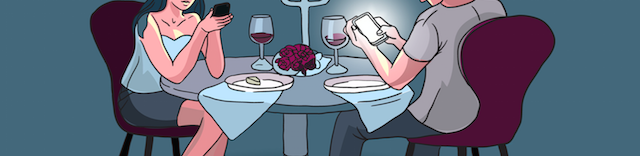
    There was rarely a time when my partner didn’t have her phone in her hand or, at the very least, in a place she could quickly grab it.

    We’d go out for a meal and it’d be there by her plate, positioned so she could dip in and out at any lull in the conversation.

    We’d take a walk and she’d have me in one hand and it in the other, ready to take a photo or catch the next Facebook notification.

    Even when we were in bed, if it wasn’t glued to her face, it’d be right by her side, lying between us like a small child who’d snuggled in for the night and ruined any chance of intimacy.

    It wasn’t good for our relationship, to say the least. Especially considering that, however unhealthy her relationship with her phone was, mine was worse.

    I didn’t realize it at the time. But in hindsight, I can see that most the time she retreated into her phone was when I’d long zoned out and been absorbed by mine: some random article or new app I’d downloaded, updates on the game, or a group chat with work colleagues.

    In that sense, we were perfect for each other. And looking around us, there didn’t seem anything too strange or excessive about our behavior. All our friends and the couples around us were also interacting with each other from beyond their screens, and they seemed perfectly happy—at least according to their Instagram posts.

    But something wasn’t right. Sure, we had our problems, I knew that. But it was something more than that: we were missing that deep feeling of connection. You know, that feeling you get when your partner understands you, without having to say a word. Or the fulfillment of being alone together and feeling like you’re the only two people in the world.

    Surely this fundamental pillar of how you feel about someone had nothing to do with our little glowing screens. So, none the wiser to what was going on, things gradually got worse and, eventually, we broke up.

    I wasn’t blind enough to see our phones had something to do with it, though. I mean, not being able to talk for two minutes without one of us phubbing the other was clearly an issue. And the non-stop messaging whenever we were apart couldn’t have been good for us.

    So when a similar thing started to happen with my current partner—both of us spending more time with our devices than each other and a feeling of disconnection growing between us—I knew there was something going on. And if one thing was for sure, whatever it was, I wasn’t prepared to let it ruin another relationship.

    I started to look more closely at our phone use and put it under the microscope: Why was it happening? Why did I prefer Candy Crush over spending time together? Why did we talk more via text than real life?

    What I found completely changed our relationship. Not only that, it changed my relationships with friends, family, and everyone I meet. And what’s best about it, I haven’t had to disconnect from social media or give up any of my beloved devices.

    I discovered the real issue wasn’t the physical presence of the phone, but rather how it had changed our idea of communication and influenced how we interact together.

    A prime example of this is phubbing—when your partner uses their phone while you’re talking.

    This was an everyday occurrence in my relationship. My partner would often ask me, “How was your day?” and start phubbing the hell out of me just moments into my response. I always thought she just wasn’t interested and was just being rude, but that wasn’t half the story.

    Because instant messaging was now our primary mode of communication, we’d trained ourselves to take words solely on face value—like you would a text or email.

    And so we would never stop to look beyond what was being laid out on the surface and consider all the other information-rich signals that make up the majority of communication—facial gestures, eye contact, tone, body language, and the emotions driving them all.

    Whenever we spoke, it was more like a means to an end. Something we did because we had to. Conversation was a chore that consisted of generic, predetermined questions and equally humdrum answers. All delivered in a way that was monotonous and unappreciative of the other’s attention and contributions.

    So it’ll be no surprise to hear our conversations were never stimulating and meaningful. And because of this, we robbing ourselves the chance to foster that deep sense of connection and understanding that’s so vital to a healthy relationship.

    Phubbing was only the tip of the iceberg. But it was enough to realize the fundamental effects phones were having on my relationships and wake me up to how they were undermining my ability to connect with people.

    Today, by simply being more aware of how we use our devices, me and my partner are closer than ever.

    What’s more, now we don’t use our phones as much as the average couple, but it’s not because we’re following orders from a couples therapist or because some rule from a relationship handbook told us to. We do it because we stay up all night talking and forget about them. Or because we go on a long walk and accidentally leave them at home.

    We do it because we’ve got back in touch with those deep, visceral feelings that nothing on Twitter or Facebook could ever come close to. And because there’s no way we’re going to let them fade away again.

  • Life Is Short—Don’t Wait to Do What You’ve Always Dreamed of Doing

    Life Is Short—Don’t Wait to Do What You’ve Always Dreamed of Doing

    “Life is short. Say what you’ve wanted to say. Do what you’ve wanted to do. Don’t wait until the only thing you can say is, I wish I’d had the courage to do it sooner.” ~Lori Deschene

    Lunch hour.

    Escaping the stale, re-circulated air of my office, I fled down Main Street in pursuit of freedom from the routine of the day.

    A rusty bell clanged against the door of a dusty used bookstore when I pushed it open.

    Scanning the horizon of bulging shelves and teetering stacks of magazines, my eyes suddenly met his and my heart began to race.

    They were the blazing orange eyes of an African lion on the dog-eared, sun-faded cover of a National Geographic magazine.

    I hadn’t seen those eyes in thirty years, but their impact on me hadn’t faded.

    As a kid I use to spend hours dreaming within the pages of these very magazines before cutting out pictures of unsuspecting lions and elephants to carry them around in a small wicker basket—a somewhat seventies version of a vision board.

    One Sunday night, I brought a three-page book I had written about these magical creatures, complete with pasted-in cut-outs, to the dining room table where everyone had gathered for dinner.

    Feeling proud with accomplishment, I handed it to my dad, a retired Naval officer, who held it up and began to read it aloud—only soon he couldn’t read anymore, for he was laughing so hard and so was everyone else.

    Of course they were just laughing because they thought it was cute, but I was only six years old. How could I possibly have known that?

    That day I stopped playing with magazine cut-outs of African animals and writing silly little stories to paste them into.

    That day I stopped dreaming about Africa.

    Have you ever had a dream that got away?

    Have you ever wanted to do something—paint sunsets, sing opera, run marathons, design skyscrapers—but stopped yourself before you even tried because it wasn’t realistic, practical or, in line with what your family/friends/co-workers expected of you?

    When we shelve our dreams, the human experience runs the risk of feeling more like a life sentence of obligations.

    When the lunch hour was up I returned to work with an African lion tucked under my arm.

    In the days that followed, I looked at that magazine often, dreaming of being under a blazing crimson African sky, only now that sky was clouded with regret.

    The opportunity of spending a ‘gap year’ volunteering in Africa or joining the Youth Corps had long since passed.

    Or had it? Yes, it’s true I couldn’t go to Africa for several months, but maybe I could volunteer in Africa for a few weeks.

    Over the next several weeks I gave myself permission to at least play with the idea. I began to research short-term volunteer opportunities in Africa with lions, elephants, and all the other magical animals I use to tote around in that little wicker basket.

    I began to budget, barter, and save, determined to make it happen.

    Even that old, worn-out lion on the magazine cover seemed to be perking up as the puzzle of a plan began to come together.

    Months later that lion, now freed from its magazine, was tucked into my passport folder as I boarded a plane for Cape Town, South Africa to volunteer on an African animal conservation project.

    Thrill and excitement deafened the echoes of friends and co-workers who thought I was going to Africa because I was ‘lost’ or approaching a mid-life crisis.

    No, I’m going to Africa because I want to stop saying, I wish I’d done it sooner.

    I arrived and met my boss, a khaki-clad, burly, young (ten years my junior) South African ranger named Gary.

    With big, strong hands on his hips, he eyed my tennis shoes and embellished denim clam diggers and said,

    “Let me guess, you’re here because you dreamed of Africa.”

    “Yes!” I beamed.

    He grunted and said, “Well it’s time to wake up, Canada. This is a working game reserve; these are wild animals.”

    “Okay.”

    “You’ll be sleeping alone over there in that tent. The electrical wire mostly keeps the animals out.”

    “Ooooo.K.”

    “And one last thing, Canada. Out here you’re going to have to learn to play with a lion’s testicles.”

    “What?! That wasn’t in the brochure! And even if it was, I won’t do that!”

    “Relax, Canada,” he said. “It’s a local expression. It means you’re going to have to get out of your comfort zone, take some risks. Have the courage of a lion.”

    The next morning when we began our patrol in an open-air jeep under a symphony of red, orange, lavender, and yellow hues playing above as the African sunrise came to life.

    Silhouettes of giant African elephants appeared in the morning mist.

    I was no longer dreaming in the pages of a National Geographic magazine, I was living them.

    Moments later Gary parked the jeep and handed me a rusty, heavy shovel and said, “Time to shovel sh*t.”

    Elephant dung. Mountains of it. It will be used as fertilizer in the reserve’s sustainable vegetable garden.

    Within fifteen minutes my back was aching, and my new work gloves were stretched out and so slippery with dung and sweat that they refused to stay on my hands.

    This wasn’t the dream of Africa I had. This was beginning to feel more like a nightmare.

    I began to question myself.

    You came all the way to Africa to shovel elephant dung?

    Maybe my dream of Africa was a silly childhood vision.

    Maybe I was lost and should have spent this money on therapy instead.

    What would my friends and co-workers say if they could see me now, knee-deep in dung, barely able to lift this antiquated shovel?

    They’d think I was a fool.

    Humiliation began to creep over me, engulf me even.

    But then I remembered Gary’s words; playing with a lion’s testicles was a huge step out of my comfort zone. I needed to have the courage of a lion. Lions don’t complain. They’re the king of the jungle because there’s nowhere they won’t go.

    And the lioness is the hunter, the conqueror, the fearless female who doesn’t back away from anything.

    And hey, I’m in Africa. I am in Africa.

    This elephant dung will help feed a village, and I get to contribute to something meaningful, something bigger than my mouthy little ego.

    Get out of your head and focus on that.

    I dug in deep. This was my dream, to come to Africa. As I became heavy with appreciation, the shovel lightened up.

    Days were spent rebuilding roads one stone at a time, by hand, darting a grumpy Rhinoceros who needed hormone therapy, tree planting within the lion’s camp as a pride of (satiated) lions looked on and moving more mountains of elephant dung.

    The elation, the satisfaction, the joy of being in this place was even greater than I had imagined and dreamed.

    It was the first time in my life I felt real and true meaning.

    It was the first time in my life I felt purpose.

    It was the first time in my life my soul was satisfied.

    And the irony was, it was the first time in my life I was paying to do a job instead of getting paid to do one.

    The more I gave of myself, the more I received.

    As my project came to a close, I removed the now almost unrecognizable lion cut-out from the pocket of my denim clam diggers and placed it with a young tree sapling in the lion’s camp.

    I no longer needed to tote him around for my dream of going to Africa had been realized.

    Sometimes we believe our dream has to be huge and world-changing, or at the very least net us millions of dollars so it has the stamp of society approval on it.

    Whether you’re moving mountains, or just moving mountains of elephant dung, a dream is still a dream, and it’s yours.

    The shadow of regret is only ever a decision away; we can keep it at bay by having the courage to play with our dreams.

    So how do we play?

    P – Give yourself permission to pursue possibilities and reshape your dreams to meet your current reality.

    L – Lay low. Don’t feel like you have to tell everyone what you’re going to do. Tell them what you did, that way you won’t be bogged down by other’s fears and doubts. Not everyone will be your cheerleader.

    A – Acknowledge your fears and doubts. When they appear, it means you’re doing something that’s meaningful to you, otherwise fear wouldn’t bother showing up.

    Y – Why not? You deserve to play, to discover and uncover those things and experiences that make your heart beat a little faster. You are worthy because you were gifted the gift of life.

    You don’t have to go to Africa to play with a lion’s testicles. You can play wherever you are.

  • How Our Egos Create Drama in Our Relationships (And How to Avoid It)

    How Our Egos Create Drama in Our Relationships (And How to Avoid It)

    “The ego is the false self-born out of fear and defensiveness.” ~John O’Donohue

    I started a new relationship in December 2015, then moved countries to be with my Swedish partner in August, 2016.

    The last year has been life changing in the best possible ways. I’ve learned so much about myself, things I didn’t have the courage to acknowledge before.

    But it hasn’t all been a bed of roses—some of the insights I’ve gleaned haven’t been that comfortable to see.

    We met on an intensive spiritual retreat in India. We’ve both spent many years working on ourselves and our issues, so it’s fair to say we’re both awake and aware. But this has not guaranteed an easy ride or a challenge-free relationship.

    We both still have to work hard on the problems that come up, affecting us both individually and as a couple.

    When our disagreements or arguments erupt, it is often over the smallest things, which seem so important at the time. A prime example is when my partner asks me to do something without saying “please” (something that’s common in Sweden.)

    Such a minor failing has the power to seriously irritate me, causing our argument to blow up out of all proportion—sending one or either of us into fits of temper tantrums that can end with one or both of us brooding and not speaking to the other.

    Although we’re both aware how childishly we’re behaving and can see our over-reactions, we are nevertheless at a loss to stop or change this process. Why? Because of our egos!

    For the first time in my life I am seeing, experiencing, and understanding the ego play that takes place in every conflict I have. These insights are allowing me to unravel the true nature of my ego and its workings.

    If I were to describe my ego, I would compare it to an irritable, barely containable caged monster on the one hand and an irate, screaming five-year-old on the other. And just like a child that doesn’t get her own way, she’s constantly throwing tantrums.

    These tantrums take the form of anger, hurt, fear, defensiveness, exaggeration, frustration, self-preservation, insecurity, self-pity, and tears—all mixed with large quantities of drama.

    In the heat of an argument, my five-year-old ego is very quick to feel hurt, so she reacts by jumping, stamping her feet, cursing, and defending herself. Then, just as quickly, the caged monster surfaces, rearing up like an angry giant, sword and shield in hand, ready to inflict hurt in return.

    I literally see my ego self rising up like a dark shadowy character, looming menacingly above my head.

    Of course I know this ego play doesn’t solve anything—it only serves to trigger my partner’s own ego defense games. Suddenly we’re both wounded five-year-olds, shouting and throwing ugly insults back and forth at each other.

    Then, invariably, we have to argue about who started it and which one of us is right.

    As you can imagine, these ego battles take up a lot of energy and are very stressful, not to mention emotionally draining.

    I notice that when I’m in this heightened state of drama, my ability for logical thinking goes out of the window. I lose all connection to my grown-up self and I feel the adult receding, regressing me back to an insecure child.

    I see myself adopting the same body language and survival strategies I used when I got into disputes with my mother during childhood.

    Looking back, it’s obvious to me that my current over-reactions have a lot to do with how I was brought up. My mother was a strict matriarch with black and white views—grey areas didn’t exist in her world. She was always right and everyone else wrong, and there was no room for argument.

    If I ever dared to argue, I would be quickly silenced with a barrage of cutting words or physical blows that would leave me hurt, feeling powerless and seething for hours. My voice was quashed, my will controlled, and I felt small and stifled.

    As a child, I didn’t have the awareness to recognize the surge of my ego during these altercations with my mother, when my very existence felt under threat. But of course, every part of me screamed silently in protest, including my ego.

    Now, as a so-called mature fifty-year-old adult, it’s quite disconcerting to visibly witness my conditioned responses popping to the surface during heated conflicts, especially when some part of me feels threatened.

    These responses haven’t altered or evolved at all since my childhood. Sometimes it feels like I’ve never really grown up.

    I still discover myself seething in the same helpless way to emotional triggers and feeling the same powerlessness when my will is challenged or when I feel controlled, as I often do during conflicts with my partner.

    My ego rears up in anger and defense in exactly the way it did when I was a child.

    And yet, even in the most extreme spells of ego drama, I’m sometimes able to take a step back from my hurt, stealing a momentary pause from the heat of my frustration.

    These short breaks allow my anger to calm, giving space for my ego to stand down. Then I’m able to recognize the reasons for my exaggerated reactions, understanding that a part of me was feeling threatened.

    I’ve observed that my biggest over-reactions occur when my partner threatens what I deem important; for example, the time and money I spend on my spiritual activities.

    In these brief moments of lucidity, the ego is fully exposed with technicolor clarity. In this instant, the cause of our argument, which seemed so important just a few minutes before, completely loses its power and dissolves, rendering the whole situation funny and somewhat ridiculous.

    My ego’s true nature is laid bare during these points of pure seeing.

    It’s utterly clear to me that my ego simply functions to protect the parts of myself I feel I must defend, secure, or guard, like my will, my way of expression, my beliefs and moral values.

    My ego jumps up in defense of these values because of the importance I’ve given them, effectively giving my ego permission to react whenever these values feel challenged.

    Amazingly, the truth is, these morals can only exert power over me if I allow them to. I can equally decide not to give them any power at all, which should gradually stop my ego’s need to defend them.

    I know it will take time to break this pattern of over-reactions to emotional triggers, since my conditioned responses are almost automatic now. However, in conflict situations, if in one time out of ten I don’t react, it will certainly make a difference to my life and relationships, won’t it?

    What a liberation that will be!

    For years I’ve unknowingly been trapped in the same ego cycle of trigger/reaction, trigger/reaction that developed when I was a child.

    Now, with the benefit of being able to witness my ego play in action, I no longer feel a prisoner of its games. For the first time in life, I am learning to choose whether or not to react.

    These other insights around my ego are helping to improve my partner relationship, as well as the relationships with family and friends.

    The ego wants to blame others.

    We have all become so accustomed to blaming other people and circumstances that we are often not even conscious that we’re doing it.

    On the surface, it’s much easier to blame others, because it removes the burden of accountability from us and places it firmly at the feet of the other. However, although blaming others appears to be a quick-fix solution, in all honesty, it isn’t.

    Believe it or not, blaming others takes away our control of the situation and passes it onto the other. It prevents us from seeing the whole truth of the issue and blocks us from fully understanding ourselves, which can keep us stuck in the same obstructive patterns of behavior.

    For years I blamed my mother for everything that was wrong in my life. I blamed her for not being there for me, for not supporting my dreams, and for not being the parent I expected her to be. Spending so much time and energy blaming her, I wasn’t able to see my own part in the situation.

    When I finally had the courage to stop blaming my mother, it came as quite a shock to me to realize that I was equally responsible for the things I was unhappy with.

    It’s clear to me that my ego’s fear of admitting culpability kept me in blame mode.

    I naturally progressed onto blaming my partner, because my ego makes it difficult for me to accept my part in a conflict that I am at least partly responsible for. So it’s no surprise our arguments escalate as they do.

    Ultimately, we must all strive to accept responsibility for every action we take, even the ones we’re ashamed of. The more we’re able to do this, the stronger we become and the weaker our egos will be, gradually loosening the grip they have on us.

    The ego covers up.

    Another thing I can say about the ego is that it will do anything to cover up its mistakes, especially when it sees it’s wrong. Its attempts to cover up increase when caught red-handed, behaving just like a child caught with his hand in the cookie jar.

    I remember when I was a child, even when I was caught in the act, I would do everything I could to cover up my mistake, trying my best to deny the blatant truth.

    Maybe my actions as a child could be excused, but sadly, my behavior as an adult hasn’t improved—I still find myself fighting to deny the truth when I’m unexpectedly caught off guard. Like when my partner surprises me, by correctly guessing the trivial cause of my upset.

    My ego hates being so easily called out, so it must cover up and defend.

    One of the hardest things for any of us to do is to admit we are wrong, because when we own up to being wrong, it automatically makes the other right.

    And being wrong is something our egos cannot bear. As a result, we find it difficult to say sorry or to ask for forgiveness, which exacerbates our conflicts.

    I’m also recognizing that our inability to admit our wrongdoing keeps us stuck in our defensive positions, which allows our egos to fool us into fighting, justifying, and defending every point of view—a complete drain of our energy.

    I’ve noticed, however, that when I see the truth and can openly admit it to my partner, surprisingly, rather than separating us, the admission brings us closer together, healing some of the hurt we created during our conflict.

    So admitting that we are wrong need not be a negative experience, but can instead empower us, lessening some of the control our egos have on us.

    The ego wants to hurt back.

    For me, one of the worst things in the world is the pain of feeling hurt, as I imagine is true for most of us.

    Sometimes, the hurt we feel paralyzes us and we’re unable to fight back, but at other times, the only thing we can think of is how we can hurt the other person back.

    Our egos trick us into believing that hurting the other will alleviate the pain we’re feeling.

    I’ve realized that in all conflict situations, it is actually our egos that feel hurt. Again because some value or aspect of the image we have internally built up of ourselves is being challenged, threatened, or undermined in one way or another.

    I’m ashamed to say that on many occasions, both in my childhood and adulthood, my ego has wanted nothing more than to inflict as much pain on others as possible, as a way of lessening some of the hurt it was feeling.

    But retaliation is not the answer; it only adds more fuel to the fires of our egos.

    Maybe I can be forgiven for saying that in my childhood, hurting others was an unconscious reaction to my own feelings of hurt. And in the recent past when I was still unawake, hurting someone who hurt me was my natural course of action. But now, with my increasing awareness, knowingly hurting another is not something I can condone.

    In the heat of ego fights between me and my partner, when my ego rears up ready to defend itself, it’s hard, but I am becoming more and more able to check myself before I go over the line with insults I know will cause my partner pain. Even when I feel he has crossed the line with me, I can still consciously stop myself from going too far.

    I consider this a huge triumph over my ego, and something I’m proud of.

    Every time I can stop myself from blindly over-reacting to a perceived threat to my values and can become an observer of my ego and its games, I know I’m taking a step in the right direction.

    The more conscious we can all become of our ego play in action, the more freedom we will gain from our egos. Then, over time and with consistent effort, positive changes to our life journeys and relationships are inevitable.

    Artwork by artbymanjiri, CC 2.0

  • How to Dissolve Social Anxiety by Doing Nothing

    How to Dissolve Social Anxiety by Doing Nothing

    “Your thoughts have to understand one thing: that you are not interested in them. The moment you have made this point, you have attained a tremendous victory.” ~Osho

    “What do you do when you go out alone to the forest for the whole day?” my friend asked.

    “Nothing. I just sit there, enjoy the peace, and let my thoughts be,” I replied.

    “So you meditate,” she said.

    “No,” I objected. “I just sit there and do nothing.”

    “But that’s meditation,” she insisted.

    I smiled and shrugged my shoulders. “Okay, if that’s what you want to call it.”

    At that time, most people and society were a big, mean, frightening monster I kept trying to get away from—if not physically, then at least mentally by blasting music through my headphones, escaping far away in my daydream world, or by drowning my invasive negative thoughts and feelings in drugs and alcohol.

    Yet, the real monster was inside of me and didn’t plan on leaving any time soon.

    I remember how my social anxiety got worse around some people, usually the ones who seemed to feel superior, arrogant, and judgmental toward others. At least that’s how I perceived them in my subjective reality as a socially anxious person. But this wasn’t the only determining element for the intensity of my fears.

    Authority figures were frightening, too, even the kind ones.

    The truth is, when you have social anxiety, you have such low self-esteem and an intense feeling of inferiority that you think pretty much everyone is superior to you.

    So as a general rule, my brain decided that everyone is better and cooler than me, and that pretty much everyone thinks I’m ugly, stupid, and worthless. Therefore, I better stay away from people if I want to avoid mocking, judgment, and rejection.

    Every time I didn’t respect my brain’s wish, an alarm in the form of severe anxiety would go off.

    Actually, that alarm went off even when just the thought of some people crossed my mind.

    But after hours of my special meditation, these thoughts lost their grip. I would think of people, and no unpleasant emotions would arise, or if they did arise, much less than before.

    I would feel at peace… until the chaos of the city and society would get the best of me again. It would usually take just a day or two before I’d feel pretty much as my old anxious self, which might seem too short to be even worth the time to get out of a big city. It might seem like my few-hours long trip was meaningless.

    Yet, every meditation made me a little bit stronger and a little bit more peaceful.

    Nothing is meaningless. That’s one of the precious lessons I’ve learned from nature.

    When everything seemed to lose its meaning, I would look at nature’s beauty surrounding me. I would look at plants and know they are not meaningless. Besides having their special roles in the ecosystem, they appease me. So if they are not meaningless, nothing is, because in nature, everything breathes and lives as one.

    There are many more lessons the natural world has taught me.

    You know what’s best about being surrounded by meadows, trees, birds, and butterflies?

    You feel the life around you, but you know there’s no judgment or rejection involved, not in the same sense as in human society. No thoughts. Nature just is.

    Especially plants. There’s something about them that is very calming.

    Wild landscapes inspire me to just be. And when you “just are,” without judgment of good and bad, you become incredibly peaceful.

    You have probably heard of Jim Rohn’s quote, “You are the average of the five people you spend the most time with.” While it might not always be true, I believe it generally is. That’s because we are influenced by our surroundings and social interaction.

    Spending time in nature is like becoming infected with that peaceful just be feeling.

    What does this have to do with social anxiety?

    At first glance, it doesn’t have much to do with the “social” part of anxiety, but read on.

    Social anxiety is born out of a feeling of unworthiness, of not feeling good enough, of judgmental thoughts defining you as “bad” and defining other people as “bad,” “good,” or “better.”

    When you just are, all the good and bad disappears and gives place to indescribable peace.

    You become stronger and untouchable.

    As I sit there on a meadow with the forest surrounding me, I just let my thoughts be.

    I don’t try to stop them, create them, or analyze them. I don’t even observe them.

    I probably can’t say I get lost in them either.

    It’s more like I get lost in the peaceful part of myself while I let all the thoughts do whatever they want. I let them be, and with that, I let them go.

    I am emptying myself.

    One of my friends once said, “Why do you say you are emptying yourself? You should say you are refilling, not emptying.”

    I say emptying because I don’t think that you have to fill yourself up to become the highest version of yourself.

    Your true self is blissful, happy, loving, and peaceful. Unhelpful thoughts cover up that peace and make you get lost in the labyrinth of heavy and unpleasant feelings like anxiety, low self-confidence, fear, anger, and sadness.

    When you let go of those thoughts, you automatically become everything you ever wanted to be.

    So in the end, I like the idea of calling “just sitting in nature, doing nothing” meditation. After all, it creates the effect meditation is supposed to create.

    If you haven’t already, I invite you to try this “meditation” yourself. Sit there for a few hours. Or at least for one hour. Needless to say, looking at your phone doesn’t count as “doing nothing,” so leave it at home or in your pocket.

    No need to analyze, observe, stop, redirect, or create your thoughts. Just be there. Don’t try to be present, and don’t try not to be. Don’t try to be without thoughts, either, because as soon as you try to do anything with your thoughts, you are creating new thoughts, more thoughts, and the “just be” state is gone.

    Just be. And let thoughts be too. It’s one of the best paths to yourself because when you lose all the unhelpful thoughts, you find yourself.

  • Our Words Have Power (So Speak Kindly To and About Yourself)

    Our Words Have Power (So Speak Kindly To and About Yourself)

    “I monitor my self-talk, making sure it is supportive and uplifting for myself and others.” ~ Louise Hay

    Three years ago, I ended up with no work in a foreign country. I was almost depressed, as I didn’t know what to say when people asked questions about my profession. The idea of making no income injected my mind with a wide repertoire of worries, fears, and concerns.

    I was lost and stuck, and the way I was labeling myself at the time felt quite painful: unemployed. Not only did it look like I had a serious problem to deal with, I was starting to feel like I was a problem, myself.

    We all perceive the reality of our experiences filtered through our own lenses, the expectations we set on ourselves and others, and our individual system of belief. To some people, being unemployed is a fact. Not good or bad, normal or abnormal, right or wrong. To me, it held a strong negative connotation. In a world that generally validates our self-worth through what we do for a living, being left with no work made me feel like a total failure.

    Thanks to Wayne Dyer, one of the spiritual teachers who helped me grow into who I am today, I managed to change my perspective and see things in a much different light. Here’s what I remember him saying in an interview on YouTube: “Your only problem is your belief that you have a problem. When you change the way you look at things, the things you look at change.”

    His words spoke to me from the inside out. It came like thunder: a wake-up call that was going to shift my entire experience. The moment I decided to look at the situation from another angle, everything changed.

    I decided to eliminate the word “unemployed” from my vocabulary, and I went for more empowering words instead. I was “job hunting,” and “looking for better employment opportunities” while being “in transition to a new career.”

    Those feelings of frustration and sadness, which came with a deep sense of unworthiness and identity loss, got replaced by a much cleaner space of possibilities, hope, and curiosity for a fresh start.

    By changing my perspective and the language I was using to describe my experience, I stopped feeling like a victim. Things were not imposed on me any longer, and I had power.

    All of a sudden, I could see the bright side of the situation. When I was busy with work, always running somewhere, working overtime to reach goals and fulfill my duties, I so much wanted to get more time. When I was left with no job, I accused life of being unfair. It wasn’t.

    I realized I had all the time in the world—and what a precious gift that was, because time never comes back! I had enough savings to rely on and a supportive husband, as well. And I had a dream to pursue—to do soul work with people and make this world a much better place. One year later, I got certified as a coach.

    Today, I know that was a real blessing in disguise. “Unemployed” was not a weakness, but an opportunity for me to grow professionally and build a new career from scratch.

    I have also learned that failing with anything doesn’t make me a failure, because I am not what I do. Being left with no work was an experience, and it didn’t have to define me or lower my self-worth unless I allowed it to.

    One more time, Wayne Dyer was right: I am a “human being,” not a “human doing.”

    You see, the thoughts we think and the words we speak have tremendous power. Words are a form of energy, and their vibration has a high impact on the way we feel and think; they can either empower us or put us down.

    I invite you to try the following exercise: think of a situation in your life that looks like a problem. Stay for a moment with that and get mindful of how that feels in your body.

    Now, think of the same situation as if that was an issue or a topic for you to brainstorm, reflect, and deal with. Can you see the difference and how much lighter you feel?

    You’ve done nothing else but replacing the word “problem” (which feels like a burden, something heavy for you to carry) with “issue” (much lighter, something that you could find a solution to).

    When I was a child, my mother advised me always to pay attention to my words. “One can kill or save another with only one word,” she said. I didn’t get what she meant at that time, but now I do.

    Looking back on my life, I came to realize I spent many years punishing myself with disempowering words about who I was. Thinking I wasn’t good enough, perceiving myself as a failure when I was making mistakes, taking myself for granted, unable to acknowledge my achievements, as if “anyone could do that” or “it wasn’t anything big or special.”

    “Stupid me!” “I’m not good enough.” “I’ll never get this.” “This is too big for me.” “I am average.” That’s how the voices in my head used to sound.

    Years later, thanks to the beautiful work of Louise Hay, I have learned that being mindful of my self-talk is one of the best forms of self-care and self-respect.

    “You’ve been criticizing yourself for years, and it hasn’t worked. Try approving of yourself and see what happens.“ ~Louise Hay

    I knew I would have never told my best friend what an idiot she was for doing this or saying that. And if she were to consider herself ugly or stupid, I would have never encouraged such an idea. I would have supported her in the best way I could.

    It took me a while to understand how unfair I was to myself: talking to others kindly and showing them compassion while putting myself down every day. Just like everyone else, I was also a person, worthy of being seen and listened to, appreciated, understood, forgiven, respected, acknowledged, nurtured, and loved.

    The day I stopped making myself small with my self-talk, my life transformed, and here’s what I know to be true today:

    I am whatever I believe myself to be. If I think I am smart, beautiful, ugly, or stupid, that’s what my reality becomes. We all get to shape our own story by the way we feel, act, and think.

    Besides that, I don’t have any weaknesses; I only have areas for growth.

    While I am aware of the things I need to work on (do less and be more, become more patient and sometimes calmer, talk less and listen more and so on), the very fact that I have replaced the word “weakness” by “area for growth” is empowering. Like everyone else, I am on a journey called Life, and that’s all about learning.

    My husband and I moved to Mexico a few months ago. We can understand Spanish, but neither of us can speak it. I could see this as a weakness, but I choose not to. This is nothing but an area for growth: we are both going to acquire new skills, expand our knowledge, and grow as individuals. We’ve already started to take lessons.

    The words we use in our everyday life have power. They can either destroy or build relationships with ourselves and other people. Getting mindful of our self-talk is one of the best forms of self-love and self-compassion. Let us choose our words wisely.

    Language shapes our behavior, and each word we use is imbued with multitudes of personal meaning. The right words spoken in the right way can bring us love, money, and respect, while the wrong wordsor even the right words spoken in the wrong waycan lead to a country of war. We must carefully orchestrate our speech if we want to achieve our goals and bring our dreams to fruition.” – Dr. Andrew Newberg, Words Can Change Your Brain

    And now, I would like to hear from you. If there were one single disempowering word for you to eliminate from your vocabulary, what would that be?

  • Why I Drank, How It Destroyed Me, and How I’m Healing My Self-Hatred

    Why I Drank, How It Destroyed Me, and How I’m Healing My Self-Hatred

    TRIGGER WARNING: This post deals with an account of sexual assault and self-harm and may be triggering to some people.

    Hi, I’m Adriana and I’m an alcoholic.

    When I look back at my life, I realize it was inevitable that I’d end up here.

    By the time I was nineteen, I’d already had a history of self-harm through cutting, a byproduct of my depression and anxiety. I was anorexic. I’d had a near cervical-cancer scare not once, but twice within a six-month period, leaving my gynecologist back in Sydney speechless. “I have never had a case like yours.”

    I’d survived an abusive relationship that, I believed, left me with no other choice but to end my life. If I were going to die, I’d rather die by my own accord, not his. So, I swallowed forty Panadol pills, two at a time, within thirty minutes. I felt my body slowly shut down as each minute passed by, and ironically, it was the first time in a long time that I felt alive.

    I’m not writing about the sugarcoated life many have engaged with on my social media feeds over the years. I am here to introduce you to my self-hatred, which you don’t see each time I post a filtered photo on my Instagram page.

    I fell in love with the wrong person when I was seventeen. The first six months together were filled with happiness. I was convinced he was the one I’d spend the rest of my life with, and at seventeen my hunt for a husband was over. Hashtag winning.

    I couldn’t have been more wrong.

    Over the course of the ten months that followed, he routinely beat me, and I covered up the evidence to protect him. He psychologically raped me, repeatedly telling me, “Who’s gonna love you when I’m done with you?” He even sodomized me.

    He threatened my life if I didn’t listen to him or if I dared to tell anyone the truth. I had two friends who begged me to walk away, but no matter how powerless I felt, their concerns meant nothing to me. So over time, they gave up trying.

    He told me when to speak—“Don’t be too funny, Adriana. I don’t want people liking you more than me.” He also told me what to wear, and I had to ask permission if I wanted to go out. Worst of all, he stripped me of my right to feel human, true to the nature of how insidious an abusive relationship can be. In this case, love really was blind.

    I internalized the trauma to such an extent that I carried the shame, guilt, and pain with me throughout my twenties. I forgave him long before I forgave myself, which led me to a path of unconscious self-destruction.

    It was my fault for holding onto those first six months and hoping the real him would return. It was my fault that I let him treat me the way that he did. It was my fault for not leaving, particularly after the first time he hit me. It was my fault because surely I was doing something wrong that would trigger him to hit me. It was my fault because by staying, I was asking for it.

    So I did what most young people do when they’re nineteen and single: I started my clubbing career and my relationship with Jack Daniels. A year before, alcohol repelled me; now it was my savior. This also led to the introduction to a string of dysfunctional people I’d come to call my friends.

    You know, you should never judge a party girl. Every party girl has a backstory, but in my case, no one cared enough to find out. They just bought me more drinks.

    People would say they envied my life—how I had zero Fs for the world around me—but what most people failed to see was that, in reality, I had zero Fs for myself.

    Then I entered the permanent hangover I now call my twenties.

    I started going to festivals and was introduced to ecstasy. I still remember the first time an e hit my bloodstream. Like most users, I tried to relive that feeling every time I popped a pill. Eventually, ecstasy became boring, and I started experimenting with pure MDMA. It was a little bit riskier and more dangerous, but it didn’t matter because I didn’t matter.

    I was then introduced to cocaine when I was twenty, and that became my favorite drug of them all. Cocaine meant that I could drink more. It also meant that I had something in common with people who I usually wouldn’t associate with.

    Cocaine turned me into a version of myself that was confident and unstoppable. When I was high, I used to think to myself, “Imagine you were this confident and unstoppable but didn’t need cocaine to get you there.” Just imagine!

    I often found it funny how the drug was commonly referred to as “the rich man’s drug,” yet it left me feeling emotionally bankrupt.

    At twenty-one, I was partying in Las Vegas with some friends when I got busted with an eight ball of cocaine—and got away with it. Fortunately, I was given a slap on the wrist and banned from entering half the hotels in Vegas for life. Personally, I was more devastated because that meant that I could never be a Playboy bunny.

    I remember the undercover policewoman taking me down to the public toilets, handing me over the bag of coke, and asking me to flush it down. I took this as an opportunity to bribe her into letting me keep the bag.

    You’d think that an incident like that would encourage me to hang up my party dress and clean up my ways. But it didn’t. I continued down this path, playing roulette with my life.

    Not all was tragic. I did find myself in a loving relationship a year later, and for three years lived a ‘normal’ life. He loved me, and I loved him as much as I could. But what is love when you don’t love yourself? This voice inside my head constantly whispered, “You’re not good enough for him.”

    Once that relationship ended, I was straight back to my self-destructive ways, drinking heavily on most nights.

    On one occasion, I decided it would be “cool” to bring a guy home and drink skull cafe patron out of the bottle. Mind you, I was already intoxicated. The next morning I woke up peacefully in my bed. A few hours later, I received a message that read, “I need you to take the morning-after pill ASAP.”

    I thought, hmm, it’s not my ideal situation; sh*t happens, I suppose. It’s $30 in Australia, and you can buy it over the counter, fortunately, but the problem was, I couldn’t remember having sex.

    To this moment, I don’t. I had blacked out.

    I felt so exposed, vulnerable, and disgusted with myself. Then the shame kicked in. Who the hell did I think I was? What was I becoming?

    I decided I needed to stop drinking, and I was successfully sober for three months. I survived parties, lonely nights, and even the ultimate test, a big fat Croatian wedding.

    I never considered that I had a problem with alcohol. I thought that alcoholism was a condition you could learn to control.

    In my late twenties, I decided to move myself from Sydney to London to “find myself.” We all know the saying that you must “lose yourself” in order to “find yourself,” and I did just that.

    London is a fascinating city to lose yourself in. There was always an occasion to drink. I wasn’t one of those wake-up-and-drink-right-away type people. I was more self-respecting than that; I waited till lunchtime and continued until I blacked out! But as a high-functioning alcoholic, I still made my work deadlines.

    I was always around people who didn’t just use drugs; they abused them. And no matter how much I knew the difference between right and wrong, I was perpetually on a quest to distract myself from myself.

    There was no one more delighted to meet another person who was more messed up than me. “Great,” I thought. “Let’s talk about your problems; I’m not ready to talk about mine.”

    I slept my way around, seeking someone who would understand and rescue me. I was bed hopping, using sex as a way to validate myself and feel worthy. It was nothing less than a cheap thrill.

    I attracted males who were misogynistic and dominant and resembled the character of my first love. Everyone had an agenda to take a piece of me. I was aware of this; I just didn’t care.

    I had one who would eventually tell me that maybe I shouldn’t be so upfront and honest about my past with the next guy because “it may turn him off.” But it was okay for him to turn me over in my sleep, get on top, and insert himself inside of me because he was in the mood. This was the many occasions that I was raped.

    Then there was the one who slapped my face as I told him to get out of me, but he kept going, smiling as he watched the tears roll down my face.

    Before I forget, there was another who was more than willing to buy me cocktails all night while telling me he couldn’t wait to take advantage of me later on, but made me call my own cab when I threw up all over his bedroom. Apparently we had sex too.

    We can sit here and go on about my clouded judgment when, in actual fact, this dialogue and connection was just my comfort zone.

    A year ago, completely fed up with myself and my chemically addictive ways, I decided it was time to kill myself. I was emotionally exhausted and starved. My body no longer felt pain, and I could longer taste alcohol. I was so deep in depression I could feel it in my blood.

    I planned my suicide, step by step, over several days and kept reminding myself that the world was better off without me helplessly roaming within it, without a purpose, doing more harm than good.

    I was a bad person because I was a broken person, as many boys had told me. I may not have intentionally hurt those around me, but I had a decade-long struggle during which I perpetually hurt the one person I never knew how to love, myself.

    I started writing my suicide letter and decided I needed some background noise. On the front page of YouTube was a video titled “How to overcome procrastination by leaping afraid,” by Lisa Nichols. This video would end up saving my life and distracting me from my open wounds that were so desperately trying to dry up.

    There is nothing that scares an addict more than sobriety and having nothing to turn to when that darkness from your past begins to appear and say, “Hey, remember me?” But I knew my problem with alcohol was fueling my depression and, therefore, contributing to my self-hatred. I had to break this cycle of hate.

    I sat in my silence and said, “Adriana, you have two choices right now: You can continue down this path, knowing you’re going to keep doing the same thing, getting the same results; and I’m pretty sure that’s what Einstein defined as insanity. Down this path your addictions will kill you or you may do it yourself—whatever comes first. Or, you can do something you haven’t done in the last ten years: give sobriety a chance and see if things are different on the other side.”

    I was twenty-nine when I said enough. My grandfather was sixty. Some people never have an age. Some people simply drown and instead of living to their full potential. They just exist.

    Every year on my birthday, I would blow out my candles and wish for love. Last year, my wish came true, and I started the tumultuous road to recovery, healing, and self-love. It may be a cliché, but it’s true: Who’s going to love you if you don’t love yourself first?

    I knew that the life I dreamed of was on the other side of my fears, and getting sober was a stepping stone. I just celebrated eight months of sobriety, and although this may not seem like long, it’s the longest I haven’t poisoned my blood in ten years.

    It hasn’t been easy. I have cried alone in my room. I had cried walking down the street. I have cried at parties and events. I’ve had breakdowns in several AA meetings. I have cried during a yoga class when the tears were triggered by the damage I had done to my body. I felt it all.

    I heard voices telling me I’d fail and I should just stick to my old ways, the ways I knew best. I almost relapsed twice in the first three months because I was tempted to show my new friends who my old friends knew me to be.

    But I am healing and getting stronger.

    I’ve learned that we find our greatest strengths in our darkest shadows, and there is no way you can know what happiness is until you figure out what it isn’t.

    The relationship we have with ourselves is the longest relationship we’ll ever have. Yet, we spend prolonged periods of time neglecting ourselves to suit the world around us.

    We chase happiness in momentary triumphs instead of simply choosing it by putting in the work to keep ourselves self-aware and on our own paths of personal enlightenment.

    We avoid taboo topics like addictions because they make people uncomfortable, but we are more than willing to engage in these addictions because they make us more comfortable with ourselves.

    We are united by owning our struggles and sharing our stories and divided by our quest for perfection and appearing perfect to the world around us. Perfection is an illusion, and God, did I learn this the hard way.

    I don’t deny my demons because instead of feeling ashamed of them, I’m now proud of how I’ve overcome them. And I know my greatest strengths have surfaced from my deepest struggles. Because of what I’ve been through, I’m more compassionate with others in similar situations, and I’ve also developed a strong sense of determination to do the inner self-work required to get past my trauma.

    How many of you can look yourself in the eye and say, “I love you” without knowing deep down that you just lied? I’m still learning, but courtesy of sobriety, I’m getting there.

  • How to Ask for What You Want and Need (No, It’s Not Selfish)

    How to Ask for What You Want and Need (No, It’s Not Selfish)

    “It’s not selfish to put yourself first—it’s self-full.” ~Iyanla Vanzant

    I’ve always thought of myself as individualistic. When I was a teenager, I often felt the desire to go against the grain, dressing alternatively and shunning bands my peers liked because I felt they were too popular. So it came as a huge surprise to me when my therapist called me a people pleaser the other day.

    I recently started cognitive behavioral therapy for insomnia, and during the first session my therapist identified that I put other people’s needs and wants ahead of my own.

    He’d asked me to give an example of a situation that is currently making me anxious (since anxiety is both a cause and symptom of insomnia), and I told him a landscaper made a mistake in my yard and I was feeling bad asking him to fix it.

    I’d hired the landscaper to build a fence and incorporate a parking pad into my backyard space. While the fence turned out awesome, the landscaper brought too much loam and turned the parking pad area into a hill that sloped down from the fence to the garage. When I asked him to level it, he got angry and said he had already spent man-hours on the project and would be losing money.

    I started to feel bad. Was his business doing okay? Did he have kids?

    “The job you agreed upon was for him to level it,” my therapist said. “It has to be level.”

    “But what if he is losing money?”

    “That’s none of your business. You wanted it level. It has to be level.”

    It took him repeating that sentence to me a few more times before the concept clicked, and I knew he was right. I was putting someone else’s wants and needs above my own. I do it all the time.

    “Why don’t I put myself first?” I asked him. “It’s like I think I don’t deserve to be treated as well as other people.”

    I expected my therapist to say I have low self-esteem and needed to work on that, but instead he said, “Because you’re framing it wrong.”

    Then he asked, “What’s your favorite ice cream?”

    Thrown off by the change in topic, I stammered something about Maple Walnut.

    “And is there an ice cream flavor you dislike?”

    “Tiger.”

    “So when you go to an ice cream store, do you ask yourself whether you deserve Maple Walnut or if you should just accept Tiger?”

    “Of course not.”

    “There you go. It isn’t about whether you deserve to have something, it’s that you want it. Plain and simple.”

    It was simple. Suddenly I felt like I’d been let in on the secret all the confident, take-no-crap, boundary-setting people in my life have known forever. If they want something, they go for it. They don’t stand around questioning whether or not they deserve to have it.

    In my case, I wanted the parking pad incorporated into my yard so that I could enjoy the added space. Therefore, the backyard has to be level.

    “Now that you know your position, the next step is to communicate it correctly,” my therapist continued. “Do not ask, ‘Can you please make this level?’ Simply say, ‘We agreed it would be level, so it has to be level.’”

    We ran through hypothetical life situations where I could apply this technique, and each time I made the mistake of asking the other person to “please” grant my wishes instead of communicating my wants and needs. Every time I smiled sheepishly at the mistake, it hammered home how I unconsciously present myself to other people.

    While trying to be polite and accommodate everyone else, I might actually be telling people I’m a doormat. Of course people are going to walk all over me because I haven’t given them guidance on where they can and cannot step!

    At the end of the appointment, I resolved to start setting boundaries and ask for what I want in life, and I saw results immediately. When I told the landscaper the yard had to be level, he fixed it. By no longer questioning whether or not I “deserved” the same treatment as everyone else and simply asking for it, I gained self-confidence.

    Granted, not all situations in life are as clear-cut as standing up for yourself with a landscaper. There are times to stand your ground and times to compromise, and the trick is to learn to tell the difference.

    Sometimes our wants and needs can directly affect other people, or their wants and needs can be in conflict with our own. In this case, it’s important to remember to balance healthy self-assertion with consideration and respect for others.

    For someone who habitually puts other people’s wants and needs ahead of her own, putting myself first simply means treating myself the same way I treat them—not trampling on everyone else!

    The ice cream story has changed my perception on putting myself first. It’s not selfish—it’s self-full. Sometimes I slip back into old habits and wonder if I deserve something, but then I remind myself I wouldn’t accept Tiger when I want Maple Walnut.

    Here are a few simple steps to setting boundaries and asking for what you want and need in life:

    1. Know your position.

    The most important step in setting boundaries is to know your position—what you want—and to stick with it. That way when someone comes back at you trying to change your mind, you can simply go back to your position.

    Imagine you’re at a dealership and you tell the salespeople that your budget is 10K. If they respond, “We have a newer model with leather seats and a sunroof for 13K,” your response should be, “My budget is 10K.” If they tell you only rust buckets go for 10K, tell them your budget is 10K and then walk away.

    Don’t forget what you want or need. It’s easier not to be bullied or walked on when you are confident in your position.

    2. Communicate your position.

    Communicate your position properly is just as important. When you ask someone to honor your wishes or approve of your position, you’re asking them to make you happy. But when you tell them what you want or need, you’re making yourself happy.

    If a friend asks you to go to a party with them but you don’t want a late night, you can choose to say no or agree to go on your own terms. Rather than asking if it’s okay if you leave early, tell them that you will go with them for a bit but you want to get a good sleep.

    If a friend is having an elaborate and expensive birthday and you can’t afford to attend multiple events, tell them. You do not have to apologize. Simply communicate what you can and cannot do.

    People don’t necessarily aim to walk on you, but if you don’t communicate what you want and expect, there is a greater chance it will happen. Have you ever felt taken advantage of but didn’t communicate your feelings, and the frustration built up inside of you until you finally snapped? Or worse: snapped at the wrong person? I’ve definitely been guilty of that.

    If you set boundaries and communicate them, everyone will know where they stand, and it will prevent future blowups.

    3. Stop asking if you “deserve” what you want.

    In my opinion, this is the most important principle. Do not question whether or not you deserve things in life. Simply know what you want and go for it.

    People who don’t set boundaries often don’t feel they “deserve” to set boundaries, and they feel that way because they’re used to always putting other people first. Their low self-esteem has been reinforced by their own inability to state what they want. It’s a vicious cycle.

    We can’t always get what we want in life, but we definitely won’t get it if we don’t ask. By focusing on what you want or need in life, rather than questioning whether you’re worthy to receive, you will help guide your own success and self-confidence will follow!

  • Breaking the Chains of Victimhood When You’ve Been Abused

    Breaking the Chains of Victimhood When You’ve Been Abused

    “Toxically shamed people tend to become more and more stagnant as life goes on. They live in a guarded, secretive, and defensive way. They try to be more than human (perfect and controlling) or less than human (losing interest in life or stagnated in some addictive behavior).” ~John Bradshaw- Healing the Shame That Binds You

    Do you feel like a victim? Are those around you suggesting that you are acting like a victim? Are these same people telling you to get over it and move on? Do these judgments and statements feel harmful or helpful for you?

    Most people making these harmful statements and suggestions do so with very little understanding or experience with being a victim. They have not taken the time to really listen to your story of what has happened in your life. They make their judgments from the place of never being a victim or not being willing to accept that they were.

    People with a history of victimization do not need tough love, harsh words, or anyone’s reality check. Those things are most likely part of what happened to them. They need love, support, empathy, and compassion. If you are unable to give these things to them, the best thing you can do for them is to please stay out of it!

    With that said, how do we break the chains that our victimization has had us bound in for so long? I know that many of the people I’ve worked with, like me, never totally allowed themselves to be a victim. We have lived our lives from the perspective that our victimization was somehow how our fault. It is this thought process that keeps us stuck.

    I was sexually abused at the age of five by my mother. At that age, I didn’t have the cognitive ability to understand that my mother was at fault or that she could ever hurt me. I only had the ability blame myself; I must have done something wrong or been bad.

    In order for us to break the chains, we must be willing to give the responsibility, shame, and guilt of what happened to us back to our victimizer. When we hold on to these feelings we are kept in limbo. It keeps us trapped between the pain of our victimization and the feeling that we were responsible for what happened to us. It’s no wonder we feel trapped.

    In my case I unconsciously chose to bury the feelings from my abuse as deep and hidden in my psyche as I could. Of course, today I know that they never went anywhere except out of my conscious thoughts. Those feelings continued to work in my life like background programs running on a computer. Not seen, but affecting every area of my life.

    “I think the first step is to understand that forgiveness does not exonerate the perpetrator. Forgiveness liberates the victim. It’s a gift you give yourself.” ~T. D. Jakes

    Forgiveness is the last link in our binding chain. But, how do we get there? The most important thing to understand about forgiveness is that it comes at the end of a process. Very often we stay stuck because we misunderstand this process and think that it starts with forgiveness.

    That may work for a while, but it’s like cleaning a room by throwing everything in the closet and closing the door. It’s merely an illusion, and a temporary fix at best. Forgiveness is more than a cerebral action. To be complete it must include our soul, heart, emotions, and our physical body.

    I know for myself it had to start with the complete acceptance of the fact that I was victimized. No more minimizing what happened or making excuses for my victimizer. No more false macho pride telling me I was a punk to admit I had been taken advantage of and that it hurt.

    My start was sitting alone with myself. No music, phone, TV, or reading material. Just me, myself, and I. You would think that this wouldn’t be very difficult. Well, it was for me, and after about ten minutes I thought I was going to rip out of my skin. The difficulty with it was that I was forced out my fantasy world and into reality. I was no longer running, ducking, dodging, or sneaking away from my life.

    It was too much for me to handle on my own, so I decided to seek professional help. I found a great therapist who worked with me one on one and in a group setting. I always suggest to people to err on the side of caution and do this work with a professional.

    I was stepping into a part of my emotional world that I had spent a great deal of time and energy avoiding at all costs. I knew that the way to forgiveness was through my abuse and its emotions, not over or around it. To do that, I needed an experienced guide.  

    In therapy, we talk a lot about recovery by discovery. The peeling back layers of the onion. This describes my journey through my emotional quagmire to a T. As with most things, the first layer was the hardest. That was because my first layer was composed of anger, which has always been the hardest emotion for me.

    I had been told all my life that it was not okay for me to be angry. I was too big and I might hurt someone.

    When my siblings maliciously teased me and I did not have the words to stop them, my only resolve was to beat them up. In my parent’s eyes, I was then the one acting inappropriately and was punished. By making me the perpetrator in the situation, they basically were shaming my anger.

    So a great deal of work was needed for me to be all right with tapping into my anger. Once I became comfortable with feeling angry, the next obstacle was to be able to tap into my anger while working in a session with my therapist and closing the lid on it when I was done.

    My anger had been bottled up and pressurized for so long it was like a blast furnace. I had to learn to cap it off so I did not leave with it raging and blast those around me like a flamethrower.

    Once that work was done, I learned that the anger was covering my pain. So my process became one of removing layers. Finding and releasing the anger, then feeling and dealing with the pain. Over and over again until I reached its core, which was all pain.

    I will always remember spending a whole session with my therapist on the floor sobbing and wailing as my body released waves and waves of pain and hurt.

    Then a miracle occurred: I was done. It was over. Not like a faucet was turned off. It was like a vessel becoming empty.

    It was shocking and I looked at my therapist expecting her to ask me why I closed down. She looked at me with the most beautiful and empathic look I have ever seen and all she said was “You are done.” Not with all the work that I needed to do but with being a victim of my sexual abuse.

    I was now in a place where I could completely forgive my mother with no residual feelings of attachments. I have learned that what works best for me when I have made big shifts like this in my healing is to ground them in a ceremony.

    So, I wrote my mother a letter and traveled to where her ashes were cast. I read the letter out loud and then burned it. The last thing I did was to say aloud that I forgave her and have a friend cleanse me with burning sage. I walked away feeling complete and resolved.

    Did that mean that I was whole and complete? Of course not; I still had a lot of work to do. But I now knew that I had worked through the biggest and most painful victimization of my life. If I could do that, I could handle and was willing to do any other work needed to be done.

    The greatest act of love I have ever given myself was the willingness to do what I needed to do to heal. It no longer feels like work but it is now a blessing I have been given. Every day I pray that all those who need to heal choose to do this work. My hope is that you do!

  • A 7-Step Plan for Finding Love After a Devastating Breakup

    A 7-Step Plan for Finding Love After a Devastating Breakup

    “Resilience in love means finding strength from within that you can share with others.” ~Sheryl Sandberg

    It took me a couple months to start repairing my broken heart after the toughest breakup of my life. I thought we were going to spend our lives together, but the gods of love had other plans.

    After I’d grieved in healthy (and not-so-healthy ways) I knew I could take two paths: stay stuck in my misery or pick myself up, dust off my sadness, and make a plan to move on.

    And now it’s time for you to move on and find love again, too.

    I know it’s not easy. For years I believed my ex was “the one” and the thought of finding someone new after our breakup was terrifying.

    But I got back on my horse and kept riding. I felt the fear of rejection, putting myself out there again, playing the “dating game,” trusting someone new, and wasting my time with people I didn’t connect with.

    But finding love doesn’t have to be complicated and scary if you follow a plan, just like anything else in life.

    You want to start your own business, take a vacation, or get out of debt? Make a plan.

    You want to find love? You’ve got to make a plan for that, too.

    If you don’t have a plan you’ll continue stumbling around in the dark hoping you’ll miraculously find true love. So if you’re struggling to find love and tired of the same old patterns leading you into the arms of the wrong people, then listen up…

    Step 1: Let go of your ex.

    Have you really let go of your ex and moved on from your breakup?

    If you haven’t let go, you’re not going to find love. Period.

    On the first date I went on after my breakup I talked about my ex. A lot. I knew I was breaking the sacred rules of first dates, but I didn’t care. I wasn’t about to hide my true feelings. Because the fact was I was still sad about it. It was clear to me that I wasn’t yet over the breakup.

    But I also understood that if I had my ex and my breakup on my mind there was never going to be room for new love to enter.

    Do you still have negative feelings around your breakup? Are you holding onto anger, shame, or resentment?

    If you want to find a new partner and true love, you’ve got to let that stuff go.

    Whether you’re getting over a recent breakup or a breakup that happened months or even years ago, you have to let go.

    How?

    First, stop avoiding and suppressing your negative feelings. We avoid dealing with our feelings in all sorts of ways: binge-watching television, eating, sex, alcohol, drugs, and telling people, “Everything is fine,” when we’re actually a hot mess.

    Instead of avoiding and suppressing, let your feelings flow through you and get comfortable with the discomfort. Don’t chastise yourself for the feelings. Ask yourself, “Where is this coming from?” and, “Why is this coming up NOW?” Getting curious is always healthier than suppression.

    Second, get back to doing things you love. Sometimes when we’re in a long-term relationship, we lose ourselves. Go do things that light you up inside and bring you joy. Go take that hip-hop dance class, join a new gym, or write the book you’ve been putting off.

    And finally, make sure you have someone who listens to you without judgment and will let you vent when you need to. You think you don’t have someone to talk to? Think harder. You might be surprised of how willing people are to help and listen when you tell them how much you’re hurting. Exploring solutions is always easier when we have someone who listens instead of feeding us useless clichés like, “Time will heal.”

    Other solutions to exploring our feelings are support groups in your community, online forums, or starting a journaling practice. Get the stuff out and you’ll be surprised how much easier it becomes to let it go.

    Step 2: Believe that you have more than one soul mate.

    “But Eric,” you say, “I already found my soul mate and now they’re gone!”

    It’s okay. All is not lost.

    Because there’s no such thing as having only one soul mate on this planet. If you’ve already found one, good for you! But guess what? There are more out there!

    How do I know that for sure? I don’t. But if you want to go on staying stuck in your breakup and feeling sad about losing your soul mate, I can guarantee you won’t find a new person who brings out the light inside of you, who makes you feel special, wanted, and supported.

    Believing you have only one soul mate is nothing more than a limiting belief—and limiting beliefs are meant to be overcome.

    If you haven’t yet found a soul mate, this is still an important point to understand. If you convince yourself there’s only one soul mate for you out there, you’re going to put too much pressure on every new relationship you enter into. Remember, there are multiple soul mates out there for you. But I promise, if you’re lying on the couch watching Netflix, you’re not going to find them.

    Step 3: Don’t date people just because they’re the exact opposite of your ex.

    When you go through a devastating breakup you convince yourself that you’ll never date someone like your ex ever again! “That’s it!” you scream, “I’m going for someone totally different than my ex!”

    Your ex hated spontaneity and adventure? You’re going after a rock-climbing, world-traveling, adrenaline-seeker.

    Your ex had blonde hair? Only brunettes from now on!

    Your ex didn’t like reading, cats, Star Wars, trying new restaurants, the opera, camping, people-watching, or road trips? You get the idea.

    But the problem with this approach is that it’s a knee-jerk reaction. Instead of thinking about what you really, truly want in a relationship, you jump in blindly. Dating someone just because they’re not like your ex probably won’t end well.

    The solution?

    Go to Step 4.

    Step 4: Get clear on your values.

    Our values are the guiding lights in our lives.

    If you’re not clear on what you value, how can you find someone who shares your values? Because if you’re dating people who don’t share the same values as you, it’ll never work.

    Think about your past relationships. Remember those times when you first started dating someone and you discovered something that didn’t jive with your values? And remember how you brushed it to the side and said, “It’s probably not that big of a deal. Maybe I’ll change….or maybe they’ll change.”

    Sound familiar?

    Fast-forward to your breakup. I’ll bet some of those old clashes in values came up throughout the breakup process, didn’t they?

    Get clear on your values and don’t negotiate, undermine, or reduce them. Stay true to them and find a partner who shares your values. If you do this, you’ll be taking a huge step toward finding love again.

    Step 5: Say “no” to relationships that are a waste of your time (and theirs).

    It’s hard to say “no.” We don’t like hurting people’s feelings and letting people down, so we say “yes” to things we shouldn’t. Then we kick ourselves afterward for not having had the guts to say “no.”

    When we delay our “nos” we’re wasting our time and the other person’s time. We go on third, fourth, and fifth dates with people who we’re really not interested in, but we just can’t tell them the words, “I’m sorry, I just don’t want to be with you.” Instead, we draw it out into a painful process of indecision, stress, and fear.

    How do you say “no” to someone you’re not interested in continuing dating?

    You say, “I’m sorry, but I know what I’m looking for in a partner and you’re not that person.”

    Now, you don’t have to use those exact words. You have to find your own balance between honesty, compassion, and staying true to your values. Because if you’re clear on your values after Step 4, there’s no reason to waste your time with people who don’t align with what you’re looking for.

    And really, what’s so bad about saying, “You’re not the partner for me?” Personally, I’d rather hear that and say my goodbyes than feel attacked by a laundry list of all the areas I lack and reasons we’re not a good couple. Just because things didn’t work out with someone doesn’t necessarily mean I should change; maybe it just means there’s a better match out there for me.

    Yes, people might feel hurt by your honesty. But ultimately, that’s for them to deal with. I don’t say that to be callous; I say that because people aren’t going to grow if you lie to them, coddle them, and keep saying “yes” when you’d rather say “no.” Ultimately, that honesty is going to help both of you move forward in a healthier way.

    Step 6: Improve yourself.

    No matter how many self-help books and articles on Tiny Buddha that you’ve read, we all have blind spots and weaknesses.

    After my latest breakup, I realized I needed to work on some things. I reflected on my fear of commitment. I got clear on my core values. I worked on my ability to communicate my feelings around tough subjects like sex, money, and having children.

    I read new books, worked with a coach, and traveled by myself. I met new people and shared life experiences with them in a vulnerable way.

    It’s really hard to take a long, hard look in the mirror and ask ourselves, “Where have I been going wrong? What can I do to make myself better?” It’s so much easier to point a finger and say, “It’s your fault! Not mine!”

    But true growth can only happen when we look inside ourselves. When you grow and become a better version of yourself you’ll develop more confidence—and we all know confident people are a lot more likely to find true love.

    Step 7: Work it!

    If you’re ready to find someone new, you have to go out and find them.

    It drives me a tad crazy when people say, “I want to find love, but if it happens it happens. I’m not going to go out looking for it! I’ll let the universe do its thing.”

    Are you kidding me? When is the last time something that made your life better came to you while you were sitting around doing nothing?

    If you want to find love, go out there and look for it!

    When we put ourselves out there, get out of our comfort zones, and face our fears, amazing things start to happen.

    Go to social gatherings with new people. Find common interest groups in your community. Talk to a stranger on the bus or metro. Hell, give online dating a try!

    If you want to find love, you have to get out there and meet new people. Sure, each time isn’t going to be a fruitful experience, but that’s what it’s about. When good things start to happen (which they will) you’ll look back and understand all the effort was worth it.

    Now, this seventh step isn’t about obsessing over finding love to the point that it’s unhealthy. If you’ve followed the steps above this shouldn’t be a concern because you’re now feeling more confident in your own skin. If you get better at saying “no,” get clear on your values, and improve yourself, then you’re ready to find love.

    But if you’re afraid of being alone for the rest of your life and desperate to find a partner no matter how wrong they are for you, you’re not ready for Step 7. Go back and work through Steps 1 to 6 until you’re ready to find love for the right reasons.

    Don’t forget…

    Finding love isn’t easy. This plan can take a long time to master.

    But when you find that special person you’ll know that all the effort, struggle, rejection, failure, and time-investment was worth it.

    True love is a beautiful thing. It shouldn’t be degraded to a pipe dream for the lonely-hearts-club. True love is something that everyone should strive for because life is a lot more fun when we can share it with a person who brings out the light inside of us.

    If you haven’t found love yet, please don’t give up. It’s out there. And if you follow the right plan, I know you’re going to find it.

  • Why We Push Ourselves Too Hard and How to Work Less

    Why We Push Ourselves Too Hard and How to Work Less

    “Never get so busy making a living that you forget to make a life.” ~Unknown

    I was sitting on the beach with my wonderful girlfriend, trying to relax on our vacation in Florida, yet I was racked with anxiety.

    We were lying under a large umbrella, taking in the beautiful waves and swaying palm trees, attempting to recover from the past months (and years) of overwork and overstress. But all I could think about was a marketing initiative I was working on for a client.

    The more I tried to chill, the more nervous I became. My girlfriend lay peacefully, dozing off occasionally, while I was busy fending off a full-blown panic attack.

    Did I hurry back from our beach session to get back to work? That would be crazy, right? Well, it was worse. I pulled out my laptop and went to work right there on the beach.

    I was so addicted to my computer and so stretched thin with commitments that I couldn’t even enjoy this highly anticipated vacation with the love of my life. In fact, the only thing I can remember when I look back on this trip is my stress. I don’t remember enjoying the beach or ever feeling present.

    When I got back from Florida, I didn’t feel refreshed at all. I more desperately needed a vacation after it than I did before it. Not only had my over-commitment to work prevented me from enjoying my time away, it led me to operate at below my best for many months following.

    Why did I do this to myself? It was a combination of things. I was insecure and using money to mask it. I was correlating my self-worth with the amount of money I had in the bank. I worked more to distract myself from my anxieties. But most of all, I was working myself to death because of how the human brain works.

    The Psychology of OverWorking

    The benefits of working less are counterintuitive but well documented. There are the obvious benefits—such as having more time for hobbies, friends, family, health, or even working on bigger and better projects—and then there are the less obvious benefits, such as improving creativity and productivity.

    Tim Ferriss’ proposition of a “four-hour workweek” is attractive to our rational thinking brains, but in practice, it’s surprisingly difficult to work less.

    The reason we work more than we need to—sometimes to the extent of actually hurting our productivity, health, or personal relationships—may lie in how humans have evolved.

    In their book Why Beautiful People Have More Daughters: From Dating, Shopping, and Praying to Going to War and Becoming a Billionaire – Two Evolutionary Psychologists Explain Why We Do What We Do, Alan S. Miller and Satoshi Kanazawa postulate that our brains are shaped by evolutionary pressures to survive and reproduce. We’ve adapted to recurring problems faced by our hunter-gatherer ancestors.

    “Our human nature is the cumulative product of the experience of our ancestors in the past, and it affects how we think, feel, and behave today,” Miller and Kanazawa write. People who showed no anxiety to threats would not have taken the appropriate steps to solve the problems and therefore may not have survived.

    In his book Evolutionary Psychology: Neuroscience Perspectives Concerning Human Behavior and Experience, William J. Ray describes how these evolutionary adaptations can actually hinder us from properly interpreting reality:

    “Consciousness is just the tip of the iceberg; most of what goes on in your mind is hidden from you. As a result, your conscious experience can mislead you into thinking that our circuitry is simpler than it really is…our modern skulls house a Stone Age mind.”

    In the context of work-life balance, our brains didn’t evolve to determine exactly how much we need to work. Our brains simply want us to survive and reproduce, and working more seems to contribute to those end goals. Our brain’s anxiety about survival and reproduction motivates us to work more, even though it’s not usually in our best interest over the long term.

    Similarly, our brains crave sugar because in the past, calories were scarce, and we needed to eat as much as possible to account for extended periods without food.

    Sugar has a high calorie density, so it was very economical for our ancestors. As a result, many people today have a tendency to overeat unhealthy foods, even though we don’t face a problem of the scarcity of food like we did before the agricultural revolution. Unfortunately, sugar contributes to a number of health problems over the long term, but our brains don’t understand that.

    Our brains think working excessively to gather resources contributes to survival and reproduction. But it doesn’t know how to moderate. More work doesn’t always lead to more money, let alone a more fulfilling life. At its worst, excessive work can lead to burnout, depression, panic attacks, and a lack of meaningful relationships.

    Here are four signs you may be working to the point of your own demise:

    • Working far beyond what is needed despite the risk of negative consequences
    • After reaching a goal, you immediately set another more ambitious one.
    • Refusing to delegate work, despite the opportunity cost of doing the work yourself
    • Creating more work that doesn’t add value in order to avoid feelings of guilt, anxiety, insecurity, or depression

    To be clear, there are benefits to working hard. Working more can help you get more done, and, assuming you are doing the right work, that can help you make more money. And there are times when anxiety is rational and you legitimately need to work more in order to survive. But more often than not, working too much can do more harm than good.

    The counterintuitive reality is that working more does not always mean working productively if it means you’re going to burn out.

    Simple But Hard Choices

    We have a choice about how to deal with working too much. Like so many other challenges, there is the simple but hard solution and a complex but easy solution.

    For your health, the simple but hard solution is to eat more healthy food and less unhealthy food. This solution requires discipline, but it doesn’t cost money, and it’s proven to work. The complex but easy solution is to pay for the latest diet products.

    The simple but hard solution to workaholism is to work less. This means saying “no” to unnecessary projects and responsibilities. However, I call this the hard solution for a reason. First, it would be a bruise to your ego to admit you can’t handle something. Second, it requires introspection and change in order to address underlying anxieties or insecurities that may be the impetus for pathological working habits.

    Fear or frustration with executing on the simple solution incentivizes us to change course. So we add complexity.

    These complex but easy solutions include productivity apps, time management processes, or even prescription drugs. They can help us eke out a couple more units of productivity on a given day, but they often have negative side effects over the long term, and more notably, they enable us to avoid blaming ourselves or putting in the hard work of conquering our anxieties and insecurities.

    These solutions are like playing whack-a-mole—they only solve the surface-level symptoms. James Altucher provided an apt analogy in writing about the power of saying “no” to bad opportunities:

    “When you have a tiny, tiny piece of sh*t in the soup, it doesn’t matter how much more water you pour in and how many more spices you put on top. There’s sh*t in the soup.”

    Often times, continuing to work excessively, even while using the latest and greatest productivity apps, only leads to burnout, which results in an extended period of low productivity or, worse, an unfulfilling life, void of meaningful relationships or even physical and mental health problems.

    How to Work Less, Survive, and Prosper

    Your brain doesn’t know or care that working less won’t prevent you from surviving or reproducing in modern times.

    It doesn’t know how much money you have in your bank account or how many hours you need to work in order to retire in thirty years.

    It definitely doesn’t care about helping you achieve higher ambitions like finding love or having fun on weekends.

    You feel anxious about working less because your brain only cares about surviving and reproducing.

    But we’re not slaves to our lizard brains. The idea that working less can help you accomplish more requires some critical thinking. However, with awareness of how our brains work, we can make decisions that are healthier and more productive.

    So, how can you counteract your brain’s adaptive impulses? I’ll share two strategies that have worked for me.

    First, know your priorities. Every time you say “yes” to more work, you’re saying “no” to the other aspects of your life that you value. By taking inventory of your list of priorities and where work lies on that list, you can make decisions that will help you live a more fulfilling life.

    Second, address the underlying issues. Oftentimes we work to avoid thinking about our insecurities or shortcomings. Or, we think we need to have more money in order to be loved. I’ve been guilty of both of these.

    Once I gained awareness of these issues, it was easier to make healthier decisions about my work. I worked to conquer my anxiety instead of making it worse by burying it in work, and I’ve dispelled the myth that I’m not worthy of love unless I have massive amounts of wealth.

    Since doing this work, I’ve said no to many great opportunities in order to keep my life in balance. It’s difficult at the time, but I’m healthier and happier for it.

    It may sound idealistic to work less, but if it can help your health, productivity, and life, isn’t it worth a shot? If it doesn’t work for you, keep in mind that there will always be more work to do!

  • Kindness Isn’t Weakness (and We Need It to Survive)

    Kindness Isn’t Weakness (and We Need It to Survive)

    “Too often we underestimate the power of a touch, a smile, a kind word, a listening ear, an honest compliment, or the smallest act of caring, all of which have the potential to turn a life around.” ~Leo Buscaglia

    Many of us are brought up today to look after number one, to go out and get what we want—and the more of it we can have, the better.

    Our society preaches survival of the fittest and often encourages us to succeed at the expense of others.

    I was no different, and while I noticed a tendency to feel sorry for others and want to help, I was too busy lining my own pockets and chasing my own success to act on these impulses. I worried that kindness was me being soft and, therefore, a weakness that may hamper my progress, especially at work as I moved up the ranks.

    It was only when I quit my corporate career, after years of unhappiness, to realign my values and rebuild a life around my passions that I learned the true value of kindness and how it has impacted my life since.

    I volunteered overseas with those less fortunate. I lived in yoga ashrams and spent time with Buddhist nuns and monks across many different countries. I learned how compassion and kindness can be a source of strength, and since then I’ve applied this wisdom, with success, repeatedly into my own life.

    Our natural response to seeing someone in distress is to want to help. We care about the suffering of others and we feel good when that suffering is released. This applies if we do it ourselves, see it in a movie, or witness it in real life. It makes us feel good. Feeling like we’re making a difference in the world and helping those who need it brings us joy; it gives us meaning.

    My grandma was the most giving person I ever knew.

    When her weekly pension arrived she delighted in giving the grandchildren money, even though it meant having little to spend on herself.

    Family members would get upset that they bought her lovely gifts, which she then re-gifted to others, often less fortunate. Over the years I began to understand that it if she gifted it to someone else, it meant that she liked it and thought it was worthy of sharing.

    Knowing the pleasure she got from giving to others and that she wasn’t in the position to buy things herself, I saw it as her getting the gift twice: the pleasure of receiving it but then also the pleasure she got from being able to give it to someone else. The recipients were always grateful and touched by her kindness too.

    Buddhists say, “All the happiness there is in the world comes from us wishing others to be happy.” When we do good deeds for others it makes us feel good.

    James Baraz quotes statistics on why giving is good for you in his book Awakening Joy. “According to the measures of Social Capital Community Benchmark survey, those who gave contributions of time or money were 42% more likely to be happy than those who didn’t.”

    Psychologists even have a term for the state of euphoria reported by those who give. It’s called “helpers high,” and it’s based on the theory that neuroscience is now backing up: Giving produces endorphins in the brain that make us feel good. This activates the same part of the brain as receiving rewards or experiencing pleasure does.

    Practicing kindness also helps train the mind to be more positive and see more good in the world. There’s plenty of it out there; it just doesn’t seem like it because, while the kind acts outnumber the bad, they don’t make as many headlines.

    When I think back to how life was before, I realize that I wasn’t even being kind to myself, so it makes sense that I didn’t value kindness for others. I’ve learned it’s about self-respect first, and from there it’s much easier to respect others. Kindness as a skill taps into our true strength. We can respect ourselves when we are being kind to others and to our planet.

    Friends would warn me I was too soft and that people would walk all over me. Whether I was buying a coffee for a homeless man (he should get a job and buy his own coffee) or letting someone else go in the queue before me (you were here first, don’t let them push in).

    Sometimes I think this comes from fear, or a sense of entitlement and protection of one’s self. I guess that’s the ego at play.

    Most of us are kind. I believe it’s part of our innate nature. It just gets a bit lost sometimes or drowned out by all the noise of a more selfish sense of being—particularly in our consumer-driven society where we’re taught we must have things for ourselves, and the more we can get, the better. Where money is such a force and where we put up fences rather than inviting people to share in what we have.

    In business as a senior manager, I used to think that any signs of kindness would be viewed as weak. I used to dumb down skills like empathy and try to act like the tough business leader I thought the world expected me to be. In more recent years I’ve noticed that having time to be kind builds trust and relationships and garners the sort of respect that leads to strength in a leader.

    Don’t get me wrong, it is not about being lenient, giving in, and not holding people accountable. It’s about being reasonable, fair, open, and trustworthy; supporting others, empathizing with them, recognizing them when they’ve done well, and showing you care. Not by overpaying them or extending their deadlines, but by asking how their weekend was, getting to know what motivates them, how they feel and who they are.

    It’s too easy to justify desire, self-indulgence, and miserliness with the survival of the fittest mentality. We tell ourselves this is based on Darwinian evolution and competition to survive. What we have overlooked is that a fundamental part of our survival is cooperation, working together, looking after each other.

    Humans did not evolve to be big and strong or with big fangs. We survived because we helped each other. Look how ancient tribes lived. They didn’t see competition as a priority but thrived on cooperation. It is the essential nature of living things to cooperate, not dominate. Yes, there’s competition in nature, but the basis is cooperation. In The Descent of Man Darwin did mention survival of the fittest (twice), but he also mentioned love (over ninety times).

    I’m not suggesting we all need to donate our savings to charity or move overseas to rebuild huts in poor villages. There are many small gestures and so many opportunities every day: getting coffee for a coworker who’s struggling, helping a mother with her shopping, holding the door open for someone, smiling at a stranger, or asking the store assistant how their day is going.

    It makes people feel good when they are on the receiving end, but also it makes us feel good because we are being kind and connecting with others on a genuine level. Kindness increases our sense of fulfillment and joy, it helps us build resilience, and it’s also a source of strength, as well as a skill that aids our success.

  • 7 Misconceptions That Keep You from Achieving Peace of Mind

    7 Misconceptions That Keep You from Achieving Peace of Mind

    “There is no greater wealth in this world than peace of mind.” ~Unknown

    Achieving (and keeping) peace of mind is high on my priority list, yet my choices didn’t always reflect this, particularly when it pertained to my work.

    Over time, I realized that I needed to change to live a more peaceful life.

    If you’re feeling stressed, overwhelmed, and frustrated, it may be time to bust a few misapprehensions. Here are a few of the main ones that compromised my peace of mind.

    1. Money will make me happy.

    I formerly considered money and material possessions to be the ultimate sources of happiness, and my life’s aim was to earn and acquire as much as I possibly could. Because of this, my professional commitments were constantly eating into my personal time with my loved ones, and vice versa.

    There I was, trying to give my best at work while simultaneously catering to the needs of my family to the greatest extent possible. I was trying to excel at everything, but I wasn’t doing justice to either of my roles. And I wasn’t enjoying any aspect of my life.

    There came a point when I realized my schedule was depleting me, and I could not serve from an empty vessel. Now, I’ve come to understand that money can buy you fancy things but not happiness.

    There can be no happiness without peace of mind, and materialistic things can’t provide that. Indulging in a certain degree of hedonistic pleasure will do you good, but happiness comes from feeling at peace with who you are and how you spend your time.

    Also, spending wisely can make a huge difference to your peace of mind. Today, investing in meaningful and memorable social interactions such as family vacations, sporting events with friends, and concerts with near and dear ones brings me more satisfaction than spending money on a pair of designer shoes ever did.

    2. There’s no room for mistakes.

    It’s hard to feel peaceful if you punish yourself for making mistakes. You may even end up avoiding risks and new experiences to escape the pain of your own self-judgment. Remember, trying new things not only opens up avenues for you, but also brings a sense of fulfillment in life.

    The key is to perceive mistakes as lessons rather than failures. I could easily get down on myself for, consciously or unconsciously, choosing material gains over all-round prosperity. But, choosing to learn from experience worked wonders in speeding up my healing process.

    Now, instead of focusing on my errors, I pay attention to the feedback received and the experience gained.

    Instead of feeling bad for focusing too much on money and things, I focus on learning from my past, letting it go, and making my present better.

    At the time, my near and dear ones told me that they missed my presence and attention. They also mentioned how they worried about me neglecting my needs while trying to double my earning capacity.

    So, these things had to change for sure, and over time, I did find balance through conscious efforts. I feel so much more in control of my destiny now, which brings me inner peace. I didn’t think bouncing back from supposed failures would feel this empowering, but it does.

    Think about it; if you learn from mistakes, you end up a much wiser and happier person, so really, mistakes are valuable.

    3. Shunning negative emotions brings peace of mind.

    When my mind was troubled, I often experienced bouts of anger, frustration, anxiety, and other negative emotions. And I tried hard to fight them.

    There were times when I masked them under the guise of a fake smile, indulged in a lot of retail therapy, and even overate to make myself feel better. I wanted to get rid of my demons by any means possible.

    After all, that’s what you’re expected to do, right—keep your real feelings to yourself and plaster a smile on your face to appear happy and successful? However, as Carl Jung said, “What you resist persists.”

    Emotions don’t go away when we hide them. If anything, they control us even more; we just don’t realize it. Also, emotions are what make us human. Not feeling them means we’ve become robots.

    Avoiding negative emotions can give you the feeling of being trapped in a prison, because when you can’t accept them, you can’t deal with them. You deny yourself the opportunity to resolve those feelings permanently and feel free.

    I’ve found healthy ways to come to terms with my emotions with the help of mindfulness, meditation, and even by writing them down. Peace doesn’t come from suppressing your feelings; it comes from working through them.

    4. Getting ahead in life is all that matters.

    In our quest to stay ahead in the rat race, we forget that no amount of getting ahead will ever feel like enough. And more importantly, by pushing to get ahead in one part of our life, we “fall behind” in others.

    When I was focusing on money and material pleasures, I missed family milestones and cancelled on friends’ get-togethers just so I could work more. This, in turn, made me stay late at office, even though I was well aware that my family awaited my return so we could spend some valuable time together.

    I thought I’d make up for lost time later on. Little did I know that ignoring my needs would affect my relationships, physical health, and mental state. I’m glad I realized my true priorities sooner rather than later and that I made a conscious effort to create balance.

    We often undermine the importance of balance. We cannot expect to find peace if we’re constantly chasing our dreams and neglecting ourselves and our relationships. A lot of people are under the impression that only achievement will bring them happiness and peace. However, this is far from the truth.

    Sure, secure finances are crucial to our peace of mind, but we need to draw a line between what we need and what we want and focus more on the former. Only then will we know real peace.

    5. I need to hold on to my past and think about the future.

    No, you really don’t! We can experience peace of mind only in the here and in the now. I live in the present and this is where I find my peace. This is where the answers to all my pressing questions are.

    If I keep going back to the choices I made in the past, I will never be able to move on. I believe that I made the kind of progress that I did because I chose to let go of my former decisions and lifestyle, and I stopped thinking about the money I was going to have in the future. I consciously became more concerned with what I was achieving in my present.

    Holding on to your past will only allow it to control your present. Everyone has experienced a mix of happy and hard moments. While reminiscing about the good times once in a while is fine, you need to let go of memories and moments that hold you back or instill fear in you.

    Thinking about the future, on the other hand, will lead you to daydream and imagine potential outcomes, which may be far worse than the reality. So pondering too much over what’s to come won’t help much either.

    Life always happens in the present, and it’s only by truly experiencing it that we can find peace of mind.

    6. To express my feelings is to be weak.

    Being in the situation that I was in (and knowing that I’d brought it upon myself), I wanted to talk about how I was feeling and seek help for dealing with it. And it’s not like I didn’t have an audience. I knew I could always speak to my family and friends, and they’d offer me an ear and a kind shoulder to cry on. However, I was too afraid of being perceived as weak or vulnerable, which reinforced my silence. After all, I was supposed to be the pillar of strength to them, and not the other way around.

    A lot of us feel uncomfortable expressing ourselves. This is especially true of people like me, who grew up in a family that didn’t encourage open expression of emotions.

    I had a hard time opening up to my family about the hardships I was facing, but when I did, I experienced a catharsis of sorts. It was liberating to not have to carry the anxiety and frustration alone. You can experience this too.

    We need to realize that expressing our emotions in a healthy manner is a sign of strength rather than weakness. It takes a brave person to be honest about his or her feelings. More often than not, the bravado is rewarded with peace of mind.

    7. I need to be or feel a certain way.

    There was a time when I thought I needed to be visibly successful to gain approval from those around me, but all that did was make me unhappy. I was always too preoccupied with trying to receive validation.

    The truth is, you really don’t need to be anyone other than yourself or do anything you don’t want to do. We all have this image of our “ideal” selves and we try to live up to that as best as possible. But, this can sometimes mean setting ourselves up to be someone we’re not. How can that bring peace?

    Accepting ourselves, on the other hand, can be immeasurably liberating. When we accept ourselves and our values and build our lives around what’s actually important to us, peace inevitably follows.

    Achieving peace of mind is a gradual and a continuous process, and it’s not just about knowing what to do, but also understanding what not to do. Start with busting these misconceptions and you’ll be well on your way to peace, happiness, and contentment.

  • How to Start Liking Your Body More (Just as It Is)

    How to Start Liking Your Body More (Just as It Is)

    “Body love is more than acceptance of self or the acceptance of the body. Body love is about self-worth in general. It’s more than our physical appearance.” ~Mary Lambert

    This past week, I got married.

    For me, this symbolized not only a new chapter in my life with a partner, but also a new chapter in life with myself.

    Here, in this new chapter, I officially left behind the woman who was constantly trying to mold herself into whatever she needed to be to (hopefully) be accepted and loved by a partner.

    And instead, I found the woman who was unapologetically herself and loved for it. In fact, that’s what ironically got her to this point in the first place.

    And I left the girl who used to get by on a diet full of grapes, lettuce, and coffee. Who thought the thinner she was, the more worthy she was.

    This sad, hungry girl was replaced by a woman who didn’t think twice about losing an ounce to fit into a white dress, and who embraced her curves, thighs, cellulite, wrinkles, and all that goes along with the celebration (yes, celebration) of aging.

    My twenty-something self would be amazed.

    To be honest, my thirty-something self is amazed.

    If you had told me how I’d feel about my body and myself today, even ten years ago, I wouldn’t have believed you.

    And that realization got me sitting here, reflecting, thinking, “Wow, what a journey.”

    How did I get to this radical place of self-acceptance?

    While it’s difficult to pinpoint any particular moment that landed me here (because there isn’t any one moment), there are certain things that pop up that I distinctly remember that allowed me to begin liking my body (and myself) more.

    That allowed me to stop obsessively counting calories and to start actually enjoying food.

    That allowed me to trade frantically exercising for mindfully moving (and connecting with) my body.

    That allowed me to swap feeling shame about my thighs for gratitude that I have thighs.

    Here are a few of those things that allowed me to start learning how to like my body more. I hope they help you just as much as they helped me.

    1. Get clear on how you want to feel in your body and why that’s important to you.

    First thing first, you need to know how you want to feel in your body.

    Because you can’t get to where you want to go if you don’t know where that is.

    So make the time, grab a pen and journal, find a quiet calm space, and ask yourself, “How do I want to feel in my body?”

    Or, if it’s easier, ask yourself, “In my ideal world, where I am kind to myself, what would my relationship with my body look like?”

    Write your answers out.

    When you have your answers, ask yourself, “Why is this important to me?”

    Know that you may need to ask yourself “why” five to seven times and really dig deep to uncover the core reason changing your relationship with your body is important to you. Just continue asking “why” until you feel your heart is speaking instead of your head.

    You’ll need this reason to understand yourself more and to reflect upon when you feel frustrated and like you want to throw in the towel, because you will have those moments. But when you remember your WHY, you’ll rekindle your connection to being kinder to your body and yourself.

    For me, my “why” centered on the fact that I couldn’t imagine going through my entire life at war with my body. I just couldn’t. I wanted to feel confident and free in my body, not shameful and controlled.

    It took time and daily work to get to a new place, but my “why” and my vision of where I wanted to go was so strong I continued showing up.

    You can do this too.

    2. Flex your gratitude muscle.

    One of the most interesting tools I used to like my body more was gratitude. Today, you see this word everywhere, but there’s a huge difference in seeing it all over social media and online mediums versus putting it to use.

    When I began making the shift to what my body allowed me to do versus what my body didn’t look like, I was amazed.

    I slowly began forming this new perspective that my body was a gift and a vehicle that allowed me to move through life. And it was my job to nurture it, take care of it, and stop being so mean to it.

    What happened is that I became appreciative. I appreciated that I had thighs to hike, that even though I had cellulite, I could run a half marathon or participate in a yoga class. And it was through this viewpoint that I also came to like who I was as a person more.

    I appreciated that I was open to growth, that I was compassionate, and that I had the ability to inspire others. Ironically, I found that I was more than just a body.

    And so are you.

    You’ll be able to see this if every day, you bullet point one or more things that you are truly grateful for or appreciate about yourself.

    I promise that practicing gratitude is popular for a reason—it works.

    3. Surround yourself with healthy bodies.

    A huge part of my journey was surrounding myself with healthy bodies, all sorts of shapes and sizes, online and offline.

    Because what can so easily happen is that we end up comparing ourselves to ideals that aren’t even real or that aren’t physiologically possible for us because they’re simply not the intended shape of our bodies.

    For example, I used to be obsessed with model-type thighs. And then one day, it hit me. Those thin, “leggy” model-type thighs are not a part of my body shape. No matter how much I exercise or how little I eat, my body will never go there.

    And it was through this realization that I began paying attention to all types of bodies—smaller bodies, bigger bodies, in-between bodies—and I found that there are no better types of bodies; they’re just all bodies. And it’s how we treat them that matters.

    So if you’re struggling here, I highly recommend unfollowing social media accounts that make you feel bad about your body. And, if you haven’t, find a place to move your body where you feel comfortable and accepted. Because if you don’t feel comfortable in your body or accepted, you won’t want to go there to exercise, and movement is such a huge part in connecting with your body in mind, soul, and spirit.

    4. Connect and acknowledge your underlying fears.

    Acknowledging and understanding your underlying fears when it comes to your body is so huge. Those fears hold answers. But so many times, we’re taught to simply brush them under the rug and try to fit in and look like everybody else.

    But what if you allowed yourself to dig into your fears?

    To understand what you’re actually worried about?

    And then to dig deep and question if that fear is an actual truth or if it’s something that is truly just a fear?

    For me, when I allowed myself to examine my body fears, I found that I was afraid of not being accepted, of not being the way a woman was supposed to look.

    You see, as a little kid, I was always teased or left out because I was on the chunky side. I wasn’t one of the popular girls. When I realized that I could overexercise and undereat to become thinner, and that I looked more like how the girls in the magazines and the popular girls looked, that’s what I did.

    My deep underlying fear was not being accepted; it actually wasn’t about my body size.

    I internalized this and then realized that the key people in my life didn’t care about my body size (in fact, they were concerned by my shrinking size and misery). Rather, they cared about who I was as a human being.

    In other words, they accepted me for what was beneath my skin.

    So my fear that if I weren’t a certain size, I wouldn’t be accepted was just that—it was a fear. There wasn’t truth behind it.

    Wrapping my mind around this was revolutionary (and it still is).

    You can begin to connect and break through your fears too by first playing with the idea that you may have body fears. And then get curious and see what comes up for you. If fears come up, examine them and allow yourself time to question if they’re true or just a fear.

    5. Focus on actions that make you feel good in your skin.

    Releasing the need to lose weight or look a certain way and instead focusing on doing things that make you feel confident and good in your body is a game-changer. When you do this, your body will come to its natural state of being, no question.

    And trust me, I know this is so much harder than it sounds, but by really showing up and experimenting in your life and then keeping what works well for you and leaving behind what doesn’t, you will naturally like your body more.

    Simply because you’ll feel more “at home” in it.

    For example, when I first started down my body acceptance path, I realized I actually really disliked spending two hours a day in the gym. It made me feel worse about my body. So I experimented with walking and strength training and discovered I loved it.

    Later, I’d discover yoga and go on to become a yoga teacher.

    Yoga, during my body hate days, was something I said I’d never ever do.

    Today, I love it.

    You never know what you’ll find when you let go of the outcome and follow what feels right.

    I also discovered that I actually loved cooking healthy, nutritious meals with lots of veggies and tasty food. Before, I only allowed myself bars and wraps where I knew the exact calorie amount.

    You see, when I started truly allowing myself to let go and to experiment with enjoying food, moving my body in ways that felt good, and talking to myself kindly and coming at my body with gratitude instead of hate, something miraculous happened.

    I learned how to not only accept but my body, but to like my body.

    And I know that when you focus on actions that make you feel confident in your body, you’ll begin to like your body more too.

  • Overcoming Defensive Thinking: If You Try to Avoid Criticism, Read On

    Overcoming Defensive Thinking: If You Try to Avoid Criticism, Read On

    “We are used to thinking of thinking as a good thing, as that which makes us human. It can be quite a revelation to discover that so much of our thinking appears to be boring, repetitive, and pointless while keeping us isolated and cut off from the feelings of connection that we most value.” ~Mark Epstein

    I grew up with parents who seemed to love me until I was eight but then turned on me inexplicably.

    Suddenly, my father would hit me, two knuckles on top of my head, yelling, “Why don’t you listen?”

    My parents gave me grudging credit for my large vocabulary, remarkable memory, and precocious reading, so I invested everything in my mind, but it didn’t make much of a difference. I had no real approval, escape, or safety. As a result, I became trapped in my head, always looking for ways to gain their validation and protect myself from the pain of their disapproval.

    I later learned that I was engaging in “defensive thinking”—attaching to favorable situations and trying to avoid anything that might bring criticism.

    “But Dad, what about—“, I’d gulp, hoping he wouldn’t yell or hit me. I’d inevitably fail to get a favorable response, and my inner critic would yell at me, too, “You idiot! Why did you say that?”

    So, before the next time, I’d tell the critic, “This is what I’m going to say,” and he’d respond, “You better hope you don’t make a mistake, like last time, you dope! You’re supposed to be so smart, but you’re stupid!”

    My father’s alcoholism, with its predictable unpredictability, made my ego’s maneuvering useless. No matter how feverishly my mind worked to protect me, the abuse continued.

    In college, for the first time in years, I experienced a healthy emotional life, as my wonderful friends accepted me for who I was, not who I tried to be.

    But when I came home after graduating in July 1977, with time between college and graduate school, I regressed from age twenty-two to age eight.

    I anticipated my father’s rages and insults and struggled to hold on for three months.

    I’d talk with wonder and excitement about Nietzsche and Hume, and my father would sneer at me, “The problem with people like that is that they didn’t do enough dishes.”

    I knew this was a thinly veiled criticism of me, since I’d invested so much in my own mind.

    Worst of all, I knew the sneer compensated for the fact that I was now taller and bigger than he was. He couldn’t reach the top of my head to hit me anymore.

    But words hurt, and those did. The inevitable conclusion: Maybe I was worthless.

    I’d wondered that at age eight. In the same house, I wondered it again at age twenty-two.

    My mind would literally race to stay safe, losing the present, blaming myself for the past, and anticipating the future, with dread, in a futile attempt to escape abuse.

    One night, after returning from a trip I’d taken without my father’s approval, my mind simply stopped its chatter. Perhaps it happened because I realized how little power I had to change my situation. It was the first time I could ever remember feeling safe, despite my environment.

    I was totally absorbed in the present moment.

    At first I thought it was depression. I only realized later it was something else.

    Authenticity.

    Although my mind eventually resumed its chatter, I realized that, even in the most insecure of places, I could feel the emptiness of peace.

    Protection

    We start engaging in defensive thinking because our inner critic works like a prison guard to provide a minimum of safety against some exterior threat.

    If you couldn’t explain the intimate betrayal of your parents, you had to find an explanation for it in your own behavior. The mental alternative, the absolute randomness of the event, was too awful to contemplate.

    Let’s say I was working on my father’s most obsessive pastime, his yearlong quest to ready enough wood to heat the house all winter. I’d cut the wood badly; insecure, I’d hesitate and I’d fumble. I wouldn’t know how to operate tools (I’d become frightened of them, thinking them extensions of his explosive anger).

    For years, my father grabbed tools out of my hands in frustration, insisting on doing tasks himself; so my hesitation, and his impatience, simply got worse. He thought I was lazy. He’d grown up in a tough environment but was unaware that he’d made my environment just as bad.

    Maybe if I criticized myself first, I thought, I’d head off his criticism. The tragic part of this type of behavior is that it creates a lifelong pattern of self-abuse. If you do that often enough, over a long enough period of time, even after the original critic’s death, your inner critic will be only too happy to continue.

    I tried desperately to escape his negativity, as one tries unsuccessfully to escape a wave. I didn’t ride it gently or dive below it, but tried to jump above it. I knew that the inevitable end of such futile jumping was to be dashed against the hard ocean floor, powerless.

    Enforced habits die hard when there’s no escape.

    My own internal critic was, if anything, more savage than my father. Since I couldn’t understand why a loving father could change so completely out of the blue, the problem had to be me.

    I lost too many days to “defensive” chatter, particularly during high external stress. I’d spend hours talking to my ego, trying to justify my likes, such as reading and music, and to avoid dislikes, like physical labor and mechanical challenges, since I knew, from experience, these would always produce father-disapproving results.

    How did I overcome this internal situation that threatened to ruin my life daily?

    1. Seek help.

    My healthier mind became possible through therapy.

    Mentally healthy individuals have an inner parent that talks their internal child through difficult times. Sometimes, due to long-term trauma or a one-time event, that stronger part, that inner parent, becomes unavailable.

    I took on a partner who simply “stood in” for the stronger part of me until I could get control of defensive thinking. My therapist became the nourishing external parent until I could connect again with the nourishing parent inside.

    I was always an extremely gifted advisor to other people, yet I couldn’t provide the same service to myself. Now I can.

    2. Look carefully at the defensive mind and its chatter.

    My first therapist suggested a Buddhist approach and vocabulary to our work together.

    Suddenly, I discovered meditation and slowed down my experiences to review both my reactive and automatic thought patterns. I realized that the mind can uncouple itself from the false self of the ego entirely, observe, and step into core, silent authenticity.

    At that time, I discovered a life-saving book, Joan Borysenko’s Minding the Body, Mending the Mind. I would begin to relax as I’d read her descriptions of how the mind functions, what the mind was made for, and what is was not intended for.

    I’d follow her advice to close my eyes, breathe, and simply watch with inner eyes as my mind became empty; and finally, best of all, I’d remember to slip into the pose of the “witness,” the observer behind my “chatter.” In fact, Borysenko brought home to me the fact that the internal “observer” is the greatest servant of the nourishing inner parent.

    The book also characterized the ego as “the Judge” with its negative protectiveness, and so I began to review how I mediated my thoughts, experience, and existence.

    3. Get in touch with attachment and aversion.

    A book I discovered later, Mark Epstein’s Going to Pieces Without Falling Apart reaffirmed and further explored what Borysenko had introduced me to, the dynamic of “attachment” and “aversion”—the two-headed monster of self-induced delusion and pain.

    Our ego wants to “attach” to external praise, while it wants to “avert” criticism.

    It’s unhealthy to be dependent on outside approval in this way, and it’s also not conducive to healthy relationships. Defensive thinking cuts us off from the present and prevents us from dealing with others authentically, since we’re focused on getting a certain reaction from them, not simply engaging with them.

    Also, it’s fruitless to try to avert criticism, since it’s inevitable. And we can’t always be sure someone’s actually criticizing us. As I dug deeper, I discovered that, all too often, I projected my trauma-induced inner critic into the actions or words of people around me.

    I attributed random talk and actions to some larger rejection of me, when the only person consistently rejecting and criticizing me was, in fact, myself.

    “Even-mindedness,” as Borysenko calls it, is the sure way to peace, since it enables us to disinvest from both external praise and blame.

    4. Re-experience the pain behind the inner critic.

    After decades of therapy, extraordinary persistence, hard work, and courage, I finally re-experienced the dislocation of my father’s rejection of me. I sat in a room with someone I trusted watching me in silent sympathy and support, as my body convulsed with racking sobs.

    I could now be eight again so that I could re-experience the trauma, sympathize with myself, reintegrate, and move on.

    In those therapy sessions I learned that my thinking was a defense mechanism. It was a flimsy barrier against the overwhelming pain in my gut, a life-affirming yet almost intolerable pain I could not approach for decades.

    Suddenly, after violent re-immersion in that eight-year old’s world, I developed the inner holding tank for feelings that healthy people have so they don’t bounce from emotional gut pain into defensive mind-trapped thinking.

    But I could never have reached that place of direct and terrible re-experience without slowly peeling away the layers of defensive thinking.

    Allowing myself the direct pain experience without any attempt to rationalize it freed me from the internal critic, the involuntary product of trauma.

    I could accept the awful truth: I didn’t have an explanation for my father’s changed behavior, and it wasn’t my fault.

    My critic was the tragic misuse of a fine mind never meant to substitute for authentic feeling, whether joy or pain.

    When both my sons were born, despite the overpowering stress that my inner critic subjected me to (I thought I’d be a terrible father due to my own father’s behavior), I felt this incredible peace.

    It was like gentle submersion into a quiet, clear pool.

    The water was warm, the solitude womb-like, and the entire experience felt like perfect peace.

    Only emptiness allows such an experience.

    Everyone suffers from self-criticism, but the healthiest people temper and compensate for their inner critic with a nourishing inner parent.

    If you can peel back the layers of your defensive thinking gently and compassionately, then do so.

    If, as was my case, your inner chamber of emotion is so unreachable due to the terrors that lurk there, then bring in a trusted external partner, a therapist, who can be the surrogate you need in order to patiently rediscover the nourishing inner parent who is your birthright.

    Observation and mindfulness can be keys to unlock the doors of practiced defensive thinking.

    Consistently open the channel to that inner nurturing presence, stay present as you experience life, and get behind the critic’s reason for being.

    As a result, you can liberate yourself from a defensive life.

    Live free, and find a safe and healthy way to feel the joy of fertile emptiness.

  • Why I No Longer Need to Be the Best at Everything I Do

    Why I No Longer Need to Be the Best at Everything I Do

    “I am not bound to win, but I am bound to be true. I am not bound to succeed, but I am bound to live up to what light I have.
” ~Abraham Lincoln

    As a child, my father always told me, “At everything you do, you have to be number one.” I tried. In some ways, I succeeded. I got high grades. Sometimes, the highest. Sometimes, I got awards.

    I became an expert at figuring out other people’s expectations and meeting them. This got me approval, but it never made me happy. I wasn’t passionate about grades, awards, or approval. I didn’t feel butterflies in my stomach while doing math. I didn’t feel shivers down my spine while conjugating French verbs.

    I loved to write, sing, dance. I was the girl who made up song lyrics and got them stuck in her head. I was the girl who stayed up after her parents went to bed to dance around, sing into my pillow, and crawl out onto the roof to dream about flying far, far away. I was that girl who couldn’t understand my thoughts until I wrote them down.

    Despite my parents’ wishes for me to pursue an academic, intellectual route, I went to theatre school. There, I thought I would explore the deepest crevices of my desires. I was wrong.

    I found the fine art education world to be shallow, and I found myself to be the same. My mind fixated on being the best. I never was. Disappointed with myself as much as the program, I dropped out. I slunk back to logic and facts. Skepticism. Analysis. Things I was good at. I got good grades. I got awards.

    But being good at something is never a replacement for loving it. I was addicted to academic achievement because it earned me approval. I could never get enough. Again, I got hungry for art.

    After I almost led myself into an early grave, I realized how important it was to make time for the things that made me feel alive. Yet on that journey, I’ve found myself constantly in the intermediate pile. Sometimes, beginner. Never, ever the best.

    I run all the time, but I’m not fast. I’ve been doing yoga for ten years, but I still can’t do Crow Pose. I’ve been playing acoustic guitar on and off for years, and I still struggle with barre chords. I’ve been singing since I was a kid, and my performances are inconsistent. I’ve been writing since I could hold a pen and doing it for a living since 2012, but most people have never heard of me.

    For years, my father’s voice haunted me, telling me to always be number one. I tried to reject his advice, refuse it, write it off as worthless egotism. But still, it gnawed at me.

    One voice in my head said I should accept myself just the way I am. Another part couldn’t help but point out all the room for improvement. Along the way, I’ve realized that one voice doesn’t need to defeat the other. They just need to learn to get along.

    Accepting my skill level at something is self-loving. Who would doubt that? But assuming that my skills can’t or won’t ever get better is self-sabotage. To work on improving myself is a kind of self-acceptance too. I accept my ability to learn—however slow and awkward that learning process might be.

    Some people say that we should always try to be better than who we were yesterday. I can’t agree with that. Some days, I’m less patient, less energetic, and less kind than I was the day before. And that’s okay.

    Because, for me, the goal isn’t to be number one compared to others. And it’s not even to be number one compared to past versions of myself. Instead, I’ve learned to do be the best at just one thing: being my own number one fan, supporter, friend, and mentor.

    It’s not an easy job. It’s not easy to unconditionally love someone and motivate them to make changes. It’s not easy to hold someone when they’re breaking down one day and push them to do better the next day. It’s a paradox and a balancing act. It’s hard. But it’s incredibly worthwhile.

    I spent all those years competing. Trying to be the best. Trying to be perfect. Trying to get recognized, acknowledged, noticed. Trying. Trying. Trying. Never succeeding.

    But now I know that the reward for pursuing the passions that light me on fire isn’t the same as the reward for pursuing status, recognition, or achievement. There are no grades, no awards, no medals that can quantify the way my chest bursts open when I sing something real. There are no numbers to measure the lightness I feel in my body when I write words that make me sob and cry and heal. The reward is the experience.

    We live in the age of self-esteem. The school system tells young kids: “You can be anything you want to be! You can do it all!” But the message woven into even the most encouraging words is that the measuring stick of success is achievement, recognition, award.

    What if all that those kids want to be is happy? Or angry? Or tortured? Or whatever it is that they feel in that moment.

    Self-esteem is nothing but a cheap replacement for self-love. I don’t need to esteem myself. I know I’m an awkward, beautiful, human mess. At most of the things I do, I’m somewhere between mediocre and interesting. At some things, I’m between awful and mediocre. But I love that I do them anyway.

    I appreciate myself so much for doing the things I love, even though I’m not “number one” at them. I am grateful for how much time, care, and effort I put into trying to be a good friend to myself.

    And that’s what I think life is really about: learning about myself. Trying to be a good friend to my reflection. A best friend, even.

    So many of us miss out on the chance to experience self-intimacy because we forget what friendship is all about. It’s about secrets, inside jokes, and adventures. It’s about heartbreak, healing, and presence. We don’t love our friends for how skilled, accomplished, or perfect they are. We love them for being real, for walking beside us on the confusing, chaotic road of life.

    And that’s what I seek to be for myself: an intimate friend. A fellow voyager. A curious companion. Maybe it doesn’t sound like much. But to me, it’s an accomplishment that I achieve and celebrate every single day.

    **Editor’s Note: Vironika has generously offered to give away ten digital copies of her new book, The Art of Talking to Yourself (preview available here). A different kind of self-help book. Instead of giving you expert advice and magical solutions, this book will help you discover your own expertise and use it to hear, understand, and change your inner conversation. You can learn more and read reviews on Amazon here.

    For a chance to win, leave a comment below. You don’t have to write anything specific. “Count me in” is sufficient! You can enter until midnight PST on Sunday, August 13th. 

    UPDATE: The winners for this giveaway have been chosen. They are: Aegira, Simona Celarova, Ted Young, Kat Gál, Bernadine, Gregory Dees, Athreyi Raj, Jessica Rodriguez, Gayne Brenneman, and Marty Lesak Sloditski.

    Photo by Allef Vinicius

  • How I Prioritize and Take Care of Myself Without Feeling Selfish

    How I Prioritize and Take Care of Myself Without Feeling Selfish

    “I am worthy of the best things in life, and I now lovingly allow myself to accept it.” ~Louise Hay

    Looking back on my life, I see that for a long time I struggled to take care of my own wants and needs and didn’t make them a priority. I used to find that very uncomfortable, and sometimes even selfish. I was a master of giving, but I faced serious obstacles to receiving.

    By nature, I am a nurturer. I find tremendous joy and fulfillment in giving, so the old me used to offer plenty of time and energy to everyone else (my family, friends, and employers). I was always doing my best to please others and make them happy. I still believe there’s nothing wrong about that, and that my only mistake was treating myself as unimportant.

    Several years ago, while I was working for an international corporation in Shanghai, I was assigned to organize a major team-building event for the organization. I decided to go for a Chinese food cooking class. It all went beautifully, and everyone had much fun. People were cooking, laughing, and taking pictures, while I was supervising and making sure everything went impeccably.

    After the cooking class, it was time for dinner, time to eat that delicious food and enjoy a relaxing evening together. I had spent hours setting the tables, preparing different team games, and making sure this event was going to be a party to remember. And so it was, especially for me.

    I will never forget that day. It was transformational; a wake-up call that shook me to the bones. My colleagues asked where I was going to sit and have dinner, and I couldn’t answer. I had been so focused on making everything perfect for everyone else that I had completely forgotten about myself.

    Everyone had their seats and was ready to enjoy a nice meal, except for me. I was planning to grab some food at the end, if anything was left. I’d entertain everyone and play the master of ceremonies, even if no one had ever asked me to do that.

    I was the only one responsible for that unfortunate decision to please everyone but me.

    My first reaction was to blame myself. How could I have done such a thing? How could I have been so stupid? Deep inside, I felt angry with myself, and upset with my mother, as well.

    Since an early age, I watched her dedicate herself to us, her family, day and night: never tired (that’s what we thought), always available and willing to help. I watched her taking care of the household and working full time, including night shifts.

    I would have wanted her to teach me differently, to tell me about healthy boundaries and self-care. But that was the best she knew, and she did the best she could. Her mother had done the same thing, and so had her grandmother.

    Today, I feel thankful for that precious gift. My mother taught me how to serve, nourish, and nurture from the heart. However, there was one more thing for me to learn as a grown-up woman: that self-care was not selfish, but fair. Like everyone else, I am also a person, worthy of love, care, and attention.

    Today I know I needed that experience, to understand how old, inherited patterns of behavior didn’t serve me well. We can only change what we are aware of and accept to be true about ourselves, and staying in denial is a trap.

    So here’s what worked well for me and helped me take much better care of myself:

    1. Do more things for my heart and soul.

    If I can’t find time for myself in my busy agenda, I make it. We all have twenty-four hours a day, and my wants and needs are important.

    I have started to spend a higher number of hours all by myself. It doesn’t mean I’m not a social person or I don’t love the people around me. That’s how I reconnect with myself and get grounded, reflect, and recharge.

    I take breaks between working hours; I am not a robot. Sometimes, I go out for a nice walk in nature. I watch a good movie or read a good book. I listen to relaxing recordings, with my eyes closed. I sometimes treat myself to a massage. I use the beautiful bed sheets and the nice towels instead of saving them for the guests, because I’m worth it.

    2. Take good care of my body.

    I know my body is the temple of my soul, and the only one I’ve got, so I make sure I give it nutritious foods and plenty of water. I schedule those much-needed doctor appointments and yearly health checks. I take a nap when I need rest; put my phone on silent and disconnect from the outer world for a while. Surprisingly, the world does not collapse.

    3. Set healthy boundaries with the outer world.

    One of the most difficult things I had to learn was how to say no to things I didn’t really want to do, without feeling selfish, guilty, or overly worried that I might hurt or upset someone else.

    I struggled with this in my personal relationships (like when I saw a movie in town on a Sunday because a good friend had asked, even though my body only wanted to sleep and recharge), but not only in this area of my life.

    This was a challenge at work, as well, whether I was saying yes to tasks that were not part of my job profile or volunteering to take on new projects when I already had a lot on my plate.

    But one day, I decided to speak up for myself and see what happened. Surprisingly, everything was just fine when I started telling people what I needed.

    To me, setting healthy boundaries was a learned practice, and here’s where I am today:

    If it sounds like a “should,” I don’t do it. I have learned how to say no to things I don’t really want to do without fearing I might disappoint others.

    Saying no doesn’t mean I dislike or reject the other person. I know I can’t disappoint anyone. People disappoint themselves with the expectations they set for whom they want me to be and what they expect me to do. It’s always about them, and it has zero to do with me. If they truly love me, they would understand.

    It’s not my job to please others, and I don’t feel like I owe anyone any explanations or apologies for the way I am spending my precious time, and with whom. We always choose how much we give.

    Setting boundaries in a relationship might look selfish to the outer world. In reality, it is a form of self-respect, self-love, and self-care.

    4. Stop fighting for perfection.

    Years ago, I almost got burnt out at work. I was working ten hours a day as a rule, plus weekends. I couldn’t sleep well, and I generally spent my weekend time recovering from stress through overeating.

    One day, I collapsed. I often saw my colleagues leaving the office after the normal working hours, while I was doing overtime on a regular basis. I blamed myself for being less intelligent than my peers, thinking that my brain couldn’t handle my assignments at the same speed. In other words, I thought I was stupid.

    I had a chat with my manager about my workload, and that was transformational. I told him it felt too hard to handle. I will never forget that manager’s words:

    “Sara, I do appreciate your hard work, and I’m very pleased to have you on my team. However, I want you to know that I only expect you to run the daily business. I have never asked you for perfection, but for good enough.”

    That was mind blowing. For the first time ever, I came to understand that “good enough” had never been part of my repertoire. I couldn’t define what that was. I wanted things to do everything perfectly so no one could hurt me or blame anything on my performance. I was an overachiever, identifying my human worth through my professional results and achievements.

    I was raising the bar so high that my body couldn’t cope with the expectations I had set for myself any longer. Nobody else was responsible for my situation, but me.

    So here’s what I’ve learned from that experience: The need for perfection is energy consuming, and it can be exhausting for both body and soul. If this sounds familiar to you, please know that you will never get rid of perfectionism till you learn how to be okay with good enough.

    Today I do the best I know and be the best I can be in every situation, and I aim for progress instead of perfection. I have learned to embrace my mistakes as much-needed opportunities for growth. I know am not a Superwoman, and that we all have good and bad days.

    5. Let go of the “do it all” mentality.

    In a society that values human worth through how well we do things in life (based on individual results, goals, and achievements), most of us have forgotten just to be. Everyone is in a hurry, doing something or running somewhere. Many of us have even started to feel guilty for doing nothing.

    But here’s what I believe: Doing nothing doesn’t necessary mean I’m lazy. As long as it comes from an empowering place of choice—my own choosing—doing nothing is an action!

    6. Love and approve of myself, as I am.

    I’ll be brutally honest with this one: I often used to put other people’s needs above my own not because I genuinely wanted to help others. In many cases, I did it because I wanted people to like me. I wanted to be seen as someone who could handle everything in my private life and career so that people would perceive me as invincible, irreplaceable, and strong. Especially at work, I wanted to feel important, valuable, and needed.

    This came along with a very strong need for control, as I thought that would allow me to trust that I’d always be included in my group of friends, safe and never abandoned. According to Maslow’s pyramid of human needs, we all have a basic need to feel a sense of belonging to a group or community. However, if the cost is living behind a mask and having a hidden agenda, our relationships can become inauthentic, unhealthy, and even toxic.

    Looking back on my past, I realize that I often used others as an instrument of self-validation. I spent so much of my precious time trying to please others that I didn’t have any energy to focus on myself and what I truly wanted.

    I needed others to fill my void and help me avoid myself. Focusing on other people was a way for me to escape my own flaws and limitations. I used to associate this behavior with the extroverted side of my personality, but today I know that was a lie.

    Once I learned to approve of myself unconditionally and treat myself as if I were my own best friend, I didn’t need others to validate me. Though I still need to be loved and appreciated, I am not needy for approval any longer. And I no longer try to control how people perceive me, as I know they’ll always see me filtered through their own lenses.

    Once I began to take care of myself—body, mind, and soul—I started to feel happier and more balanced, energized, and alive. Investing in my self-care was the best decision I could ever make, and a life changing one.

    And now, I would like to hear from you. Have you ever felt like taking care of yourself and prioritizing your heart’s desires was selfish? Do you also tend to put other people’s wants and needs before your own? And why do you think that is?