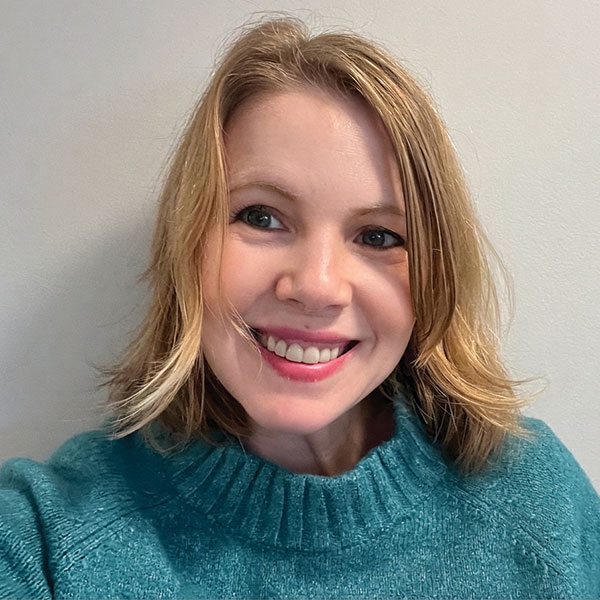
Author: Allison Briggs

  • The Hidden Lesson in Projection: It’s Never Really About Us

    The Hidden Lesson in Projection: It’s Never Really About Us

    “What others say and do is a projection of their own reality, their own dream. When you are immune to the opinions and actions of others, you won’t be the victim of needless suffering.” ~Don Miguel Ruiz

    For most of my life, I didn’t fully understand what projection was. I just knew I kept becoming the problem.

    I was “too much.” Too intense. Too emotional. Thought too deeply. Spoke too plainly.

    Again and again, I was blamed, misunderstood, and cast out for holding up a mirror to things no one wanted to see.

    But in my forties, I began doing shadow work in and out of therapy. At first, I thought the shadow was the broken part. The mess to fix. The thing to hide.

    But I slowly realized: the shadow is where the gold lives. It’s the part of us we disown—but it’s also the most authentic expression of who we really are.

    As a little girl, I was naive and blunt in the way that children often are. I remember saying I didn’t want to share the toys I’d just received for my birthday. My stepmother called me spoiled. But I wasn’t being selfish—I was just being honest. The toys were mine.

    What I didn’t understand then was that my words touched a nerve that had nothing to do with me.

    I think, deep down, my stepmother felt she was always sharing my father—with his past, with his pot-smoking, drug-dealing friends—and there wasn’t much left over for anyone else. Adding me into the equation was one more person who might “take” him from her. And when I voiced a desire to keep something all to myself, it reflected something she couldn’t have: all of him.

    Rather than face that pain, she projected it onto me. I became the one who was “too much,” “too selfish,” “too entitled.”

    My father didn’t know—he was always gone. And I was punished, not for being bad but for mirroring what she couldn’t name in herself.

    And so I learned to shrink. To share when I didn’t want to. To give more than I had. To stop being “the problem.”

    But I wasn’t the problem. I was just being real. And being real in a family built on denial was dangerous.

    Eventually, the truth would always find its way out—on my tongue, in my eyes, in the questions that slipped past my filter. And when it did, I paid for it. With silence. With exclusion. With shame.

    Again and again, I internalized it: I talk too much. I am too much.

    But the truth is—I was never the problem. I was the mirror.

    I reflected what others didn’t want to see in themselves. And people hiding from themselves don’t want mirrors near them.

    When someone’s identity depends on a carefully constructed mask, truth feels like a threat. And most people? They’re wearing masks.

    Therapy helped me see it differently. I stopped asking, “What’s wrong with me?” And I started asking, “What if this isn’t about me at all?”

    That question changed everything.

    When someone’s reaction to me was intense or filled with judgment, I learned to pause. To listen more closely.

    And most of the time, I realized they weren’t telling me about me. They were narrating their own wounds. Their history. Their fear. I just happened to be standing close enough to reflect it back.

    Because that’s what mirrors do. They don’t distort. They reveal.

    Eventually, I stopped defending myself. Stopped over-explaining. Stopped pleading to be understood by people who had already cast me in a role I didn’t choose.

    I just stood still. Reflected what I saw. Sometimes I might say, “You seem really bothered by what I just said—what’s that about?” Not because I’m better. Not because I’m more evolved. But because my gift is clarity. I see and name what’s real.

    I still ask for clarity—and that’s the reason for the question. But the question itself often raises awareness of that person’s own motivations, their own inner truth or knowing. Some people pause and reflect. Most don’t—or at least I don’t get to see it. And that’s okay with me.

    I don’t chase belonging anymore. I don’t shrink myself to fit.

    Because now I understand: this is my gift. I see clearly. I speak clearly.

    My clarity doesn’t always make people comfortable. But it’s mine. And I won’t abandon it anymore.

    Because I now know that when someone reacts strongly to me, it’s rarely about me at all. It’s about what my presence reflects. And I don’t need to defend against that—I just need to stay clear, stay kind, and stay me.

  • Brilliant, Not Broken: A Powerful Reframe for Neurodivergence

    Brilliant, Not Broken: A Powerful Reframe for Neurodivergence

    “It is not our differences that divide us. It is our inability to recognize, accept, and celebrate those differences.” ~Audre Lorde

    For most of my life, I asked myself a quiet question:

    What’s wrong with me?

    I didn’t say it out loud. I didn’t have to. It was stitched into how I moved through the world — hyperaware, self-correcting, and always just a little out of step. I knew how to “pass” in the right settings, but never without effort. Underneath it all, I was exhausted by the daily performance of normal.

    Looking back, it’s clear where it started.

    I grew up in a home marked by emotional chaos and unpredictability. Like many kids with developmental trauma, I became hypervigilant before I even had words for it. I learned to track mood shifts, tones of voice, the silences between the words. While other kids were absorbing math lessons, I was reading the room.

    In elementary school, I wasn’t the loud kid or the front-row overachiever. I was the quiet one in the middle row—not bold enough to be in front where people might see me, and not defiant enough to risk the back, where the “bad kids” got called out, punished, or ignored. I learned early that safety meant staying in the middle: visible enough to avoid trouble, invisible enough not to stand out.

    I didn’t know what the lesson was. But I knew who the teacher favored and who she didn’t. Who had a rough night at home. Who was trying too hard. Who had checked out. And who was silently hurting the way I was.

    I was always paying attention—even if they said I was unfocused—just not in the way the teacher wanted me to.

    I also daydreamed. Constantly. I lived in fantasy worlds that I made up in my head, complete with characters, backstories, and dialogue. I wasn’t trying to avoid reality—I was trying to survive it. And those imagined worlds were often kinder than the one I was stuck in.

    So when people say things like, “That child is so distractible,” I want to pause them.

    Sometimes, what you’re seeing isn’t a disorder. Sometimes, it’s a child adapting to a world that feels unsafe.

    What We Call Disordered Might Just Be a Different Kind of Wisdom

    As I got older, I started to realize how many of the things we pathologize—especially in women, neurodivergent folks, and trauma survivors—are actually adaptive or even gifted traits. But because they don’t fit the dominant mold of what “healthy” looks like, we call them broken.

    Let me say this clearly: Different doesn’t mean disordered. And even when support is needed, that doesn’t mean the person is lacking.

    Take ADHD. It’s often reduced to disorganization or forgetfulness, but for many people, it reflects fast-paced, pattern-jumping brains that crave stimulation and thrive in high-innovation spaces. That same brain might struggle in school but light up in entrepreneurship, the arts, crisis work, or tech.

    Take anxiety. Yes, it can be overwhelming. But beneath it is usually a sensitive nervous system attuned to energy, risk, nuance. In trauma survivors, it often reflects the ability to read between the lines—to sense what’s not being said, to prepare for every possible outcome. They keep themselves and others safe by seeing the risks before the bad thing happens.

    Take autism, especially in girls and women. What gets labeled as rigidity or social awkwardness might actually be deep authenticity, truth-telling, and sensory brilliance in a world full of noise and social masking.

    Even depression can be a form of wisdom—a body demanding rest, a soul refusing to keep performing, a nervous system finally saying “enough.”

    What Neurodivergence Really Means

    Neurodivergence isn’t one thing. It’s a big umbrella. It includes conditions like:

    • ADHD
    • Autism
    • Learning differences (like dyslexia or dyscalculia)
    • Sensory processing differences
    • Mood disorders (sometimes)
    • PTSD and C-PTSD (especially when they cause long-term brain changes)

    For some, it’s hardwired. For others, it’s trauma-shaped. And for many of us, it’s both.

    In my own family, neurodivergence runs deep.

    My mother lived with bipolar disorder and schizophrenia. My oldest son has ADD and anxiety. My youngest is autistic, has an intellectual disability, and also lives with ADHD. I’ve carried complex PTSD, anxiety, depression—and honestly, probably undiagnosed ADD too.

    We are not broken. We are not less.

    We are a line of deeply sensitive, differently wired humans trying to survive in a world that doesn’t always recognize our kind of brilliance.

    I know what it is to be the outcast.

    I watched my mom become one—judged and misunderstood by her own family, dismissed by society because her bipolar and schizophrenia made people uncomfortable. I’ve watched my youngest son become one too. He’s autistic, has an intellectual disability, and ADHD. And I know—deeply know—that if I hadn’t chosen to value his wiring, the world might have crushed him. For a little while, it did.

    But this kid plays the drums like nobody’s business.

    He is fiercely protective, wildly loyal, and more emotionally intuitive than anyone I’ve ever met.
    And every once in a while, he’ll say something so specific, so strange, so piercingly true, I swear he’s reading my mind — or someone else’s.

    We don’t talk about this kind of intelligence enough. The kind that doesn’t show up on standardized tests or IQ charts, but lives in the bones. In the music. In the knowing.

    Neurodivergence simply means your brain functions in a way that diverges from the norm. That’s not bad. That’s essential—because the “norm” was never built with all of us in mind.

    The Bigger Picture

    We live in a culture that rewards sameness: attention that stays linear, emotions that stay tidy, learning that happens on schedule.

    But real life is messier than that. And real people are more complex.

    Some of the most powerful thinkers, healers, leaders, and artists I know live with labels that would’ve sidelined them if they hadn’t learned to translate their differences into power.

    Different doesn’t take away from the conversation. It adds to it.

    And the next time you wonder if something is “wrong” with you,  pause.

    What if that part of you isn’t broken?

    What if it’s just misunderstood?

    What if it’s trying to show you something the world forgot how to hear?

  • The Lie of Packaged Healing and the Truth About Feeling

    The Lie of Packaged Healing and the Truth About Feeling

    “Emotions are not problems to be solved. They are signals to be felt.” ~Vironika Tugaleva

    We’ve been taught to package our emotions like fast food—served quick, tidy, and with a smile. Americanized feelings. Digestible. Non-threatening. Always paired with productivity.

    If you’re sad, journal it. If you’re angry, regulate it. If you’re overwhelmed, fix it with a three-step plan and a green juice. And if that doesn’t work? Try again. You probably missed a step.

    This is how we sell emotional healing in the West—marketed like a self-improvement product. Seven-minute abs. Seven habits. Five love languages. Follow the formula. Find the peace.

    But what if the formula is the lie?

    As a mental health therapist, I’ve lived it on both sides. I’ve sat in the client chair, feeling broken because my sadness didn’t resolve after enough gratitude lists. And I’ve sat across from clients who whisper their grief like a confession, wondering what they did wrong because they still feel something.

    They aren’t doing it wrong. They’re just human.

    Healing isn’t about “doing” our feelings. It’s about learning how to actually feel them—without the compulsion to justify them or translate them into something useful.

    You owe no explanation for your feelings.

    And still, even knowing that, I get caught in it too.

    I, too, am a product of this culture—a place where feelings are only tolerated when packaged properly. Not too loud. Not too long. Preferably resolved by morning.

    Because of that, there are days I feel a deep aloneness. But I’ve come to realize the aloneness isn’t a flaw—it’s a longing. A longing to be witnessed in the fullness of my humanity. Not fixed. Not analyzed. Just seen.

    I don’t need validation. I don’t want to defend how I feel. I just want space. Presence. Room to let the feeling pass through me.

    The loneliness reminds me how deeply I’ve been shaped by a culture that fears emotions unless they come with an action plan.

    So I’ve learned to hide mine from most people—not because I’m ashamed, but because they’re afraid. People are afraid of their own feelings, so of course they’ll fear the vulnerability of mine. Most people in this country don’t know what to do with real feelings. And the doing has become the problem.

    That fear of being too much or too messy is rooted deep not only in American culture but also me.

    That part inside me judges the part of me that feels sadness at times. She calls it weakness. Not out of cruelty, but out of fear. She believes that if she can shame that part, a much younger, more authentic part that lives inside me, she won’t risk being shamed by others.

    I’m sure many other Americans have this exact same part inside them as well.

    We have to be tough, suck it up—whatever that even means.

    The part of me that gets sad. The part that gets afraid. The part that feels lonely. These are parts I exiled long ago. But I am beginning to bring them home to me. The parts that are terrified of taking up space. They don’t know yet how precious they are.

    They’re not just tender. They’re wise. They’re the intuitive, empathetic, deeply alive parts of me. The parts our culture has spent countless centuries trying to forget.

    But I won’t forget those parts. Not anymore.

    I speak to them now, with clarity and compassion. I tell them: You are allowed to feel without defending it. You are allowed to take up space without apologizing for the weight of your truth. Expand. Don’t shrink.

    The sad one. The scared one. The one who wants to hide. The one who’s learning to stay. Even the critic. They can all exist inside me—side by side—without contradiction. Without shame. Without needing to explain themselves to anyone.

    I will no longer betray them because others betray their own parts and project their self-betrayal onto me.

    There’s a whole galaxy inside me, and there’s a whole galaxy inside of you. Of course no one else will fully understand it.

    What matters is that I do.

    And I’m learning… I’m not here to be understood. I’m here to simply be me—and to allow all that resides in me to be, too.

    And maybe you are, too.