Tag: self love

  • I’ve Learned That I Deserve…

    I’ve Learned That I Deserve…

    When I was growing up, my parents never spoke to me about what I “deserved.” They spoke to me a lot about what was “expected.” They were very clear about that.

    They expected me to be tough, hard-working, well-read, and smart. They expected me to help others, especially those struggling on the margins. They sent me to work in impoverished parts of the world, so I would realize I was very lucky and really had nothing to complain about. They expected me to go to church every week, to be honest, to help my brothers, my cousins, my community. They expected me to hold my head up and keep walking forward no matter what.

    They expected me to stand up when they walked into a room, something I continued through their dying days. The list of their expectations went on and on. And along the way, their expectations of me slowly became my own.

    But over time, another word crept into my life. Slowly at first, even timidly, because for me the word and the concept felt foreign, maybe even embarrassing.

    That word was deserve. To think you “deserve” something when others have so little felt arrogant and selfish—as in, Who do you think you are? I got that message from my parents.

    But I’ve come to understand that there is power in the idea of deserving.

    For example, if you’re a hard worker, you deserve to be appreciated and respected by those you work with. That’s not asking too much. And if you work a lot, you deserve rest. My parents wouldn’t like me saying that, but it’s true. Resting your body and your mind isn’t lazy, it’s being smart. You and your body deserve to rest, so you can be healthy. Emotionally and physically—and then work some more! (That’s the part my parents would like!)

    You deserve to be treated kindly by your friends, family, and significant others. As I say to my kids over and over, “Your siblings deserve your respect.” And as I say to their friends, “So do I. So stand up when I come into the room, look me in the eye when you talk to me, and don’t you dare text at the dinner table!” I realize that if we don’t treat ourselves as if we deserve these things, it’s hard for others to see that actions like those are important.

    So what do you deserve? That’s up to you. I can only answer with what I have come to believe I deserve.

    I deserve to be happy. Much of that is in my control, but just knowing that I deserve it has helped me be happier. And being treated kindly and respectfully starts with how I treat myself.

    I deserve to rest and take breaks. That’s why I go to Cape Cod every now and then for a few days. I’m not yet at the place where I can say I deserve a really long vacation, but I’m working toward that “deserve.”

    I’m no longer embarrassed to admit I deserve these things, too: I deserve to live in a safe place. I deserve to love and be loved. I deserve the right to dream again. Yes, I do. Dreams are not just for twenty-somethings. Dreams are for all of us at any age.

    I deserve to grieve in the manner that works for me. If that’s longer than others would like, so be it. I deserve to have people around me who tell me the truth, lift me up, want the best for me. I deserve to take time for myself. If that’s to read, take a nap, go out to lunch with friends, that’s fine.

    I deserve to laugh as much as I want.

    I deserve to not know. That’s right. Until I know, I deserve to be unsure or uncertain of how I feel about something or someone. It’s okay. I deserve to express my opinions, and I don’t deserve (nor, by the way, does anyone else) to be attacked for what I said, for who I am, for what I believe. I deserve the right to change my beliefs once I’ve seen they hurt me or hold me down, or when I discover a better way.

    The list goes on, and it can also grow and change. In fact, I expect it to. I hope it will. I deserve that.

    I write all this in the hope that you will think about what you deserve. I hope you will allow space in your life and your mind to have this conversation with yourself way earlier than I had mine. It’s not selfish or arrogant. It’s a way to be kind and loving to yourself.

    This thing called life is a magical journey. I find it doesn’t always make sense. It’s filled with uncertainty, joy, struggle, surprises, disappointments, and rewards. It isn’t always fair or clean and neat. You deserve to design it the way it works for you and then redesign it if you want to.

    That’s what I’ve come to expect. That’s what I’ve learned I deserve.

    Now go have a great day. You deserve it!

    From I’VE BEEN THINKING… by Maria Shriver Reprinted by arrangement with Pamela Dorman Books / Viking, an imprint of Penguin Random House LLC. Copyright © 2018 by Maria Shriver

  • The Wounds of Rejection Heal With Self-Love and Self-Awareness

    The Wounds of Rejection Heal With Self-Love and Self-Awareness

    “There is no magic cure, no making it all go away forever. There are only small steps upward; an easier day, an unexpected laugh, a mirror that doesn’t matter anymore.” ~Laurie Halse Anderson

    It began in elementary school. I was a chubby immigrant with a thick accent and hand-me-down clothes. I so badly wanted the other kids to like me, and I had no idea why everything I said and did seemed to push them away.

    My jokes and comments would trigger awkward silences or ridicule—especially in groups. Those moments were traumatizing, but they were also confusing. How could I make them like me?

    As I learned English, I found some company in the schoolyard, but I continued to be bullied for my weight, my clothes, my face that turned red so easily. It didn’t help when I started going through puberty at age nine, younger than every other girl in my class.

    In elementary school, I remember walking home one day when two boys followed me, calling out things like “Put on a few pounds this year, haven’t you?” I remember staring at my feet, putting one in front of the other, walking home as fast as I could.

    The wounds of being rejected, bullied, and ostracized buried deep. I never felt safe unless I was completely alone.

    In high school, I remember walking home once and realizing that a popular guy from a grade above was walking behind me. He didn’t say anything to me, but my heart started beating wildly, and I became hyperaware of my arms swinging back and forth. How awkward were these long appendages coming out of my body! How awkward was I!

    Even though I would walk home as fast as I could, I didn’t feel any safer around my family. In my parents’ house, emotional expression wasn’t encouraged or accepted. The only safe place was alone with myself.

    But as time went on, the anxiety I felt about other people’s opinions of me crept into my alone time too. I worried. I ruminated. I overanalyzed.

    It was difficult to live in fear all the time, so I developed all kinds of ineffective habits that helped me feel in control. I starved myself. I lied. I got addicted to anything I could get my hands on.

    I’ve been on a long journey of healing—not only the toxic ways I had learned to avoid feeling discomfort around other people but also the scars that caused that discomfort in the first place. The path has been long and hard. I’m still walking it.

    I’ve learned a few things that have been helpful. For example, I’ve learned to find the thoughts that trigger anxiety in social situations and question them. I’ve found the places in my body where I tense up when I think this way, and I’ve learned how to relax them.

    I’ve learned that the feeling of rejection won’t kill me (while running from it almost did). I’ve learned to sit with all kinds of uncomfortable emotions without running away.

    I’ve learned to reduce my overall anxiety levels with exercise, lower caffeine intake, journaling, mindfulness, and lots of alone time.

    I’ve learned that working out before social occasions lowers the chance of being triggered. I’ve learned that allowing some time afterward to replay social situations in my head actually helps—as long as I give myself a time limit and wrap up with some self-loving thoughts when the time is done.

    I’ve learned that, sometimes, I should actually take the advice of my self-judgment and change how I talk to people. I’m still learning about which advice to take and which to leave. I’ve learned to be gentle with myself while I figure it out.

    When I first went a few months without falling into a deep self-judgment hole, I thought I was cured. I thought I would feel free in social situations forevermore. But life had other plans.

    I have learned to think of social anxiety and fear of rejection as allergies. I’m allergic to thoughts like “Do they like me? What should I do to make them like me? What did I say wrong? What should I do so they don’t think I’m weird?” Most of the time, I can avoid falling into old patterns. I hear those thoughts and think, “Nope, I’m allergic to that. That’s not good for me.”

    But sometimes, I don’t catch the thoughts until it’s too late. Or I start having them when I’m tired or stressed out. Or I experience a series of rejections and don’t have enough time to process through them before my emotions and thoughts weave into a tight downward spiral.

    It happens. It happened last week. It lasted for four days. I’ve learned to forgive myself, be gentle, and know that I’m doing my best.

    I have friends with celiac disease who experience side effects for at least a few days when they eat gluten. At that point, the damage has already been done. The only thing they can do is not make it worse. So that’s what I try to do as well.

    I try not to judge myself for being stuck in self-judgment for a few days. That makes it easier to deal with. I try to think of it as my mind being swollen and sick. It needs time to heal. It needs love and patience. It doesn’t need more of the thing that made it sick in the first place.

    Each time my mind gets swollen with judgment, I have an opportunity to talk to myself with love, patience, and kindness. I also have an opportunity to learn more about myself. I try to extract some wisdom out of each period of suffering.

    I used to want to get rid of this for good, but lately, I’m realizing that maybe I never will be. Maybe it really is like an allergy. No matter how well I can learn to avoid the things that make me feel horrible, they will always be bad for me.

    Although these episodes are still unpleasant, I no longer feel helpless when they come. I’ve been practicing. I feel a sense of accomplishment each time I can navigate through periods of self-doubt with self-love and honesty.

    I can’t control what makes me sick, but I can be a kind, loving nurse to myself when I get that way. And that gives me some sense of control over the situation.

    I couldn’t control what happened in the past. And I’ve realized I can’t control my triggers in the present. But I can control how I respond to those triggers. And if I fail to respond differently, then I can control how I respond to that failure.

    However small, there is always room for a choice. And instead of focusing on what I can’t do, I’m trying to focus on what I can.

    It’s a hard road. If you’re in the middle of a similar journey, I hope you’ll cut yourself some slack and give yourself some credit for how far you’ve come. You’re doing the best you can, and that’s more than enough.

  • 7 Self-Love Practices That Helped Me Heal from a Devastating Divorce

    7 Self-Love Practices That Helped Me Heal from a Devastating Divorce

    “Unlike self-criticism, which asks if you’re good enough, self-compassion asks what’s good for you?” ~Kristin Neff

    My husband and family were my world. Although I’d found joy in my passion of writing, my heart revolved around my marriage. I thought we were happy. Then one day, he dropped the bomb: “I don’t love you anymore.”

    Two weeks later, I found out he’d fallen in love with another woman who lived across the world. He didn’t want me anymore.

    Sure, I’d known for a while something was wrong—that knowing deep in your gut that you can’t put your finger on, that tackles you in the quiet hours of the night, making it hard for you to sleep. That taunts you with fear when he doesn’t act as loving toward you as he used to. But I ignored it, because he was my world.

    I’d fallen in love with him at a time when my self-esteem wasn’t too good. Social rejection at school, losing a parent at a young age, and being steeped in a very strict religion had all played their parts in making me feel that I wasn’t good enough. He made me feel loved and wanted. I was codependent and I didn’t even know it.

    The next few months, after he took the rug out from under my world, I felt like I was dying. The pain, the rejection, and the hurt were all-encompassing, but I had a little light inside me. It was called hope. I suddenly had this hunger to heal, to become strong, and to find my truth. I began my self-love journey.

    It all started when I read Choosing Me Before We, by Christine Arylo. She spoke about self-love in her amazing book. I realized that if I ever went into another relationship, I would put myself first. I wouldn’t go into something giving and giving and giving, knowing my own needs weren’t met. I would run far away from a man who used me in any way. I would turn away from anything less than true intimacy and love.

    The problem was, in the loneliness, I entered into a rebound relationship, despite what I’d decided. The deep hole left in my heart made me blind to how harmful it was. The relationship was much worse than anything I’d experienced in my sometimes dysfunctional marriage. I had to learn the hard way. I eventually turned away, eyes finally wide open. But I’ve grown. And grown.

    This is how I’ve healed through self-love, because self-love is the foundation of emotional and mental well-being.

    Non-Judgment

    When divorce hits you right between the eyes, you get flung into the five stages of grief with no mercy. They assault your soul like a tsunami. But they also wash over you and heal you.

    I learned to let myself grieve. It was painful. I had to keep coming back to the same pain and sorrow, the same anger and “why?” questions, over and over again. But I let the waves hit me again and again. After awhile, they were smaller, gentler, more manageable.

    I didn’t judge myself for my pain. I grew in my self-compassion and non-judgment. I learned to love, nurture, and coddle myself. Gentleness was my motto. And that helped me heal.

    Self-Respect

    When you’re steeped in a judgmental, strict religion, it’s hard to grow up with self-respect. You believe you were born in sin, and that you are this weak being who is bound by it. You are hard on yourself because of the rules imposed on you.

    As the scales fell away from my eyes, I began to see that I’m a beautiful being. I’m worthy of respect. I am good to the core. We all are, but sometimes the mirror is cracked.

    It’s hard to always respect yourself, but once I made that decision, I grew by leaps and bounds. I also realized how my ex’s words and actions had broken me down at times—or more so, I’d allowed his perception of me to affect the way I saw myself.

    Now I could accept myself no matter whether I was having a good hair day or not, and even though I wasn’t this skinny youngster anymore. I could accept myself even when I didn’t act like a saint or I didn’t feel great! Non-judgment—I’m a work in progress.

    No matter what shape my body is, I respect it because it’s beautiful and does amazing things. I still have bad days when I want to pull my curls out as they don’t cooperate or I want to get rid of the rolls around my middle, but then, mindfully, I remind myself that it’s the heart that matters. And that society has lied to me on what is beautiful. Society has honored perfection, not authenticity and true beauty.

    Boundaries

    This is a hard one for me, but as I’ve begun to set boundaries around me, to protect myself from people taking advantage, my sense of safety has increased. I’ve chosen to be single for now, as I know I’m not ready to enter into a relationship without falling back into codependency and losing myself again. I’m relishing in my freedom and the growth of self-love.

    If I entered into a relationship now, I wouldn’t keep up the right boundaries because I would jump over hoops to keep this person in my life—hoops that hurt me. I have often given parts of myself to a man before I wanted to, just to keep him interested. No more!

    Boundaries comes in all shapes and sizes, and whenever we say “yes” when we want to say “no,” we are being unkind to ourselves. It’s hard because there is a spot inside of us that loves to help and please people. And it feeds something in us. So, we have to find the balance. I’m a student of self-love and I’m learning the balance every day.

    Self-Nuture

    I’ve learned to find ways to nuture myself, and I’ve actually had a blast. In making sure I have a daily spiritual ritual, I’ve bought myself a few special things, I’ve joined a dance group to meet people and to just have fun, and I’ve taken up a hobby to just unwind; I’m thoroughly enjoying my freedom.

    I didn’t realize how much of my energy I’d put into making my husband happy. All because I was afraid he would leave me. I bent over backward for him and oftentimes, didn’t feel free to just be myself and put “me” first.

    I’m loving putting me first; even with having three teens to look after and running a busy household, my downtime is my time. It’s been healing my soul. I feel like I’m just starting on this journey of self-nuture and self-love. I can’t wait to discover more. But even the little bit I’ve learned has changed my whole mindset on life.

    A Spiritual Practice

    I began a meditation practice around about the time my marriage broke down. It grew as my desperation grew, especially during a very difficult time after experiencing crime as a single woman. This practice has become the lifeblood of my existence. It has helped me to calm deep anxiety, find peace, grow spiritually, and learn mindfulness.

    As I’ve become more mindful, I’ve grown aware of when I sabotage myself with negativity and anxiety. It’s not always easy. But I have hope and my peace is growing.

    Meditation has taught me how to be me and how to connect with the divine. It’s taught me the value of silence and taking things slower, of breathing and resting. The joy of listening and tapping into higher consciousness and the higher self.

    Alongside my meditation practice, I also have a self-Reiki practice every day to balance my energy, heal me, and give me peace.

    I’ve been devouring spiritual books and growing in my faith in the Universe and my knowledge. I’ve opened my eyes to see truth in many faiths and practices. It’s enlightened my soul. It’s put me on the path of love and peace.

    Self-Knowledge

    I’ve learned to tap into my intuition. Yes, I’ve had several men take an interest in me. I’ve learned to say “no,” because my gut says “no.” It’s been hard. When you’re lonely, you’re keen to have someone in your life, but I’ve learned to listen to that voice inside and say “no” when it hasn’t felt right deep in my gut.

    I’ve grown in my intuition practice by doing Reiki, reading oracle and tarot cards for myself (such a powerful mirror into the soul), practicing soul writing, and just plain going with that deep, inner voice. I’ve grown more aware of miracles and synchronicities; I’ve grown in gratefulness.

    Finding tools to get in touch with my higher self / Spirit has been essential in this time of my life. I’ve had to grow up fast. When I married my husband, I was young and naïve. He was the main breadwinner and head of the home. I’ve had to learn greater responsibilities and make big decisions for my family, instead of relying on him to steer the ship.

    Being able to access my higher self has led me to make more guided and calmer decisions. It’s increased my sense of peace and wholeness as I’m following my true desires and that still, gentle voice that’s deep inside. It’s enabled me to navigate difficult relationships and situations with a sound mind. Yes, I sometimes get it wrong, but it’s like a fitness routine—the more you practice it, the better you get.

    Letting Go

    I think the hardest part for me has been to let go and forgive. Together, hurt and resentment have been the one wave that has broken most violently upon my shore. But part of self-love is forgiveness.

    We only harm ourselves when we refuse to forgive those who have hurt us. Yet, as much as we know this fact, it’s not always possible to feel forgiveness straight away. In fact, it’s taken me one and a half years since that dreadful day to start to see the light. Today, I prayed for the well-being of my ex and the woman he left me for. And I meant it! I want their highest good.

    The thing that has actually helped me to forgive the most is to realize my own worthiness. As soon as I chose to believe that I wasn’t responsible for what happened or that there wasn’t something dreadfully flawed about me which made him leave me, the desire to blame disintegrated. I released and validated myself and it became easier to release him. I began to see him as a human being with his own hurt and pain—that’s why he’d hurt me.

    I have to choose daily to release him and what happened back to the Universe. I choose daily to believe that what has happened is being used for my good. And it is. I can see how much I’ve grown. I can see how love has worked this whole thing out to make me feel more loved and more supported.

    What I’d deeply feared happened to me, and I’m still okay. I’m more than okay! I now know that it will always be okay. That deep inside, no matter what happens to us, we’ll be okay. We are whole; we are love; we are connected. We are growing and evolving toward better beings. We are deeply, irrevocably loved!! I’m going to practice that love every day. It’s called self-love.

  • Be Good to Yourself: 10 Powerful Ways to Practice Self-Love

    Be Good to Yourself: 10 Powerful Ways to Practice Self-Love

    “Self-love, self-respect, self-worth: There’s a reason they all start with ‘self.’ You can’t find them in anyone else.” ~Unknown

    It was one of those nights.

    I was in a busy New York bar, having fun and enjoying myself. That was, until someone asked me: “So, what do you do?

    Within a few seconds my fun, happy, playful side vanished and in entered a girl full of doubts and insecurity.

    The truth was… I had no freaking idea about what I was doing! I had just left my corporate job and now I was on a journey to discover what I truly wanted to do in life.

    That question stripped me down to feeling naked and exposed. Because I didn’t have a job title.  (Unless “I-don’t-know-what-I’m-doing-with-my-life” works?) I had nothing externally to “prove” my worthiness with.

    I’ve always been pretty confident. My dad used to give me incentives for challenging myself. “Climb up that wall and I’ll buy you an ice cream.” “Be Santa Claus for your siblings and you’ll get that nail polish you really want.”

    So, I never had a problem saying yes to things, such as taking job offers abroad and accepting challenging positions and demanding projects. Of course I had moments of doubt, but even when I doubted myself, I always said yes and found a solution one way or another.

    Until that moment in the bar, I had (unconsciously, of course) proved my worth through my achievements. I had thought of myself as someone who valued herself no matter the job title, relationship status, or bank account condition.

    But, when I left my job and other external things fell apart, so did my value. Or at least, that’s what it felt like.

    In short, I had confused self-confidence with self-esteem. Oops!

    Here’s what I mean by this:

    Self-confidence is about trusting yourself and your abilities. For example, you can be confident in one area, such as cooking, dancing, or communicating, but then insecure in another, such as dancing or public speaking.

    Self-esteem, on the other hand, is about how you see yourself. It’s about your perception of your worth. No matter what happens on the outside, do you treat yourself with love, care, and respect or not?

    As a high-achiever, it’s easy to trick yourself and think you have self-esteem. I mean, as long as you perform and do well, it’s all good, right?

    Yeah, until you don’t. That’s when the sh*t hits the fan…

    When I realized that I saw myself as less worthy, cool, and interesting because of my external circumstances, I decided this wasn’t good enough for me. And it shouldn’t be good enough for you either, if this resonates. As they say, your biggest breakdowns often become your greatest breakthroughs.

    So, I got to work. This time, not by proving my value, but by practicing self-love. Below are some of the most powerful ways I’ve discovered to do just that:

    1. Focus on being someone who loves.

    If you’re in a place today where you don’t love yourself, it’s hard to take a quantum leap and become someone who does. Just like when you’re building muscles, self-love takes consistent practice.

    Instead of loving yourself, focus on being someone who loves. That is, allow love to flow through you as often as possible. Focus on what you love about the people you meet. Focus on what you appreciate while going to the store, sitting in a meeting, or while speaking to someone. Simply, adjust your body to positive emotions by finding as many things to love and appreciate as possible.

    2. Tap into what it looks and feels like to be loved.

    It’s easy to be loving toward ourselves when things go as planned, when we succeed and people like us. Not so much when stuff falls apart, we screw up or get rejected. When we struggle the most, that’s also when we tend to be hardest on ourselves.

    In those moments, ask yourself how someone who loves you deeply you would act. What would they say? What would they do? How would they behave? Odds are, they wouldn’t criticize, judge, and berate you. They’d offer you kindness, compassion, and acceptance. If you can’t think about a specific person or memory, imagine how the most loving human on this planet would be toward you. Then practice being that toward yourself.

    3. Stop comparing yourself.

    Comparison is a killer to self-love. And we aren’t usually very nice when it comes to comparisons, right? Instead, we take our greatest flaws and compare them to someone else’s greatest success. In short, you’re doomed to fail.

    Instead, realize that you write your story. Realize that you can’t compare your life to someone else’s because no matter how well you know them, you never know how they feel or how they perceive their life. Instead, spend your time and energy to nourish and build your path.

    4. Take baby steps to create the life you long for.

    Desires are powerful. And so, to take action turn those dreams into reality is to honor and care for yourself. By taking daily actions, you signal that you’re worthy of living the life you desire.

    It doesn’t have to be big action—just small and consistent steps in the direction that stirs joy, care, and excitement. This demonstrates that you care and respect your dreams and thus yourself. Has there ever been a better time to do that than now?

    5. Ask your guidance system for help.

    Imagine that your emotions are guiding you. When you feel good about yourself, it means that what you’re thinking is aligned with how your soul/higher self sees you. When you feel bad about yourself, it’s a red flag telling you that a change of perspective is needed

    If you think a thought such as “I am [something you don’t like about yourself],” how does that feel? Probably not so good, right? Then it’s a sign to think a different thought. Try to replace that with something kinder. For example, “I’m just so lost and confused” can be replaced with “I’m doing the best I can to move forward.”

    6. Surround yourself with people you feel good with.

    Oh, this is an important one! You may have heard Jim Rohn’s famous quote before: “You are the average of the five people you spend the most time with.” Think about who those people currently are. Do they inspire, fill you up, and want what’s best for you?

    Just because you’ve been friends doesn’t mean you need to keep spending time together. Just because you’re taking a break from someone, doesn’t mean you won’t be close again. Be picky about who you spend your time with—don’t give it away in the spirit of mercy. (That’s not nice, neither to you or the other person). Be there because you want to; otherwise, don’t.

    7. Be compassionate when sh*t hits the fan.

    So many of us (myself included) tend to beat ourselves down when we need our love the most. When we fail or screw up or someone rejects us, that’s the time we often get even more down on ourselves. Beating someone who’s lying down, sounds fair? Um, nope.

    So instead, choose to be most loving and forgiving with yourself when things don’t go as planned. When you stumble and fall. When you say the wrong things. When someone rejects you or a project fails. Ask yourself what you need and then spray that all over yourself.

    8. Make room for healthy habits.

    Yep yep! Start truly caring for yourself by mirroring that in what you eat, how you exercise, and what you spend time doing. Do stuff, not to “get it done” or because you “have to,” but because you care about you.

    Don’t feel like going to the gym? Then maybe put on a soul-soothing podcast and go for a walk. Create habits that are healthy, not just mentally but also emotionally.

    9. Postpone your worry and negative thoughts.

    Are you ready for a really great tip? If so, then get excited. A very powerful technique I recently discovered is called a “worry-free month” (named it myself). Think about how much of your worry that actually serves you. Sure, some of the worry has a purpose, as it tends to give us a little kick when we need to get our sh*t together and start acting.

    But, my guess is that 97% of it is useless. Whenever those thoughts enter your mind, tell them, “Thanks, but I’ll deal with this next month.” By telling your mind that you’ll deal with it later (plus saying when), you stop feeding negative thoughts and thus decrease its momentum. Then, you simply do this month after month.

    10. Accept what you cannot love.

    This might have been the greatest game-changer for me. Because let’s face it: It’s easy to love what you love about yourself and not so easy with the things you don’t. So, instead of even aiming to love those parts, which will probably just make your mind go “Are you kidding me?”, focus on accepting them.

    One thing I’ve had a hard time accepting about myself is that at times, and for no real reason, I can get very nervous. Simple things, such as going to the supermarket can feel very difficult. Instead of rejecting or trying to love this nervous side of myself, I’m reminding myself to accept it. When it happens, I’ll tell myself something along the lines of “It’s okay, I can be nervous going to the supermarket today. It’s not the end of the world.”

    You don’t need to love everything about yourself to develop self-love; all you need is acceptance. Next time something happens that makes you want to get down on yourself, see this as your practice to accept what is.

    Care for the World by Caring for Yourself’

    Life is full of ups and down. Health can transfer into disease. Successes can be turned into collapses. Romantic love can be transformed into coldness. But, no matter what happens on the outside, we can still have a solid foundation built on self-love.

    Self-love isn’t a luxury; it’s a necessity in today’s society. So, start implementing some of the practices above and most of all, have compassion with yourself when you fall short. Then simply brush yourself off and get back into it again. As they say, practice makes perfect.

    Finally, realize that by caring for yourself, you care for this world. Your actions have a ripple effect on others.

  • Twisted Love: What I Learned from Being in an Abusive Relationship

    Twisted Love: What I Learned from Being in an Abusive Relationship

    “Never wish them pain. That’s not who you are. If they caused you pain, they must have pain inside. Wish them healing. That’s what they need.” ~Najwa Zebian

    Most of us don’t grow up and say we’re going to be killers.

    Most of us don’t grow up and say we’re going to hurt people.

    We don’t grow up thinking and planning to hurt ourselves.

    But there are moments in our lives in which we’ve stepped outside of ourselves and made decisions that impair our lives. Decisions that remain with us for a lifetime.

    Then we have difficulty forgiving ourselves because what we did went against everything we’ve ever believed. We wonder if this is who we’ve always been. We wonder if we’re able to change.

    Pivotal Moments in Time Teaches Us Everything We Need to Know

    I remember when I slapped my ex-girlfriend.

    We were arguing for hours. She made a horrific comment about my son, and I snapped. I slapped her. I felt ashamed.

    For the first six months of our relationship, things were great. Then I started to pull back. I realized I was too invested in her and not in my home life. I was not only caring for my son but also my teenage sister.

    Things changed.

    I went from being with her regularly to telling her I couldn’t stay. Because she felt abandoned by me, she became verbally abusive. When we argued I would walk away because I knew what was coming next.

    She knew my vulnerabilities and every last dark secret of my soul. And she used them as if they were ammo in an Ak-47 to eviscerate me. This led to her becoming physical. It went on for months. We were held hostage by pain, fear, and a twisted love.

    I found myself holding on to someone who bullied me but loved me, who wanted to love me despite my pain but hated me because of my pain. Most of the time I felt suspended in the twilight zone.

    However, the relationship became more and more emotionally and physically abusive. It never seemed like it was abusive. It was common for lesbians to “have drama.” It was common to be pushed once, maybe twice.

    But, I knew something was wrong when I started to hit back. I’ve never been in a fight in my entire life, and here I was brawling with the love of my life.

    Relationships Do Have An Expiration Date

    But it makes sense. I grew up in an abusive household with a dominating aunt. There were several years of not fighting back, several years of taking the abuse, several years of not raising my voice.

    I grew up feeling undeserving of love. I grew up in a household of shame, of never feeling good enough. It makes perfect sense I would repeat this cycle as an adult with my most important teacher.

    When someone calls you a pansy, a doormat, or says you’re too sensitive, it reaffirms that you have no self-worth.

    I found myself finally fighting back.

    I resisted for so long, and I took the beatings, the name-callings the same way I did as a child. But at that moment, I didn’t know who I was. I smashed objects to the ground, I kicked, I choked, and the both of us became other people.

    We became little girls who have been frightened our entire lives, little girls whose families promised to love them but didn’t. Little girls who were both abandoned. One withdrew from the world, and the other fought the world with intense rage. Little girls who feared the other would leave.

    During our last fight, I told her to leave. I couldn’t say any more sorries, nor could I hear them from her. I didn’t like who I was with her.

    Often we stay in relationships way past the expiration date. It curdles and creates a sickness in our bodies. I checked out of the relationship because our relationship ended years ago but we both couldn’t bear to let the other go. Afraid of the solitude that laid ahead of us. Comfort erodes joy.

    When you find yourself in a relationship and you don’t know who you are, that’s when you leave. When you see yourself doing things that seem like an out of body experience, that’s when you leave. When you find yourself hating coming home knowing that person will be there, that’s when you leave.

    I feared to leave her behind because I understood her pain. I understood why she was angry. We were opposites. I calmed her because I knew how to. I felt guilty wanting to leave. But hurt people, hurt people.

    Tie Up Loose Ends Before They Crush You

    If you have unaddressed pain and begin relationships with people who also have unresolved issues, these issues will surface in the ugliest and most unexpected ways.

    We don’t train our thoughts and we don’t heal our hurts because most of us aren’t living from the inside out. We don’t know how to. Then we try to love each other, and it just doesn’t work.

    You wouldn’t race in a Kentucky Derby without training. We enter relationships without making the necessary connections and insights from our childhood that made us who we are today.

    We don’t learn to understand the person that looks back at us in the mirror. We haven’t developed ways to begin authentic introspection. But most of all we haven’t mastered our emotions. We’re emotionally stunted individuals who fight for what we lost in our childhoods just to feel it in our adult lives. We struggle to fill the deep craters in our souls.

    My aunt was abusive out of fear. I learned later she was dealing with a bitter divorce. She emigrated to the States a married woman with three children (and me as a fourth), and within months her husband abandoned them. She didn’t know the language. And at one point was living in a homeless shelter. She was angry.

    We never learned how to love. My ex-girlfriend didn’t learn it in her home, and I didn’t learn it in mine. People can’t give you something they don’t have. We can’t expect them to unless they are aware, willing, and have done or are ready to do the work.

    We don’t know what we don’t know. But once we do know it’s our responsibility to change.

    When We Learn the Lessons They Won’t Be Repeated

    Being in an abusive relationship taught me the following things:

    Focus on self-love.

    The world opens up to us when we begin to love ourselves. It’s going to be impossible to create loving relationships without first looking within and loving ourselves. This goes for both platonic and romantic relationships.

    Two of the best books that started the process for me was The Gifts of Imperfection and The Power of Vulnerability. I soothed the abused child inside of me through compassion, love, and forgiveness. I began practicing the use of gentler and kinder words towards myself. A question I began asking is, how can I love myself more today?

    Let go of control.

    We can’t control other people’s feelings; we can’t control if and how they heal themselves. It isn’t our responsibility to heal people. All we can do is have compassion, empathy, and love for them. What is under our control is our decisions to stay or leave, the way we react, and whether we reach out for support.

    Nothing’s wrong.

    There’s nothing wrong with us. We’ve learned defense mechanisms either in our childhood or young adulthood that protected us. We’re humans having a human experience. But we don’t need those defense mechanisms anymore. What protected and worked for us as children, no longer serves us as adults.

    Be gentle.

    The inner critic will peer its disruptive head around the corner with the attempts to tear us down. It’s at this very moment we have to be gentle with ourselves by using compassionate and loving language. The more we do this, the more we minimize the sounds of the inner critic.

    We’re loveable.

    Despite not feeling loved, I am still loveable. No matter how deep our scars are and no matter how many painful experiences we’ve had, we’re still loveable.

    We’re enough.

    I’m enough. The Universe created us, and if you believe in a spiritual deity, know that they don’t make mistakes. We’re enough, we’re not too much, and we’re not missing anything. We’re enough because the Universe created us perfectly imperfect.

    “Self-respect, self-love, and self-worth, all start with self. Stop looking outside of yourself for your value.” ~Rob Liano

    Life often takes us on an unbearable path for reasons we may never know or understand. And sometimes we aren’t always able to assemble the puzzle pieces. But we aren’t beholden to our circumstances, and despite our situations, we can rise above, heal ourselves, and begin to live the best life possible.

    It begins with a decision. A decision to no longer hurt, a decision birthed from worth, and a decision to forgive.

    Wherever we are in life, it’s never too late.

    It’s never too late to begin loving from within.

  • 5 Questions To Ask Yourself Before You Start Looking For Love

    5 Questions To Ask Yourself Before You Start Looking For Love

    “Don’t rush into any kind of relationship. Work on yourself. Feel yourself, experience yourself and love yourself. Do this first and you will soon attract that special loving other.” ~Russ Von Hoelscher

    Being in love is awesome. Sharing your life with someone special who gets you, adores you, and loves you for who you are is amazing. Sometimes, though, we need to work on ourselves before we are ready to attract a true love like that.

    Rather than jumping into yet another romantic adventure without thinking, I encourage you to answer these few questions. I know, at the time of my love search, that they would have served me well.

    Instead, I spent ten years dating every jerk under the sun, getting my heart broken on more than a few occasions, and wasting tons of time. I did a lot of growing and learning too, but if you can avoid pain, why not?

    In the end, it was all worth it, but if you want to speed up the process and find the best way to the right person, then I believe these questions can help you.

    Here they are:

    1. Am I ready?

    Readiness is not simply about being ready to give up things like your freedom and independence and devoting yourself to nurturing your relationship and sharing your life with another person. Readiness is also very much about living a fulfilled life right now as a single person. It’s about not needing a partner, but wanting one.

    Readiness is free of desperation. Readiness is about living purposefully and passionately. Being ready means being okay with your life as it is right now. Being ready is not about filling the gap in your life with a romantic partner, but creating a life you love to live. When you are this kind of ready, you attract happy partners and create happy and lasting relationships.

    2. Am I happy?

    You need to be happy before you can find a happy partner and build a happy relationship with him or her.

    It took me years to dissolve the belief that I’d be happy once I met someone and take responsibility for my own happiness. I now know that happiness doesn’t magically show up the moment you meet the love of your life. Happiness has to already be there. Nobody is responsible for your happiness but you. You need to tap into the happiness within.

    How can you do that? To start, shift your perspective and appreciate what you have rather than focusing on what you would have if you were in a relationship. And my number one tool to tap into the happiness within is a regular meditation. This will help you be more present in your life so you can tune into all the many other reasons to be happy.

    The happier you are right now, as a single, the happier a relationship you will be able to create. And this might go without saying, but the happier you are, the more others will be drawn to you.

    3. Are my boundaries healthy?

    It’s nice to imagine that love has no boundaries, and once you have found that amazing person, life with them will be nice and easy. Sorry to burst your bubble, but that is a recipe for a disaster.

    Without strong boundaries, you will lose yourself in any relationship you find yourself in. You will lose yourself in pleasing, accommodating, and compromising to the point where you won’t remember who you are and what you need.

    Healthy boundaries help you build healthy relationships. Healthy boundaries help you maintain a crucial sense of self. Healthy boundaries let others know where they stand with you and what is expected of them. Healthy boundaries give others clarity and make things simple. You need them in dating, in relationships, and definitely in your marriage. You’d better set those boundaries now and stick to them!

    Here are a few examples of boundaries which will help you maintain your sense of self and honour your own needs:

    • Don’t give up things you love doing for your partner
    • Speak your mind and say “no” when it feels like a “no”
    • Regularly do things on your own or just with your own friends
    • Have your own goals and dreams
    • Have your passions and purpose
    • Respect your own values
    • Spend quality time only in your own company

    Sticking to these rules will make you feel more empowered in early stages of dating and relationships. You also get more respect from people because by having boundaries you communicate self-respect to them.

    4. Do I love myself?

    How much love you have for yourself will determine your romantic decisions. If you don’t feel worthy of love, then you will make compromises that could hurt you. If you don’t feel like you are the best thing that can ever happen to a guy, then I reckon you still need to work on self-love.

    Self-love is bold. Self-love is about owning your greatness and uniqueness. Self-love is about claiming your desires. Self-love is about knowing what you deserve and going for it without apologising. It’s only when you love yourself that you won’t sabotage your dating and romantic happiness.

    To go deeper with self-love and recognizing your own worth you can create a list of 100 things you love, admire, appreciate, and respect about yourself. The things which make you feel proud about who you are!

    Also, you can create a little self-love ritual. In the morning, you can say: I love you, so today I choose to… eat healthy food, have some fun, exercise, go to bed early, have a bath, read a book etc. And in the evening, before you fall asleep you can appreciate yourself and say: I love you because… you are an awesome person, you are very helpful, you are fun, you are hot, you dealt with this client at work amazingly well today, you’ve cleaned the whole flat and it looks amazing…etc.

    5. Do I know what I want from a relationship?

    It is not enough to know that you want a relationship. It is not enough to know that you’re done with being single. It is not enough to know that you miss the company of a significant other.

    You need to know what kind of person you want to share your life with. You need to know how you want to feel in your relationship. You need to know how you want to live your life once you are in a relationship. Most of all, you need to know the type of person you want to be in this relationship.

    Take a piece of paper and journal about it. Gain clarity and explore what kind of relationship you want to create, and don’t forget to determine your non-negotiables! Knowing this will help you navigate \dates and avoid painful mistakes with people who can’t give you what you want and need. And for that, you need to know what you want in the first place, right?

    Be honest with yourself while answering these questions, and don’t judge yourself for going after what you want. Knowing what you want can save you lots of heartache and time. If you want your next relationship to be with someone who’s right for you, so your love together can last and thrive, it’s important to spend time getting to know yourself first.

    If some of your answers indicate that you’re not ready for the love search yet, don’t be afraid to take time off to deepen your relationship with yourself. This will only serve you long term. It is an investment into your amazing relationship, and investments do take time.

  • How I Stopped Chasing Happiness and Started Enjoying My Imperfect Life

    How I Stopped Chasing Happiness and Started Enjoying My Imperfect Life

    “I want to live my life without stress and worries. I don’t need to be rich or famous. I just want to be happy.” ~Unknown

    Have you ever set a goal and then become obsessed with it, making it the center of your life and arranging everything else around it? Did you think that only after you achieved your goal would you be totally relaxed and happy?

    I’ve done this many times before.

    Throughout my life, I’ve measured my happiness by my achievements. I pushed to get good grades in school, then focused on going to a good college, then getting a high-paying job.

    However, even after getting all of those things, I was not happy. After attaining them, they felt ordinary, not as extraordinary as I thought they were.

    The feeling of achievement was not that awesome after all.

    I blamed my achievements for my dissatisfaction—that they were not tremendous enough for me to feel happy. So I thought I had to do more. I found a new goal, and I fell into the trap again.

    I always had something to pursue, and I could never feel happy until I achieved everything.

    I abandoned other things in my life to pursue them. My excuses always were “I can’t rest right now. I am busy doing [x]. I will do that after I achieve [x]. I will be relaxed and enjoy my life only after [x].”

    My [x] constantly changed from one thing to another. And I never let myself rest. I deferred my life to the future. Now was never a good time to enjoy life.

    Even when I went out with my husband for a date night, I could never really enjoy my time.

    The feeling of guilt was always there to haunt me, to blame me for ditching my work, for being relaxed and lazy. Only when I felt miserable and exhausted did that guilt fade away.

    That was when I realized something was not right.

    The Problem with Measuring Your Happiness by Your Achievements

    In the next couple days, I attempted to stop thinking of how to achieve my goals and paid full attention to how I was feeling. I took time out for myself, just to think about my life.

    And it was a painful realization that not only I did not enjoy my life, I missed out so many things in the process.

    I Forgot the Ultimate Goal of My Life

    Everyone wants to be happy, including me. My ultimate goal is to enjoy my life. But I constantly postponed my happiness while working toward other short-term goals.

    I thought I was in charge of my life and my happiness, but I wasn’t. I let those short-term goals control of my life. As a result…

    I separated myself from my loved ones.

    In my vision of a happy life, I was always there with my family and for my family. But the hard truth was, I was not.

    In fact, I turned them down when they showed concern about me. I felt like they didn’t understand my choices.

    The whole reason I needed to achieve more was to be with them when they would be happy and proud of me. But that was not what they wanted. They wanted me, not my titles.

    Whenever I achieved something, they were happy for seeing me happy, not for anything else.

    A part of my happy ending was already with me, but I did not see it.

    I hurt my own feelings.

    As I was busy chasing the idea of my perfect life, measuring my worth by my achievements, I wasn’t fond of myself

    When I did not meet my target, I felt unworthy and I beat myself up.

    When I earned something, it wasn’t extraordinary enough to be proud of. I even beat myself up for not trying harder to receive something bigger.

    I had a rough relationship with myself. I thought I was never good enough for my own love, or for anyone else’s.

    It’s painful believing that you are unloved.

    I damaged my health.

    Because I was fixated on achieving my goals above all else, I ignored my body when she screamed for rest. I thought I only deserved to rest when I could no longer work, when all of my energy was gone.

    If I rested before my energy ran out, I thought I was a loser. A loser would not achieve anything.

    I worked my way to exhaustion just to earn myself some rest. I physically drained my immune system until just a simple cold would easily break me.

    Learning to Be Happy with My Imperfect Life

    We all have the tendency to compare ourselves with others. I grew up believing life is a race, and I tried to be the fastest horse.

    Social media has made this worse. We see other successful people and we crave their achievements. We think if we were as successful as they are, as rich as they are, as talented as they are, we would be as happy as they are.

    Only this isn’t the case.

    The truth is that we are different people, we have different goals and desires, but those are not factors that determine our happiness.

    Happiness is not the result of our effort. It cannot be measured by our accomplishments.

    Happiness is the direction we choose and the way we live our lives. For some, happiness is to hear your mom’s voice on the phone every day. It may also be hearing all the funny things that happened to your one-year-old niece. Or the look in your husband’s eyes when you spend quality time with him.

    Happiness probably can be measured by laughter. Deep down, happiness is love and self-love. It’s realizing how beautiful your life actually is.

    Here are few things I have done to discover my happiness.

    Meditation

    Meditation allows me to catch my breath, slow down, and look at my life with a totally different perspective.

    I used to think I could never meditate because I could not sit still and not think of anything. But I started small with eight minutes a day, and I’ve surprised myself.

    I finally learned that meditation is not about clearing your mind and thinking of nothing; it is about truly accepting who you are and not letting your wild thoughts control you. It helps me recognize and detach from my thoughts; to let go of all the chaos in my life.

    Stay in the moment

    After I started practicing meditation, I began to accept the moment more fully. It was not easy at first, as my mind was always wandering around, making up stories about my life. But as soon I surrendered to the present, I began to show up and truly live in the moment.

    I no longer try to read a book while having lunch. I no longer think of my work while cooking or taking a shower. Instead, I try to taste the food in every single bite, to listen to different noises I make in the kitchen, to feel the warm water running over my body and let it wash off all of the stress and anxiety.

    Needless to say, I have never felt more alive. I now recognize how beautiful and colorful my life is.

    Start writing a gratitude journal

    I end my day by writing a gratitude journal. It felt silly at first. But writing down all the beautiful things brightens my life and makes me appreciate them even more.

    No matter how hard we try, we can never feel positive all the time. Life is brutal sometimes. Still, a gratitude journal helps me to let go of the negativities and feel grateful for the things I have.

    Self-love affirmations

    I start my day by telling myself how beautiful life is, and how much I love myself. Before I get out of my bed, I smile and tell myself, “Thank you for another wonderful day. I love you.”

    When I put my feet on the floor, I thank myself and tell myself “I love you” again. I affirm this fifty times a day, and as a result, I’ve started to believe in myself.

    It is eye-opening and life-changing to see how wonderful it is to have another day to live, to feel love and to enjoy life to the fullest.

    “Today might not be perfect, but it’s a perfect day to feel happy.” ~Lori Deschene

    Happiness is not something to pursue in the future. Happiness is available right now, right where you are. When we stop chasing the shadow of happiness, we begin to recognize that all the things we need to to be happy have been with us all along.

    I still set goals to pursue, but I no longer arrange my life around them. I’ve stopped comparing myself with others. I’ve stopped trying to become a person whom I think will be happy someday. And I now realize what truly matters to me.

    I put myself in the center and I surrender to my heart, my soul. I let my heart tell me who I really am. I see, hear, smell, and taste like I never have before.

    I enjoy all the quality time I have with my husband, I enjoy calling my mom every night just to hear her voice. I enjoy sitting quietly and listen to what my soul has to say.

    Even though life has ups and downs, I now know all the emotions are different colors in my happy-ever-after picture. I appreciate that I can still feel them.

    And I know my life is not perfect, but today is a perfect time to feel happy.

  • Highs and Lows Are Part of Growth and It All Makes Us Stronger

    Highs and Lows Are Part of Growth and It All Makes Us Stronger

    Just like a muscle needs to tear to grow stronger, sometimes we need to wade into our own darkness to find a brighter light.” ~Lori Deschene

    Sometimes we need to journey into the deepest, darkest, scariest, most painful places inside in order to reach the next level.

    This is what happened to me earlier this year.

    When I was younger, I was in an abusive relationship that created a lot of stories in my head. These stories became beliefs that I carried around for a long time. Beliefs like, “I’m not good enough,” “Relationships are painful,” “I don’t have a say,” “I need someone else to show me I’m worthy,” and “I need to be perfect to receive love” (just to name a few).

    As a conscious adult, I’ve done a lot of healing work and spiritual development around this, and am proud of the growth I’ve experienced between where I was then and where I am now. But even still, I have setbacks. We all do.

    None of us are immune to the fears and self-doubt that pop up when “life happens.” None of us are safe when the ground we’ve worked so hard to establish gets ripped out from us.

    After lots of self-development and work around relationships and love, I recently declared to the Universe that I was no longer afraid of being alone and that I was no longer afraid of being vulnerable and my “true self” in a future relationship. So, the Universe delivered. Big time.

    I met someone new. He wasn’t like the other men I’ve dated—men who are safe and stable, and who give me a sense of being in control of the situation. He was uncharted territory for me. Hard to read. Mysterious. Kept me guessing.

    He would surprise me with nice gestures like showing up with sunflowers, sending me unexpected notes about how beautiful I am, you know… the works. Not to mention the sex. THE SEX! For the first time, possibly in my whole life, I felt really seen, appreciated, valued and truly beautiful while having sex. There was nothing awkward or uncomfortable or weird or threatening about it. I had met Mr. Perfect… or so I thought.

    What I know now that I didn’t recognize then was that this guy was an assignment. The Universe heard me loud and clear when I announced that I was ready to be alone and/or in a vulnerable relationship (which is actually a very confusing declaration to make in the first place, so… no wonder stuff got weird!), and so I was sent this guy—let’s refer to him as Mr. Perfect from here on out—as a test.

    Mr. Perfect was an opportunity for me to put into practice all of the things I had learned about myself over the past twenty-five years.

    Let’s just say that I failed that test. Miserably.

    After an all-out eight-day binge on this guy, we were both like a couple of strung-out addicts, totally manipulative and controlling and hopeless about our futures, but pretending everything was just groovy. We were practically playing house together when we hadn’t even known about the other’s existence just a month earlier.

    Somewhere throughout the week with Mr. Perfect, my energy shifted. I went from this high-vibe, loving, independent, strong version of myself, to this weird, controlling, self-conscious, anxious, creepy version of me. I went from Jennifer Aniston status to that chick in Mean Girls who’s obsessed with Regina George way too quickly, and my old limiting beliefs started to take over.

    Suddenly, I was operating from that old, abusive relationship version of me.

    The version of me who thought that being vulnerable in a relationship meant getting hurt.

    The version of me who thought that the guy needs to control everything, and that I am not safe to speak up about what I really want, because you never know how he’s going to react.

    The version of me who felt uncomfortable in her own skin, so tried really hard to look pretty, say the right thing, and always do something more in an effort to be noticed.

    The version of me who thought that I needed a man to “save me,” or that he was the one answer to all of my problems in life.

    You can only race like that for so long until you crash.

    And so, eight days of passionate sex, cute notes, sleepless nights, hours of butterflies in my stomach, several dinners, one brunch, way too much tequila, and two bouquets of flowers later, we bottomed out. Both of us.

    Mr. Perfect and I took a crash course in “How to Not Date as Intentional, Conscious Human Beings 101.” Our worlds both went spinning—his, with a huge f*ck up at work, likely the result of us spending too much time together; mine, reversing to harmful coping behaviors that used to show up when I was younger.

    When I got the text from Mr. Perfect that started with “We need to talk,” I went into a downward spiral of emotion and drama. He wanted to end things. I wanted to die. I literally paced outside my apartment building for three hours trying my very best to not have a heart attack.

    I questioned everything. Was any of it real? Did I mean anything to him? How could I screw this up? How could I fix it? I needed to fix it. How could I mess up such a perfect thing?

    But suddenly, I had a beautiful recognition. I noticed that there was a shift. In my heart space, I could feel the presence of my Higher Self. The part of me that’s connected to something bigger. The part of me that knows these stories of not being good enough are complete BS.

    And just like that, I was no longer living in the stories that were sending me into a near panic attack. I was above that. I knew that I was better than that. That I deserve more. That it wasn’t my fault. That I didn’t do anything wrong. That I was still just as worthy as love and acceptance and beauty as anyone else on this planet.

    In that moment, I forgave myself.

    I forgave myself for the behavior that caused him to end things.

    I forgave myself for the fact that I let it get to the point where we even engaged in an eight-day binge on each other.

    And most importantly, I forgave myself for all the negative and self-doubting talk, limiting beliefs, and lame stories I told myself when it happened.

    I saw that the stories were keeping me stuck. I saw that they made me revert back to this old version of me that I no longer was. And I saw that I had the awareness and the power now to intentionally choose to believe a different story instead.

    I chose to believe that this story was no longer serving me, and that I could rise above it.

    That I actually didn’t need a man to “fix” me or to complete me, but that I had actually been doing that work on my own all along.

    I decided that I was done with this belief of not being good enough.

    I was soooo done.

    I decided then and there to stay committed to this path of personal growth and transcendence, because I see now how all of the pain and struggles that I’ve been through actually happened for me, not to me.

    All of it was for a reason.

    You can do the same. Everything that you’ve been through—every negative thought or limiting belief or fear that you’ve had that’s kept you from what you want the most in life—it’s all within your power to change. If you decide that you deserve it.

    Healing is not linear. There will be highs and lows, laughs and tears, moments of total bliss and moments of complete uncertainty and self-doubt. But your Higher Self is there through it all, and S/he wants to see you come out stronger through each and every assignment that the Universe throws your way.

    S/he is cheering you on from the sidelines and always there for support as your #1 fan, no matter what crazy stuff comes across your path. And that person, that part of you, needs you to show up to these assignments. To really face the fear head on, to feel the pain, and to move through it.

    Because on the other side of fear and pain and struggle and darkness lies your greatness.

    Looking back at it now, I don’t think I failed the test the Universe sent me. I think I passed it. Because I chose my Higher Self, I chose self-love, and I chose me.

    Maybe that was the lesson all along.

  • Self-Love Means Never Saying “You Complete Me”

    Self-Love Means Never Saying “You Complete Me”

    “You can search throughout the entire universe for someone who is more deserving of your love and affection than you are yourself, and that person is not to be found anywhere. You yourself, as much as anybody in the entire universe deserve your love and affection.” ~Buddha

    A popular topic in the glossy magazines, learning to “love yourself” always seemed to me to be a self-indulgent first-world pastime.

    It seemed obvious that the commonly-repeated mantra “love yourself first” was just a sign of the times in a world where something like half of all marriages end in divorce. When I dug a little deeper I often found either a list of new spa treatments or a litany of new age catchphrases.

    All meaningless—that is until a series of failed relationships taught me the hard way why you have to love yourself first.

    I had always walked into relationships from the standpoint of something I needed or wanted. I wanted to feel valued and loved. I needed to feel that my struggles had meaning, and I found this in external validation. I craved for someone to stand by me and tell me that I was worth it.

    In my extremely busy and fast-paced life, I was surrounded by people so very lonely, starved of meaningful connections in a world of transactional relationships. Always the alpha-male, I craved a safe space where I could lower my defenses and be affectionate. A relationship became my way of getting what I thought I needed.

    For a decade of my life, this didn’t go well, and it certainly didn’t end well. It ended with me on the floor of my living room surrounded by pills and full of suicidal thoughts. But, after I picked myself up, this and many other truths revealed themselves to me.

    A need arises from something we find missing in ourselves.

    We need someone to tell us we’re important because we don’t feel worthy to begin with.

    We feel lonely because our lives aren’t full, and we’re waiting for someone to fill them up.

    We so crave those affectionate and reassuring words from someone we care about because we don’t feel pretty, smart, promoted—or whatever—enough. If he or she is a good mate, our need is satiated. This is why “you complete me” became such a widely expressed notion of the power of love. Unfortunately, that sort of thinking leads to dangerous places.

    We aren’t “complete” to begin with because of the very thing(s) we feel we’re lacking, or the inadequacy of our being.

    We make ourselves as attractive, accommodating, or desirable as we can to cover up these faults and fool an eligible partner into looking past our shortcomings. Eventually, we win, and then the prize is ours. And they both lived happily ever after. Except that rarely happens because that void always needs to be filled.

    We’ve told ourselves the story of our lives and convinced ourselves of the short (or long) list of things our partner can give us that will make us happy at last. But somehow it’s never enough, and when we get it, we want more of it, or something else entirely. Our demands to be listened to or supported or valued somehow seem to increase over time.

    And maybe we even become resentful. After all, we need to keep our partner fooled into continuing to see past our inadequacies, so we “hustle” for love.

    We have put so much effort into making ourselves attractive to begin with, and it’s very difficult to ever let the mask slip, lest he or she find the truth and see us for who we are. It all takes so much effort, and maybe we begin to think “It’s his fault I feel this way.”

    This is where coming into love from a place of inadequacy leads. But, when we accept ourselves for who we are, when we recognize our flaws but do not doubt our worth, we don’t seek wholeness in another person. Perhaps we even work on our perceived flaws, but we recognize these as suboptimal behaviors, not something wrong with us.  We do bad, but we are not bad.

    It’s still totally natural and healthy to have a set of desirable characteristics when we seek out that someone and boundaries for acceptable behavior, but this is a matter of choice, not need.

    When we enter a relationship from a place of worthiness and self-acceptance, we don’t hold our partner accountable for our shortcomings or expect her to fix us. We can focus on joy—which is happiness from within—rather than expecting or demanding that the other person supply it from without.

    After all, when we expect our partner to supply stuff to us in order to make us happy, crudely put, he or she becomes our dealer. Though of course it’s a bit more emotionally complicated than that, we are in a sense using the other person to fulfill our own ends, and guess what? He or she is probably doing the same to us. It somehow works!

    And what does it mean to accept yourself wholly, warts and all? What is it to say: “Maybe I let my jealousy get the better of me sometimes, but my heart is in the right place, and I don’t need anyone to prove that to me”?

    How is it that someone can say, “I’m responsible for my own happiness, and I want so very much to share that with another person”? That is loving yourself first, and that love has to stem from a deep place of worthiness.

    Love is many things, but one of them is total acceptance with no barriers. If we can’t feel that way toward ourselves, then how can we feel that way with someone else? What we do not accept about ourselves, we do not reveal to someone else.

    Love is also the most highly evolved, pristine form of connection, and connection is what gives meaning to people’s lives. This then leads to the false assumption that we need to be given love by other people in order to feel whole.

    In fact, the reverse is true. When we feel whole, we are able to love other people, and that is how we connect.

    This took so many years and so much heartache for me to figure out. When I looked back on all those failed relationships, though I typically still felt justified in some of the grievances I had, I took responsibility for the fact that it never would have worked out as long as I was seeking validation from another person.

    It would be nice and neat for me to say that now, possessed of this understanding, I found the one and am in the midst of my happily-ever-after. That’s actually far from the case! But, what I can say is that I’ve been in a couple of relationships since, and although their endings hurt, they in no way destroyed me or shook me to my core the way they had previously.

    Never again did I doubt if I was worthy of that kind of happiness or having those kinds of boundaries of self-respect. The grieving process happened, but it ended, and I remained who I was.

    To love myself first is to never have to say “you complete me” again, because I am complete just the way I am. It is to stop hustling for love and allowing myself to be loved. Far from being self-indulgent, it is such a humbling feeling, and it will set you free.

  • Tiny Buddha’s Guide to Loving Yourself On Sale for 99 Cents

    Tiny Buddha’s Guide to Loving Yourself On Sale for 99 Cents


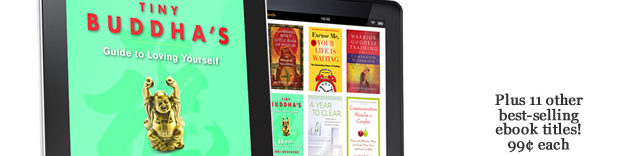
    Hi friends! I’m pleased to announce that the eBook version of Tiny Buddha’s Guide to Loving Yourself has been selected for The Great Autumn eBook Sale, which is offering twelve powerful eBooks for just 99 cents each, from now until October 19th.

    About Tiny Buddha’s Guide to Loving Yourself

    Tiny Buddha’s Guide to Loving Yourself  shares forty unique perspectives and insights on topics related to loving yourself, including:

    • Realizing you’re not broken
    • Accepting your flaws
    • Releasing the need for approval
    • Forgiving yourself
    • Letting go of comparisons
    • Learning to be authentic

    Featuring stories selected from hundreds of Tiny Buddha contributors, this book can help you overcome critical, self-judging thoughts to create a peaceful, empowered life.

    Some of the other titles in The Great Autumn eBook Sale include:

    • Don Miguel Ruiz’s The Little Book of Wisdom
    • Communication Miracles for Couples
    • Let Go Now: Embracing Detachment
    • A Year to Clear: A Daily Guide to Creating Spaciousness in Your Home and Heart 

    Click here to see the full list of 12 bestselling titles you can choose from for only 99 cents each.

    The reduced prices are only available through midnight on Thursday October 19th, so be sure to act quickly if you want to take advantage of this unique opportunity to load up your eReader while saving big.

    If you’d rather grab a hard copy of Tiny Buddha’s Guide to Loving Yourself, you can get one on Amazon here. Or, if you’re more drawn to my latest book, Tiny Buddha’s Gratitude Journal, you can find that here.

    Happy Wednesday!

  • Book Giveaway: Tiny Buddha’s Gratitude Journal and The Self-Love Experiment

    Book Giveaway: Tiny Buddha’s Gratitude Journal and The Self-Love Experiment

    UPDATE: The winners for this giveaway are Alexandra Martinez and Kathy Kortegaard.

    Happy October, friends! Over the past several months since I launched Tiny Buddha’s Gratitude Journal, I’ve been excited to receive some wonderful feedback on the thought-provoking prompts and questions, and the coloring pages.

    I decided to create this journal because adopting a gratitude practice has been life changing for me; it’s shifted my perspective, boosted my mood, and enabled me to hold on to optimism during some of the darkest times of my life.

    And I chose to include coloring pages because I’ve been obsessed with adult coloring since it became a thing. Sitting with my markers and a book with intricate pictures or mandalas, I feel relaxed, completely focused on the present, and joyfully connected to the creative part of my brain.

    If you haven’t yet picked up a copy—or if you’d like an extra for a friend—now’s your chance to win one.

    And because the best gratitude practice is rooted in appreciation for yourself, I’m also giving away a copy of my good friend Shannon Kaiser’s new book The Self-Love Experiment.

    About Tiny Buddha’s Gratitude Journal

    This flexibound interactive journal includes questions and prompts to help you reflect on everything that’s worth appreciating in your life.

    Sprinkled throughout the journal are fifteen coloring pages depicting ordinary, often overlooked objects that enhance our lives, with space for written reflection on the page.

    Tiny Buddha’s Gratitude Journal will help you recognize your blessings, focus on the positive, and foster optimism so you can be your best, happiest self every day.

    About The Self-Love Experiment

    Whether you want to lose weight, land your dream job, find your soul mate, or get out of debt, it all starts with self-love.

    Shannon Kaiser learned the secrets to loving herself, finding purpose, and living a passion-filled life after recovering from an eating disorder, drug addiction, corporate burnout, and depression. She walks you through her own personal experiment, a simple plan that compassionately guides you through the process of removing fear-based thoughts, so you can fall in love with life.

    If you want to change your outcome in life, you have to change your daily habits and perspective. The Self-Love Experiment will help you do just that.

    The Giveaway

    To enter to win a copy of Tiny Buddha’s Gratitude Journal or a copy of The Self-Love Experiment:

    • Leave a comment below sharing something you’re grateful for today or something you appreciate about yourself (or both!)
    • For an extra entry, share the link to this giveaway on one of your social media pages and include that link in a second comment

    You can enter until midnight, PST, on Sunday, October 8th. Books will ship during the week of October 16th (as I’ll be on vacation before then).

    If you’d rather not wait to grab both of these books you can find Tiny Buddha’s Gratitude Journal on Amazon here, and The Self-Love Experiment here.

    FTC Disclosure: I receive complimentary books for reviews and interviews on tinybuddha.com, but I am not compensated for writing or obligated to write anything specific. I am an Amazon affiliate, meaning I earn a percentage of all books purchased through the links I provide on this site. 

  • Why I Drank, How It Destroyed Me, and How I’m Healing My Self-Hatred

    Why I Drank, How It Destroyed Me, and How I’m Healing My Self-Hatred

    TRIGGER WARNING: This post deals with an account of sexual assault and self-harm and may be triggering to some people.

    Hi, I’m Adriana and I’m an alcoholic.

    When I look back at my life, I realize it was inevitable that I’d end up here.

    By the time I was nineteen, I’d already had a history of self-harm through cutting, a byproduct of my depression and anxiety. I was anorexic. I’d had a near cervical-cancer scare not once, but twice within a six-month period, leaving my gynecologist back in Sydney speechless. “I have never had a case like yours.”

    I’d survived an abusive relationship that, I believed, left me with no other choice but to end my life. If I were going to die, I’d rather die by my own accord, not his. So, I swallowed forty Panadol pills, two at a time, within thirty minutes. I felt my body slowly shut down as each minute passed by, and ironically, it was the first time in a long time that I felt alive.

    I’m not writing about the sugarcoated life many have engaged with on my social media feeds over the years. I am here to introduce you to my self-hatred, which you don’t see each time I post a filtered photo on my Instagram page.

    I fell in love with the wrong person when I was seventeen. The first six months together were filled with happiness. I was convinced he was the one I’d spend the rest of my life with, and at seventeen my hunt for a husband was over. Hashtag winning.

    I couldn’t have been more wrong.

    Over the course of the ten months that followed, he routinely beat me, and I covered up the evidence to protect him. He psychologically raped me, repeatedly telling me, “Who’s gonna love you when I’m done with you?” He even sodomized me.

    He threatened my life if I didn’t listen to him or if I dared to tell anyone the truth. I had two friends who begged me to walk away, but no matter how powerless I felt, their concerns meant nothing to me. So over time, they gave up trying.

    He told me when to speak—“Don’t be too funny, Adriana. I don’t want people liking you more than me.” He also told me what to wear, and I had to ask permission if I wanted to go out. Worst of all, he stripped me of my right to feel human, true to the nature of how insidious an abusive relationship can be. In this case, love really was blind.

    I internalized the trauma to such an extent that I carried the shame, guilt, and pain with me throughout my twenties. I forgave him long before I forgave myself, which led me to a path of unconscious self-destruction.

    It was my fault for holding onto those first six months and hoping the real him would return. It was my fault that I let him treat me the way that he did. It was my fault for not leaving, particularly after the first time he hit me. It was my fault because surely I was doing something wrong that would trigger him to hit me. It was my fault because by staying, I was asking for it.

    So I did what most young people do when they’re nineteen and single: I started my clubbing career and my relationship with Jack Daniels. A year before, alcohol repelled me; now it was my savior. This also led to the introduction to a string of dysfunctional people I’d come to call my friends.

    You know, you should never judge a party girl. Every party girl has a backstory, but in my case, no one cared enough to find out. They just bought me more drinks.

    People would say they envied my life—how I had zero Fs for the world around me—but what most people failed to see was that, in reality, I had zero Fs for myself.

    Then I entered the permanent hangover I now call my twenties.

    I started going to festivals and was introduced to ecstasy. I still remember the first time an e hit my bloodstream. Like most users, I tried to relive that feeling every time I popped a pill. Eventually, ecstasy became boring, and I started experimenting with pure MDMA. It was a little bit riskier and more dangerous, but it didn’t matter because I didn’t matter.

    I was then introduced to cocaine when I was twenty, and that became my favorite drug of them all. Cocaine meant that I could drink more. It also meant that I had something in common with people who I usually wouldn’t associate with.

    Cocaine turned me into a version of myself that was confident and unstoppable. When I was high, I used to think to myself, “Imagine you were this confident and unstoppable but didn’t need cocaine to get you there.” Just imagine!

    I often found it funny how the drug was commonly referred to as “the rich man’s drug,” yet it left me feeling emotionally bankrupt.

    At twenty-one, I was partying in Las Vegas with some friends when I got busted with an eight ball of cocaine—and got away with it. Fortunately, I was given a slap on the wrist and banned from entering half the hotels in Vegas for life. Personally, I was more devastated because that meant that I could never be a Playboy bunny.

    I remember the undercover policewoman taking me down to the public toilets, handing me over the bag of coke, and asking me to flush it down. I took this as an opportunity to bribe her into letting me keep the bag.

    You’d think that an incident like that would encourage me to hang up my party dress and clean up my ways. But it didn’t. I continued down this path, playing roulette with my life.

    Not all was tragic. I did find myself in a loving relationship a year later, and for three years lived a ‘normal’ life. He loved me, and I loved him as much as I could. But what is love when you don’t love yourself? This voice inside my head constantly whispered, “You’re not good enough for him.”

    Once that relationship ended, I was straight back to my self-destructive ways, drinking heavily on most nights.

    On one occasion, I decided it would be “cool” to bring a guy home and drink skull cafe patron out of the bottle. Mind you, I was already intoxicated. The next morning I woke up peacefully in my bed. A few hours later, I received a message that read, “I need you to take the morning-after pill ASAP.”

    I thought, hmm, it’s not my ideal situation; sh*t happens, I suppose. It’s $30 in Australia, and you can buy it over the counter, fortunately, but the problem was, I couldn’t remember having sex.

    To this moment, I don’t. I had blacked out.

    I felt so exposed, vulnerable, and disgusted with myself. Then the shame kicked in. Who the hell did I think I was? What was I becoming?

    I decided I needed to stop drinking, and I was successfully sober for three months. I survived parties, lonely nights, and even the ultimate test, a big fat Croatian wedding.

    I never considered that I had a problem with alcohol. I thought that alcoholism was a condition you could learn to control.

    In my late twenties, I decided to move myself from Sydney to London to “find myself.” We all know the saying that you must “lose yourself” in order to “find yourself,” and I did just that.

    London is a fascinating city to lose yourself in. There was always an occasion to drink. I wasn’t one of those wake-up-and-drink-right-away type people. I was more self-respecting than that; I waited till lunchtime and continued until I blacked out! But as a high-functioning alcoholic, I still made my work deadlines.

    I was always around people who didn’t just use drugs; they abused them. And no matter how much I knew the difference between right and wrong, I was perpetually on a quest to distract myself from myself.

    There was no one more delighted to meet another person who was more messed up than me. “Great,” I thought. “Let’s talk about your problems; I’m not ready to talk about mine.”

    I slept my way around, seeking someone who would understand and rescue me. I was bed hopping, using sex as a way to validate myself and feel worthy. It was nothing less than a cheap thrill.

    I attracted males who were misogynistic and dominant and resembled the character of my first love. Everyone had an agenda to take a piece of me. I was aware of this; I just didn’t care.

    I had one who would eventually tell me that maybe I shouldn’t be so upfront and honest about my past with the next guy because “it may turn him off.” But it was okay for him to turn me over in my sleep, get on top, and insert himself inside of me because he was in the mood. This was the many occasions that I was raped.

    Then there was the one who slapped my face as I told him to get out of me, but he kept going, smiling as he watched the tears roll down my face.

    Before I forget, there was another who was more than willing to buy me cocktails all night while telling me he couldn’t wait to take advantage of me later on, but made me call my own cab when I threw up all over his bedroom. Apparently we had sex too.

    We can sit here and go on about my clouded judgment when, in actual fact, this dialogue and connection was just my comfort zone.

    A year ago, completely fed up with myself and my chemically addictive ways, I decided it was time to kill myself. I was emotionally exhausted and starved. My body no longer felt pain, and I could longer taste alcohol. I was so deep in depression I could feel it in my blood.

    I planned my suicide, step by step, over several days and kept reminding myself that the world was better off without me helplessly roaming within it, without a purpose, doing more harm than good.

    I was a bad person because I was a broken person, as many boys had told me. I may not have intentionally hurt those around me, but I had a decade-long struggle during which I perpetually hurt the one person I never knew how to love, myself.

    I started writing my suicide letter and decided I needed some background noise. On the front page of YouTube was a video titled “How to overcome procrastination by leaping afraid,” by Lisa Nichols. This video would end up saving my life and distracting me from my open wounds that were so desperately trying to dry up.

    There is nothing that scares an addict more than sobriety and having nothing to turn to when that darkness from your past begins to appear and say, “Hey, remember me?” But I knew my problem with alcohol was fueling my depression and, therefore, contributing to my self-hatred. I had to break this cycle of hate.

    I sat in my silence and said, “Adriana, you have two choices right now: You can continue down this path, knowing you’re going to keep doing the same thing, getting the same results; and I’m pretty sure that’s what Einstein defined as insanity. Down this path your addictions will kill you or you may do it yourself—whatever comes first. Or, you can do something you haven’t done in the last ten years: give sobriety a chance and see if things are different on the other side.”

    I was twenty-nine when I said enough. My grandfather was sixty. Some people never have an age. Some people simply drown and instead of living to their full potential. They just exist.

    Every year on my birthday, I would blow out my candles and wish for love. Last year, my wish came true, and I started the tumultuous road to recovery, healing, and self-love. It may be a cliché, but it’s true: Who’s going to love you if you don’t love yourself first?

    I knew that the life I dreamed of was on the other side of my fears, and getting sober was a stepping stone. I just celebrated eight months of sobriety, and although this may not seem like long, it’s the longest I haven’t poisoned my blood in ten years.

    It hasn’t been easy. I have cried alone in my room. I had cried walking down the street. I have cried at parties and events. I’ve had breakdowns in several AA meetings. I have cried during a yoga class when the tears were triggered by the damage I had done to my body. I felt it all.

    I heard voices telling me I’d fail and I should just stick to my old ways, the ways I knew best. I almost relapsed twice in the first three months because I was tempted to show my new friends who my old friends knew me to be.

    But I am healing and getting stronger.

    I’ve learned that we find our greatest strengths in our darkest shadows, and there is no way you can know what happiness is until you figure out what it isn’t.

    The relationship we have with ourselves is the longest relationship we’ll ever have. Yet, we spend prolonged periods of time neglecting ourselves to suit the world around us.

    We chase happiness in momentary triumphs instead of simply choosing it by putting in the work to keep ourselves self-aware and on our own paths of personal enlightenment.

    We avoid taboo topics like addictions because they make people uncomfortable, but we are more than willing to engage in these addictions because they make us more comfortable with ourselves.

    We are united by owning our struggles and sharing our stories and divided by our quest for perfection and appearing perfect to the world around us. Perfection is an illusion, and God, did I learn this the hard way.

    I don’t deny my demons because instead of feeling ashamed of them, I’m now proud of how I’ve overcome them. And I know my greatest strengths have surfaced from my deepest struggles. Because of what I’ve been through, I’m more compassionate with others in similar situations, and I’ve also developed a strong sense of determination to do the inner self-work required to get past my trauma.

    How many of you can look yourself in the eye and say, “I love you” without knowing deep down that you just lied? I’m still learning, but courtesy of sobriety, I’m getting there.

  • Why I No Longer Need to Be the Best at Everything I Do

    Why I No Longer Need to Be the Best at Everything I Do

    “I am not bound to win, but I am bound to be true. I am not bound to succeed, but I am bound to live up to what light I have.
” ~Abraham Lincoln

    As a child, my father always told me, “At everything you do, you have to be number one.” I tried. In some ways, I succeeded. I got high grades. Sometimes, the highest. Sometimes, I got awards.

    I became an expert at figuring out other people’s expectations and meeting them. This got me approval, but it never made me happy. I wasn’t passionate about grades, awards, or approval. I didn’t feel butterflies in my stomach while doing math. I didn’t feel shivers down my spine while conjugating French verbs.

    I loved to write, sing, dance. I was the girl who made up song lyrics and got them stuck in her head. I was the girl who stayed up after her parents went to bed to dance around, sing into my pillow, and crawl out onto the roof to dream about flying far, far away. I was that girl who couldn’t understand my thoughts until I wrote them down.

    Despite my parents’ wishes for me to pursue an academic, intellectual route, I went to theatre school. There, I thought I would explore the deepest crevices of my desires. I was wrong.

    I found the fine art education world to be shallow, and I found myself to be the same. My mind fixated on being the best. I never was. Disappointed with myself as much as the program, I dropped out. I slunk back to logic and facts. Skepticism. Analysis. Things I was good at. I got good grades. I got awards.

    But being good at something is never a replacement for loving it. I was addicted to academic achievement because it earned me approval. I could never get enough. Again, I got hungry for art.

    After I almost led myself into an early grave, I realized how important it was to make time for the things that made me feel alive. Yet on that journey, I’ve found myself constantly in the intermediate pile. Sometimes, beginner. Never, ever the best.

    I run all the time, but I’m not fast. I’ve been doing yoga for ten years, but I still can’t do Crow Pose. I’ve been playing acoustic guitar on and off for years, and I still struggle with barre chords. I’ve been singing since I was a kid, and my performances are inconsistent. I’ve been writing since I could hold a pen and doing it for a living since 2012, but most people have never heard of me.

    For years, my father’s voice haunted me, telling me to always be number one. I tried to reject his advice, refuse it, write it off as worthless egotism. But still, it gnawed at me.

    One voice in my head said I should accept myself just the way I am. Another part couldn’t help but point out all the room for improvement. Along the way, I’ve realized that one voice doesn’t need to defeat the other. They just need to learn to get along.

    Accepting my skill level at something is self-loving. Who would doubt that? But assuming that my skills can’t or won’t ever get better is self-sabotage. To work on improving myself is a kind of self-acceptance too. I accept my ability to learn—however slow and awkward that learning process might be.

    Some people say that we should always try to be better than who we were yesterday. I can’t agree with that. Some days, I’m less patient, less energetic, and less kind than I was the day before. And that’s okay.

    Because, for me, the goal isn’t to be number one compared to others. And it’s not even to be number one compared to past versions of myself. Instead, I’ve learned to do be the best at just one thing: being my own number one fan, supporter, friend, and mentor.

    It’s not an easy job. It’s not easy to unconditionally love someone and motivate them to make changes. It’s not easy to hold someone when they’re breaking down one day and push them to do better the next day. It’s a paradox and a balancing act. It’s hard. But it’s incredibly worthwhile.

    I spent all those years competing. Trying to be the best. Trying to be perfect. Trying to get recognized, acknowledged, noticed. Trying. Trying. Trying. Never succeeding.

    But now I know that the reward for pursuing the passions that light me on fire isn’t the same as the reward for pursuing status, recognition, or achievement. There are no grades, no awards, no medals that can quantify the way my chest bursts open when I sing something real. There are no numbers to measure the lightness I feel in my body when I write words that make me sob and cry and heal. The reward is the experience.

    We live in the age of self-esteem. The school system tells young kids: “You can be anything you want to be! You can do it all!” But the message woven into even the most encouraging words is that the measuring stick of success is achievement, recognition, award.

    What if all that those kids want to be is happy? Or angry? Or tortured? Or whatever it is that they feel in that moment.

    Self-esteem is nothing but a cheap replacement for self-love. I don’t need to esteem myself. I know I’m an awkward, beautiful, human mess. At most of the things I do, I’m somewhere between mediocre and interesting. At some things, I’m between awful and mediocre. But I love that I do them anyway.

    I appreciate myself so much for doing the things I love, even though I’m not “number one” at them. I am grateful for how much time, care, and effort I put into trying to be a good friend to myself.

    And that’s what I think life is really about: learning about myself. Trying to be a good friend to my reflection. A best friend, even.

    So many of us miss out on the chance to experience self-intimacy because we forget what friendship is all about. It’s about secrets, inside jokes, and adventures. It’s about heartbreak, healing, and presence. We don’t love our friends for how skilled, accomplished, or perfect they are. We love them for being real, for walking beside us on the confusing, chaotic road of life.

    And that’s what I seek to be for myself: an intimate friend. A fellow voyager. A curious companion. Maybe it doesn’t sound like much. But to me, it’s an accomplishment that I achieve and celebrate every single day.

    **Editor’s Note: Vironika has generously offered to give away ten digital copies of her new book, The Art of Talking to Yourself (preview available here). A different kind of self-help book. Instead of giving you expert advice and magical solutions, this book will help you discover your own expertise and use it to hear, understand, and change your inner conversation. You can learn more and read reviews on Amazon here.

    For a chance to win, leave a comment below. You don’t have to write anything specific. “Count me in” is sufficient! You can enter until midnight PST on Sunday, August 13th. 

    UPDATE: The winners for this giveaway have been chosen. They are: Aegira, Simona Celarova, Ted Young, Kat Gál, Bernadine, Gregory Dees, Athreyi Raj, Jessica Rodriguez, Gayne Brenneman, and Marty Lesak Sloditski.

    Photo by Allef Vinicius

  • How to Boost Your Self-Worth: 7 Tips to Feel Better About Yourself

    How to Boost Your Self-Worth: 7 Tips to Feel Better About Yourself

    “The more we see ourselves as a vibrant, successful, inspiring person who boldly declares and manifests her vision, the more we become just that.” ~Kristi Bowman

    I was kind of a chunky kid growing up.

    In my own little world of trolls and playwriting, I didn’t notice the chunk. I genuinely liked me. But when I entered the “real world” of opinions, people, and comparison, I began to realize or rather feel that perhaps my body wasn’t good enough.

    This thought was like a seed that was then planted in my brain. And every time I thought about it, I watered it. Soon enough, that seed sprouted and feelings of not being enough were just a part of who I was.

    I was really good at disguising those thoughts, though. Most in my circle had no idea of how I really felt.

    To be brutally honest, I didn’t even know how I really felt until an event that happened (years later) shined so much light on my deep-rooted feelings of not being enough that I could no longer not acknowledge my feelings. At this point, I fully acknowledged that I had some serious work to do.

    The beginning of the event (you’ll see why I say beginning shortly) was with a boy. I was in my twenties. We were newly dating. We had just come back to his place after a nice dinner. We kissed. We decided to change and put on some comfy clothes to watch a movie.

    While I was changing, a funny, unpleased look washed over his face, and he told me that he was surprised my stomach wasn’t really that flat. That I had somewhat of a “muffin top.”

    I stood there, pulling my shirt over my head, stunned. I didn’t know what to say, so I didn’t say anything.

    After the movie, I left, covered in shame. I felt confused, embarrassed, and alone. Despite all of that, I continued to still see him until he inevitably dumped me a few weeks later.

    The real event was my reflection after this relationship ended, when I realized I felt so poorly about myself that I continued to stay with someone who made me feel deep shame. More importantly, I realized that he was just echoing and reflecting back my own feelings of not being good enough.

    It was in this moment that I decided I was, in fact, enough, and that things were going to change.

    Here’s what I did to begin to boost my self-worth and how you can begin to recognize your own worth too.

    1. Pretend you are your own best friend.

    Simply start to notice what you’re saying to yourself. You may be taken aback by how often you’re saying unkind things to yourself (I know I was), but know that it’s totally normal and part of the process. Allow yourself to observe the thoughts that come up and not judge yourself for having them.

    When you notice that you’re in this unkind space, ask yourself, “If this were a friend coming to me with these thoughts, my thoughts, what would I say to them?”

    This question would always wake me up and radically change my self-talk. I could see how mean I was being to myself. I wouldn’t speak to any other human being like I spoke to myself, let alone a friend. You may find this is the same for you.

    If this is difficult for you, it may be because you don’t think you deserve this level of kindness. First of all, you do. Second of all, you can combat this by choosing to focus on one thing you appreciate about yourself that day. Perhaps you appreciate that you decided to go on a walk even though you didn’t want to, or you were kind to your coworker, even though she was being unkind.

    Reflecting and recalling things you appreciate about yourself isn’t always easy, but the more you practice it, the easier it becomes. And it’s in this space you’ll begin to see you deserve to be spoken to kindly, just like you would speak to a friend.

    2. Surround yourself with people who bring you up.

    I was notorious for saying yes when I really wanted to say no. Again, it all boiled down to not valuing my wants, my needs, or myself. The first time I said no (with grace), I was petrified. I was worried the other person would hate me.

    Funny thing is, they didn’t hate me. They began to respect me more. And the more and more I declined outings, events, dates, work, and time with people who brought me down, the more I made room for the things in my life that made me shine, feel happy, and feel whole.

    By feeling this way, I began to really fall in love with myself and appreciate the power I had to make myself feel grounded. I began to feel enough.

    And it was during this time that I joined a local yoga studio, signed up for meditation classes, and started regularly hiking. Through these activities, not only did I find self-worth, and myself, but I also began to grow a beautiful support network of likeminded individuals who would eventually become friends.

    You can do this too. Find and/or make time for activities that bring you joy, and know that a simple hello and a smile can go a long way.

    3. Ask close friends or family members what they appreciate about you.

    Sometimes (or a lot of the time) a kind word from someone we love and trust can go a long way. Their perspective can also help shed some light on qualities about ourselves we previously dismissed.

    And when you have these words in writing, you can pull then out and reread them whenever you feel down.

    The email I sent, and that you can send too, went something like this: “As one of the key people in my soul circle, would you mind telling me what you appreciate about me? I’d be so appreciative!”

    Try it. Save their words. And reread them when you need them.

    4. Get curious about why you’re triggered.

    We get emotionally triggered for all sorts of things—words, actions, decisions, comments, and the list could go on.

    When I got serious about feeling my worth, instead of getting angry with others, situations, or myself when I became emotionally triggered, I got curious and began asking myself what still needed to be healed. By doing this, I was able to really heal my wounds and understand myself better, so the next decision, action, person, or words I chose would lend to better, more loving choices.

    For example, comments about how much or how little I would eat triggered me because I thought someone was judging my body.

    This observation made me realize I had more healing to do around accepting my body and being grateful for it. So I began to write what I appreciated about my body every day in a journal. Slowly, over time, I came to fully love my body—cellulite, “muffin top,” and all.

    You can do this too. The first step is simply becoming aware of when you’re emotionally triggered, leaning into the “why” behind it all, and seeing what still needs to be healed.

    5. Focus on kindness and helping others.

    Choosing to switch my focus from “What’s wrong with me?” to “How can I give back?” was immensely powerful.

    What made me see and feel my worth was helping others—giving a compliment, holding open a door, calling my grandma, starting a random conversation with the woman bagging my groceries, helping an elderly gentleman who had fallen get back up, extending an ear, a hug, and a tissue for a girlfriend after her long hard day.

    By giving back, even in tiny ways, I saw how much of an impact I had. I saw I mattered. I saw I had the power to create happier moments for others and literally turn frowns upside down. And when you see that you’re capable of this, you can’t not see that you are worthy and deserving of love, including your own.

    You can try this too with as much as a simple genuine compliment.

    6. Practice gratitude for who you are as a human being.

    In today’s world, we’re so used to looking at things from the outside in. I didn’t (and still don’t) want to feel my worth based on my looks. Our looks fade. Our soul never does.

    I knew this but didn’t know how to really feel it until I began making notes of why I appreciated and liked myself, on a soul-level. Not on the superficial level. For example, I began writing down things like, “I appreciate that I have such a deep capacity to feel.” This was such a simple, yet transforming exercise.

    You can begin to create this practice too. Every morning or evening (whatever feels best to you), in a journal, bullet-point a few things that you appreciate about your soul self that are unique to your last twenty-four hours.

    For example, if you encountered a rough situation at work and you were kind regardless, you could write “I appreciate I acted with grace and gentleness at the office today in an uncomfortable situation.” Or, you could write, “I appreciate my grace and gentleness.”

    The point is that your gratitude focus here is inward. You’re appreciating the qualities that make you uniquely and beautifully you. And you’re showing up daily to shine some light on them. And yes, know this may feel odd at first, but over time, it becomes easier, and naturally this appreciation of who you are positively changes your self-worth.

    7. Realize everyone has their own struggles.

    I had always known everyone had their own struggles, but I hadn’t fully internalized it. When I began creating a new tribe of souls who appreciated me, lifted me up, and who made me feel safe, I was able to talk about some of my struggles with loving myself and feeling worthy.

    When I did this, others began to open up about their own struggles with self-worth. This made me feel less alone, and ironically, made my self-worth soar through the roof because by simply being open, I was able to help others move through their own self-worth struggles.

    Here, I saw that I wasn’t alone and that I had more power than I thought. You do too.

  • How Reframing Your Self-Critical Thoughts Can Help Ease Anxiety

    How Reframing Your Self-Critical Thoughts Can Help Ease Anxiety

    “Don’t let the sadness of your past and the fear of your future ruin the happiness of your present.” ~Unknown

    I know what it feels like to be scared.

    I know what it feels like to question your sanity, your worth, your place in this world.

    Sometimes, all I can do is repeat the words it’s okay over and over and over again in my head, until I kind of, somewhat, maybe start to believe it’s true.

    Anxiety sucks. Depression does too. They’re not my favorites of the emotions we humans get to experience. But, truthfully, they have a purpose.

    I’ve been having panic attacks for a little over six months now. They’re still new to me, and every one is so different.

    The physical symptoms change, I’m still learning what my “triggers” are, and the ups and downs between my moods vary in time and extremity. But there’s one thing that has been consistent since the beginning, which is that every time I start to feel anxiety or depression creep in, I instantly hate myself.

    I sense the pit of worry in my stomach, and I hate myself. I wake up feeling sad, and I hate myself. I have to transfer money from my savings account, and I hate myself. I mess up at work, and I hate myself. I feel the uncertainty of my future, and I hate myself.

    As soon as I begin to enter that state, it’s the start of the freaking pity party of the century. Pretty soon all of my thoughts sound something along the lines of…

    I’m so messed up.

    No one else feels this way.

    I’m broken beyond repair.

    I shouldn’t feel this way.

    Why can’t I just be happy?

    I’m not good enough to be happy.

    There’s no way I’m going to get through this.

    I thought I had come so far.

    There’s just no point.

    I can’t remember the last time I felt happy, or excited, or tired, or bored, and thought anything close to these dark, nasty thoughts. So why do I instantly start abusing myself with such hateful thinking when these specific emotions of anxiety and depression appear?

    But wait! There’s good news here. This isn’t just a pity party, after all.

    I realized that there’s a way to pull myself out of the cyclical trap of feel sad or anxious, then hating myself for feeling sad or anxious, and then hating myself for hating myself for feeling sad or anxious.

    It’s a vicious cycle, but there is a simple solution: compassion, self-love, and reframing.

    For example, today I had a series of mini breakdowns, which included locking myself in my car so I could cry in (semi) privacy, throwing up in the bathroom at work because my stomach was so full of acidic worry it made me sick, leaving work early because of how I felt, and sobbing in my shower for about twenty minutes while wasting precious hot water. (#BestDayEver)

    So what did I do to turn it around?

    I treated myself with compassion and self-love, and reframed my negative thoughts.

    I showered, put on comfy clothes, made a cup of tea, and lit my favorite candle. I turned on Girls in the background because Hannah always makes me feel better. I read a few pages from one of my favorite books. I did some deep breathing. I told myself “I’m going to be okay” at least one hundred thousand times (slight exaggeration, maybe).

    Then, I started to pay attention to my thoughts as an outside observer. I was able to look at some of the terrible things I say to myself like “I’m so messed up” and “I shouldn’t feel this way,” and was able to crack them open for analysis.

    I was able to look at it from an objective point of view and question: Are these thoughts really true? And if not, can I replace these thoughts with ones that are actually true?

    Some examples…

    I’m so messed up became I’m going through a tough time right now, like everyone else in the world has, but it doesn’t reflect my worthiness or importance as an individual.

    I shouldn’t feel this way became It’s okay to feel down or nervous sometimes, because it’s temporary and it doesn’t define who I am.

    I’m broken beyond repair became I’m just figuring the craziness of this life out, as we all are, and I’ll feel better soon.

    There’s just no point became I have an infinite number of resources and people in my life who love and support me, and I’m worthy of that love and support.

    The stories that we tell ourselves are just that: stories. What we say to ourselves in our heads can hugely impact the way we perceive our lives and our self-worth.

    As the Buddha said, “We are shaped by our thoughts; we become what we think. When the mind is pure, joy follows like a shadow that never leaves.”

    By becoming more mindful of the stories running through your mind, you’re able to take an objective view on how those stories makes you feel, and then decide if they’re worth keeping around or not. If they’re not, choose to let them go.

    Reframing, self-love, and compassion are the three tools I use to help guide me through anxiety and depression. It’s all a learning process, but I can confidently say that this has helped me so much more than self-medicating or trying to ignore the problem.

    By observing our thoughts and the way we speak to ourselves in times of struggle, we can get a picture of how much we actually love ourselves, and then ramp up the love and positivity until we can’t help but feel better

    If you’re going through anxiety, depression, or any other tough time, I encourage you to:

    • Slow down; hit pause
    • Remember that you’re worthy of love and happiness
    • Take a few deep breaths, and tune into that inner dialogue you have going on
    • See if there are any negative thoughts or stories running through your mind that you can challenge
    • Replace them with positive, love-based truths

    Try to remember that we’re all just living, breathing, crazy little human beings, floating around on this planet through a limitless universe for a microscopic moment of time. None of us really know what the heck is going on here.

    We’re all just trying to get by, and have a little fun while doing it. Remember that you’re worthy of love from others, but most importantly, from yourself. And try to ease up on yourself. It’s okay to feel bad. It’s also okay to feel good. They’re two sides of the same coin, and that’s what this life is all about… our depth of human experiences and our connection to something more.

    I’m thankful for anxiety and depression because those emotions present me with an opportunity. It’s a chance for me to fall victim to my fear-based, negative stories, or for me to choose to see things from a place of love instead. The next time you feel those emotions creeping in, I challenge you to ask yourself, what do you choose?

  • 5 Lessons from a Dating Detox (for Anyone Who’s Looking for Love)

    5 Lessons from a Dating Detox (for Anyone Who’s Looking for Love)

    “Sometimes when you lose your way, you find yourself.” ~Mandy Hale

    Ever since I can remember, I was determined, even desperate, to find love. My life felt empty and lonely.

    I wanted to be happy and feel loved. I believed everything would be all right if only I had my man.

    For years my self-esteem was non-existent. I had no clue how to build a relationship with a man. I had no boundaries. I felt unworthy and unlovable.

    I started dating online. I kept meeting different men and occasionally I would meet someone who I would see for a while.

    Because of my low self-esteem and desperation, I often ended up with men who were not ready to commit or couldn’t give me what I needed.

    After a few months I would feel drained and the relationship would come to an end. Again, I would find myself back on the dating scene desperately looking for Mr. Right: flicking through tonnes of profiles, interacting with hundreds of men and meeting a handful of them only to find out that I had nothing in common with most of them. It was frustrating and disheartening.

    I was stuck in this cycle for years. A relationship, a breakup, serial dating; a relationship, a breakup, serial dating …

    It was an emotional roller coaster: of hopes and disappointments, loneliness and tears, rejection and heartbreak, with the odd bit of fun.

    After my last low quality relationship, I panicked. I was thirty. I had no husband, no kids, no house, nothing to my name. And I still thought that having a man was the solution.

    I redoubled my efforts, going on a string of boring and uninspiring dates with guys who had nothing to offer.

    By this point, I was absolutely exhausted with the whole thing. I was tired of dating and chasing love, tired of waiting for The One, tired of hoping, tired of having to constantly pick myself up and put myself back in the dating game.

    At that point I had lost my all faith in love, which although didn’t feel nice, was the best thing that could have ever happened to me.   

    After one of my boring dates, I woke up the next morning and couldn’t even remember the guy’s name. It felt wrong.

    I reflected upon my last few dates and realized that I didn’t want to waste my time any more.

    This was the moment of truth. For the first time in my dating career I was honest with myself and admitted that all my crazy dating efforts hadn’t brought me my desired outcome. I was nowhere even close to finding The One.

    I felt useless. I felt like a failure. I felt like there was something fundamentally wrong with me since I couldn’t even find one freaking man with whom I could be happy. How much dating do you have to do to find one man, right?

    I sat down and asked myself a few questions: Why am I running away from myself? Why do I so desperately want to have a relationship? Why can I not stop dating and just be with myself for a while? And most importantly, what am I learning from being single? That was it. I took a notebook and started writing and the answers kept flowing.

    After asking myself these fundamental questions, I realized that the only thing to do was to stop dating. I wanted to take some time out to re-evaluate my approach to love and romantic relationships.

    I deleted my online profiles and cancelled my memberships. I started my dating detox.

    I felt a deep desire to reconnect with myself. For about two years I didn’t even think about men. I focused on myself. I didn’t pursue anything. I stopped hoping. I let go of my expectations. I was free.

    I began to appreciate many things about my single status. I found so many blessings in living my life as a single person. I genuinely started to like being single rather than run away from it.

    The more I connected with myself, the less lonely and desperate I felt. I stopped fearing lonely weekends as I filled them with things I loved doing. Life became easier.

    I started to enjoy spending time on my own. I became comfortable with silence and solitude. Bit by bit I was finding myself. Then one day, I felt complete for the first time in my life. I had found my bliss.

    After my transformation, I was ready to date again—just for fun, with no expectations. I definitely wasn’t looking for a serious relationship.

    The quality of my dates improved as I became more selective and had stronger boundaries.

    I went out with a few high quality men and I enjoyed my dates even though I didn’t click with them romantically. I had more fun.

    A few short months after my detox, I met a charming, wise, mindful and very loving English man who exceeded all my expectations. I fell in love with him and he fell in love with me.

    For the first time in my life, I am in a happy and healthy relationship with a man, not a boy, for a change.

    And together we have a little munchkin who has brought even more fun and happiness to our lives. This is something I had given up on a long time ago; with my luck in love I didn’t believe that I would ever find a man who I could have a family with.

    When I became happy with myself I became also ready to meet a happy and emotionally healthy man. Having done the inner work, I had become the woman who was ready to attract her dream man. I became the person I was looking for.

    Dating detox was the best thing I could have ever done to turn my love life around.

    My journey through seven years of singledom, more than a hundred online dates, and one dating detox had taught me many lessons and helped me find myself. I want to share five of the most important lessons with you.

    1. Accept where you are.

    Resisting being single will only create more conflict within yourself. I hated being single for years. I desperately wanted to be in a relationship to feel happier, but I kept attracting wounded men like myself.

    This running away from being single didn’t serve me one bit. I eventually came to the realization that being single is being in a relationship with oneself. This is the most natural relationship of all, but we have been conditioned to believe that we need someone else to be happy and fulfilled.

    If there is no man or woman in your life, you connect with yourself. Nothing will give you more comfort than finding this secure place within yourself.

    Make the most out of your life while you are single. There are so many advantages to being single and it is time to start to count your blessings.

    Accepting your single status is a crucial step in becoming ready for a relationship. When you become a happy single person, the desperation for a romantic relationship disappears. You are then in a much better place to attract someone who is emotionally healthy and happy.

    You want to find yourself in a place where you want a relationship, but don’t need one.

    2. Take responsibility for your own happiness.

    For years I had been putting my happiness in the hands of men. I spent too many years being miserable waiting for a man to come along and make me happy; every time I was single I was unhappy.

    When I realized that I might be single for another five or ten years, it hit me that I didn’t want to spend them being miserable. I stopped putting my life on hold and started to enjoy my life in the here and now.

    I stopped postponing my happiness. I started to do all the things I had imagined doing with my future partner. I signed up for the gym. I travelled more. I started to save up for my future house. I took up swimming, working out, yoga etc.

    And guess what. When you are happy you become more attractive, and you attract a different kind of person.

    Not only did my single life improve but also my dating and love life.

    Most of all, I discovered that I didn’t need anybody else to be happy. I realized that I was responsible for my own happiness and not some man as I had believed for many years.

    3. Recognize that your relationship with yourself is the most important one.

    I figured that the relationship I have with myself is the only guaranteed relationship I will ever have. Others might come and go, but I can’t ever escape myself.

    The quality of the connection you have with yourself will determine the quality of your relationships with others, including romantic relationships. If your relationship with yourself is not happy and healthy, it will be difficult for you to create a healthy and happy relationship with someone else.

    Your romantic relationship is only as good as the relationship you have with yourself.

    I tackled loneliness first. I started to spend more time in my own company. I scheduled quality time with myself in my calendar. I had Sundays to myself. Solitude and silence became my friends. I wrote a lot, kept a journal and made time for self-reflection and meditation.

    These practices helped me dive deeper within myself and I began to feel stronger and more secure within myself. For the first time in my life, I started to enjoy being with myself.

    4. Self-love comes first.

    If you don’t love yourself, you cannot fully love others and neither can you fully receive love. It took me twenty years to understand what self-love actually is.

    And for me it is a practice, not a feeling. It is a practice of choosing myself and what feels right for me.

    When you start practicing loving yourself so many things start to change in your life.

    Your confidence and self-esteem increase. You have the courage to be your authentic self. You stop looking for approval. You become better at asserting your own needs when it comes to dating. You recognize your own value and you aim higher in love. You have stronger boundaries. You become more selective. These all lead to making better romantic choices and choosing better partners.

    Self-love is seriously powerful. I found true love when I started to love and honor myself, and I thought my job was done.

    Now that I am in a relationship, I realize that this work never ends. You constantly need to practice self-love. You will find new depths to this practice and experience new aspects of self-love. But to be happy in a relationship you must first love yourself.

    5. Find yourself before you find your partner.

    To find true love, you need to know your true self. Take some time to explore who you really are. Spend some time in solitude and be prepared to answer some honest questions about yourself.

    Question your beliefs, as you may find that some of them are not even yours! What are your needs? What are your dreams? What do you want? What is important to you in life?

    Attracting a partner from a space of knowing yourself well usually results in finding someone who values and wants the same from life. When you don’t know who you are, you also cannot know who you want to share your life with.

    Finding yourself is also about realizing that you are a whole and complete person. It is about understanding that you are capable of satisfying your own needs and desires. It’s about making your own dreams come true, being comfortable on your own, having a strong relationship with yourself and living your life as a single, proudly and boldly.

    When I look back at my single life and all my struggles in love, I now understand that I was searching for love in the wrong way. If I had to do it all again, I would start with a dating detox and getting to know myself first.

    Only then you can find your true match and build an amazing romantic relationship with another person.

  • 6 Questions to Help You Love Yourself More When It Feels Impossible

    6 Questions to Help You Love Yourself More When It Feels Impossible

    Sad painting

    “You yourself, as much as anybody in the entire universe, deserve your love and affection.” ~Buddha

    In 2012, self-love became the most important thing in my life. After self-loathing and addiction led me to rock bottom, there was nowhere to go but up. When someone asked me last year how long I’d been on the self-love journey, I counted back from 2012. That’s when I thought it began.

    In my old journals, however, I recently found something strange and incredible—my self-love journey started long before I thought it had. Years prior to hitting rock bottom, I’d been having the same epiphanies: I need to love myself, I need to stop trying to get other people to love me, I need to be kinder to myself.

    Yet those epiphanies wouldn’t last. In fact, I habitually forgot about them as I returned to my “normal” back then—anxiety, depression, self-judgment, social anxiety, and a host of addictive behaviors that helped me escape these uncomfortable states.

    Strangely enough, when my suffering was at its worst, few people could have said that self-love was the problem. I had an outward facade of ironclad self-confidence. Most people thought I loved myself too much.

    Yet my journals tell another story. It is a story of not only silent suffering but also accidentally ignoring all my attempts to heal that suffering. Even though I was chronically self-sabotaging, I was also trying to help myself along the way.

    In a Facebook comment to one of my other posts on Tiny Buddha, someone wrote, “A lot of truth in this, but I’m so tired of the thing about loving yourself. Nobody has ever written about how this happens when you don’t feel that way. It sounds so simplistic—just love yourself first. Great, still no answers!!”

    It might be ironic to give an even more simplistic answer to this, such as “Find the answers within you.” But I think it’s important to note that there is a difference between simplicity and ease. The most important lessons in life really are simple—love yourself, find your own answers, know yourself. Yet implementing these lessons is a lifetime job full of tears, fears, and uncertainty.

    The truth is—the answers are within you, just like they were within me. It’s just a matter of discovering them and implementing them consistently.

    Your answers are within your experience. But they aren’t filed into neat folders. They’re scattered in every moment between alarm clocks, worries, and errands. They’re also not labelled by which questions they answer. You might get a bad feeling about something and that could be self-love, but it could also be fear.

    So, instead of answers, I’d like to provide some questions. Your relationship with yourself is unique and your answers will be unique. And the answers will keep changing. You can ask these questions every day, and that wouldn’t be too much.

    1. How can I better understand this experience?

    One sentence that I found frequently written in my old journals was, “Why does this always happen to me?” I said this about periods of depression as much as relationship patterns.

    When I asked this question, I wasn’t looking for an answer. My biggest mental health breakthrough was learning to genuinely ask that question. No, really, why do I always end up alone when I most need people? Why do I sometimes experience overwhelming periods of depression? Thus, I started to learn important things about myself.

    I learned that I had a tendency to never take breaks, strive for perfection, and burn myself into the ground. I also learned that I had a way of pushing people away to “test” if they’d stick around. Seeing these patterns was painful, but much less painful than believing I was broken, unworthy, and doomed to being alone.

    When you’re in the middle of criticizing or judging yourself, take a moment to shift your focus toward understanding.

    Instead of trying to fix your emotions or your reactions, how can you understand them better? What are your feelings trying to communicate to you? How can you acknowledge these messages?

    Instead of beating yourself up for saying or doing something, how can you get a more holistic perspective on your motivations for saying/doing this thing?

    When you make a conscious decision to be more curious about your experience, you will naturally stop resisting, judging, and criticizing it. The more you embrace each moment, the more you will be able to embrace yourself.

    2. Who am I beyond my behaviors, thoughts, and emotions?

    To be able to embrace the ups and downs of life without losing self-love, you must love yourself beyond those ups and downs. This is the difference between self-approval and self-love.

    Approval comes and goes. When you make a mistake, you might disapprove of yourself. This is healthy and normal. If you didn’t experience lulls in self-esteem, you might never learn from your mistakes and end up hurting others.

    Self-love, on the other hand, is something you need in each moment—especially when your self-esteem is low.

    When you don’t approve of your behaviors, ask yourself who you are beyond those behaviors. How can you accept yourself beyond the rollercoaster of day-to-day experience, so that no matter what those experiences are, you continue to think of yourself as worthy of existing?

    3. What do I need right now?

    Each day, ask yourself what you need. Like this, you can begin to nourish yourself. You can also begin to understand some of the side effects that you experience when you don’t meet your needs. Once you feed your hunger, you’ll better understand your symptoms of starvation. This can lead to profound self-forgiveness.

    Especially when you are trying to break bad habits, you can ask which needs you’re trying to meet with those habits.

    Every single self-harming action, even if it hurts you deeply, also serves you in some way. Maybe your unhealthy habits make you feel comfort, control, or even help you gain attention. The need behind each behavior is always valid, but some behaviors are more sustainable and healthy than others. By acknowledging your deeper needs, you can make a plan to consciously meet them in a healthier way.

    One thing I’ve discovered that I need is movement. I have so much energy in my body from day to day. I didn’t realize this for a long time because I expended that energy on chronic anxiety.

    When I realized that I could use my energy to be physically active, my life changed. My anxiety levels plummeted. I formulated a completely different relationship with my body. I also got a new perspective on my long struggle with eating disorders, smoking, and addiction.

    I had a basic need to control my body, to influence my physical state. I still have that need. The only difference is that, now, I’m making conscious choices about how I’m going to meet it.

    4. How can I give myself what I need?

    Once you discover what your needs are, you can begin to anticipate them and fulfill them.

    Simply to acknowledge your desires is half the work (especially if they are different from those of the people around you).

    The other half of the work is asking yourself, every day, how you can meet your needs. The key is to foresee your hunger and feed it before you feel starved. This way, you can avoid relapsing into those desperate self-destructive habits.

    5. How can I acknowledge the needs that I can’t yet meet?

    Let’s say you discover that you need more alone time than you thought. And suppose you discover this while living with four roommates. Chances are, you will not be able to meet this need overnight. However, self-love isn’t a report card on how quickly you’ve fixed your problems. It’s simply the practice of having a kinder relationship with yourself.

    You can acknowledge your frustration and your desires before taking action to address them. You can comfort yourself and assure yourself that you are going to do something about it. Remember how you’ve felt better when other people have reassured you. How can you give that kind of reassurance to yourself?

    6. How can I take responsibility for myself?

    One thing that might interrupt your journey of self-nourishing is waiting for someone or something else to save you.

    You might acknowledge your need for appreciation, but instead of taking action to meet it, you might tell yourself a story about when it will come.

    You might tell yourself to wait until some promotion, accomplishment, or event. Thus, you can lose out on valuable opportunities to love yourself.

    Start to pay attention to which needs you aren’t meeting because you’re putting them into the future or into other people’s hands. And ask yourself how you can begin to meet that need right now by yourself.

    We all long to have someone be attentive to us—to really care about what we’re going through and how to make it better.

    The most beautiful part of learning to ask and answer these questions on a regular basis is this: your longing will finally be fulfilled.

    You do not need to wait for someone to make you feel like you are worth listening to and caring for. Your savior has been waiting in the mirror all along.

  • How to Start Loving the Parts of Yourself You Don’t Like

    How to Start Loving the Parts of Yourself You Don’t Like

    Love yourself

    “To be beautiful means to be yourself. You don’t need to be accepted by others. You need to accept yourself.” ~Thich Nhat Hanh

    The sun was breaking into my living room as I was sitting at my dining table, viewing a video that I had just recorded for my Facebook group. It was the first one I took, two minutes long, and there were ten more waiting to be recorded.

    I had just pressed the play button to see how I look and sounded, and boy, was I in for a surprise.

    I kid you not, I felt like I was watching Gargamel from The Smurfs and not me. The only thing I could see, over the entire screen, was my big, bumpy nose. The bump was distracting enough that I literally didn’t hear a word I said.

    All I could hear was my inner voice, loudly ranting, “Oh my goodness, look at that nose! Do I really look like that?! This is horrible! Hideous! I can’t look like that in all of my videos, I just can’t! Eeww!!” I was shocked.

    I snapped out of it and thought, “I need to fix this!”

    I marched straight to my bathroom, took out my makeup bag, and started searching though my eyeshadows and foundations like a maniac.

    I had never tried contouring in my life. I had seen only two video tutorials, and thought “damn, that’s a lot of work,” but this was obviously one of those “there’s a first time for everything” moments.

    Trying to remember how to do it, I took some light shades, some dark ones, and started applying. Put a little here, a bit there, and after ten minutes of playing around… Mamma MIA! Will you look at that? I fixed my nose. I am A GENIUS!   

    I proudly cat walked into my living room, sat down in front of that blinking camera, and recorded a new video with my new, straight, slim nose.

    It looked fantastic while I was recording. Then I pressed play to watch the video and was in for another surprise.

    Again, I didn’t hear a word I said in that video. Then, anger took me over. I was disappointed in myself.

    My inner voice kicked in again, louder than before: “This is not you. This is not the person I know. It’s a nice nose, but… Where am I? This is not me. And what’s next, are you gonna fix your lips for the next video so they look bigger?”

    I didn’t care about my nose anymore. I didn’t care about the perfect lines, nor the perfect lighting. The only thing I could think was that I’m someone who encourages others to practice self-love, and yet here I was, in shame, trying to camouflage the part I didn’t like just so I could feel better.

    This isn’t loving yourself. This isn’t embracing all parts of yourself. This isn’t living authentically. 

    I pressed stop and thought “Scr*w this!” Then I went to the bathroom and cleaned my face with the biggest grin on. Seeing the real me in the mirror, I felt pride because I could be me. Freely.

    I calmly walked into my living room one last time and recorded the most honest, openhearted, all natural video. Me and my bumpy nose. I posted it straight away—the first take. No editing, no pimping. And the responses I got from them were beautiful.

    I think a lot of us feel the way I did way too often, which is why I want to share with you what I shared with them: How to turn the parts you don’t like about yourself into your most beloved ones. How to love and accept them.

    On days when you feel like this, here’s what you can do to feel better and more loving.

    1. Realize that you took the wrong turn.

    My reaction came from the urge to hide my imperfection. I felt ashamed of how I looked and I wanted to cover it.

    I wanted to look prettier, but not because I felt the need, like we all do, to feel great or look amazing for some special occasion.

    Had my desire to put on makeup come from me wanting to emphasize my gifts, look a bit different, and play with my beauty, I would be okay with that.

    But that wasn’t the case. I rejected myself. I told myself I was hideous. I wanted to be fixed. Like I was broken and there was something wrong with me. This wasn’t the first time I did this.

    For a long time, I was ashamed because I “felt too much.” People constantly told me, “Oh, you and your emotions! You’re such a cry baby!”

    It took me a while to accept that part of me, to accept that I am highly emotional. Today I can say I simply love my emotions, good and bad. I made them my number one guiding system through life. They always tell me if something’s right or wrong for me and always help me to make right choices and decisions.

    We can feel such shame. But for what? What good does it bring us?

    If you come from the place of “there’s something wrong with me,” know that it’s a sign you took a wrong turn—you turned to shaming and blaming yourself.

    Realize that there is nothing wrong with you. We all feel like there is once in a while.

    Befriend yourself with the thought that we are all perfect just as we are, with our imperfections. Some imperfections we accept, and some we use as opportunities to grow. My nose or wild mood swings, your smile or silly quirks, her lips, his chin, our fears, our dreams—it’s all as it should be. Unique and perfect in their imperfection.

    2. Hear the words you say to yourself.

    It amazes me how mean we can be to ourselves. The words we say in our minds can be the cruellest. Would you ever tell a friend (or anyone, actually) “OMG, look at you! You look horrible! You are hideous!”?

    You wouldn’t, would you?

    If your friend was feeling ugly that day, you would probably remind her how amazing she is, tell her that her beauty is way deeper than her skin, and that you adore exactly the parts of her that she didn’t like (just like my closest friend told me “I love your nose!” right after she saw my video). Because this is how you talk to your loved ones.

    So, why don’t you try talking to yourself the same way—like you’d talk to a loved one?

    Look in the mirror and say something like, “I am aware that you feel ugly/stupid/alone/(insert your own) today. So sorry to hear that. You remember that day when you were glowing, and felt so good, even your friends told you, ‘What’s up with you today, you are shining!’ That’s you as well. Know that you are beautiful inside and out, whether you feel it today or not. I love you nonetheless.”

    Go on, give it a try.

    Because how you feel comes from what you say to yourself.

    Start practicing kind conversations with yourself. You are a kind person, I’m sure, so I bet there are a lot of loving things you could say to yourself.

    3. Know that it’s okay to have good and bad days.

    Some days, when you catch a reflection of yourself, your first thought is going to be “Oh, hello there good looking!!” And you’ll smile, maybe even wink.

    But on some days, you will wake up in the morning, look at your reflection, and say “Awful!”

    Both of these days are perfectly okay.

    We can’t be 100% self-loving and self-accepting every day of the year and every minute of our day. That’s life.

    Loving yourself is a continuous practice. It’s a way of living. It’s something that you cultivate every day. On days when you don’t like yourself, know that it’s just that—a moment when you don’t feel so good. It’s not the first time and it certainly won’t be the last time.

    Instead of adding insults and making yourself feel even worse about it, acknowledge it and remind yourself that it will pass. Perhaps blow your reflection a kiss. A kiss always feels nice.

    Trust that it will pass. Because now you’re practicing kindness and self-love (loving all parts of you). You’re working on it. You got this.

    4. Decide that it’s a matter of a choice.

    When we reject a part of ourselves, we deepen that sense of unworthiness. Every time you do this, you cut the wound deeper and fall further into a hole of self-loathing.

    I wasn’t going to let myself fall deeper down that hole.

    I looked at my imperfect self in the mirror and said, “Today I hated a part of me and it was my nose. Now, I choose to own, love, and accept that part of me. Today, I love and accept myself just as I am.”

    In that moment I felt immensely self-loving. I felt free from judgments and self-criticism.

    Some days I don’t feel that way. I say these words and I don’t feel that instant rush of love. It might happen to you as well. And that’s okay.

    On days like those, you can say: “Now, I am willing to try to accept and love that part, too. I am willing to try to accept and love myself just as I am.”

    I hope my story and this post will inspire you to start looking at the parts of yourself you don’t like in a different light—not to push and hide them away, or be ashamed of them, but to completely love and accept them. For I am most sure they are the parts that make you lovable exactly as you are.

    Which parts are you willing to own, love, and accept today?

  • 9 Ways to Silence Self-Criticism and Embrace Self-Love

    9 Ways to Silence Self-Criticism and Embrace Self-Love

    Girl with flowers

    “I don’t know a perfect person. I only know flawed people who are still worth loving.” ~John Green

    Do you ever wonder if that voice in your head is right?

    Do you relive events, scouring through every detail to look for places where you went wrong in your actions?

    Do you ever walk away from a conversation with your inner voice ranting that you should have done better—that you should have said this or that instead?

    That self-critical voice became a prominent friend of mine. I called it the gremlin. The gremlin leapt onto my shoulder after every conversation with a friend or acquaintance. Whispering in my ear in a snarky voice, repeating every sentence and telling me what I should’ve said instead.

    The gremlin and I would have dinner together after a shopping trip and review how much I’d spent, critiquing what I should have left at the store. We would then scrutinize the meal I’d just eaten and have a dash of dessert, since I had already gone overboard. This would inevitably be followed by a vicious verbal attack on my body.

    The worst part was that the gremlin played on my insecurities, exposed my weaknesses, and actually made me more critical of others (in an attempt to silence my criticism of myself).

    I realized how detrimental a friend the gremlin was when I was diagnosed with depression and anxiety. During a group therapy exercise, I could not write down two people who I thought would have something good to say about me. I just sat there with tears from my ugly-cry falling in my lap. It robbed me of any joy in relationships with others and myself.

    It was a devastating eye-opener.

    Allowing the gremlin to run the show had eroded my self-love and ruined my self-esteem.

    Self-criticism had dirtied my mind into thinking that nothing would ever go my way. I had nothing left inside that seemed admirable. All that I had experienced and achieved up until that point had no meaning for me.

    I eventually managed to break it off with my self-critical voice and built unconditional self-love. But it took consistent practice in searching for my own valuable qualities.

    These are some of the methods that worked for me:

    1. Confront your own gremlin.

    Confrontation is difficult, especially if it’s a part of yourself that you’re confronting.

    But if you want to rid yourself of your gremlin, you have to do it.

    How?

    One of the first things I did was consciously examine every thought. I listened to the tone of my internal dialogue. I found that it was not a loving or supportive voice.

    It was hard to recognize at first, but with practice I heard the distinct voice of my gremlin. I began to question its validity. Were its criticisms actually true? Was it taking things out of context?

    I questioned the beliefs about myself that the gremlin had been whispering to me all those years. I realized I had taken many things out of context, and my inner criticisms were extreme and punitive.

    Would it surprise you if I told you it is actually very satisfying to call out your gremlin and put it on sabbatical? It is a relief to confront the unending criticism and listen for a more supportive voice. When you stop taking its criticisms to heart, you’ll finally open yourself to self-love.

    2. Choose gentle observation.

    This world is a competitive place, and it’s easy to fall into the trap of scrutinizing your abilities. You have a lot invested and want to control the outcome of your experiences. This can create high expectations and disappointment when things do not run smoothly.

    At one of my past jobs, if I made a mistake, I would end up falling into the pattern of berating myself all day long. This accumulated until I no longer felt I did a good job, lowering my self-esteem.

    Now I choose to gently observe my productivity and monitor my progress. If I make a mistake, I correct it to the best of my ability and move on.

    It is through repeated acknowledgement that your self-love is able to blossom. Create a habit of recognizing a kinder vision of yourself—one that is more humane.

    3. Forgive yourself, and then forgive yourself again.

    We all make mistakes, but even tragic ones do not warrant withholding self-love. Self-forgiveness is an art that needs to be practiced and reinforced, especially when you’ve got a harsh internal self-critic.

    My gremlin has berated me through the years about not being a dedicated parent due to my time spent on self-care. To prevent myself from slipping back into depression and anxiety, self-care has become my lifeline and a way to maintain good health. Occasionally I have to put it before my family so I may attend groups or self-improvement classes.

    My family feels the impact of it, and when they protest, my self-critic whispers until I feel guilty.

    So I forgive myself for the time I’ve spent away. I forgive myself for forgetting something important that they told me because I was preoccupied with keeping my mind quiet. I forgive myself for putting myself at the top of my priority list.

    Forgiveness is a skill to be honed and perfected. The main benefit is freedom from the scorn of your inner critic. So forgive yourself daily.

    Every night before you go to sleep, make some time in your bedtime ritual to forgive yourself for something, even if it’s just a small mistake or done out of necessity. Tell yourself it’s okay, that these things happen, and see if there is a way to improve the situation.

    4. Expand your view.

    Sometimes you only see what is in focus. But when you focus on something too closely, you miss all the beautiful scenery. A Monet painting looks like mere splotches if you scrutinize it closely. But when you look at it from a distance, its beauty is breathtaking.

    In the past, whenever a friend hadn’t returned a call or was late for a night out, my gremlin would tell me they didn’t like me anymore. It would tell me it’s me and I was sliding down the popularity scale.

    But this was never the case. Whenever I expanded the view, I realized my friends had their own lives keeping them busy, and they missed me as much as I missed them. When we would finally get together, we had a great time, and I would experience all the love that was available to me.

    Your inner critic will always focus on the negative possibilities and make everything your fault. But when you expand your view, you’ll see the world is a very intricate, complicated piece of art meant to be appreciated as a whole.

    5. Let go of judgment.

    Life unfolds, and conversations evolve in the moment. It is when we look back with the benefit of hindsight that we judge ourselves for what was said and done. This habit is difficult to break.

    Recently, I had a conversation with my daughter. It really could have gone better. We ended up yelling, screaming, and crying. I let my emotions control my responses.

    My gremlin started in, and I immediately shut it down. I could have easily let it rage on with the judgments. I recognized that I could’ve done a better job of pausing and controlling my emotions.

    When you recognize those moments in which you’re judging yourself, show yourself compassion. You didn’t know how that moment would develop. You were just doing the best you could.

    It’s okay to think about what went wrong, but only in the spirit of improving yourself so that you don’t make the same mistakes.

    6. Choose something different.

    The inner critic often falls into certain thought patterns, and recognizing these patterns can help you develop different ones. A common phrase your inner critic may use, for example, is, “You always . . .”

    My self-critic would tell me, “You always interrupt people when they are talking.”

    It was true. I felt an inner excitement to share my experience when someone was talking with me, and I would interrupt them. I started to purposefully pause and became a deep listener. It has given me a deeper connection to the people I encounter.

    Listen for your inner critic’s distinct phrases; it’s a key time to evaluate the situation and try a different approach or reaction. This is probably one of the only times your inner critic is being helpful.

    When you choose a different way to act or react, you hone your skills and gain confidence in making choices that are beneficial to yourself and others.

    7. Remove the shackles.

    Sometimes being chained to your self-critic becomes comfortable and keeps you in familiar surroundings. The voice tells you to stay put, or you risk failure.

    What part of you is afraid to try something new? The freedom to explore new opportunities can uncover talents you possess, build upon your strengths, and may even lead to a new career or hobby.

    I benched my inner critic and started playing ice hockey at forty-three years old despite the fact I couldn’t skate at first. I gained new friends, improved my health, and learned some teamwork skills.

    The next time you recognize that your self-critic is keeping you safe, sign up for that class you’ve been eyeing or do something epic. Call that crazy friend of yours who is always going skydiving, and give it a try. You may just find an activity you become passionate about.

    8. Recognize yourself in others.

    We can often see others’ strengths more clearly and forgive their mistakes more easily than our own. But the qualities you see in other people are in you as well. It’s called the mirror effect.

    If you practice thinking kindly of and speaking kindly to others, it’s easier to recognize your common strengths.

    For example, pick two people now. What strengths do you admire in them? What do you normally compliment them on? Make a list of those strengths. Where do you see them in yourself as well?

    Optimize how you can rely on those strengths to help build more self-love.

    9. Unwrap your imperfection like a gift.

    Your gremlin has been sharing your imperfections with you for years. Acknowledge how those traits can work for you in your life.

    I have always been obsessive to the point that it has prevented me from finishing projects and kept me up all hours of the night. Simple projects that someone else would complete as “good enough” would become epic projects exacting perfection for me.

    My gremlin would tell me if I didn’t do something the right way, I shouldn’t bother doing it at all.

    But while this obsessiveness can be a curse, it can also be a blessing. You’ll never find me delivering sloppy work.

    For instance, when I was a teenager, I had pleasantly surprised my parents when they had me sand the peeling bathroom ceiling, and it came out as smooth as silk.

    And as an adult, I ran a large craft fair. I’d obsess over every detail for months, but this resulted in every fair going off without a hitch for the five years I helped.

    No matter what perceived flaws you have, you are an extraordinary human being. When have these flaws actually been helpful, and when have they hindered you? Choose to work on two flaws that would vastly improve your life, and accept the others as unique personality traits.

    Live free from Self-Criticism and Embrace Self-Love

    Since I’ve been challenging my inner critic, I no longer waste time putting myself down. Instead, I have developed a deep appreciation for my personal strengths and feel more confident. My depression is gone, and my anxiety has subsided. My mind doesn’t race after every conversation, and I feel a sense of peace most days.

    You too can experience this kind of freedom.

    It takes a simple awareness that will develop easily if you pick one or two of these methods and start to use them mindfully. Your skills at recognizing your self-critic will slowly build until you are not listening to it at all.

    Give yourself permission to let that cantankerous voice go and replace it with a supportive, empowering recognition of your strengths.

    Radiate so much love for yourself that the gremlin will be stunned into silence.

  • When Fear and Panic Win: How to Deal with Anxiety

    When Fear and Panic Win: How to Deal with Anxiety

    Panicked man

    “Anxiety happens when you think you have to figure out everything all at once. Breathe. You’re strong. You got this. Take it day by day.” ~Karen Salmansohn

    As much as I believe that you can move through fear to do whatever it is that you want to do, sometimes fear wins.

    Sometimes, try as you might, you can’t push yourself forward. You retreat, worn, battle scarred, banged up, and with your tail between your legs.

    You wave your white flag. You surrender.

    Fear wins.

    But it is in this moment of loss that you can learn some very important things.

    Let me explain.

    Earlier this year, a friend invited me to a play. Looking forward to it, I got dressed, ate lunch, and headed out to take the train.

    On the train to the show I had a panic attack.

    Sometime along my teen years, I developed a phobia called emetophobia (the fear of throwing up). It manifests itself most often as panic attacks, usually in confined spaces like trains. It had been better for years, and that day on the train the panic came back.

    Through sheer grit, distraction, and tears I made it to the theater, pulled myself together. and tried to pretend that I was okay (to my friend and to myself).

    We made it to our seats in the top row in the corner and panic began again. About five minutes into the show, the panic returned, and all I could do was hop out of my seat and book it down the steps and out into the hallway.

    I tried to wait it out. I went to the bathroom, paced in the hallway, went downstairs, but I couldn’t go back inside. I sent a text to my friend to tell him that I wasn’t feeling well and needed to go home, and then I left, absolutely defeated.

    Still feeling too anxious to get in a moving vehicle, I decided to walk, or rather I just started walking. I walked almost 1.5 miles (or 2.4 kilometers) home wearing heels. About halfway home, I called my mother to tell her what happened and began to cry hysterically.

    What a sight. Fear had won. I had lost.

    Shame, disappointment, and self-hatred poured into my psyche from all angles.

    “What’s wrong with you? You’re defective. You’re unlovable like this. You’re a failure. How can you write about fear when you can’t even master your own?”

    My mind hurled insults faster than I could catch them, and by the time I got home I was so exhausted that all I could do was go to sleep.

    After I woke the next day and in the weeks after, I began to journal about my experience and speak to people about what happened.

    I learned some things that have made a profound difference in how I experience and deal with anxiety now and I’d like to share them with you.

    1. You are not alone.

    The National Institute of Mental Health estimates that 18% of adults in the United States experience an anxiety disorder. That’s at least 50 million people! And when you add in what’s likely to be similar rates around the world, that figure grows even more.

    When you’re struggling with fear, it’s easy to feel like you’re alone and no one else goes through what you go through. Anxiety is way more common than you think, and while it’s sad that it affects so many people, you can use that knowledge to lighten up on any judgment you make of yourself.

    2. With that said, there is nothing to be ashamed of.

    Fear, anxiety, and panic don’t make you defective or broken; they make you human. When I experienced a panic attack, I would find myself feeling ashamed. Like I was wearing a scarlet letter, branding me as a worthless person.

    Ever notice how people who suffer from a physical challenge like arthritis or poor vision or a broken leg don’t often feel ashamed about their condition? It’s just something they’re dealing with. They are not lesser people because of it. It’s the same with fear-related struggles.

    There is nothing wrong with you if you struggle with fear, anxiety, or panic attacks. It’s just something that you’re dealing with.

    3. Sometimes fear wins, but it’s how you bounce back that matters.

    If I’ve learned one thing thus far in this journey of life, it’s that there’s always something to work through. This means that while you might be accomplished in dealing with fear in one area (for example, I’ve developed the ability to go to social events by myself, in spite of fear), you might come across other areas that you want to work on, and that’s just life.

    The power comes in recognizing this, acknowledging that you’ve had a setback and then picking yourself up, dusting yourself off, and trying again some other time. In that way, fear may win a small skirmish, but not the long-term battle.

    4. Sometimes fear wins, but it’s what you learn that matters.

    Again, fear doesn’t win for long or at all if you learn something about yourself or life through the process.

    When I panicked on the train and at the theatre and immediately went into self-hatred and judgment, I realized just how much I was loving myself with conditions. When things went well, I felt pretty good about myself, but as soon as I felt anxious, I snatched that love away.

    True self-love comes from accepting yourself as you are, not from waiting until you are perfect. It’s about loving yourself in spite of what you feel might be wrong, and not because nothing is wrong. Let those things that you find lacking in your life make you love yourself more.

    Learning to use the panic attack as a signal to love myself more has made me feel safe in my own body to experience whatever it is that happens to come up.

    5. And in addition to self-love, learn to treat yourself with extreme care and kindness.

    Pretend you’re dealing with a small child who is terrified. What would you do? Probably not yell, judge, or berate the child. You would likely give the child a hug, offer to buy them a treat, play with them, or try to make them laugh.

    Pretend you are that child. Give yourself what you would give that child. In many ways we all carry around our child self, even when we become adults.

    6. Who you have in your corner outside of yourself also makes a difference.

    Fear can be so isolating. It’s easier to retreat to the safety of your own known thoughts than it is to chance being exposed or judged by another. At least that’s what I used to believe.

    I now believe that fighting fear completely alone can be so much harder. Having at least one person in your corner who you can talk to about your fears and your bouts with anxiety can help you keep moving forward. Someone who can say to you the things that you have a hard time saying to yourself. Someone who is kind and caring and can help you learn how to be kind and caring to yourself by internalizing their words.

    7. And finally, panic feeds on running.

    It’s the running that makes things worse, so find ways to stay with what’s happening.

    I’ve been learning more about what happens in our bodies when we have a panic attack, and it’s essentially a fear-symptoms-fear cycle.

    You feel or think a scary thought. Your body responds with the fight-or-flight response, causing your heart to race, your breathing to quicken, your hands to shake, your stomach to feel weak. You interpret those physical symptoms as something being wrong and then you get more afraid, furthering the cycle, until you’re in a big panicky mess.

    The most effective way to deal with these feelings is to understand what is happening in your body, know that it’s not dangerous, accept that you feel those things without trying to push them away (being fully able to admit how much the feelings are uncomfortable), and then just wait and let them pass. In time, they inevitably will.

    As much as I resist this, I’ve since tried this approach many times, and while uncomfortable, I’ve seen it work enough that I’m convinced that there’s something to it.

    The more you can view your panic attacks as an opportunity to learn about yourself and practice unconditional self-love, the less you will feel like a victim in your life. And when you feel empowered to know that you can trust yourself to move through any scary situation that comes your way, in the end you will have won.

    I’d love to hear what you do to support your journey when fear and panic win. Please share your tips (or questions) in the comments below so we can all support each other!