Tag: Peace

  • 33 Things to Accept and Embrace

    33 Things to Accept and Embrace

    “Letting go gives us freedom, and freedom is the only condition for happiness.” ~Thich Nhat Hanh

    Today is my 33rd birthday, and at this very moment I am likely sipping a fruity drink by a pool in Las Vegas.

    My boyfriend and I go there often on his Monday and Tuesday off days because it’s not too far from LA; the weekday hotel rates are great; and we’re both huge fans of buffets, shows, and (occasional) poolside day drinking.

    Since I’m writing this in advance, I can’t speak to how I actually feel right in this very moment, but I imagine (and hope) it will be a little something like this:

    I’m wearing a bikini, not a one-piece, like I did for years when I was younger—and I’m rocking it with confidence because I’ve finally decided my imperfect 5’1″ figure is flawsome.

    I’m fully lathered in sunscreen, despite my pasty, almost transparent complexion, because I’ve realized I need to take care of my body if I want it to be healthy.

    I’m mesmerized by the sun and the water, and easing into the moment, despite having a ton of work to do and even more professional uncertainty.

    And I’m grateful for a million and one things worth loving—smiling strangers, free WiFi, enjoyable work I do through it, and time to disconnect from it.

    Looking back over the years, I realize my biggest challenge has always been learning to let go. I put so much energy into trying to control my body, my relationships, and my future that I wasn’t able to relax and enjoy the moment.

    This is something I still work at, but I’ve made a lot of progress.

    So in honor of this day, I decided to share with you 33 things I’ve learned to accept and embrace:

    1. Beauty cannot be defined. Beauty is a reflection of what we deem valuable. For me, it’s an inner radiance and bliss that transcends judgment and fear, or at least makes an effort to.

    2. Perfection cannot be obtained (and it’s boring anyways). Trying to be perfect makes us feel inferior and desperate to change; owning our uniqueness makes us feel worthy and excited to evolve.

    3. Love will be messy at times. Sometimes love looks nothing like the ideal. Unless you’re in an unhealthy relationship, lean into the messiness. That’s where the intimacy is. (more…)

  • Tiny Wisdom Buy One Give One eBook Sale

    Tiny Wisdom Buy One Give One eBook Sale


    In case you didn’t just read my post 33 Things to Accept and Embrace, today (August 28th) is my 33rd birthday, so I decided to run a fun promotion as a way to celebrate.

    For today only, if you purchase the Tiny Wisdom eBook series (5 eBooks for $19.97), I will send a free set to a friend of your choice. Weekly email subscribers, this offer is valid for you on August 31st.

    All you need to do is order your set, forward your confirmation email to me at emailATtinybuddhaDOTcom, and include your friend’s name, email address, and any note you would like to include.

    If you’ve already purchased the series and would like to take advantage of this offer, you can purchase another set today and I will send sets to two of your friends. Just follow the instructions above for both friends and note in the email that this is your second purchase.

    I will be away until late tonight, so please note you will not receive a response from me (and your friend will not receive his or her set) until Wednesday.

    The Tiny Wisdom eBook Series

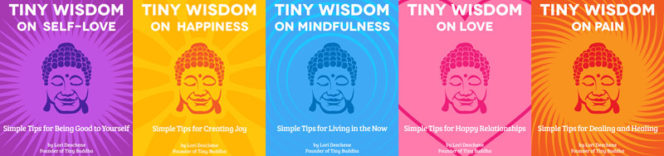
    Earlier this year, I created 5 short eBooks with posts on the following topics:

    • Self-Love
    • Happiness
    • Mindfulness
    • Love
    • Pain

    They aren’t lengthy how-to posts with overwhelming lists of action steps. They’re short reflections on the little things that make a huge difference in our daily lives. They’re reminders of what matters and how to embrace it, right now, instead of focusing on all the things that only bring us down.

    They’re concise. They’re focused. Most importantly, they’re relevant to the challenges we all face every day.

    These eBooks are available individually or as a complete package. On it’s own, each eBook costs $4.97. The full package of five costs $19.97—which essentially means you get one free if you buy the whole series (and for today only, you receive a second set to send to a friend).

    Buy the Tiny Wisdom eBooks 

    Note: You can purchase the eBooks individually for $4.97 each, or scroll down to buy the whole series for $19.97. Today’s promotion is only for the full set. (more…)

  • Life Isn’t Good or Bad; It Just Is

    Life Isn’t Good or Bad; It Just Is

    Ankh scale

    “Freedom is instantaneous the moment we accept things as they are.” ~Karen Maezen Miller

    Seemingly for months now, upon learning anything new, my seven-year-old daughter has asked me, “Is it good or bad?”

    Not brushing at night—good or bad? One hundred degree temperatures—good or bad? Water leak in the furnace—good or bad?

    Some things are more obvious than others, but it’s the stuff in the middle that requires a more subtle explanation, especially as I go through life with the stress and anxiety of trying to both deal with uncertainty and figure out life in the “new normal” called chaos.

    I wrestled with trying to make her understand that sometimes life is neither good nor bad—it just is.

    But like any child trying to adjust the settings on her moral compass, she had difficulty in trying to understand that there can be some things that fall neither in the good nor the bad category.

    Recently something happened that tested this notion and, in some strangely profound way, might have helped me find a way to explain life (as I understand it) to my seven-year-old.

    My wife’s grandmother passed away.

    Having been raised by her grandmother for most of her young life in India, my wife was distraught and sad. Although my daughter had very little contact with her great-grandmother, given the vast ocean that separated them, she could tell that her passing affected her mom deeply.

    At first we didn’t know how to explain the passing to our chirpy and inquisitive child. So we didn’t, for a day. We avoided it. But then, as seven-year-olds do, she overheard me on the cell phone explaining to someone what had happened.

    Almost instantly, a happy-go-lucky child became eerily quiet upon hearing that her mom’s grandmother died. She didn’t have to ask if it was good or bad. It was bad.

    But is it? (more…)

  • See the Love Around You and You’ll Feel More Love Within You

    See the Love Around You and You’ll Feel More Love Within You

    “The most important thing in this world is to learn to give out love, and let it come in.” ~Morrie Schwartz

    There is a Native American tale that tells of a young boy speaking with his grandmother. She tells the boy that she has the spirit of two wolves living and battling inside of her; one is vengeful and unkind, as he sees all the world as a threat, and the other is loving, secure, and nurturing.

    The little boy asks his grandmother, “Which one will end up winning?” and the grandmother replies, “Which ever one I feed.”

    We all have this pull inside of us: We can either nurture our fears and insecurities, or we can nurture our trust in love, kindness, and acceptance. This is not a new concept.

    There is an endless amount of information out there about connecting with your inner self and finding happiness from within.

    However, all that information can feel overwhelming and even discouraging. If you’re anything like me, you may find yourself still aching from a broken heart, or beating yourself up for the chocolate-chip cookie you just ate shortly after reading about finding forgiveness, gratitude, and self-love.

    What I realized was missing for me in my quest for self-improvement—and what kept pulling me back to my old, familiar negative thinking, feeding the insecure wolf—was faith.

    In order to make the meaningful changes that allow us to release the grasp of our fears and limiting thoughts and beliefs, we have to be willing to believe in the positivity—believe that we deserve to stop beating ourselves up and looking for an external solution to “fix” us.

    It’s not enough to just think it. We have to believe it.

    The limiting beliefs of our fears are deep-rooted, and so we need to meet them from our gut level. We need to really believe that it’s okay to step out of our darkness and connect with our light instead.

    Okay. So, how do we do that? (more…)

  • 50 Amazing Gifts from Living In The Now

    50 Amazing Gifts from Living In The Now

    “If we are not fully ourselves, truly in the present moment, we miss everything.” ~Thich Nhat Hahn

    Recently something truly amazing happened. I was sitting at the beach feeling the warm winds, taking in the gleaming blue Pacific. It was the time of day when the sunlight turns the ocean into waves of sparkling radiance.

    The beauty touched me deeply. In that appreciation of the moment, something shifted inside me. I became so present that my identity of self dissolved into the background.

    I was not only in the universe, but the universe was now in me.

    As I write this I feel the energy of heightened awareness flowing through me, and have the privilege of enjoying that goose bumpy moment again. This is the universe affirming a moment of true significance.

    Two insights stand out for me as I explore the significance of this early evening experience:

    First, as I entered into full appreciation for the beauty of the moment, I became completely in the now. In the present, love, joy, higher consciousness, and peace naturally arise.

    Second, in the now, I entered into unity consciousness where my self-identity shifted to a place of oneness with all of life.

    These two insights led to a list of expanded possibilities that I would like to share with you. But first, here is a practice you can explore that will assist you in becoming fully present:

    This simple but powerful practice is mindful breathing.

    Find a peaceful place. Quiet work’s the best. Begin by feeling your chest expand as you breathe in, then notice your chest relax as your breathe out.

    As you tune in and feel your body in response to the breath, you become fully present. Each mindful cycle of the breath brings you more fully into the moment.

    When your mind wanders, gently bring your focus back to your body’s response to the breath. Breathing in this way brings peace to your mind, aliveness to your body, and joy in the moment.

    After a while, you can do this practice even in noisy places. My favorite time for breathing mindfully is on a walk.

    Now, 50 gifts from living in the present, as promised: (more…)

  • Giveaway and Interview: Seeing, Knowing, Being by John Greer

    Giveaway and Interview: Seeing, Knowing, Being by John Greer

    Note: The winners for this giveaway have already been chosen. Subscribe to Tiny Buddha for free daily or weekly emails, and to learn about future giveaways!

    The winners:

    Regardless of our individual beliefs, we all want to feel a sense of wholeness to experience the present moment with peace and connection.

    It’s the foundation of spiritual practice, however we define that individually: We want to stop feeling a need to fix ourselves, and instead awaken to the infinite beauty of who we already are.

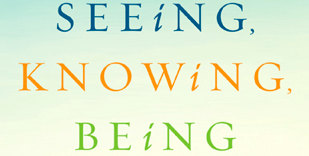
    In his powerful new book Seeing, Knowing, Being, meditation teacher John Greer explores insights from a wide range of spiritual traditions, inviting us to challenge our perceptions and thought patterns to access our inner knowing and experience oneness with the world around us.

    Laden with evocative metaphors, the book breaks complex ideas into understandable parts, inviting us to challenge what we think know for a greater awareness of what actually is.

    I highly recommend Seeing, Knowing, Being to anyone looking to explore or deepen their understanding of non-duality.

    The Giveaway

    To enter to win 1 of 2 free copies of Seeing Knowing Being: A Guide to Sacred Awakenings:

    • Leave a comment below
    • Tweet: RT @tinybuddha Book GIVEAWAY & Interview: Seeing, Knowing, Being http://bit.ly/O9HQWS

    If you don’t have a Twitter account, you can still enter by completing the first step. You can enter until midnight PST on Sunday, July 29th. (more…)

  • Creating Peace by Finding a Connection to the Earth

    Creating Peace by Finding a Connection to the Earth

    “You get peace of mind not by thinking about it or imagining it, but by quietening and relaxing the restless mind.” ~Remez Sasson

    In a world that constantly barrages us with information, it becomes a daily struggle to unplug and find peace. The “need to” and “should do” and “must do” of our ever-frantic lives overwhelms us and creates a stress that threatens to unravel.

    As a child my happiest days were those spent outdoors. Even then, peace came while watching the flowers bend in the wind and the clouds stretch across the sky.

    As an adult it became a struggle to unplug and “justify” time to do these simple, fulfilling activities that truly are life’s happiest moments. Even hiking in the mountains close to home, I couldn’t get away from myself and my thoughts about “hurry up and get back to”… the email, business, website, or whatever was waiting on my desk.

    So in order to find true quiet I ventured to the ends of the Earth. The answer for me to find this peace was to become an explorer, seeking peace over the edges of the world, the literal edge of human existence. My soul sought the extreme.

    There is a line that marks the edge of the survival zone of our species. I found that stepping over that edge is both the scariest thing in the world and the most peaceful. The knowing that I am “beyond” allows me to release all “human” thoughts and concentrate on simply “being.”

    In my search, I have found four of the most incomparable and inhospitable places on earth that represent “over the edge” for me. Being in these places, means truly disconnecting with “man’s world” and fully embracing and connecting to the natural world and its rhythms.

    It is immensely powerful and a strange dichotomy, balancing on that line, more alive than ever, yet so near to possible death.    (more…)

  • The Power of Acceptance: Stop Resisting and Find the Lesson

    The Power of Acceptance: Stop Resisting and Find the Lesson

    “Of course there is no formula for success except, perhaps, an unconditional acceptance of life and what it brings.” ~Arthur Rubinstein

    Sometimes you’re an observer of other people’s lives and you think you’ll never experience what they’re living, whether it’s a positive or negative situation. You think, “That will never happen to me.”

    Part of the real beauty of life is that it’s unpredictable. Nothing is permanent, everything changes, and of course, a lot of things can happen that will transform who you are and have an impact on your life. The problem is that we need to cultivate the ability to truly accept whatever comes and embrace it.

    We need to develop the habit of looking at whatever happens through a positive mindset instead of a negative, defeatist one.

    Of course, life will bring many challenges, such as the death of someone we love, and it’s not easy to embrace them when we’re suffering and wishing those things would have never happened. But if we start cultivating acceptance in our lives right now, we’ll likely cope with future crises in a different way and view them from a different perspective. We will accept instead or resisting.

    I am big fan of Deepak’s Chopra’s The Seven Spiritual Laws of  Success. He dedicates one complete chapter (Law #4) to how we need to receive with open arms what happens to us, because if we fight and resist it, we are generating a lot of turbulence in our minds.

    He explains that we might want things to be different in the future, but in the present moment we need to accept things as they are. That’s the way you can make your life flow smoothly instead of roughly.

    During the last year of my life I have learned the true power of acceptance.

    The first lesson I learned was last year when my boyfriend broke up with me after three years together. Even though I was reluctant to believe he wouldn’t give me a second chance during the initial months, I eventually realized I had no option but to accept his choice and move on with my life. (more…)

  • How Pain Can Guide Us and Make Us Whole

    How Pain Can Guide Us and Make Us Whole

     “Life’s challenges are not supposed to paralyze you, they’re supposed to help you discover who you are.” ~Bernice Johnson Reagon

    We all internalize our suffering to one extent or another. Some of us instinctively take it to a point where it manifests as various physical aches and pains. When I was little, my body learned to carry the burden of the pain that was too big for my heart.

    In some ways, it’s served me very well. It let me compartmentalize enough to function beautifully in certain areas. I have an Ivy League education, many work accolades, and all that jazz.

    But oh, the cost to my dear body has been high. I’ve had chronic pain since I was 16, which has amplified over the years into to difficulty walking, standing, heck, even sitting. I’m physically limited in where I can go, what I can do, and how much energy I have on a daily basis.

    It has been a tremendous price to pay, and I have been so resentful of my body for the life experiences I’ve missed out on.

    I’m in my 30s, and there are 70 year olds who can dance circles around me. It has only been lately that it’s dawned on me how grateful I am for the sacrifice that I unknowingly made. I got through what I needed to, and it’s gotten me to a place where I have the safety to stop, lay my burdens down, and heal.

    Separating from my pain and storing it in my body allowed me a container to put everything I wasn’t able to consciously hold. It also provided a buffer to keep my life experiences from damaging my soul, my faith in humanity, and my spirit. That is exactly what I needed way back then.

    I don’t need it anymore.  (more…)

  • 5 Meditation Myths and the Benefits of Starting Today

    5 Meditation Myths and the Benefits of Starting Today

    “Freedom is instantaneous the moment we accept things as they are.” ~Karen Maezen Miller

    My personal rock-bottom wake-up call came a few years ago when, despite having achieved all of my personal and business goals, I found that I still wasn’t content or experiencing peace of mind.

    Feeling frustrated, I realized that I could no longer rely on my future to fulfill me. I knew continuing to work so hard to accomplish bigger and better goals wasn’t going to relieve my eternal itch that there must be more to life than this.

    To make matters worse, my increasing frustration led to a rocky time in my relationship, which inevitably ended with my partner leaving. Along with the beautiful child I’d been raising, the great house I was living in, the fancy car I was driving, and the pile of money we’d jointly secured as projects fell away too.

    Rock bottom, needing peace, I started exploring alternative ways of thinking, being, and living.

    It was around about that time when I met a group of meditation teachers that changed my life. I saw in their eyes a peace and joy that I had rarely seen before. And the more I spent time with them, the more it became obvious to me that their inner peace was consistent.

    Hungry to experience the same, I packed my bag and headed off to meditate with them for a few months. I spent ten weeks on the island of Patmos in Greece, followed by a further fourteen weeks in the mountains of Mexico.  

    During my time meditating I had a total turnaround in thinking. I discovered the real cause of my persistent problems had never been my failings at “thinking positively.”

    Instead, my habit of thinking was the ultimate cause of my problems. When I was busy thinking, I was missing the peace that’s always present. And by learning to think less and be present, I found life much more enjoyable.

    Meditation serves many purposes, from stress relief to self-awakening. Personally, I started meditating because I was fed up with my mind working overtime. I wanted peace, and through meditating regularly I have become less focused on the movement of my mind and more aware of the pristine peace that is always present. (more…)

  • Giveaway and Author Interview: Patience by Allan Lokos

    Giveaway and Author Interview: Patience by Allan Lokos

    Note: The winners for this giveaway have already been chosen. Subscribe to Tiny Buddha for free daily or weekly emails and to learn about future giveaways!

    The Winners:

    Patience is one of those qualities we aspire to possess, but sometimes struggle to embody. We associate patience with goodness—and for good reason, since patience enables us to be loving and supportive to others.

    But patience is also a fundamental building block of happiness. It just plain hurts to feel harried, stressed, rushed, and eager to get there—whether it’s a physical space or a state of being.

    This is something I know all too well, as I’ve often felt pushed by this subconscious internal need to do things quickly and perfectly, which just exacerbates my anxiety, since this translates into a lack of patience with myself.

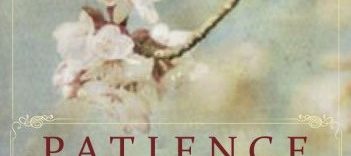
    It’s something I work at, which is why I was excited to read Patience: The Art of Peaceful Living, by Allan Lokos.

    The founder and guiding teacher of The Community Meditation Center in New York City, Allan Lokos has studied and practiced meditation for nearly two decades. In his insightful book, Lokos provides gentle encouragement and practical tools to step back, slow down, and foster a sense of equanimity.

    I highly recommend Patience to anyone who feels easily annoyed, angered, and stressed, and to those who want to deepen their existing mindfulness practice.

    The Giveaway

    To enter to win 1 of 2 free copies of Patience: The Art of Peaceful Living:

    • Leave a comment below
    • Tweet: RT @tinybuddha Book GIVEAWAY & Interview: Patience by Allan Lokos http://bit.ly/KVyQ85

    If you don’t have a Twitter account, you can still enter by completing the first step. You can enter until midnight PST on Friday, July 6th.  (more…)

  • How to Forgive When You Don’t Really Want To

    How to Forgive When You Don’t Really Want To

    “Freedom is what you do with what’s been done to you.” ~Jean Paul Sartre

    Like so many other women, I had a complicated, often fractious relationship with my mother. I had moved thousands of miles away, but an email or a phone call was enough to irritate me.

    Visits were tense, nail-biting experiences, where I couldn’t help but analyze each thing that she said to see if it contained a passive-aggressive double meaning, at which point an argument would brew.

    For years it had not mattered what anyone told me about how to forgive, and they had told me a lot:

    • Resentment is the poison you feed yourself, hoping someone else will die.
    • Forgiveness is a choice.
    • Refusing to forgive is living in the past.

    I thought I wanted to forgive her. I knew what it was costing me to carry around the resentment, the replaying of old arguments and the anticipation of future conflict.

    Yet something in me didn’t want to forgive, and this was the truth that I had resisted owning for so very long.

    We don’t like admitting to the fact that some petty part of ourselves doesn’t want to forgive people. We say we “don’t know how,” and that might be true, but the other truth is that some part of us often doesn’t want to forgive.

    We don’t want to admit that this part exists, because of all the stories it piles on top of us—stories that we’re mean, petty, judgmental people.

    Of course, we’re expressing mean, petty, judgmental behaviors when we refuse to forgive.

    It’s not intentional. It’s just that we’ve been hurt, and forgiveness feels like letting someone off the hook, or pretending that it was okay that they did what they did.

    The irrational fear is that if we forgive, someone else will do “it” again. But the truth is, whether or not we forgive has nothing to do with controlling another person’s behavior.

    People do what they do. The only person to let off the hook is ourselves, by not concerning ourselves with monitoring someone else’s behavior, or replaying the past.

    So, how can you move through the process of forgiving others?

    These aren’t “easy steps” by any means, especially because many of them are worked in tandem, but nonetheless they are pieces that make up the whole.

    First, acknowledge the parts of you that don’t want to forgive.

    The parts that want to punish by not forgiving, that derive some artificial source of power from withholding forgiveness.

    It’s a sign of health that we become aware of those places rather than pushing them away, pretending that they don’t exist.

    Secondly, if you’re aware already of the fact that you don’t want to forgive, consider the stories that go along with that.

    I’ve already mentioned a few. Perhaps the most common is that forgiveness will mean that someone is absolved from responsibility for their behavior.

    Here is what I know: When someone wrongs another, they always suffer. They might not tell you about it, or they might put on a bravado. They might not even be aware that their behavior is at the root of their suffering.

    But trust me, they suffer. If someone is unkind, they suffer from either the conscious belief that they were unkind, or they suffer from the unconscious fallout of their behavior. (“I don’t understand why people leave/I always get fired/I feel so isolated and alone.”)

    Third, find the common ground.

    Where are you just like this person that you don’t want to forgive? This is the part that people resist most.

    Perhaps your partner cheated on you, and you know for certain that you would never cheat on your partner. But, if cheating is a form of deception, can you see places in your life where you have deceived someone else? Are you 100% honest on your taxes? Did you ever shoplift as a teenager? Do you tell “little white lies” at work?

    No, I would never suggest that a cheating partner is equally as painful as stuffing a t-shirt into your purse when you were a young, reckless teenager.

    What I’m suggesting is that the two are borne of the same places. Deceit has its roots in fear—fear of being honest, fear of not getting something needed.

    When we see that we are equally as capable of acting out as the next person, and especially when we compassionately see the fear that drove them to behave the way they did, there’s the potential for release.

    Finally—and this is the big one—realize that lack of forgiveness is rooted in a lack of boundaries.

    This goes back to the fear that if forgiveness were granted, “it” might happen again because the person thought that they could “get away with” it.

    The person you know you need to forgive in your life might not even be alive anymore, but if they’re alive and real in your head, that’s enough.

    This is the moment of choice: Are you going to decide that you won’t tolerate XYZ behavior, dynamics, and beliefs in your life?

    The moment that you decide that you won’t tolerate the behaviors that led you not to forgive is the moment that things shift.

    Caution: In movies the hero or heroine “gets back” at someone and then walks off into a happy ending.

    That’s not what we’re talking about here. If your boss routinely puts you down, you don’t tell her off and that’s your “power.”

    Rather, you decide that you won’t tolerate the put-downs, you come up with a plan for how you’re going to handle it when they arise, and then you actually assert that boundary, while looking at her with pure love because you know that her put downs are causing her immense suffering (even if you can’t see the suffering).

    What happens in moments like these is that the put downs become about as believable as a drunk, homeless man who is shouting obscenities on the street. He’s clearly not altogether there, and you can have compassion for him because his suffering is so visible and his words so illogical.

    Here’s the big secret: When humans are unkind to one another, they’re not so very different than that guy. Many of us are just using different language and wearing nicer clothes.

    When you decide what boundaries to put in to place, and what you will and won’t stand for, you release the fear that “it” will happen again. What “it” can touch you when you’ve already decided that you aren’t going to let it penetrate?

    The moment came—and it was a completely innocuous moment for me, sitting in six lanes of backed up traffic, my thoughts discursive—when I realized that when it concerned forgiving my mother, I get to decide who I am.

    My life was what I said it was, and a painful relationship with her need not be a part of it any longer, if I decided that it was so. I knew that all I wanted to do was simply love this woman who had given me life and who had taught me so much about who I wanted to be.

    There was nothing but gratitude in my heart.

    Before my own experience of deep forgiveness, as I waded through years bouncing from one therapist’s couch to the next trying to “figure out” how to forgive, I would have thought this moment impossible. I would have doubted the elegance of its simplicity.

    But it really is true: “Freedom is what we do with what’s been done to us.”

    It is not the circumstances of our lives that matter. It is what we choose to do with them.

  • Being Honest with Ourselves and Removing Our Masks

    Being Honest with Ourselves and Removing Our Masks

    “Our lives only improve when we are willing to take chances and the first and most difficult risk we can take is to be honest with ourselves.” ~Walter Anderson

    For almost two-and-a-half decades, I hid behind masks. I sensed as a very young child that I lived honoring my true self, like most children do, but as I got older, I started putting on masks as a way to fit in. One of my first masks was that of a juvenile delinquent.

    Over time, this mask became almost embedded in my skin. I discovered the world of alcohol, drugs, and mayhem, and I felt trapped and unable to escape from it. Shame and guilt filled me with fear and kept me from breaking free from this chaotic lifestyle. I was afraid to ask for help.

    But in the late eighties, I attended a self-help workshop. This presentation introduced me to a way of living that radically altered my life—inner journeying.

    I was intrigued by the presenter’s story and his thoughts of living a life that required him to look inside for answers. I had very little understanding or practice with looking within.

    The workshop opened up a whole new way of living for me. It focused on removing masks. As I listened to the speaker, I found myself thinking about my own life and the masks that I hid behind.

    I felt uncomfortable, so I started to question myself on how I was living.

    This new self-awareness pushed me to start looking inside of myself for answers to the problems that were plaguing me.

    I was young and self-employed, on my way to making a name for myself in my business community. I was also self-absorbed with weightlifting and exercising. I was the typical story of the “skinny kid who transformed his body.” To others, my life looked good.

    But my inner landscape told a different story. I was lost in a world of darkness, pain, and anxiety. Even though I was experiencing some modest success with my business, my past was starting to haunt me.

    I felt like a fraud, and I was starting to feel like my outer world was about to crumble.

    What had kept me going through all these years of turmoil was the fact that I had become an expert on wearing masks! I had no idea who I was, and despite all the good things going on in my life, I felt like I wasn’t being honest with myself. I wanted to be real. (more…)

  • The Freedom of Not Needing To Be Right

    The Freedom of Not Needing To Be Right

    “You have your way. I have my way. As for the right way, the correct way, and the only way, it does not exist.” ~Friedrich Nietzsche

    Yesterday I drove my mother and father to the VA hospital in Albuquerque for a doctor’s appointment. I had never been to a VA hospital before. I guess I should have expected the numbers of crutches and canes, armless and legless veterans, young and weathered faces alike.

    I was personally witnessing the costs endured when humans war against each other.

    “Isn’t it odd,” I said to my mother, “that human beings war with each other?”

    Why in the world do we do that?

    Then I considered the ways in which we war on an interpersonal level. We humans war to varying degrees with our partners, our friends, our bosses, our co-workers, our siblings, our parents—pretty much all in the name of our need to be “right” or the need not to be wrong.

    We war over ideas and beliefs that we often have never questioned. These include ideas from our upbringings, our religions, our scars and wounds, and our existential need to identify ourselves in some way.

    How early did we lose our childlike wonder? When did we lose that innocent state in which we did not judge others, nor need to be “right”—when we saw the best in everything and everyone, and when it did not matter that someone was Christian, Muslim, Buddhist, atheist, republican, democrat, omnivorous, vegetarian, gay, or of a different race?

    When I observe my ten-year-old grandson, he appears to have no tendency to judge other people, not yet anyway. He has no need to diminish others, nor does he feel threatened by them.

    Would we, as children, have told lies about someone just because we wanted to win an election? Would we have been dismissive or even cruel to someone because they were of another race or religion? I don’t think so.

    As little children we only cared that we were loved. And we were still curious about everything.

    Somewhere along the way we lose our innocence and start to judge others. This becomes a primary source of our social anxiety and the undermining of our self-esteem, because if we are judging others, we fear that we are also being judged. (more…)

  • Discovering Peace from Within and Creating Fulfillment in Life

    Discovering Peace from Within and Creating Fulfillment in Life

    “Our greatness lies not so much in being able to remake the world as being able to remake ourselves.” ~Gandhi

    The feeling of inner-strength and fulfillment can be enough for us to move mountains. For the most part, we all have the desire to do and be great. It’s just a matter of finding the right pieces to put together to make it happen.

    Part of that discovery process is being able to overcome the low states of energy that hold us back from finding our inner happiness and confidence. When we feel refreshed, vibrant, and able to make the right choices for ourselves, the right actions and results follow.

    Like so many others, I once viewed the sources of happiness and fulfillment in my life as events that were few and far between. I’d have some good days here and there, but they were mostly based on what didn’t go wrong at work, at home, or with my finances. It certainly took a toll on my self-esteem and sense of worth.

    It was hard to be great when I didn’t feel great. 

    Events that I had no control over ruled my thoughts, feelings, and actions. Work-related frustration built up during the day, and nights at home were stressful and emotionally trying. I even let things like the weather and traffic on my daily commute ruin what could’ve been a perfectly productive and amazing day.

    It left me in a constant state of doubt and disarray, searching and wondering when the next positive experience would come along just so I could feel good again. It was a destructive way to live, and it continuously put stress on all the important areas of my well-being.

    In my eyes, I finally hit rock bottom: My finances were a mess, my personal relationships were suffering, and so was my emotional and physical health. 

    When my friends or family would ask how I was doing, my reply was always preceded with a long and drawn out sigh. (more…)

  • Are You Running Away from Yourself?

    Are You Running Away from Yourself?

    “No matter where you go, there you are.” ~Confucius

    I am accustomed to not moving. To move was to feel pain—the pain of seeing how worthless I believed myself to be. Sometimes I would sit in the same place for hours, sometimes not leaving the house for days.

    By isolating myself, I avoided finding evidence in the outside world that proved how I saw myself was the absolute truth.

    My worst nightmare was that others would show me (through what they said or didn’t say, or what they did or didn’t do) that they too found me as rotten as I knew myself to be.

    And so, I was often left in the privacy of my own dreaded company. My best friends were the little pills that I could rely on to knock me unconscious. I had neither the tolerance nor strength to face myself, and I often chose the easy way out.

    Sedatives, tranquilizers, hypnotics—I lived for them. They provided me respite from the constant agony of my internal voice, which asked, “What’s wrong with me? Why am I so damaged? Why do I hate myself? What have I done to deserve this?” And concluded, “I don’t want to feel again.”

    Sleeping was my only escape. And I did more and more of it. 

    Sometimes I pushed the boundary too far: Like the time when I swallowed enough hypnotics to probably kill a few buffalos. When I simply woke up a few hours later asking for coffee, I lost interest in testing myself that way again.

    But when I started realizing I was losing chunks of memory, I knew I had reached my limit. I would bump into people on the street who talked about a party I was at and I had no memory of ever being there, nor the few days surrounding the event. (more…)

  • Finding Positive Ways to Express Difficult Emotions

    Finding Positive Ways to Express Difficult Emotions

    “Never apologize for showing feelings. When you do so, you apologize for the truth.” ~Benjamin Disraeli

    Each day, month, or year I want to be something different when I grow up. At some point I want to open up a smoothie truck with a best friend, I want to teach yoga to cancer patients, and I want to travel to Australia and become a bartender just to support myself.

    But more so than what I want (or think I want) to be, I know what I am. I am a wife, a sister, a friend, an Egyptian, a listener, a weirdo, a poet, a marketer, a dog mom, and a wannabe yogi.

    But most of all? I am emotional.

    I am so emotional at times that my husband comes home to an inconsolable wife sitting alone on the couch crying. And what has set me off into this uncontrollable fit, you may ask? Some kid in a commercial misses his dad who is on a business trip, and (thanks to Skype services) he gets his bedtime story from 3,000 miles away. Sad? Yes, I know.

    Sad, but common. I have emotional friends. I also have completely apathetic friends. I love them. They are completely real with me when I get out of hand and help bring me back to earth.

    Something I just can’t help but get emotional over is death.

    It’s funny because I don’t have a problem with my own death. I could talk about that for days—how it’s going to happen, when I think it will happen, anything, until my husband tells me he doesn’t want to hear about it anymore and leaves the room.

    My grandparents along with many members of my family live in Egypt. I went to Egypt every other summer since I was born. I looked forward to seeing my cousins, the beaches, my aunts—everyone, but specifically my grandfather. I am my grandfather’s favorite grandchild (his words, not mine). (more…)

  • How I Found Inner Peace Despite the Drama in My Life

    How I Found Inner Peace Despite the Drama in My Life

    “Peace of mind is not the absence of conflict from life, but the ability to cope with it.” ~Unknown

    Like many people, I lived my life for a lot of years failing to understand inner peace is a choice. I am not sure what I thought. Perhaps I didn’t believe anyone could feel a lasting peace inside. I did know that my own feelings of peace were always transitory.

    There were many ups and downs in my life, too many claims on my time and too many difficult situations to be dealt with. I think I actually believed inner peace could only be achieved by monks and saints, or anyone living a reclusive life who didn’t have to deal with everyday struggles.

    I was stuck in a world of confusion, wondering how peace could be mine when there was always something, some drama going on in my own life or the lives of those I loved.

    In fact, it seemed to me that the whole world was filled with stuff, negative stuff mostly, which I read about in the newspaper, saw on the television, or heard from someone I knew.

    It was the kind of stuff that pulls at your emotions—the breaking news story of a missing woman being found murdered, the tragedy of a child being killed by a hit and run driver, the numbers of homeless people tripling, and a devastating Tsunami killing thousands and paralyzing a country.

    Then there were the stories closer to home—my friend’s husband being diagnosed with cancer and dying three months later, my father suffering from dementia, my best friend’s marriage falling apart—all tearing at my heart and leaving me hurt and grieving.

    In my own personal life too, my emotions dipped and peaked along with how much control I felt I had over my own happiness. I literally felt like a puppet on a string, and asked myself over and over again, “How can I feel a constant inner peace in my heart and life when my emotions see-saw up and down according to what is happening in and around me?”

    Looking back I know I believed that my emotions were important. After all, wasn’t being emotional an essential part of being alive? Emotions made me feel real and allowed me to extend empathy to everyone else.

    But in the deepest part of myself, I did not feel good most of the time. I longed to not be so emotional. I wanted to be released from all the conflict in my life—to not react to other people’s words and anger, to feel serenity in my heart.

    It was an almost desperate need to alter or to stop the negative cycle of events which seemed to dominate my relationships and my life.

    I believe it was that intention which kept on surfacing in my mind and in my heart that fueled my spiritual search and led me to discover a more peaceful way to live, despite the conflict in my life. (more…)

  • Why We Need to Embrace the Middle Place

    Why We Need to Embrace the Middle Place

    “The light at the end of the tunnel is not an illusion. The tunnel is.” ~Unknown

    A dream: I am in a woman’s prison. The cells and halls are dark and dirty. The prison looks like a damp dungeon. Inside the cells are women dressed in rags along with their children.

    I am not in a cell, but walking around, observing the faces of desperate, imprisoned women. I need to get out, and find myself in an empty corridor, long and wide.

    At the end, I see a glimpse of light: freedom through the corridor. After a long walk, I arrive at the place of light, an oasis, an ocean retreat filled with sunshine, laughter, and happy people wearing white.

    But before I enter the long tunnel, I see a girl crying, and I ask her why. She tells me she has a feeling something bad is going to happen to me.

    This dream has become the metaphor of my life. The quote above resonates with my dream and the journey I have walked, but what has inspired me to write this post, is this: the tunnel is the illusion.

    It would seem that since the “new age” movement, we have heard a lot about illusion—about what is real and what is not. What we should focus our minds on and what we should not.

    How we have a choice that we need to make every day, perhaps every moment, between fear and love. Between prison and freedom. It makes us think we might have some power in a world that often does not make sense or brings us to places we would never want to be.

    Here is another quote by Carl Jung.

    “There is no coming to consciousness without pain. People will do anything, no matter how absurd, in order to avoid facing their own Soul. One does not become enlightened by imagining figures of light, but by making the darkness conscious.” 

    It is not that I don’t agree that the tunnel is an illusion, but it concerns me that this word, illusion, gives us permission to not care about the tunnel—to not care about the process, which brings us from where we are to where we are going. (more…)

  • 3 Questions Worth Asking to Find the Right Answer for You

    3 Questions Worth Asking to Find the Right Answer for You

    “Sometimes questions are more important than answers.”  ~Nancy Willard

    My twenties and thirties were an endless quest for “The Answer.” As if there were only one.

    The one answer that would change everything. Make everything right. Make me happy.

    What Didn’t Work

    I searched high and low for answers. I’d read the latest book, hoping it held the key. I’d watch to see what others said and did, assuming they had the answers.

    My M.O. was simple:  read, observe, imitate, emulate.

    I was always searching outside myself.

    Always thinking finding the “right” answer would hold the key to happiness and contentment.

    I’d think, “This is it!” 

    “This” being a new career, new city, new relationship, new wardrobe, or new hobby.

    Inevitably, though, the proverbial bloom on the rose faded and whatever “this” had been became the latest thing that wasn’t.

    The problem was, I never did land on the right “answer.”  All my searching and seeking deceived and misled me.  Or more honestly:  I deceived and mislead myself with all my searching and seeking.

    I couldn’t understand why I kept getting the answer wrong. I was smart and resourceful. I was making an effort.

    Why didn’t I seem to want what I thought I wanted? Why did my “answers” for happiness keep turning out to be wrong?

    Shifting Focus

    It was only years later I shifted my attention to a different part of the equation, and started to focus less on the answers and more on the questions.

    And that has made all the difference.

    It finally dawned on me: My answers were someone’s right answers, just not mine.

    How did I come to this breakthrough? (more…)