Tag: mindful

  • Living in the Now When It’s Stressful: 4 Mindfulness Tips

    Living in the Now When It’s Stressful: 4 Mindfulness Tips

    “If you worry about what might be, and wonder what might have been, you will ignore what is.” ~Unknown

    A few weeks ago, I learned that my beloved dog, Bella, had become ill with kidney disease—a condition that will most likely not allow her to live longer than a year. I was devastated when I heard this news.

    At only eight years old, Bella didn’t seem old enough to be so sick, let alone be a year (or less) away from dying. Coping with her condition and the impending loss has been incredibly difficult—nearly impossible at times—but amid all of the pain and anxiety, I’ve come to one powerful conclusion: Life is too unpredictable not to enjoy the moment.

    The number of moments I have left with Bella—or with anyone, for that matter—are unknown. For the past three years (ever since I launched my blog, Positively Present), I’ve tried to focus on living in the now, but nothing has made that goal clearer than Bella’s recent diagnosis. Realizing my time with her is limited makes every minute even more important.

    That being said, staying present is still a daily battle. In the throes of my constantly racing thoughts—How long will she live? Is she feeling okay? Why isn’t she eating? What does the vet’s tone really mean?—it’s been incredibly difficult to enjoy the time I have with Bella.

    And, unfortunately, more often than not I find myself living not in the moment, but in the future, worrying about what will become of Bella and my life without her.

    Worrying about the future has been severely hindering my ability to live fully in the present moment, which is what I need to do most in this limited time I have left with my precious pup.

    Knowing the importance of living in the moment is one thing; taking action is another. It can be challenging to live in the now when then now is tough, but I’ve discovered a few tactics and tips to help me stay focused on the moment—and enjoy every minute I have with Bella. (more…)

  • Eliminate Proxies for a More Authentic, Present Life

    Eliminate Proxies for a More Authentic, Present Life

    On the web, there is something called a proxy server. It often sits in between a request (for example, let me watch YouTube!) and what is requested (in this case, the YouTube video file) and “passes” the request, and the result, back and forth between two computers.

    In the early days of the Internet, it was created as a way to make easier and more efficient the incredible complexity of so much information and so many people wanting to access it. There are other benefits, too—security, speed, protecting identities and information. But, it’s still an intermediary between Thing A and Thing B.

    There is, however, another kind of proxy. Whenever I hear the word, I think of Afghanistan and the notion of a “proxy war.”

    The USA and USSR might not have faced each other in battle, but in Afghanistan and so many other places, fought a “proxy war” by taking different sides in a different conflict and letting others fight it out on their behalf.

    I’ve reflected on the notion of proxies as relates to the human experience, and wanted to share some observations from my own life.

    Let’s say work is stressful; I’m facing the reality that I am, in fact, middle age; I’m out of shape and not happy with what my lack of exercise says about my discipline or, given the history of heart disease in my family, my priorities.

    We’re late for school, and my son is slow to put on his shoes.

    “Son!” I yell. “Come ON! Put on your shoes. We’re late for school. This is NOT ACCEPTABLE BEHAVIOR!”

    Valid points. My son needs to learn responsibility, and understand the importance of commitments—in this case, the implicit contract between him and his school, as to his obligations and what he gets in return in the form of an education.

    But, he’s only 6. A clear and direct, but supportive and loving, reiteration of why he should remain mindful of the time would be more appropriate. Losing my temper makes my son an unwitting proxy for other things.

    These proxies are not productive. I try to keep an eye out for them—whether I’m the proxier or the proxied—and I try not to let people, situations, or things become transformed into something that they aren’t. (more…)

  • Are You Shut Down and Disconnected?

    Are You Shut Down and Disconnected?

    “When we get too caught up in the busyness of the world, we lose connection with one another—and ourselves.” ~Jack Kornfield

    I had to work on Easter at my job in a coffee shop. I missed out on my family’s big holiday party, and I struggled with quite a bit of resentment about the whole deal. I could have gotten someone to cover for me, but because I’m one of the more experienced employees and we were short-staffed, I was told that I needed to work.

    I wasn’t too terribly happy. I came in to work and immediately launched into the craziness of Easter in a coffee shop, sliding Americanos to travelers across the counter with a stone face.

    I was amazed at how unforgiving people were. I thought that Easter would bring out the best in people, but it seemed to make some act grumpier and more disconnected. Many of them weren’t happy for the same reason that people are grumpy at Christmas: They hate spending extended time with family.

    So I slogged through the day, helping grumpy people stay awake on the road to a place where they didn’t want to go, when suddenly a single interaction changed the course of my day: A man came in, greeted us warmly while he ordered his coffee, and then apologized.

    “I’m sorry that you have to work so that schmucks like me can have their coffee.”

    This one sentence transformed my whole day. This guy had gone out of his way to connect with us, and made made me feel both happy and ashamed—happy that there was someone out there who didn’t get too caught up in his own troubles to connect; ashamed that I had fallen into that very trap myself. (more…)

  • Be a Master of Where You Are Now

    Be a Master of Where You Are Now

    “Have respect for yourself, and patience and compassion.  With these, you can handle anything.” ~Jack Kornfield

    I hadn’t taken a yoga class in a while, and in the midst of my busy schedule I finally gave myself permission to go. Needless to say it had been a few months since I found myself in a downward dog position.

    Something was different about my participation in two classes I recently took. I wish I could say I was able to go deeper into the poses, but it was actually challenging because my flexibility is not where it used to be.

    What struck me were the many great metaphors that these two women, Michelle and Debbie, were sharing in their yoga instruction.

    I confess, I’m a metaphor junky and look for them everywhere. I can probably blame my dad for that since he spoke to me in metaphors while growing up.

    What I noticed and appreciated about my instructors was that they were both very passionate about the practice of yoga. They were cognizant in educating us about position names and consistently reminded us to breathe.

    I also loved that there were so many other rich messages to be heard, metaphorically of course, being that I was paying attention to them.

    There were some gentle reminders that could be related to many different areas of life—career, relationships, wealth and finances, material purchases, and health. As I share them with you, I‘m curious as to how you would relate to them in your own unique way. (more…)

  • Conscious Healing: The Power of Mindfulness and Meditation

    Conscious Healing: The Power of Mindfulness and Meditation


    “Smile, breathe, and go slowly.” ~Thich Nhat Hanh

    One morning I woke up and noticed a few strange red bumps on my arms—bug bites, I thought.

    Then, the next day, more bumps. Within one full week, my skin went from being clear and tan to being covered with red, scaly teardrop spots all over my body, including my face.

    My self-esteem and confidence were thrown out the window; my comfort zone reduced to about the size of a prisoner’s cell.

    I went to the dermatologist, avoiding any possible eye contact or bright office lights, and made my way into the office. The doctor came in and I watched her eyes go straight to my arms and hands. By the look of it, she immediately knew what it was.

    I’ve had Psoriasis before but nothing this excruciating. She explained to me that I had Guttate Psoriasis. In short: no magic pill to cure it. Creams alleviate it (although they never worked for me, ever). Light therapy helps, but the ultimate cure: meditation and believing that I would get better.

    Just put yourself in my shoes for a second and imagine your skin completely shifted gears on you over the course of one week, and the only answer that you get from a professional with a foreign-sounding name, holding an iPad, is meditation and belief. Sounds like a load of crap, right?

    But when you’re in the mercy of the unknown, and you literally feel like jumping out of your own skin, you will do anything to get better.

    I’m not here to complain or give you a medical testimony on Psoriasis. I’m here to tell you how my skin alleviated tremendously in about two months by being mindful of my actions and thoughts, harnessing the effectiveness of words, and exercising the practice of meditation. (more…)

  • How to Avoid Burnout and Take a Digital Break

    How to Avoid Burnout and Take a Digital Break

    “Fear is a natural reaction to moving closer to the truth.” ~Pema Chodron

    By the end of 2011, I was trying my hardest not to see it: burnout.

    I’d been going full steam ahead since I turned my part-time business into a full-time vocational mission, back in 2009. When people remarked that I was doing a lot, I would wave away their comments and say facetiously, “Well, you know—I’m a Sagittarius with three planets in Virgo.”

    Part of the reason I didn’t want to really look at what was going on was that 2011 had been a banner year. After years of hard work, I was (finally!) starting to see the benefits that come with it: increased traffic, more clients, and more requests to collaborate on projects with people I admired.

    But the burnout was obvious: not looking forward to Mondays, not wanting to check email, feeling perpetually tired and overwhelmed, and sometimes, resentful.

    I really wanted to be away from the computer, away from email, and definitely not getting distracted with social media. This thought was always followed by an immediate fear: “I can’t do that! I’ll lose everything I’ve worked for!”

    But as Chodron says, fear is what happens when we move closer to the truth.

    My truth was that I wanted a complete digital break. So finally, from December 15th 2011 through January 15th 2012, I took one.

    Since so many people have asked me “how” I could possibly run a business and take thirty days away from being online, I’ll share what I learned. (more…)

  • Giveaway and Interview: The Mindful Manifesto

    Giveaway and Interview: The Mindful Manifesto

    Note: The winners for this giveaway have already been chosen. Subscribe to Tiny Buddha to receive free daily or weekly emails and to learn about future giveaways!

    The winners:

    If you read this site regularly, odds are you’re familiar with mindfulness, and you may even meditate regularly.

    It’s a simple practice that can dramatically improve our physical, mental, and emotional well-being, since it helps ground us in the present moment, and frees us from the burden of dwelling on the past or worrying about the future.

    Whether you’re new to mindfulness or not, you’ll likely find some helpful tools in The Mindful Manifesto: How Doing Less and Noticing More Can Help Us Thrive in a Stressed Out World. Straight-forward and comprehensive, the book offers detailed instructions to retrain our minds—and be kind to ourselves in the process.

    Mindfulness teacher Ed Haliwell, who co-authored The Mindful Manifesto with Dr. Jonty Heaversedge, took some time to answer a few questions about the book; and he generously offered to give away 5 copies to Tiny Buddha readers.

    The Giveaway

    To enter to win 1 of 5 free copies of The Mindful Manifesto:

    • Leave a comment below.
    • Tweet: RT @tinybuddha Book GIVEAWAY & Interview: The Mindful Manifesto http://bit.ly/H7vMTw

    If you don’t have a Twitter account, you can still enter by completing the first step. You can enter until midnight PST on Friday, April 6th.

    The Interview

    1. Tell us a little about yourself. How did you come to teach mindfulness?

    I came to mindfulness practice when I was experiencing a lot of stress, depression and anxiety. I kept searching for ways to change how I was feeling, and several people suggested learning to meditate. (more…)

  • How to Stop Dwelling on the Life You Could Be Living

    How to Stop Dwelling on the Life You Could Be Living

    “If you concentrate on what you don’t have, you will never, ever have enough.” ~Oprah Winfrey

    I’ve often compared myself to others and imagined that they have a better life than I do.

    The youngest of eight children, I grew up with a mother who often said, “So and so must really be happy! Look at them! They know how to live life.”

    Becoming a widower at the age of forty with eight children to raise was not easy on her, which is why she constantly wished her life were different. And somehow, those thoughts and words stuck with me.

    I’ve frequently felt that I’m not enough, despite being a professor and researcher, having published books, and having presented at conferences in Brazil and abroad.

    No matter how much I’ve done and accomplished in my life, I usually catch myself looking at other people´s lives and thinking they´re better off (despite all the webinars, self-development books, self-improvement mp3s, and meditations I have done).

    I compare myself to people who somehow “seem” to lead a more fun life. In the beginning of my career, I thought that other researchers were always “producing” more than I was.

    This type of thinking also manifests in the suspicion that I could be living another life.

    Let me explain: We sometimes get stuck, thinking the past, or our “lost opportunities,” as we like to label them, are better than the present.

    Our thinking might sound like this:

    “If I had done such and such, I would be living my dreams.”

    “I could be living this adventurous life in another city doing something else.”

    “I´d be so happy if only I had…”

    This is where the problem lies.

    Lost opportunities happen when we are nowhere instead of now here.

    We are nowhere when we live in the present lamenting the past, dreaming of a future that may never come if we are not mindful about our present, about the now here.

    No one can be happy if not in the present. (more…)

  • Simple Tips and Reminders about Living in the Now

    Simple Tips and Reminders about Living in the Now

    “If we are not fully ourselves, truly in the present moment, we miss everything.” ~Thich Nhat Hanh

    A person I work with recently left me an article about the unproductiveness of multitasking. On it was a sticky-note saying, “I think you’ll like this article. I wish I could do better in this area. I find it difficult, if not impossible, to not look at e-mail for a couple of hours if I’m at my desk.”

    I immediately thought of my dad. He and I had met for lunch a few days earlier. He’s in his mid-70s and still loves his career, continuing to work nearly full-time.

    At one point in the meal it occurred to me that unlike everyone else I know (myself included), he wouldn’t be receiving a call or a text message during our time together. He has a cell phone, but he always turns it off when he’s meeting with someone, whether a business meeting or a personal get-together.

    He doesn’t put it on silent. He doesn’t put it on vibrate. He turns it off.

    What a nice feeling for me, to be with someone who was totally present—and what a nice thing for him, to be living fully in the present moment.

    My smartphone isn’t set to notify me when I get a new e-mail, but I regularly feel the temptation to check it, particularly in moments when there is a “lull in the action.”

    For example, I recently checked my email (under a jacket so as not to disturb anyone else) when I was bored during a movie. That’s just the kind of thing that caused me to hold out on making the move to a smartphone in the first place—the concern that I would let the ease of access to things like e-mail suck me in at times when I previously would have been happy to do without.

    Back to my eating with my dad. Here’s another thing that anyone who has a meal with him will notice: He’s an incredibly slow eater—likely the slowest eater you have ever met. He chews for a long time, and he savors every bite.

    He eats mindfully. (more…)

  • Where Do You See Yourself in Five Years?

    Where Do You See Yourself in Five Years?

    “Begin at once to live and count each separate day as a separate life.” ~Seneca

    “Where do you envision yourself in five years?”

    This is a common interview question. Managers like to find employees who set goals for themselves. They think it is a sign of a person who is motivated and wants to get ahead in life.

    I used to believe this too. I constantly badgered myself, “You should be further along in your career.” “Everyone else your age is in management positions, why aren’t you?” “Maybe I should get an MA so I can get a better job and be more qualified.”

    There was constant pressure on me to be more, to achieve more, to do better, to be better than what I was right then. I put that pressure on myself. American society idealizes the upwardly mobile, outwardly wealthy, ambitious person.

    When I was in my 30s I had a Director position with a good company, a husband, two kids, and a nice house in Florida. I was living the American dream. If asked my five-year plan in an interview I would have said to continue to move up in the company, to earn a higher salary, go back to school to get my Master’s Degree, send my kids to the best schools, and build an extension on my house.

    All my goals were exterior driven—to do, strive, angst and work, work, work, work harder. But life happens and you can’t control or predict what will be thrown your way. 

    In the next five years the economy tanked, and my husband was in danger of losing his job, so he wisely found another—in Indiana. We moved to the Midwest where I had never even had the slightest inkling of desire to live. (more…)

  • Living Fully Book Giveaway and Interview with Shyalpa Tenzin Rinpoche

    Living Fully Book Giveaway and Interview with Shyalpa Tenzin Rinpoche

    Update: The winners for this giveaway have already been chosen. Subscribe to Tiny Buddha to receive free daily or weekly emails and to learn about future giveaways!

    The Winners:

    Have you ever felt like the present moment is passing you by while you’re caught up worrying, analyzing, planning, and trying to protect yourself from pain and loss?

    It’s one the pitfalls of the human condition: we often paralyze ourselves in the pursuit of happiness and abundance, and in the process, miss out on the joy right in front of us.

    Shyalpa Tenzin Rinpoche has devoted his life to helping people live joyful, mindful lives, free from the burdens of their minds.

    In his new book, Living Fully, Finding Joy in Every Breath, Rinpoche summarizes his teachings in succinct, easily digestible sections. The result is a guide for living in the moment, peacefully, connected to the people and the world around us.

    The Giveaway

    To enter to win 1 of 2 free copies of Living Fully:

    • Leave a comment below
    • Tweet: RT @tinybuddha Book GIVEAWAY & Interview: Living Fully (comment on the blog to win!) http://bit.ly/ydAMit

    If you don’t have a Twitter account, you can still enter by completing the first step. You can enter until midnight PST on Sunday, March 11th.

    The Interview

    1. You were trained to be a Lama from the age of four. Did you always feel certain you wanted to be a spiritual teacher?

    Even though I was trained in the most ancient Tibetan Buddhist spiritual tradition from a very young age, I personally never intended to become a spiritual leader. (more…)

  • What Dogs Teach Us about Peace, Joy, and Living in the Now

    What Dogs Teach Us about Peace, Joy, and Living in the Now

    “Joy is what happens to us when we allow ourselves to recognize how good things really are.” ~Marianne Williamson

    Are you a dog lover? I know I am.

    Animals of all kinds can bring us so much joy, not only when things are going well, but also when we feel pain and are suffering.

    “Man’s best friend” can be our true and faithful companions through thick and thin. We look to our pets when we are ready to play and laugh, and they instinctively know when we need their support.

    I’ve had a dog most of my life. From purebreds to mutts, I’ve loved them all. It has always felt comforting to me to have a dog around. The joy dogs provide is well worth the effort.

    We all have struggles and challenges in our life, and it’s during those times that our pets can really come in handy to help us find our joy.

    One of my most stressful challenges was discovering my daughter’s addiction to crystal meth. I felt blindsided by this discovery. I knew she was struggling, but this was something I had never expected.

    I learned from this experience that the time I have spent working on myself, as opposed to the time I have spent trying to fix her problem, has been the most meaningful and the most productive. Despite having addiction in my life, I could find my joy again.

    For parents in the midst of addiction with their children, it can be emotionally exhausting for long periods of time. It’s easy to let the stress of the situation overtake you.

    I am one of the lucky ones. My daughter has gone on to seek recovery for her addiction. She has grown and matured in ways I would never have expected.

    We have both learned life lessons, and have evolved into new and hopefully better people. We both know to take it one day at a time.

    From this experience, I found I needed to change. I needed to approach life in a new way.

    As I watch my dog go through her day, I realize the lessons are really right there in front of me if I care to pay attention.

    Here are some of the ways I can be the person my dog wants me to be, and be the person I want to be as well. I know that whatever life brings me, joy is still always there for the taking. (more…)

  • Create Solutions, Not Resolutions

    Create Solutions, Not Resolutions

    New Day

    “What lies behind us and what lies before us are tiny matters compared to what lies within us.” ~Ralph Waldo Emerson

    With the New Year approaching, resolutions are on everyone’s mind.

    I’ve never liked the word “resolution.” As defined in the dictionary, resolution means “a firm decision to do or not do something,” and anyone who’s ever done, well, anything knows that life rarely works like that.

    I prefer to think of my January decisions as New Year’s solutions. Defined in the dictionary as “a means of solving a problem or dealing with a difficult situation,” solutions are useful and practical. Thinking about them now helps us find peace in whatever may happen in the year ahead.

    The best solution I can think of, and one that is especially helpful after the excess of the holiday season, is letting go.

    I often hear stories from people who decide at the beginning of a year that this will be the one when they’ll be able to fix their bodies.

    They want to “fix” themselves; they want to look like their high school pictures or their super fit best friends or whoever’s on the cover of Vogue.

    My feedback for all who are constricted by a negative diet mentality: let go.

    This seems counterintuitive, ironic, cruel, and maybe even ridiculous. You’ve just connected with a powerful desire about what you want your life to be like, and now I’m going to tell you that you have to move forward completely unattached to the outcome of whether you’ll get the life you want and will now be working toward.

    The crux of this philosophy is that in order to get that which we want, we must let go of our need and desire for it.

    This may sound impossible, unattainable, and completely contradictory; however, this is where freedom lies.

    I know firsthand that letting go is the path to freedom and joy. My struggle with weight started when I was a toddler. When I got older, I thought that if I could only lose the extra weight, I would be happy.

    I did lose the weight—a hundred pounds—between my twenty-fourth and twenty-fifth birthdays. I had finally achieved what I thought was my goal; I was thin, so I should be happy, right?

    I was more miserable than ever. I was so worried about gaining the weight back, so scared that I might relapse, that I couldn’t enjoy my newfound health.

    I was stuck living in fear that the future would not be what I wanted, that I would lose control, that my hard work would be for naught.

    It was only when I figured out how to live in the present, how to be focus on the now and not concern myself with worrying about things that had not even yet happened, that I was able to be happy.

    After learning to do that, not only was I content for the first time in my life, but I also was able to keep the weight off without worrying about it. I have kept that a hundred pounds off for twenty-four years.

    We achieve the life we desire when we begin living for the moment, in the moment, and because of the moment. Finding happiness in this New Year will not be an outcome or a result. It is doing; it is being.

    How can your foster this way of being in your life? It begins with looking at those things we desire most and finding the bliss in working toward them in the present—not in achieving them in the future.

    Achievement is still the goal, but ironically, you only get there by letting go of the need for it. (more…)

  • The Unexpected Path to Living the Life You Dream About

    The Unexpected Path to Living the Life You Dream About

    “Of course there is no formula for success except, perhaps, an unconditional acceptance of life and what it brings.” ~Arthur Rubinstein

    I used to be a big fan of working hard, really hard. I still work hard, but I do it from a place of inspiration and peace, instead of fear and must.

    In the past few years, something has shifted within me. It is both confusing and wonderful. I cannot put my finger on exactly what is going on, but it seems to be happening in just the right way.

    Like Arthur Rubinstein says in the quote above, there are no formulas for living the life you secretly dream about, because if you simply accept and welcome life, it’ll reveal itself to you.

    It is not through effort that you mold the universe to your liking, but from allowing the universe to mold you, and show you the way.

    When I began doing what I love, which is showing people how they can be more fulfilled in their work, I thought I had to take a predetermined path to my destination.

    And it almost stopped me, because I didn’t believe in myself. I saw so many others doing what I wanted to do, and they were more accomplished, had more knowledge, and were more successful.

    Or, so it seemed.

    I almost didn’t take action, but I’m glad I did.

    The Biggest Pitfall

    One of the biggest mistakes I made was trying to find the answers outside of myself when the answers were always inside.

    I’m not saying you should abandon learning and research altogether, but for me, it reached a point where I had to listen to my heart, and feel where I should go.

    I resisted going down this path for a long time, and I still sometimes do, because I’ve been a big fan of the mind, of logic.

    However, I’ve realized that I don’t know it all, and when I listen to my heart, I seem to be led to more happiness, peace, and freedom in my life.

    The early days were a struggle, but as I began seeing results, I started trusting my heart more and more. (more…)

  • Book Giveaway and Interview with Rick Hanson: Develop a Buddha Brain

    Book Giveaway and Interview with Rick Hanson: Develop a Buddha Brain

    Update: The winners for this giveaway have already been chosen. Subscribe to Tiny Buddha for free daily or weekly emails and to learn about future giveaways!

    The Winners:

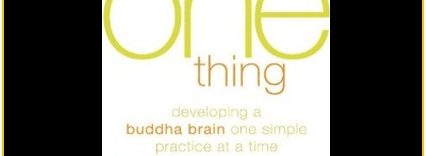
    I read a lot of books about mindfulness; this was by far one of my favorites. In his book Just One Thing: Developing a Buddha Brain One Simple Practice at a Time, Rick Hanson offers practical, daily practices, backed by the latest in brain research, to help us avoid stress, improve our mood, enjoy life more fully, and develop emotional resilience.

    This is not merely a book of mindfulness exercises; it’s a guide that helps us rewire our brains for increased happiness and overall well-being. I highly recommend Just One Thing to anyone who’s felt overwhelmed by disempowering, negative thoughts.

    The Giveaway

    To enter to win 1 of 2 free copies of Just One Thing:

    • Leave a comment below.
    • Tweet: RT @tinybuddha Book Giveaway & Interview with Rick Hanson: Develop a Buddha Brain http://bit.ly/rW3u3N

    If you don’t have a Twitter account, you can still enter by completing the first step. You can enter until midnight PST on Sunday, December 11th.

    The Interview
    1. Your work is based on the idea that meditation and mindfulness can change the brain. Can you expand on this?

    Actually, I’d put this a little more broadly: my work—and that of many other scholars and clinicians—is grounded in the general fact of “experience-dependent neuroplasticity,” which is the capacity of mental activity to change neural structure.

    For example, researchers studied cab drivers who must memorize London’s spaghetti snarl of streets, and at the end of their training their hippocampus—a part of the brain that makes visual-spatial memories—had become thicker: much like exercise, they worked a particular “muscle” in their brain, which built new connections among its neurons.

    Similarly, another study found that long-term mindfulness meditators had thicker cortex in parts of the brain that control attention and tune into one’s body.

    In the saying from the work of the Canadian psychologist, Donald Hebb: “neurons that fire together, wire together.”

    Fleeting thoughts and feelings leave lasting traces in neural structure. Whatever we stimulate in the brain tends to grow stronger over time.

    A traditional saying is that the mind takes the shape it rests upon. The modern update would be that the brain takes its shape from whatever the mind rests upon—for better or worse. The brain is continually changing its structure. The only questions are: Who is doing the changing: oneself or other forces? And are these changes for the better?

    In this larger context, my focus is on how to apply these new scientific findings: how to use the mind to change the brain to change the mind for the better—for psychological healing, personal growth, and (if it’s of interest) deepening spiritual practice. I’m especially interested in: (more…)

  • The Days Will Run Out

    The Days Will Run Out

    “If we are not fully ourselves, truly in the present moment, we miss everything.” ~Thich Nhat Hanh

    I heard this story recently while listening to a favorite radio show of mine. It was about this homeless man who was detailing some of his experience with homelessness.

    He told stories of sleeping outside in the rain and waiting for hours to get into an overcrowded shelter. He even told a story about another homeless man, who could speak no English, who told him about how he had spent a sleepless night in a trash compactor because he felt safer and was drier than sleeping out on the street.

    He didn’t get much sleep, however, because all night he kept worrying that someone might press “the button.”

    The single story he told that stood out in my mind, however, was the story of the time he was offered the job of house-sitting for a friend.  As you could imagine, the thought of existing somewhere safely, of being sheltered from the weather, of being able to relax on a couch and watch TV was overwhelming for him.

    He was excited like a child might be excited before being told that his parents had decided to go out and buy him a brand new bicycle.

    There was no doubt that he was thrilled about all these things, and he certainly had a right to be. With all that he was about to experience, however, the thing that he looked forward to the most was sleeping. 

    Really? Sleeping? I wondered, how could he be excited about sleeping when he had a house all to himself?

    The thing is, sleeping in a warm bed, to most of us, is something we take for granted. Something we don’t ever think about. But, as this man detailed, sleeping is tough when you’re homeless.

    You don’t get much sleep when the cold and wet are invading every inch of your body. Most of the time, when you do sleep, you sleep with one eye open for fear of having something stolen, or being attacked.

    So when he first fell like a rough heavy stone into the softness of his friend’s bed that first night, all he could do was lay there looking at the dark quiet ceiling and feel grateful. Then he said something that was special to me. Something that resonated inside me like the assertive crisp ring of a bell.  (more…)

  • 5 Ways to Find Your Center When Life Feels Overwhelming

    5 Ways to Find Your Center When Life Feels Overwhelming

    “Within you, there is a stillness and a sanctuary to which you can retreat at any time and be yourself.” ~Hermann Hesse

    We’ve all had moments when life’s demands left us feeling stressed and scattered. In these moments, it’s helpful to have some simple tools to help us gain composure and come back to our center.

    Let me paint a picture for you of a scene from my daily life at its most overwhelming.

    On a recent Tuesday, I drafted my evening’s “to-do” list, which contained the following items: Go clothes shopping for my son, get groceries, cook up some dog food, cook dinner, give my son a bath, put laundry away, walk the dog, and prepare for a workshop that I was to present that weekend.

    Like most working parents, I have to fit a lot of tasks into a brief period of time on weeknight evenings.

    Clearly all of those items weren’t going to get accomplished. But I felt compelled to try.

    And then, mid-afternoon, a feeling of illness began to creep over me, starting with a headache and progressing into nausea and profound fatigue. By the time I got home, I had revised my list, and whittled it down to: Bathe my son.

    I felt incapable of anything else.

    Still, even with a truncated list, my evening became chaotic very quickly. Our newly-acquired dog was dripping blood all over the house, including the white slipcover. She was not sick—she was in heat.

    As I tried to attend to the mess, my son called to me from the kitchen. He held his cupped hand out to me, and proudly exclaimed, “I caught it so it wouldn’t fall on the kitchen floor!”

    I will allow you to draw your own conclusions about what his hand held, but I’ll give you a hint: He’s potty training.

    In the mean time, my head was throbbing, my stomach was retching, dishes from the previous day were piled up in the sink, laundry from the week sat haphazardly on my bedroom chair, and the workshop I was to present in four days had not been planned or prepared for. Not to mention, I had a hungry child and dog to attend to.

    Sometimes, when external factors like these seem overwhelming, we feel unable to remove ourselves from the situation long enough to gain perspective and compose ourselves in order to move forward.

    Very often, these external factors become internalized, and our minds start reeling. “I’ll never get it all done, my life is spiraling out of control, I can’t get myself together…” The internal loop can be loud, persistent, and ultimately paralyzing. And once it begins, it is hard to stop. (more…)

  • CD Giveaway, Relax: 6 Techniques to Lower Your Stress

    CD Giveaway, Relax: 6 Techniques to Lower Your Stress

    Update: The winners for this giveaway have already been chosen. Subscribe to Tiny Buddha to receive free daily or weekly emails and to learn about future giveaways!

    The Winners:

    Last year, a representative from More Than Sound reached out to me to share the publishing company’s new mindful driving CD, Awake at the Wheel.

    As someone who frequently deals with Los Angeles traffic, I especially appreciated the opportunity to hear and share a CD focused on making the roads more peaceful.

    Recently, More Than Sound connected with me again to introduce their latest offering, a CD by emotional intelligence expert Daniel Goleman titled Relax: 6 Techniques to Lower Your Stress.

    I’m grateful for the opportunity to share it with you and offer 5 free copies as a giveaway!

    The Giveaway

    To win one of 5 free copies of Relax: 6 Techniques to Lower Your Stress:

    • Leave a comment on this post.
    • Tweet: RT @tinybuddha Giveaway – Relax: 6 Techniques to Lower Your Stress http://bit.ly/vr9r6O

    You can enter until midnight PST on Friday, November 11th. If you don’t have a Twitter account, you can still enter by completing the first step.

    About Relax: 6 Techniques to Lower Your Stress

    Chronic stress can disrupt almost all of your body’s processes. It’s been shown to increase the risk of numerous health problems including heart disease, sleep issues, digestive complications, fatigue, depression, anxiety and obesity.

    Daniel Goleman, Harvard-trained psychologist and author of Emotional Intelligence, developed Relax, a 45-minute audio program to help listeners effectively and naturally reduce stress. Since there’s no one universal antidote to stress relief, Dr. Goleman’s guided session offers several exercises to suit a variety of personal preferences:

    • Deep breathing exercises
    • Deep muscle relaxation techniques
    • Guided auto suggestion exercises
    • Relaxation countdown
    • Breath focus and tension release techniques
    • Breath count exercises
    Learn more about Relax: 6 Techniques to Lower Your Stress at More Than Sound. You can also “like” the Facebook page for Relax for stress reduction tips.
  • How to Meditate at Any Time without Meditating

    How to Meditate at Any Time without Meditating

    “If we are not fully ourselves, truly in the present moment, we miss everything.” ~Thich Nhat Hanh

    Flour. Salt. Water. Yeast. As I push the warm, soft dough against my palm, I feel the cold stone countertop underneath. I feel my hips leaning up against the cabinets. I hear my breath inside my head.

    As I knead the dough, it changes. The dough becomes more elastic and flexible, ready to rise and be baked into a crusty loaf.

    As I make bread, I change. My thoughts go quiet. I come into the now.

    I have struggled with an inconsistent meditation practice for months. In those moments when I successfully meditate and clear my mind, I feel such a sense of accomplishment and peace.

    But as any beginning meditator knows, those moments are few and far between.

    Usually, my scattered mind is split between keeping track of the time, trying to quiet the voice in my head, and chastizing my body for fidgeting. 

    I struggled and pushed myself to meditate properly with little success, until I realized that any act can be a meditation.

    I discovered this fundamental insight through books by Eckhart Tolle and Thich Nhat Hanh. It is not so important to sit with a perfectly erect spine for twenty minutes per day in meditative bliss. What is important is to be here, in the now. Living your life. Noticing what is. Noticing life.

    So often throughout our days we are lost in our thoughts. We may be on the train or in the shower, but in our heads we are already giving that important presentation, having the difficult conversation, worrying about and planning for what might happen next. (more…)

  • 11 Simple Ways to Supercharge Your Time in the Now

    11 Simple Ways to Supercharge Your Time in the Now

    “To be alive is to totally and openly participate in the simplicity and elegance of here and now.” ~Donald Altman

    Five years ago my life was a mess. I was anxious, worried, afraid, and running away from my feelings. I was running away from the present moment.

    So, what happened?

    I started applying what I knew, which were really simple things such as breathing, visualization, and being aware of my thought patterns.

    I haven’t found the Holy Grail; I simply took action. I had no idea how much my life was about to change, I just knew something had to change, because the way I was living (and feeling) wasn’t cutting it.

    I’d had enough of suffering. I wanted more. I’m not perfect, no one is, but I’m moving forward. If you’d like to do the same, I recommend the following.

    1. Breathe.

    What would an article about being present be without breathing at the top?

    I stumbled onto old Buddhist texts early on in my life, and they emphasized breathing, so I started doing that.

    At first it was hard because my mind was racing all over the place, but after a while I became aware of the muscles and subtle energy sensations in my body.

    When I focused on one part of my body, I started noticing a tingling of energy there. When I anchored myself into this very moment through my breath, I felt good, sometimes amazingly good. (more…)