Tag: dreams

  • Why True Happiness Is Not Just About Reaching Your Goals

    Why True Happiness Is Not Just About Reaching Your Goals

    “Success isn’t about how your life looks to others. It’s about how it feels to you.” ~Michelle Obama

    Do you have goals? Why do you have these goals? What will change if you accomplish them?

    Will you be happy?

    Think about this for a second: You’ve already achieved goals that you said would make you happy.

    Pause.

    Think about that again.

    You’ve already achieved goals that you said would make you happy.

    Well, that’s a humbling reality check, isn’t it? So why aren’t you experiencing everlasting happiness and satisfaction?

    No matter the goal’s size, the reward level, or the amount of success achieved, it all passes in the blink of an eye.

    Wherever you go, there you are, my friend.

    Actress Emma Watson, known for her role in the Harry Potter series, said, “I’ve realized that the success I’ve been seeking is not the success I want. I’m no longer sure what my own ambitions are or what success even means.”

    Singer-songwriter Justin Bieber said, “I’m a person who has feelings and I’m sensitive. All these things that people think are wonderful, it’s like, I don’t even know what this means. I just want to be happy.”

    Entrepreneur and author Tim Ferriss said, “The 4-Hour Work Week was a runaway success, but it didn’t make me happy. In fact, it made me more stressed out and miserable than ever before. I realized that true happiness comes from doing work that you love, not from achieving external success.”

    In his autobiography Open, Tennis player Andre Agassi wrote about his realization after winning his first Wimbledon title: “I thought it would be the greatest moment of my life, but it wasn’t. I felt empty. Winning Wimbledon was just another step in the journey.”

    Musician John Mayer said, “I thought that if I had a hit record, I’d finally be happy. But then I had a hit record, and I was still the same guy with all the same problems. I had to learn that happiness comes from within, not from external achievements.”

    Every single one of these people struggled because their identity became tied to external validation.

    No longer were they pursuing their craft for the love and passion they once had; the unhealthy relationship with the goal made it an ugly means to an end that left them feeling directionless.

    If you want to remain happy, give yourself a process that creates enjoyment.

    It’s the progress we make toward the goal that makes us happy. It’s living up to our potential.

    It’s doing something that makes your life feel like it matters. It’s the decision to make something a priority in your life. This is the only thing that will change your life.

    There’s nothing you can buy or achieve that leads to everlasting happiness.

    Every job is a joke in comparison to raising a child. There’s not even a close second.

    Parenting cannot be mastered like a skill acquired by a mechanic because there is no set formula or blueprint for raising a child. Every child is unique, and the challenges and joys of parenting are constantly changing.

    Unlike a skill that can be honed through practice and experience, parenting requires adaptability, patience, and a deep understanding of each child’s individual needs and development. Every parent is navigating the journey of parenting without a definitive manual, learning and growing alongside their child.

    Put simply: Every parent is hanging on for dear life. You’re simply along for the ride.

    Yet, it’s given me the most joy I’ve ever had.

    And this is from a guy who once popped MDMA like they were candies from his grandma’s purse: there’s no delight more unspoiled than the cascade of dopamine that drenches your mind, a waterfall of ecstasy, tranquillity, and pleasure that quenches your thirst for happiness.

    But holy crap, the other side of that pill was a water slide straight into hell. The recreational use of ecstasy was my own means to an end. It left me hollow, nightmarishly depressed, and unwilling to cope because life felt black and white.

    Having a daughter brought color back into my life.

    I didn’t even want to be a dad until my mid-thirties. Mainly because I felt like a train wreck and, selfishly, I thought it would make me unhappy.

    Now I feel like every day has meaning. There is no end goal. There’s only the North Star of living up to my potential as a person and father. It feels like my life matters. I have a priority that’s bigger than myself.

    And it’s the sobering reminder that kids (and adults) don’t hear the words you say, they watch your actions.

    The shit you actually live and breathe.

    They see what you value by your behavior.

    When I decide to show up despite feeling depressed, I’m happy not because I’ve achieved something but because my action is a vote toward the person I want to become.

    That person, to me, is someone who doesn’t shy away from obstacles. That person sees value in being vulnerable. That person acts out of integrity because true alignment is the only thing that makes us happy. Why? Because that person takes action even when no one is watching. That person knows that happiness comes from within.

    Your journey might be riddled with self-doubt and past mistakes, but remember, happiness isn’t a destination; it’s found in our everyday choices and the actions we take.

    For starters, live by your values, every single day.

    Every morning, take a quiet moment to reflect on your core values as you sip your coffee or tea. Then, decide on one action you can take that day that mirrors those values. This isn’t about grand gestures but the simple, everyday decisions that sculpt the canvas of your life.

    Next, revel in the journey, not just the destination.

    Think of the celebrities and their revelations. It was never about the final accolade but the thrilling ride that got them there. It’s not the finish line that counts most, but the steps taken, the hurdles overcome, the growth experienced.

    So pick something you’re passionate about. Work at it, bit by bit, every day. Find joy in every small victory, every lesson learned. Relish the journey, not just the anticipation of the destination.

    Lastly, value relationships and personal growth over trophies.

    The most profound joys often bloom from genuine human connections and the growth we experience alongside them. Set aside some time each day, even if it’s just a few minutes, to connect deeply with a loved one, a friend, or even with yourself. The treasure lies not in the praises the world showers on you but in the smiles you share, the understanding you build, and the personal battles you conquer.

    It’s not just about achieving your goals; it’s about realizing your worth, showing up for yourself and the people you love, and recognizing that you and your choices matter.

  • Feeling Pressured to Follow the Crowd and Become Someone You’re Not?

    Feeling Pressured to Follow the Crowd and Become Someone You’re Not?

    In a world that pressures us to conform and toe the line, it can be hard to live a fulfilling, authentic life.

    We can easily spend years trying to be someone or something we’re not—checking off all the right boxes, meeting everyone’s expectations—all in a bid to gain approval from society, our peers, our parents, and even ourselves.

    But this comes at a steep cost to our well-being. Not only do we lose ourselves and slowly disconnect from everything that brings us joy and meaning, but we can also end up hating ourselves for struggling to measure up… when ironically, we don’t even really want the things we’re pushing ourselves to achieve. We just think we’re supposed to attain them.

    If any of this sounds familiar to you (and I suspect it does for most of us), I think you’ll appreciate this heartfelt letter from Tiny Buddha contributor Antasha Durbin Solomon’s book, Are You on the Right Track? A 101-Day Guided Journal from the Universe.

    I hope it serves as a reminder that the best person you can ever be is yourself.

    Letter 71: Living an Authentic Life

    Dearest One, 

    You could spend your entire life pretending to be someone you’re not, all in a bid to gain acceptance from others. But when your journey comes to an end, you’ll pull off the mask you’ve been wearing and realize you wasted your life playing pretend. 

    Or you can make the conscious decision to take the path less traveled and live authentically as yourself. This takes courage, especially in a world that programs you to believe that money, beauty, and recognition are the most important things in life. 

    Let this letter serve as a reminder that your time on Earth is limited, but you are not. Don’t waste another second pretending to be someone you’re not. Embrace your uniqueness and every attribute that makes you who you are. Explore your interests. Build upon your passions. And spend your time—your greatest currency—in whatever way truly serves you. 

    You get one shot at this life. Make yours count. 

    With endless love,

    The Universe 

    Are You on the Right Track? is truly a treasure trove of inspiration and motivation. Each letter offers simple yet powerful reminders to help you take back your power and live a purpose-filled life. And the journal prompts can help you dig deeper and make meaningful change, one step and one day at a time.

    To access the full journal and all 101 letters, click here. When you buy the book (eBook or paperback), you’ll receive free enrollment in Antasha’s popular online course, “21 Days of Energy Healing for a Happier, Healthier Life,” which typically costs $49.99. To gain access:

    Antasha will then provide you with an access code and course link.

    I hope you enjoy this transformational journal as much as I did!

  • The Pressure to Dream Big and the Beauty of Wanting Less

    The Pressure to Dream Big and the Beauty of Wanting Less

    “What if I accept that all I really want is a small, slow, simple life? A beautiful, quiet, gentle life. I think it is enough.” ~Krista O’Reilly-Davi-Digui

    Why do we feel such pressure to dream big? I think it starts in childhood when parents, teachers, and other adults start asking the question, “What do you want to be when you grow up?”

    One of the many problems with this question is its premise. In the classroom, at church, at youth camp, at home, you are not alone, and you’re able to hear, understand, and internalize how others might answer this question. If you pay close attention, you’ll notice changes in responses from one age group to the next.

    For young children, the answer is very simple and correlates with their immediate environment. A little girl may answer that she wants to be a mother when she grows up. A little boy may answer that he wants to be a police officer. A pre-teen girl might say she wants to be a teacher, while a pre-teen boy might say he wants to be a detective. A teenage girl might want to be a singer when she grows up, or a teenage boy might want to be a football player.

    By the time most of these children reach young adulthood, the answers will not be as varied and light-hearted as they used to be. The answers will start to have a certain pattern. The most common answers will be doctors, lawyers, investment bankers, pilots, engineers, etc.

    There are certainly many reasons for this, but the one I want to highlight is financial freedom and all that comes with it.

    At some point in our lives, we become aware of the power that money wields, and our dreams, aspirations, desires, and lifestyles begin to shape around it.

    Where I come from, it’s not uncommon for teachers to advise students not to become teachers, but to try to become doctors or pilots because those professions usually make more money. Everything else is less urgent.

    There is a strange story that we tell ourselves that states that, as long as there is money, everything else will fall into place. If you’re already well into your adulthood, you’ve probably made the unpleasant discovery of how untrue this story is. But that doesn’t necessarily mean you’ve changed your goals.

    Whether you become a doctor, a teacher, a creative, a small business owner, or something else, our dreams and aspirations usually take on very similar shapes.

    Our dreams are no longer just about having a comfortable roof to call home, but about having an enviable location, income-generating properties, and vacation homes as well.

    Our desire is no longer just to own a car for convenience but to own two or more cars, preferably expensive and good-looking ones.

    Our goal is no longer just to be healthy, to have a perfectly functioning body in terms of strength, balance, flexibility, and proportions; it now has to be defined, toned, provocative, and basically a work of art to see, admire, and discuss.

    Even a simple walk is no longer just a walk. You need to count your steps, calculate calories burned, and share your results.

    Financial freedom is no longer about meeting everyday needs or putting a bit aside for a rainy season or emergency, but it is now a full-time job on top of your full-time job and side hustle.

    With the advent of happiness gurus, vision boards, affirmations, and feel-good culture, our dreams and desires are becoming unbearable. There is now a formula to dreaming and desiring and an expected, standard result to match.

    I always find it curious how almost all vision boards across the globe tend to look the same. It is even more curious when you account for the fact that we are all raised in different homes and different cultural and religious backgrounds, we physically look different, our educational background is varied, yet our desires, dreams, visions, and aspirations seem to have morphed into one.

    Most common on the vision board are all the material possessions. The unique home, the expensive car, the enviable vacation destinations, the perfect partner, and despite our different genes, bone density, height, etc., the body goals are very similar if not identical.

    We are all reciting the same morning and evening affirmations of prosperity and abundance.

    You will be hard pressed to find a vision board that is filled with desires related to patience, kindness, apologizing, picking up trash, checking on your neighbor, calling family members more, feeding stray animals, finding contentment in your finances as opposed to making more money, being thankful that the bus stops next to your dwelling and that in that season you have no desire for a car, or making peace with the changes that come with: an aging body, a pregnant body, a sick body, a body that has carried and birthed other humans, a differently abled body, etc. There could be vision boards like this, but it’s not the norm.

    We are all free to dream, desire, and visualize the kind of lifestyle we want; we all know this. What needs to be said is that you can also desire little and dream simply, and that your dreams and desires are still worthy.

    You are not lazy, you do not possess little or no faith at all because your dream life, the one you visualize and create in your mind, those deep desires and longings, look something like this:

    Walking or cycling to all the places you need to get to, buying second hand clothes, living in a simple home, eating what you grow and keep, creating your own entertainment with what you have and having a good time while at it, working and earning less, napping in the afternoon, reading on the balcony guilt-free, wailing away your evenings or weekends chatting with people, be they family, neighbors, friends, or just strangers, and showing up in your life make-up free, or without having to spend many hours and dollars on your appearance.

    If you have never desired to wear expensive perfume and you are happy with a basic body spray or nothing at all, your desire is of value.

    If you have crooked teeth but don’t have an overwhelming desire to get braces, you are not settling for less; you, my friend, have been touched by contentment.

    Maybe you prefer to take walks, practice yin yoga or mat Pilates, or dance to your favorite music as opposed to doing HIIT and sweating at the gym. Yes, you have wide hips, a good dose of cellulite, stretch marks, perhaps a tiny stomach pooch, and the workouts you enjoy will not sculpt that body, but maybe you couldn’t care less.

    No, you are not lazy for not wanting to put yourself through military-like training on a daily basis for a lifetime just to be an art form for others to enjoy. If you are at peace and see the value in the kind of body movements you enjoy, that is all there is to it.

    If you don’t plan expensive vacations but instead choose to take small breaks in your everyday life—be it going to the seaside on the weekends, going to the beach in the afternoons, or just going for a hike once a week or treating yourself to lunch at a nice restaurant—these are all ways to relax and experience new things. You are not settling for a mediocre life just because you are doing life differently or cheaply.

    Being financially poor by today’s standards should not equate, nor does it, to being mentally poor, physically poor, emotionally poor, friendship poor, relationship poor, happiness poor, joy poor.

    You are not less of a person because you do not drive a fancy car (or any car), you live in a small apartment instead of a house you own, you do not own any luxury brands or items, you do not vacation in Greece, and you attended a small vocational college (or none at all).

    Define what’s important and meaningful to you, and do not cast it in stone. Always allow yourself, your definitions, your ethos, your values, your dreams, your desires, your visions, your affirmations, your emotions, your body, and your belief systems to change, to evolve with time and the changing seasons of life.

    Life doesn’t always have to expand, ascend, and increase. It also descends, decreases, and compresses. This is okay. All stages of life are worthwhile and hold value, and you are allowed to enjoy them, be in them, and be at peace while at it.

  • Two Guided Resources to Help You Live a Fulfilled, Empowered Life

    Two Guided Resources to Help You Live a Fulfilled, Empowered Life

    For many of us, setting goals is easy. Bringing our visions to life is a lot more challenging. And since we inevitably encounter obstacles and self-doubt when we try to do anything new, it can be hard to stay focused, motivated, and confident in our potential and our dreams.

    I remember back in my twenties, before I started Tiny Buddha, I set and abandoned goals countless times because I wasn’t clear on what would be meaningful for me personally. I just knew I felt behind in life and pressured to succeed, which made it hard to choose and stick to anything.

    If you’re struggling on your path like I did, fortunately, you don’t need to travel it alone.

    I’m thrilled to introduce you to two guided journals from Tiny Buddha contributor Antasha Durbin Solomon that will empower you on your journey to success—helping you gain clarity on your goals, understand what it takes to bring them to fruition, and provide you with a structured path to follow.

    **You can get free sample pages for both journals here!

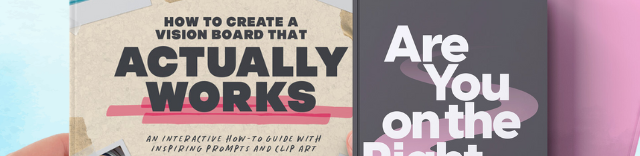
    Book One: Are You on the Right Track? A 101-Day Guided Journal from the Universe

    Get ready for a daily dose of inspiration! This journal features heartfelt letters from the Universe, thought-provoking quotes, and carefully crafted journal prompts tailored to daily themes.

    Whether it’s focused on forgiveness, gratitude, or living with purpose, each entry will gently guide you in the right direction.

    If you’re to release past programming and push past personal limits so you can live an extraordinary, empowered life, this journal is for you.

    Get your copy here.

    Book Two: How to Create a Vision Board that Actually Works

    Unlock the power of visualization with this three-part journal. It’s designed to walk you through the vision boarding process, ensuring complete clarity about your deepest desires and showing you precisely how to turn them into reality.

    With 200+ cut-and-paste images, inspirational quotes, and insightful prompts, creating an actionable vision board is easier than ever. This how-to guide will help you find clarity, set a plan of action, and overcome procrastination, taking your dreams from concept to reality.

    In the interest of full disclosure, I was skeptical about the idea of manifestation in the past because I wondered if it would encourage attachment to specific desires and outcomes. But I’ve come to realize that many of the things we want are actually things we need. Connection, purpose, physical wellness—we all need these things to be our best selves and to make a positive impact on the world.

    Antasha has created a powerful tool to help us all meet those needs—one vision and one action step at a time.

    Get your copy here.

    Intrigued? Head over to Antasha’s site to get free sample pages for both journals.

    I hope these powerful tools help you create lasting positive change!

  • 5 Ways to Explore the World and Feel Excited About Life

    5 Ways to Explore the World and Feel Excited About Life

    “Twenty years from now you will be more disappointed by the things you didn’t do than by the ones you did do. So, throw off the bowlines. Sail away from the safe harbor. Catch the trade winds in your sails. Explore. Dream. Discover.”  ~Mark Twain

    In 2022, I wanted to quit my job and didn’t know why. I was about to embark on a six-week trip to a country I’d always wanted to visit—New Zealand—to work in sports TV production. I loved the people I worked with, the company I worked for, and the buzz I got from live TV. Still, it wasn’t enough. I needed to explore these feelings further.

    That word “exploration” was the key. It took me back to 2004, when I was in a hostel in Laguna Beach, an eighteen-year-old girl travelling alone. When I was growing up, I didn’t want to follow the traditional route of going to university just to find a corporate job, climb the career ladder, and retire with a good pension. The perfect path for many was not an option that excited me.

    I was travelling around the U.S. West Coast, hoping to find adventure and opportunities, but I knew I’d need to start seriously thinking about my future and next steps when I returned to London.

    I sat on Huntington Beach and spent some time thinking about what I wanted my life to look like. I wanted to work for a reputable company that could offer me travel opportunities. I couldn’t identify what I wanted to do with any precision, but I knew that was a good starting place.

    A few days later, on July 7, I was awakened in the early morning by a fellow Brit who informed me that terrorists had just attacked London. For the rest of the day, I was glued to the BBC, watching the tragedy unfold. In between the journalism, adverts depicted BBC correspondents working all over the world, and that’s when I thought the BBC might be the company for me.

    Several months later, I returned to London and applied to be a production team assistant for a BBC sister company. To my astonishment, I got the job. I was so excited! A new job, new people, and new opportunities.

    During my first week, I overheard my boss speaking on the phone with a friend in the BBC Sport division. She was preparing to travel to Germany to spend six weeks working on the FIFA World Cup. My mind exploded. That was the job I yearned for. I wanted to work in sports and travel to the most spectacular events on earth.

    I asked my boss if she could find out whom I could contact to get a foot in the door in that department. It wasn’t straightforward, but after several attempts and emails to their senior production manager, I was asked to come in for a coffee and informal chat.

    Fast forward eighteen years. I’ve travelled the globe to work on the biggest sporting events, from World Cups in South Africa and Brazil to the London Olympics, Euros in Poland and Ukraine, umpteen Formula 1 and Formula E races on five continents, sailing regattas off the coasts of Australia and the US, cricket in the Caribbean and New Zealand. And that’s just a partial list.

    Travel has shaped my life in so many ways. It has impacted my outlook on life, perspectives, relationships, and goals. It has taken me out of my comfort zone time and time again and allowed me to be inspired by new things.

    I have loved my job and still do, mostly, to this day. So it was a surprise to me when I felt the urge to hand in my notice.

    Truth be told, throughout my career, I’ve always been restless. I have consistently sought out new opportunities within the framework of my role. I’ve moved between companies, permanent contracts, temporary contracts, and freelancing. I’ve trained to become a teacher, left TV to work on sports documentaries, returned to TV, become a tutor as a side job, and set up my own business.

    It wasn’t that I was unhappy in TV production. I just love exploring and presenting myself with new learning environments. That eighteen-year-old in me who never wanted to follow the common path society can push us down still lives within me. And I wouldn’t change her for the world. If I’d never explored different paths, I never would have had the courage to create a lifestyle around my passions, purpose, and skills.

    Exploration is one of the greatest purposes of humankind. Everything we know about the world comes from those who explored before us. Discoveries in medicine, science, technology, religion, geography, space, and philosophy have changed the world for the better. They have led to greater equality of race and gender, alleviation of poverty, advances in health and education, tolerance and peace, and preservation of the environment.

    The world is constantly changing and developing because of our need to explore and continue learning, growing, creating, building, making, connecting, debating, and trying new things.

    So, if you’re feeling stuck and want more fulfilment in your day-to-day, it might be helpful to remember there’s a whole world out there to discover. Our time on Earth is finite. Life should be lived, explored, and enjoyed. Through exploration, you might just stumble across that sweet spot that lights you up and creates a new path for your future.

    Here are three reasons why I believe exploring and discovering new opportunities could be the recipe for a more fulfilled life:

    1. Exploration is a natural requirement for humanity.

    It is as necessary as warmth, love, food, and shelter. Exploration has been the driving force behind humankind since the dawn of time because it is at the centre of everything we do. We explore everything we do from the moment we are born through play, travel, work, speaking, writing, experimenting, singing, and interacting with each other. Let alone the preciousness of exploring the world through the eyes of our children.

    From religion to literature, politics to science, and design to philosophy, we are constantly asking questions and searching for new ways to develop our minds and abilities. There is no end to exploration. It is the driving force behind our survival as a race.

    2. Exploration creates more self-awareness, which I believe is a critical aspect of meaningful living.

    It allows people to understand their strengths, weaknesses, and areas for growth. By becoming more self-aware, you can gain a deeper understanding of your passions, values, and goals, and can make more intentional choices about how you live your life.

    3. Exploration inspires us and gives us hope for a better future.

    There is a vast world outside waiting to be explored. It offers adventures to be experienced, endless possibilities, stories to be created, and dreams waiting to come true.

    Having a curious and hungry mind allows you to discover goals and options that will bring you more fulfilment and happiness. You can chase your dreams with the comfort of knowing that it’s possible to understand almost anything. By constantly learning, you see what’s possible for yourself and others and alter your perspective of the world.

    Exploration doesn’t have to involve big steps such as quitting your job, moving countries, or travelling the world seeking adventure. Instead, we can seek exploration in our every day, and the good news is there are plenty of opportunities to explore and seek purpose wherever you are in life.

    Here are five ways you can implement exploration into your everyday lifestyle immediately.

    1. Look at your passions and interests and find a way to get more involved in them.

    Whatever interests you—art, animals, baking, singing, decorating, driving, teaching, embroidery, music, or sports to name a few—find a way to go and explore how to implement this into your daily or weekly routine.

    This could be interning, volunteering your time, picking up a book, subscribing to a podcast, emailing someone who is successful in that field, or taking a class. Getting involved in this area will open up your creative channels. The key is to allow yourself permission and time to experiment.

    2. Be spontaneous and get out of the humdrum routine and predictability of your daily life.

    Play a different radio station on your way to work, choose a brand new restaurant or cuisine on the weekend, walk a different route around your park, order something completely different off the menu, or choose a different vegetable to cook with each week. There are always surprises and fascinations in store for us if we are open to exploring new ways; we never know what we will discover.

    3. Connect with new like-minded people.

    You never know what conversation might spark a new thought or perspective. You can find inspiration from one word, a smile, or an interaction that can change your outlook on a situation. For example, buying from a local business instead of a corporate chain allows you to get to know the owner and the story behind their product. Their story might just inspire your exploration journey.

    4. Even if you can’t pack a suitcase and fly to far-off destinations, that doesn’t mean you can’t transport your mind to them.

    Movies, documentaries, TV shows, and books can all transport you into new worlds and cultures. Next time you settle down with a good book or in front of the TV, why not choose a new genre and be open to learning new things?

    5. Your clothes are one way to show the world what you stand for and who you are.

    Fashion has a huge impact on your mindset, mood, and confidence. Experiment with different clothing, mix and match what you already have, and play around with what makes you feel most confident so you’ll want to get out in the world and explore.

    We can open the door to exploration in everyday life. After all, the reason for your exploration is not to discover your life’s purpose. The purpose of your life is to live it!

    Exploration is a continuous journey toward self-improvement and personal growth that allows you to live a life that is fulfilling and meaningful to you. Don’t give up on exploring what you want and pursuing your dreams. Your life is what you make it, and it’s worth trying to make it what you want it to be. So go! Explore and discover. Embrace the journey and enjoy the ride!

  • You’re Never Too Old To Feel Inspired, Excited, and Alive

    You’re Never Too Old To Feel Inspired, Excited, and Alive

    “I do not want to get to the end of my life and find that I just lived the length of it. I want to have lived the width of it as well.” ~Diane Ackerman 

    I’m in the business of watching people take risks. I observe them tackling challenges, fear, and discomfort, and sometimes, “making firsts” in their life.

    I observe a lot as a flight attendant, and sometimes wonder if my official title should rather be “Human Observer,” or “Social Experimenter.” It feels more accurate, or at least it’s the part that I typically enjoy the most. I’m also what’s called a “Death Doula” and hospice volunteer, both of which I consider to be more of a passion rather than a kind of “job” or “position.”

    I not only enjoy observing and assisting people through their living process, but also through their dying process. That includes everything in between. My interest in humans isn’t just with the young (who the media unfortunately tells us are the only “relevant ones”), but I rather have a special spot in my heart for the old and the dying.

    I experienced a rather benign interaction a couple of weeks ago, walking to my gate in the Salt Lake City Airport at the beginning of my work trip. As I was passing the TSA security area, a hunched elderly woman, slightly ahead of me, dropped all of her belongings. Her belongings included a small rollaboard and a large tote purse. Her bags were ripping at the seams with the items I’m sure she diligently chose ahead of time.

    My husband, who also happens to be a “Human Observer” with the same Human Observing company, was walking with me. The timing aligned perfectly—she dropped her bags, resulting in several items spilling out, and we, following right behind her, were ready to help pick up the pieces.

    It was just the interaction I needed at that time.

    As with any job, position, or career, it’s easy to feel “burnt out,” rundown, or simply uninspired, given the right circumstances. No matter how exciting your job or life may seem to other people, it’s your “normal,” but likewise, it’s your individual responsibility to keep that flame of inspiration burning.

    A similar idea can be true for what may seem like a “boring” life or “boring” job: it may be your ultimate passion and inspiration. Either way, life and circumstances ebb and flow. Sometimes you just need to get out of your own head and stop thinking about the same day-in, day-out rudimentary topics of your life.

    At the time, I had been feeling fairly lackluster. I’d been working more than normal and had barely had time to myself to contemplate and be introspective (which I desperately need on a regular basis), let alone time to even be home. This interaction changed things for me in that moment and has stuck with me since.

    It was clear that she was traveling solo. I helped pick up her dropped rollaboard luggage as my husband started helping with her tote bag. I noticed that some of the items that dropped from her bags were French language and culture-related books. She was disorganized, no rhyme or reason for any items’ place, and you could tell she used every inch of space possible.

    “I’m going to Paris for a month, and I’ve never traveled before! This is everything I’m bringing!” She exclaimed, her smiling face closely looking up at me. I’ll never forget her look—that wrinkled, rough face with a peeling nose, disheveled short hair, and haphazardly put-together outfit. She was ecstatic, and it almost seemed as if she had been waiting to tell someone—anyone—about what adventures she was about to embark upon.

    As my husband worked on putting some items back in order, quietly talking to himself (“these will just fall out again if we don’t put them here”), I told her how excited I was for her and how amazing it is that she is doing this—going for it. Her excitement radiated onto me, and I couldn’t help but feel absolutely elated for her.

    We exchanged some additional niceties, and we helped her find her departure gate. For the next several minutes after parting ways, I had the biggest, dumbest smile stuck on my face.

    I would have loved to have been a fly on the wall (plane “wall” or otherwise) throughout her journey—to see her sense of wonder and curiosity with everyone and everything she was to encounter. I think about her now, conscious of the fact that she’s exactly halfway into her journey.

    This entire interaction then made me wonder, “What was it in her life that served as the catalyst for this decision of hers?” What made her decide, “Yep, this is the time. I’m just going to go for it. What have I got to lose?” She didn’t look like your stereotypical “adventurer.” She wasn’t trying to be anyone but herself.

    In a modern world where the young, adventurous ones are on Tik Tok, YouTube, or Instagram, it was refreshing to see a normal, mature person just going for it. I see and experience examples of this kind of thing on a regular basis, but I guess I just wish that perhaps someone from a younger generation who may be insecure about the direction of their life could experience these things with me.

    As much as I’ve experienced those who are brave and taking up hobbies or doing things that inspire them, I’ve also seen the opposite: those who are afraid of the new. It seems as if people get settled in their ways and end up saying to themselves, “Welp, this is it. This is my life now.”

    But why do we do that? It seems so counterintuitive to how life should be: full of exploration and wonder. I don’t think this is a particularly new or modern concept. I don’t think it’s because of social media that more mature folks aren’t taking risks or taking up hobbies they genuinely enjoy.

    This is not to say that I think everyone should get on a plane and go to Paris. Traveling isn’t inspiring for everyone. For some, perhaps the exhaustion or the stress outweigh any benefit. To each their own. Perhaps your version of exploring curiosity or wonder is creating a garden, deciding to read more, finally getting into stand-up comedy, going outside more, or digging into that sourdough bread kit.

    Deciding to lead a life full of exploration and wonder doesn’t need to fit a particular theme. It’s getting out there (or staying in there) and doing what inspires you. It’s doing it for you—no one else. And sometimes it may take a catalyst against your will to make something happen.

    I can’t assume that it was something perceived as “negative” that happened to our Parisian friend that made her, for the first time ever, embark on a month-long trip across the world. But I find it fun to explore the possibilities.

    Many may also say they have a fear of “failure,” but what are we defining as “failure?” Does “failure” even exist if you’re actively enjoying yourself and not doing it for anyone else? You’re never too old to find inspiration—whether it be through a hobby, an activity, or through others. Our lives and deaths are constantly in cycle. That cycle is always in motion. You’ve got to keep moving.

    I think Ms. Paris, who I admire so, knew this. We didn’t need to have this particular conversation for me to know that.

  • How To Make Peace with Regrets: 4 Steps That Help Me Let Go

    How To Make Peace with Regrets: 4 Steps That Help Me Let Go

    “Under any circumstance, simply do your best, and you will avoid self-judgment, self-abuse and regret.” ~Don Miguel Ruiz

    The other day, I told my adult niece that I regretted selling my downtown condo several years ago.

    “On no,” she said. “You told me back then that you were finding the lack of light was getting to you. You weren’t happy there.”

    I had no memory of that until she reminded me. And surprisingly, it lifted a great deal of my painful regret around it. It helped me change from regret to recognition that I’d made the right decision.

    That got me thinking about other things I regretted. Am I remembering them correctly, or am I revising history? In other words, am I suffering needlessly?

    Memory is a funny thing. We don’t usually remember all the details of a situation. We pick and choose.

    For example, my regret around selling my condo focused on missing its cool location, being aware of how the value had increased, and reflecting on the many fun times I had with friends and family there.

    My memory did not include how much construction has been going on in that location these past years, how my two favorite restaurants closed, and how the best neighborhood coffee shop in the world went out of business.

    My regret, my emotional pain, was based on very limited data, some that isn’t even relevant anymore.

    Isn’t that interesting?

    Is it possible that all our regrets don’t take into account enough information to help us feel more at peace with these painful situations?

    I decided to sit and reflect on some of my other regrets. Would it be possible to alleviate some of my suffering by broadening my perspective on them?

    Here’s how I made peace with my regrets:

    Step One: I reviewed the regret and thought about all the things that were going on at the time of the disappointment.

    For example, let’s take my early career as a singer/songwriter. When I looked back on it, I felt regret, deep emotional pain over never recording an album of my songs.

    There was a lot going on in those years surrounding my career. Specifically, I was never totally happy. I spent more time reading self-help and spiritual books than practicing my craft.

    I had a hard time relating to other musicians. And I really had a terrible time with the record company executives and producers. I didn’t like how they treated me.

    I even had my manager ghost me. And that was way before we even knew what ghosting was.

    In addition, I was on the road a lot, playing in smokey bars, which was really challenging given that I neither smoked nor drank.

    And because I spent a lot of time as a solo performer with just me and my guitar, I spent way too many days, nights, and weeks alone in strange communities, eating in bad restaurants, because that was all I could afford.

    Hah! You see how remembering the details around the regret can be so eye-opening? Until I did this exercise, I honestly had forgotten about all of that.

    Step Two: I reflected on how this bigger picture influenced the outcome that I was currently regretting.

    There was nothing very inspiring or exciting about the day-to-day grind of being a musician on the road for me.

    Everything seemed very hard. Finding places to play, driving long distances, meeting with executives who were judging me and my music, dealing with agents and other musicians, and missing my family.

    It was all hard. And I didn’t like it.

    I dreamed of finding colleagues who would help me to fulfill my potential as an artist. Except for a small handful, the ones I worked with seemed much more interested in furthering themselves.

    I felt used.

    Ugh!

    And although I enjoyed the time I spent living and working in New York City and Los Angeles, I was a Canadian citizen and unable to obtain a proper work visa.

    That meant I would go back and forth across the border often, keeping my fingers crossed that I wouldn’t get caught!

    Step Three: I explored another way to look at the situation, often called “reframing.”

    Reframing is exactly what it sounds like. If you had a frame, maybe 24” x 24”, and you placed it on a very large painting, you would be focused on the section of the painting within the frame.

    But what about the huge picture all around it? If you moved the frame, you’d see another piece of the picture.

    And if you expanded the frame to be the full size of the entire canvas? Now you’d see a very different picture.

    We can reframe situations in our life this way. By moving the frame around, and especially by expanding it, we simply see a different picture of reality.

    As I reflected on all the things that were going on with my early musical career, I began to see the bigger picture. And guess what? I felt the pain of regret lift from my heart.

    Of course I quit that career!

    Of course I was unhappy!

    Of course I didn’t get to fulfill my goal of creating an album. The situation was not going to support that, no matter how hard I tried.

    Step Four: I made peace with what was once a regret.

    Certainly, sitting here now with an MP3 of my songs in album form seems like a great thing.

    But there was always a good chance that it was not going to be something I was proud of. I didn’t have the support structure to make that happen.

    And what happened instead of sticking with my music career?

    I came back home to my family, went back to school, and had the best time learning, writing, and studying topics that I found inspiring and fascinating.

    Coming back to school gave me the chance, as an adult, to explore who I really was, find my true passions, and commit to how I might share those passions with the world.

    University was the best time of my life.

    Conclusion

    This exercise has helped me heal. I no longer have emotional pain around what I used to see as a disappointment for my life.

    I have insight now that leads me to believe that the music business was not my passion, not my purpose, and would never have made me happy.

    This great insight provides me with great relief. I have found peace where once there was the emotional pain of regret.

    I hope you try these steps for yourself and learn how to make peace with your regrets.

  • Stop Waiting for Perfection and Fall in Love with Your Life Now

    Stop Waiting for Perfection and Fall in Love with Your Life Now

    I know, so cliché, right? I can practically hear your eyes roll. But hear me out.

    In a society driven by results, achievements, and ideals of perfection, there is a huge pitfall that I am becoming increasingly aware of—that we can be so focused on trying to achieve our “best life” that life itself could pass us by and we would have missed it. Missed the beauty of just being here.

    We’ve all heard the sayings “Slow down and smell the roses” and “Life is a journey, not a destination.” We hear these sayings and pass them off as embroidery on a quaint pillow, but what if we didn’t? What if life really is in the details?

    I mean, how many of us will ever actually attain the “perfect life” we are being sold? Are we just trapped in never-ending, self-defeating cycles of diets, bad habits, and perpetual “self-improvement”?

    What if we just paused for a second. Took a break from social media. Blocked out all the outside noise. Just got quiet. What would your inner voice, your subconscious, tell you?

    What makes you truly happy? What feeds your soul? Makes you tick? Even reading that back I realize I sound very “new age,” but what I mean is, aren’t we done with being told what will make us happy? And why does life have to be spectacular to be fulfilling? Can’t what we have just be enough?

    Recently, I lost my dad after a very short and aggressive battle with cancer. I didn’t see it coming. I thought he would go on forever.

    I had been estranged from my dad for a few years before he got sick. We had drifted apart for lots of reasons but mainly because he was never there for me. Our relationship was very one-sided and usually consisted of me running after him, wanting him to notice me, to give me the love and approval I so badly felt I needed from him.

    He wasn’t any of the things a father should be. He wasn’t reliable or safe or protective or even present, and I resented him for abandoning me when I was little.

    But when it came down to it, when I faced losing him, when I saw him in his hospital bed and he told me he “wasn’t long for this world,” all of that melted away and I longed desperately for more time.

    I wish I had let go of my expectations, my resentment, and my pride and just accepted him and salvaged a relationship with him. I loved my dad, and I wish I had spent more time just being with him. Now, that time has passed.

    His loss taught me something. Life is precious. We don’t have forever. We have now. This moment. We can choose to love our lives now.

    Don’t wait until you’re skinner, prettier, fitter, earning more money, famous, a millionaire. (Most of us will never be those last two things.)

    If your life is particularly hard right now and your needs aren’t being met, work to change what isn’t working. But don’t get so focused on what you want that you forget what you already have.

    Let’s stop wasting the precious time we have here with the people we love, who make our life beautiful.

    Appreciate all the little things that make you happy.

    For me, it’s coffee shops and lazy mornings, walks by the river or in nature, grabbing lunch with my friends or dancing the night away, cuddles on the sofa, spending time with my kids, those few precious moments with my partner in the morning before the day begins.

    These things are what make a life. While we are striving to “live our best life,” we run the real risk of completely missing the one we are already living.

    My one wish is that we all wake up and start appreciating the life we have right now. That we reject the notion that we have to have perfect bodies, perfect faces, perfect houses, families, relationships, to have a truly happy life.

    Wake up to the fact that we are being sold this lie purely so that we buy more stuff, work more hours, keep striving for the mythical pot of gold at the end of the rainbow.

    Love your life now. Fall in love with all the little things. Happiness doesn’t come from physical possessions. It comes from appreciating everything money can’t buy. You could already be living your “best life” without even trying.

  • How to Show Up When Nothing About Your Life Is Perfect

    How to Show Up When Nothing About Your Life Is Perfect

    “I saw that you were perfect, and so I loved you. Then I saw that you were not perfect, and I loved you even more.” ~Angelita Lim

    I’m not a perfect parent. I’m not a perfect partner. I’m not in perfect health. I’m not a perfect friend. And I’m far from perfect with my finances.

    Hell, nothing about my life is perfect. And guess what? I’ll never be able to attain perfection in those areas. And I’m sorry to say it, but neither will you.

    Don’t be fooled by calling yourself a perfectionist. Perfection as a destination is what causes procrastination. And for most of us, it’s nothing more than an excuse to avoid putting in the work, because why try if we don’t have the skills to be perfect?

    Unfortunately, this belief that we can attain perfection is bullshit. It’s an idea adopted from the school system. Grades were meaningless because they had nothing to do with effort. They were a simple way of ticking boxes for the masses.

    Conversely, a meaningful life comes down to your effort when no one is watching.

    What did you do today? Did you show up? Did you make an effort to be a better parent, a better partner, be in better health, a better friend, and better your finances?

    No effort = No progress = No reward.

    We can’t put off living our lives hoping that someday these areas will magically be perfect.

    Yesterday is dead and gone. Tomorrow is nothing more than a dream. So focus on today.

    You’re living right now. This is your chance to be better.

    Want to be a better parent? Want to be a better partner? Want better health? Want to be a better friend? Want better finances?

    Start by putting your phone down and giving each area your undivided presence.

    Be with your kids. Be with your partner. Be with your health. Be with your friends. Be conscious with your money.

    Perfection is horribly discouraging because who the hell has time for their ideal two-hour morning routine? I sure as hell don’t. With a kid who isn’t in daycare, running a business, and paying bills, many days feel like I’m flying by the seat of my pants.

    And that’s also why many of us fail to progress on what’s meaningful. If you get stuck in an all-or-nothing mentality, it almost always means you’re doing nothing.

    But suppose you did something radical and showed yourself empathy in these moments. In that case, you’ll change the entire trajectory of your life by simply showing up.

    Don’t have time to go to the gym? Don’t have time to do an at-home workout? Don’t have time to go for a walk? Don’t have time to do ten squats and a few pushups?

    Pick your kid up, throw on some Taylor Swift, and throw a dance party, you crazy fool.

    Change the scope of what you deem a win for the day.

    When you accept that perfection is impossible, you can get down to the actual work of making improvements because you’ve given yourself a way to show up every damn day.

    Every action you take (or don’t take) is a vote toward the person you’re becoming. Don’t discount the truth that small actions create colossal change.

    Think of a single vote: In a democracy, a single vote can be the deciding factor in an election, which can have significant consequences for the direction of a country.

    Think of a small spark: A small spark can ignite a large fire, which can have severe consequences for people and the environment.

    Think of a tiny seed: A tiny seed can grow into a large plant, providing food, oxygen, and habitat for various living things.

    Think of a simple idea: A simple idea can lead to development of a new technology or product that changes how people live and work.

    Think of a single word: One word or phrase can spark a movement, change public opinion, or inspire others to take action.

    Dedicate today to taking one small action on something that matters to you, even if it’s just five minutes and feels insignificant.

    This small, simple, single step you’ve been putting off could be the catalyst for the explosion that propels you forward and transforms your life (and the world) for the better.

    You got this.

    You deserve a better life.

  • How I Stopped Worrying About Running Out of Time to Achieve My Goals

    How I Stopped Worrying About Running Out of Time to Achieve My Goals

    “The only thing that is ultimately real about your journey is the step that you are taking at this moment. That’s all there ever is.” ~Alan Watts

    One thing that is promised to each one of us in life is death. No one will avoid dying or feeling the pain of losing others. From a young age I remember being aware of this fact, and it scared me.

    As I got older, I began to feel a sense of pressure that I was running out of time and loss was imminent. The thought of losing my loved ones and the uncertainty of what may happen worried me. I wanted to avoid the feelings of loss and limitation, so I unconsciously began to move faster.

    There was a deep fear that if things didn’t happen fast, they would not happen at all and that I wouldn’t have enough time.

    Faster became better, and I started the hamster race of working hard to achieve my dreams. Whether that was finishing school, starting a career, being in a healthy relationship, starting a family, being fit… even my spiritual journey became a race to happiness that only existed in the future!

    I realized later in life that this mindset was born out of fear—the fear of loss, the fear of the unknown—and protection from these fears was a quick accomplishment. It created an immense amount of stress and suffering because all goals and dreams take time to build.

    I believed sooner was better, and if it wasn’t fast then it wasn’t happening at all. I began to find reasons for why it wasn’t happening—that I was not good enough, life was unfair and hard, and it was not possible for me. Each time I repeated these limiting beliefs, I took one step away from my dreams and developed more anxiety.

    This led to a cycle of starting, quitting, and then searching for something different. I would garner the courage to start something new only to fall flat on my face when it didn’t happen. The cycle of shame would repeat, impacting my mental health and my ability to move forward.

    I wanted to see proof that I was achieving my goals and searched for tangible evidence to feel good while simultaneously ignoring all the wonderful things that were right before my eyes. Like living near the ocean, spending time with my loved ones, talking walks along the coast, having meaningful conversations with friends, and enjoying moments of quiet with my favorite cup of coffee. These mean so much to me now.

    I wanted the degree, the paycheck, the happy photo of me surrounded by friends, rather than the silence of uncertainty and the impatience I felt in the present. My fear of time took away the only real time that existed, the now.

    When I slowed down and paused, I realized that I had experienced so much growth and expansion in all the years I’d thought I was wasting time. Every roadblock had challenged me to change. In fact, my anxiety, fear, and disappointment around my slow progress led me inward to heal my relationship with time.

    Though many of my dreams did come true, I was only able to recognize them when I slowed down and let go of the “when.”

    I was able to achieve this by practicing meditation, breathwork, and awareness. With time and consistency, the present moment became filled with color, and its beauty swept me away from the ticking time bomb of the future. I began to enjoy each step of my journey, whether it was the beginning or end.

    With the gift of hindsight, I can see that it is not about the “when” but about the “what.” What I’m doing right now in the present. The number of negative and limiting beliefs I placed upon myself and the shame I felt were due to an emphasis on always “thinking forward,” and a lack of being with myself in the present.

    The truth is when we let go of our misconceptions of time and follow our dreams patiently, we see that time is not against us; the process is a necessary part of our journey.

    The time it takes to reach our goals is not empty; it is filled with learning and unlearning so that we find ourselves. In the end it is not the achievement that leads to freedom, but the wisdom that comes from living life.

    If we make the present moment our friend rather than our foe, we can experience and appreciate our present journey rather than focusing on our arrival.

  • New Year’s Resolutions Simplified: It’s as Easy as 1, 2, 3

    New Year’s Resolutions Simplified: It’s as Easy as 1, 2, 3

    You and I will probably come across a hundred articles about New Year’s resolutions in 2023 … again. And, if you and I are like the majority—the well-intentioned, regular people who genuinely want change—we will aspire to big things and later get frustrated and give up on the list we made … again.

    But what if we kept it really simple this time? What if we didn’t have to make an endless list and be reminded, by looking at it, of all the things we may fail at again?

    What if we made it as easy as one, two, three?

    Let us do that instead, shall we?!

    1. Make “one” your magic number. Count to one each day, starting now, not from January 1st—NOW! What is the one thing you want and will do today?

    One email or paragraph you will write, or one chapter you will read, or one person you’ll reach out to. Who is the one lucky person you will text or call to tell them how you miss or appreciate them? Or how encouraged you feel by knowing them or how you want to ask forgiveness from them? Who is the one person you can write to or call to laugh about that one fun memory that you only share with them?

    I personally made a commitment to write or call or pray for a person whenever they cross my mind, that same day; I do not wait. There is a reason, I believe, we are reminded of people, and life is so fragile. I don’t want to miss an opportunity and regret not uplifting someone who could have been encouraged, or speaking kindness to someone who could have benefited from it.

    What’s one thing you will do today to move toward a healthier and happier you?

    Maybe it’s just one set of squats while you are washing the dishes; one jump rope you will order and one minute of jumping you’ll do when it arrives; one glass of beer or coke or a sweet drink you’ll replace with water or tea or decaf coffee just once today. Which one item will you change in your menu today for something that is better for your body?

    What is the one happy song you will listen to in the car or on a quick walk that you will take today? What is the one shop you will drive to, parking really far away, so you can get extra steps walking back and forth?

    2. Remember that there are two significant ways that your brilliant mind registers and remembers everything: through words and images.

    Paint clear, vivid, beautiful pictures for your mind of what it is that you want. Think backward; create an image of what your completed accomplishment looks like to you and make it as detailed and as exciting as you possibly can.

    See yourself having arrived at the healthy weight you want, you fitting into an outfit of your desires, hearing your friends and strangers complimenting you on how radiant and healthy and great you look, thinking about how you love taking care of your body inside and out.

    See yourself having completed your degree, project, letter, book, task, whatever. See yourself walking across the stage, people wanting to buy your product, welcoming your project, asking you to give your presentation again, asking you about and enjoying the summary of what you read or learned.

    Imagine yourself buying that house you have painted in your mind and furnishing it and having friends over and laughing and resting in your comfortable space every day!

    See yourself in a relationship you just repaired or found and are enjoying. See how good it is for you and the other person; see and hear the uplifting conversations you are having and the fun activities you are enjoying together. Dream in pictures!

    When talking to yourself, use words that are kind, uplifting, life-giving, generous—not the opposite. Speak in the same way you would to someone you love and care about; someone whose success would make you as happy as your own; someone you want to see happy, encouraged, loved. Talk to yourself in your mind and out loud like that each day and see what happens.

    3. Imagine yourself as a triangle.

    One side is your mind, connected to the second, your heart, connected to the third, your amazing body, with the entire space inside filled with who you really and most profoundly are—your spirit.

    All of you needs to be cared for, attended to, and nurtured. Pay attention to what each part needs and requires. How is it lacking? What is it missing? What one thing can you do today to nurture each part?

    I nourish my spirit through prayer and silence daily, which fills me with focus, strength, and insight, and I always pray for at least one person outside of my family as well. Walking is what helps care for my body during this season of life.

    So there you have it: one, two, three.

    When you get to the end of your day today, be sure to congratulate yourself on that one thing you did, that step you took, and look forward to doing it again tomorrow. Be your cheerleader and encourager and then, over time, you’ll see that change you’ve been looking for.

  • The One Thought That Killed My Crippling Fear of Other People’s Opinions

    The One Thought That Killed My Crippling Fear of Other People’s Opinions

    “Don’t worry if someone does not like you. Most people are struggling to like themselves.” ~Unknown

    For as long as I can remember, I have been deathly afraid of what other people thought of me.

    I remember looking at all the other girls in third grade and wondering why I didn’t have a flat stomach like them. I was ashamed of my body and didn’t want other people to look at me. This is not a thought that a ten-year-old girl should have, but unfortunately, it’s all too common.

    Every single woman I know has voiced this same struggle. That other people’s opinions have too much weight in their lives and are something to be feared. For most of us women, there is nothing worse than someone else judging our appearance.

    After that fear first came to me in third grade, I carried it with me every day throughout high school, college, and into my twenties. This led me to trying every diet imaginable and going through cycles of restricting and binging. I just wanted to lose those pesky fifteen pounds so I could finally feel better about myself and not be scared of attention.

    There was no better feeling than getting a new diet book in the mail and vowing that I would start the next day. Following every rule perfectly and never straying from the list of acceptable foods. I stopped going to restaurants and having meals with friends because I wouldn’t know the exact calorie count.

    All this chasing new diets and strict workouts was because of one simple thought that I carried for years. I just assumed everyone was judging my body and would like me more if I lost weight. I was constantly comparing my body to every other woman around me.

    This fear of what other people thought also led me to have a complicated relationship with alcohol in my late teens and early twenties. At my core I am naturally sensitive, observant, even-keeled, and sometimes quiet. But I didn’t like this about me; I wanted to be the outgoing party girl that was the center of attention.

    The first time I got drunk in high school I realized that this could be my one-way ticket to achieve my desired personality. With alcohol I was carefree, funny, and spontaneous, and I loved that I could get endless attention. I was finally the life of the party, and no one could take it away from me.

    I wanted everyone to think that party-girl me was the real me, not the sensitive and loving person that I was desperately trying to hide. Classmates were actually quite shocked if they saw me at a party because I was so different than how I appeared in school. It was exciting to unveil this persona to every new person I met.

    But the thing with diets and alcohol was that this feeling of freedom was only temporary. When the alcohol wore off or the new-diet excitement faded, I was back to the same feelings. In fact, I found that I was even more concerned about what people thought of me if the diet didn’t work or the alcohol wasn’t as strong. I feared that they would discover the real me.

    The irony was that whenever I drank, I felt worse about myself after the alcohol left my system. I felt physically and emotionally ill from the poison I was putting into my body. I would often be embarrassed about not remembering the night before or fearing that I said something I shouldn’t have. It was a nightmare of a rollercoaster that I no longer wanted to be a part of.

    I decided in my mid-twenties that alcohol would no longer have power over me. That I wouldn’t rely on it to feel confident and instead work on loving the real me. I decided to break up with alcohol and put it on the back burner. I was moving to a new city where I didn’t know anyone, so I figured this would be a good time to start fresh.

    Once I moved and started my new life, those same familiar fears and pangs of shame started to show up again. If I wasn’t the loud party girl, who would I be? What would people think of me if I wanted to stay in and read instead of partying? I wasn’t confident in my authentic self yet, and I was desperately looking for a new personality to adopt. That’s when I turned back to a familiar friend for help: dieting.

    In the span of five years, I tried every major diet out there: paleo, keto, vegetarian, vegan, counting macros and calories, you name it. I dedicated all my free time to absorbing all the information I could so I could perfect my diet even more. At one point I was eating chicken, broccoli, and sweet potatoes for every single meal. My body was screaming at me for nutrients, but I continued to ignore it.

    Then one day I hit that illustrious number on the scale and finally felt happy. Well, I assumed I would feel happy, but I was far from it. I felt like absolute crap. My hair was falling out, I had trouble sleeping for the first time in my life, my digestion was ruined, and I had crippling fatigue. I finally lost the fifteen pounds, but my health was the worst it had ever been.

    I felt betrayed. The scale was where I wanted it, but I wasn’t happy. I was more self-conscious of my body than ever before. I didn’t want people to look at me and notice my weight loss. That little girl that cared about what people thought was still ruling my life. I had to make a change, and I had to start loving the girl in the mirror no matter what I looked like. My life depended on it.

    It was during one of those nights where I felt so confused and lost that I stumbled into the world of self-development. I bought my very first journal and the first sentence I wrote was: “Self-love, what does it mean and how do I find it?” I vowed to myself that I would turn inward and get to know the real me for the first time in my life. 

    This new journey felt uncomfortable and scary and pushed me completely outside my comfort zone. I couldn’t just hide behind external sources anymore like I did with alcohol and strict diets. I had to get to know authentic Annie and show the world who she was.

    It was in this journey that I found my love of writing and inspiring people. I decided to follow my dreams and get certified as a life coach and finally make my writing public. But when I went to hit publish on my first post, that same fear reared its ugly head.

    This time I was deathly afraid of what my coworkers and friends would think. They would see the real me, the sensitive soul that had deep feelings and wanted to inspire other people. This fear caused me to deny who I was for far too long, again.

    I hesitated for years to share my writing because this fear stopped me. But this time I wasn’t going to let it have control over me anymore. One day this thought popped into my head and stopped me dead in my tracks. It was an enormous epiphany and one I couldn’t ignore. The thought was:

    When I am eighty years old and looking back on my life, what do I want to remember? That I followed the same path as everyone else or I followed my heart?

    As soon as that thought came to me it was like I was hit over the head. For the first time in my life, I understood it. I realized that if I kept living my life in fear of other people’s opinions, I wasn’t really living my own life.

    Every human is here to be unique and serve out their own purpose, not to just follow the crowds blindly. I couldn’t live out my purpose if I wanted to hide away.

    Self-acceptance and self-love come from knowing and respecting all parts of myself. It comes from acknowledging my shadow sides and still putting myself out there regardless of opinions. It comes from going after big and scary goals and having fun along the way. Because the absolute truth is this: other people’s opinions are not going to matter in one year. They won’t even matter five minutes from now.

    So now I want you to ask yourself the same question: What do you want to remember most about your life when you are at the end of it?

  • My Deepest, Darkest Secret: Why I Never Felt Good Enough

    My Deepest, Darkest Secret: Why I Never Felt Good Enough

    “Loving ourselves through the process of owning our story is the bravest thing we’ll ever do.” ~Brené Brown

    Lunge, turn, reverse, jump, land and rebound, push, pull, cut, run, double turn, fling, pause…

    Not good enough! Smooth the transitions, make it cleaner, find more ease!

    Heart pounds, ragged breath, muscles burn…

    You need more weight on the lunge and point your damn feet when you jump. Do it again.

    Repeat. Lunge, turn, reverse, jump, land and rebound, push, pull, cut, run, double turn, fling, pause…

    What is your problem? Why is it so sloppy? Clean it up! Do it again.

    Not good enough, do it again carved a deep groove into my brain, branding it like a wild bull by a hot iron. Not good enough. My mind, not my teacher, was brutalizing me, taunting me, teaching me “discipline” to improve my dancing.

    I improved—enough to become a professional dancer—but I couldn’t internalize or recognize any of my accomplishments. 

    Even after being asked to join a dance company before I graduated college, I continued to struggle with “not being good enough.” Despite the many compliments I received for my performance and choreography, I brushed them away thinking that they were lying to me, just placating me with false praise.

    I faltered in my performance, felt paralyzed by fear that would not always fade away once the performance began, distrusted my ability to remember the choreography, always fought the anxiety of being in front of an audience, and cried oceans of tears because I could never reach the bar I had set for myself. My confidence and faith in my ability to perform to the level that I wanted to plummeted.

    I loved dancing so much. I loved moving my body through space, the creative process, and working with a group of talented dancers to create shows. I loved rehearsals because I felt relaxed and at ease, like I could perform with the freedom that I couldn’t feel onstage. I loved refining and smoothing transitions and was described as a “liquid” dancer. I loved expressing my style through my movement.

    But the tension between my passion and my insecurity created an internal trip cord. I didn’t trust myself. In rehearsal I was militant about practicing the steps over and over, even when everyone was exhausted, because I still didn’t trust that I knew the choreography.

    I had made mistakes before, blanked out onstage, and felt deep humiliation and shame for not performing someone else’s choreography as well as I should have or meeting a paying audience’s expectations. I was proud that I had so much stamina to rehearse twice as hard as I needed to. If I rehearsed extra. then maybe it would finally quiet the critical voice in my head.

    It didn’t quiet the critic and the cycle continued.

    The shame of being a mediocre dancer led to working harder, but fear of making mistakes or not reaching the goal led to fear of being seen as mediocre, which led, once again, to shame. Shame is dark, subtle, slippery. Over and over, I went through this cycle, the shame cave becoming deeper and darker, until I was lost in it, burned out from so much effort and so little reward.  

    After ten years of pushing myself to learn, pushing against my fears, pushing myself to excel, and beating myself up along the way, I couldn’t push through any longer. I had nothing left to give. The trickling current of anxiety and depression became a flood and swallowed me up into a profound depression. Everything felt arduous, even the simplest daily tasks.

    I looked at people in the streets around me and thought, “How is everybody not depressed? How is anybody smiling?” But they were—smiling, laughing, moving through their days effortlessly, accomplishing wonderful things—and I was not. I was depleted of all vitality.

    I quit performing and turned to my yoga practice to help heal from the burnout. I learned therapeutic yogic principles about balancing effort and ease, surrender, non-grasping, contentment, non-violence (even toward oneself).

    It seemed only natural to become certified as a yoga teacher and, as I began to teach, I encountered the same insecurities. The same thoughts arose—I need to be an excellent yoga teacher, need to create excellent sequences, have excellent pacing, use excellent language to help guide students into an excellent experience. I felt the same performance anxiety—debilitating self-consciousness

    What are they thinking about me? Am I giving them what they need? There are so many different people in my class. They are different ages with different bodies and different life experiences. What do I know to teach other people?  I have only ever been a dancer so how do I know what other people need for their bodies?  

    I didn’t want to harm anyone because I didn’t know enough or have enough information and, once again, I quit after a couple of years.

    My deepest darkest secret, feeling inherently flawed and chronically inadequate, took up space in my heart and my throat. Rent-free. In fact, I was paying for its unwelcome residence. 

    My next strategy was simply to take the pressure off myself. I chose low-pressure jobs that didn’t require a big performance from me. I was lucky and these were jobs that I liked that suited me well as I slowly healed from years of chronic self-abuse.

    In my early forties I came across a term that I identified with—imposter syndrome.

    High achievers’ fear of being exposed as a fraud or imposter. Unable to accept accolades or compliments or awards for one’s talent, skill, or experience.

    Imposters suffer from chronic self-doubt and a sense of intellectual fraudulence that override any feelings of success or external proof of their competence.

    I thought, “That sounds like something I can relate to,” but I wasn’t ready to face it head on. I was finally feeling contented in a job that I liked, without the pressures of performing in ways that touched that deep insecurity, and I wanted to soak that contentment in.

    And then Covid-19 happened, and I lost that job.

    Midway through the pandemic, in an effort to be proactive about the next phase of my life, I turned my attention to developing a yoga therapy practice. Create a mission and vision. Come up with content and language. Identify my audience. Create a website and so on. And again, I came up against the deepest darkest secret that had been so blissfully dormant for several years. I was surprised at its potency, but I decided I was ready to face it head on.

    I remembered imposter syndrome and started researching again. Again, I checked all the boxes—except one. In so many articles that I read, examples were given of well-known people who struggled with imposter syndrome. These are people who have achieved extraordinary things, are in the public eye, and have either overcome or pushed through their demons to go on to incredible accomplishments.

    Naturally, I thought, “Well, I’m no celebrity, have no major awards or accomplishments to speak of, and I haven’t achieved that much in my career, so this probably doesn’t actually apply to me.”  

    Such is imposter syndrome.

    Comparison to others (who we deem higher achieving than we are) will trigger a cascade of shame and doubt. 

    Few people actually talk about imposter syndrome—either they don’t know about it or don’t want to discuss it because of the deep feelings of shame or insecurity that accompany it.

    I want you who silently struggle with imposter syndrome or dysmorphia or profound shame and insecurity to know that I, too, have struggled, but it’s getting better.

    Drop by drop, my cup fills as I take every opportunity to be kind to myself where in the past I would have criticized.

    Having studied positive neuroplasticity, I now understand our brains’ negativity bias and the protective role of the inner critic. I have a newfound appreciation for our natural protective mechanisms and gratitude for the ability of the brain to learn and grow new skills.

    I’m starting small, taking small steps to create an inner garden of welcome. A beautiful nurturing place where I invite one or two for tea and laugh and share experiences and stories.

    And after some time, I hope the garden will expand and the walls begin to crumble a little and I can have a small group for tea, stories, and dancing. And then gradually over time, the garden will expand further so that I can host more people in for tea, stories, dancing, and games.

    I can imagine that remnants of the walls will remain as a reminder of where I’ve been, and I can look at them with gratitude for keeping me safe for a while as I softened and settled and tended to the garden within.

  • What Carrots Are You Chasing, and Are They Worth the Sacrifice?

    What Carrots Are You Chasing, and Are They Worth the Sacrifice?

    “Not to arrive at a clear understanding of one’s own values is a tragic waste. You have missed the whole point of what life is for.” ~Eleanor Roosevelt

    I promise this essay isn’t an attempt to convince you that you’re living inside The Matrix. (Okay, maybe it is a bit.)

    But do you ever find that days, weeks, or even months have passed that you didn’t feel present for? I describe this odd sensation as feeling like you’re going through the motions like Bill Murray trapped in Groundhog Day.

    Every day bleeds into the next because you’re future-focused, and what you’re doing right now only feels valuable insofar as it’s laying the groundwork for something else; the next stage of your career, the renovation that means the house is “done,” a number in the bank account that means you’ll never have to worry about money again.

    I think it’s fair to say we both know this is total BS. We’ve climbed enough mountains in our lifetime to know that as soon as we get what we want, we’re already planning what’s next.

    The problem is not with the aim or the goal but with the belief that we can cross a finish line that will magically make these uncomfortable feelings disappear. In psychology, they call this the hedonic treadmill.

    You know that promotion that would change your life?

    You know that new kitchen you obsess over because it would make life much better?

    You know that extra cash that would mean all of life’s money troubles would disappear?

    Will they provide everlasting happiness?

    Doubtful.

    We can blame this on the hedonic treadmill.

    It’s in our human nature to quickly return to a relatively stable level of happiness despite major positive or negative events or life changes.

    Put another way: No matter what we do, buy, or hope will change our life permanently, it’s a short-lived shot of happiness injected into our life.

    I understand why people don’t want to believe this. Because it forces us to question why we’re working so damn hard to change things and to be present with what is right now.

    When I realized this, I began to reflect on what it meant for my life in a way I couldn’t when I was lost in the chase. Accepting that we have a baseline is liberating. Most of what we’re chasing is nothing more than stupid carnival prizes in a game we didn’t know we were playing.

    If the $40,000 kitchen renovation will give you a flash-in-the-pan taste of happiness, is it worth the years of your life you need to sacrifice to pay that off?

    Is it worth more hours in the office?

    Is it worth less time with your family?

    Is it worth the crippling stress?

    You have no control over the hedonic treadmill. Still, you can control how much of your life you’re willing to trade for a future that won’t make you any happier in the present.

    It’s a hard habit to break because, as philosopher Alan Watts explains:

    “Take education. What a hoax. As a child, you are sent to nursery school. In nursery school, they say you are getting ready to go on to kindergarten. And then first grade is coming up and second grade and third grade… In high school, they tell you you’re getting ready for college. And in college you’re getting ready to go out into the business world… [People are] like donkeys running after carrots that are hanging in front of their faces from sticks attached to their own collars. They are never here. They never get there. They are never alive.”

    It’s drilled into us from the day we’re born to always think of what’s next.

    You end up chasing carrots to eat when you’re not even hungry. Hell, you probably don’t even like the taste of carrots.

    This lack of presence is toxic for our children. They end up repeating the same cycle we do when we role model the idea that we need to prioritize a future self (that may never come) over time spent with them.

    Life only feels short because we burn much of our alive time on shit that doesn’t matter.

    Do you want to experience a deep, rich, and fulfilling life?

    Start by asking, what carrots are you chasing? Are they worth the sacrifice? And what values would you honor in the present if you stopped living for the future?

    I can say family means everything to me, and I’ll do whatever it takes to support and provide for them. But if I’m consumed by my phone when I’m with my ten-month-old daughter, what value am I reinforcing? To make more money in my business so I have the freedom to do exactly what I’m too busy to enjoy right now?

    To honor my values means putting the phone down, looking into her eyes, and giving her literally the only thing she wants and needs from me. My presence. And that right there—being present enough to enjoy our lives—is what will give us the happiness we crave.

  • A Simple Plan to Overcome Self-Doubt and Do What You Want to Do

    A Simple Plan to Overcome Self-Doubt and Do What You Want to Do

    “Don’t let others tell you what you can’t do. Don’t let the limitations of others limit your vision. If you can remove your self-doubt and believe in yourself, you can achieve what you never thought possible.” ~Roy T. Bennett

    Ahh yes, self-doubt. Something that affects every single one of us at different times and at different magnitudes—even those that seem supremely confident.

    Why do so many of us experience self-doubt, and how can we overcome it?

    On a personal note, I can tell you my self-doubt comes any time I am trying something new. I’ve learned over the years where this stems from, and it may be similar for you. It comes from my parents.

    Although my parents were always encouraging, they’d also say things like, “Are you sure this is the right move?”, “Are you sure you want to do this?”, and “Be careful.” In fact, every time I left the house, that’s what my dad would say: “Be careful.” “Drive safe.” Not, “Have fun,” “Have a fantastic time,” or something along these lines.

    In my twenties I realized that it had been ingrained in me to always be cautious, which then led to me doubting myself in certain scenarios, though I’ve never been someone who shies away from challenges or holds myself back. Over the years, I learned to identify what contributes to my self-doubt and then push through it.

    Now, this isn’t the case for everyone. Other things that contribute to self-doubt are comparing ourselves to others; feeling a lack of means, intelligence, or other things we think we need to succeed; past experiences; possibly being criticized; and the natural fear that we feel when attempting something new.

    When we doubt our ability, we are allowing fear to settle in and hold us back from forging forward and taking a leap. Without trying, we are feeding the self-doubt, which means it will likely compound the feeling the next time we are faced with or offered a similar opportunity.

    So how can we detach from self-doubt and make sure we are not missing out on what could be an amazing opportunity or journey for ourselves?

    First, we need CLARITY.

    We need to first get clear on where this self-doubt is coming from.

    What is striking this feeling within you that makes you think you shouldn’t try it or you can’t make something happen? Is it the fear of the unknown, or is it the feeling of not having the ability, or something else you think you need to succeed? Are you comparing yourself to someone else in the process? Or do you think you couldn’t handle it if you failed?

    Second, we need to recognize the FACTS.

    What do you know to be true? For example, what do you know about yourself that can help prove that you can attempt or accomplish this? Have you had any similar experiences that prove you can do this?

    If you’re comparing yourself to someone else, what are the facts in this? Meaning, are you comparing yourself to someone who has already succeeded? Or are you comparing yourself to someone who is at the same stage you are? Nobody gets from A to B without experience, practice, and even failure. So, try not to compare yourself to others, as you may not know the complete story to their success.

    There was a time when I was contemplating which direction to take my business degree. I’d majored in marketing because it’s a creative field that allows for variety, which aligns with my values. But as I was working in my first couple of “corporate” jobs, I was enticed by sales.

    My father wanted to steer me away from sales. He said that it’s a hard career, it’s mostly male-driven, and it’s extremely stressful and unpredictable. But what I saw was the fun interaction sales teams had with their clients and prospects. How they were able to basically chat on the phone 80% of the time and attend fun events.

    It was a fact that sales is stressful, unpredictable, and male-dominated, but I knew myself. I knew I was different than my father. I knew I was up for a challenge and taking risks, whereas he was risk adverse. I knew if it didn’t work out, I always had marketing to step into or maybe other options, whereas my father was opposed to change.

    I had to recognize that he was from a different generation. That although what he expressed was true, there were other factors to consider. If I compared myself to the majority of people occupying these roles I likely wouldn’t have attempted it and enjoyed a fifteen-year-plus career in sales and business development.

    Finally, GO FOR IT!

    The best way to conquer self-doubt is to put yourself out there, take action, and see what happens. No success comes without failure. If it works out, you’ll be glad you did it, and if it fails you’ll learn and can progress.

    Without acting on it you will never know. At least if you push through the doubt and try you will understand yourself and your ability a lot more.

    There was a time when I was considering making a big move that I had dreamt of for so long. I loved my friends and family, but I didn’t love where I was living or the lifestyle I was caught up in. When the timing was right I decided to take the leap and move to the other side of the county alone, without a job.

    I heard things like: “Do you really want to go?” “It’s so expensive out there. How will you afford it?” And “It rains so much there, and people get depressed.”.

    If I had listened to others’ fear and angst about the move I would’ve likely lived in a miserable cycle. Instead, seventeen years later, I still feel this was the best thing I’ve ever done for myself, for my life, for my soul.

    The move brought me an even greater awareness of how resilient we are when faced with change.

    And if it hadn’t worked out, I would have had an adventure, and who knows where it may have taken me? Maybe it would have led me to something else I didn’t even know I wanted until I opened myself up to new possibilities. New possibilities I would never have known about had I limited myself based on other people’s fears.

    Don’t let others’ doubt or success deter you from going after what you want or trying something new. Recognize that you can either let your doubt leave you with regret or feel the satisfaction of taking action. Who knows, your action might actually inspire others to ditch their doubt and take a leap into a life they’ll love.

  • The Secret to Eternal Youth: How to Feel Excited About Life Again

    The Secret to Eternal Youth: How to Feel Excited About Life Again

    “To be fully alive, fully human, and completely awake is to be continually thrown out of the nest. To live fully is to be always in no-man’s-land, to experience each moment as completely new and fresh. To live is to be willing to die over and over again. ” ~Pema Chödrön, When Things Fall Apart

    I am forty-nine years old, and I’ve never felt so young in my life. Many people my age feel old. Many people younger than I am feel old, while many people who are older than I am still feel young.

    What makes someone feel young? I can assure you it has nothing to do with how many wrinkles you have. It is something much deeper than that and yet something very simple.

    Most of us get serious about life around the time we are thirty. We devote ourselves to building our career, building our family, or both. From young people who care mostly about having fun, we become responsible adults. We need to prove ourselves, to make money, to buy a house, and to secure our future.

    “Along the way, I forgot to get excited about things. Everything became a project, something I had to deal with,” a friend told me when I asked her if she was thrilled about buying a new house.

    When we build our home, our career, our family, and our reputation, there is a part of us that we leave behind. When we enter the world of mortgages, insurance, and pension funds, fun goes out the window. And when that happens, we lose our fire.

    Fire is fun; it’s freedom, it’s joy. Fire is courage and boldness. Fire is passion and excitement. Fire is being spontaneous, taking risks, and saying your truth. Fire is exercising and moving energy.

    Fire is fighting for what you believe in. Fire is believing in yourself, believing in life, believing that you deserve to fulfill your wildest dreams. Fire is having wild dreams. Fire is learning new things and teaching them to others. It’s being inspired and inspiring.

    So often we are overwhelmed with life’s demands, and we forget to have fun; we forget to keep our fire alive, and we lose our mojo. Some of us got burnt by our fire when we were younger. Fun led to addictions and other destructive behaviors. We have learned to fear our fire and avoid it at all costs.

    During a few wild years when I lived in New York City, a friend once said to me, “In our twenties we have to do crazy things so that we have something to talk about in our thirties.”

    This is how we live, feeling that from this point onward, life is going downhill toward decay. We feel like our prime years were left behind. We try to reduce the signs of aging to feel better when we look in the mirror or at pictures of ourselves. But no matter what we do, we won’t look like we did in our twenties.

    About three years ago, I started feeling old. I’d always looked younger than my age, but I lost in the Botox race, as I did not do any. I lost my passion; I lost my desire to have fun and enjoy myself; everything was very serious.

    I hated looking at my pictures. All I saw was the lack of charm and beauty that I once possessed. I tried to convince myself that these were external, irrelevant, and unimportant concerns, but they were not; they reflected something deep that was going on in my life.

    Don’t get me wrong. During this time, I was already working at something I loved with all my heart. I loved mothering my son more than anything in the world. I loved my husband and was very grateful for our marriage. But except for my work and my family role, I didn’t care about anything. There was absolutely no time or ability to enjoy life.

    Then things got even worse. I got sick and was forced to constantly deal with my health and nutrition. My diet became more limited than it ever was; I could not enjoy food anymore. I thought I was going to die. I was already older than my mother when she passed away at the age of forty-four, and it just made sense that I would follow in her footsteps to heaven.

    But I was also lucky. I was lucky because there was something inside of me that was stronger than all of this. An inner voice told me that I was still alive and that I should not take it for granted. Every day I got to live was a gift. What was I going to do with this?

    Was I going to look back and cry for not being as beautiful as I once was? Or was I going to look forward and make my life the way I wanted it to be? I realized that it was all up to me. I could continue sinking down into my dietary limitations, my homework struggles, and my aging looks, or I could ignite my fire.

    I decided that it was time to make a big move, from Israel to the US, where I’ve always wanted to live. In order to be fully alive, I had to throw myself out of the nest.

    Even though my husband had no desire to make this move, I knew it was a matter of life and death for me and that I had to take the lead. It was my truth, and it required taking a huge risk.

    During the pandemic we could not even make a preliminary visit, nor could we know for sure if our son would be accepted to school, but we had to take our chances.

    Once we settled in Asheville, NC, I bought new colorful clothes. After years of wearing black bamboo jumpsuits, I added some flair to my wardrobe.

    I took some courses with great teachers who inspired me. I got back to practicing yoga and became a part of the local yoga community. I got back to listening to music that made me want to dance.

    I started writing and publishing my work. I started telling my truth more often. I had some big talks with important people in my life. I said some things I’d never dared say before. What did I have to lose? What does anyone have to lose?

    That’s the beauty of being older. You are wiser, more experienced, you know yourself, and you understand life better than ever before. You are mature enough to deal with your fire in a healthy way.

    You already know that there is no point in pretending or hiding. You can live your truth, you can be who you really are, and you can work toward the fulfillment of your dreams. And it’s rejuvenating, so rejuvenating, despite the wrinkles and the fact that your body is no longer in its prime.

    You can live like you’ve died and come back to life. What will you do differently? Do it. Do it today. Don’t wait.

    If your life does not excite you, make it exciting. If life is not fun, make it fun. Obviously, you can’t control everything. The human experience is not always fun, but no matter what your circumstances are, you can always make things better for yourself, even if it’s just a change of attitude.

    People, especially those on the spiritual path, dismiss fun, and I am the first one to admit that I do this. There are always more important things to do. It’s so hard to find time to mother, to be a partner, to work, to cook, to write, to meditate, to practice. Alcohol is bad, drugs are bad, and sugar is bad. All the things you used to have fun with in your twenties are bad.

    For years I prepared all of my family’s meals. When you eat out, the food does not have your loving energy and is not made with the same organic, local, and fresh ingredients. This is all true, but the pressure to constantly cook had a counterproductive effect on my health.

    Today, sometimes I eat out or order in, and it makes me so happy. I am more flexible, more open, and I am much healthier. It’s all about finding the middle path. If your path puts out your fire, it means that something is wrong.

    It’s not that igniting my fire has solved all my problems. The human experience is still hard. I am still facing many challenges, in some ways even more challenges. When you change, or say your truth, it’s usually not so easy for the people around you to deal with. But I am empowered to deal with my problems. I feel fully alive and beautiful.

    Today I love the way I look. I love the way inspiring aging women and men look. When you live out of passion, courage, and truth, you radiate beauty.

    If you are willing to look beyond the anti-aging ads, you can see that aging is a beautiful process. I’m excited to age. I want to get old. My mother did not have the chance to be old. I have so many dreams to fulfill, and I am grateful for every moment given to me to fulfill them.

    One thing is for sure: I will never lose my healthy fire again.

  • Coping with the Grief of a Layoff: 5 Tips If You’re Looking for a Job

    Coping with the Grief of a Layoff: 5 Tips If You’re Looking for a Job

    “Every new beginning comes from some other beginning’s end.” ~Seneca

    We are in such a hard season of the economy, and the implications of people getting laid off are so real and unfortunately painful.

    No matter how competent or qualified you are, the job search process is hard. And even when you know your layoff was due to reasons completely outside your control, it still hurts.

    The fear, instability, and uncertainty about what your next job will be or when it will come to fruition are emotionally unsettling, and our collective toxic positivity conditioning isn’t always helpful.

    Yes, it’s true that most of us have more to be grateful for than we can feel in the moment, but our hard feelings are valid and need space to be felt.

    I was recently let go from a role that felt like a dream job when I signed my offer letter, and yes, I have healed from that pain, but I had to feel my way through all of it versus simply “thinking positive.”

    I had multiple layers of emotions even before I was let go. First, there was the disappointment that the job wasn’t what I thought it would be, then there was the grief over a chapter of my life ending without knowing why and the lack of closure.

    Despite our difficult feelings, we have the capacity to heal, reconnect with ourselves, and rediscover what needs to come alive during these often-painful seasons of transition. But we have to give ourselves permission to be real—to be honest with ourselves more than anybody else—and we also need tremendous amounts of self-trust and self-belief in a season that feels rife with self-doubt.

    Here are some thoughts that may be helpful if you were let go and are looking for a new job.

    1. Acknowledge what you are feeling.

    You have full permission to feel whatever you’re feeling right now. Feeling your feelings doesn’t make you weak; it makes you brave. And there is a difference between giving yourself permission to feel and move through them versus getting stuck. I am advocating for the former.

    Maybe you had a vacation planned that will now need to be canceled and you’re feeling disappointed, or you may be the sole breadwinner of your family and you’re feeling scared. Maybe you never had a chance to say goodbye to your coworkers, and you’re grieving the loss of those daily connections. Maybe you had the world’s best manager, and you are heartbroken to no longer be working for that person. All of your feelings are valid.

    2. Take care of yourself.

    It can be very tempting to spend every waking minute tweaking your resume, applying to jobs, or doing informational interviews. Prioritizing a few simple self-care basics can go a long way to sustaining your momentum. A thirty-minute walk, some mindfulness practice, and coffee with a friend in real life are all simple but powerful ways to help you stay grounded in what truly is a hard season.

    This can feel obvious, but during our hardest times especially, with uncertainty in the environment, it can be easy to go into a narrative of “I don’t deserve rest” or “I haven’t earned a break.” But here is the truth: Rest, downtime, joy, fun, and play are your birthrights. You don’t have to earn them, and they can actually be effective components of your achievement strategy since they all help you feel and be your best.

    3. Audit your learnings.

    Being a bit distant from the day-to-day work grind can be a good time to reflect on your learnings, who you are as a person, employee, and leader, and what’s truly next for you versus what you think you should be doing next.

    There is a difference, and even if you can’t go for the former, there is power in naming what you want so that you can find components of the “want” even in your “shoulds” and potentially build toward something that will be even more fulfilling.

    Take a moment and think about your peak moments of aliveness in your journey and how can you bring more of them where you go next. What skills do you most enjoy using? What contribution would you feel most proud to make? What are the environments and who are the leaders that bring out the best in you?

    As for me, I had long wanted to work for myself and start my own small business. Being laid off meant I could take something that I had been doing on the side and turn up the dial to do more of it full-time.

    4. Build a solid strategy.

    Once you have a sense of what you want for your future, create a routine and strategy to give your day structure and ensure you’re putting your energy in the right direction.

    There’s no one-size-fits-all strategy. It all depends on your field, aspirations, personality, the season of your career, and more. There are lots of areas where you can invest your time—job fairs, informational interviews, cover letters, job applications, resumes, networking events, and more, so make sure you have a plan while also leaving room for some serendipitous wins so you can prepare for any new opportunities that come your way.

    The important thing is to be proactive instead of reactive. It’s easy to let your fear-based brain run the show, as you scroll through social media and see what other people are doing. Focus on your goals, create a solid plan to work toward them, and stay patient and committed. It’s not a sprint, it’s a marathon, so be intentional, have a plan, and stay focused so you don’t get discouraged or burnt out.

    5. Invite support.

    And finally, my favorite, invite support, not because you are weak and can’t do it alone but because we all do better in community and connection. Find a friend in a similar situation so you can support each other and hold each other accountable. Or hire a career coach or a therapist if you can or join an online support group. Surround yourself with other humans who want to lift you up and are skilled at bringing out the best in you.

    I hope you know that you are not alone on your journey. There are so many humans across the globe navigating this uncertainty every day, unsure of when our economy will recover, when they will find a job, or how long they will be able to hold onto the job that they have at hand. Know that you are doing real hard work with everything happening in our world and the collective grief and trauma we have all experienced as a human species over the last two-plus years.

    I hope you can see your own brilliance, talent, and wisdom and build up the courage to share it bravely with the world.

  • 5 Ways to Start Valuing Your Time and Making the Most of It

    5 Ways to Start Valuing Your Time and Making the Most of It

    “It is the time you have wasted for your rose that makes your rose so important.” ~Antoine de Saint-Exupéry, The Little Prince

    Oh, how I loved sleeping when I was a teenager. I would sleep for twelve hours, just as babies do.

    And guess what else?

    Another favorite activity of mine was taking selfies until I finally had a perfect one, editing it, posting it on social media, and waiting for likes. And scrolling through the feed.

    Wow. So unusual nowadays.

    I didn’t care what I was doing with my life. I chose a university degree just for fun and finished it just because I started it. I don’t even like what I chose. I had no goals, no ambitions. I was just drifting through life.

    But then adult life got in the way. Suddenly, I was married and had a child.

    What a turn.

    Now I don’t even have Instagram.

    Do you know why? Because I started valuing my time.

    And I am here to tell you that you need to do it too if you want to live a fulfilling life.

    Why should you value every second of your life?

    When I became a mom, I barely had time to brush my teeth. I didn’t have time to do anything that wasn’t related to my son.

    I started regretting all the time I’d wasted before.

    But let’s be clear: It’s not about productivity. It’s about living your life to the fullest.

    You see, when you value your time, you start valuing your life. You set your priorities straight and start doing things that matter to you. And that’s when life gets really good.

    Although my situation might be different from yours, time is one thing we have in common. And you’ve heard it a million times, but time is our most precious commodity.

    It is non-negotiable. You can’t buy more time, no matter how rich you are. And you can’t save time either. You can only spend it.

    Time waits for no one. So the sooner you start valuing your time, the better.

    Here are a few things that have helped me start valuing my time and life more that might help you too.

    1. Set your priorities straight.

    Oh, priorities. They are so important, yet we often forget about them.

    If you want to start valuing your time, you need to set your priorities straight. Ask yourself what is really important to you and start making time for those things.

    Ask yourself:

    • What do I want to do, achieve, and experience in life?
    • Who and what matter most to me?
    • What makes me happy?
    • Where do I see myself in five years?

    For me, the answer to these questions was simple: I want to value time with my son more. And I want to find a way to balance work and life.

    What I don’t want is to be glued to my phone while my son is next to me, or to watch movies instead of making small steps toward having my own business.

    Self-care is on my list of priorities too. I make sure to have enough time for myself. Even if it’s just ten minutes a day (to have a cup of coffee in silence), it makes all the difference.

    Self-care keeps me sane and happy. And when I am happy, I can give my best to my family.

    2. Realize the importance of limited time.

    We all have limited time on this earth, and we need to make the most of it.

    The idea of limited time gives so much magic to this life. It makes things more precious. And when you start realizing life is precious, time becomes more valuable to you.

    On top of that, it makes you more aware of your mortality. It might sound depressing, but it’s not. It’s actually very liberating. Just think about it: If you knew you’re going to die soon, what would you do differently?

    Do it now so you don’t end up with regrets about how you spent your time.

    I think about death every day. I accept it. And I thank the universe for being mortal.

    We never know when we are going to die, so the best thing we can do is to live each day as if it’s our last.

    3. Notice what your distractions are and eliminate (or at least minimize) them.

    We all have our own distractions. It can be social media, Netflix, video games, or anything else.

    Here is how I deal with my distractions.

    • My main distraction was Instagram. I deleted it.
    • Then, movies. I decided to watch only one movie per week. No TV series (all they did was make me escape my reality).
    • Internet surfing is another one. I decided to use the internet only for work and research. No more browsing without a purpose.
    • I open the app only if I want to relax for twenty minutes and watch something. Otherwise, it’s a huge time waster (I used to open the app and scroll through it for five minutes with no purpose).

    Once I did that, I noticed that sometimes I even got bored. And I love that feeling of not picking up my phone every time I have a free minute. I just enjoy it.

    4. Consciously choose to do one thing despite countless other activities you could be doing.

    You know those moments when you’re about to do something, but then you wonder, “Should I really be doing this? I could be doing something else.”

    This is a common feeling. We often have so many options that it’s hard to choose just one. But simply do that. Choose one activity and stick to it.

    It doesn’t matter if it’s the “right” choice or not. There’s no such thing as “right” when it comes to how you spend your time.

    I recently listened to a podcast by Oliver Burkeman. He said that we don’t want to make choices. We don’t want to decide. We want to let all the options remain available to us. This is also why we love dreaming about the future. Because all the options are open.

    But we need to make a choice. It is so liberating to make a choice. It gives you a sense of control over your life and your time and it keeps you moving forward instead of standing still.

    So, choose one thing and do it. You will feel so much more in focus because you know where you are going.

    For instance, I am writing this article. I could be doing a million other things, but I choose to do this. And it feels great. I am all in. And I am focused because I am not thinking about other things that I could do.

    5. Know that failure is a sign you’re using your time well.

    When we start a project or an activity, we want to do it perfectly. We need to be the best. Otherwise, we think it’s a waste of time.

    In reality, it is life itself. You can’t prevent failure. You will fail. A lot.

    And that’s a good thing. Failure is a sign that you’re trying something new; that you’re pushing your limits, learning, and growing.

    How can we make the most of our failures?

    • First, accept them. Don’t try to bury your failures or pretend they never happened. Acknowledge them and learn from them.
    • Second, put things in perspective. This one opportunity didn’t work out, but it’s not the last you’ll get.
    • Finally, focus on the successes in your failure. Odds are something good came from it, even if you can’t see it just yet.

    Oh, I failed so many times. I lost years of my life in failure. But I am grateful for every single one of them because they made me grow and become better, maybe even wiser.

    My biggest failure is probably my university degree. It’s three years of my life. I was so naive thinking that I can succeed no matter what bachelor’s I choose. And I chose the easiest one.

    Turns out, there is nothing I can do with my bachelor’s degree. It’s useless.

    I could have spent those three years better, but I am not regretting it. Because if I didn’t fail, I wouldn’t be so motivated today to start my own business and to create something that has meaning.

    As I said in the introduction, I was once horrible at valuing my time. But I am glad to say that I have changed. It certainly wasn’t easy. And I am not an expert at this. I still must remind myself to value my time. To cherish every moment.

    But my alarm doesn’t annoy me when it wakes me up in the morning anymore. It’s a reminder that I get to wake up and enjoy my time on this earth.

    I am grateful to still be alive.

    The time that you took reading this article is valuable. I hope it will make you value your time even more.

    Remember that time waits for no one.

    Remember that it’s non-negotiable.

    Remember that you can’t save it.

    You can only spend it wisely.

  • It’s Okay to Have No Purpose Beyond Being and Enjoying This Moment

    It’s Okay to Have No Purpose Beyond Being and Enjoying This Moment

    “I don’t believe people are looking for the meaning of life as much as they are looking for the experience of being alive.” ~Joseph Campbell

    I was sitting on my yoga mat with my legs stretched out in front of me. I bent forward into a fold, puffing and clenching my jaw as I extended my fingertips toward my toes. I was growing angrier by the second.

    A slew of sour thoughts marched through my brain.

    This is stupid. I thought yoga was supposed to be relaxing. I’m so out of shape. Other people have no trouble with this pose. This hurts. Why bother doing yoga at all? It doesn’t work.

    My mat resistance was strong at this moment, but it was also indicative of a much larger problem. Doing the pose “right” wasn’t the issue here; it was my belief that unless I could bend a certain way, I wasn’t progressing in my yoga teacher training.

    I wasn’t meeting my goal. I wasn’t being “productive.”

    And surely, there was no greater sin than that.

    A Collective Fungus

    The idea that you aren’t worthy unless you are producing results has seeped like insidious black mold into every facet of our modern lives.

    We are pressured to always be making goals, going somewhere, or achieving something. “Doing nothing” is scorned as lazy. Pursuing a hobby with no monetary value or social esteem is deemed a waste of time.

    You only have a certain number of days on this planet. If you don’t spend them hustling, you’re of no use to anyone.

    You’re writing a novel? Well, have you published it yet? How much money did you get for it?

    Oh, you’ve taken up jogging? Why? Are you planning on running a marathon? What are your weight goals?

    Don’t you want to leave a legacy behind? Don’t you want people to read off a list of impressive accomplishments at your funeral?

    But the truth is that the most meaningful things that happen to us in life have no clear point.

    You can’t cash in on the beauty of a sunset. There’s no “purpose” to stargazing. Listening to a song that transports you out of time and space doesn’t pay the bills.

    Moments like these are born from joy and wonder, and they are what give our lives meaning. It’s time we gave ourselves permission to feel them.

    1. Schedule time to do nothing.

    Once I realized how much the burden of being productive was curdling my overall joy in life, I started setting aside time to simply “be.” For me, this involved sitting on my porch with a glass of wine in hand, trying to simply be present to what was going on around me.

    No phone, no music, no screens.

    What became very apparent, very quickly, was how restless I grew without any busywork. I felt guilty and slothful. What was the point of just sitting here, enjoying the scenery? I should be out there doing something.

    But I did my best to ignore such feelings, and I continued to show up for these pockets of allotted rest. What I noticed was that gradually, the shame began to melt away. The more I gave myself permission to do nothing, the more I felt my spirit expand in the space I had created for it.

    These boozy relaxation sessions on the porch were only one way to cultivate gratitude and stillness. I tried other things as well, like bringing a more presence-focused—and less goal-oriented—attitude to my yoga practice.

    The “5-4-3-2-1” meditation was another helpful centering practice. It goes something like this:

    Take a moment to look around and note five things you see. Then note four things you hear, three things you can touch, two things you smell, and one thing you can taste. You can mix and match what senses go with which number.

    These moments of “being time” will look different for everyone. The point is to take a moment to note what is happening around you right here, right now.

    Let go of the shame that is so often attached to being “unproductive.” Give yourself permission to do nothing, even if it’s just for a few minutes a day.

    2. Abandon the idea that “self-love” means “selfish.”

    Granting yourself the grace to “be” is an integral component of self-love—a complicated and guilt-provoking term for many of us because we have so often been told that “self-love” is the same thing as “selfishness.”

    This misconception is yet another way our society has prioritized “hustling” over inner peace, and such an attitude often leads to the tragic dismissal of our own feelings and boundaries.

    Labeling self-love as selfish doesn’t stem from a healthy consideration of those around you, but from a devaluing of your own humanity.

    Self-love is the recognition that you have inherent value as a human being who takes up space on this beautiful green and blue marble.

    In practice, it means doing things that reinforce this truth—in whatever way nourishes you emotionally, mentally, and spiritually.

    For me, it means eating greener and doing yoga. It means respecting my creative process by resting so I don’t burn out.

    It means giving myself permission to let go of relationships that are ruled by guilt or fear. It means practicing embodiment through breathing exercises and checking in with my mental health.

    These are my ways of practicing self-love. They don’t have to be yours. Pay attention to what makes you feel free and joyous. Then go do that.

    Try to embrace that fact that you are worth prioritizing, every day, until this idea blossoms into your lived reality.

    3. Give yourself permission to not have a “purpose.”

    Have you ever been in a job interview and had the person sitting across from you ask, “So where do you see yourself in five years?’

    Well, consider this your official letter of permission to have no clue what you’re doing in five years—or even one year. You don’t even have to know what you’re doing tomorrow.

    The only “purpose” we have as human beings is to move toward and reflect love. There are a lot of different ways to do this, and everyone deserves the space to discover the path that is right for them.

    Ultimately, life is about joy, not productivity or the subjective goalposts of success. Grant yourself the grace to exist in this world. Being alive is a miracle.

    You are enough simply because you are.