

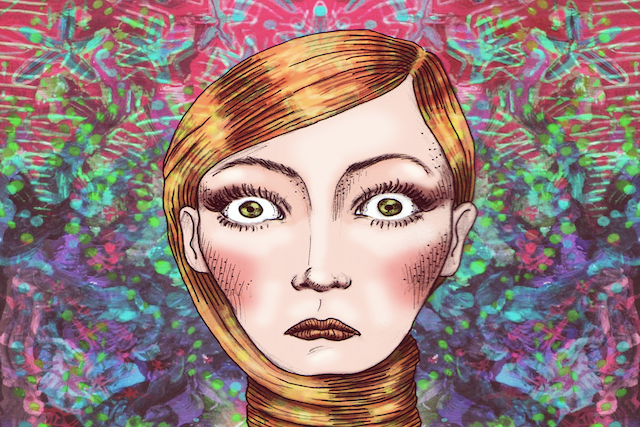
“If you always feel like you’re too much or too little, maybe you’re adding yourself to the wrong recipe.” ~Sophia Joan Short
There is an art to shrinking yourself.
As a young girl, I was painfully earnest. I hadn’t learned the craft of nonchalance that was as much a requirement for being liked as name-brand clothes and Livestrong wristbands. One day, as I chattered excitedly on the school bus home, my seat-mate scolded me: “Hailey. Calm down. You’re so annoying.”
This is how I learned that my enthusiasm made me unlikable.
At home, short tempers led to angry arguments. After conflicts, my dad would withdraw his love in a stormy silent treatment until I cleared the air—or until we both agreed to pretend that nothing ever happened. I learned the art of walking on eggshells. When I was fifteen, Dad and I got into an argument and didn’t speak for days. We orbited around each other like silent planets in a lonely solar system.
This is how I learned that my anger made me unlovable.
Years later, my first adult relationship began to unravel. I felt the pain of our withering love acutely. My then-partner withdrew further into himself with every argument, every tear, every dissonance. The more I tried to repair our broken love, the more distant he became.
This is how I learned that my needs would push away the people I loved the most.
Where did you learn that you were too much?
Were you bullied at school? Mistreated at home?
Did your caregivers say you were too loud, too energetic, too difficult? Did they neglect your interests, deny your feelings, or punish your anger?
Did your lovers withdraw their affection when you expressed your true feelings? Did they balk at your trauma? Did they hold you at arms’ length?
These experiences leave us with a resounding mantra:
I am too much.
I am too much.
I am too much.
But you are not. Here’s why.
The Beauty of “Too Much”
Those of us who give ourselves permission to feel deeply give ourselves the gift of fully participating in this world.
We embrace the vast palette of emotion that living demands. We experience the valleys of loss, the black pain of grief, and the jagged edges of trauma. We also experience the searing catharsis of inspiration, the rich colors of joy, and the deep, calm ocean of love.
Because we feel so richly, our hearts are calm harbors where others’ pain can seek refuge. We are empathetic and expansive, and when we say, “I hear you, I’ve been there,” we really mean it.
We do the hard labor of living, of feeling, every day. We have built within ourselves a powerful infrastructure for empathizing, connecting, and relating. This gives us a profound capacity to connect with others —others who are capable of meeting us there.
It’s Not About You
Every time someone implies that you are “too much,” they express their own limitations.
Emotional intensity scares those who have never learned to access their own emotions. If they don’t know how to feel their own pain, sadness, or joy, they will be incapable of handling it in others.
What they say is:
- “You’re being too dramatic.”
- “Do we always need to talk about our feelings?”
- “Everything’s fine. Why are you so upset?”
- “I can’t do this.”
What they are really saying is:
- “I am afraid of your pain because I do not allow myself to feel my own.”
- “I am afraid of your vulnerability because I never learned how to be vulnerable.”
- “I do not have the tools to handle conflict, so I will avoid it.”
- “I am afraid of failing because I don’t know how to take care of you.”
These folks have spent a lifetime erecting and fortifying walls to keep intense emotions out. They may have learned to do this as a coping skill. They may have been taught to by their caregivers. Regardless, as a result, they may push you away, withdraw, retreat, shame, criticize, or blame—anything to keep their walls intact.
Their judgments are a reflection of their own limitations, not a reflection of you. This does not justify the ways they’ve shamed you, but it may help you feel compassion for the fearful manner in which they’ve lived.
Alongside this compassion, you also have a choice.
Will you choose to shrink yourself to fit behind their stifling walls?
Or will you seek relationships with folks who embrace your capacity for feeling widely—ugly cries and happiness and all?
A Gateway to Wholeness
Despite my many efforts to become invisible, there was a woman within me who had fierce truths to speak, whose heart felt crushing pain and wild joy in equal measure. Repressing my true self was like trying to outrun the morning sun.
I wanted to be seen in all my wholeness, but I was terrified of being abandoned as I’d been before. I needed to learn—not through affirmations and visioning, but through action and supportive relationships with others—that I could be loved for who I was.
And so, I began to practice. I noticed which friends listened when I spoke. I noticed who validated my feelings and who glossed over them en route to their own stories. I noticed who welcomed me with open arms, even if I was feeling blue, tired, or anxious.
Romantically, I sought partners who acknowledged my needs instead of scoffing at them. Words like “dramatic” and “hysterical” became red flags I heeded without exception.
I sought partners who were forthright about their feelings for me—who matched my desire for verbal affirmations, physical touch, and time spent together. I still remember the shock I felt when I realized that there were lovers who wanted more time with me, more intimacy, more depth, instead of less.
Over time, my relationships became the safe containers within which I practiced wholeness. Qualities I forgot I’d had, like humor, confidence, and expertise, blossomed in these new, safe ecosystems.
Now that I’ve experienced the freedom of others’ acceptance, I have zero interest in pursuing relationships with folks who would deem me “too much.” As the saying goes: “You will be too much for some people. Those are not your people.”
—
Learning to embrace my wholeness is a daily practice. Some days are harder than others.
When I’m feeling anxious and seek comfort from my partner, sometimes a niggling voice whispers that he will leave me.
When I speak at length about a new endeavor, I occasionally fear that I’m boring my audience.
When I express grievances in my relationships, I cringe at the prospect that the recipient could throw up her hands and declare me “too much work.”
Every time I feel these fears and act anyway, I honor my innermost self. I am teaching myself—slowly, diligently, patiently—that I am worthy of expression and worthy of love. It gets a little bit easier every day.

About Hailey Magee
Hailey Magee is a Codependency Recovery Coach who helps individuals conquer people-pleasing, set empowered boundaries, and master the art of speaking their truth. She has worked with over 100 clients from the US, Canada, Ireland, France, South Africa, and more. Sign up for a complimentary consultation to learn how coaching can help you live from a place of authenticity and inner freedom. You can follow Hailey on Facebook and Instagram, or visit www.haileymagee.com.
- Web |
- More Posts






 Though I run this site, it is not mine. It's ours. It's not about me. It's about us. Your stories and your wisdom are just as meaningful as mine.
Aloha Hailey :-). Omgod me too!! And I so needed this today. Every single word. Thank you! I’m sick of trying to be less of me so the world can cope. Less “needy” less exuberant, less deep, less loving, less inquisitive, less every bloody thing! I feel like I have to wear an emotional strait jacket. And I’m over it.
And I hear you Katie on the relationships. It’s grim. And disappointing. And painful. I’m in the same situation.
But I can’t not to be anymore. I like what you said Hailey about saying no to people that say no to us. Even though the fear of abandonment is huge. But we can’t abandon ourselves. Thank you ❤️
Oh man, @megamor:disqus, how I relate to so much of what you shared! Loved the concept of an emotional straightjacket — such a waste of these beautiful, enriching qualities we were given!
Fear of abandonment IS huge. Gosh, it can be painful. But abandoning OURSELVES is no longer an option. Thank you for your words and insights! Glad we’re on this journey together! <3
This is really good to hear and so true. Affirmation that I might be in the wrong relationship which is really a tough conclusion to come to 🙁
I understand that pain really well, @disqus_K86iCxIvs0:disqus. It is very liberating to realize that we are not too much — though it can definitely spark a re-evaluation of our relationships <3
Thank you so much for sharing this it is like you were describing my childhood and young and current adult life! I reverted back to being a doormat for a man only now again realize I silenced me the real me! Thank you
Thank you for sharing! That real you definitely deserves a chance to come forth. Sending you goodness on the journey!
I don’t know your situation or your behaviours. Or the behaviours of the people who’ve hurt you.
But speaking as someone who’s had difficulty controlling their emotions and was raised in an abusive environment. There are things that are not okay that can be considered normal if you’re used to that kind of treatment.
We all have a responsibility not to be abusive to others, respect their healthy boundaries and ideally to somewhat consider other people’s needs. It can take time to develop self control.
Personally, I used to cry regularly for 3 hours multiple times a week. My fiancé supported me through that, but it’s a lot for anyone to deal with. I wouldn’t have blamed him if he said this is too much for me, it would have been healthy for him to step away and have time to himself when he needed it.
I also sometimes yelled and swore during arguments or said mean things. If this was too much for anyone. They would be being healthy respecting their boundaries.
We have a responsibility to learn to manage our own emotions and behaviours. No one has to fix anything for us or say the right thing to make us feel better. No one has to comfort us. This is okay within reason if people are protecting their own boundaries in a healthy way. It is a blessing when people choose to comfort us.
Also, sometimes feelings occur through no fault of others as a result of our psychological makeup and experiences. It’s okay for them to just be there. It’s not okay to blame other people for our feelings and issues.
I disagree that it’s a weakness in other people or that they’re emotionally stunted if they can’t cope with frequent emotional outbursts. There is such a thing as too much. But it’s okay, it’s not anyone’s fault for being that way. It means they’re in pain. Behaviours can change if people try, it’s possible to learn to manage emotions and communicate in healthier ways.
@helenacook:disqus, I really respect the points you make in this comment. I agree with much of what you said. In my opinion, there is a difference between someone “being too much” and someone acting in a way that surpasses someone else’s boundaries.
Similar to the way guilt arises from feeling badly about our *actions* and shame arises from feeling badly about *who we are intrinsically*, I believe we can act in a way that violates someone else’s boundaries without being, intrinsically, “too much.” Feeling like we are “too much” is a shame-based mentality around our identity.
As I mention in the article above, others express their limitations when they say you are “too much.” That’s not a judgment call, but rather, a truth. These limitations, or boundaries, express what they can or cannot tolerate. In other words, their boundaries are about them and their limitations — not about you and who you are.
Imagine that a woman is surrounded by four men. She cries for 30 minutes, then stops. Men A and B say, “Jeez, she is too much, I’m outta here,” and leave. Men C and D stay to comfort her, and when her tears are over, feel no ill will toward her. Would it be accurate for Men A and B to say that the woman is “too much?” Or would it be more accurate for them to recognize that their own limitations or boundaries kept them from engaging with the woman?
The main point is this: I believe it is problematic when someone weaponizes their limitations to make others feel poorly about who they are. For example, “I cannot cope with your depression. You are too much. You are too sad. You are too XYZ.” In my opinion, a more accurate truth would be, “I cannot cope with your depression. I am reaching my limitations of what I am able to handle.” In other words, the boundaries are all about the boundary-setter.
I hope that this sheds light on a nuanced perspective to this conversation. Thank you again for taking the time to share your invaluable input!
Thank you so much for this article. You were talking about me!
I’m so glad it resonates, @kellyserenity45:disqus!
So can you also explain why they express contempt towards your ‘depression privelege? ‘ I knew nothing but confusion, detachment disorder, and anxiety so bad it made me fail in school and maintain serious isolating tendencies. I’m sick to death of people getting enraged at that…. I really need to hear this sort of entry?
@disqus_achjXz5cId:disqus, thanks for taking the time to comment. I’m curious to hear your thoughts on the explanation I offer to Helena above — how does that resonate with your experience?
WOW!! and thank you. That pointed at some healing i need to do. Thank you for sharing this.
Thanks so much for reading, @disqus_OtIxpD3pCj:disqus! So glad it resonates with you.
Thank you so much for sharing this Hailey. It’s actually something that’s been on my mind quite often lately as so much of my life has been shaped by shrinking myself in order to better fit in with those around me instead of growing myself and moving beyond those who cannot accept who I am. It is only now that I’m beginning to reverse the years and years of collapsing into a smaller and “always likable” package. But the journey back into myself has its own gifts, which I’m happy to rediscover.
Hell yes, Courtney! Thrilled to hear that you’re journeying back to yourself. I’m on that same road, and so many others are, too. Sending you goodness on the journey <3