

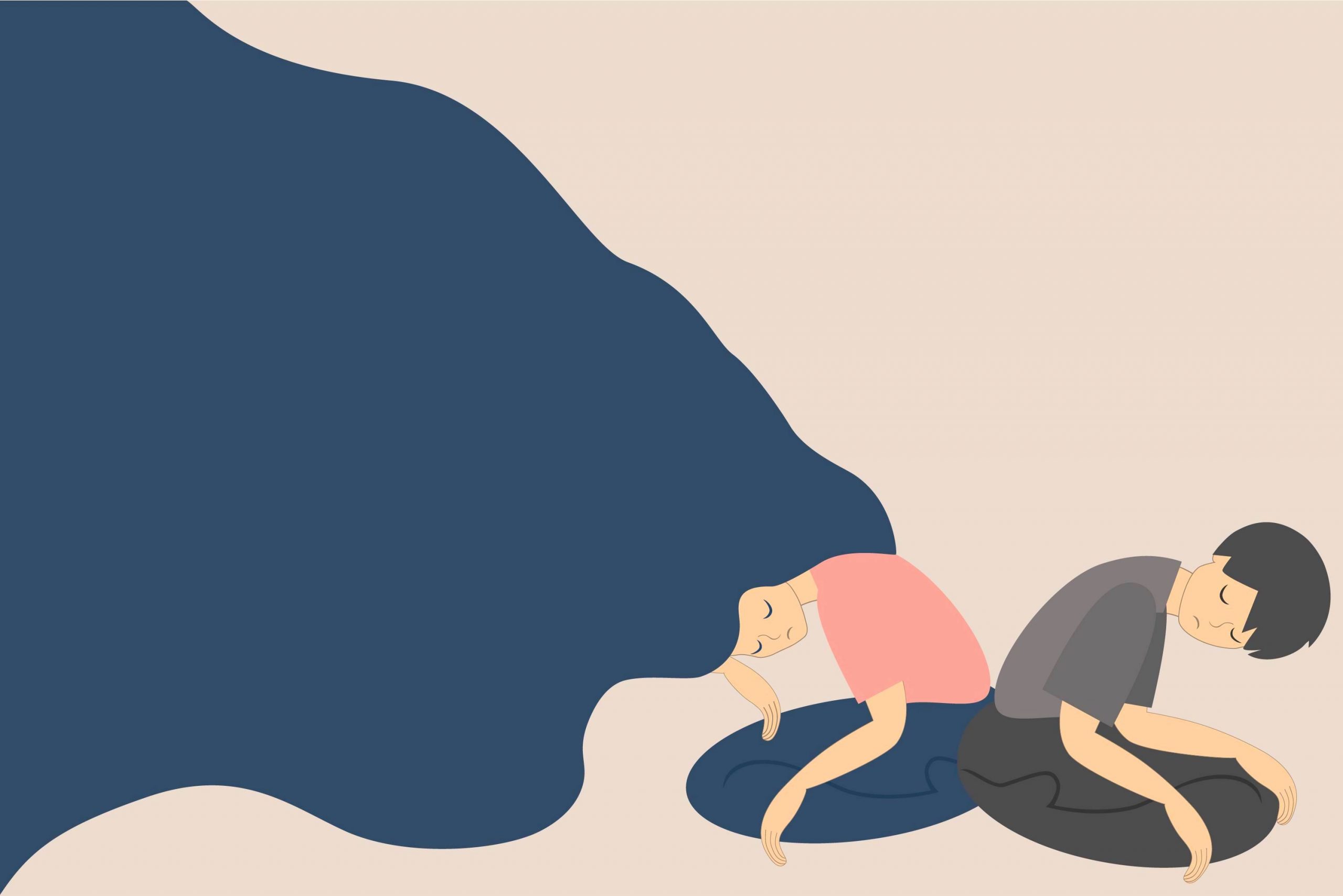
I remember the first time it dawned on me that I was in an unhealthy relationship. Not just one that was difficult and annoying but one that could actually be described as “toxic.”
It was at a training event for a sexual abuse charity I worked for. I immediately felt like a fraud!
How could I be working there, helping other women get out of their unhealthy relationships and process their pain and trauma, but not realize how unhealthy my own relationship was?
How did I not know?
Typically, as I had always done, I beat myself up over it.
I should have known, I’m a professional. How could I even call myself that now?’
Shame.
It was always there lurking in the background.
Maybe deep down I had known … consciously, most definitely not.
And so, while someone talked us through the “cycle of abuse,” I sat there seeing my relationship described to perfection.
We had a nice time until something felt off. The atmosphere changed, and I could sense the tension building. No matter what I tried, no matter how hard I went into people-pleasing mode, I couldn’t stop it from escalating.
There was always a huge argument of some sort, and we’d end up talking for hours, going round in circles, never finding any kind of solution.
Just more distance and disconnection.
I never felt heard. Just blamed. It didn’t even matter what for. Somehow everything was always my fault. And most of that time, that ‘everything’ was nothing at all. Just made up problems that seemed to serve as an excuse to let off some steam, some difficult feelings.
We never resolved anything. We just argued for days … and nights. It was exhausting.
Then came the silence. I knew it well, had experienced it throughout my childhood too.
“If you don’t give me exactly what I want or say exactly what I need you to say, I’ll take all my ‘love’ away and treat you like you don’t exist or matter to me.”
Looking back now, that may have been the most honest stage in our relationship because that’s how I felt constantly— insignificant, unloved, and like I didn’t matter.
But somehow, out of the blue, we made up. We swiped it under the invisible rug that became a breeding ground for chronic disappointment and resentment. It was a very fertile rug.
I guess it also helped us move into the next stage of the cycle: the calm before the storm … until it all started up again.
So how come I didn’t realize that I was (and had been!) in an unhealthy relationship?
Was I stupid? Naive? Uneducated?
None of those things. I was successful, competent, and a high achiever.
I was highly educated, had amazing friendships, and made it look like I had the perfect life.
Because it’s what I wanted to believe. It’s what I needed to believe.
But most of all, it’s all I knew.
The relationship I was in was like all the others that had come before.
I never felt loved or wanted, sometimes not even liked, but that’s just how it was for me. Somehow, my partners would always find something wrong with me.
My mother too.
According to them, I was too sensitive, took things too personally, and couldn’t take a joke.
I said the wrong things, set them off in strange ways, or didn’t really understand them, and was too selfish or stubborn to care deeply enough for them.
Which is funny because all I did was care.
I cared too much, did too much, and loved too much, just not myself.
And so, I stayed. Because it felt normal.
It’s all I’d ever known.
I didn’t get hit, well, not in the way that police photos show. And pushing and shoving doesn’t count, right?
(Neither does that one time I got strangled. My partner at the time was highly stressed at work, and I said the wrong thing, so it definitely didn’t count …).
Being shouted and sworn at was also not real abuse. It was just “his way.” I knew that and still stayed, so how could I complain?
See, I paid attention to different signs, the ones portrayed in the media. Not the everyday ones that insidiously feel so very normal when you’ve grown up in a household in which you didn’t matter either.
The point is that we repeat what we know.
We accept what feels familiar whether it hurts us or not. It’s like we were trained for this, and now we run the marathon of toxic love every day of our lives completely on autopilot.
Most of the time we don’t even question it. It just feels so familiar and normal.
The problem with this is that we stay far too long in situations that hurt us. And so, the first part of leaving is all about educating yourself on what is healthy and what isn’t so that you know.
Because once you know, you can’t unknow, and you’ll have to start doing something about it.
And that’s what I did.
I learned all about unhealthy relationships and how to have healthy ones. This required me to heal my own wounds, let go of beliefs and habits that kept me choosing people that just weren’t good for me, and learn the skills I needed to know to have healthy relationships such as being connected to my feelings, needs, and wants or setting boundaries effectively.
Relationships are difficult and painful when no one has taught you how to connect in healthy ways that leave you feeling liked, respected, and good about yourself.
And so, it’s not really our fault when our adult relationships fail or feel like they’re breaking us.
But we need to put ourselves back in charge and take responsibility for learning how to create the relationships we actually want to be in.
So let me reassure you and tell you that that is possible.
I did it, and so I know that you can do it too.
But it all starts with deciding that you’re done with the painful relationship experiences you are having and that you’re committed to making EPIC LOVE happen.
A love that leaves you feeling appreciated and satisfied.
A love that feels safe.
A love that lets you rise and thrive.
A love in which you feel better than “good enough.”
Decide, choose that kind of love and say yes to yourself.
That’s the first act of real love.

About Marlena Tillhon
Marlena is a highly experienced psychotherapist and success coach specialising in healing inner trauma and breaking unhealthy patterns that stop her ambitious clients from having the success they know they can have in their lives, relationships, and careers. You can find her on Instagram or Facebook and receive her free training and gifts on her website.





 Though I run this site, it is not mine. It's ours. It's not about me. It's about us. Your stories and your wisdom are just as meaningful as mine.
Speaking as someone who has been abused, I think deep down you always know when a behaviour isn’t right. Insults and violence make you feel bad. It’s that simple.
You did have healthy friendships so you did know what healthy relationships were like and I’m sure you experienced them in the workplace too.
However, you were attracted to partners that recreated that unhealthy familial bond because abuse at home was “normal” for you and people are creatures of habit.
Ultimately, the decision is which behaviours we are willing to tolerate in life, deciding how we want to feel throughout the day. Do we want better for ourselves?
Please consider the possibility that the reason you *think* you are attracted to unhealthy partners might be different than the reason you are *actually* attracted to them.
The emotional compulsion comes first.
The rationalization to explain the emotional compulsion comes second.
The rationalization is not always 100% correct.
Please consider:
URL: letter dot wiki slash conversation slash 1191
What I described was a phenomenon from a specific branch of psychology -schema therapy.
It describes unhealthy thought patterns as self-perpetuating, this is where the attraction to unhealthy people comes in.
When a therapist made me aware of the issue I was able to work on it. I learned to establish healthy boundaries and I’m no longer attracted to those kinds of people.
Of course, everyone’s reasons will be different. But when people discuss unhealthy familial bonds, usually psychology will consider that as a source.
Great article-thanks! I’ve been realizing this in my ‘relationship’ too-I even bought a house 3 hrs from him so that I could seperate. No…I didn’t look like the pictures the police take either, but he threw my laptop across the room and smashed it- and blamed me. He grabbed me and shook me and left bruises. Most importantly…the silence.
“If you don’t give me exactly what I want or say exactly what I need you to say, I’ll take all my ‘love’ away and treat you like you don’t exist or matter to me.” This is exactly what happened-too many times. If only I could have said something different…after all he has a hard job/life whatever…and I never learned to accept that I too deserved “better.” If only I could love him enough…
I did. Saying goodbye to people and toxic relationships can be hard-but the sun still rises in the morning and for the first time in a long time I feel free.
Challenging article, which is great.
As I read the thought that came to mind was that what we have here is ‘a failure to communicate’ in healthy ways. Not just with the partner but oneself. Not sure why but my observation has been that sometimes Love requires the pain of the ending of a relationship to learn.
Like Maitreya I found the words ‘not your fault’ in title provocative but only because of a reactive tendency to think of fault and responsibility as being the same thing.
The advice to take responsibility came at the end of the article and I thought it a good lesson for myself that I missed it the first read through. Determined as I was to find fault with the words ‘not your fault. A good example of why conversations and relationship so often go off the rails.
I like what Mark Manson said about Fault and Responsibility
“Fault is past tense. Responsibility is present tense. Fault results from choices that have already been made. Responsibility results from the choices you’re currently making, every second of every day.”
“There’s a difference between blaming someone else for your situation and that person’s actually being responsible for your situation. Nobody else is ever responsible for your situation but you. Many people may be to blame for your unhappiness, but nobody is ever responsible for your unhappiness but you. This is because you always get to choose how you see things, how you react to things, how you value things.”
P.S. The choice to avoid taking responsibility for the choice to enter into the relationship with the narcissist is not only a choice to remain trapped in the cycle of suffering. It is a choice that will ultimately destroy our entire world:
URL: letter dot wiki slash conversation slash 1191
Please consider making a different choice.
Please consider encouraging others to do the same.
There is a world of difference between (1) the skillful rejection of the narcissist’s attempt to break you so that he might control you and (2) the unskillful rejection of your choice to enter into the relationship with the narcissist.
There is a world of difference between (1) acknowledging the existence of a bad habit to be corrected and (2) the choice to become self absorbed in a narrative of shame which obscures clear seeing and hinders skillful movement.
The thought “I am not responsible” is undoubtedly the most unskillful of all possible thoughts. The choice to allow this thought to harden into a belief upon which our strategy for happiness is built, is undoubtedly the most unskillful of choices. It is the construction of a house of cards that will inevitably come crashing down in the future.
The Buddha would not have encouraged such self-deception.
(Though, admittedly, it is a great way for a therapist who pretends to care for the wellbeing of her clients, to trap them into a cycle of dependency on their therapist, so that a steady stream of income might be guaranteed. It should be noted, however, that the pattern of (1) breaking the spirit of your victim and (2) offering yourself up as their savior to trap them in a cycle of dependency is the modus operandi of the narcissist.)
If you give in to the temptation to avoid taking responsibility for your decisions, you may experience temporary pleasure. Mara always tempts us with the easy path. The allure of unearned treasure is particularly tempting when we are suffering.
But the cost of giving in to this temptation and adopting a belief of powerless victimhood is to ultimately trap yourself in a cycle of persistent anxiety and depression that will be difficult to escape.
Because cause and effect are far removed, it will be difficult for you to see that your choice (1) to avoid the discomfort of seeing things as they actually are (yathabhutañanadassana); your choice (2) to respond to discomfort with the easy path of avoidance (avijjā); your choice (3) to cling to craved sensory experience (kāmacchando); your choice (4) to cling to wrong views which sustain this unskillful choice (diṭṭhāsava), including and especially your belief in your own powerless victimhood is the choice that ultimately gives rise to and sustains the entire cycle of suffering (paṭicca-samuppāda).
The temptation of the drug of immediate gratification can be hard to resist.
The Buddha taught that there is one way and one way only to permanently end the cycle of suffering. Heroically turn towards the demon of avijjā with the resolute intention to defeat him and collapse the 12 links of dependent origination of suffering (paṭicca-samuppāda) by choosing instead to listen to the feedback of misprediction which the signal of discomfort is delivering to us.
Rather than seeking to silence that signal by (1) avoidance (avijjā) and (2) the construction of unskillful narratives to justify our avoidance, the Buddha taught that the signal should be investigated for insight. (paṭiloma-paṭiccasamuppāda, satta sambojjhaṅgā). Resolute determination to slay the dragon and claim the treasure of truth which is a superior predictive model of the world is the only path to nibbana; the total end of suffering.
What did the Buddha say about the construction of unskillful narratives to justify avijja?
He said (1) sabbe saṅkhārā aniccā (2) sabbe saṅkhārā dukkhā (3) sabbe dhammā anattā.
The sensory-motor predictive models of the world (saṅkhārās) which we construct to guide our movements (sammá-kammanta) should be considered to be (1) impermanent (aniccā) and (2) subject to the discomfort of misprediction (dukkhā) and (3) the BEST predictive models – the ones which allow us to see things are they actually are (yathabhutañanadassana); the ones which are more permanent and less subject to the suffering of misprediction; those which create the conditions for movement in the world with unbreakable equanimity (upekkhā) – are those that are *unconditioned* by self-absorption in the narrative (anattā).