


“It’s not a matter of ‘letting go.’ You would if you could. Instead of ‘let it go’ we should probably say ‘let it be.’” ~Jon Kabat-Zinn
I’m not good at heartbreak. I wrestle the circumstances, hate it, and can’t let go of the hope that the relationship could be transformed.
Aren’t there people who do heartbreak well? Aren’t there folks who sit in heartbreak for just a little while, then shortly fold up their hands and accept the situation? Sometimes it seems there are those who even flip a switch—”It didn’t work, we tried our best”—and that’s that, and they go about their merry lives.
I want that. How do I get that?
I was one of those children who were told they’re “too sensitive,” that I felt too much, too deep. Nowadays I understand that “You’re too sensitive” generally means “Please bottle your feelings. I don’t know what to do with them and they’re making me uncomfortable.”
Yet I still feel it would be better to be less affected. After all, isn’t this Samsara (the name Buddhist’s gave to the cycle of suffering)—this longing, doing, clinging, and grasping that I do in a heartbreak state?
My ex-girlfriend and I parted ways lovingly—she needed more signs of commitment, I needed more closeness, and we worked those issues until exhausted—but the part of me that sometimes throws fits against what-is is throwing a fit. And the phrase “let go” strikes me as unhelpful, even impossible at times. I feel the loss, and I feel the hope that things could be different.
How do I learn to be less affected? Isn’t “letting go” central to why I’m meditating, so that I can be someone, for god’s sake, who can let a thing go? To make peace and move on already?
On a recent hot day sitting by the Willamette River in Portland with my friend Claire I asked them, “What do I do about my hurting heart and all my grasping?!”
The river lapped by us. It’s the longest river in the U.S., which flows primarily north, or “uphill,” which is rare. The river comes up from Eugene and merges 183 miles upriver with the Columbia River on the border with Washington state.
My predicament feels similar to the river: Why would it (I) flow uphill? Doesn’t it contradict the idiom that water follows the path of least resistance? Wouldn’t I choose an easier path, and not feel so much? Can I go downhill like it seems people who seem to let go more easily do?
I said to Claire, “I hate this idea of letting go right now. What the hell does it mean anyway? I feel like some Buddhists are attached to the idea of letting go! There has to be a Buddhist understanding that things stick in our heart for a while and that’s okay.”
Claire looked at the river and said, “There is a word for that.”
“What is it?” I asked, eager.
“Samsara,” said Claire, humored.
Then we began to laugh. And laugh, and laugh. We looked at each other and Claire’s big brown eyes sparkled, and I laughed in a way I haven’t in too long, a way of laughing at my situation in good humor. It was laughing as surrender. Laughing as acceptance, and laughing because I saw myself for who I am—a mess. Suddenly I wasn’t taking that mess too seriously.
We marveled at how attached we get to our sadness, how it feels indicative of how much we care and love.
We laughed because we’re human, and this is what we’ve inherited: this tendency to fixate, but also simply the tendency toward heartbreak, the consequence of owning a soft heart and feeling longings for people and things that make us feel bright and alive, and then one day suddenly they’re gone and we miss them fiercely.
In a recorded dharma talk on letting go, Zen teacher Frank Ostaseski said:
“A student asks the teacher, ‘How do I let go?’
The teacher says, ‘You can’t, you won’t. You don’t.’
So I actually want to sit here and encourage us to relax more.”
Relaxing feels more resonant to me than the concept of letting go, and it’s why Claire’s response was magic: it was an invitation to lighten up.
For me, the language of letting go hasn’t felt kind or sustainable. Maybe because it’s a strong action verb; I’ve (mis)understood letting go as an action I have to take, a should—as if I’m at the racing block and the gun’s about to fire and READY SET GO I better be ready to LET IT ALL GO! when that shot sounds, or else.
Letting go can feel like a linguistic misunderstanding to me, an encouragement to transcend being human. But we don’t practice to attain exalted states; we practice to allow our life to unfold truly.
I’m reminded of Roshi Joan Halifax’s writing about grief:
“When my mother died, I received one of the hardest and most precious teachings of my entire life. I realized that I only had this one chance to grieve her death. I felt like I had a choice. On the one hand, I could be a so-called ‘good Buddhist,’ accept impermanence, and let go of my mother with great dignity. The other alternative was to scour my heart out with honest sorrow… My sadness became part of the river of grief that pulses deep inside us, hidden from view but informing our lives at every turn.”
Because I’ve been trying to force myself to let go I’ve been pushing away my experiences lately, and hating myself for longing and missing. This is violent. Being real about what impacts me, and how, is a radical and loving acceptance of my own life experience. My hunch is that allowing myself to be as I am will translate to allowing others to be as they are.
~~
Shortly before we broke up, my girlfriend gave me a palm-size Buddha sculpture. It is carved in stone, feels cool to the touch, and looks like an old bald woman who is the embodiment of what, in Zen, we call Joyful Mind (one of the three minds, or Sanshin, of practice).
Joyful Mind is all about finding delight in our difficulty and in the rich experience we have in Samsara. It is about being present in our struggle while also being attuned to an undisturbable place inside us.
This little Buddha encourages me to lighten up in the same way that Claire encouraged me to lighten up. I like this joyful Buddha’s way of laughing, the way her shoulders are so soft as to not even be trying, yet her posture is still upright. The skin around her eyes is worn from laughing.
Joyful Mind is about being present to the suffering, not about letting it go. Ironically, sometimes suffering eases up on its own when held this way.
Part of what feels impossible about letting go is that it feels easy to confuse it with spiritual bypassing—the tendency to use spiritual ideas and practices to avoid feeling emotions or to sidestep psychological wounds.
I wonder if other practitioners step into this trap, too, of seeking to attain a state that disallows the mess and vulnerability of humanness. Like can I just let go already so that I don’t feel so much, so that this isn’t so painful? Can you just let go already so that I don’t have to deal with your complex and messy feelings?
Is allowing Samsara freedom from Samsara? When Claire reminded me that spiritual practice isn’t about achieving some transcendent, tidy state, I felt ease. I accepted my inner mess and remembered that our practice isn’t about being less affected, it’s about allowing everything to show up and being honest about how we’re impacted. Allowing everything to show up means that all my fears and vulnerabilities appear, and that’s more complicated than letting go.
A fellow practitioner once told me that the reason we have two hands is because one holds suffering and the other holds the cosmic joke: we are equipped to hold the mess of life lightly. I want to be real about how I am impacted by life, and I feel newly reassured that my two hands are meant to hold it all.
In the way that in AA they use the phrase “one day at a time,” I’m going to allow my own slow progress and forget about letting go for the moment. The truth is that I’ve lost something precious, and the longing for it fills me. It’s the longing for closeness, to know and be known, the longing for understanding and shared reality, for fun and safety.
The loss of relationship is its own death and now in my belly it feels lonely. The depth of that feeling is indicative of how much I wanted to tend what I had.
This is who I am, someone who feels a thing fully, and in so many ways over the years the overculture has taught me and so many others that it’s incorrect to be sensitive, and here I’ve internalized that oppressor: I’ve tried to beat my sensitivity out of myself and force myself to let go and stop feeling what I’m feeling, to get over it already, in the name of Buddhism.
This misinterpretation has got to stop. I want to lighten up, to allow every ache, every resistance, every longing that unfolds. To allow it all, to stop resisting my experience, to watch it, to know I don’t have to act on it, and to keep good company with a sweet friend who reminds me not to take any of it too seriously.

About Cassandra Moore
Cassandra Moore is a writer who lives in Portland, OR and works as a Mindfulness Teacher for the first for-credit Mindful Studies program in the country. She is native to the desert southwest and is writing her first book.









 Though I run this site, it is not mine. It's ours. It's not about me. It's about us. Your stories and your wisdom are just as meaningful as mine.
thanks for this enlightenment!
Cassandra, I too have been labelled as sensitive and also struggled with break ups. I’d try anything to maintain a relationship and it’s got me into a lot of trouble. Buddhists talk about attachment and not getting so attached to a person that the end of the relationship will overpower us. I struggle to do this. Instead I like quotations that resonate with me as I find them helpful. For breakups I think of the fictional Dr. Frasier Crane who said ‘we aren’t mourning the end of the relationship but what we thought our life was going to be’. It’s easier said than done but I think we need to live in the moment and not imagine the future.
I heard recently (I believe in a 10% Happier podcast), that it really should perhaps rather be translated as “let it be” , rather than “let it go” and that has really helped me. it’s there, let it be there, let it happen, let it be felt, but don’t attach too much to it. let it go is hard, and let it be has sat better with me so I wanted to share that.
The world needs more sensitive people. As an HSP, I realize very few understand so for the most part, I am alone. At 62 I’m pretty darn OK with that. It’s who I am. No more fighting, only compassion and acceptance. Hard? Yes. But I wouldn’t have it any other way. Namaste.
After the breakup of a 25-year relationship I realized it wasn’t like a wound that would heal some day. Some losses are more like an amputation: you’ll survive and adapt, but there will always be a part of you missing.
This last line is so sad and poignant. I am thinking of you and hope you find some light soon 😘
I really liked this. It is important to honor our experience and let it unfold.
Great article.
I used to get so frustrated when told to ‘let go’. For the longest time I misunderstood and felt like I was being asked to forget and or pretend nothing happened.
I’ve learned that ‘Letting go’ is not a forgetting or indifference to our experience but entering fully in the flow of experience. A release from blocking experience to allowing experience to be experienced as It Is in the present.
Through the concept of ‘letting go’ we ‘Detach’ our sense of ‘self’ and or ‘ego’ from the experience. We are not our emotions, emotion is experienced.… allowing experience to flow as it is in the moment.
I sincerely believe part of our work toward enlightenment is totally experiencing the human experience. Else why would we even be here then? And that means feeling the grief. It’s not easy and I struggle with it almost daily. Three years after my marriage separation, I have to say it’s better but the sadness has not totally gone. And each time it resurfaces, I have to remind myself that it’s there for a reason – it’s teaching me something. And it shows a tender heart. I’m also a very sensitive person. But that’s who I am and it makes me compassionate and empathic towards others. And it makes joy all that much more appreciated.
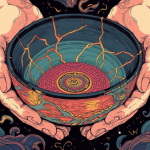
That’s a great illustration with the article. Who is the artist?
My dear beloved sibling died ‘too young’, four years ago and I think of her daily and cherish the love and fun she generously gave me and others. I miss her and it hurts,, but I focus on our great sibling relationship over many years, her many contributions in her lifetime, what lessons she showed me. There’s pain in wanting her here now. But don’t feel bitterness. or being ‘wronged.’ Helpful: where I choose to focus on about her. It’s not about my loss, her being taken by cancer. It’s about her life experience, what she did share with me and others. It’s looking to the light. Still, I sometimes weep. I feel loved by others, but there is a loneliness , almost a not being whole, being without her. She’s the only one alive and accessible who knew me since a toddler and next 55 years.
Thank you, Malcolm. That was such a helpful comment to read!
To be clear, you’re struggling with a concept that is hard to define, practice, and identify without a practical understanding of letting go. Throughout the post, I see there’s a circle in your own mind that keeps you somewhat trapped by your own misery. Because you’re using the mind to understand an absolute concept. Let me explain.
Buddha teaches us there’s two distinct forms of truth. The man-made truth and the absolute truth. The man – made truth are truths that are natural phenomenons to which are observable in the natural world. And then there’s the absolute which exceeds the observable truth. Said another way, sometimes what you see isn’t necessarily what you get. Why is a short description of truth relevant now in this case and this discussion?
Because you’re using the mind to understand an absolute truth.
To this I say good luck. I say good luck because the nature of the mind is to keep us grounded in the present sense. I am my body, I am my home, my feelings and emotions. It is the fundamental nature that keeps our identity, ours. It is cultivated and developed since birth and binds us to the mundane. There’s no mystery with the mind because if there’s a mystery, the mind doesn’t know how to respond. For instance, when the mind senses danger, the response is either fight or flight (to use the most basic example of this). So the mind attempts to keep things relative in terms it is easy enough to understand and also manipulate – to keep things stable.
The act of letting go means letting go of the mind. The constituents of the mind? It’s letting go of I, of breath, of hunger, thoughts, of yourself (identity). It also means letting go of the expectation and idea of letting go. Logically, the mind is afraid of that because if there’s no mind, there’s death, right? Game over. The end. So, we all tend to get reinforced in a cycle of samsara to ensure that we remain here. Alive and not understanding the unknown despite the drive within us to attain the unknown.
The zen quote you mentioned therefore is absolutely accurate:
You [I] can’t let go. Because you [I] are the mind. You have created expectations of what it is like to let go and that’s really just your mind attempting to help you understand an absolute process with things that often change. Which is why it doesn’t make sense. Hence the confusion, and also the headache.
Buddhism, at its heart, breaks the process of identifying who you are (absolutely) versus the image you have created with your own mind (man – made). But let’s use a different term here because letting go creates expectation and starts a cascade of processes. In a smaller sense, you are subjugating your mind to the unknown. You are letting things pass without attachment. You are experiencing life with equanimity. In the christian sense, you are giving your worry, fear, everything to God to even your mind. You are relaxing and remaining balanced.
Take a look at the leaves of spring on a particularly windy day. The leaves rarely, if ever, leave the branch. Despite the direction and strength of the wind, a leaf in spring rarely comes off the branch. In fall? Sure. In spring? It’s somewhat rare in the Windy City.
I do, however, think it is a good idea to take a break from thinking about letting go. Forget about it. Forget about what you think it means, forget about the expectations you think you will be free from (you won’t be). Focus, however, on freeing your heart and understanding who you are. The feelings never stop, you just don’t attach to them.
And perhaps this was written at a time you struggled with it, and you don’t now. If so, wonderful. Because the practice in and of itself helps transforms yourself. You understand who you are absolutely.
That can only be achieved by crossing the stream
I love it, this make me realize how neccesary is being more sensitive, we must live and understand our emotions doesn´t matter the situation!
1) Excellent point about spiritual bypassing! That is one of the most succinct terms I have heard in a long time. And 2) you can’t “let go” of something you haven’t fully owned. Feel the grief till your guts ache, cry till you can no longer cry, let the waves wash over you- WELCOME the grief, OWN the sorrow. Feel it all. And then you will see that letting go becomes what you are observing not doing.
Thanks. This article has sat on my computer for a while. Today I needed it and now I understand some more.
My mother always says get over it, move on. Get over my fathers death when I was 16, my marriage breaking up after 32 years, my sisters murder, the girlfriend who I though loved me but tossed me away like garbage. Get over it.
I am cranky with my mother and everyone else who says “Get over it!” because as you say I would if I could. But really I am cranky with myself for not being able to get over those events and lots of other small events in my life.
I want to reach that place, but there really isn’t a place. There just “Is”
Life itself is a lesson we all are learning and it all takes time to heal. You can blame the world for bringing that situation into your life but then, be greatful for all the lessons it taught you and all the strength it gave you.
I have a question maybe I can get help with. I broke up with my girlfriend of 2 years about 4 months ago because she had cheated months prior and a year prior. I knew about the one a year prior because she convinced me to stay. I stayed and a year later there was another incident, and I found out more of the truth from the original incident. I decided to finally walk away. This was the hardest thing I ever had to do because I loved her very much but at some point I had to say enough is enough. Either way it cut me to my soul, since then my life has turned for the better, I’ve lost weight, I’m generally happier and I feel in touch with reality again. My issue comes with this, she got into a new relationship a month after we split (not the guy she cheated with, I think, could be another guy who knows). This was really devastating and I didn’t find this out the news actually came to me because I decided to go no contact (which I still am). Anyway after 4 months, I still feel pain everyday but its very manageable compared to what it was. But I feel like a loser and I need to be doing more with my life. I’m accomplished I’ve done many things and am not someone that likes to be lazy but I’m a senior in college and all my people are graduated and gone. The reason I feel like a loser is because she going and doing all these things and “living her best life” while all I do is workout, go to the gym, and come home. I feel like I need to be doing more with my life, and I think this is out of ego and feeling like I need to race her. Which I know I don’t but it doesn’t stop these negative thoughts and these feelings of panic. So my question is why do I still feel this way? And or do I just need to relax and accept where I am in life right now and be okay with it?
Great article!! I too have have been told I am “too sensitive”. It always felt like it was wrong, but it’s not! It means I feel everything deeply. I don’t like the phrase “letting go” either! It has never resonated with me that well. I love that you can relate to this and speak about it. Feeling more relaxed with humor feels so much better to me instead.