

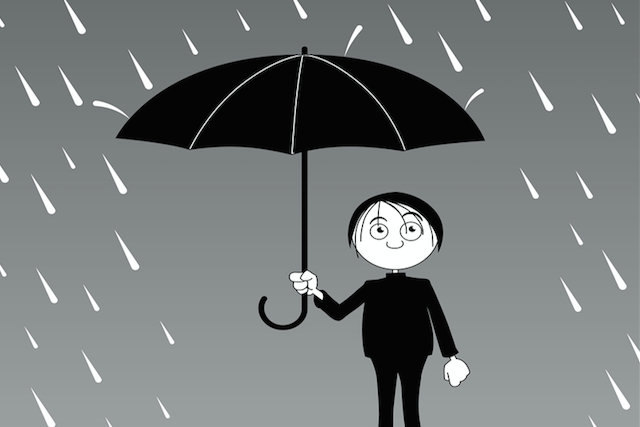
“We have so little faith in the ebb and flow of life, of love, of relationships. We leap at the flow of the tide and resist in terror its ebb.” ~Anne Morrow Lindbergh
From an early age, most of us get the message that we should be happy—from well-meaning parents, teachers, and even perfect strangers. “Smile!” we are told. “Why the long face?” we are asked. It’s no wonder we grow up with the idea that feeling anything less than sunny 24/7 is somehow wrong.
We’re ashamed to admit, even to ourselves, that sometimes we feel down. It seems that somehow we’ve failed, or that life is cheating us of our due. Facebook and Instagram certainly don’t provide a more balanced view: Everyone else is seemingly on the constant high that has become our society’s norm.
The trouble is, life’s not really like that, and when we expect it to be we only end up feeling worse. There’s almost a sense of panic when a less-than-euphoric period lasts too long (and I’m not talking about clinical depression here, just a garden-variety restlessness or boredom). We just don’t tolerate the lows very well anymore, craving a continuous fix of what the ego calls “happiness.”
I’ve personally bought in to the continuous happiness myth many times, and still have to remind myself that it is just that—a myth.
From true valley experiences like sickness or divorce, to the days when life feels just plain old “blah,” my first reaction is usually to try to “fix it.” Something must be wrong, right? I shouldn’t feel this way—I should be happy!
Something that has helped me a great deal is to substitute another word for “happiness,” a term that’s broad enough to encompass a more normal range of emotion: well-being.
You can continue to have a sense of well-being even in the midst of a low period. Well-being simply recognizes that life is a series of peaks and valleys, both in the macro view and on a daily basis. It is artificial (and impossible) to insist on a constantly in-flowing tide.
So how do we cultivate a sense of well-being? It starts with self-talk. Most of our emotional reactions to life come from the way we label our experience. The ego will jump to conclusions on very little evidence and then hit the panic button: “Oh, no! Depression alert! Not feeling good—this is a problem!!”
Try this instead: “Hmmm. I’m feeling a little down lately. I wonder what’s up with that?” And then simply sit with the feeling, and allow it to run its course. The panicky ego wants you to do something to fix what it sees as a problem. It is not comfortable simply experiencing what it considers a “bad” feeling, and will urge you to either suppress it or run away from it.
There are lots of ways to do this (and I’ve tried them all): shopping, having a glass or two of wine, watching TV, surfing the web, and so on. None of these activities is “wrong,” unless you use it to avoid or deny your true feelings. Our emotions, besides simply being a valid part of the human experience, hold important messages for us—messages that we can’t receive when we’re running away.
So let’s say you are allowing yourself to have the experience of feeling a bit down. It might even last for a season, but you tell yourself: “It’s okay. I know that this will pass too. I can let myself have this feeling and still be perfectly fine.” That’s well-being.
With well-being, you can continue to enjoy all that is good in your life and treat yourself tenderly while simply letting your experience evolve naturally. And it will evolve. The beauty of allowing yourself to feel your feelings rather than stuffing them is that they then can deliver their messages and pass on through.
Maybe the message is: You need to slow down a bit. Maybe it’s: The work you’re doing doesn’t feel meaningful anymore. Or maybe you never “figure it out.” Your body or spirit might just need a little healing or integration time. With a sense of well-being, you can trust that life is giving you just what you need, even if it doesn’t make sense or make your ego happy.
Well-being is very similar to the Buddhist concept of equanimity, which means serenity or imperturbability. Buddhism teaches that you don’t grasp at the “good” or flee from the “bad,” but accept each as it comes.
The Western mind often mistakes this for passivity, but it is not the same. With both equanimity and well-being, appropriate action is taken—naturally and calmly. As a bonus, action removed from the drama of the ego is often much more effective!
And there’s another benefit to accepting the so-called “negative” experiences of life: They actually allow you to experience and appreciate the good times far more.
When we try to go from one peak to another, we keep raising the ante: What was once satisfying is now boring; what was once a huge win doesn’t seem so impressive anymore. There’s a kind of “happiness inflation” going on that devalues what you have and makes you constantly reach for bigger and better.
It’s counter-intuitive, but the more you experience emotions like sadness or disappointment, the more you can truly feel joy and gratitude when it comes. The poet Kahlil Gibran wrote: “The deeper that sorrow carves into your being, the more joy you can contain.”
Hard times also temper us, making us stronger, more resilient, and more compassionate. Usually we see this only in retrospect, but we can also use self-talk to remind ourselves of it in the thick of those trying times: “This isn’t much fun, but I know I’m learning and growing from it.”
Feeling “bad,” far from being something to flee, offers so much to those who are willing to embrace the experience. You’ll have to buck the messages of the ego and of society, but you will gain much more in richness of life when you welcome both phases of the tide, the ebb as well as the flow.

About Amaya Pryce
Amaya Pryce is a life coach and writer living in the Pacific Northwest. Her books, 5 Simple Practices for a Lifetime of Joy and How to Grow Your Soul are available on Amazon. For coaching or to follow her blog, please visit www.amayapryce.com.







 Though I run this site, it is not mine. It's ours. It's not about me. It's about us. Your stories and your wisdom are just as meaningful as mine.
Thank you. The language is simple and easy to understand. The messege and examples in it are very enlightening.
Thank you, Rupal!
I think this is a HUGE problem in our society. Parents (and schools, churches, youth organizations, etc.) don’t teach children how to handle “negative” emotions such as sadness, anger, boredom, stress, anxiety. We want so much for our kids to have a fun-filled, happy childhood that we don’t acknowledge their “negative” emotions, we sweep them under the rug. But those feelings that aren’t dealt with will come out eventually one way or another, perhaps as a teenager who shoots up a school.
I agree – it’s really part of the whole “entitlement” issue. We feel we should always be happy, as if we are owed that by life. I think previous generations had a more realistic view of life and were able to be happy under much more trying circumstances. Similar to the 3rd world countries that rank much higher than we do on happiness scales.
I kind of think it could also be a bit the other way around. It’s complex, after all. To be fair, older generations didn’t have access to the amount of information and technology that we have now. They likely wouldn’t have been any more mentally or emotionally prepared to handle the nature of social media and the presence that world issues now have in our day-to-day lives – and right at our fingertips.
Ironically, it is usually older generations that keep telling us to be happy. I also think our generation has done a SUPERB job at recognizing emotions, for the most part. The movement for mental health destigmatization is on a roll. My friends and I are told often by older adults that they wish they were half as self-aware as we are now at our age.
American millennial culture itself is complex too. We are influenced heavily by criticisms and claims from all ends of the spectrums of politics, religion, the education system, even the health/medical field & FDA and AHA, etc, etc. The topics of controversy and constant worries are endless. We are constantly stripped mentally and emotionally of everything we’ve been taught too, through the process of becoming self-aware. Luckily we do seem to be branching out to other life philosophies (like Buddhism ;-)) and practices rather than sticking to standard teachings of our childhoods, like Christianity, for instance.
I’ve never really been able to understand why older generations are perceived to have been “tougher” (other than maybe they suppressed thoughts, emotions, desires, etc. to an extent…and I’ve noticed that does seem to come around as bitterness and intolerance when not dealt with), but it’s almost unimaginable to think of them in our generation’s circumstances. They can really only be looked at as separate things. (Sorry for the messy comment – 4 AM here)
Great rebuttal! However, I don’t think the “criticism” was of the individuals in this generation – people are people – but of current Western society. I firmly believe that we are on a steep evolutionary path, which also brings a lot of growing pains with it. At the same time, I can definitely agree with you that we have made many, many improvements over previous iterations of society! And, of course, there are always wide variations amongst individuals within a society. So – lots of factors, and sweeping generalizations will always be just as wrong as they are right. As a Libra, I can always see truth on both sides. 🙂
Very well written and insightful! Thank you
I think you got it exactly – the “I” is ego (the mind) which is the part of us that evaluates, judges, resists and grasps, all of which lead to the experience of suffering. Transcending the ego (which is the goal of Buddhism as I understand it) means that we can experience life fully, as it comes, without the story attached that makes things “good” and “bad.”
I was thinking the same thing… heard it before.. I recognize the truth in what is being said… so why don’t I ‘Gnosis’ it? What is missing?
The following part of the article drew my attention – “Buddhism teaches that you don’t grasp at the “good” or flee from the “bad,” but accept each as it comes. The Western mind often mistakes this for passivity…” which begs the question why does acceptance, feeling what we feel, letting it go ‘feel’ passive?
Why does detachment so easily turn to indifference, stoicism, fatalism… resigned to caste… Begging the questions: how to remain engaged in Life as it is? What is acceptance? What does it mean to grasp and what is being grasped?
I think that “accepting the so-called “negative” experiences of life”” is a process of not attaching the ‘I’ to the experience. The difference appears subtle but it isn’t and I suspect that this is the part that we miss. A misunderstanding of what it means to accept.
When an experience feels negative ‘I’ might feel sad. If I’m attaching the ‘I’ to the emotion sad or to the experience, I ‘become’ sad, ‘I’ become the experience and that illusion creates suffering.
Acceptance isn’t saying ‘that ok… I felt what I felt, what happened is over, I can let go now…’ (leading to the inevitable feeling that nothing matters)
Acceptance is feeling what you feel without grasping onto the emotion and thoughts that come with it. A realization that the ‘I’ is not the emotion, or thought, or experience. The concepts of acceptance and detachment of the ‘I’ working together. One without the other won’t work.
Accepting and fully experiencing the emotion/experience mindfully avoiding attaching/grasping the ‘I’ to the experience one could engage in Life as it is, all of it, the good the bad and the ugly, with a resounding Yes… caring, compassionately, (com-passion-ately.
‘I’ ‘Gnosis’ its possible…
Thank you, I really appreciate the compliment! I always say that it’s impossible to write anything new – and if it was truly new, it probably wouldn’t be true. 🙂
Western audiences mistake equanimity for passivity because teaching the concept by calling it “acceptance” causes confusion. The word “acceptance” outside of Buddhist circles can imply too much passivity, and it’s the responsibility of teachers to use a less confusing English word. I’m glad you use “equanimity”.
A new practitioner may be unwilling to “accept” because the English definition is too strong in their mind. Even teachers become confused by the word “acceptance”; they may be able to recite the MBSR definition but then use the word in contexts that show they still follow Western usage.
But what’s even more harmful is when Western society abuses the confusion to impose passivity. Doctors can use it to deny that patients’ symptoms are anything but all in their heads. Uncompassionate individuals use it to discourage survivors from naming their trauma and doing something about it. When translating ideas from Buddhist texts, we have to choose English words that aren’t already full of differing meaning, or few people will understand.
this is mind opening! as i have read in the Consumer Health Digest, acceptance is the number one path to happiness, I really need this right now as I have lost a loved one, It is really hard to move on