

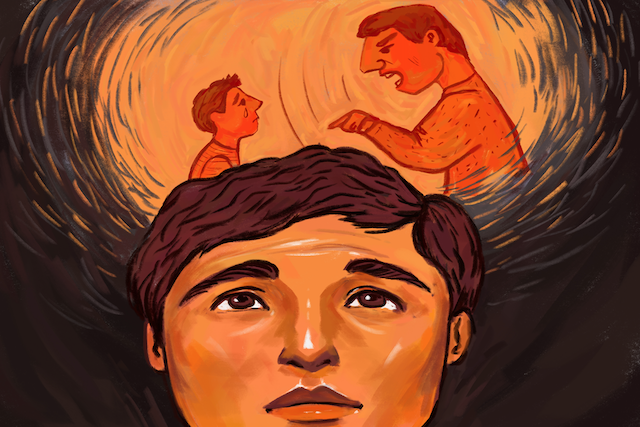
“There is no greater agony than bearing an untold story inside you.” ~Maya Angelou
Throughout my childhood experiences I did what every child does and rejected parts of myself. It makes sense because kids depend on adults for survival, so I was in no position to reject my parents. But as an adult I feel it is now my job to reclaim those parts of myself.
While I had two parents that loved me and what I’d describe as a normal childhood, nonetheless I became hyper-attuned to others, over-sensitive to criticism, and a perfectionist, particularly under stress. It led to all sorts of pain within relationships and, upon becoming parent, I could see I needed to address some things. I had little sense of self and had to learn about having and holding healthy boundaries.
I have been fortunate not to have been directly subjected to any of the more readily recognized trauma (sometimes known as big-T trauma), like addiction, violence, or sexual abuse. But my childhood was dominated by the kind of trauma that descends from the big stuff.
The aspects of my dysfunctional persona I mention above come under the heading of developmental trauma. I think it’s important to expose these aspects of who we become in the world as they have been getting perpetuated subtly throughout families all over the world for generations and they prohibit our collective growth.
Yet, for all the personal experiences I have shared, one I have never spoken of until recently is probably the one that shaped me more than anything else. Simply put, I had a mother who did not cope well when looking after us kids on her own. I learned to think ten steps ahead and project into the future in order to avoid any major meltdown. It drove perfectionist behavior in me, and I learned to choose my words carefully.
Why have I never spoken about it? I suspect this is multifaceted and ranges from things like not wanting to air dirty laundry, so to speak, to knowing that both my parents (like most parents) did the best they could with what they knew and the resources they had available to them at the time. Yet these were my experiences, for better or worse they shaped me, and if I tell my story it might help someone else.
To be more specific, mum used to often drop into this hyper tense state when she was alone with my brother and me; something I now readily recognize as a trauma state. She would say she was “up to high doh” (an old Scots expression) with our behavior, then snap at us, scream and yell, and chunter on afterward for a period of time somewhere else in the house.
When she would yell at me or chunter afterward, I now know it was most likely a deflection of her own pain. As my bedroom was above the kitchen I could hear the aggressive slights about me “being a bitch” or a “slut” or “a selfish cow” even though I was only a child.
When my father got home she would immediately approach him using a baby voice, another thing I could hear from my bedroom, conveying just how stressed she was (we kids usually being at fault). In the evenings Mum would then sit in front of the TV sucking her thumb, which I suspect were signs that she was likely regressing into her child self.
Watching this cycle, at the time, made me feel disgust and anger on top of the fear I already felt in being under her watch each day. My nervous system was under constant alert not knowing what aspect of her would show up.
Everything was our fault because we had broken the rules. With hindsight, and far more knowledge of children’s development, I now know we were just going through the normal growth and development cycles that kids go through rather than being bad kids.
Because it was probably a dissociative state that emerged when my mother was in flight-or-fight mode, it is possible (especially since Mum never did any meditation or therapy around this) that she had no clear memory of acting like that, or the frequency with which it occurred. I expect she was too identified with the thoughts of how bad we were and how bad it made her feel.
Dr. Gabor Maté’s words ring true: “It is often not our children’s behavior, but our inability to tolerate their negative responses that creates difficulties. The only thing the parent needs to gain control over is our own anxiety and lack of self-control.”
My mother was not able to do that, and nor are most people to be fair. It is far easier to blame people or circumstances than take a good hard look at ourselves and have a willingness to explore the hidden depths that we are held hostage to.
All this was unspoken with my mum. It is like it never happened, as if my brother and I somehow lived in a parallel universe.
Likely looking after young kids on her own was overwhelming and activated the trauma stored within her, perhaps in response to her own father’s violence and/or possibly the disgust at my grandmother’s passivity about it, or her own guilt in not doing something more (even although she was incredibly young at the time and couldn’t possibly have intervened).
However, when she was diagnosed with cancer my mum did say, “You know how I like to stick my head in the ground” when I tried to share with her the metaphysical possibilities related to the disease. Since my mother was most often too open with her opinions and usually gave us direct answers to questions we asked, sticking her head in the proverbial sand wasn’t something I immediately associated with her.
But now in retrospect I wonder whether, on some level, she may have been acknowledging her dissociative behavior when bringing us up, and the effects it may have had on us kids. Certainly it wasn’t something she ever directly acknowledged.
Though she did not readily share details during her life, she was simply what I would have called very dark on her father and her eldest brother. Just before she died I discovered her father was an abusive alcoholic. I also knew her eldest brother, a half sibling, abandoned the family as his father before him had abandoned him.
My mum, like a lot of people, never saw any value in revisiting those childhood experiences; she couldn’t fathom why anyone would partake in coaching never mind counseling, perhaps because she felt herself adequate enough and externalized her feelings. She certainly did not believe she was in any way held hostage to her experiences, which is what most of us would like to believe I expect.
As a result, I felt very alone and invalidated. My parents had each other, whereas my brother and I were left to deal with our emotions alone. Certainly it often felt our needs were not important (which was the predominant theme of the “do as I say and do not argue/we know best” approach to childrearing that had gone on for centuries).
While, like anyone, I could express many more things in my childhood that have stuck with me, experiencing my mother’s own trauma when we were alone with her, which was for significant amounts of our early life, elicited a feeling of constantly being on edge.
As I grew I spoke up more, unwilling to accept the emotional load being put on me, which resulted in a lot of raging arguments in my teenage years.
No one except my brother would have much of an appreciation for this, because around others my mother was quite different. In fact, around others, especially my father, she would have felt safer and, therefore, calmer. This Jekyll and Hyde behavior obviously made it very difficult for me to bond with a mum who, for all that I knew loved me, because my internal shields were well and truly up.
While I did not have the words for any of this back then, having caught myself descending into this chuntering state with both my partner and our own kids at times was a red flag for me. I knew I had to address my own reactions to break the cycle.
All that said, I feel blessed with my experiences because they helped shape me and to relate to others’ struggles and other dysfunctional behavior. I feel strongly that I have come into this life to shine a light on this more insidious type of trauma, one that lives in all of us in various guises, and help break the chain of pain that is occurring in pretty much every home across the planet. So in this sense, um was the perfect mother for me.
I also recognize that this was but one facet of my mum, one I have come to see with compassion, and she had many more that were far more positive. As a grandparent she was generous and loving, as a friend she was insightful and loyal, and as my parent she was all those things too; I always knew I was wanted and loved, it just did not always feel that way, especially when she was “up to high doh.”
It seems to me that through shame, guilt, and pain very few of us talk about our experiences, not realizing the person next to us is living their own twisted version of the same. The systemic issues we face in society today are all fed by the ongoing cycles of trauma within us and can only be solved by bringing them into the light.
We don’t all have to share our stories publicly. Even just opening up to a trusted friend or therapist can help us understand what we experienced, chip away at our shame, and break the cycle of pain so we don’t unknowingly repeat the same patterns.
So who are you protecting? What trauma shaped you? Is it time to tell your own story? Maybe sharing is the key to your healing, or helping heal someone else.

About Shona Keachie
Shona teaches by example how to find our inner truth among the often harried day-to-day practicalities of life. If you enjoyed this article, you may enjoy Navigate Life's Waves: Remember to Celebrate the Good Amidst the Chaos, Is It Worth It? How to Tend to Hope When the Future Feels Fractured, and From Overwhelm to Empowerment - Healing Your Body, Mind, and Heart in Crisis. To follow her blog, click here. Visit her at shonakeachie.com.




 Though I run this site, it is not mine. It's ours. It's not about me. It's about us. Your stories and your wisdom are just as meaningful as mine.
Hi Shona, thank you for sharing your story! I’m very sorry for what you went through.
I disagree with this big t small t talk because regular verbal abuse is very traumatic.
Children particularly internalise anything that is said to them. Verbal abuse can be incredibly damaging as it shapes thought patterns, behaviours, personalities and habits for years to come.
Great, she didn’t molest you or beat you. But it seems like you are comparing her behaviour to the worst of the worst to minimise what she did. What she did most normal healthy parents would never do.
That she never behaved like that in front of your father means that she was hiding her behaviour because she knew how wrong it was.
Have you and your mother had a heart to heart about this behaviour? Has she apologised for her behaviour? If not, I don’t know how you can assume her motives.
It seems like you’re saying well she was abused so she abused us. Only 1 in 3 people who are abused go on to abuse others. It’s a bit more complicated than that and involves an element of personal responsibility.
I agree with you here. Over the years as a therapist I slowly began to realize that these “small T” traumas could be at least as harmful than the “big T”. We have a visceral reaction when people describe physical or sexual abuses. It’s far easier to minimize the long term effects of neglectful behavior, and more difficult to describe: there’s only so many words for an absence. Yet presence is what kids need most!
I’ll agree here as I stated to Lori’s comment
Thanks Helena. It’s interesting that you mention only one in three people who are abused go on to abuse, that is I think exactly where the phrase small-t versus big-T trauma helps us to recognise the hidden types of trauma that are more ‘normalised”. Big-T trauma generally is what drives the statistics captured. Whereas I believe what many of us call normal childhoods are actually dysfunctional and fraught with small-t trauma. As you say, verbal and emotional abuse are commonplace and just as traumatising. Without conscious awareness of the unhealthy belief patterns that arise from that type of abuse (feelings of lack of worth, being different, being crazy, not belonging, not feeling safe etc) I suspect most people go on to inadvertently repeat the cycle passing on their unhealthy beliefs.
Please show me any of the statistics you’re referencing.
Domestic violence charities enable individuals to escape abusive relationships without physical or sexual abuse being present.
Industry professionals do not normalise verbal, emotional, psychological abuse and neglect. The problem with using the phrase “big T little t” is that it continues to marginalise these issues.
It’s trying to coax people into understanding these behaviours are issues by calling them minor issues.
Whereas, referring to abusive behaviours by the appropriate name (verbal, emotional, psychological, physical, sexual, neglect) helps people understand how damaging these behaviours actually are. Yes, some people are going to be initially resistant to it but that is called denial.
Additionally, using the phrase “big T little t” inherently minimises the experience of any individuals who recognised that behaviour they experienced was abusive. You’re literally referring to serious types of abuse as little trauma. This reinforces the issue of these types of abuse being normalised and people seeing them as less than.
Hi Helena,
I think perhaps I inadvertently muddled Shona’s message by recommending she add the questions at the end, reiterating the “big-T / little-t” language. (I have since edited this so future readers don’t misconstrue her message.)
Shona in no way intended to minimize this type of trauma. She herself experienced it and knows intimately the pain and damage it can cause! She wrote this post to highlight how these types of experiences are often normalized and to start a conversation about the work that needs to be done to facilitate both healing and change.
She used the little-t / big-T language because it’s already part of our vernacular, and I think perhaps this reference would have been less glaring had she not taken my suggestion about the ending.
My apologies, Shona, for steering you in the wrong direction! I know you feel strongly about shining a spotlight on the hidden abuse so many of us endure—and I’m glad to see we all agree that emotional abuse can be just as damaging as (what industry professionals often refer to) as “big-T trauma.”
Lori
Lori thanks for the commentary. I do have some larger practical concerns for the article and I would definitely like to weigh in my clinical expertise.
When individuals designate trauma in categories like this, two things are occurring:
1. Trauma can be conceptualized in a completely different framework which either minimizes an individual’s trauma or aggrandizes trauma to levels that make management and treatment of traumatic disorders exceedingly difficult
2. Creating value based modeling on a term with critical implications to individuals that are part of the helping profession (both in a clinical and out of a clinical setting).
There’s quite a few instances at the turn of the 00s that asserted this definition / framework of trauma that is applied to particular individual practitioners. However, I stress that in doing so point 1 applies. In the premise of point 1, individuals experiencing trauma can (and have) entered practice minimizing their own trauma resulting in lacking acceptance of their own trauma because it isn’t “large” enough. Paradoxically, individuals choosing this conceptualization of trauma can also experience several issues with associating their trauma or even making a potential mountain of a mole hill. In effect, we are creating another buzzword that dilutes a very critical clinical phenomenon faced by millions.
From a practical perspective, neither the APA (our governing body), or the ICD 10 define trauma in these terms as trauma can lend itself to several different diagnoses (mood, anxiety, psychotic in some extreme cases and so on). This mode of thought Big T/ Little T is not apart of clinical vernacular as it isn’t recognized by any ecumenical body. There’s a critical reason for that because it has potential to impede therapy by both the client and the therapist.
However, as I said, what a practitioner does in their practice or their blog is totally on them. I warn the dangerous effects of applying this model as most other clinicians would trained in either model for psychological treatment. I understand clearly that Shona is attempting to describe experiences of personal trauma. Which I do appreciate her shedding light on trauma as it is a critical issue in general practice as a whole.
But let’s not turn trauma into another buzzword – as a concept it has debilitating impacts on all of our lives.
Agree. This is big trauma and somewhere the author normalized trauma. I’m wondering if her family said “we never hit you”.
Maybe overt versus covert abuse would be a little more specific?
Ah yes, that does sound more specific!
Hi Malcolm,
I’m not arguing that the big-T / little-t language can minimize someone’s trauma. That thought didn’t occur to me when I first read this post (possibly because my brain is a little slow these days, since I sleep pretty poorly with an infant and a toddler!) But I can see now how this distinction can cause some to invalidate their own trauma as not “large” enough – something I, myself, actually did for years, prolonging my healing process.
I only meant to express that 1.) Shona did not coin these terms. If you google them, you’ll find articles, even on Psychology Today, using this language and 2.) She didn’t intend to minimize anyone’s trauma. She referenced the different types of trauma because she’s seen this language used elsewhere, but her intent was to highlight how even trauma that some might classify as “little” can actually be quite damaging.
I appreciate all those who chimed in with comments, as this is the very discussion Shona hoped to start! Ultimately, we all hold the same point of view and intent: to help people recognize and heal from trauma, in all its forms.
Lori
Hello Shona !!! Thanks for sharing your story. Your story will help other people to overcome the trauma they have suffered in their childhood & teenage. The biggest trauma children suffer is comparison done by parents with other children. So, your story helps the people who have suffered trauma in their childhood, to not repeat the same with their children. And this is the time where this verbal abuse & trauma will stop for future generations.