

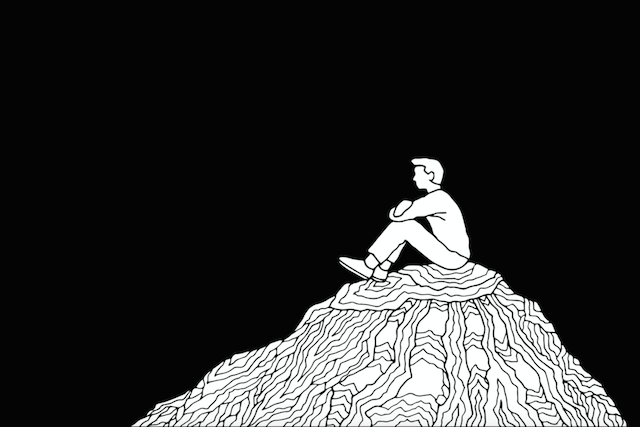
“What happens when people open their hearts? They get better.” ~Haruki Murakami
What do you do when just can’t do it anymore? When the pain is too much? The discouragement is too much? The hoping and trying are too much?
It’s not that you haven’t tried. You’ve been brave. You’ve been persistent. You’ve been soldiering on through hurt that other people don’t understand.
It’s that you’re feeling broken from the trying.
That’s how I felt when my husband died of stomach cancer. There were two healing realizations that changed not only the path that I was on, but how I felt. I think they can help you too.
In the ten months between my husband’s diagnosis and his death, I was driven by desperation.
I only slept five hours a night. The rest of the time I was caring for him. Or researching his condition. Or worrying about him.
Don could only eat a few bites of food at a time, and he was often too nauseated to want to eat at all. As I watched him waste away, I cooked as many as five fresh meals a day, trying to create something that would persuade him to eat.
Meanwhile, I lost thirty pounds.
My path was unsustainable.
I knew it, but I didn’t care. Deep down, I didn’t want to go on without him.
At the end, I spent more than a month at his side in the hospital, day and night. I left my job and children to care for him. He was my whole world.
Then he died.
In that small, dark place, I had to decide if I would die too.
Realization #1: It’s not about you.
Choosing to live didn’t come all at once, any more than feeling lost and broken had. The first step was realizing “It’s not about you.”
It may seem like that realization wouldn’t be helpful for someone who wasn’t even eating or sleeping. And how are you supposed to live your life if it isn’t about you, anyway?
But the truth is, I was neglecting myself because I was so focused on my own pain. Shifting my focus eased my suffering.
I didn’t make the shift for philosophical reasons, though. I made the shift because I saw how much my pain was hurting my children.
My teenage daughter went out for pie on a special occasion with her friends. She brought her piece home untouched for me because she said I needed the calories.
On another occasion, she brought home a Styrofoam box containing the entire restaurant meal from her anniversary date with her boyfriend, for the same reason.
When my heart started breaking from these small but mighty sacrifices, I realized how much heart I really had left.
I had thought my capacity to love, to hurt, to care had been exceeded. But it hadn’t.
Most of us have the instinct to shut down in response to pain. To pull back inside, as though cutting ourselves off from the rest of humanity could heal our broken parts. The truth is just the opposite.
Love heals.
Finding the Love that Heals
Viktor Frankl lost his entire family in the Holocaust. During his own imprisonment in multiple concentration camps, Frankl became fascinated with the differences in how people responded to the atrocities they experienced.
Everything about the camps was designed to dehumanize the prisoners. To tear them down, and to strip away their courage, hope, and identity. Most of the time it worked.
Many people gave up. Frankl described camp mates who died not just from starvation and illness, but from grief and discouragement.
Sometimes the shift was subtle–a spiritual and emotional wasting away that the body could not survive. Sometimes it was more dramatic. Prisoners walked into an electric fence or the path of a guard’s rifle.
And sometimes, in order to physically survive, prisoners let part of their spirit die as the experience transformed them into someone cold and uncaring.
But there were exceptions.
There were people who became more kind, noble, and beautiful through the experience. The difference, Frankl concluded, was that these people were living for something bigger than themselves.
They were sustained by love of family, faith in God, or commitment to science or art. According to Frankl, “Those who have a ‘why’ to live, can bear with almost any ‘how.’”
Healing comes from having a reason to hold your heart open to pain. Because when you do, you automatically hold it open to joy as well.
What do you love more than yourself?
When You Don’t Feel Like Loving
Maybe you don’t know right now what you love enough to motivate you.
Maybe the problem is that you lost someone or something you really loved.
Or maybe you feel exhausted from the way you’ve been going about loving.
I get it.
Not the specifics of your story, but I get what it’s like to be disconnected from every feeling except pain. To feel sucked dry from the giving. To be disillusioned and discouraged and so tired that the thought of loving any more is impossible.
And you know what? That’s okay. It’s okay to be with those feelings. To take time for yourself, even if all you can bring yourself to do is binge watch Netflix.
But the truth? When you’re ready, choosing love will do more to help you than almost anything else.
Love prompts us to do hard things.
It’s love that fuels parents who stay awake night after night with a colicky baby. It’s love that helps hurt friends to reconcile. It’s love that makes those relationships that have spanned the years precious, not despite but because of all the ups and downs along the way.
And it’s love that can give us the courage to walk away when the situation calls for it.
Love prompts us to make those sacrifices that in the moment don’t seem beautiful at all, but in retrospect become the most significant choices of our lives.
It’s love that fills us, when we feel our most empty.
So be brave. Let yourself love. Love an animal. Love the houseplant on your kitchen table and the nature you encounter on a quiet walk. Love the contributions you can make toward the greater good. And love the people around you.
Love Grows
I started back at my job a few weeks after Don died. It was tough. We had taught at the same college, working out of the same building, for a decade. Memories were everywhere. And because I teach psychology, there were many discussion topics that were triggering for me.
I did it because my kids needed me to pull it together. For them.
But as I did I it, I realized I was also doing it for me. The classroom became my happy place. I felt better when I got out of my head and focused on my students.
My own pain was still there, of course. I cried in class more than once that first term. When I did, my students cried with me. They thanked me for being brave and open, and they offered me the same love and encouragement I had been trying to give them.
That’s because love grows. That’s the magic of it. Even when you think you don’t have much to offer, it becomes enough, and to spare. When it is freely offered, love expands within us and around us with the giving.
So how do you get to that point when you are feeling too worn out to give?
Realization #2: Sometimes it has to be about you.
When you get real about doing the impossible, about trying when you don’t know how to try anymore, you have to accept that it’s going to take all of you.
It’s going to take you showing up fully. Owning your own power. Being unapologetically yourself.
It’s going to take you making yourself the hero of your own story.
So what have you been holding back?
Is it love?
What it Looks Like to Love Yourself
When I was at my lowest point, my kids pointed out the ways I wasn’t taking care of myself. And because I didn’t want them to follow my example, I listened.
I finally got medical treatment for a back problem that had been bothering me for years. I started buying myself little things that I enjoyed. I planned activities that weren’t really necessary, but that I wanted to do.
In my world, trying had meant chronically neglecting myself so that I could put just a little more time, energy, or money into someone else.
It’s no wonder I felt like I couldn’t keep going. I was right.
Step one was nurturing myself with the same tangible attention I would give to someone else who I loved.
But loving yourself means a lot more than a new haircut and a bubble bath.
What it Feels Like to Love Yourself
Loving yourself means showing up in your own life.
It means giving yourself the best you have to offer and trusting that it is enough.
It means being willing to try something new. And to keep trying.
It means believing that you can create something beautiful even when all you’re feeling is pain.
It means respecting your own boundaries.
Loving yourself means being willing to do the hard things that will help you in the end.
It means when you start to feel sorry for yourself, you stop. And you reconsider how to connect the dots between the events in your life. Because you get to determine the meaning of it all, and to decide how you want to move forward.
And it means that when it’s time, you let go of the dreams that used to fuel you and dare to believe in new ones.
Choosing Life
When your spirit has been crushed, when you have no more words for the pain and no more heart for giving, remember:
Love heals our broken places.
Loving others. Loving yourself. It’s the same flow that heals everything it connects to.
Those wounds hidden carefully away inside? They are the ones that don’t heal.
The wounds bravely opened sting, yes. There is pain, but it is healing pain. Sadness felt and released opens space for joy.
Gently offer love like sunshine, and feel your spirit grow toward the warmth.

About Angie Schultz
Angie Schultz, MSW, loves to help people transform emotional pain into meaning, joy, and growth. When she’s not teaching college psychology classes, she blogs at The Becoming Place. You can follow her on Facebook or Twitter. Subscribe here for free insider updates.





 Though I run this site, it is not mine. It's ours. It's not about me. It's about us. Your stories and your wisdom are just as meaningful as mine.
Thank you. Perhaps new dreams are in order.
I think the core of this article is good advice and I’m also very sorry the author lost her husband.. And I’m glad she seems to be in a good road now. But I have to say that I think this sentence “They let themselves waste away from starvation, illness, or grief”, when talking about concentration camps is a very bad choice of words. I don’t think the circumstances in the camps can and should be compared to anything, and to make it sound like the people willingly “let themselves starve, get sick” is so wrong. They were systematically starved and abused. There was no way out. There was no choice. You shouldn’t compare this. Had to get that off my chest. Normally really appreciate tiny buddha, but this bothers me a lot.
Thank you for the feedback that that line wasn’t reading well, Jiji Totoro. I’ve revised it, and hopefully Frankl’s intent is coming through more clearly. I love his story, because the circumstances he survived so far exceed what most people ever have to suffer, and yet he chose to use that experience to teach the rest of us how to live with joy anyway. In addition to his book, Man’s Search for Meaning, Frankl founded an entire model of therapy, called logotherapy. Mentioning him here is a way of honoring his life mission. I certainly was not likening my experience to his. I see him as a great great role model and inspiration.
You have misinterpreted what the author is saying and you have missed her point.
Beautiful!
Thank you xx
My teacher “Gangagi” says “In an effort to avoid a broken heart, we live in a constant state of broken heartiness” This goes along with your statement about opening heart to pain but also letting the love in as well. I am currently in a situation where no matter how much effort and attention I put into my job, it just doesn’t matter although I keep telling myself it does. Much like growing up with an alcoholic parent. If I work really really hard to be a good child they’ll stop acting that way and all will be well. Sometimes the best thing one can do for themselves is to step back and realise in those times that it isn’t their fault, and they are not a bad person, just caught in a bad situation.
Angie, your post was a miracle in my life today. You captured so much of me in this. Thank you for the gift of honesty, authenticity, and vulnerability. My past 3 years have in many ways destroyed the picture I had of my life and opened me up to unbearable grief from my children’s illnesses (diabetes, heroin addiction, depression and alcohol and pill abuse). Grief can be just as strong when the people are still alive – when you lose all that you dreamed and hoped for. Yet, destruction of that picture has forced me to draw a new sketch – more just a charcoal drawing right now – rough edges, less colorful, but still beautiful in a different way and becoming clearer all the time. I keep a small plaque with these words in my family room “Life does not have to be perfect to be wonderful”. It is a motto for many dealing with addiction in their lives. Your words about redefinition are so very powerful. Thank you, thank you for your courage in sharing your journey.
I’m so glad it helped! Thank you for reaching out and letting me know. And thank you for your beautiful words describing your journey. You are an inspiration.
Thanks a lot for this great article, Angie!
The woman whom with I spent the last two years fully in love, making projects and planning a future together has just broken up with me a couple of days ago. It is not a comparable situation to yours, but it is still a loss. I feel so tired, so drained. I have tried on two different occasions to make her realise that love and forgiveness can make us become stronger and happier as a couple. The first one succeeded, but this time I feel it is just not going to happen again.
I have the feeling that every time I love someone with all my heart and soul, start planning a future together, it is just a matter of time before they leave me. I will stay with this phrase of yours for the weekend to start growing in me that little flame of love that is still there: “… it means that when it’s time, you let go of the dreams that used to fuel you and dare to believe in new ones.”
For someone who has lost many and still struggles with those losses, your words have made me cry, and given me insight and hope. Thank you.
Angie, thank you! You have been where no one expects to go and I’ve been there too. It will be one year next Wednesday since my beautiful, strong, healthy and happy husband was wiped out by an autoimmune disease in 6 short weeks. At no point did we or the doctors expect him to actually die from what some people live with for decades. But he did. Without knowing it, I have been living your advice quite unintentionally but it does seem to be helping. I decided to keep my husband’s mechanical business going despite having no mechanical training myself. I did it primarily for his devoted employees who loved him and because his presence was strong in the workshop and business we built up over 10 years. But as time went by, I started doing it for me! It became my personal challenge to not only keep his legacy alive but to build something different and just as successful, for myself! I have always been the worker bee but never the queen. And it feels good to see the business turn around after the initial blow and 6 month slump. I did that! And I did it whilst giving thanks for and being grateful to the people who helped and supported me along the way. I love these people more deeply than I ever could have in my old life because my husband took up all of my love and all of my life. My hopes and dreams of our retirement died with him and I grieve for those lost golden years together. But I am starting to see a glimmer of a new future. It just hasn’t taken shape yet. Thank you for affirming my reason for living.
A lot of “I”s “me”s and “my”s in your reply.
Troll. If you don’t have anything constructive or KIND to say here, then GET OFF.
This is one of the best articles I’ve read on Tiny Budha and I am a huge fan of this blog. Thank you.
You use the word “I'” an awful lot.
What does that even have to do with the subject? Troll. Get off.