

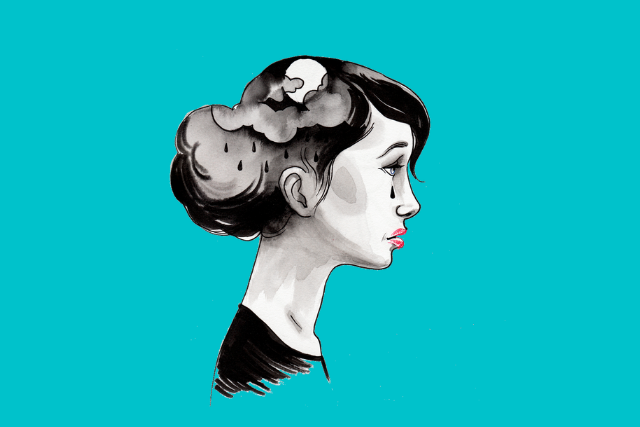
“You don’t have to be brave all of the time. You are not damaged or defeated. Have patience. Give yourself permission to grieve, to cry, and to heal. Allow a bit of compassion, you’re doing the best you can. We all are.” ~Unknown
Growing up, I received the message that everything had to look a certain way. It was only okay to feel positive emotions, and any expression of unruly emotions was totally unacceptable.
It wasn’t that anyone directly said this to me. I wasn’t given a written set of rules to follow. I wasn’t given any speeches or trainings about how to present myself in public. But the message came across.
It was relayed to me in phrases like “Don’t cry, you’re fine,” “Relax, people are watching,” “Just ignore them,” and “Don’t let things bother you.” It was conveyed to me through subtle criticisms of my reactions, which in my mind translated to “You aren’t good enough if you feel bad.”
In many ways, I was raised to feel uncomfortable with my emotions. I came to believe that negative emotions were a defect within me rather than a natural and essential part of my being. It wasn’t anything my parents did deliberately to try and hurt me. In fact, they were probably trying to avoid seeing me in pain. They were simply following what most people and parents do.
We advise others to avoid their pain and upset feelings. To snap back into shape, even after immense tragedy.
We hear things like “Your cousin died? Well, he’s in heaven now.” “You had to put your dog to sleep? Well, he’s just crossed the rainbow bridge; and anyway, you can always get another dog.”
People don’t advise you to sit with uncomfortable emotions. They don’t tell you it’s okay to feel sad, hurt, or scared.
As a young and impressionable little person, I internalized my parents’ messages and fought against every “negative” emotion I had. That is, until the feelings I was trying so hard to avoid took over my body and manifested themselves as a series of seemingly unexplainable health issues and panic attacks.
As I got older, I became so anxious that I couldn’t hide it anymore. Once I reached the point of being uncontrollably uncomfortable, I set out on a journey of self-exploration.
I came to realize that my only choice was to examine what I was feeling and explore what those feelings could tell me about myself. For the first time in my life, I decided to figure out what my emotions were really about. I decided to find out why I was so damn anxious.
Many of us are embarrassed and ashamed of our own feelings and thoughts.
We think our unfavorable emotions make us weak, and we worry that other people would think less of us if they knew how bad we actually felt. If we allow dominant ideas about tough emotions to take over our own thoughts, we can wind up feeling shame for the rest of our lives.
When we’re emotional, we can feel completely powerless, like we’re never going to gain any kind of control over our thoughts, bodies, or surroundings. It can feel so uncomfortable to be upset that we choose to numb ourselves rather than risk feeling any pain.
For so many years, I had it all wrong. But once it clicked, everything changed.
The point of being alive isn’t to numb our feelings; we’re always going to feel something, and sadness is always going to try expressing itself in our lives. That’s a fact of life. We can try to avoid it all we want, but the more we distance ourselves from this reality, the more control it gains over us.
Freedom comes when we can feel our tough emotions expressing themselves, but no longer let them rule our lives.
The more we try to avoid our true nature, the more whatever we don’t want to feel shows up with a vengeance.
The more I tried to rid myself of worry, sadness, negative thoughts, and panic attacks, the more they seemed to persist. The more they persisted, the more reactive I got to feeling anxiety. And the more reactive I became, the more power anxiety had over my life.
When we try to get rid of anything in life, we create resistance; and the more we resist something, the more it shows up. Famous psychologist Carl Jung stated that “what you resist not only persists, but will grow in size.” So, the goal here isn’t to get rid of anxiety, panic attacks, or sadness, it’s to work on our intolerance of those feelings. It’s to learn how to manage ourselves through the discomfort of it all.
We don’t gain comfort, self-compassion, and calm by resisting or wishing things were different; we reach true calm by letting it be okay when we’re sad and anxious, and then letting it go.
The more you fight it, the more it will show up; the more you let it be, the less power it will have over you.
This is, of course, easier said than done. It’s a natural instinct to try banishing anything that feels uncomfortable. However, by continuously practicing deep acceptance for what is, we put ourselves in the best position to change it, or even achieve freedom from it, so that we can move past it.
Here’s what I did to pull myself back from numbing myself and stumble into my new world with tolerance of my emotions:
1. Know that it’s okay to be anxious and upset.
Without a doubt, the most important thing to remember is that it’s okay to feel overwhelmed and stressed out. It’s okay to feel lost and unsure. It’s alright to have no idea how you’re going to hold it together sometimes. We put so much pressure on ourselves to be happy all the time. It’s okay to acknowledge when times are tough. It’s alright to feel anxious, even if it’s uncomfortable.
2. Become an observer of your life.
Instead of judging and getting angry with myself for feeling a certain way, I decided to be an observer of my emotions and environment. I chose to slow down and watch. I remind myself that when we’re busy judging ourselves for the way we feel, we aren’t honoring ourselves.
Our emotions are involuntary; we have no control over them. However, what we do have control over is how we decide to respond to those emotions. When we accept our emotions as they come, take ownership of them, and avoid taking them out on the people we love, we train ourselves to manage our emotions from within.
3. Decide who you want to be.
I’ve found that it’s much easier to be happy, nice, and upbeat when your life is going well. It’s a lot harder to hold onto yourself when stress and anxiety are high. Knowing this, I work at trying to stay true to who I am, even in unfortunate situations. Even if I’m feeling agitated or upset, I know I can choose to respond in ways that allow me to shine through. Just because I’m not feeling so great, doesn’t mean I need to take it out on anyone I care about.
4. Know it’s okay to feel strong emotions.
During hard times our emotions can feel more intense. We may lose hope or be more reactive. Even though it’s totally fine to maintain an optimistic perspective of life, it’s also important to allow ourselves to process and feel the full spectrum of emotions.
5. Remember that even negative emotions have a place in our lives.
Sadness, anger, frustration, boredom, anxiety etc. all have a place in our lives. The key is not to avoid or numb these emotions, but to experience them and learn to manage them effectively so they don’t run our lives.
Unfortunately, many of us don’t know how to manage our negative feelings—in part, because we’ve been taught to repress them. As children, many of us are told not to cry, which leads us to believe that crying is bad.
As adults, when we experience emotions like depression or anxiety, our natural impulse is usually to mask those feelings. We may have an inner voice telling us to forget about it; we may even turn to drugs, food restriction, or binge eating to distract us from our emotions.
As human beings, we’re simply incapable of numbing a select set of emotions. So, when we numb sadness, we also numb happiness, joy, and other positive emotions. What’s worse is that as we struggle with our own negative emotions, we may create even more suffering. It’s hard work to deny something we’re truly feeling. It takes energy; it wears us down. So rather than try to ignore our feelings, it better serves us to work on observing them.
It’s alright to admit that you’re hurting or struggling. We all go through hard times. And maybe we can find a bit of comfort in remembering that we aren’t alone. But first, we must accept what’s happening. Then we can decide how we want to best deal with it.

About Ilene S. Cohen
Ilene S. Cohen, Ph.D., is a psychotherapist, blogger, and professor. She’s a regular contributor to Psychology Today, with her most recent release of her self-help book entitled, When It’s Never About You. Her work is fueled by her passion for helping people achieve their goals, and lead fulfilling and meaningful lives. To learn more about Dr. Ilene visit www.doctorilene.com.







 Though I run this site, it is not mine. It's ours. It's not about me. It's about us. Your stories and your wisdom are just as meaningful as mine.
Interesting Ilene, this never came to my thoughts before. The perfectionist mentality of mine constantly felt that what’s wrong, requires fixing or a solution to it. And I can never take “no” or “no solution” as the result. Surprisingly (am still trying to) understand and digest better of your messages to sit with it, and actually allowing the “negative” energy flow or sit with you is actually okay to be with. Not suppressing, hiding, running away from it. But to rather appreciate, feel and learning to manage it better – Allowing both good and bad times.
Thank you for sharing Ilene. Take Care.
Thanks Mike for sharing your thoughts.
Ilene you made a comment… “Knowing this, I work at trying to stay true to who I am, even in unfortunate situations.”…. is it possible that this is what your parents were trying to tell you? By staying true you are containing and readjusting to remain kind and positive not explosive?
Thanks Tracey. We can’t really know what others intentions are. I am sure they weren’t bad, I just experienced the message that “negative” emotions are bad. With my children, I explain that their emotions are okay they can feel any way they want. However, if they act out badly I show them other ways to deal with and manage their big emotions.
Excellent piece of advice. The example of crying in younger age is very helpful to understand how we build our resistance to situations that could and maybe should be considered normal. Very helpful material!
Thanks Kyriakos!
This speaks so directly to me. Like the article, I have no memory of ever being told not to feel certain emotions but definitely as I got older I have been told countless times not to cry when I’m upset or not to be upset at all. Most poignant is an ex boss telling me during my performance review that I wasn’t going my job and I needed to improve or … Needless to say, my anxious mind jumped straight to thinking I was going to get fired and I started tearing up only to be told not to get upset. I’m slowly starting to acknowledge that I have feelings of sadness or upset from tine to time but that balances out the happiness I now have in my life.
Hi Sam, I am happy that my article resonated with you. Thanks for sharing your experience.
Very nice article Ilene. It will be more interesting if you could say an example of how to manage an anxiety in your point of view. I am basically a sensitive person and faced depression many times. Initially I thought since I am weak hence I got depression. Later I understood from my doctor due to some chemical unbalance in brain depression is coming and genes has some implication on that. However still I am uncomfortable with anxiety.Say for example if I have spotted or about to do some speech or performance in future or thinking there can be some chances of those all I feel anxious, hand trembling,voice shivering and chance to skip those events. Do you have any advice how to manage my anxiety in a better way?
@ilenestrausscohen:disqus Very nice article Ilene. It will be more interesting if you could say an example of how to manage an anxiety in your point of view. I am basically a sensitive person and faced depression many times. Initially I thought since I am weak hence I got depression. Later I understood from my doctor due to some chemical unbalance in brain depression is coming and genes has some implication on that. However still I am uncomfortable with anxiety.Say for example if I have spotted or about to do some speech or performance in future or thinking there can be some chances of those all I feel anxious, hand trembling,voice shivering and chance to skip those events. Do you have any advice how to manage my anxiety in a better way?