

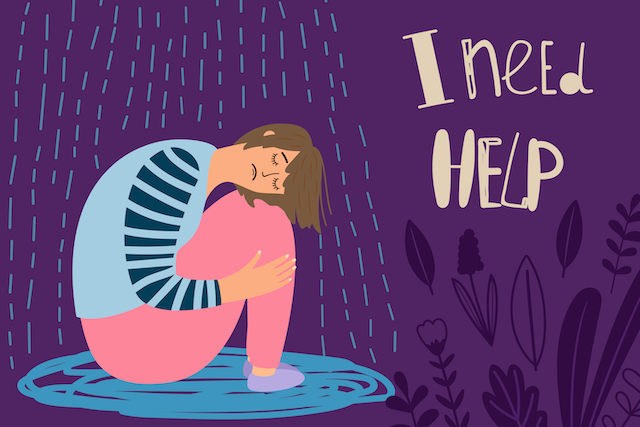
“Quiet the voice telling you to do more and be more, and trust that in this moment, who you are, where you are at, and what you are doing is enough. You will get to where you need to be in your own time. Until then, breathe. Breathe and be patient with yourself and your process. You are doing the best you can to cope and survive amid your struggles, and that’s all you can ask of yourself. It’s enough. You are enough.” ~Daniell Koepke
I feel a bit like Frodo Baggins. I’m on this tireless, seemingly never-ending journey just like he was. Only I don’t have a ring that needs destroying. I’ve been searching for the elusive answer to slay my inner demons and become the best version of myself. And I’m tired.
The best way to describe this insatiable desire for improvement is an itch I can’t quite scratch. I can’t recall how many times I’ve gone down the Google rabbit hole, spending hours reading blogs and articles, Instagram posts, you name it. Just one more and I’ll stop. Okay, just one more!
I’ve realized that the reason I have become so utterly obsessed with the idea of working on myself is because of my past. It always traces back to the past.
In school I was bullied. At home I was abused. As I got older, I beat myself up over every mistake. I told myself it was my fault I was unlovable. All of these experiences taught me that who I was as a human being was somehow wrong.
It took years for me to discover self-help. As I recall, it started with mental health blogs. I’d find as many as I could and binge read them, even though they all contained essentially the same information.
I joined Facebook groups about OCD, depression, anxiety, childhood abuse, and compulsive skin-picking. I thought, “Cool, now I’ll have so many new tips to try!” until I eventually left each group because of the overwhelming number of posts.
When I was still using Instagram, I only followed mental health accounts. I was bombarded with influencers and therapists sharing their expertise on how to change your life. I ate it up, but I was also scared that I would miss some life-changing piece of advice that could heal my trauma if I didn’t refresh my feed every five seconds.
I’ve read self-help books. I’ve listened to podcasts. I’ve watched YouTube videos. But it wasn’t until I started counseling that I realized I had a problem.
It dawned on me that the all-consuming need to “fix” myself was making me feel like garbage, which is ironic if you ask me. Self-help books are supposed to help us, but those books, along with the blogs and Instagram posts, made me feel like I needed to change who I was in order to be good enough.
Even though I still sometimes slide into that old comfortable habit that is the self-help rabbit hole, I am becoming increasingly more aware of how negatively this habit affects me. I continue to discover new things along this journey.
The self-help industry preys on us—or some people in the industry I should say. (Clearly, I enjoy some self-help sites still, or I wouldn’t be sharing this post here!)
I feel like reading so many self-help books created problems I didn’t even know I had and made me feel worse. This is how it has become a multi-billion-dollar industry. The more problems we have, the more info and help we need. I recommend creating a little balance with consuming self-help materials. Focus on reading just for enjoyment sometimes. It feels really good.
And try to be mindful about your intentions with self-help. If you’re looking to heal old wounds and work on the issues that hold you back, self-help can help. If you believe you are fundamentally flawed, it won’t.
We must realize that we are enough as we are and that we don’t have to prove our worth by doing more things or becoming this or that.
Trauma can create distrust in ourselves and our ability to decide what’s best for us. We often look to others to have all the answers to make us feel better. It can be really hard to trust ourselves, but think about this. Why would anyone else know what’s best for us when they haven’t walked in our shoes? We have to learn to be your own guide.
Self-help can make us feel like failures. There are so many products that claim to have the secrets to learn how to live our best lives, lose fifty pounds, fall in love, get rich, stop being depressed, and finally get over the past. That’s a lot of pressure to put on ourselves in order to live someone else’s ideal version of life.
The most important thing I’ve learned is that it’s okay to stop the constant striving for more. That it’s okay to stop searching for the answers to all our problems and just live.
For so long I’ve been looking for the path that will heal me, that will make me feel worthy and whole, and this is the root of my obsession with self-improvement. I can learn to just breathe and relax in the moment. I can just be without all the noise of others telling me how I should be. And you can too.

About Tina Blacksmith
Tina Blacksmith is an animal lover and mental health advocate. She enjoys writing and getting outside and exploring the beauty that Oregon has to offer. She blogs at Not Defined by My Past.






 Though I run this site, it is not mine. It's ours. It's not about me. It's about us. Your stories and your wisdom are just as meaningful as mine.
Thank you, Tina! That was gold!
Thank YOU for reading. I appreciate it very much.
Well the insight in this article, is something I’ve been contemplating for several years now. Stop the obsession with getting better and better, and enjoy the now. I’m good enough. Stop the struggle. If you lean something along the way that makes life better, great, but leave the obsession behind and enjoy the moment. So enjoyed the insight shared here.
Thank you so much!
Aho! That’s a great distinction and place for inner discernment: when is my desire for “inner work” and “healing” healthy, and when is it coming from a basic belief in my not ok-ness. Thank you! I so relate.
Exactly! Totally agree! Thank you.
Think you have almost shed the pains and light about what I am hurting from. For so long that I have probably hide myself from. Constantly thinking that I need to fix this, I need to fix that. Thank you so much for sharing Tina.
This is me in a nutshell. I appreciate your kind words.
I can relate. It was a odd moment when I realized the ‘self help’ can become a addiction.
Here is a riddle I’ve sought to answer: “When does the seeker become the finder?
“i was lying to myself when I thought I was lost; I have never been lost – I just wasn’t ready to be found.” – Nikki Rowe
“You are the way and you are the goal, and there is no distance between you and the goal. You are the seeker and you are the sought; there is no distance between the seeker and the sought… You are the means and you are the end: this is the great way.” – Osho, Hsin Hsin Ming
“Not all those who wander are lost” – J.R.R. Tolkien
“I have been and still am a seeker, but I have ceased to question stars and books; I have begun to listen to the teaching my blood whispers to me.” Hermann Hesse
“We shall not cease from exploration, And the end of all our exploring, Will be to arrive where we started, And know the place for the first time.” – T.S. Eliot, Four Quartets
Thank you to the original poster and your comment. Just in everything in life there is a balance. My subconscious was telling me that I was getting addicted with “self help”. I thought I was the only one that had this mindset in the world but I am proven wrong. It is okay to just live and be who you are in the moment without striving to over analyze if you are doing mental health “right”. Thank you!
Thank you.
Send my thanks to the writer. Perfect time.
Thanks 😊
However tells us we need ‘fixing’ are very often the ones with the problem.
Thank you so much and congrats for getting to where you are 💙
Yes! Love this article! You have hit the nail on the head. Self-help can be a positive influence but only when it helps us to change damaging or unhealthy/unhelpful behaviours, not when it makes us feel like our inherent self is wrong or needs improvement. I always say it’s not about changing who you are, it’s about changing who you are being/performing, to make it more closely align with who you are at your core. In other words, helping you live in a way which is authentic to you, and where you trust yourself, rather than thinking you need to ‘improve’, achieve or meet impossible & damaging external expectations. Thank you for sharing!
I was doing a research on the webs about why I am so obssessed with healing my trauma..it’s making it worse.. I can say I had OCD mixed with a lot of anxiety..these stem from the traumas my family caused to me.. anyways..I went recently to a therapist..it felt like she wasn’t taking me seriously..yet she confirmed my suspensions about suffering from pTSD..duh..since that moment ..my mental health got worse and I became even more obssessed with healing myself..
I think maybe you’re right.. in a lot of points
Anyone can relate to my situation?