

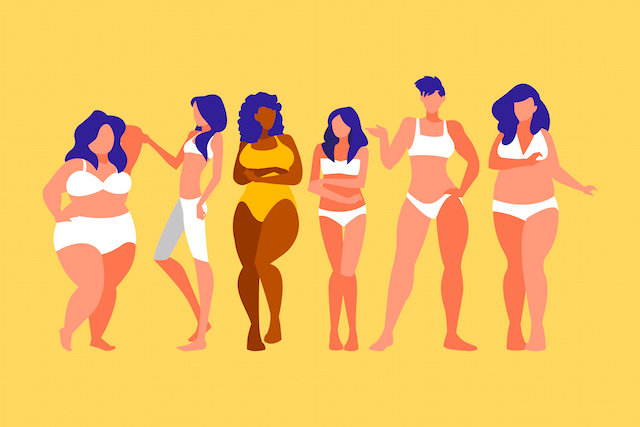
“The most difficult times for many of us are the ones we give ourselves.” ~Pema Chodron
I’m on my phone, posting a photo of myself on Instagram. It’s a vulnerable shot—I’m holding my bare belly.
I type in the caption “Accepting my body isn’t easy, but it’s worth it.”
I mean this, but I also have voices in my head telling me to delete the picture because I’m gross, not good enough, and a phony.
I get half a dozen comments supporting me, mostly emoji hearts. One comment reads, “I wish I had your confidence.” I feel weird reading it because my feelings are mixed. I don’t necessarily think of myself as confident all the time.
In fact, my reality is that I’m struggling with body image more than I’m swimming in acceptance. I think about how this person is comparing their backstage to my highlight-reel.
We do that—we look at ourselves as “not enough” and think that others have it all together.
We’re our harshest critics, and we hyper-focus on aspects of ourselves and bash them. We think that behind closed doors we are monsters. But when we focus all of our attention on that behind-the-scenes person, we’re not taking into consideration how human others are, too.
The truth of the matter is that things aren’t always as they appear on social media. Yes, I realize I’m calling myself out, but I think it’s important for people to know that even people who seem wildly body-positive struggle, too. I mean, body acceptance is damn hard.
I didn’t get to this point overnight, finding relative peace with myself. It’s been a long time of hating myself and wishing I was different. Even with finding some peace, I’m not “cured.” I don’t have a magic dose of body love all of a sudden.
In fact, body acceptance doesn’t have to be self-love at all. It’s commencing on a simpler level. How about I just try to find acceptance in myself to think that this is how my body is at this moment? This is where we are, here in this body. It’s simple, but not easy.
It’s important to note that body acceptance is a moment-to-moment thing rather than a state of being in which you exist. It’s something that has to be fought for but is sometimes settled on.
My background is that I’ve had eating disorders over the years, I’ve dieted like it was going to save me from body image issues, and I’ve had long periods where I weighed myself every day. I’ve also counted Cheez-Its out of the box, vowing to eat only the serving size. I’ve suffered in not accepting my body and instead succumbing to diet culture.
At points, I thought I had it under control. I had dieted just right. I had even lost some weight. Inevitably, though, the self-disgust seeped in. I fell off the wagon over and over again, binging, particularly on sweets and foods high in carbs—the very foods I was depriving myself of.
I’d say, “screw it” and I’d devour pizza with friends. I’d eat alone with a carton of ice cream or a box of cookies. Binging was inevitable after deprivation. While the high was fun during, it led to being sick and hating myself even more.
In a fit of despair, I’d vow to “get back on the wagon” the next day.
I’d tell myself I was definitely going to do better next time, but next time never permanently came. I may have been able to string together a few days of what I saw as “good” eating, but never lasting change.
I got to a point where I felt defeated.
Diet exhaustion looked like no longer finding joy in foods. It felt like a rock in my stomach. It sounded like sighs from having to make what felt like complicated food choices over and over again every day.
I couldn’t count my Cheeze-Its anymore. The scale was haunting and owning me. I feared social gatherings with friends, sometimes even avoided them. The next diet be it Keto or Whole 30 just sounded like another opportunity to fail.
I got tired of chasing my tail. Diet culture wasn’t working for me anymore.
What was the alternative? My ears started to perk up when I saw body-positive content on my social media feed. There were promises of body freedom and breaking the cycle of binging. I couldn’t believe it, but I thought about trying it for myself.
The only thing was that I was terrified of trying it this way. The path of body acceptance sounded like giving up to me. It was far from it, though.
I don’t remember if I googled body positivity, ran into it on social media, or some combination. I remember the despair I felt in searching for it. Thoughts passed through my mind like “could this work?” or “could this be real?” For so long all I had known was war with my body.
While I was terrified, the positive effects of body acceptance began to flood my world in the best way possible.
I found influencers like Lauren Marie Fleming, Megan Jayne Crabbe, and Jes Baker. These women showed me that you could be happy and free in any body type. They started to break down those ideas I had about fatness and even what constitutes health.
I started my journey. I downloaded all the podcasts I could on the topic: Food Psych and Love, Food were my favorites and top-ranking in the podcast charts. I filled my arms with books like Health at Every Size by Linda Bacon and Shrill by Lindy West. I religiously followed Instagram influencers like Virgie Tovar and Tess Holiday.
Their messages were essentially the same:
- Your size doesn’t determine your worth.
- People can take actions to be healthy at any size.
- Food isn’t to be defined as “good” and “bad.”
- Dieting doesn’t work, and long-term weight loss from dieting is not sustainable.
- All bodies are good bodies.
- You can listen to and trust your body.
These are just a small handful of the variety of beautiful messages I got from these amazing body-positive activists. They brought me hope.
I also compared myself to them.
I imagined their lives being perfect. I believed they had totally overcome diet culture and were floating above the clouds in body acceptance land. I thought that in order for me to experience freedom, I had to completely rid myself of negative thoughts.
My backstage looked more like some body-accepting thoughts mixed in with a whole lot of self-loathing. Even today, I look down at my belly in disgust some moments. I guess the difference is that I have tools and messages to turn my thinking around these days.
Some horrible thoughts that actually go through my mind are:
- You’re only worthwhile if you’re thin.
- No one’s ever going to love you.
- You’re a failure and pathetic.
- You ate terribly today.
- Tomorrow I’ll eat “better.”
I’m not immune from these thoughts just because I strive for body acceptance. In fact, these thoughts infiltrate my thinking regularly.
It’s not a matter of having negative thoughts or not, it’s what I do with them.
What I do with them these days is breathe through them. I turn them around and don’t let them control my life. In turning them around, I tell myself things like:
- You’re worthwhile at every size.
- You’re incredibly lovable.
- The only thing that’s failed is diet culture’s promises.
- You were feeding your body the best you could.
- There’s no hope in a diet tomorrow.
I want others to remember this when they think that myself or any other body-positive person on social media has it all together. I have to remind myself, too, when I go to compare my insides to another person’s outsides.
We’re all just trying to figure it out, perhaps fumbling in the process. Those of us who are lucky enough to be working toward body acceptance know that this journey isn’t perfect. Changes aren’t going to happen overnight. Even the changes that do happen aren’t totally polished.
Just as others don’t know all that’s going on inside of us, we don’t know what’s going on inside of another person. They could be struggling just as we are. Attempts to mind-read only bring pain.
What if that person you’re admiring is thinking the same self-deprecating thoughts as you are about themselves? What if they’re not happy with the way they’re eating and their relationship with their body isn’t nourishing?
You can’t compare what’s going on inside of you to what’s going on outside for another person. All you can do is work to have the best relationship with yourself as possible.
Acceptance is difficult and a process. In no way am I saying that it’s easy breezy. We wouldn’t all struggle so hard with accepting ourselves if it was easy.
By recognizing that the person in the picture is just a human being, we see that we can have acceptance for ourselves, too. So, stop measuring yourself up to someone else. You’re your own person, flawed and beautiful. You deserve your own acceptance.

About Ginelle Testa
Ginelle Testa is a passionate wordsmith. She's a queer gal whose passions include recovery/sobriety, social justice, body positivity, and intersectional feminism. In the rare moments she isn't writing, you can find her doing yin yoga, thrifting eclectic attire, and imperfectly practicing Buddhism. She has a memoir coming out with She Writes Press in September 2024. You can find her on Instagram.









 Though I run this site, it is not mine. It's ours. It's not about me. It's about us. Your stories and your wisdom are just as meaningful as mine.
There are so many things people struggle to accept. Some people are fine with the way they look, but perhaps believe they are ‘not clever enough’ ‘not rich enough’ etc etc. When we view any kind of advertising, we should ask ourselves ‘does this really relate to me or is it someone trying to exploit me for profit’ We are all, each and every one of us, entitled to be our true selves and in this world are many many true selves who deserve to be seen.
Good stuff right here. 🙂
Great article. We live in such a hyper-competitive/comparative culture. Defining ourselves by how we look or what we do is normalized. We forget that there’s a ‘real’ me in there somewhere. Deciding who and how I wanted to be and having regular check-ins with myself has helped tremendously. As long I remain vigilant to MY standards I am content. Age has forced me to accept that old guy I see in the mirror every morning. Now he smiles back at me. Thanks for writing. Namaste.
It takes courage and honor to open like this! Thank You for your insight.
Body positivity is baloney. It’s fake. It discriminates against women and other body types and ages. It’s sexist. It’s ageist. It means nothing. Body positivity does nothing to help a woman find her power, her self esteem. It locks women into being nothing but their body.
Body positive models like the insufferably smug Tess Holliday promote the same crap we women are fed our whole lives. She’s young, attractive and made up with more paint than a Sherwin-Williams store, i e., women still have to define themselves as what is sexy to men. If you’re an older woman, or slim, or not willing to look like a pinup model 24/7, then the body positivity movement doesn’t want you. It’s an exclusive club and it promotes delusion, lying to yourself and letting wounds fester. Body positivity addresses not what empowers our souls, not what makes us individuals, but rather what fake means we are supposed to utilize in order to look like the narrow definition of an attractive woman. Young. Sexy clothes. Lotsa makeup. Hypocrisy at its finest. And its most damaging.
This article proves my point. It focuses on the body, on looks, it obsesses. I had anorexia and bulemia for almost two decades. I know all the pain expressed in this rather beautifully written article. But, affirmations don’t work. They never will. To heal from an eating disorder, one must go deeper than the surface. The mind is sick and the soul is sick. No matter how much how talk to the mind, your soul knows the truth. Your soul needs to heal.
Seriously, forget those body positivity models who exhibit no personality, no smarts, nothing substantial. They shill for the patriarchy. Find your soul’s medicine. Acupuncture, Reiki, EMDR. These go beneath the surface. Especially EMDR, if acupuncture and Reiki aren’t your bag. EMDR will rid your body and soul of the trauma that created the eating disorder and the self-hatred. If you are willing to go deep and face the demons and trauma and get rid of it, then you can heal. Not everyone is willing to do the work. But it’s worth it.
Thank you. Body positivity is well and good, but from what I’ve seen in My 600-lb. Life, many fat/obese people have mental health problems eg. childhood sexual abuse, which don’t get dealt with with the BP movement.
I feel like struggling with body acceptance is only half the issue. These thoughts of self hatred, can easily be present in other areas of life. So is the problem really how you feel about your body? Or how you feel about yourself? Personally, I found that positive affirmations don’t work when I don’t believe them.
What has helped is challenging these negative thoughts, proving to myself that they’re not true. Also, like Jill Meredith suggested, dealing with the trauma. I chose to see a psychologist.