

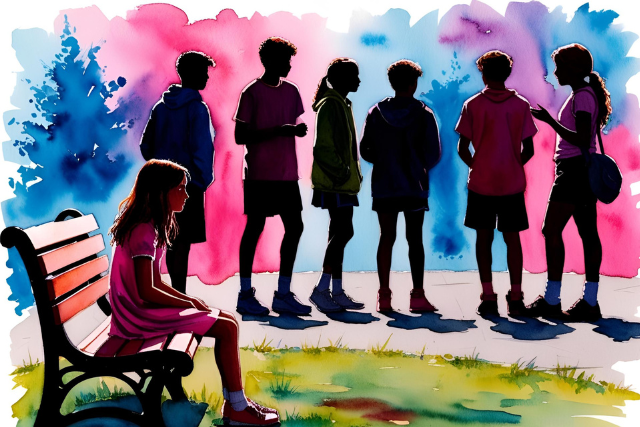
“In a world where you can be anything, be kind.” ~Unknown
“Girls are mean!” I nodded knowingly as my boss struggled to explain the difference between raising boys and girls. I couldn’t speak to raising boys, but I remembered all too well what it was like when my daughters were growing up.
Girls traveled in packs, always with a leader at the helm. And almost every week, one of the lesser-ranked members was cast out, ostracized from the group. More often than not, it was one of my daughters. I distinctly recall their heartbreak—the kind of deep, inconsolable sorrow that only a child can feel when their world is upended.
Then, just as suddenly as they had been exiled, the social winds would shift. They’d be welcomed back into the fold, all smiles and laughter, as if the agony of rejection had never happened. And just like that, it was another poor girl’s turn to bear the brunt of exclusion. My daughters, now safely back in favor, never hesitated to play along, inflicting the same pain they had so recently endured—all in an effort to stay in the leader’s good graces.
It’s easy to think of this as just ‘girl drama,’ but is it really? I found myself wondering: is meanness learned, or is it wired into us? And oddly enough, my horse helped me answer that question.
From Outcast to Enforcer
A few years ago, I moved her to a new home, where she had to integrate into an unfamiliar herd. The top mare wasted no time making it clear—she didn’t like my mare. For two weeks, every time I arrived, I’d find her standing alone on the outskirts, gazing longingly at the hay she wasn’t allowed near. And every time, she would run to me, silently pleading for help.
It reminded me so much of my daughters. It broke my heart.
But then, something shifted. Slowly, she earned her place. She ingratiated herself with the top mare. They became inseparable—best friends. And soon enough, it was my mare turning on the others, asserting her own dominance.
Watching my mare transform from the outcast to the enforcer unsettled me. I realized—this wasn’t cruelty. It was instinct. The unspoken rules of survival. And the more I thought about it, the more I saw those same rules playing out in my own life.
Sure, we may not bite or chase each other away from the hay, but we have our own ways of keeping the social hierarchy in check. The whispers. The inside jokes are at someone else’s expense. The subtle shifts in who gets included and who doesn’t.
Had I been any different? Had I, too, learned to play the game—shifting, adapting, and excluding, not out of cruelty but out of the same deep, instinctual need to belong?
Were We the Mean Girls?
I don’t really remember the “mean girls” when I was in school. But looking back… that probably means I was one.
I never thought of myself as particularly cruel, but I do remember moments that make me wince now. One in particular stands out.
There was a girl in my class—let’s call her Claire. She was bright and talented, and she attended speech and drama classes. One day, in a rare moment of vulnerability, she opened up to us. She admitted that when she was younger, her parents had sent her to those classes because she had a speech impediment. She had worked hard to overcome it, and in that moment, she was trusting us with a piece of her story.
And how did we respond?
We laughed. And worse—we turned it into a joke. Every time she was in earshot, we’d start singing “Words Don’t Come Easy.” It was meant to be funny, just harmless teasing. At least, that’s what I told myself at the time. But now, I cringe at the memory.
She had been brave enough to share something real, and instead of honoring that courage, we used it against her.
At the time, I didn’t think of myself as mean. I wasn’t the ringleader, just someone going along with the joke. But does that really make it any better? Looking back, I realize that staying silent—or worse, laughing along—makes you just as much a part of the problem.
If anyone I went to school with happens to read this—especially Claire—I’m sorry.
Do We Grow Out of It?
I’d like to believe that kind of behavior is just a phase—something we grow out of as we mature, as our empathy deepens, as we learn to control our baser instincts. After all, kids can be cruel, but their brains aren’t fully developed. They act on impulse, driven more by the need to belong than by a true desire to hurt anyone.
Surely, then, adulthood brings wisdom. Surely, we learn to be better.
Sadly, that’s not always the case.
We like to think we’ve evolved beyond schoolyard cliques, but the truth is, meanness just becomes more subtle. Instead of playground exclusions, it’s office gossip. Instead of outright teasing, it’s backhanded compliments and judgmental whispers. The tactics change, but the instinct remains.
How to Break the Cycle and Choose Kindness
The instinct to exclude, judge, or tear others down may be wired into us, but unlike my mare, we have something powerful: awareness and choice. We don’t have to follow our instincts—we can rise above them. Here’s how.
1. Recognize the pattern.
The first step to change is awareness. Meanness doesn’t always look like outright bullying—it can be as subtle as rolling your eyes at someone’s success or staying silent when a friend is being excluded. Start paying attention to the moments when judgment, gossip, or exclusion creep in. Ask yourself:
- Why am I doing this?
- What am I gaining?
- How would I feel if I were on the receiving end?
2. Challenge the scarcity mindset.
Much of our instinctive meanness comes from a deep-seated belief that success, beauty, or belonging is limited—that if another woman shines, it somehow dims our light. But that’s simply not true. There is enough success, happiness, and love to go around. Lifting others up doesn’t take anything away from you—it strengthens everyone.
3. Replace gossip with encouragement.
Gossip is a social bonding tool—we do it to feel connected. But there’s a better way. Next time you’re tempted to tear someone down in conversation, flip the script.
Instead of:
“Did you see what she was wearing?”
Say:
“I love how confident she is to wear that!”
Compliments—especially when given freely, without expectation—have a way of shifting the energy in a room.
4. Make kindness a habit.
Kindness isn’t just about grand gestures—it’s in the small, daily choices.
- Smile at a stranger.
- Invite the quiet colleague to lunch.
- Defend the person being talked about behind their back.
- Support your friends’ successes without comparison.
The more you practice, the more natural it becomes.
5. Teach the next generation.
If you have children, especially daughters, talk to them about social dynamics. Share your own experiences. Show them what healthy friendships look like.
When they come home upset because they were left out—or because they left someone else out—help them navigate those feelings with empathy and self-awareness.
6. Be the one who makes room at the table.
In every social group, workplace, or community, there are people on the outskirts—just like my mare once was. You have the power to invite them in. Inclusion is a choice. So, the next time you see someone being left out, be the person who makes space for them.
Final Reflection: Who Do You Want to Be?
Every day, we have a choice. Not just in grand, dramatic moments—but in the quiet, ordinary ones.
The choice to include.
The choice to uplift.
The choice to be better.
So today, ask yourself: Who needs a seat at your table? And will you make room?

About Samantha Carolan
Sam Carolan is a personal development blogger and EFT coach passionate about helping women embrace the beauty and challenges of midlife. Through her work at Loving Midlife, she offers insights, tools, and inspiration to navigate life’s transitions with grace and resilience. When she’s not writing or coaching, Sam enjoys reading, horse riding, and yoga.









 Though I run this site, it is not mine. It's ours. It's not about me. It's about us. Your stories and your wisdom are just as meaningful as mine.
Hi .Although I agree with the constructive comments such as kindness etc. I strongly disagree with 'us', as being , especially taring women, as mean.
The experience of this writers childhood does not bear any resemblance to mine and my attitudes to friends
and people,throughout my life. I am horrified by the sexist attitudes in this piece of writing.Thank you so much for taking the time to share your thoughts.
I’m truly sorry that the piece felt hurtful or sexist to you—that was never my intention. I write from a deeply personal place, and this blog reflects my own experiences growing up. I absolutely recognize that everyone’s story is different, and I’m really glad to hear that your experience was more positive.
My hope in writing this post was not to make sweeping generalizations, but to open a conversation—about how subtle forms of exclusion, criticism, or competition can sometimes shape our relationships, often in ways we don’t even realize until much later. I also hoped it might invite reflection for those who have felt wounded or have unknowingly wounded others.
Your perspective is a valuable part of that conversation. Thank you again for adding your voice.
I hope you sent this same sentiment to whoever wrote the script for Mean Girls 1 and 2 movies.
I really don't agree with your generalised statements like "girls are mean" and "girls traveled in packs, ALWAYS with a leader at the helm"
I'm a girl, I have never experienced what you're stating as facts nor have I seen it happen around me.
Yes, some people had mean behaviour and I've seen bullies but that's not specific to girls. I have been bullied, by boys.
There was no "leader" in the girls around me.
I agree with J that this article feels very sexist.
Thank you so much for sharing your thoughts—I really appreciate you being part of this conversation.
I'm genuinely sorry that the post came across as sexist. That was never my intention, and I deeply regret if any part of it felt hurtful or dismissive of your experience. The blog was written from a very personal place—rooted in reflection, not fact.
Watching my daughters navigate hurtful behaviour from peers made me reflect more deeply on my own time in an all-girls school. It prompted me to look back honestly at moments when I may have stood by or joined in, and to ask myself how I can be better, now and going forward. Writing about it felt vulnerable—almost like a confessional—but I hoped it might resonate with others who’ve had similar reckonings.
I absolutely respect that your experience was different, and I’m really glad to hear that it didn’t mirror mine. We all carry different stories, and that’s part of what makes these conversations so important.
Do you see the Mean Girls movies 1 and 2 as sexist?
I want to say thank you for your courage and honesty in writing this article. Your work itself impressed me as a reader, but also made an impression on me as a person.
Thank you so much for your kind words.
Not sure why anyone would have anything negative to say about this post. It was thoughtful, sincere, and much needed. I've also noted how SOME women (not all) can act this way. Kids in general are mean; they're still learning social skills. When it comes to adults, we assume they've practiced people skills enough to know how to treat others fairly. Unfortunately, many people (men & women) are insecure, envious, or haven't been taught compassion. Some are downright narcissistic. I wish that all women would see each other as helpers and encouragers not rivals.
Hi Anna Maria,
Thank you so much for taking the time to share your thoughts. It really means a lot to me. I love that this post has opened up space for these kinds of honest conversations—it's exactly what I hoped for.
I completely agree with you. It’s heartbreaking that insecurity and competition can sometimes get in the way of real connection. I believe we’re meant to lift each other up, and hearing your perspective just affirms that even more.