


“Our ancestors knew that healing comes in cycles and circles. One generation carries the pain so that the next can live and heal. One cannot live without the other, each is the other’s hope, meaning and strength.” ~Gemma B. Benton
I thought I had no value, my opinion meaningless. My sense of self was decimated. Finally, I got angry and attacked.
“You can’t imagine the pain you’ve put me through!” I yelled. “You don’t even know who I am. You can’t see it. You’re refusing to take responsibility for the way you raised me! Not thinking is not an excuse! You don’t even care to try to understand what you’ve done to me!”
This was me to my retirement-age parents about a year ago. Those yelling sessions happened several times. They called the police on me once.
None of it did an ounce of good. They can’t see it.
The more I have experienced with depression, anxiety, and recovery, the more I am convinced that the events and circumstances of my past—and my parents’ past—have shaped me much more than my brain chemistry.
I’m pretty confident that the problems I’ve suffered from are derived from generations of unhealthy behavior. I believe the effects of intergenerational trauma shape us much more than we might realize.
I’m not a researcher, so I only have my own experiences to base this on; it very well could be different for someone else. But from what I’ve seen from my grandparents through my kids, this succession of trauma is difficult to break. It takes different forms, but it always rears its ugly head. In my grandparents, it was alcoholism; in my parents, physical abuse; me, emotional abuse.
I don’t consider any of us to be bad people, but we have each passed horrible things on to our children.
My mom’s dad was an alcoholic and very strict. Her mom didn’t actively do anything wrong, but she turned a blind eye to what her husband was doing. Mom won’t talk directly about it, but reading between the lines, I believe her brother abused her as well.
My dad’s dad was killed in a car accident when my dad was five. That left my dad as the man of the house, with no father figure. His mom never remarried and worked full time to support the family, meaning my dad was mostly on his own.
So then, this is how it all added up for me: Because of the abuse she suffered, my mom became a narcissist with no empathy. My dad became an absentee father who always blindly agreed with my mom. I was raised so that every good thing I did reflected well on my mother, and every mistake I made was my own fault.
It took me forty-four years to unravel all this. I’m still trying to figure out who I really am. I know I crave attention and approval from women. I’m insecure and selfish. At times, sometimes for long stretches, I distance myself from my wife and kids. But I’m working on it.
I’m also working on forgiving my parents. It’s not easy, but I know it’s necessary for me to keep progressing. They’re just flawed people, like me, after all. I’m mainly having trouble with my mom, a selfish, self-centered, and ignorant woman.
If I forgive my parents, it will be for my own peace of mind. I will know then that I did everything in my power to make peace with them. That doesn’t mean, though, I want to keep them or my extended family in my life.
Some people aren’t going to change, and we each have the right to decide whether we want that kind of person around us. I feel that most of my family is dysfunctional. It’s a really tough decision.
My mom’s favorite excuses for her behavior, which she refuses to acknowledge, are “That’s the way I was raised” and “I never thought about it.” Must’ve been glorious to live a life and raise a child without responsibility.
I know I need to do better. I need to take responsibility for creating change and break free from the intergenerational beliefs and behaviors I see as unhealthy. My family sees this as a rebuke.
To find my hope, meaning, and strength, I may have to leave my entire family behind. That’s a heavy decision, but it’s one I will probably need to make.
It will mean that I’ve learned the lessons of my parents and used them to bring power and strength to myself and my children. I can only hope that happiness and peace come along for the ride. That would be the greatest gift I could give to my kids.
I can’t sit around waiting for the negativity and condescension to go away, or for them to make an effort to understand my problems. In order for me to get better and start living my own life, I need to be the one making the rules. I need to be positive and I need to take care of myself.
In being raised as children and in raising our own children, we receive many messages. Some are helpful, some are hurtful. We need to be aware of those messages as adults, discarding the harmful ones and emphasizing the healthy ones. We need to be honest with ourselves and others, and willing to admit when we’re wrong. We need to constantly question everything.
Some of the messages I received growing up were “You’re not as good as you should be,” “Conformity is good, being different is bad,” and “You don’t matter enough,” sprinkled in with healthy doses of guilt.
My wife and I have tried to instill the opposite in our kids. Everyone matters. Your opinions and feelings are valid and important. Be yourself and follow your dreams.
None of this is easy. It takes awareness, courage, and the determination to live a better life.
Some will have bigger hills to climb. Some will look around and find the support they need has been around them all along. Others will be alone and will have to dig deep inside themselves to find the strength to live better.
No matter our situation, we all deserve the happiness that comes with living our best lives. And the secret isn’t money or success; it’s filling our lives with love. This requires us to heal any childhood wounds that prevent us from giving and receiving love.
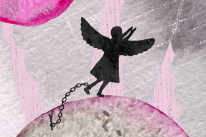
Your present may be built on your past, but it doesn’t have to be controlled by it. In order to break the chains of intergenerational trauma, you will most certainly face some serious challenges. Here are some recommendations from my experiences that may help you.
Have courage.
If you look at your past with clear eyes, you’re likely to see a fair bit of unpleasantness. Pain, abuse, manipulation, deceit could all be there. And they could be coming from people you love.
Facing all of that will take courage and energy. It’s difficult and emotionally exhausting to look at your life objectively. You have to keep reminding yourself to see what’s really there rather than what you’ve always thought or what you want to see.
Going against the tide of several generations of family is a daunting prospect. You might alienate or offend people you love, but you are worthy of living your life your way.
Things don’t have to be the way they’ve always been. You don’t need to suffer just because your family chose to suffer in the past. But, understand this is difficult work.
Have confidence that doing this healthy work for yourself is worthwhile. Stay focused on self-care and keep your eyes on the bigger picture.
Have a support group.
A support group can be built of any mixture of people. Friends, relatives, co-workers, or even strangers. It can be formal or informal. The best support groups possess various experiences, perspectives, and personalities.
What you are doing is huge, and it’s going to be a significant help to have at least one or two people you can lean on while you do this. If you have more, great. But don’t try to do this alone; find yourself a support system before you start.
My support group is patched together from people who have read my articles and responded to them, people I know from online interest groups, and a few people from real life, too.
My group has layers, an inner circle I hear from often, a group that checks in every couple of weeks, and a group that is just more encouraging when they hear what I’m up to.
I’ve had the gift of actually growing my support group while I’m going through this. I’ve opened up to some people and found that we’ve been through similar circumstances. This can give you new ideas and solutions to your problems.
And don’t forget, a doctor, clergy member, or a therapist can be part of this group for you. You can also consider trying organized local support groups if that appeals to you.
The more love and support you can gather around yourself, the more strength and conviction you will find you have. This love and support feeds off itself. The more you give, the more you get back.
Have motivation.
Remember why you’re doing this. You’re setting out to build a better life for you and your children. The thought of overcoming this pain can be a liberating and positive force.
Being aware of what put us where we are today will not only give us the motivation but also the direction we need to create positive change for ourselves and our children.
Not all the changes we make will be successful, but if we keep going and correct our mistakes, we can still help ourselves and our kids learn healthier behaviors. We can stop perpetuating a lineage of abuse, domination, neglect, hurt, and unhealthy coping mechanisms.
There’s no finish line in overcoming intergenerational trauma. Keep being aware. Keep moving forward, and be the force that is constantly pushing toward healthy change in your family.

About Jason Large
Jason Large has been experiencing depression and anxiety for twenty-six years. He has recently made a link between his own troubles and his family's history. He writes with the hope of helping others in similar circumstances. If you’d like, you can reach Jason on jasonlarge73@gmail.com.








 Though I run this site, it is not mine. It's ours. It's not about me. It's about us. Your stories and your wisdom are just as meaningful as mine.
This was a good read and I can identify with a lot of it. I do feel though that you’re being a little harsh with your parents. It sounds like that might have been your mother’s way of apologizing (maybe that’s the only way she knows how). If someone is taking the time to hear you out and admit they’re wrong, in my opinion that means something. That person clearly cares to hear how you’re feeling and what you have to say. I too have delt with abuse and I understand fully loving people from a distance. I do not however understand bashing someone who cared to listen to your feelings and validate them. As you said, she suffered abuse as well so I feel you should show a little more empathy. Also, your behavior toward your parents sounds a little abusive as well. It is great that you are “breaking the cycle” with your own children so that they may not have to endure trauma.
Thank you so much Jason for this article. It hit so close to home. I decided in 2010 to go no contact with my mother due to her emotional and mental abuse. I have had my ups and downs with the decision but ultimately I have found peace. I get lonely as there isn’t much family in my life and I wish it was different. However, the walking on egg shells and trying to be the perfect daughter was exhausting. I am not at the point of forgiveness yet but I know I will get there one day.
I would like to thank you for your story and description of the linear process taken by multiple family generations and the knock on effect this travels through them. I, like yourself, have fought long and hard to understand the dysfunction and complexities I’ve grown up, and struggled in, but unlike you I was the youngest of 4&the only girl born to older parents who are no longer alive so I cannot discuss the history with them. I have long since decided to extricate myself and, surprisingly my 4 daughters from the extended blood line, in the name of honesty, decency and what I consider a more forgiving lifestyle. I am a recovering alcoholic/addict and practise the 12-step programme in my life, something that has benefitted all of us and I have made my amends to my children for my errant and ignorant parenting passed down by my parents. I consider also that we are all collectively recovering from CEN, as detailed by Jonice Webb in her literature and referred to on Tiny Buddha often, and think of our lives as a journey of discovery and replenishment. I thank you again for your post and hope to read more of your thoughts in the future xx
What a brave post.. thank you for sharing and good luck in your decision
Good to read Jason .
Glad you found very healthy mechanisms to help you and subsequently your family.
Thanks for sharing.
X
Sometimes it is ignorance that makes people become who they are and passing it on.
Wow this reminded me of my family. I’m 23 and I moved out last year. I know I’m a positive influence on my brothers lives (14 and 11) and it kills me that they live with 2 alcoholics that argue daily. It made me grow up with a lot of anxiety and I don’t want them to have the same problem. Not sure if there’s anything I can even do
This article was excellent Mr. Large. Bless you.
Hi Harmen,
It sounds like our situations are pretty similar. Thanks so much for sharing your story. I’ve started doing some research on this topic, and what I’m finding is that trauma is usually passed down through three generations – Our grandparents, our parents and us. The trauma is transmitted behaviorally as you would expect, but also becomes imprinted in our DNA. It’s basically unavoidable. It’s up to us to choose how we deal with it.
All the best,
Jason
Your article helped me enormously at a moment of imminent relapse. I can relate to every single word you wrote (I just don’t have a support group as I find it hard to connect to people). It was great to read this today and wake up, pull myself together and stay focused again so that my son won’t go through what I’ve been through (hopefully!). Thank you.
I agree..
If I dont separate from my parents, replase is evident and I know the blame will always be on me. I choose life and positivity. If that means removing them from my life…so be it! Be encouraged
Thank you for sharing on Tiny Buddha. I know not where I come from, nor where i am going, but stories like these show me that I’m not the only one.
My mother passed in ’04, my father in a home. My father drank a lot and caused much trauma in our house growing up. My mother tried to do right, but it was difficult I imagine. I miss her now more than ever. I’m 50 now and only just began to understand things better and am just beginning to find myself. (cliche, but true) I recently left my wife and kids cuz I was doing more harm than good. I miss my wife and kids immensely, but they don’t feel the same.
Again, thank you.
Incredible! and so helpful. Thank you!