

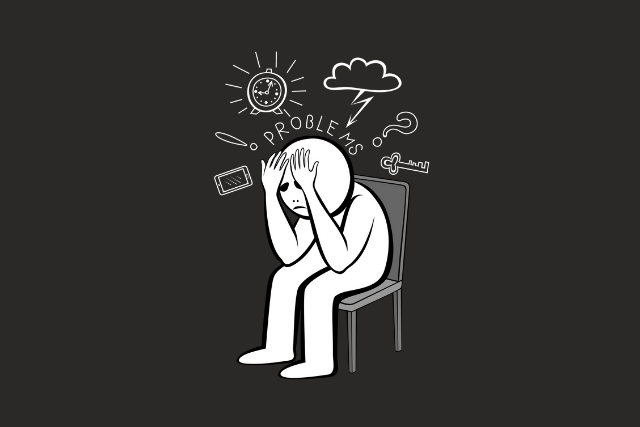
“Anxiety is like a rocking chair. It gives you something to do, but it doesn’t get you very far.” ~Jodi Picoult
Many years ago, I worked in the technology sector in Austin, Texas, which is a big “tech town.” I was incredibly focused on building my career and earning a higher and higher salary.
I also have two daughters, who were in elementary school at the time. I’m divorced and am the primary care giver for them. Like so many divorced moms, I was doing a lot.
I would run through a mental list of daily to-dos from the time I woke up and continue to do so throughout the day. I didn’t want to forget anything. I was juggling home life, work life, and trying to have a personal life too.
Overwhelmed? You bet I was.
I frequently felt like I was rushing from one thing to the next, all day long. Rush to get the kids and myself out the door in the morning. Rush to work.
At work, I would be focused on getting everything done so I could be out the door in time to get home to make dinner and help with homework. I usually also had some sort of housework to do in the evening.
I rushed to get my daughters to bed on time and hoped I would have enough time for some “me time” so I could actually relax and have some quiet time before bed.
But, I’d already be thinking about the list of things I had to do the next day, and the cycle would start all over again.
What I thought I felt was stress. We all hear the phrase “I’m so stressed out,” particularly when we have a lot going on. That described me perfectly. I was constantly busy, so I was constantly stressed.
Or so I thought.
What I actually was suffering from was high-functioning anxiety.
High-functioning anxiety isn’t a specific type of anxiety, but rather a term that refers to anxiety where the individual is still highly functioning, with the anxiety “just below the surface.”
Think of high-functioning anxiety as hidden anxiety, where others may not realize someone has anxiety at all.
Individuals with high-functioning anxiety are often very successful and tend to be high achievers. Their anxiety doesn’t prohibit them from accomplishments. In fact, their anxiety may be part of the reason they are successful.
Their anxiety drives them to do more in both their personal and professional life. To outsiders, they will appear put-together, competent, and often appear calm.
But on the inside, those with high-functioning anxiety spend a lot of time overthinking and ruminating. They are afraid of failure and worry about what others think of them.
This described me perfectly.
I had never heard of high-functioning anxiety and had a perception of those with anxiety as people who are fearful, wide-eyed, and maybe even shaky or jittery. I thought that people with anxiety couldn’t function “normally” and that their anxiety would perhaps even be debilitating.
I didn’t think that anxiety applied to me at all.
But I am high-achieving and successful, and anxiety is a big part of what got me to where I was at that point in my life. I didn’t realize that I had anxiety, and no one else would have either.
That constant mental to-do list I mentioned? That was me overthinking. And it wasn’t just my daily to-do list that I was overthinking, it was everything.
I overthought regarding my daughters and their school work. I overthought about what needed to be done in terms of housework. I overthought about other people and their motivations, why they said specific things or why they didn’tsay things.
My mind was constantly going, chattering away.
I had my sights set so high, particularly as it pertained to my career, that I was afraid of failure and thought the mental obsessions at work were me just “pushing myself” or me doing a good job.
Truly, I thought that the way I felt was part of what gave me my edge, and that people I thought of as less successful were people who were lazy, or didn’t spend time thinking enough about how they wanted to be and how they wanted to get somewhere in life.
The problem is that those with high-functioning anxiety are just as at risk as others with an official mental health diagnosis of an anxiety disorder. They are prone to mental and physical fatigue, and could be likely to use alcohol or drugs as a coping method.
And I did get mental and physical fatigue. In fact, I wound up developing a severe autoimmune reaction that was triggered in part by the anxiety. I had been operating at a heightened state for so long that my body and nervous system could no longer cope.
My body just “gave out.”
That illness was a huge wake up call for me and led me down a path to healing myself that I never could have anticipated. I took a holistic approach to healing that included a radical diet change, journaling, and energy healing.
I also started to do a lot less. I let things go because I had to.
It took me about a year and a half to heal my body and along the way, it was my mind that healed too.
I started to really assess who I had been and the path I had been on, and frankly, how unhealthy I had been in my mental churning and preoccupations. I still didn’t realize that I had been in the throes of high-functioning anxiety (I stumbled upon the concept later), but I did realize that I didn’t want to be the person that I was before.
I wanted to be at peace.
If you suspect that you have high-functioning anxiety, know that you can heal also.
One healing technique I often use, still to this day, is the “feet on the floor” method, which is a very simplified but highly effective alternative to meditation. It can be done either sitting or standing.
With your feet on the floor, focus on feeling your feet touching down. Feel your entire foot as much as you can: heel, sole, ball of foot, and toes. Still focusing on your feet, take a few deep breaths.
When you feel your feet on the floor, you become very present to the moment and get out of your head. This technique brings you into the moment and can help calm you down, particularly when you feel yourself spiraling with racing thoughts.
Plus, this technique is super sneaky. You can do it anywhere and no one knows you’re doing it. You can be sitting at your desk at work, standing in line at the grocery store, etc. and no one around you will have any idea you are using this technique.
The more you practice feeling your feet on the floor, the more often you’ll automatically do it without having to remind yourself to do it. Once you feel yourself start to get anxious, you’ll use the technique almost like second nature, because you’ve trained yourself to do it and it is so effective.
Another way to manage your high-functioning anxiety is to make abstract art that represents how you want to feel instead of anxious.
You don’t have to consider yourself an artist to use this technique. A simple blank white sheet of paper and some markers are all that are needed. Just let your hand flow with colors, shapes, and patterns that represent how you want to feel. If you do happen to be artistically inclined, you could draw a self-portrait or you in some scene or setting where you feel calm and joyous.
When you’re creating art, you’re accessing a totally different part of your brain than you use when you’re in the midst of anxiety. Being artistic is a way for you to tap into another part of you that is outside of the anxiety. Plus, it can be very cathartic to create.
Use these two techniques often, plus focus on making small changes and know that it will take time to heal. You’ll have good days and bad days. In working through your anxiety, focus on the good feelings when you have them and tell yourself that you want more of them.
They will be your anchor.

About Heather Rider
Heather Rider, known professionally as The Energy Synergist, is an anxiety specialist. She is a former overworked, overstressed perfectionist. While working in the Austin high tech industry, she developed a severe autoimmune reaction that was triggered in part by high-functioning anxiety. She now works with high-achieving, high-stress women who are ready to shift out of anxiety without the use of pharmaceuticals, using nontraditional, holistic approaches to healing. www.theenergysynergist.com.











 Though I run this site, it is not mine. It's ours. It's not about me. It's about us. Your stories and your wisdom are just as meaningful as mine.
The human condition is a spectrum of emotion. Anyone would experience stress and anxiety overworking themselves. Anyone can get ill doing that over a sustained period.
The issue is these negative beliefs you had which only resolved somewhat when reality forced you to understand that they weren’t true and appropriately modify your behaviour.
Do you still believe that people are lazy? Or do you believe that people have different experiences and different levels of ability to cope for various reasons?
Society pushes a lot of harmful beliefs on us because they make us consumers and producers. It’s how capitalism functions.
People struggle with so much and if they don’t talk about it, it can be difficult to see. The majority of people are doing the best they can to cope with their personal struggles and survive.
Thank you for sharing your story. I think I’ve definitely had a bit of this. I ended up in hospital last year with strange symptoms that the doctor didn’t understand. Turns out it was caused by anxiety. I do have generalised anxiety disorder but I have to say I identify with a lot of what you’ve shared in your story. I have been put on medication for my health as I really needed it to function. I’ve noticed that I’m less perfectionist and lazier now. A part of me hates that, but it’s made me realise that maybe I was too highly functional. Everything had to be perfect and when things went wrong, I couldn’t cope well. I’m learning to relax now and I feel great. Art definitely helps, and meditation, and grounding. I like your idea of focusing on the feet. I’m encouraged by what you said that the healing takes time. I expected it to happen almost immediately, but it seems to come in steps. I’m working on my thoughts and that helps.
Be gentle with yourself and realize that taking a break is not being lazy. Glad the “feet on the floor” idea sounds good to you!
Thank you for sharing the 2 techniques to get out of the anxiety mode.I have been following the first one and it really helps. will try the art technique too 🙂
I’m so glad these techniques are useful to you!
Hi Heather, I know I’m late to the party but thank you so much for posting this! I relate to many things that you wrote in here (including the autoimmune reactions too), and this makes me feel like I’m not alone in experiencing it.
I have always been very anxious due to my hectic working schedule. People always tell me that I’m doing relatively well in comparison to others which often made me feel like I am undeserving of help from others. Many times I felt guilty because society always pushes me to sort my problems on my own, by saying that ‘there is always someone in a worse situation than you’. As a result, for years I coped with many issues alone that looking back now, were things and issues that do require help from family and friends (and even sometimes, professionals). This made me develop depression and anxiety over the years, and I felt the constant need to contain all my emotions and stress so that I can still function and no one can see it (which feels awful). It was only when I gathered my strength to ask for help and redefine my expectations of myself that things start to get so much better.
The techniques you wrote here are super useful, and love how I can use it whenever I need to. I’m glad that this topic is discussed and it certainly made my day! Take care and I hope that you’ve been doing well.
Ana-Rosa, Thanks for the response and sharing your personal story.
Do you have any other techniques? I definitely have high functioning anxiety. However the art technique won’t work for me. I will try feet on the floor but hoping you have another tip. I am a graphic designer, and art director and creating art causes me more anxiety. I just find myself self critiquing and having it to be perfect, and thinking about all the work projects and freelance projects that require attention.