


“Setting boundaries is a way of caring for myself. It doesn’t make me mean, selfish, or uncaring just because I don’t do things your way. I care about me, too.” ~Christine Morgan
In my early twenties, I could shout into a megaphone at a political rally of thousands, but I couldn’t decline drinks from strangers at the bar. I could perform original music for an attentive audience, but I couldn’t tell my friends when I felt hurt by something they’d said. I could start a business, advocate for new laws at City Hall, and share deeply personal poetry on Facebook, but I simply couldn’t speak up for myself in moments of conflict.
At the time, I had no idea that boundary setting and speaking up were systemic issues millions of people struggled with. I didn’t understand that my inability to set boundaries probably originated in my childhood as the cumulative result of my untended emotional needs.
I just thought I wasn’t trying hard enough.
I judged myself mercilessly for being unable set boundaries. I spent many mornings scribbling viciously in my journal, unpacking the previous day’s events. These are unedited excerpts:
“She asked to reschedule our meeting, and even though I promised myself I’d never schedule an early-morning phone call again, I did—for 7:00am. Ugh. Why didn’t I just ask her to reschedule?”
“I resent him so deeply for how he treated me, but when I saw him in the coffee shop yesterday, I acted like everything was peachy keen. What the hell? I’m so frustrated. How do I get better at standing up for myself??”
Woven tightly around my self-judgment was a thick mesh of confusion. I was the type of person who looked forward to therapy, hoarded self-improvement books, and spent evenings with girlfriends unraveling the scrappy tangles of our psyches. I liked understanding myself. You can imagine, then, that I was totally and completely flummoxed by my inability to understand—never mind remedy—my people-pleasing habit.
Most of the time, the thought of saying no—to friends, family, lovers, and colleagues—simply didn’t enter my mind space. No matter how uncomfortable or unsafe I felt, the only future that felt available to me was one in which I pleased the offending person and later felt victimized and resentful.
Other times, when I felt brave enough to simply entertain the notion of saying no, I felt a heaviness in my chest and a closing in my throat. The words literally couldn’t escape my mouth.
My friends who had no issues setting boundaries were wary of my explanations. To them, setting a boundary was like swatting an annoying gnat. But to me, it was like battling a saber-toothed tiger.
I wish I’d known then what I know now: that boundary setting isn’t a simple box to check off of your self-care to-do list. It represents a complicated matrix of issues related to one’s family of origin, socialization, limiting beliefs, and, most importantly, one’s relationship with oneself. Setting boundaries is the final step on an extensive journey of self-reflection and diligent practice. Had I understood this years ago, I would have been able to reassure myself:
You are not weak.
You are not stupid.
You are doing the best that you can.
We set boundaries to protect ourselves. In order to protect ourselves effectively, we need to know what we’re protecting. Developing a rich understanding of our own needs, desires, values, and vision gives us the firm sense of identity we need to keep from wavering in our commitment to speak our truth.
When I didn’t have a clear sense of who I was or what I wanted, it was easy to let others define me; wait for others to speak up for me; resent people who didn’t proactively predict or meet my needs; prioritize others’ needs over my own; and seek value from external sources, like whether others liked me or found me attractive. Combined, these tendencies were painfully disempowering. I often felt like a shadow of myself.
I first began to build a solid sense of identity after I went through a devastating breakup with a long-term partner. My codependency had been a contributing factor to our separation, and I was finally beginning to understand that I couldn’t expect others—lovers, parents, friends, or colleagues—to be my purpose for living.
I also couldn’t allow external measures of success—like climbing the career ladder, losing weight, or winning awards—to be the driving forces behind my behavior.
I had to go deeper. Here’s how I did it.
Step 1: Meet your fundamental needs.
At first, I wasn’t sure where to begin. I mean, how do you build an identity?
In that fragile state of post-breakup unknowing, questions like “Where do you see yourself five years from now?” or “What direction do you want to take your business in?” were enough to reduce me to tears. I didn’t know what direction I wanted my career to go in. I didn’t even know how I would get through the weekend.
What I did know was that I wanted Kava tea before bed, and that I couldn’t sleep without lavender oil in my diffuser, and that going on long walks around the park with my best friend made my heart feel lighter.
As I explain in my previous post about discovering what you want when you’re a people-pleaser, these mild, uncomplicated wants were sacred whispers from my innermost self. By pursuing these small desires, I learned to trust myself.
Maslow’s hierarchy of needs gave me a helpful roadmap as I became more accustomed to taking care of myself.
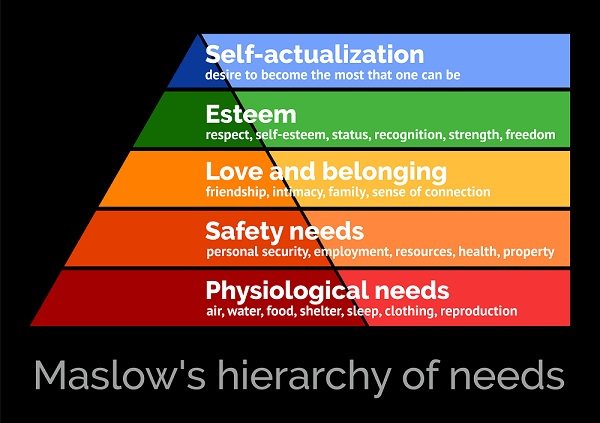
Recovering people-pleasers like me rarely meet our own needs and/or prioritize others’ needs instead. Oftentimes, we neglect even our most elementary needs at the bottom of the hierarchy.
In the past, for example, I regularly cancelled dentist appointments and annual physicals, though I fiercely encouraged others in my life to take good care of themselves. I didn’t get enough sleep and postponed trips to the grocery store.
Only when I began to meet these primary needs did other, more complex desires arise. We must meet our own fundamental needs on a regular basis in order to construct the firm foundation upon which our sense of identity will be built.
Step 2: Uncover your core identity.
Over months, I slowly climbed Maslow’s hierarchy, continuing with basic self-care as more vibrant desires surfaced. I began to crave rich social connections, meaningful bonds with family members, travel, and dancing. My natural curiosity, which I hadn’t felt connected to in years, awakened.
Ultimately, I found myself considering how I could make the most of my life—how I could self-actualize and “become the most that one can be.” I considered the following questions during my morning journaling sessions:
- Vision: What do I want my future to look like?
- Identity: Who am I and what roles do I play?
- Values: Which principles or morals most resonate with me?
- Skills: What abilities do I possess?
- Desires: What do I crave?
Exploring my identity across multiple planes gave me the chance to learn how expansive I actually was.
For starters, I possessed far more skills that I’d ever given myself credit for! I was uniquely empathic, a good listener, organized, and great at designing systems.
I learned that I valued personal freedom, self-expression, financial responsibility, and playfulness.
As someone who was recovering from a codependent romantic relationship, I was stunned to remember that I was sister, a daughter, a coach, a community leader, a best friend, and more.
Wide-eyed, I realized that I was so much more than the shadow-self I’d felt like months before.
I’d spent so much time defining myself by others that this simple exercise—putting my pen to paper and exploring myself for thirty minutes—was a milestone: not only because of what I discovered, but because I took the time for myself to do it at all.
Take some time to explore your own roles, values, morals, abilities, and desires. It’s easier to set boundaries to protect the things that matter to you most when you’re clear on what those things are.
Step 3: Bring your authentic self to your relationships.
In retrospect, that early period of self-discovery was the most profound period of my life to date. It was characterized by the uncompromising commitment to prioritize my innermost self. Most importantly, those months provided me the firm foundation I needed to bring my authentic self to my relationships with others.
Boundary setting is like working a muscle—difficult and exhausting at first, but eventually, second nature. With this new understanding in hand, I began to tentatively set firm and healthy boundaries in my relationships.
At first, simply saying no to a party invitation was a challenge. But I did it.
Not long after, I set non-negotiable work hours and withdrew from a few extracurricular commitments that no longer served me. It was hard, but also felt totally righteous.
As I pocketed these small successes, setting harder boundaries felt less impossible. Eventually, I told best friends when their actions upset me; terminated romantic partnerships that weren’t meeting my needs; and unpacked old childhood hurts with my parents. I’d be lying if I said I didn’t dance around my kitchen once or twice—okay, definitely twice!—totally overjoyed that boundary setting was coming more easily to me.
After each difficult conversation, rocky though it may have been, a weight lifted from my chest. In the absence of that weight, I could navigate the world more freely. I noticed that I was more present for my clients, more playful with my friends, and more authentic with my family. Relationships that had once been a source of resentment finally felt nourishing because I was bringing my full self to the table.
Notice when you’re being inauthentic in your relationships so can you start creating this same freedom for yourself. Practice communicating what you think, want, and need and sharing how you honestly feel. Once you start working this muscle, it becomes much easier to set boundaries in all areas of your life.
It’s A Lifelong Journey
Putting my truth into action is a lifelong journey because my truth is always changing. My relationships grow, my needs shift, and my identity—the very bedrock of who I am and what I’m protecting—transforms.
Years later, I still occasionally find myself challenged by moments of confrontation. In those moments, I always harken back to the fiercely empowering truth that I set these boundaries to protect the vibrant inner self that I’ve come to know and respect.
I like to remember that this journey may not be linear.
I like to remember the progress I’ve made so far.
Most importantly, I like to remember to have patience and compassion for this inner self of mine. She has become so brave. She exposes herself to the elements, and risks being seen, known, and loved by herself and by others.

About Hailey Magee
Hailey Magee is a Codependency Recovery Coach who helps individuals conquer people-pleasing, set empowered boundaries, and master the art of speaking their truth. She has worked with over 100 clients from the US, Canada, Ireland, France, South Africa, and more. Sign up for a complimentary consultation to learn how coaching can help you live from a place of authenticity and inner freedom. You can follow Hailey on Facebook and Instagram, or visit www.haileymagee.com.
- Web |
- More Posts











 Though I run this site, it is not mine. It's ours. It's not about me. It's about us. Your stories and your wisdom are just as meaningful as mine.
Knowing how to love myself , uncompromisingly committed to meeting my inner needs first and setting boundaries are the best things that ever happened to me, the world and people around me. It`s unbelievable to see how much you have let yourself down for too long when you get to this realization but having empathy and compassion gives you the power to heal, forgive and let go. Thank you for the beautiful article.
Great Article! Setting healthy boundaries not only protects ourselves but those we engage with. It is perhaps a odd paradox that healthy boundaries open us up.
Thank you, @disqus_fFiHFldEHi:disqus! Agreed; boundary-setting is totally beneficial for all involved!
I can understand how difficult it can be for anyone raised to believe that others matter more than they do. I was constantly being told by my adoptive father as a child that I must do well at school so that he would be proud of me. Ironically, what he did, was make me resent schoolwork because I knew it was all for him not for me. Equally ironically at the great age of 63, I find that I love learning new things. It is important to remember that people who truly care for you, will never demand you do things simply for them and their egos. Easier said than done ( as are most worthwhile ventures ) but well worth the effort.Some people, even if we are related to them in some way, are best deleted from our awareness.
So true, @sianelewis. It’s really cool to hear how you rediscovered your curiosity and interest in learning years later, too — a very affirming experience!
Thank you so much for this Hailey. This article is so beautifully written. A lot of what you said resonated with me. I was an only child, but even then, I never felt like I was either of my parents’ first priority. My dad was too busy having affairs, and my mum was too busy trying to keep his attention. Counselling and support from friends and other important people in my life have slowly helped me recognize that I have needs. Needs that weren’t met when I was growing up, and that it is okay to say no when my parents put me down or walk over me. Thank you.
@disqus_W7hhQVUujQ:disqus, thanks so much for sharing this <3 It's invaluable to have those support systems later in life who can help remind you that your needs are valid, too!
I enjoyed reading this post because I feel like so many others can relate of feeling unheard or not able to truly show our authentic selves. I have a similar journey where I was helping to empower others in my job within social work, but inside it was (and sometimes still is) to speak out my boundaries. I realize now that it is like a muscle and I have to keep on using it until it feels so natural that I don’t even have to remind myself. I can’t wait to see that part of my journey, thanks for sharing!
Karen, totally! I love thinking of boundary-setting as working a muscle because it gives us permission to take it slowly, work out by work out, and gradually watch that strength grow over time. There is a kindness and compassion within that method of personal change. I’m wishing you the best; can’t wait to see what lies ahead for you! <3
Really good article. I always look at beautiful people and don’t get why they have boundary issues. I think that if I established boundaries I wouldn’t have any human in my life.