

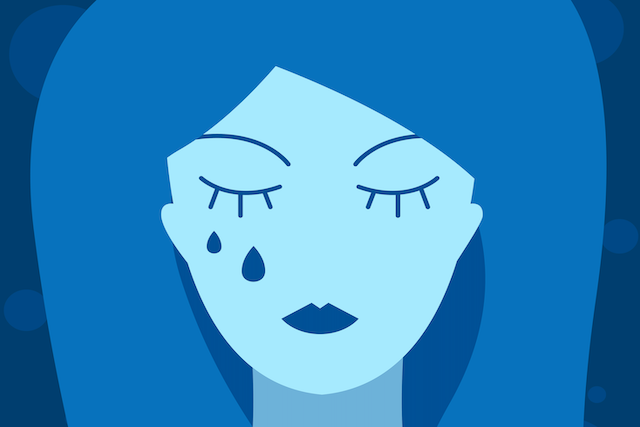
“The answer to the pain of grief is not how to get yourself out of it, but how to support yourself inside it.” ~Unknown
Since losing my husband Matt over eight months ago to cancer at the age of just thirty-nine, I have noticed so many changes happening within me, and one of those changes is a fierce sense of protectiveness that I have over my grief.
We are living in a unique time in history. The world has turned upside down due to the coronavirus pandemic, and at the time of writing this the UK had just passed 100,000 Covid-related deaths with many more not involving Covid.
That is an obscene amount of grieving people, and when I also consider the fact that not all loss is related to death, I suspect that everyone in the country is experiencing grief on some level right now.
But I worry that this universal loss has become so entrenched within our daily lives that it is now considered the norm to be traumatized.
The news of more deaths no longer seems to shock us. We’ve become detached from each other in order to survive and preserve ourselves, and this is being reinforced daily with messages of staying home and socially distancing.
Our human need for closeness and connection has become secondary to the very real threat to life we are facing, and so we willingly obey to these new rules—we wear masks and keep away from each other, we retreat, and we don’t complain about the psychological wounds we are facing as a result of this because the alternative is even worse.
There is a collective sense of numbness, which is a well-known coping mechanism for extreme levels of stress, and I cannot help but tune into this from my own fear response.
I also feel numb sometimes, and I can certainly see the rationale for adopting this defense mechanism, but this is why my grief feels like a gift to me now: I am thankful that I can connect with and embrace my feelings of pain and anguish. This is my healing; this is me moving through life as I know I was intended to do.
We weren’t made to deny or repress our emotions, we were made to learn and grow through them, because emotions are energy and energy needs to move. When I refuse to allow my emotions space to be present within me, they become trapped inside.
I know this because it has happened to me before. Grief is strange, it is the most painful and intense experience I have ever had, and yet it is also recognizable to me. I know that I have felt it before but in a different form and at a different time.
Deep down I also have an inner knowing that I am meant to feel it. In the past, I was scared of the enormity and intensity of my emotions, and so was everyone I was close to. They would recoil when I expressed them, so I would repress them instead and do everything I could to push them down.
The result? Years of suffering with anxiety, depression, and unexplained physical illness and ailments, which I now understand to be a manifestation of my trapped trauma.
Bessel Van der Kolk defines trauma as “not being seen or known.” To be truly seen is to risk vulnerability, but we are continuously shamed for being truly vulnerable in our society, a society which rewards busyness and productivity above our human needs.
Unfortunately, this mutual denial can prevent us from healing. In our culture there is a lack of tolerance for the emotional vulnerability that traumatized people experience. Little time is allotted for the working through of emotional events. We are routinely pressured into adjusting too quickly in the aftermath of an overwhelming situation.
So, we have a problem. At a time when more of us than ever need to embrace vulnerability to avoid retraumatizing ourselves with a lack of connection to others, we are simultaneously battling with a sense of internalized capitalism. Which do we choose? Authenticity or attachment?
I believe that we need both, but I also believe that it must start with authenticity, and here’s why.
My grief feels sacred to me, like it’s the last bit of my love for Matt that I have left, and for that reason I refuse to let it pass me by without really experiencing and cherishing it.
I recognize that the authentic, broken me is just as important as the joyful, whole me, and that I cannot expect to experience one without the other.
I do not wish to drift into a false identity where I am always “okay” or “fine” or “not too bad” when anybody asks because really that is all I am permitted to say in those moments. I cannot speak the truth because the truth is unspeakable. There is an unspoken rule that we must never expose our pain in too much depth, we must keep it contained within a quick text message or a five-minute chat in order to help keep up the illusion that we have time for compassion within our culture.
But we all know that’s not the truth if you live as we are subliminally told to live—with a full-time, demanding, and challenging career and a mortgage to pay, with a family to look after and a social life to uphold, with a strict routine that includes time for exercise, meal planning, and keeping your appearance aligned with what is currently deemed socially attractive, and with just enough spare time to mindlessly consume the latest Netflix drama.
It really leaves little to no time or the emotional energy it would take to fully witness another person’s pain. So, we turn away from it instead, because we know that if we dare to look a grieving person in the eye, we can locate the universal phenomenon of grief within ourselves and find some affinity to it. And that throws up all sorts of questions that go against our busy lifestyles we are grappling to keep hold of.
When I have too many superficial exchanges, however well-meaning they are, I end up feeling more disconnected and lonelier than if I hadn’t had an exchange at all, so I choose solitude instead.
Some pain cannot be spoken of, it can only be felt, and for me, that can only happen when I have the space and time to intentionally tune into the feelings, without having to cognitively bypass them at every opportunity. However, without a witness to my pain, I never truly feel seen or known either.
The more time that passes, the harder it is to bring Matt up in the brief conversations I am still able to have or to express my true feelings.
I’m aware that with time my grief becomes less relevant as more and more people are experiencing their own losses. But I have barely even begun to process Matt’s death. He died during the pandemic, and I am still living in that same pandemic eight months on. I have been locked away for my own safety and for the safety of others, so the true effects of my loss and the trauma attached to it won’t be fully felt until the threat has lifted.
My brain has been wired for survival for almost a year now—what must the effects be of that?
I am afraid that the rawness of my pain has a time limit to it, and if I do not fit into the cultural narrative of grief, then I will be rejected, and it’s that fear of rejection that continues to pull me away from sitting with my pain. I have become hypersensitive to other people’s reactions, and I can sense when my pain is too raw and uncomfortable for them, so I avoid the loudest and most consuming part of me to enter the conversation in order to make them more comfortable
But… I’ve noticed a pattern happening when I prioritize others’ comfort over my authenticity.
I begin to suffer. I experience emotions like fear, anger, and guilt, and these pull me away from the pure-ness that is my grief. Pain and suffering are not the same thing. Pain is a necessary component to healing and growth, but suffering is a bypassing of the raw pain underneath.
I believe that the key to healing is to embrace the sorrow of loss throughout life. Loss happens continuously, but we often forget to experience it because we glorify the illusion of always being strong, mentally healthy, and resilient.
Fear is a block to healing. It activates our survival brain and keeps us there. Never feeling safe enough to process our emotions, we continue to suffer instead.
Alice Miller, the renowned swiss psychologist, coined the phrase “enlightened witness” to refer to somebody who is able to recognize and hold your pain, and this becomes a cycle. Once you have had your authentic pain validated and witnessed, this frees up space for you to become an enlightened witness to another.
That is why I believe there are so many people needlessly suffering right now. We are all afraid to confront the human condition of pain because we are afraid to lose our attachments to others, so we mask it and avoid it and deny it at any cost.
I am terrified of losing my attachments to others too. I am terrified of ending up alone, and I am terrified of never being loved again. But I am more terrified of having to sacrifice my true self in order to gain that love.
So, I vow not to put my grief on hold, and I welcome you to join me. However deep the pain becomes, I encourage you to sit with it and honor it as being a true reflection of the magnificent intensity of being human.

About Claire Austin
Claire is a Creative, Person-Centred Counsellor and Supervisor working with all age groups but specialising in healing Trauma in Children and Young People. She loves to help others to re-connect and re-claim their own spirituality and authentic selves. You can find Claire’s services here on Facebook. Since losing her husband in 2020 she has also started writing her blog Forever39 where she writes him letters to help her process her grief. You can connect with Claire via her blog here.





 Though I run this site, it is not mine. It's ours. It's not about me. It's about us. Your stories and your wisdom are just as meaningful as mine.
Challenging post… I’m not sure what to do with it… Maybe that’s was the point
I wonder if it hasn’t always been this way.
Thankyou for sharing and letting yourself be seen
An image that came to mind was the still point that is dancing. Can we experience and honor grief and dance? To Engage and respond to Life as it is while at the same moment ‘sit in it’?
I watched the movie “In and of Itself” last weekend. Everyone so badly wanting to be seen and at the same time terrified of being seen… the sound of the revolver turning to chamber a round that may or may not be their, Click… It broke my heart open.
I don’t know…
“I asked of my soul, be still and wait without hope, for hope would be hope for the wrong thing;
Wait without love, for love would be love of the wrong thing;
There is yet faith, but the faith and the love are all in the waiting…
Wait without thought, for you are not ready for thought:
So the darkness shall be the light, and the stillness the dancing.” TS Eliot
My father recently passed and I find myself seeking that stillness…
I don’t think the world has become desensitized about loss. In fact, in this last year, the thing which has directly resulted in us coming together for each other, has been loss, grief. We all grieve in our own way and time. But, we are not solitary creatures. We require a human touch, a kind word, a hug, a prayer, a smile. Even in grief we need each other.
I have lost my mom and it is killing me
I have lost my mom and it is killing me
I hope you will be okay, please spend time with the others in your life and let them help you with what you’re going through. I had to respond because I’m so terrified of losing my mom lately, I really hope you’ll be okay.
My mother died in 2019 of a lupus related complication with her kidneys and lungs. I remember knowing deep down after several weeks on a ventilator that she was ready to go. I remember sitting in the hospital room feeling grateful I could be there, to hold her hand, stroke her hair. It felt sacred. It was and still is sacred. My grief was a holy thing, a necessary thing. I remember how people treated me differently and I found myself trying to put on a mask of numbness. I could barely manage a true smile, so I chose neutrality just to get through interactions with others. But I would write poems, talk to her out loud, and eventually made my own little shrine I would change with flowers, shells, stones, etc. little things I thought she’d love to see or ask about if I showed her. I know now I was honoring not just her, but my grief and loss. I still honor it today and it changes shape and color as time goes on. In a way, it helped me be present for others grief, too. I’m glad I never suppressed it. If my tears broke out in front of someone I learned to say, “I miss her,” instead of apologizing. Sometimes the other person could even stand in that moment with me. Others were not ready or were equipped to handle it, and I did not take it personally. But our grief is ours, each one unique, like the person we miss. Thank you for writing this, I believe there are so many who feel as you do who needed to hear this today. You are honest and vulnerable and that speaks straight to the heart of grief itself.
Claire, your article resonates with me on so many levels I won’t even start to respond or I’ll never stop! I became a widow 2 & a half years ago ( I have finally stopped counting the days and weeks) He was 54 and sickened and died in a short 6 weeks so there was no time to “prepare” for grief. Afterwards there was so much to do and organize that grief got put on hold for a fair while. When it did hit, I was sideswiped by the intensity and depth. However, I had previously learned enough about the process to approach it with a degree of “curiosity” about how it was affecting me and everything around me. My childhood was “stolen” by my Mother’s mental health issues and I recognized the grief of losing that little girl.
Luckily, I have made it out the other side a stronger, more resilient human being, living a successful single life. I love and appreciate the people around more deeply. At 60 I’m even considering another relationship.
I hope your journey (and indeed, that of the entire Globe) continues to it’s natural conclusion and you (we) reach the other end of the tunnel of grief and detachment and out into the embrace of the sun and each other.
Dear Claire, I know there isn’t anything I can say that will lighten your grief. But I do know that just knowing someone wishes they ‘could’ lighten your grief made me feel better when my mom died last September. I hope that’s true for you, too. If I was there I would bring you luscious brownies, a hug, and two ears to listen. In the meantime, I wish you comfort and love in your journey.