

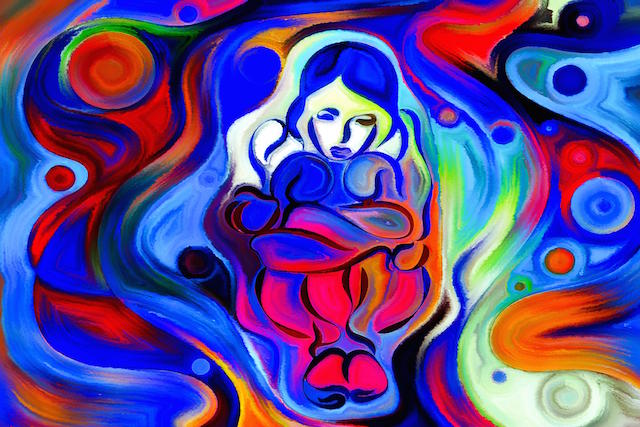
“There is some kind of a sweet innocence in being human—in not having to be just happy or just sad—in the nature of being able to be both broken and whole, at the same time.” ~C. JoyBell C.
“I just feel like it’s never ending… like I should be more over it by now,” my friend says, her eyes looking down at her mug of tea. She lost a loved one three years ago in tragic circumstances.
Her words make me sad, and there are layers to my sadness: I’m sad for her loss, her grief, for the difficulty she faces daily as she continues her life without this person. Also, I’m saddened by her belief about her suffering; that it’s somehow not okay or normal to still be so sad.
This is not a woman in ruins. She has a good life. A job she loves, a beautiful home, and family. She’s a wonderful mother to her children. But she is deeply sad. She carries this sadness around with her everywhere she goes—on the train to work, on the sofa while she watches Netflix, out to dinner.
Her sadness is heavy, yet she carries it with a grace that belies its weight. It’s not ruining her. Yet it’s there, like a psychological shadow, even in her happier moments.
This conversation made me think more broadly about our societal beliefs about loss, our attitudes toward sadness, and the inherent problems these give birth to.
My grandmother died over six years ago now. She died horribly and quickly from a brain tumor. From the time of her diagnosis to her death, there were only three weeks.
Her death didn’t feel real for a long time, and initially I didn’t grieve as I expected I would.
Months afterward, it started to sink in. As it did, the sadness came. It didn’t consume my every waking thought and feeling, but it was there beside me, wanting me to turn toward it. For a long time, I found this very hard to do.
My cultural conditioning that sadness was ‘bad’ added a toxic layer on top of the raw experience of sadness and made me feel somehow ‘wrong’ each time I felt sad.
A Kind of Healing-Perfectionism
“Get over it.”
These words suffuse the space around us, deeply ingrained in the cultural lexicon of healing. “I’m over it,” we say to ourselves. We assure others that they will do the same. Worst of all, we hold the belief that we should be over it by a certain time.
We believe that this is the hallmark of a perfectly recovered loss/trauma/sadness—the gold standard of “I am perfectly okay now.”
Is anyone ever perfectly okay? Is this really what we’re aiming for?
Is there anyone who doesn’t walk around with the roots of sadness grounded in their being, even as their happiness exists above these depths? I don’t know of these people.
What I do know is that the greatest lie we’ve been sold about success and happiness is that these things exist in our lack of sadness or pain.
The notion of “getting over” a loss speaks more to an ideal than a reality. Like many ideals, it’s alluring, but the closer you move to it, the more you see the danger. It gets in the way of our understanding about loss and grief, and it congests the fullness of our hearts.
It disconnects us from our emotional truth and gives credence to an expectation about the course of grief that we cannot live up to. When this happens, there is one predictable outcome: We add judgment to our suffering and turn a natural process into a pathological problem, something to be ‘fixed.’
Certainly, when it comes to dealing with loss, there are times when a normal emotional response can turn into a condition in need of intervention—if our initial sadness fails to abate with the passage of time, and we continue to be obsessed with our grief and unable to function in our everyday lives.
In such cases, therapy and possibly medication are required. Yet, within the boundaries of what can be considered a healthy reaction to loss, there is a great range.
What does a normal, healthy response to loss look like? How should it feel? How long is it okay to still experience sadness? When should we get over it? Should we ever? Says who? Why? What does “getting over it” even mean?
When we think about the need to get over a loss, what we’re referring to is arriving at a psychological destination of being untouchable, unshakable. Reaching a point where we are largely unaffected, even by the fondest memory, or the most difficult one, of that which we have lost.
It’s a kind of healing-perfectionism that needs to be named for what it is. Such ideals around suffering cause further and unnecessary pain and obstruct the very heart of what it means to be human. When we use the language of “getting over” loss, we are reinforcing the belief that sadness is something that must be overcome.
Co-existing with Our Sadness
We are conditioned to move toward things that feel good and to retract from those that feel bad. Primally speaking, it’s about survival. Sadness is one such ‘bad’ feeling; we recoil from it. Yet this retraction isn’t so much based on the inherent quality of the emotion as much as our insidious belief that sadness is, per se, bad.
Of course, sadness isn’t a pleasurable experience—psychologically speaking, it’s classed as a “negative” emotion. However, we are not simple beings, and the primal drives we have are not so simple either; as such, it is often necessary to go against our basic instincts—to move away from pleasure (as in the case of addiction) and to move toward pain (as in healing).
In healing from loss, ignoring and resisting our sadness will only send it deeper into our psyche and our bodies. One thing we know for certain is that when we fail to acknowledge our feelings, they continue to affect us anyway—influencing our thoughts, our emotions, and our decision-making beneath the level of our conscious awareness.
One of the biggest problems with the idea of getting over loss is the implication, and subsequent expectation, that there is a life span to our sadness. A progressively tapering timeline where, after a certain point, the volume of our grief has reached a finite baseline—zero.
Depending on our unique losses and our personality, the acceptable lifespan might be one year, two years, three years, four. But at some point, as time marches on, we’ll turn to our sadness and ask it why it’s still sitting with us.
We’ll start to tell ourselves that it’s “been too long.” Yet, try as we might, we cannot force or sadness to leave, so we’ll do the only thing we can: turn our minds away from the sadness that lingers on in our bodies. We’ll disconnect.
We Can’t ‘Fix’ Our Sadness, and We Don’t Have To
Whilst Elizabeth Kubler-Ross may have delineated the stages of dealing with death (denial, anger, bargaining, depression, and acceptance), these were originally meant for those who were themselves dying, not for those who were dealing with the death or loss of another.
An unfortunate consequence of applying the concept of linear stages of grief to our human experience of loss is, again, the expectation of a finite ending; we go through the stages and we reach The End.
The less convenient truth is that grief is non-linear; there is no one pattern it’s obliged to follow.
Yet this concept of a finite resolution speaks to our society in a broader sense. Humans are exceptionally good at finding solutions. If there’s a problem, we solve it. If something’s broken, we fix it.
This way of thinking is part of what makes us great; without it, we wouldn’t have the technological advances we have. But the problem arises when we apply this mode of thinking to our human suffering.
Our bodies can be fixed; we can give someone a leg when they’ve lost one, sew a deep cut, stop an infection with antibiotics. But what of our sadness in the face of loss? How are we to ‘fix’ that?
When we’re sad, we are not broken. We are suffering, and this is different. Sadness is a normal response to the experience of loss. Yet in a culture obsessed with fixing what’s broken, the idea of “getting over it” starts to infiltrate the rawness of our experience and dilutes the edifying, tragic beauty of living with loss.
Making Space for Our Sadness
It also speaks to our discomfort with ambiguity and paradox, especially in the realm of our emotions. We cling to our separate boxes; we seek the clear delineation of “I’m over it” versus “I’m still suffering.” Such thresholds don’t exist in life, nor in love.
But rather, two opposing, seemingly contradictory emotions coexist; I am both okay and I am suffering. We must give ourselves permission to be the complex and contradictory beings that we are if we want to be fully human.
Healing is not a line, but a wave. It’s organic, meandering. It doesn’t always move in one direction with one energy. But the most important thing is that it moves—if we allow it to.
When we have lost, we must learn to live side by side with our sadness. Attempting to shut it out will shut everything out. There is only one highway where emotions in the body make their way into the awareness of the mind; joy, sadness, frustration, peace—they all travel along this same road.
There are no alternate routes. Which is why when we judge our sadness and push it away, we inevitably push away our joy also. Rather than wasting our energy on the hopeless eradication of sadness, we must make a home for it. A place where it is welcome to live.
We, in the West, are not so hot at embodying the truth that our sadness has a right of its own; we can’t really control it, any more than we control our joy. Certainly, we can’t structure our life around it, but we can make a space in our life for it to coexist.
Its resting place is in the same sweet spot as our deep joy and gratitude. Sometimes I say to myself, “My sadness is a person too.” This is how I think of it. And in this thought, a respect for it arises.
Side by Side, Sadness and Love
Our belief in the notion of getting over our sadness also robs us of one of the most beautiful opportunities of healing—experiencing love by the act of remembrance.
The thing that keeps our sadness close is remembering the love we hold but cannot give to someone we’ve lost. Memories are how we relive a person. They’re a way that we honor the existence of another. They’re also how we re-live a part of ourselves and bring meaning to our life.
In our remembrance, we suffer. We feel sadness. And there is such poignant beauty in this; it’s an edifying kind of pain because it’s born from the depths of our love. To never feel sad, then, would be a kind of forgetting.
The last thing we want to do when we’ve lost someone we love is to forget them. And yet, when we buy into the belief that healing means a lack of sadness or pain, we avoid the memories of the people we’ve lost, and in our avoidance, we disconnect from our love. Because to feel this love is also to feel the pain of it.
Where does the love we hold for someone who is no longer with us go? It lives in us. But to breathe life into it, we have to let it live in our hearts right next to the pain that love and remembrance bring.
When we do this, we soften. There is a release. We expand. We connect, both to ourselves and also to others.
Compassion can only exist between equals; when I know my suffering and let it speak to me, I can see and speak to yours.
You don’t need to overcome your sadness. That is not the measure of your healing.
The measure of healing lies in the relationship between you and your sadness. You don’t have to make friends with it, but you do have to learn how to allow it to live in you, to respect its right to be there even as you respect your wish that it wasn’t.
This is no small feat. It is the most courageous and bold thing you will ever do, to live in that dichotomy. To inhabit that space.
Let this be the measure of your healing.

About Claire Rother
Claire Rother is a somatic practitioner, nervous system expert, trauma coach, and integrative health specialist. She helps others to reconnect to their innate wholeness, transform trauma, recover from burnout, and create embodied experiences that deeply honor and nourish them. Her work is a passionate and soulful fusion of mind-body modalities that blend together science, somatics, and psychology. You can follow Claire on Instagram here and learn more about her and her work on her website here.




 Though I run this site, it is not mine. It's ours. It's not about me. It's about us. Your stories and your wisdom are just as meaningful as mine.
The longer I don’t see my dear man the harder it gets, sadness is always there and everyday panic attacks comes on an instant sometimes waking up having one, I wouldn’t of thought that would ever be a issue or possible. The only thing that helps is sedation meditation. I know I’ve got a long way to go.
This is likely the best article I have ever read on loss. Truly.
I think people usually say “maybe you should get over it” to those with an “unhealthy” fixation on sadness.
3 years of depending on the kind of relationship is perfectly normal. And your friend sounds like is managing their grief in a healthy way.
The problem is when it’s managed in an unhealthy way and develops or feeds into an existing mental health issue.
You’re right sadness doesn’t go away entirely. But it does taper and become easier to manage with time and therapy.
*trigger warning*
8 years after being raped I still experience flashbacks. They’ll likely never go away. In the past I was traumatised by them as well as by the experience itself. I didn’t want to feel the pain. It seemed overwhelming.
Since then my reaction to the feelings has changed. I accept the feelings, I address them and I don’t fixate on them. Flashbacks hurt in the moment, but to a lesser degree and I don’t because I don’t fixate on it, it doesn’t cause a lasting mood.
Hi Helena, thank you for taking the time to share your thoughts and personal story.
I am so sorry for what you went through.
My heart is glad that you have been making progress on your healing journey and that you are better able to accept and address the feelings you have. I salute you. Claire x
I so wanted to agree with this article, especially since I totally buy into the basic premise: we never “get over” a tragic loss, a terrible injustice or other awful situation. Never do we think about losing our mother to that drunk driver and say “Yeah I’m cool with that. It doesn’t make me sad!”
While the exact lexicon of how to deal with sadness is limited by the imperfect tool of language, I view it as some mix of “move past” and “properly contextualize” as opposed to “get over.”
Sadness is a perfectly healthy and human emotional reaction to negative stimuli. Something bad happens and we’re sad, while when something good happens we’re happy. That’s totally normal.
When we think about something terrible that happened in the past, we should feel sad. That’s what for me is wrong with the “get over it” terminology. The question is: we’re living in the present. Why are we thinking about the past? There are many good answers to that of course, but in many cases there are not: our thoughts are causing our suffering.
Sadness can be healthy. Suffering, while normal, is never healthy. It is carrying around sadness from an event that is not present. If the stimuli is present, then it’s sadness, not suffering.
Remember, the Buddha set out to find the solution to solving human suffering. When he did, he achieved enlightenment. So, unless someone is claiming to have achieved buddha-hood, suffering is on the menu if you’re a human being. However, that’s not to say it’s good or healthy or should just be accepted.
The trouble I have with this article is it (perhaps inadvertently) seems to suggest that we just accept suffering and sets up what I see as a false dichotomy: we either reject our feelings of sadness or we just accept suffering as an endless state of being.
In fact, there is a very ambiguous, complex and debatable in-between: learning to move past our sadness, properly put it in context and not carry it around with us at all times.
How we do this, how long it takes and what this looks like has been and will be the subject of many a debate, book and article…in fact, I’ve been thinking about it for a long time and may now just write something. Nevertheless, I think the author is too far off in seeming to just accept suffering as a healthy way of life. This is not the answer.
Hi Josh, Thank you so much for sharing your insightful thoughts about this article. I enjoyed reading them.
Any suggestion that what I am recommending is to wallow or ‘accept suffering as an endless state of being’ is certainly inadvertent. This piece is really speaking to the idea that feelings are meant to be felt. We know from a lot of research that suppressing our feelings or attempting to block them out doesn’t work and has negative effects on our life. The acceptance of suffering doesn’t mean that we accept that we will endlessly be in a sad state of being. In fact, the acceptance of it is the means by which we can allow ourselves the opportunity to heal and move through it – to let it open our hearts and connect us with all living beings.
One of my favorite passages from Pema Chodron that sums this up beautifully is:
“We think that by protecting ourselves from suffering, we are being kind to ourselves. The truth is we only become more fearful, more hardened and more alienated. We experience ourselves as being separate from the whole. This separateness becomes like a prison for us – a prison that restricts us to our personal hopes and fears, and to caring only for the people nearest to us. Curiously enough, if we primarily try to shield ourselves from discomfort, we suffer. Yet, when we don’t close off, when we let our hearts break, we discover our kinship with all beings.”
Claire x
I think this article hits the nail on the head, and can be applied to chronic illness, too. People often ask me if I’m “better,” as if I must recover from my incurable illness in order to be OK. I’m not better, but I AM OK – I can be both. Yes, my illness has led to loss, and those losses make me sad. But there’s more to my life than my illness or my sadness, and I think that’s very hard for others to understand.
Yes Kelli, you are so right; we can BOTH be okay and also, experiencing hardship/pain/difficulty. I am so glad you found this article resonated with your personal experience of chronic illness, and I am sorry for the losses you have experienced due to this.
Not defining ourselves by our sadness or illness is an empowering and courageous act – we are so much more. You are an inspiration.
Claire x
Sadness is part of loving a person. I still feel a sadness that my adoptive mother died when I was six years old an wasn’t able to raise me as i know how much she wanted to. However I try to live the life I think she would have wanted me to , I know she would n’t have wanted me to spend my life in continual grief. On the other hand, when my adoptive father died , I felt nothing but anger that I’d had to know him as he was totally vicious physically mentally and emotionally. Certainly there was no grief. Given the choice, I would have preferred someone I would have grieved for, however hard that might have been.
actually , its been4 months of broke up with my bf i dont know what i actuulay feel right now i just pertent to like happy face in front of alll i dont know i am regreting or just waiting for him . i just missed him like hell but as he hurts me so much there is little guitl like its over at all. feels so lonely in surrounded people friends family , just wnat that guy to call again once and ask are you you happy!
Thank you for sharing Dikshita. I hope things in time become more clear for you. Sending you love and blessings on this journey you are on. Claire xx
As the friend mentioned in this article, you have turned my world upside down for a moment. This is a new perspective which had never even occurred to me until now… So much of the past five years has been spent ‘grappling’ with grief, struggling with the sadness… when all along maybe I just needed to sit with it. Wow. Powerful stuff, Claire – you may have just changed my life. THANK YOU!
Gosh, what an honour. My heart is so full and glad that these words spoke to you so deeply. That is the best response I could have wished for. Xxx
Hi Claire, I’d like to thank you for your insightful article. I might have had a difficult time understanding your statements about sadness 10 years ago, but I do empathize with your friend.
My mother passed away 10 years ago, 4 months after being diagnosed with brain cancer, and I live with the sadness that she is not with me every day. But, I also remember the wonderful years we spent together, the happy memories are right there with the painful memories. She was my best friend and confidante, and I will probably think of her every day until I die. I’m perfectly fine with that.
It is true that one can carry the sadness with them, and have a happy, well-rounded and adjusted life, with a great career. That is my life. I am truly thankful for the years that I had with my mother, and feel a great compassion for those who’ve never been able to experience the kind of love that I had with her.
Her passing has become a part of me, but it doesn’t mean I don’t still speak to her or think of her, or at the right moment have a little cry because I can’t be with her. I am the woman I am today, because of her.
I do believe my healing journey is finished, and accept the sadness as a part of who I am now. Nothing ever stays the same in one’s life.
Thank you again for your insightful article.
Cheers!
Hi Theresa, thankyou for taking the time and energy to respond to the article. I am so sorry for the loss of your mother – I can only imagine how hard that must be. Your thoughts and reflections about your experience of sadness and how it has changed who you are are poignant and beautiful. I am so pleased you read the article and that it spoke to you. Blessings, Claire xx
I am sure that more than one person read this as a person who may not have “died” but the nature of your relationship did..I have been experiencing this form of grief for about a year now-I even get worried my counselor is thinking to herself-:Just get over it.” but as you say the beauty of memories do come up-why this relationship was so important and meaningful to you..the more you loved the more you grieve-that is what I have learned-it will never go away totally-it has changed who I am..
Hi Lynette, thank you for reading and taking the time to share your own experience. Loss and pain certainly do change who we are, and our relationship towards them are an important part of our personal/spiritual journey. I just shared this quote with a commenter above but wanted to share with you also because I think it will speak to you:
“We think that by protecting ourselves from suffering, we are being kind to ourselves. The truth is we only become more fearful, more hardened and more alienated. We experience ourselves as being separate from the whole. This separateness becomes like a prison for us – a prison that restricts us to our personal hopes and fears, and to caring only for the people nearest to us. Curiously enough, if we primarily try to shield ourselves from discomfort, we suffer. Yet, when we don’t close off, when we let our hearts break, we discover our kinship with all beings.”
Pema Chodron
Claire x
thank you for your kind response-namaste…peace, love , joy..
Wonderful article. My spiritual teacher says “In the effort to avoid a broken heart, creates the state of a broken heart” Extremely similar to what is written here. The author brilliantly captured the essence of this concept and it resonated deeply with what I have learned concerning this subject.
I was at my mother’s bedside when she peacefully took her last breaths. Her and I had a good close relationship, and there wasn’t any major baggage to work out before she passed. I feel that had a lot to do with me quickly coming to terms with her passing. I had a few moments in the months afterwards, but the bulk of the grieving was dealt with.
Do I still miss her? Sure, but not in a way that grabs my heart and mushs it like playdoh. I was in my mid 40’s when she passed, so that helped and the both of us said every possible thing we could to each other. I joked that we said “I love you” to each other so many times that it got on our nerves. Even though the core principles of this article are true, everyone is different and some need more time than others to come to terms with loss.
Much love and peace!
Deep breath…..exhale tears.