

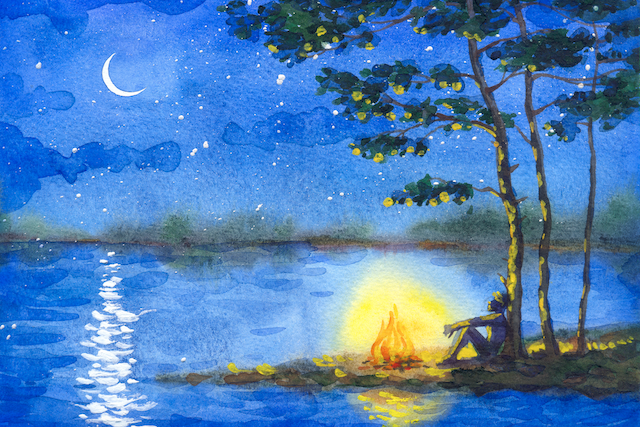
“To be content doesn’t mean you don’t desire more, it means you’re thankful for what you have and patient for what’s to come.” ~Tony Gaskins
There’s a thought I want to share with you that used to keep me up at night.
It’s a toxic idea that caused me stress and burnout and actually got in the way of my productivity and creativity (and more importantly, my happiness).
Nevertheless, I hung onto it, and eventually came to see that it wasn’t just me. It was actually prevalent in many developed societies.
The thought went something like this: If I accept who I am, where I am, and what I have, then I will become unproductive and lazy.
Unconsciously, it boiled down to the following misconception: acceptance = contentment = laziness.
A few years ago, I may not have admitted to you that I believed this, but I certainty acted as if it were true. I was by no means lazy; I was self-motivating and self-employed, working day in and day out. But at the end of the day, no matter how much I had “achieved,” no matter how many things were crossed off the to-do list, I would still find myself sitting at home with two thoughts.
1. I didn’t do enough today.
2. I need to do more tomorrow.
These thoughts never allowed me to truly relax, and this caused a cycle of anxiety and tension. At some point, like many of us, I came across the idea and practice of self-acceptance. But no matter how much I tried to tell myself that everything was okay, I simply couldn’t feel that this was true. I couldn’t shake the thoughts about not having done enough, not being enough, not being content with the moment.
Unsurprisingly, this was terrible for my mental health.
Finally, I was talking about this with a friend of mine, and they casually asked me the following question.
“What would having done enough actually look like to you?”
And then it dawned on me. I had absolutely no idea. In truth, there was no such thing as enough—it was a constantly moving target. “Having done enough” was just a vague notion I used to fuel this myth of anxious productivity that I’d bought into.
I didn’t need to be anxious to be productive, I didn’t need to be productive to be content, and being content would not make me lazy.
I even started to realize that the opposite was true. When I accepted whatever was happening, I would be more content, and when I was more content, I would have more energy and confidence, which translated to more productivity.
Humans are creatures of habit, and it was ritual and routine—not fear and anxiety—that would determine what I achieved. The worry that had driven my life for years was a complete falsehood!
I’ve learned it’s possible to be both content and productive—no anxiety required. Here’s how.
5 Ways to Be Content and Productive
1. Start small.
If you’re stuck in the habit of feeling you never do enough, don’t try and challenge it all at once. Try letting go of your attachment to a couple of ideas and see where it gets you. For example, maybe you feel that relaxation is something you only deserve on days where you’ve completed your to-do list. You could reframe this so relaxation is something on your to-do list that is a priority rather than a bonus.
2. Run an experiment.
If you’re convinced that feeling content with some aspect of your life could be detrimental, why don’t you try it out?
Why don’t you try a week where you don’t stress yourself out about eating clean, going to the gym, or working on some non-essential project. Record what you do anyway, then compare the difference in outcome between weeks where you are allowed to feel content regardless of whether you meet all your expectations, and weeks where you anxiously push yourself. You may find that you do more than you expected you would without the internal pressure.
After a while you may also find that your sense of contentment doesn’t hinge upon your day-to-day achievements—but if it does, then maybe you need to look at reward-based motivations, rather than punishment-based motivations.
3. Focus on the process and not the outcome.
This is time-tested wisdom, but it’s not always easy to follow. Think about it as a value you have, rather than something you do or a skill you acquire. To value the process over the outcome is to place your attention on what you are doing rather than why you are doing it.
Fixating on the end result or outcome makes it easy to get trapped in cycles of future-oriented rumination. This is not only unpleasant, but also takes up energy that you could devote to the task at hand. On the other hand, if you focus entirely on the immediate task—the what and not the why—then you are more likely to fall into the flow-state, and less likely to fall victim to worries and mental chatter.
4. Less desire, more trust.
There are two ways we can look at the idea of hope. One is the hope you have when you want or desire something. Like when you hope for a promotion or a bigger car. The other is a more general and vague sense of trust that you have. Like, I have hope that things will turn out okay.
If you can reduce the first type of hope, the desire for something else, while increasing the second type of hope, trust that everything will be okay, then self-acceptance will become a habit, not just an ideal.
5. Approach goals indirectly.
Economist John Kay calls this process obliquity. Sometimes when we strive aggressively to achieve a goal, we can trip over our own feet. This is why some goals, such as happiness, are best achieved by taking an indirect route.
For example, instead of saying, “This year I want to meet my soul mate,” you could say, “This year I’m going to meet more people and be curious about what they all have to say.” Instead of saying, “This year I want to be happier,” you could say, “This year I’m going to put aside thirty minutes a day for things I enjoy—like writing songs—and give 100% of my attention to those things for thirty minutes.”
If you feel that you need to do more, but that feeling is never going away, maybe it’s time to try experimenting with the feeling that you can try and do less?
How have you struggled with feelings of self-acceptance and the belief that you’ve never done enough? Let us know in the comments, we’d love to hear from you.

About Benjamin Fishel
Ben Fishel is a counsellor and psychotherapist. He has a background in neuroscience, counselling and existential psychotherapy and is on a mission to help people improve their mental health with cognitive science and spirituality. Ben offers a telehealth counseling service worldwide (with the exception of Canada & the U.S.). Don’t forget to follow him on Facebook for more of his essays!





 Though I run this site, it is not mine. It's ours. It's not about me. It's about us. Your stories and your wisdom are just as meaningful as mine.
Thank you for this! I am someone who is seemingly fueled by anxiety and a constant, never ending mental (and many physical) to-do list. I am terrible at truly relaxing and very prone to burn out — as a very hard-working and self motivated person who works full time and also has a side business and a lot of passion projects all with a bout of perfectionism which makes it even worse.
I will try to use some of your advice and thoughts to fend off the feeling that I MUST stay busy, and to prioritize a ‘less is more’ approach to my life. I also just need to constantly remind myself to slowwww dowwwwn because I’m always moving at light speed — which also really does no good in the long run.
What I try to do is remind myself how I use to burn the candle at both ends when I was a lot younger and it is no need to do it now. I especially use this trick when I go on social media and see what looks like people doing so much more than I am. I also try to incorporate a JOMO attitude (the joy of missing out), I reenforce that by saying truthfully if I don’t do more what am I going to miss out on. Usually when it is all said and done and the next day comes around, not much at all.
It has been a learning curve and some times that feeling I should be doing more rears up, but I use the above tactics realizing it is process. Especially from a guy even when sick felt he had to get something done.
Oh I totally relate to this, and I love “JOMO”. I often found that when I got sick, it was the only time I sort of allowed myself to take a break, but I still felt like I wasn’t doing enough! Kind of amazing that someone else feels the same and makes me feel like wow, maybe I do need to address this issue (reading it objectively, it’s easy to think “oh gosh, of course you don’t have to do something when you’re sick” when it’s someone else, haha).
The feeling of not doing or being enough is so ubiquitous in our culture but I think we tend to act like it’s normal to be this way (meaning, the idea of “consuming/producing”, going for your dreams! etc). Even if pursuing your dreams is something of value, there is such a “don’t be lazy” stigma attached to it, esp. these days when I see people half my age making millions on tik tok or youtube or whatever. I mean, forgetting whether it’s my dream, or not, (it’s not) just the idea that “everyone else” is doing something better or more productive or cooler than you and it looks as though it’s so easy for them, has been challenging for me so much. Likewise with friends around me who seem to easily have landed into their careers and stuff and I feel in a lot of ways I’ve been hiding, even though I also have been so productive over the years (doing live shows, recording and releasing two albums, making music videos and various creative projects, being in relationships). But I have been plagued with the idea it’s just NOT ENOUGH compared to how my friends managed to use that same time to build actual careers and families. So in this sense, the demon of comparison is a key factor in using my mind against me. I used to do it before the internet, too, with famous musicians or actors I admired. But social media makes it 10x worse, in my opinion, because it’s not just David Bowie, or Joni Mitchell or someone who seems sort of magical and special who is doing it, but it’s your highschool friend, your ex, a random 15 year old… so I have felt in the past like ‘well, I REALLY have no excuse now. It’s not just one special person in a million, it’s literally everyone around me, so what’s MY problem?” It’s quite sad and I’m grateful at least to be aware of it. But it’s just a societal change where we are believing in and telling stories that are untrue, most of the time. And that feels scary to me; like people are believing in the shadows projected on a wall from the fire, rather than the objects that are casting them. (To steal Plato’s famous “Cave” allegory). I hope our culture shifts towards this perspective as the majority.
When I dive into this above thought process and general topic, I usually go back to my dad/childhood stuff and the feeling of being ‘not good enough’ on a level in relation to emotional issues, as well, not just productivity in the realm of capitalism/being American/keeping up with the joneses, etc. Like this self-imposed blame (“not being enough”) as a coping mechanism for external pain or neglect or something… it’s complex of course. But I have a hunch that this issue is so pervasive in our culture because we are feeding into these deep wounds, as well, on a really deep level. If you grow up feeling like you were usually f-ing up, or getting something wrong (because you were critisized or met with conflicting messages) then, at least in my experience, you tend to overcorrect by trying to manage and control as much as you can (aka DO as much as you can) to keep that chaos at bay. But as this article points out so well, it’s quite the opposite that needs to be done, and the “doing” is often, actually, the chaos! Once we grow up, of course.
I remember a story about my grandfather about how he could never relax, and he was manic/depressive. I wonder, too, how that relates in my family and beyond. And how that “disorder” might often stem from something as simple as being overwhelmed and swinging wildly from two extremes to deal with it. And I also recall my stepdad who would say he feels like he’s “not doing enough” if he sits and watches a movie in the daytime (vs. at night). I find it fascinating, too, how these sanctioned ideas of what is or isn’t “okay” (watching tv during the day as opposed to the “proper time” at night) has so much affect on us. I wonder, too, if this is related to human’s tribal dna and wanting to belong. Like, the idea that “everyone starts to wind down around 6 and have dinner and watch a movie” so if you aren’t doing that, you are “outside the pack” and therefore “wrong/bad/lazy”. Maybe it’s a stretch but I think it all relates and is just so fascinating!!
I love how this article relates it all to contentment, it’s not something I had realized before, but it’s a huge missing piece! Thanks for that! I feel like i am getting much better at managing my anxiety and giving myself a break, and truly enjoying being content, battling the ego that freaks out when challenged with the idea that I may be more than my external projection or trappings.It’s interesting as I was just feeling this major trigger as I am getting older and sort of doing things around the house, like setting up more of a home, and plants and having more responsibilities and making home life a priority (since we are home so much now)… when normally I want to just escape town all the time and have an adventure, etc. Not that that’s BAD but, I find that the former relates to this idea of “being content” and as soon as I started to realize “…oh, am I content living here and tending to plants and getting a new washing machine” etc. I started to PANIC. Like as if the idea of being content meant not only “i’m now lazy” but also that I’m giving up my youth. This, too, I think is such an important connection to what I was saying about outside culture and the dual messaging of being simultaneously young, constantly/effortlessly creatively productive and free AND amassing large amounts of STUFF, a HOME, building a family, having a baby etc and taking on those more “traditional” ideas of “contentment”. But not many people are actually talking about true, spiritual contentment. Anyway, I just noticed how this all triggered that so thought i’d share! 🙂
Beautiful write up…and that painting is amazing!! Who is the artist?
This is from Deposit Photos, where I get all the site’s artwork, and the artist is listed as just “marinka.”