

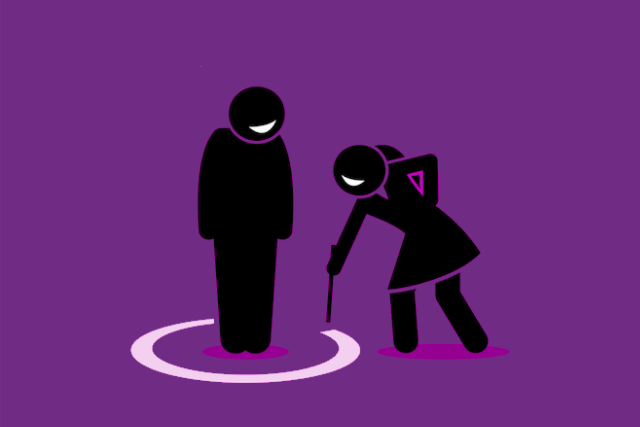
“Boundaries aren’t about punishing. Boundaries are about creating safety for yourself.” ~Sheri Keffer
The person sitting beside you at the bar keeps talking to you despite your obvious disinterest. The flirty Uber driver mentions—three times—how beautiful you are. Your cousin’s new boyfriend gives you a too-long hug with wandering hands.
In awkward situations with strangers, we tend to hope that non-verbal cues will be sufficient to set a boundary. We use silence, crossed arms, uncomfortable laughter, and glares to communicate discomfort. But some folks cannot—or will not—take the hint.
Here, we find ourselves at a crossroads: We can either set clear verbal boundaries or tolerate the uncomfortable behavior indefinitely.
For the longest time, I struggled to set boundaries in awkward situations with strangers. Throughout childhood, I was taught how to be kind, nice, and open-minded—but never how to have difficult conversations and advocate for myself. I worried that setting firm boundaries was mean, so I tolerated uncomfortable behavior in silence, which allowed the awkward situations to escalate even further.
Eventually, I realized that setting firm boundaries is a form of verbal self-defense. It is our responsibility to advocate for, and protect, our time and space.
My goal for this article is to demystify the process of boundary-setting and offer concrete suggestions of language you can use to be clear and direct. These are phrases I’ve crafted, edited, and re-crafted over years of boundary-setting practice. My hope is to help you make awkward situations as not awkward as possible.
Before we dive in, let’s get clear on five key principles for boundary-setting:
-
When we refuse to set a boundary, we prioritize other people’s comfort over our own needs. Setting boundaries is a courageous act of putting ourselves first. It’s a great way to break the people-pleasing habit and practice the art of self-care and verbal self-defense.
-
Difficult honesty is not unkindness. It’s not mean to stand up for yourself. It’s actually the most truthful and authentic way to interact with others.
-
You can manage your boundaries or manage other people’s feelings, but you can’t do both. The bottom line is, your boundaries might make people feel frustrated or resentful. That burden is not yours to bear. As the saying goes, “The only people who get upset about you setting boundaries are the ones who benefited from you having none.”
-
It’s not your job to protect people from feeling uncomfortable. Remember: the folks imposing on your space aren’t giving your comfort a second thought—so don’t twist yourself into knots trying to protect their feelings. As Registered Clinical Counselor Jordan Pickell says, “It makes sense for people to feel bad and weird when they have crossed a line.”
-
Safety first. If you ever feel unsafe or threatened, do whatever you need to do to get to safety. Don’t be a boundary-setting hero.
For consistency, the examples below use “Bob” as the generic name of our boundary-violator. However, folks of all genders, ages, races, etc., violate boundaries.
Certain suggested phrases are direct and firm. Others are lighter and playful. Experiment with the language to find the tone that works best for you.
Case #1: The Handsy Hugger
Maybe it’s an eager fan who approaches you after an open mic performance. Maybe it’s your step brother’s uncle who you see twice a year at family barbecues.
Handsy Huggers comes in many shapes and forms, but they all have one thing in common: they hug you for an uncomfortably long time with wandering hands.
My recommendation: In a scenario that runs the risk of uncomfortable physical contact, it’s better to avoid a hug altogether. Next time a Handsy Hugger approaches you, give yourself permission not to enter his outstretched arms. Hang back, offer a smile (or not), and when he looks at you quizzically, say, “I’m not in the mood for a hug today, Bob.” In the next breath, redirect the conversation to literally any other topic.
Case #2: The Flirty Uber Driver
I have been asked, by two separate Uber drivers, if I would consider marrying them. I’ve sat in the backseat as Uber drivers have commented on how much they liked my clothing and eyed me from the rearview.
When you’re in someone’s Uber, you can’t exactly escape to the ladies room. Some drivers will continue bantering with you even if you put headphones on and stare blankly out the window.
My recommendation: Depending on your mood, you can use a casual or direct approach.
-
Casual: “It’s been nice talking with you, but I’ve had a long day and don’t really feel like talking right now.”
-
Direct: “To be honest, your comments are making me uncomfortable. I’d prefer not to talk right now.”
(Note: If your rideshare driver makes you feel unsafe or threatened, report them through the app immediately.)
Case #3: The Non-Stop Texter
You meet a nice man named Bob at the bar or on a hike. You exchange numbers. Within hours, your phone begins buzzing. Bob asks you a litany of questions. He sends a greeting every morning. Throughout the day, your phone erupts with Bob’s favorite Youtube videos of tap-dancing cats.
You don’t reply, but your silence doesn’t deter Bob from sending text after text after text. You consider ignoring his messages wholesale, but you’re concerned that if you run into Bob in public, you’ll feel guilty and awkward.
My recommendation: Despite the rising popularity of cell phone boundaries, some folks seem to feel entitled to your time and space via your inbox. They’re not. You’ve got two options:
-
If you hope to keep this person as a friend but adjust how often you text, try this: “Bob, I like to have healthy boundaries with my phone and I’m not interested in texting this often. Next time we meet up, let’s have a conversation about our expectations for communicating when we’re not together.”
-
If you feel overwhelmed and want to cut the cord entirely, try this: “Bob, I’m not open to a friendship with you at this time. You’ve been reaching out a lot recently and I feel overwhelmed by it. I have no hard feelings toward you and I wish you the best.”
Case #4: The Person At the Bar Who Won’t Stop Talking To You Despite Your Obvious Disinterest
I like to write in my journal at bars. I’m a sober lady and I don’t drink, but I love feeling comfortably anonymous in a social atmosphere.
Despite my hunched posture, downcast eyes, and scribbling hand, many a barstool neighbor attempts to strike up a conversation with me. The first one or two questions are fine—a pleasantry, really—but often, my bar neighbor will continue on, chatting at me despite my obvious disinterest.
I can’t count the number of times I have diverted my eyes and offered muttered “uh huhs” and “yeahs” before throwing a twenty onto the bar and escaping into the night, feeling resentful.
My recommendation: Especially when alcohol might be involved, it’s best to set a firm boundary as clearly and directly as possible. Turn to your barstool neighbor and say, “I appreciate the chance to chat, but I don’t feel like talking right now.”
Case #5: The “Harmless Older Person”
Ah, yes. The older lady or gentleman who uses your age difference to justify being “harmlessly flirty” with you. Any of this sound familiar?
-
“If I was your age, I’d have swept you off your feet by now!”
-
“You’re a real beauty, you know that?”
-
“I just love the sight of a spry young man.”
-
“As my father used to say: Just ‘cuz you’re married doesn’t mean you stop lookin’.”
It doesn’t matter if the speaker is 20 or 200—if someone’s flirtation makes you uncomfortable, you have every right to shut that commentary down.
My recommendation: Keep it simple. Try this: “I know you’re trying to be kind, but please don’t make comments like that. They make me feel uncomfortable.”
Case #6: The Uninvited Mansplainer
There’s nothing quite like the particular fury of having a man 1) assume you know nothing about a certain topic because you’re a woman, 2) explain said topic authoritatively, indefinitely.
Merriam Webster defines mansplaining as “when a man talks condescendingly to someone (especially a woman) about something he has incomplete knowledge of, with the mistaken assumption that he knows more about it than the person he’s talking to does.”
Ladies, you might be familiar with mansplaining if you’ve ever bought strings at a guitar store, watched a sporting match, or discussed anything related to cars, electronics, or grilling. Opportunities for mansplaining abound.
My recommendation: Make it clear that not only do you know this information already, but you’d really like them to stop. Try this: “I’m really familiar with (insert topic here) and I don’t need any more information. Thanks anyway.”
Case #7: The Personal Space Invader
You’re standing on the subway, or in the check-out line, or at the club, and someone’s body is too close for comfort. Maybe it’s intentional, which is creepy. Perhaps they aren’t aware of the space they’re occupying. Regardless, you’re not enjoying their front near your back / the smell of their breath / their odor.
It’s time to set a boundary.
My recommendation: “Excuse me, could you please move back and give me some space? Thanks.”
Case #8: “Can I Have Your Number?”
You’ve been chatting with a stranger, Bob, for a few minutes. As he gets up to leave, he asks for your number. You’re not into it.
This circumstance tends to elicit boundary-white-lies, such as “Sorry, but I have a partner,” or “Oh, I don’t give out my phone number to strangers.”
I understand that white lies might be your most comfortable entry point into boundary-setting. I am, at heart, a boundary-setting pragmatist. That said, when you’re ready, experiment with a firmer approach. It might be scary, but it will certainly be empowering.
Bringing Boundaries To Life
By now you’ve probably realized that, in each of the cases above, the words you can use to set boundaries are pretty straightforward. It’s actually saying them that’s the hard part.
With this toolbox of phrases in hand, you can bring these boundaries to life using three simple steps:
Step 1: Practice boundary-setting aloud.
Many of us have never fathomed speaking up this directly. Our ability to boundary-set is just like any other skill: it takes time, effort, and practice.
In the comfort of your own home, practice stating your boundaries aloud. Get used to wrapping your tongue around the words. Consider standing in front of a mirror and using a firm, confident tone.
At first, it will be uncomfortable and strange—guaranteed. You may find yourself worrying about being “mean,” “rude,” or “harsh.”
These reactions are totally normal and totally surmountable. Practicing your boundaries alone makes them easier to retrieve when you’re feeling burdened by the tension of an uncomfortable situation.
Step 2: Role play with your friends. (Yes, really.)
Once you’ve developed an arsenal of failsafe boundary phrases, practice with a friend or two.
Give each other feedback. Tell your friend when she sounds overly apologetic. (“Stand in your power, girlfriend!”) Tell your friend when she’s sounding like a huge, mean jerk (“Okay, maybe take that down a notch.”) Have fun with it.
If you want to uplevel your boundary-setting game, ask your friends to push back against your boundary. (Psychologist Harriet Lerner refers to this as a countermove: a “change back!” reaction.) Practice re-asserting yourself in the face of annoyed reactions. This way, when you begin setting these boundaries out and about, it will feel natural and familiar.
Step 3: Practice
As with all new skills, don’t expect perfection immediately. Your first few boundaries in the real world might be clunky, awkward, or embarrassing. Maybe you’ll speak too quietly and the offender won’t be able to hear you. Maybe you’ll boil over in rage and feel terribly guilty afterwards.
All of this is normal. Be patient with yourself as you strengthen your boundary-setting muscle.
P.S.: What About Silence?
Is silence ever an effective form of boundary-setting? To answer this question I like to refer to writer Courtnery J Burg’s take, which she published on Instagram this year. She writes,
“I’m all about boundary work. But sometimes the healthiest, best way to keep your sanity is to just walk away. To not respond. To not answer that text or that call. Sometimes the answer is no answer at all. This isn’t the same as avoiding. It’s acknowledging what is yours to carry + what isn’t. It’s remembering that not all situations must be handled with delicate gloves and deep, heartfelt energy. That occasionally, no response CAN BE your response and that you have nothing to feel guilty for and no one to explain yourself to for it.”
Generally, I advocate verbal boundaries because 1) they’re most effective, 2) I spent many years trying to be “good” and “quiet” and I’m rebelling, and 3) they’re a great way to practice your boundary-setting muscle. However, certain awkward situations with strangers are most effectively curtailed with silence.
As a rule of thumb, I use silence as a boundary with:
-
Catcallers. Silence or the middle finger tends to do the trick.
-
Strangers who message me insistently through social media. Most folks with public social media profiles will occasionally receive a deluge of creepy messages from strangers. Don’t engage. Block the account.
-
Arguers. Suppose I set a firm boundary and the stranger argues my point — asking me “Why?”, urging me to reconsider, etc. You do not owe a stranger any justifications or explanations. Your work is done.
With time, boundaries that once felt impossible or too-awkward to assert will be second-nature. By practicing this skill of verbal self-defense, you will give yourself the gift of moving confidently and powerfully through the world. You deserve it!

About Hailey Magee
Hailey Magee is a Codependency Recovery Coach who helps individuals conquer people-pleasing, set empowered boundaries, and master the art of speaking their truth. She has worked with over 100 clients from the US, Canada, Ireland, France, South Africa, and more. Sign up for a complimentary consultation to learn how coaching can help you live from a place of authenticity and inner freedom. You can follow Hailey on Facebook and Instagram, or visit www.haileymagee.com.
- Web |
- More Posts











 Though I run this site, it is not mine. It's ours. It's not about me. It's about us. Your stories and your wisdom are just as meaningful as mine.
Wow, thank you Hailey. Just recently walked away from a colleague who turned out to be my friend, but then I decided to disconnect with her to protect my energy and to spend my precious time to more valuable things. This women and the other friend always talk about other people every time we are having our lunch and I became so fed up with their negativities. Now I am happy spending my lunch break alone with my self. And your article made me so happy because I realized I’ve made the right decision for my life. 😊 All the best, Hailey ♥️
@annlumbes:disqus, thanks for sharing some of your story. It can be HARD to set those boundaries, especially with friends — but the freedom we experience as a result is utterly empowering! Nice work. Thank you for your words!
I can fully relate! I work with other men, and the way they act (supervisors) is childish beyond description, and more toxic than Three mile island (yes, I’m dating myself) I feel extremely pushed out of the organisation although 15 years and lots of hard work and determination over the years. Sometimes as many know, when certain group come into power and you do not fit into that group, they will make life miserable for you until you leave. Most times the rot extends upwards so there is little you can do.
“The magic of menopause”. At age 64, I don’t experience a lot of encroachments anymore–and I love it.. I do remember being 6 or 7 though, and my mom saying “Oh don’t be silly! Climb up in Uncle Jack’s lap and give him a big holiday hug and kiss”. In my 20″s and 30’s, it was horrible–I struggled a lot.. My mom’s actions had left me uncertain and ill prepared. Good article–but don’t sit in bars and expect you can control a drunk. Place yourself in better surroundings.
Thanks so much for your words, @disqus_PV9VwQJfOi:disqus. Oof. So few of us are taught how to set boundaries and advocate for ourselves in childhood. Couldn’t agree more with “Don’t sit in bars and expect you can control a drunk.” Sometimes removing ourselves from physical spaces is the very best boundary we could set.
Thankyou for this empowering post. I have tried setting boundaries in the past, but the moment I say no to someone’s enntitled desires, they do not just take it at face value, instead get into full on revenge mode. For example: Few years back, when I was in job training, we were grouped into teams for project work and each team was assigned few rows of systems so that members from each team get to sit next to each other as it would be easy to work. I was the only one in my team who had to ‘adjust’ somewhere else away from my team as there were not enough systems at one place. I was not even asked for my opinion,but my team members automatically assumed that I will be the one to ‘adjust’. Rows were allotted to each team, but seats were based on first come first serve basis. I started lagging behind in my work as I was always away, so I made it a point to go early everyday and sit along with teammates. There were two people from my team who always wanted to sit together as they were ‘friends’ and did not want to be away from each other. One of them always used to pester me to go back to ‘my seat’ which was away from the team, as she wanted to sit with her friend. Now I put in efforts to go early and get a seat for myself with my team, so it made no sense that I would give up my seat for such a silly reason, especially with my work at stake. I rejected and explained her the reason why I couldn’t sit away. I thought all was good as she did not say anything suspicious and continued with my work for a month and a half. But, I did not know that she had hidden resentment and hatred against me just for not playing along with her. During the rating time at the end of my training, I came to know that she b**lsh*tted about me to our trainer who was incharge of the ratings. She lied a lot about me to her by saying that I was not sincere about my work and did not perform well and that my whole team suffered because of my underperformance. I admit I was not a great performer as the field of work was new to me, but I worked sincerely and did fair enough during the whole training period. My trainer was intially giving me an average 3 rating, but because of the girl’s nonsense, I lost my rating and I was given the least rating in the whole class. It had a very deep impact on my project allotment after training. All my hardwork was wasted away. Such things happened to me many times whenever I tried setting boundaries with people. It is very scary to deal with such people, so I just use white lies and extreme politeness in fear of being a scapegoat in their crazy revenge game. Could you please suggest what to do in such situations?
Oh, @Gongjoo:disqus —that situation sounds awful. So sorry you went through that. I relate to this sentence: “I was not even asked for my opinion, but my team members automatically assumed that I will be the one to ‘adjust’.”
It’s important to remember that we can only control our own actions and reactions—not others’. Part of learning to set boundaries is learning to sit with the discomfort of others not liking our boundaries. That is much harder when their “dislike” could lead them to threaten our physical, emotional, or financial safety.
As I mention in my post: “Safety first. If you ever feel unsafe or threatened, do whatever you need to do to get to safety. Don’t be a boundary-setting hero.” Sometimes white lies are the safest way to handle these abusive situations. In situations that are lower-stake, you can exercise the boundary-setting muscle.
Great Article. Boundaries is a topic that doesn’t get enough attention.
“The art of freedom lies in the setting of healthy boundaries”.
This quote rocks, @disqus_fFiHFldEHi:disqus! Thanks for your words.
My husband and I recently moved to Huntsville AL, which I consider very much in the Bible Belt and inundated with “Southern” Culture. Please don’t be offended. I’m sure that means different things to each of us. What I often experience with strangers, specifically in an employee to client/customer dynamic, is how often a stranger will start dumping their crisis, wounds, drama, trauma, hardship, etc. I’m a very empathetic person so initially I would respond with empathy, compassion and concern for their wellbeing. However, the frequency in which it occurs left me feeling violated and taking inventory of what was going on with me. “Tell Your Story”, shouldn’t be something a person walks around dumping without any concern for how and where it may land. I appreciate the prod and reminder that I’m responsible for my boundaries. I will confess, I struggle with what I may say that is not rude and doesn’t compromise me in a service capacity. How’s this, “Hey, just do a great job with my hair without dumping your stuff on me, please and thank-you”, will most likely lead to… “Honey, did you notice the back of your hair? It looks like a five year old cut it.” How does one make space to “connect” without inviting vampires?
@BlackWingedAngel, you pose such a fantastic question. Thank you for raising it. I have often wondered how to allow myself to be empathetic, compassionate, and open WITHOUT becoming energetically drained and resentful. It is a balancing act I am constantly working on, even after years of practice.
In the example you gave — being confined to a chair while someone does your hair (which felt somewhat similar to the Uber Driver example in the article) — I might say something like “It’s been so rad to chat and connect with you. I’m noticing I’m feeling a bit tired, so you would mind if I zoned out in silence for a bit?” (You never need to ask for a permission to set a boundary, but it is something I will occasionally do if I want my comment to feel conversational and open.)
The phrasing can change, but the essence is that I try to make those awkward boundaries more about my personal needs (I’m tired, I’d like to sit in silence, I need space) than the other person’s undesirable behavior (You’re dumping on me, Please don’t overshare, etc.) I hope this helps!
So amazing Hailey. I can’t wait to read more of your work. 🙂
Thanks so much, @justinapetrullo:disqus! <3 <3
Some time ago, I was chit chatting with a man who owned a furniture store. He was very cordial, and I remember how elegantly he disengaged our conversation without being glib. He pleasantly said “I really don’t mean to be rude but I have pick up my son from school.” I thought what a nice way of getting your point across and not being a jerk.
Being able to set boundaries and doing so without rubbing the wrong way with people is a true artform and takes a while to perfect. It’s not what you say yet how you say it as with story.
@disqus_XXgg2dv3Zc:disqus, couldn’t agree more with this sentence: “Being able to set boundaries and doing so without rubbing the wrong way with people is a true art form and takes a while to perfect.” It’s hard (yet rewarding!) to find a balance between firm and compassionate.
Wonderful article!! It helps me so, so much. Thank you.
I have a question. What do you do to set boundaries with people who are constantly negative and seeking validation, but who you can’t practically distance yourself from and have to work with them?
I’m in this situation with someone and have to spend hours every day with them. I’ve tried being both indirectly polite and more direct, but wow both times it blew up quick. This person does not do anything they perceive and ‘criticism’…and they have a pattern of looking far too deeply into everyone’s words to scout out criticism and defend themselves. Then it fizzles just as quickly and they resent my boundary setting attempts and make personal jabs to try and make me feel guilty for setting a boundary in addition to reverting back to their old patterns. It’s hard because I have to interact with this person every day for an unforeseeable amount of time (like a year, probably) for financial reasons.
It’s not a healthy environment/relationship, but I’m doing my best to build financial stability and move away from them. In the meantime…how does one handle something like this?
Hi Mi, I know this was posted 2 years’ ago, but wondering how you got on?
GIRL. THANK YOU for this article. It’s so thorough and speaks to so many situations that many of us (unfortunately mostly women) experience often if not daily. Can’t tell you how much I appreciate this. xo
I’m thrilled it resonates with you, @disqus_8NCKGsn7o0:disqus! Thank you for your words and kindness!
Hi Hailey,
I don’t like animals, and I often get uncomfortable around other people’s pets. I am nervous and afraid of them, but if I can get over that, I still don’t like them. How can I set boundaries in the moment in a firm but light way? Most of these scenarios are with strangers and acquaintances, but even with close friends, I’d prefer some helpful phrases for in the moment, rather than having to wait and have a whole conversation about it. I don’t like when others’ dogs lick me, put their paws up on me, jump on my lap, jump on the couch or table I’m at, walk or sniff my stuff. The most recent time was at a friend’s party. It was at her house, and she has a dog, but two of her guests brought dogs, one guest even brought two. The dogs were on my lap and my rommmates’ laps all night, and we hate dogs. Everyone else loves them and thinks it’s an honor to have them crawl on them and lick from their plate. How can I set a boundary in a situations like that up front without distancing myself from the people there? I know many pet owners who are considerate, and don’t assume that their pet’s presence is wanted. What about for those who are not?
Thanks,
Michelle