

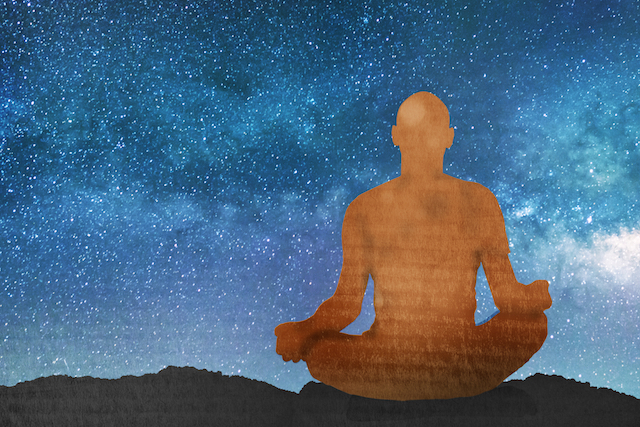
“Don’t try and save yourself. The self that is trying to be saved is not you.” ~Mooji
Three months ago I had a strange experience.
It wasn’t strange in that it had never happened before. It was strange in that it was unexpected. Unexpected in the way a hiccup comes up out of nowhere to interrupt a meal. No, actually, it was more unexpected in the way a sudden illness overtakes a period of health.
Just for a bit of context, over the last six months, I’ve generally been the calmest I’ve felt in years—maybe even my whole life. But recently this has come with a strange side effect. When negative emotions do arise, as they inevitably do, I’m sometimes even more reactive to them than I used to be.
So three months ago when I woke up abruptly in the middle of the night with a ball of anxiety in my chest it was, well, unexpected.
And my mind immediately kicked into overdrive.
“Why am I anxious?”
“Is there something I’ve forgotten?”
“Is there something coming up that I’m nervous about?”
“Am I sick?”
And then the most dangerous question of all:
“Have I really been anxious this whole time and the calm isn’t real?”
This question is very tricky. If I was a character in a movie, I’d been standing up out of my seat and yelling at myself on the screen, “Ignore it! Ignore it! You’re fine, go back to sleep!”
But it’s tricky because it feels like there a grain of truth to it; on some level we can all relate to that sense of doubt. Our minds tend to come up with explanations based on our feelings, so this sensation of anxiety was (unsurprisingly) causing my mind to come up with a story based on these feelings.
The whole ordeal lasted less than five minutes. Fortunately, in this moment of tension, I was mindful enough to see how far-fetched these thoughts were. I settled on a far more pragmatic explanation; I’d become so unused to feelings of anxiety, that when they did arise, they were a shock to the system, so my mind immediately tried to rationalize them.
And then I went back to sleep.
Moments like this one would come again, and what I needed to do was simple. Any five-minute mindfulness book would have had the answer.
All I needed to do to keep the calm was to not care that these thoughts and feelings were there. I just needed to be completely disinterested, to not touch anything in my mind. Following the instructions in a moment of distress, however, is much easier said than done.
So I remembered what I’d heard a yoga teacher say once in an uncomfortable pose where the students had their hands above their heads for a long time.
“Just tell your mind that things are going to be like this for the rest of your life. It’ll get bored of the pain and move on.”
I took that idea and started applying it whenever worries came up. I managed to convince myself that I didn’t need to fix anything and that feelings of anxiety were just really not that interesting. It worked out pretty well, so well in fact, that I thought I’d go into a little bit more detail of how I managed to do so and share it with you.
Here are five ways you can begin to accept anxious feelings and live a better life.
1. Accept that you can never know why you are experiencing anxiety.
As problem-solving creatures, when we experience discomfort we immediately try and understand why. But not everything in our lives has a straightforward answer. There are a multitude of factors that lead to anxious feelings, from genetics to work to relationships to diet, memories, and even the weather.
Trying to pinpoint one reason so that you can have a concise narrative in our minds is a lot less effective (and a lot more tiring) than simply accepting the fact that you don’t know why. This acceptance also allows you to focus your energy toward more practical, calm-inducing strategies such as journaling, yoga, and exercise. When we have more energy, we’re more alert, and this naturally makes us more engaged in our work and home lives, safeguarding us against anxiety and rumination.
2. Accept that anxiety is neither good nor bad.
Seeing your anxiety in a wider perspective is best illustrated with a Taoist story (origin unknown):
“There is an old farmer who had worked his crops from many years. One day his horse ran away. Upon hearing the news, his neighbors came to visit. “Such bad luck,” they said sympathetically.
“Maybe,” the farmer replied. The next morning the horse returned, bringing with it three other wild horses. “How wonderful,” the neighbors exclaimed.
“Maybe,” replied the old man. The following day, his son tried to ride one of the untamed horses, was thrown, and broke his leg. The neighbors again came to offer their sympathy on his misfortune.
“Maybe,” answered the farmer. The day after, military officials came to the village to draft young men into the army. Seeing that the son’s leg was broken, they passed him by. The neighbors congratulated the farmer on how well things had turned out. “Maybe,” said the farmer.”
To accept anxious feelings, try to treat them like the farmer in the story treated his horses. You never know what good may come from your anxiety! In fact, the calm in my life that I mentioned at the start of this article is a direct result of the meditation practice I started, and continued, because of anxiety.
3. Accept that everyone will experience some form of anxiety.
When we experience pain we’re hardwired to respond to it, and in that response our perspective is distorted. We become the center of the universe, because we are only feeling our pain in that moment, and not anyone else’s.
It can be calming and reassuring to know that everyone goes through periods of worry. There are billions of people who have dealt with whatever feelings are coming up in your experience, and there will probably be billions after you. So don’t by any means underestimate your capacity to handle the situation.
4. Let go of the idea that you shouldn’t have anxiety.
How would you feel about anxiety if everyone in the world had it? Or if you were told that it was a necessary and useful part of life? You’d probably worry about it a lot less. The idea that you shouldn’t have any feeling stems from the need for things to be better. If you can let go of the normative belief that anxiety is wrong, then your mind will naturally become less and less interested in it.
This goes hand in hand with the idea that anxiety holds you back in any way—you want to let that go too. Anxiety may, in fact, hold you back from an immediate action, but if we recall the Taoist story of the farmer and his horses, we can never truly know in what direction anxiety will take us.
5. Become bored with your anxiety.
This last one is the most difficult but the most important. Often anxiety is so painful that we become fascinated, obsessed even, with understanding and solving our worries. We want to get rid of the pain of anxiety as soon as possible.
Sometimes this is useful, as we come up with strategies to manage our emotions, but a lot of the time it validates the power of our anxiety and adds fuel to the fire. The mind will only focus on what it values; if you can manage to become bored with your anxiety, it will loosen its grip on your life.
—
The steps I’ve outlined in this article are, like I explained in my own experience, much easier said than done. I hope, however, that I’ve given you a slightly different approach you can take toward dealing with any negative emotions.

About Benjamin Fishel
Ben Fishel is a counsellor and psychotherapist. He has a background in neuroscience, counselling and existential psychotherapy and is on a mission to help people improve their mental health with cognitive science and spirituality. Ben offers a telehealth counseling service worldwide (with the exception of Canada & the U.S.). Don’t forget to follow him on Facebook for more of his essays!







 Though I run this site, it is not mine. It's ours. It's not about me. It's about us. Your stories and your wisdom are just as meaningful as mine.
Interesting article. Looking back on my own experiences becoming bored with my anxiety has been very helpful in dealing with it. Perhaps creates just enough space to get some perspective and move forward.
Begs the question what is anxiety… If I am calm while experiencing anxiety is it still anxiety?
If I am calm while everything around me is calm is that the same experience of being calm when my thoughts and everything around me are chaotic? Am I calm or is that noting is happening around me that is attracting attention.
“You don’t have to control your thoughts. You just have to stop letting them control you.” – Dan Millman
Hi Pieter,
Funnily enough I had a question like the one you raise come up in my Masters programme recently but it was about madness. What is madness and what is sanity, and when does the experience become the label and vice versa.
Nice Dan Millman quote as well, gets straight to the point. It’s so easy for us to form an antagonistic relationship to our minds.
Fab article, Benjamin! I read something recently about experiencing physical pain – if you acknowledge the pain and allow it, it can actually help to lessen it (rather than trying to fight it). I realized recently that we can do the same with uncomfortable feelings as well – we can let them be, as they are, without feeling like there’s something wrong with us. I know many people who deal with anxiety, and this is a really helpful post for them. Thanks!
Thanks Claire!
The point you made about physical pain makes complete sense. Physical pain in and of itself is actually far easier to deal with than the rumating around that pain. The same goes for anxiety, what typically makes it’s such torture are the meta-emotions (emotions about emotions) rather than the initial experience itself!
Very very true, Benjamin! 🙂
This was a very well written article! Almost every great moment in my life was polluted with anxiety. Realizing that anxiety is neither good nor bad is really powerful, and you had a fantastic way of putting it into words. Thank you!
Hi Carl, thanks for the compliment. I hope that you have many more great moments and they continue to be less and less influenced by anxiety. And if they are, I hope you become increasingly ok with it!
Excellent article! Anxiety has been a struggle for me and some family members over the years. There are some great tips here for helping to minimize anxiety when it rears its ugly head. I especially love the story about the farmer. I’m going to remember that one the next time anxious moment.
Thanks for the read Tim. Yeah stories are great at hammering points home. Thank the Taoists for that one!
I love this, especially the wisdom of your yoga teacher! Telling the mind how it is and letting it get bored and move on is really powerful. Thanks for sharing.
Its very hard not to think you shouldn’t have anxiety. It is exhausting, frightening and stops you enjoying life sometimes, so when you see others just getting on with things calmly, how can you not resent it? Tough one!
Personally, the 1st advice is not true for me. I know why I get anxious feelings, because I spent a lot of time observing and identifying my triggers. I know that anxiety is just the unhealthy way my brain is trying to protect me. So when I feel anxious, I try to remember that it’s perfectly normal to want to protect myself, that I’m not currently in danger and that anxiety instead of protecting me is actually hurting me.
Mr. Fishel thank you for your insight. Humans get sick and suffer as a result of its own created illnesses, the human animal doesn’t want to see the health benefits of letting go! Having control of things has become obsessive and compulsive. The need to feel a sense of importance has overwhelmed the human mind and takes it to unhealthy extremes as the animal basks in power, money, sex & fame! It appears that we just can’t get bored out of these things and therefore the illnesses and suffering will continue.
I have been dealing with almost disabling anxiety since yesterday (because of a project that I have to submit and the various issues that keep cropping up). I don’t know whether it was luck or something else that
i found this post, but it was really useful. I stopped reading mid way and just accepted that this is how I’m going to feel for some more time….probably a day or two more, so it doesntd really matter what is causing it and why i cant control it, it just is and its alright if it stays…..and surprise surprise i feel better!!! So thank you soo much for this post!
Hi excellent well written article. How about you feel agitated restless and nervous all the time with out apparent reason? My anxiety is very particular, o don’t have any fears and worries at all. I just can’t relax.
Sounds similar to my own anxieties. Early traumas can lock you into persistent sympathetic nervous system activation. Even if you weren’t old enough to remember!
If you center yourself and actively seek out the central point of your physical sensations of tension then you can observe / accept that Nexus until it releases. Takes a whole lot of practice to do that and even more to avoid slipping back into anxiety, but it is effective.
Ah, this is carefully crafted out. I do feel there’s a bit of contradiction in the 4th Point.
Nonetheless, Anxiety isn’t good or bad like you stated, but it causes way more stress than one thinks. I had tried to subdue mine at some point, but then learned to live and grow”Over: it. Nicely written.