

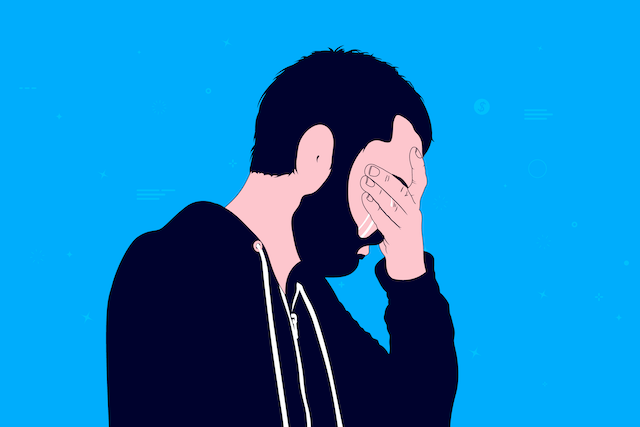
“And some days life is just hard. And some days are just rough. And some days you just gotta cry before you move forward. And all of that is okay.” ~Unknown
Over the years I’ve built myself a bit of a reputation as “the emotional one.”
I was always the first to cry at weddings, and that included my own. At that one I barely stopped throughout the ceremony! And as soon as I’m beyond the half-way point of any good holiday, it’s inevitable that a pretty epic sob is waiting in the wings.
At this point I should probably mention that I’m a forty-three-year-old male. I also live in the UK, a country that’s proud of its “Bulldog spirit” and “stiff upper lip.” What this really means is that we’re a country where many people are uncomfortable with their own emotions, and shockingly bad at processing them.
That brings me on to the point of this post—and it’s a happy post. I’m delighted to report that in the past few years I’ve come to see the true value in being able to cry, and being unashamed to do so.
This doesn’t mean I’m somebody who has frequent public meltdowns that make people uncomfortable! In fact, it’s quite the opposite. I’ve reached the point where I’ve learned to recognize my own internal pressure valve. I know when it needs releasing, and know how to do it in a private, dignified, and healthy way.
Human beings are the only animals with the ability to cry. It clearly has a purpose, and it doesn’t take much research to discover it has serious benefits, both mentally and physiologically. Crying is thought to reduces stress hormones and relax the nervous system.
There are alternatives to crying, and we see them all the time: unhealthy behaviors, addictions, outbursts of anger and violence, and patterns of arguments and disharmony.
That takes me back to the whole “stiff upper lip” thing. Emotions have to come out somewhere, and in my experience it’s the people who are fixated on being “strong” and “manly” who live lives cluttered with arguments and hangovers.
On balance, I’d much rather have the ability to cry, and no shame in doing so. Recently, I feel I’ve learned to take it further than that to the point that I can use crying as an extremely useful tool in my mental health armoury.
So, what got me to that point? The answer is simple: fatherhood.
My oldest son has just turned seven years old. And he’s very much like me. It’s a much-misused word, but he’s a “sensitive” lad. He’s hugely empathetic, and a wonderful gentle soul. He’s also very sentimental and—again like me—as likely to be touched by joy as by sadness.
Like everyone else in the world, we’ve had a challenging time since the pandemic began. One of the hardest parts has been navigating the children through it. This means dealing with their lockdown loneliness, but also constantly working out what to tell them so they’re as protected as possible without us insulting their intelligence.
Another part of this is recognizing when it’s all getting a bit much for them.
I can pretty accurately predict when a “meltdown” is incoming for my son. And I always ensure that I’m there ready for him when he wants to let the tears out. I encourage him to take as long as he needs. I cringe when I see parents saying, “that’s enough now,” or worse.
None of this means I’m trying to raise a child who’s constantly in tears! But I am trying to raise a child who knows that having a good howl is a wiser and more evolved way of releasing emotion than punching somebody in the playground or having an undignified argument.
While I’ve been teaching him this, I’ve been learning myself. Just as I’ve learned to predict when he may soon need to “let it all out,” I’ve become much more attuned to when I need to too.
I have some mental health issues. Anxiety is the main one, with a generous scattering of OCD and some periodic depression as the cherries on top.
One thing that indicates my mental health is in trouble is when I can’t cry. Depression is often misunderstood. For me, when it’s at its worst, it manifests as being emotionally empty and numb.
In fact, “the big cry” often marks the turning point in a spell of depression. It means I’ve started to feel again. I’ve learned the pattern over many years, and it’s now got to the point where I can say “I need to cry.”
And that’s a really powerful thing. I know what I need to do, so that empowers me to consciously try to do it nowadays.
As we’ve already established, crying can release stress hormones and calm the nervous system. Who wouldn’t want to do that, especially during a spell of poor mental health?
The trouble is, far too many people are conditioned to feel ashamed of showing emotion. But it’s not like I phone all my mates and say, “I’ve been feeling a bit low, so I’m setting aside an hour today to go in the bedroom with a bunch of sad songs and some tissues.”
This last happened just a few days ago, and I did tell my wife my intentions. That in itself involved a little embarrassment and vulnerability. But when I re-emerged a little later, she said that I looked like a different person—with a bounce in my step and colour back in my cheeks.
That’s why I’ve written this. It is deeply personal, because nobody’s ever proud of having a good cry. I can’t help wondering whether that should change.
I am proud that my children don’t have to live in a house where there are needless arguments. A home where we process emotions in a healthy way—a way that humans alone have access to.
So get that “crying tunes” playlist ready. Learn which old photos set you off, or which films are certain to “hit you in the feels.” And don’t be afraid to tuck yourself away for a while and use the power of emotion to enhance your mental health.
To be clear, this isn’t a weapon I have to deploy frequently or publicly, but it’s one I’ve come to love having at my disposal. It’s there for you too, so don’t be scared or embarrassed to make use of it. The alternatives may be more popular with the “stiff upper lip” crowd, but they don’t benefit them, or the people around them.
Let it out.

About Ben Taylor
Ben Taylor is a UK-based IT consultant, freelance writer and blogger. He runs a self-improvement site at TinyLittleChanges.com, and provides advice to home workers at HomeWorkingClub.com.







 Though I run this site, it is not mine. It's ours. It's not about me. It's about us. Your stories and your wisdom are just as meaningful as mine.
It’s unfortunate something so natural and therapeutic can be so controversial.
Oh, isn’t it just?! I’m currently thinking about which of my platforms to share this article on, which reflects that shame and controversy. It shouldn’t be that way.
Thank you for writing this. I relate with this a lot. I grew up in a household where I was told ”that’s enough” by my parents. Then I realised the power of crying. I felt better and my thoughts fell in perspective after a good crying session. I loved the article
Aw, thank you, I’m please you liked it 🙂 Especially important to me with it being so personal…
“At this point I should probably mention that I’m a forty-three-year-old male. I also live in the UK, a country that’s proud of its “Bulldog spirit” and “stiff upper lip.” What this really means is that we’re a country where many people are uncomfortable with their own emotions, and shockingly bad at processing them.”
The USA is a lot worse with people shutting down other people’s emotions and having this John Wayne stoic attitude. When was the last time, you see any of John Wayne’s characters have a good cry?
If God didn’t want us to cry, then he wouldn’t have given us the ability to do so, and if any people don’t like crying, then they need to take it up with God. Of course, you can tell those people that it is God’s will and they have no say in contesting God’s will. That should shut them down.
I used to cry a lot when I was a child but over time, I did it less and less to the point where I can’t cry anymore whether in private or public. The same for laughing. The only way to get laughing and crying again is when I retired so I can do those things in public without being shame/ridiculous by my bosses and coworkers. If people would been allowed to cry, it would certainly cut down on people being angry and lashing out in anger.
Beautiful article.
Thank you! Clearly the UK doesn’t have the monopoly on toxic masculinity!
You have many people in the USA who refused to believe that masculinity can be toxic when it is abused and misused and furthermore, do not see the positive benefits of the feminist side of a person’s personality as well.
Brilliant article thanks. I’ll be keeping this one. Men who anyone who doesn’t cry scare the crap out of me. It’s so essential.
I completely get the bulldog thing. I’m a NZer and we are born with an emotional straitjacket. I’ve worked my whole life to hack it to pieces. It’s one do the reasons I won’t live back there.
We have one of the highest teen and especially male suicide rates in the world. All that “tough, rugged and durable” “toughen up” And “Kia kaha” has done some real damage. It’s shameful.
One of our All Blacks came out years ago. For being….. no, not gay. For having depression. NZers need an attitude adjustment on emotional health. We pride ourselves in being tough. And we are. But I’m also healthy enough these days to do my full range of emotions.
So hats off to you. This article made my day. I salute you sir!!
It felt like “coming out” for me when I first revealed I had anxiety. The friend I chose to tell literally suggested I “grow a pair.”
I’m glad attitudes have moved on since then (though I doubt his has!) Many other people have been far kinder, and that initial reaction is a large part of why I’m so determined to speak openly about mental health.
As a child growing up I found myself in tears often.
Now as a 68 year old male, I welcome crying.
There are tears of Joy as well as gloom doom and sadness.
Like the song says “It’s my party and I’ll cry if I want to”
Thank you posting, it made me feel included in that wonderful experience aka The Human Race.
Glad you enjoyed it David and thank you for your kind comment 🙂
I remember an episode from the Newhart Show, where Michael told Dick Loudon that he was going to cry and used the lyrics from song It’s my party and Dick couldn’t argue with it. There was also another episode where the Vanderkellens did not cry, but they did cried when they found out that they were cut out of the will of one of their family members and if they dispute the will, they will get sued.
Great article Ben, thank you for shining a light on this subject!
I would add that crying also serves a social purpose. Bear in mind one of the reasons that babies cry is to signal when they need something to their caregivers. Please consider your needs when crying.
As with anything, there is an unhealthy side to crying. Excessive crying is an symptom of depression and/or anxiety, and might stem from difficulties with emotional regulation. Personally, I have had these difficulties in the past.
Thank you for reading it! 🙂
It’s definitely worth working hard to let those tears flow. I’m personally not in as good a place as I was when I first wrote this article and have felt too numb to cry over the past couple of weeks. I know I’ll feel better when I manage it. It’s not the solution to everything though, and I would urge you to seek some support if you’re stuck in a dark place. Sending you positive vibes.