

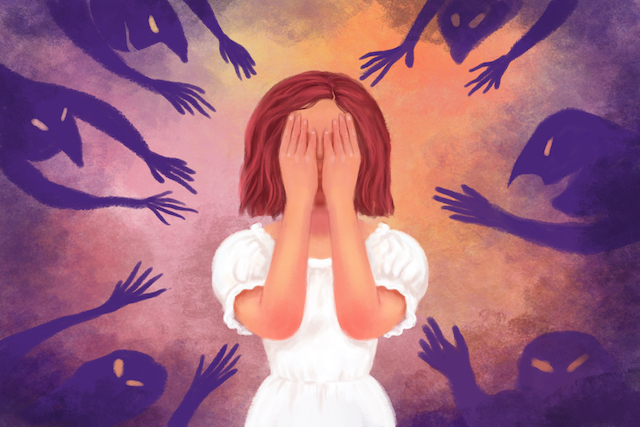
“Don’t try to understand everything, because sometimes it’s not meant to be understood, but accepted.” ~Unknown
As a child, I never had the opportunity to develop a sense of self. I had a father who was a drug addict. A mother who was abused by my father. And later, we had my mom’s possessive and controlling boyfriend. It was tough finding a consistent role model in the mix.
I was one of four kids and we grew up in a trailer, sharing one bunk bed among us all. As children, we often would brutally fight with each other. We all wanted our own space and sense of self, but there wasn’t enough to go around.
With our mom working so much, her boyfriend would watch us. He seemed to enjoy punishing us. I remember feeling so afraid. I didn’t want to do anything wrong. I wanted to have his love because it felt like the only way to be safe. I never felt good enough, not to my mom, dad, or the boyfriend.
Starting in my teen years, codependency started really kicking in, and I wanted my mom for everything. I unknowingly was part of her triangulation between me and my sister. We both craved her love and wanted to have her favoritism.
As a wild child, my sister was stuck with my mom’s negative self-projections, I received the positive. As the years progressed, these roles flipped, and I suffered a sense of rejection and confusion as to what I had done wrong.
Life was hard and I couldn’t live with the fear and shame, so I learned to unplug from my feelings. At the same time, these unprocessed feelings would cause outbursts of anger. I started feeling entitled to anger. It felt like life had kicked me so hard as a child, why wasn’t it getting easier? Why was it getting worse?
My learned dysfunction kept me yearning for connection but fearing it and pushing people away at the same time. I wasn’t capable of trusting others in a healthy way. With each loss, I took on more shame and perceived failure.
As I struggled through life, I was oblivious to the amounts of shame my family dynamic had me carrying. My mother’s triangulation and manipulation created an environment where she was justified in lashing out with no accountability. Everyone else was to blame for her poor reactions to situations.
As my mom and sister became a team, I became the problem who needed to learn how to accept and love them unconditionally. There was nothing wrong with them treating other people poorly. It was okay for them to deceitfully hide family secrets (e.g.: Mom drove home drunk from the bar and doesn’t remember getting home), because I wouldn’t agree, so they were justified.
I felt like I was on an island, broken and unable to figure out what was wrong and how to fix myself because the “rules” of justification changed so swiftly, and always in their favor.
Having no sense of self and being completely enmeshed with my mom and sister, I felt beyond broken each time I was accused of not being able to love unconditionally. I was worthless and a disgusting human being who was incapable of even a basic emotion that everyone else had.
It took a lot for me to see that love for my mom was making me feel close only when she was going through tough times, making me part of her someday club (our motto: “someday” will never happen for us).
My sister learned to use her money to express her love. She would take me to dinner and give me her quality hand-me-down clothes. While I was grateful, it also became justification for her to do crummy things toward me, usually when she had been drinking.
While sober, if she had a problem, she’d choose to “forgive.” The only problem is that she hadn’t really forgiven me because one night while everyone was having fun, I might get tired or I didn’t think a joke was funny or I looked at her the wrong way, and it would all come flooding out—every stored feeling she had been holding back for days or weeks.
If either my mom or sister hurt me, the expectation was that I should just get over it. There was no need for them to take accountability because “we are human” and “I am happy with who I am.”
I wanted to be loved and accepted but couldn’t ever really find my place within my family because the dynamics were so volatile. I was suffocating in the conflicting feelings. I felt angry but ashamed. I was unhappy and felt worthless.
When I hit bottom and I couldn’t see one thing in my life that gave me worth, I knew that I needed to make changes. I reached out and got help from a therapist and joined a local support group.
As I am separating from the dysfunctional patterns, the things that have helped me are:
1. Ask for help.
Dysfunctional family dynamics often create shame around the idea of talking to others. It’s seen as exposing family secrets and going against the unit. Nobody should suffer due to things out of their control. Reaching out helps you find the compassionate outlet you deserve and need.
I have been in therapy for about two years now. It has been the only time of my life where I have been able to experience consistent, reliable, and healthy direction. It has supported me in learning how to have self-compassion and make healthy, but tough choices.
I didn’t want to accept the reality that my mom and sister will likely never truly see me for me. My role as a scapegoat is brutally necessary for the emotional “economics” that occur within my family.
Therapy helped support me in my choice to find myself outside of my family of origin. There was much pain in going from seeing my family every weekend to now living a life outside of them. It required radical acceptance and the knowledge that I am unable to change anyone but myself.
I was lucky to have a kind, compassionate, reliable therapist to guide me as I dealt with each of the emotions that came up during this time.
2. Accept others as they are.
As a scapegoat in a dysfunctional family unit, I have learned to accept my situation for what it is. I have to set my expectations for what others are capable of giving.
We have no control over others or their view of the world. All we can do is accept a situation for what it is and assess if it is healthy for us. Once I accepted that my mom and sister do not really see the family dynamic as dysfunctional, I was able to free myself of the anger and need for control. They are blind to the ways they protect themselves emotionally and unwilling to have an open mind about it.
There is sadness, but I see that the relationship dynamic causes so much pain for me, and I cannot fix this on my own. While I am compassionate toward the pain they must be carrying, I see that I cannot continue a relationship that is built on dysfunctional habits.
3. Know your worth.
As an enmeshed individual, my worth was defined by external sources. I wanted my mom, sister, brothers, friends, coworkers, and acquaintances to validate me as a good, worthy person. I desperately needed to feel like others liked me enough to feel I had worth.
I now know that we all have worth, and it’s our individual responsibility to maintain this worth from within.
I have a tough inner critic, so having a consistent mindfulness practice has helped me establish my worth. It is hard to find worth when you are caught up in your own head, believing the negative thoughts going through it. Mindfulness helps me turn away from these thoughts and label them as just that, thoughts.
The more we tune out our negative self-talk, the more we can acknowledge our mistakes and learn from them without sinking into a low and getting down on ourselves. With this brings the awareness that our mistakes do not diminish our worth. Our worth is inherent. A mistake is just a mistake.
4. Learn what healthy love looks like.
Our family of origin doesn’t always teach us what healthy love looks and feels like.
In dysfunctional families, each person loves based on their limited capacity to process their own emotions. When someone has to keep reminding you that you are unconditionally loved, ask yourself, how do I feel right now? For me, I felt hated and restricted to being what was easy for my mom and sister.
Love should connect you with your inner joy. We all feel down at times and cannot rely on others to make us feel good about ourselves at all times. But I do feel that when someone loves you unconditionally, you shouldn’t feel lost. The joy of this love should be consistently present and help carry you through the tough times (e.g.: disagreements, hurt feelings, etc.).
When it comes to my mom and sister unconditionally loving me, I have had to accept that they love me the best and only way they know how while hiding from their shame. If they lash out, they are not able to carry the shame and embarrassment of their own actions. They cannot validate my feelings or experience in any way. They need me to carry this responsibility for them. This is not unconditional love.
—
As you move through the necessary steps to separate from learned family dysfunction, please remember that you didn’t learn these things by yourself and you will not unlearn them by yourself, nor should you.
Oftentimes things like depression or anxiety are a hurdle. Building a community is scary but necessary. This can be reaching out to a therapist or searching for support groups in your local community.
For years I struggled thinking that I could fix what was wrong with me on my own. It wasn’t until I reached out and got help that my mind was able to open up, process traumas, and make lasting changes.

About Eleanor Smith
Eleanor is hoping to encourage others to find self-compassion and personal growth towards a joyful life.




 Though I run this site, it is not mine. It's ours. It's not about me. It's about us. Your stories and your wisdom are just as meaningful as mine.
Thank you for sharing Eleanor!
There is a difference between dysfunction and abuse. For example, a person with mental health issues being unable to establish a healthy relationship is dysfunction. What your family does is abuse. Verbal and emotional abuse is often downplayed. But the effects of it can be severe.
Unless they decide to change at some point, it is likely that you will be subject to abuse at their whim for the duration of the relationship.
I think depending on the context, the terms “ dysfunction” and “ abuse” can either have different meanings or the same. In this case, having a dysfunctional family can also mean having an abusive family.
Depending on the individual’s understanding of language sure. From a psychological perspective no. Abuse involves hurting other people. You can be dysfunctional and not hurt others.
Yes but you can also be dysfunctional and hurt people..?
Thank you Eleanor for sharing your story and insight. As someone who is also in the process of rebuilding oneself after being estranged from a toxic family, it’s comforting and encouraging to know that I am not alone.
I’ve had friends who behaved in a similar way as you describe your family. The thing is, because of my childhood and dysfunctional family, I had a lack of self-esteem and I lived with “friends” like that for many years.
I’ve changed a lot over the years, have been going to therapy for several years. Mostly because of a depression and anxiety I used to suffer from.
When I got better I managed to discover how very toxic those relationships was and how destructive the connection between us was.
So I decided to stop seeing those people, I stopped making any effort towards them and I didn’t reach out to them at all.
Today I consider myself lucky that I was capable of making that choice and I’ve never regretted leaving those people.
I’m proud of myself that I was able to get out of those toxic relationships.
I’ve learned a great deal from those relationships and for that I’m grateful, it makes it a lot easier to avoid people like that now.
Because to me I find that the terms can be interrelated.But based on what you have said it is not.
That’s fair. Essentially, all abusive behaviour is dysfunctional. Not all dysfunctional behaviour is abusive.
Dysfunctional simply means to not function normally.
Abuse means to intentionally and repeatedly behave in a harmful way towards others.
Using the terms interchangeably can be a bit insulting towards dysfunctional people that don’t behave abusively.
Additionally, softer language such as “dysfunctional” is often used to minimise or deny abusive behaviour. By simply describing abuse as not the norm, harmful connotations are ignored.
I see, thank you for your insight. That cleared the misunderstanding. Just out of curiosity, by any chance, are you a professional? Or someone related to the field of psychology/ counseling?
Yes, and that is called being abusive. Why do you have a problem with the word abuse?
Often people minimise what is happening to them by refusing to acknowledge it as abuse. That’s something that I have a problem with as someone that has been there myself. It’s a form of denial.
I don’t have a problem with the word abuse. I just wanted to have a clear understanding between the two.
No, but my partner is. I double checked my understanding with him. I learned a lot from therapy over the years.
i can relate..good one Eleanor.. thank you for sharing
“As a scapegoat in a dysfunctional family unit, I have learned to accept my situation for what it is. I have to set my expectations for what others are capable of giving.”
I’ve been roaming around this site for quite sometime now and notice that most of what is shared around here is quite old so, I’m sure this comment is long passed discussion mode but I’ll leave one anyway.
I feel your explanation above and understand it as a good way deal with situations like this. Definitely a way I am capable of handling issues like yours but for me, there are times where I may “choose” the less recommended ways in how I want to feel about those who have put so much of their time and effort into making me feel in such painful ways as intentionally wanting me to feel shame and guilt for anything they want me to feel as such, and want me to be hurt with in all that time and effort they put into successfully filling my soul full of…HURT
Abuse in any form is what it is…Abuse. And the pain…Is the pain. And certainly, in most abusive beatdowns of hearts and souls, the pain is worse part of abuse. But, there are times…Way too many times, in which the worse part of abuse for a victim who will unfortunately face a very difficult and concerning journey ahead in life, is when having to watch the abusers get away with it knowing there is no acceptable reason for letting the abuser walk away from any damaging beatdown of a targeted soul, and allowing that abuser to carry on in life…Doing what abusers will do best in life…And continue to abuse others and most likely…Continue abusing the victim that for some shameful reason, isn’t able to get the abuser out of their life and all the cowards around who “choose” to look the other way, never show up before or after…And now it’s too late to give that brave but beaten soul a “better” chance to heal before they die….
And I would choose…NOT TO…Accept the situation as it is…And that is an anger any victim is certainly “entitled” to feel.
The pain…is the pain.
Not all injured souls heal as properly as others. And it shouldn’t be that way…to all of those looking away but know damn well what they see before choosing to pretend like they didn’t just leave a soul all alone to fight for their life against ab abuser who knows they targeted the perfect soul to feast on. Ain’t nobody coming for that soul.