

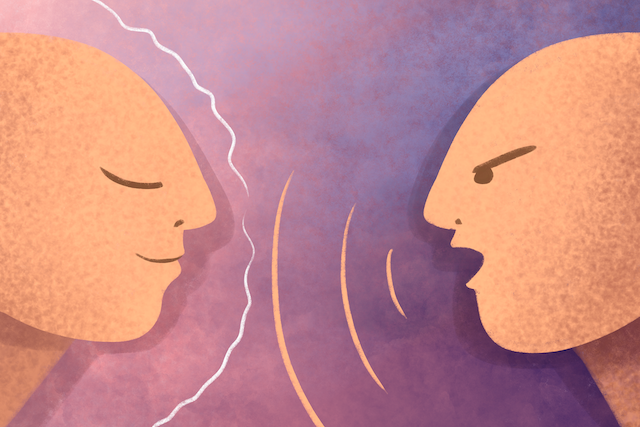
“The only person you can now or ever change is yourself. The only person that it is your business to control is yourself.” ~Melody Beattie
In 2019, I decided to leave my marriage and start over. Although my relationship with my ex-husband brought deep pain and many months of suffering, I felt content with my decision.
In a short time, I began to feel great. I developed a healthy routine, exercised regularly, began meditating every day, spent time in nature, maintained healthy and deep connections with people, and tried to focus on the positive.
For a few months, it seemed to be working. Until I met a man and got emotionally involved with him. I realized then I’d really been living in denial.
The moment I began dating or seeing someone more intimately, my life felt unmanageable. Suddenly, I would abandon my daily routine and spend days preoccupied with what this person was doing or why it would take them thirteen minutes to respond to my message. I’d become obsessed and wonder, “What’s wrong with me?”
I was quick to throw a tantrum to create more drama and fights. In some twisted and weird way, it felt exciting. I had something to resolve and take care of. I was feeding off the extreme lows and highs with people I dated.
As an adult child of an alcoholic, I didn’t understand what it meant to be addicted to excitement, as stated in the famous laundry list. Now I do.
My need to control the other person, the fear of abandonment, my obsession over people’s feelings, and my desire to fix their problems while ignoring mine brought an unbearable pain I couldn’t ignore anymore.
It all broke down this year. I met someone who once again triggered my codependency and challenged my trauma wounds. Shortly after we started talking, I began to feel crazy again. Constant anxiety, fear of loss, desire to control and manipulate situations, were coming to the surface until the relationship ended. Another failed attempt to be in a relationship.
What followed was intolerable emotional pain. I never felt so lost in my entire life. I couldn’t function properly, I couldn’t eat, I couldn’t work, and I was paralyzed by desperation, hopelessness, and loneliness.
Meanwhile, somewhere between my pain and inability to see my worth, I broke through.
For the very first time, I was forced to feel my emotions. Although it felt brutal at times, I was at least feeling. The pain cracked me open in my core and didn’t allow me to numb anymore. Anger, worthlessness, guilt, shame, fear of loss, the pain of believing I am hard to love—it all came pouring out full force.
Who would have ever thought that a broken heart, or at least what I perceived as a broken heart, would uncover my codependency and lead to emotional healing and more authenticity?
For the next couple of months, I would come home, lie on the floor in the middle of my bedroom in a fetal position, and brace myself for the emotional outburst that was about to come. I was processing and releasing my emotions, and there was no coming back.
I would breathe heavily and cry uncontrollably for days and weeks to come. I would cry at work, at the store while picking avocados, when I was falling asleep, or watching a TikTok video. It didn’t matter. For the first time in my life, I was feeling my feelings and didn’t push them away.
Honestly, I wasn’t quite sure what was happening. I had no logical explanation for this emotional rollercoaster until I talked to one of my good friends, Gaia. She mentioned a book she was reading, Codependent No More, and suggested I check it out.
I never considered myself codependent. By definition, I was the opposite of it. I had my apartment, paid my bills, lived on my own, worked while building my business, and took care of myself.
However, I decided to give it a shot and read it. What followed was epiphany after epiphany and a few A-ha moments. I began to understand why I felt crazy when entering any intimate relationship or a possibility of one. I began to see how the pain from my codependency allowed me to open up.
As I was sitting in my studio apartment while contemplating everything I’d learned and now understood about codependency, I knew that this was about to significantly transform my life if I did the work and didn’t stop.
Living with a person with chemical dependency shapes you into a control freak with unhealthy survival mechanisms. Codependency is one of them. The only way to change is to be willing to face the truth and commit to deep inner healing.
So, the question was, “What is the next best step I can take right now to heal and recover?”
At first, I needed to take personal inventory and be honest with myself. Who am I? What are my toxic traits, and when does my codependency step in? When do I manipulate people? Am I trying to fix people’s problems to increase my value and prove my worth? How can I stop doing that and rely on myself for approval and validation?
I remember the day when my mum called and let me know that our dog, Aida, had suddenly passed away. Shortly before her call, I’d had one of my emotional relapses and picked a fight with a person I was seeing at that time. I then used this disturbing news and my sadness as a tool to manipulate the other person. The victim façade I put on made them forget about my toxic behavior and feel sorry for me instead. What can I say? Manipulation at its best.
Honestly, it was not easy, admitting to myself that I manipulated people, that I was emotionally dependent on them and wanted to control them. This was not the type of resume I would want to show around, but at least it was real.
I was standing in my authenticity, and it felt incredible.
Once I became aware of my behavior, it was time to forgive.
The tricky part about growth and healing is that once you become aware of your shortcomings and trauma sabotaging techniques, it is easy to move from practical awareness to self-judgment.
So, I needed to forgive, forgive, and forgive some more. Therefore, I incorporate forgiveness into my meditation practice. I didn’t understand how utterly guilty I felt until I sat down to practice forgiveness through meditation for the first time.
After I closed my eyes and said out loud, “I forgive myself,” I had to pause the recording. My emotions came pouring out. It felt as if I had been holding my breath and finally exhaled after many years of keeping things inside. The guilt and shame came washing over me, and I began to release them.
I finally gave myself a break and instead of harsh judgment and criticism, I offered myself acceptance and empathy.
One of the most common patterns of codependent people is that we constantly feel guilty and not enough, and we limit ourselves from anything good or loving since we don’t believe we deserve it. The only way through this madness is to use compassion and understanding toward what we have done or who we believe we are. It’s about empathizing with our past, becoming aware about what happened to us and the impact it had.
No one is born to manipulate and control. It’s not who we are. It’s who we become as a survival mechanism. We adopt these toxic traits until we are brave enough to look in the mirror, admit to our mistakes, and break our patterns. And the only way is through self-forgiveness.
I started to work the 12-step program for codependents. I also learned that recovering from codependency is a journey, not a destination. Healing codependency is about self-control, constant self-care, practicing detachment, surrendering, and developing a healthy relationship with power.
As I learned from Melody Beattie, an author of numerous books on codependency, recovery is the only way to stop the pain.
Growing up in a household with chemically dependent people or in a home that doesn’t provide safety and proper nurturing, you may develop an unhealthy relationship with power as a coping mechanism. You may believe that if you can control and predict everything and fix people’s problems, you’ll be fine. You’ll be in control. You’ll be loved and enough.
But the only thing you can fully manage is yourself. Any time you try to control things or people, you’ll experience pain when they don’t meet your expectations. As you may already know, people do what they want, and many situations don’t play out the way we envision.
One of the biggest lessons I’ve learned this year is to find my power by looking into a mirror. Stopping the pain is about practicing detachment, letting go, working on my recovery to overcome the fear of loss and abandonment, and giving myself as much love as I possibly can.
The need to control often results in desperation that brings suffering, while practicing detachment and caring for yourself brings peace and allows healing.
Today, I say with confidence, “I am codependent.”
I am aware that to live healthier, I must stay truthful to my recovery. Sometimes I win, and sometimes I fail. Over time, there will be fewer losses and more wins. It comes with practice. I am mindful of the emotional and mental relapse that comes with the process. I know that I will fall into my old patterns and then struggle to get back on track.
However, I know I have the power to make different choices. When things seem to fall apart on the outside, it’s time to go inside, feel, process, and forgive. That’s my new way of life. Although it challenges and triggers wounds I need to heal, it gives me hope to believe those good things can happen for me too.

About Silvia Turonova
Silvia helps financially independent women transform their relationship with money, addressing both the emotional and the practical side through a personalized money system. She created the HerEaseWithMoney Starter, a free 10-minute money guide for women ready to take their first step. Get it here. You can also find her on Instagram.










 Though I run this site, it is not mine. It's ours. It's not about me. It's about us. Your stories and your wisdom are just as meaningful as mine.
Silvia, I can’t thank you enough for this article. I couldn’t believe how relatable your experience was for me when reading it. Thank you for sharing — this has helped me with some insights and clarity around my own experience. I so very much appreciate it. Thank you.
Bethany, thank you so much for your kind words. I am utterly grateful for support and help this article provides for you. It also reminds me that we aren’t alone and that there are many people out there who fight with these challenges in order to build a healthier life. And the best thing is that we are doing it. Sending you lots of peace, healing and love.
I read Codependent No More a couple of years ago and it resonated with me in many ways. You had this to say and I’m trying to let it sink in and tell me something: Growing up in a household with chemically dependent people or in a home that doesn’t provide safety and proper nurturing, you may develop an unhealthy relationship with power as a coping mechanism. You may believe that if you can control and predict everything and fix people’s problems, you’ll be fine. You’ll be in control. You’ll be loved and enough. I try to predict every bad thing that will happen and be prepared for it. I also learned to be uber responsible from a young age. Thank you for that statement though. It really hit home. I’m going to keep thinking about it. It makes sense to think it though….you don’t want the other person to be mad at you so you try to foresee the things that will set them off and fix them before it happens. I get it. But how much do I still do this, even 40 years later? And then I need to answer: how do I stop?
Since you read “Codependent no More” I am sure you are familiar with the 12-step program. Especially the first 3 steps is what I exercise more than anything. Admitting to myself that I am powerless over a situation or a person and then turning to a higher power and trust it. That’s what allows me to let go and detach. I actually made the word DETACH my screen saver on my phone. Anytime I feel things are out of control and I experience desperation and hopelessness, I pull back and keep reminding myself to detach and let go until I actually feel it. Nancy, did you try to exercise the 12-step program?
I’m wondering how to tell the difference between someone who is codependent, and someone who has borderline personality disorder.
Maya that is a great question. I wasn’t familiar with what borderline personality disorder is so I looked it up. Many symptoms they describe is what I experience as a codependent. I would say the difference is the need to control, something that codependents want to do. In my opinion, finding out whether someone is codependent or has borderline personality disorder is about taking lots of personal inventory, deep self-awareness or even seeking a professional who can help with identifying the real cause.
Wow, you freaking nailed it. Thank you so much for this article. I have struggled with these traits for years and at 38 I am now trying to give up control. It is so hard but I need to do it for me and so maybe I can one day be open and vulnerable to people instead of trying to manipulate. Peace and Love!
Thank you Abigail. I agree that it isn’t an easy task. If our brains are wired to live a certain way for so long, it takes times and lots of practice to change that. Just the fact that you are aware of it and actively working on it means that you are on the right path, something many people never take on. What is helping me the most is focusing on those little victories and staying away from judgment. Have you tried working the 12 step program for codependents?
Parts of this resonated with me, other parts didn’t at all. I’m a child of an alcoholic parent, but I don’t believe I’m co-dependent. I don’t manipulate or control others. I am addicted to excitement though… still working on finding healthy outlets for that.
That’s because people don’t always become codependent if their parent has problem alcohol use. Codependency can develop in a variety of situations, alternatively it might not develop.
Personally, my response to problem alcohol use was staying away from it. Everyone responds differently.
Good luck with the cravings for excitement!
Yep. Addiction to excitement is one of the things I have to manage myself. Growing up in unstable household makes the peace and stability almost unattractive. I agree with Helena, not every child who grows up with an alcoholic parent is necessarily codependent. I noticed my codependency kicking in more after my marriage ended. My ex-husband used to drink a lot which brought lots of uncertainty and fear and therefore a need to control. One of the best ways that’s been helping me when it comes to the excitement part is meditation. It makes me better understand how valuable and empowering it is to just be still and peaceful, something adult children of alcoholics aren’t used to feel or experience. Do you meditate?
I would by lying if I said I had a consistent meditation practice. I’d love to get it built into my daily routine.
There is a funny saying that goes “if you don’t have time for 20 minutes meditation daily, it means you need to meditate at least an hour.” Something that I remind myself constantly when I feel there isn’t the “time.” First, you want to take away the overwhelming part, meaning how long to meditate. I would start with as little as 5-7 minutes a day, preferably morning when you are rested. As you go along, add a few more minutes here and there. Also, I recommend guided meditations if you struggle to sit still at the beginning. Many of them focus on different parts of healing like self-love or forgiveness. YouTube is full of them. One of my favorites are meditation from Joe Dispenza where he combines meditation and science. I’ve noticed they work well for me. Let me know if you have any questions or is there any way I can help.
Such a powerful article Silvia, Thank you! I am 58 years old, moving from my apartment, up to where my 88 year old mom is, to help her as she needs it. My father was a functioning alcoholic (journalist for a national newspaper) and my mom was/is a social butterfly, and though I know she loves me, my sense was she always preferred to “go hear the music play,” so to speak. I believe I was the “parent pleaser” when I was young, and then the people pleaser at various times throughout my life. I also have attachment issues (I believe anxious/avoidant?), so I have stayed clear of intimate relationships for the most part due to fear, but also because of negative thoughts of not being worthy, or lovable. I have spent the last year trying to find a therapist, but covid has made it a daunting task to find someone who has client vacancies. As I prepare to move, I even found myself trying to connect with the new tenant to try and make something easier for her. My landlady reminded me to “let her figure it out!” It was a bit of a wake up call, that I want to “dot the ‘i’s and cross the ‘t’s for others, forgetting myself in the process. I’d love to find a 12-step program for co-dependents. I will have to google this. Tiny Buddha, you have great articles and information! Blessings~~
Rosslyn I totally recommend the book “Codependent no More.” It covers the entire 12-step program and explains what it is. There are more books on codependency from the author of this book but I would start with this one. It made me understand a lot about myself and why I do what I do. Instead of feeling “crazy”, I found the reason for my behavior. I wish you luck and sending your lots of prayers, love and healing energy. Let me know if I can help you in any way.
This is so helpful Silvia! “Thank you so much!”
All excellent articles xx thank you so much