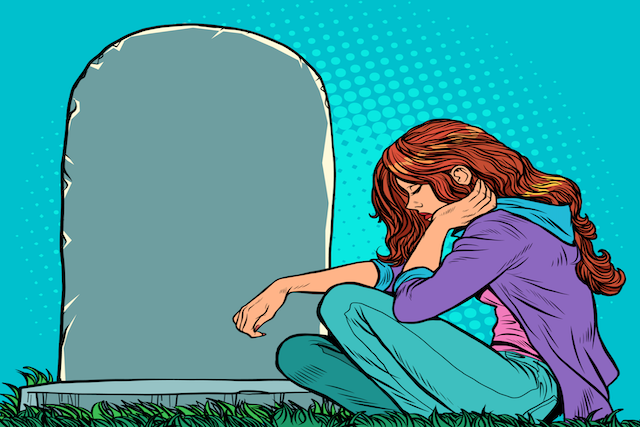
“Deep grief sometimes is almost like a specific location, a coordinate on a map of time. When you are standing in that forest of sorrow, you cannot imagine that you could ever find your way to a better place. But if someone can assure you that they themselves have stood in that same place, and now have moved on, sometimes this will bring hope.” ~Elizabeth Gilbert, Eat, Pray, Love
I had a tumultuous and interesting relationship with my father. He was a strong, proud man in his spirit as well as in his physical appearance. In my younger years, I knew my father as the final disciplinarian, the breadwinner, and the patriarch of the family. Even at a young age, I felt disconnected from him and did not agree with his harsh parenting choices.
While I do not want to speak too much ill of my deceased father, to put it lightly, he was not always the most sensitive individual regarding other people’s emotions or thoughts.
Perhaps it was my father’s past filled with deep hurt from abuse and alcoholism in childhood. Maybe it was the manipulation techniques he learned being a psychologist to control people. Either way, abuse, particularly emotional abuse, ran rampant in my home.
During my senior year of high school, he was diagnosed with a serious, life-changing illness. When his job laid him off due to his failing health, his decline became even steeper. My father, the man who was the epitome of control and strength in my family, lost control of all bodily functions and became very frail and fragile.
Tasks considered elementary or simple became very hard due to his disease. Activities such as unbuttoning buttons, writing a letter, or eating became very difficult. He started to have severe, deep hallucinations, and his weight started to drop rapidly. These are just a few of the many symptoms his disease caused.
The year before he died, I took a gap year between high school and college to help my mom take care of him. Due to this, I experienced his journey through sickness and death very closely. That year was the “year from hell.”
Not only was I helping taking care of a dying parent, but we had an enormous bedbug infestation in our home, as well as a flood that wiped out our entire downstairs. It was one of those years that brought me to my knees. My mother, being the only person who went through the experience with me, often wonders how we got through that year alive and/or sane. It was that bad.
I saw things that truly broke my heart and diminished my spirit. I picked up my bleeding father when he fell. I witnessed his severe hallucinations. One night, he got a scary look in his eye and screamed that there were people with guns in the house that were going to kill us. I hid in my room with the door locked, afraid of him.
My most painful memory was seeing him right before his death when he was going in between consciousness and unconsciousness. I have never seen anything like that before. The memory still haunts me.
When he died during my freshman year of college, I thought I would be fine. I had spent a year watching him decline, so I could just move on, life as normal, right? The grief would not hit me. I had already worked through all of that. BOY, I was in for a wild ride.
I had spent the last year going through an incredibly difficult experience and because of what I had been through, my maturity was way beyond the normal eighteen-to-twenty-year-old. I struggled to fit into a party school college environment. The things college kids cared about at this point seemed so trivial to me. I was busy thinking about the impermanence of life and funeral plans; my friends were thinking about rush week.
I fell into the deepest depression of my life. I was in so much pain that I felt the only way out was to not be present on this earth. I would pray that when I went to sleep, whatever existed “up there” would take me and I would never wake up. Getting through the day felt like running a triathlon. The only time I felt solace was when I was asleep.
So how did I get here? How did I go from being the most depressed I have ever experienced to sitting here at a coffee shop peacefully typing away?
I want to share some of the most important tools that helped me through my grief journey and helped me through my depression. While they all may not work for you, I am hoping that at least one of them will help you find peace. Most importantly I want to stress, over and over again, you are not alone. There is a light to the end of the tunnel, as cliché as it sounds.
Be gentle with yourself.
When I was working through deep trauma and grief, I was surprised how my body reacted. I did not realize that while I was processing what had happened on a surface level, my subconscious was processing the experience as well. Due to this, I was incredibly tired and emotional all the time. I needed so much sleep and time to decompress.
Giving my body and mind the time I needed to process what I had been through was incredibly important. Working through difficult experiences mentally and emotionally is not a sprint. It takes time. Being gentle with myself and not rushing my healing journey was very helpful in the long run.
Find a skilled mental health professional ASAP.
My partner recently asked me what was the best thing that has happened to me in the past ten years. I told them it was my mom getting me a skilled and powerful therapist at sixteen.
I know there is therapy shaming that goes on in a lot of circles. I have witnessed people who are in the mental health field who refuse to get therapy. While they believe in mental health for other people, they believe they do not need anyone to help them even though they are struggling deeply.
Speaking as someone who has spent her entire life researching mental health and intends to make it my livelihood, let me just say this once and for all: Everyone, no matter how healthy or “woke” you are, can benefit from seeing a skilled mental health professional.
Being able to share your problems with a trusted individual, who is educated and trained to handle trauma and difficult situations, is incredibly healing. Therapists will give you techniques and tools to move through your difficult situations and will be a non-judgmental place to hold space for you when processing painful life circumstances.
That being said, I often tell my friends that finding a therapist is like finding the perfect sweater. Not everyone is going to fit. People have different techniques, energy, and listening styles. Let yourself explore and what is best for you and do not be discouraged if it takes a few people to find a positive fit.
Share your story.
The power of sharing your story is profound. The opportunity to claim something that has happened to you and express it to people who will hold space for you is an incredibly healing and cathartic process. When I was able to express what I was feeling, I felt like those feelings did not have power over me anymore. I felt liberated.
As a caveat, I learned that it was important to carefully consider whom I chose to share my story with. I chose people who I was confident had earned the right to hear my story. So if I knew that Aunt Sally was going to brush my story aside or tell me that my feelings weren’t valid, I didn’t share my story with her. She had not earned the right to be a witness my experience.
My life journey and experiences are beautiful and valuable. It is an honor for me to share them.
Depending on your environment and support group, you may want to get creative with who you choose. I know that not everyone has a group of supportive friends or family members. If you fall into this category, I strongly suggest you look for other avenues such as grief support groups, national helplines, group counseling, talking with a mentor, and/or reaching out to a counselor. No matter your situation, you are never alone. There are people out there trained and ready to help.
Gratitude, gratitude, gratitude.
When I was in my deepest pit of grief and depression, feeling gratitude seemed impossible. I truly felt there was nothing to be thankful for in my life. My friend recommended that I start writing down ten things I was grateful for everyday when she heard how much I was struggling.
I did not write down huge things. I wrote about the little joys in life. No matter how sucky things were, there was something that made my life easier every day. Sometimes it was the fuzzy blanket that was draped over me to keep me warm. Or the trashy T.V. show I was binging that made me laugh. Or even though I declined, the invitation that my friend sent to ask if I wanted to get coffee with her.
The other thing I started making myself to do in the morning was writing the three things I was looking forward to each day. When I was at my deepest point of depression, sometimes the things were incredibly small. However, writing down what I was looking forward to pushed me forward even when I felt overwhelmed. This may seem like a small thing; however, practicing gratitude daily is still one of my most helpful tools to stabilize my mood.
Be open to receiving alternative forms of help.
I have always been resistant to taking anxiety/depression medication. This was due to some uneducated biases in my past that I have worked through at this point in my life. However, processing my father’s death and the grief that followed while at college was incredibly painful. I remember being so depressed in the mornings, I would stare at my dorm room ceiling and pray that I would just die. Getting myself out of bed was even harder.
My therapist suggested I get on depression medication, but I was resistant. Finally, one day my mother said to me, “Angela if your best friend was in this much pain and medication may help her, would you shame her into not taking it?”
“Of course not,” I thought. “I would absolutely encourage her to take it. Who knows, maybe it could help?” Once I said those words, I knew what I had to do.
I went to a psychiatrist and he set me with a low dosage of depression medication to make me feel comfortable. You know what? It tremendously helped. In fact, if I hadn’t taken this medication, I do not know if I would be writing this article for you today.
I write this not to try to push anyone to take a certain kind of medication or to try certain forms of healing. However, I do encourage people to try new ways of healing from your experience. If you have gone through an extraordinary painful experience, sometimes it is going to take more intense measures to get back to a new normal.
Find a sense of community.
If this experience, or even 2020, has taught me anything it is that we are not meant to live these human lives alone. It is incredibly important when we are going through difficult times to surround ourselves with people and environments we can lean on and that can support us.
For me it meant dragging myself to a grief support group every Wednesday, even though I was drowning in homework and had so many things going on in my life.
It meant pushing myself to go out with my friends who loved me, even when I didn’t really feel like it or felt too sluggish.
Community for me was making me go to the Unitarian Universalist Church on Sunday. Sure, I did not know anyone and I sat alone; however, I felt deep comfort in a room where people were just focused on spreading love.
If I needed alone time, I by all means took it. However, making intentional time to spend time with people who made me feel comforted and loved was incredibly important.
Remember that this is a season, and your pain will lessen over time.
I remember when I was at my worst point with depression, I truly did not believe it was going to get better. I was in such a dark place that I literally could not even fathom that I would feel like myself again. People would tell me I would be happy again and I would roll my eyes. They didn’t understand how much pain I was experiencing.
The pain was telling me there was no way I would get through this experience. I would feel this unhappy forever. I was permanently changed. I felt like I had dropped down so low into the pits of it, that there was no way out. I felt helpless, stuck, and alone.
However, fast forward four years to now, I want to say that those people who told me it was going to get better were absolutely correct.
Sometimes when working through deep depression or deep trauma the brain can play little mind games with you and tell you things will never get better. I promise with all I have and all I am that at some point you will see the light again. You will be so glad you stuck through the pain and appeared on the other side.
A Note on Grieving a Toxic Person in Your Life
Sometimes when we experience the death of a toxic or abusive person in our lives, we have mixed emotions. This is something that is not talked about, and something I really struggled with in my healing journey.
Let me be clear, I did not want my father to die, and I did not want him to feel pain. I would never wish that on anyone. However, he did cause a tremendous amount of pain in my life, and this, in turn, has caused sometimes conflicting emotions for me when processing his death.
Sometimes when I miss him, the memory of him slapping me across the face would pop up in my mind. Or when he would emotionally manipulate me over and over again to get what he wanted, and I would finally concede exhausted from the games. It is still hard for me to process and talk about these experiences.
I want to stress that if you have a similar experience of someone dying who was a painful person in your life and you feel mixed emotions, you are not alone. You are not a bad person. Or evil. Or sick. You have received trauma from an abuser, and it is natural to be angry with them, whether they are dead or alive.
The emotions and feelings you are processing are valid, and most importantly, they are okay. I am not going to sit here and pretend that I have all of this figured out. To be honest, the complex grief stuff, I am still working through. However, what I can do is hold witness to your feelings and remind you that whatever you are feeling is not strange or a reason to be ashamed.
With closing this article, I want to express that all these suggestions above, I still implement them into my life even though I am not depressed or feel much grief anymore. The things I learned to help me through the journey of grief, trauma, and depression help me be a happier individual now.
Maybe I had to go through that experience to learn that, or maybe I would have figured it out eventually without it. One will never know. However, I do know that I have never felt more liberated in my life, and I am truly thankful for those painful years. They led me to my beautiful life today.


Leave a Reply