

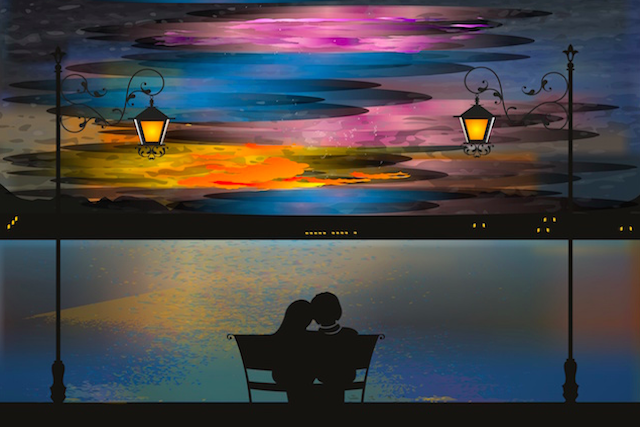
“Try not to confuse attachment with love. Attachment is about fear and dependency and has more to do with love of self than love of another.” ~Yasmin Mogahed
The feelings we get when meeting someone new are hard to understand at times. We have biopsychosocial and even spiritual responses and interactions with people we come into contact with.
We’ve all met someone and felt like we just want to be around them. They make us nervous (butterflies), we can’t think straight, we’re self-conscious, we just feel an overwhelming… pull toward them.
I have (like many before me) spent my life equating this experience with the very beginning stages of love or may even go as far as to proclaim this as “love at first sight.”
I did this because:
1. It didn’t happen often. In years and years of dating and searching for “the right one,” I only got that intense experience a handful of times. So I equated that emotional reaction with the quality of the connection.
2. I felt like any and all ambivalence disappeared from my mind and emotions. I knew, in those moments, with those people, I wanted to be around them, I needed them in my life. The questioning of ” what do I really want?” seemed to fade into oblivion. Doubt seemed to disappear from my mind.
3. I felt extremely attracted to them. Not just physically, but mentally and emotionally. It wasn’t purely lust, so it had to be more.
But what if I said, this isn’t remotely real romantic love at all? What if I said this isn’t lust either? What if I said books like Romeo and Juliet, The Notebook, Twilight, and many others alike, have gotten love completely and utterly wrong all along?
Now some of you may say, “Yeah, I knew that was all wrong.” But our culture and society were built on this deeply passionate idea of love and marriage—after all, they go together like a horse and carriage.
Our subconscious minds have been programmed to want that kind of big love, that kind of dedication, that kind of commitment. The kind that would play out like, you know, the movies.
I had this revelation recently after meeting someone and being overtaken by these emotions, for the first time in a while. I immediately went to the idea that maybe she is the one, maybe this is it. I couldn’t think straight. I couldn’t focus. I just wanted to be with her. I just wanted to be close to her.
Then I realized something quickly, while in the throes of my serendipitous fairy tale encounter: This was out of character for me at this point in my life.
I felt I couldn’t be myself. I felt like I was out of control. My confidence was muddied by nerves. I felt like I had no say in what was happening between us and what was happening inside of me. Something else took over. I knew it wasn’t purely lust and I knew, intuitively, it wasn’t what love should feel like. So what was it?
After years of growth and work, I knew one thing for sure: Balance is the secret to life. So feeling incredibly unbalanced was a red flag to me. I dug deeper. I thought back to my training as a counselor, the presentations I had given on attachment theory, and the digging I had done on my own attachment schemas.
And I realized when I quieted all of those seemingly out of control, but elated feelings, the emotion that came to the forefront was, anxiety. Pure anxiety.
I thought back to every relationship or encounter that made me feel that way, and in an effort to get to the bottom of this, I desperately asked my higher self what they had in common—and it was clear right away.
They all ran away at some point. But to be more accurate, they were all emotionally and psychologically ambivalent or wave-like in their attachment orientation. This meaning, in the context of ambivalence, they went back and forth between being emotionally available and unavailable. Sure of what they want, then unsure and pull away.
Psychological ambivalence is defined as a state of having simultaneous conflicting reactions, beliefs, or feelings toward some object.
Attachment theory is far too in depth to dive into in this article, but in short: We all develop attachment patterns stemming from childhood relationships with our caregivers, and they are ever evolving throughout our teenage and adult years as we go head first through friendships and romantic relationships.
Wave-like tendencies, in regards to attachment, are typically characterized by swaying back and forth from anxiety to ambivalent states.
So here is what happened to me: Every time I met a beautiful and intriguing woman who radiated unavailability, my teenage, insecure, anxious self forced its way to the surface from the deepest caverns of my psyche.
This strong, out-of-control feeling I associated with love was just my own wave-like attachment schema thrown full throttle into anxiety mode.
On the surface, these relationships and connections felt right and felt amazing for me because my own tortured ambivalent nature seemed to fade away, and the intense energy taking place during this dynamic essentially acted like a high. But, on a deeper level, I felt utterly rooted and anchored in anxiety.
It was deceiving. I knew what books and movies portrayed true love and soul mates to be, and my brain automatically associated these strong emotions and interactions with those narratives.
From Victim of Love, to Empowered Co-Creator of Love
I realized that real true love is a choice; it isn’t something that happens to us or triggers us. At the heart of empowerment is in fact choice. When we choose to have romantic relationships with the people that balance us, we are in control and empowered enough to choose and co-create, with that person, what that relationship will ultimately be.
We can alchemize and create relationship dynamics such as passion, dedication, and unconditional love—all of the fairy tale cues we yearn for. All accomplished by setting the intention to have that type of relationship and backing it up with actions that align with those intentions. But it must start from a space of feeling balanced in our love interests energy and presence.
In this moment of clarity I was able to realize literature and society had it all wrong. I had it all wrong. Big romantic love isn’t this overpowering energetic force that takes us over and sweeps us off of our feet. It is something we intentionally choose to co-create, from a balanced place—with a partner who draws feelings of peace from within us, not anxiety or fear, and a partner we can be our most authentic self with.
So How Do You Make The Shift and Create Healthier Romantic Relationships?
1. Understand your attachment schema and piece your own patterns together.
There are plenty of books out there, the most helpful and well-rounded of them being Your Brain on Love, by Stan Tatkin.
2. Remember, awareness is the first step.
It won’t stop you from feeling those intense emotions when you are around someone who triggers your attachment schemas, but it will empower you to make healthier choices about what role those people do or don’t play in your life. We have been conditioned on multiple levels to seek overwhelming love; it isn’t a habit we can break overnight.
3. Continue to become more aware, and heal your wounds any way you can.
Re-write the stories you’ve told yourself about what love is and what love is not that have held you back from having the type of relationship you really want. It takes time to reprogram the narrative and build real love from a balanced place, without more self-sabotage.
4. Balanced romantic relationships can start in a multitude of ways, but friendship seems to be the most naturally balanced place to start from.
This doesn’t mean force friends first, in an inorganic way; it just means listen and pay attention to how you feel when you are with that person.
5. Notice when you feel inner peace, joy, authenticity, vulnerability, and acceptance when in the presence of someone.
Those are the sentiments and emotions felt when rooted in balance. Anxiety (butterflies), fear (please don’t leave me), an anxious need to be with someone, and feeling like you need to be something or someone you aren’t—those are the biggest indicators that you are not coming from a balanced place.

About Jeremy Scott Lambert
Jeremy Scott Lambert is a Coach + Psychotherapist that works with couples and individuals all over the world. He has a passion for helping people create conscious relationships and their best lives. Check him out at JeremyScottLambert.com.





 Though I run this site, it is not mine. It's ours. It's not about me. It's about us. Your stories and your wisdom are just as meaningful as mine.
Thanks a lot Jeremy. I want to let you know that I’ve been feeling the same way from time to time and I was wondering why. Recently I met a girl, and the same thing that happened a year and a half ago, was happening again to me. And tonight, talking to a friend I found out some clarity about this matter.
I had this article opened in one of my tabs for couple of weeks “to read later”, today I decided to read it and I assure you nothing is coincidence. Thanks. This explains a lot. I will keep this in mind.
Amazing article and insight Jeremy! Thank you!
This is so true. Thank you!
AWESOME article. Very helpful insights! 🙂
Excellent! Thank you!
“And I realized when I quieted all of those seemingly out of control, but
elated feelings, the emotion that came to the forefront was, anxiety.
Pure anxiety.” WOW. I’m having an aha moment about a recent ridiculously charged, passionate, emotionally unbalanced high of a relationship where I was constantly feeling slightly manic and people noticed. I had never taken anxiety medication until I met this person. I had never had sleep problems until we broke up. I had never felt so depressed, moody, fearfully lost in my life after breaking up and he ran away in fear I was too good for him. I had never felt love like this before EVER and I’m a grown adult. I am still reeling from the year together and was worried I’d never find this feeling again. But after reading this maybe I shouldn’t want to have this intensity again with someone and be thankful for the experience. Thank you!
I realized when I quieted all of those seemingly out of control, but elated feelings, the emotion that came to the forefront was, anxiety. Pure anxiety.- this absolutely resonated with me.
I find it incredible how this feeling takes over, and like you say makes one feel out of control. And yes it’s an absolute high. I would even stretch as far to say its a kind of addiction. But once you become truly aware, the intense grip of this lossens. And it creates a space where you realise, its all a choice. Ultimately the choice is ours to spin out of control or pause to gain some perspective of what’s really happening.
Thanks for the article. It’s food for thought.
Wow, I so needed to read this today! Thank you 🙏🏻
Thankyou Jeremy,
I am with a bloke who creates all the balanced feelings you spoke about in 5.
Id been wondering wether the affectionate/love feelings I have for him were real or just convienient because I like my alone time and dont have the teenage/movie head over heels yearning I thought meant real love. I do miss him after a few days though:) Your article was such a relief to read. Looks like I have the the right thing already….the makings of a beautiful relationship to grow and build. I thought because I was making it what I wanted by choices and actions that it wasnt real…turns out it’s the best real you can get. Definitely an Aha! moment,
Thanks again.
This is a great article. I agree with everything, but I do have a question. I do feel like there should be some chemistry and new relationship energy, or you’re just forcing a love that isn’t there. I was married 18 years to someone who was compatible (“good” for me), but with whom I had very little attraction, which eventually killed the marriage. I feel like there should be some of that new relationship excitement, but perhaps not to that degree where you feel out of control as you describe. Does that make sense?
Hi Diana, I’m with a guy who started as a friend, quickly became my best friend and a few months later he asked me out. While we were friends we had a lot of laughs and I enjoyed his company, I felt his absence after days without contact, but I didn’t think he was particularly attractive. Once we started dating, there was (and still is) definitely the new relationship excitement and chemistry. It was as if his touch ignited a spark in me. I’ve never felt so safe to be authentic with a partner before, perhaps in part because having married and divorced the wrong one I have little time for superficial friendships, so as friends we had a very open discourse from the beginning. I have other close male friends where there’s no attraction and we just remain friends. I’m hopeful that this one is a keeper. I agree with you, there definitely should be attraction and excitement, I can’t imagine a long term relationship working out wonderfully without it.
Thank you for explaining this so clearly. Amazing article.
Definitely something I have thought of but then I think about thoss who actually have that high and end up together, in love always…I know they are rare but they exist….how would we explain them? I really don’t want to be in a balanced but stale relationship….
Beautiful article, thank you.
I found this offensive