

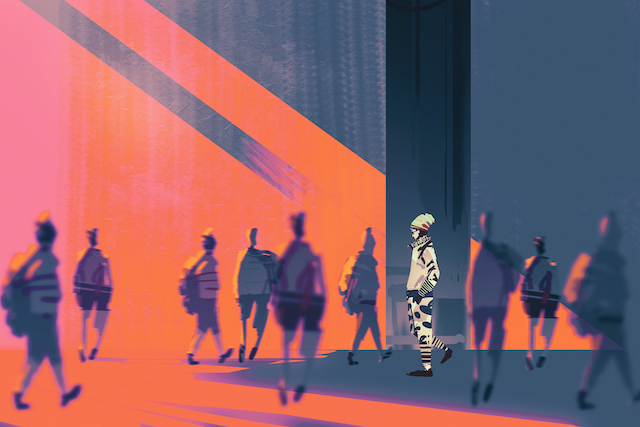
Dear estranged adult,
What I want you to remember is that it was never really about you, although it might have felt like it at the time and it might feel that way now.
When your parents told you over and over you weren’t good enough, that you would never amount to anything, they were just projecting their own feeling about themselves on to you because deep down, they do not feel they are good enough and don’t believe they have amounted to anything.
Maybe these feelings were passed down from their parents, or maybe your parents have regrets about their lives that they transfused on to you, but these reasons are not that important. Not as important as that fact that what was said to you, what was done to you, was never your fault. It was not about you.
You were always good enough; you were always going to amount to something. and that might have threatened them. No one is born unlovable or unworthy of love, no one.
Over the years I have learned that people’s words, actions, and beliefs have very little to do with me and are more about themselves.
As people interact with others, they project how they think, what they believe, and how they feel on to others. In fact, we all do this, even you and I do it. But what sets us apart is the fact that we can reflect on how our actions and words impact others. We can see the world from our own perspective and can also understand how others might see it.
If you grew up in an environment like mine, you were taught the incorrect belief that how others see things and how others see you is more important than how you see yourself. You were likely taught to put your own thoughts and feelings aside and instead engage your parents’ thoughts and feelings.
In some cases, you might have mistaken their thoughts and feelings as your own. You might have heard their voices in your head over and over, and you might have found yourself saying their words.
Over time, if you were at all like me, you began to experience dissonance with what your parents told you, and you began to connect with your own ideas, thoughts, and feelings.
In some cases, you might have felt doubt about your ideas, and you might have tried to suppress them. In other cases, you might have found yourself on a teeter-totter between your thoughts and their paradigms of you on the other side. But either way, you found your truth, and even though it caused you pain you found your voice.
As you found your voice you found yourself and started to speak your truth. As you started to speak your truth you were told over and over “But they are your parents, they love you, you can’t cut them out, you can’t let them go. They are getting older, they need you.”
In your heart you know the truth, but because you were taught to listen to and believe the voices of others you questioned yourself and tried over and over to reconcile. With each attempt to fix a broken relationship, your heart ached until you knew you could not take it any longer. You had to listen to your own voice, or you would break.
You likely wrestled with guilt and you might feel guilty now. If you are struggling with guilt over going no contact with your parents, let me ask you a few questions:
How do you feel after you have interacted with your parents in any form? Be honest with yourself.
Do your parents respect your boundaries?
Is there healthy reciprocity in the relationship?
Do you feel you can be who you are, and state your truth without judgment?
Do you feel respect or love or acceptance from your parents?
If the answers to these questions are painful, know in your heart you have made the correct choice for you. You have made the choice that is best for your health and well-being.
Now here you are, an estranged adult child. You are navigating the world without connection to your family of origin. You might be stronger than you have ever been, in some cases happier, healthier, and more confident then you have ever been.
Every day you confront the childhood trauma that brought you to this choice with clarity, resolution, and strength to work through it.
You might have done things you did not know you were capable of doing; you might have built a supportive family of your own and/or helped others in the ways you needed help. You might be taking small steps every day to live as your best self. Take a moment to celebrate that!
You have done something that no one should ever have to do, you have made one of the most painful choices you will ever have to make, and you have been misunderstood by so many—and yet you remain strong. You remain true to yourself and your story!
Maybe you are desperate for people to understand your story, to validate your lived experience. You might long for your parents to say that they are sorry for the pain that they have caused you. I know because I have felt and longed for these things, but the truth is you don’t need these things.
You might question why. Why will my parents not understand the pain they have caused me, say they are sorry, and love me the way I have needed to be loved all my life?
I wish I had an answer that would satisfy these questions and somehow take away that pain. The best answer I can come up with for you and for myself is that some people are not ready to accept that they are the villains in your story, and they might never be. Rather than reflect on what you have asked, they lash out, desperate to protect their narrative as kind and loving parents.
Parents often don’t want to experience any cognitive dissonance, or things that cause them to question who they believe they are as parents and as people. This may be why you do not get the validation you deserve. The truth is, you don’t need that apology you might never get, and begging and pleading with them to validate your truth is likely hurting you.
Some people will never understand you; some people will hurt you in more ways than you can imagine, and they’ll walk away as if it was all your fault or as if nothing ever happened. This is about them; it’s not about you. You know your story and you are prepared to own it. You are living it despite adversity. and I am proud of you for that.
Please try not to focus on those who don’t understand, don’t try and convince them to see it your way. You will be better off emotionally if you abandon those fruitless efforts. Sometimes people can only understand what they themselves have lived through.
If your friends or extended family grew up with supportive parents, they might not even be able to picture what you went thought, and that is okay. Instead, try to surround yourself with people who do understand and do your best to validate your own lived experiences. Write or record notes about your experiences, and when you start to question yourself, look back at these and self-validate. This helped me when I questioned myself, and I still do this today. I know this is not easy.
Take time to celebrate you, because you deserve it. You have discarded the story your parents tried to write for you, and you have started to write your own. You have walked away from abuse and adversity in a society that sees you as the problem, and you continue to stay strong every day.
Tell your story, live your truth, and never be ashamed of the painful choice you had to make. The abuse and the way you were treated was never about you, it was about them. You have virtues, insights, and values. You are lovable and you deserve to be celebrated and loved for the person you are and the person you are becoming. You are not alone.

About Jen Hinkkala
Jen Hinkkala is PhD student, researcher, and teacher of arts education in Canada. She strives to understand what factors and experiences lead to higher levels of wellness, resiliency, and self-care among arts educators and students. Jen is also a life coach and specializes in self-care, well-being, time management, performance anxiety, estrangement, overcoming abuse, career paths, and anxiety. Jen runs a support group for estranged adults and a group to support personal development. Follow her here: Twitter / Blog.








 Though I run this site, it is not mine. It's ours. It's not about me. It's about us. Your stories and your wisdom are just as meaningful as mine.
Very good article Jen. I have some additional thoughts about why abusive parents abuse their children. I think it boils down to change is hard and difficult to achieve on your own.
I don’t know if you agree, but as people are abused as children some abusive behaviours can become normalised and we rely on other people telling us when we’re doing something wrong. At that point there’s a moment of choice. Carry on the way we’ve been going and follow in the footsteps of our parents. Or focus on developing self-control and empathy out of a desire not to hurt others, which isn’t as easy as it sounds. The difference between us and them are the choices we make and any help we receive along the way. Older generations may not have had access to these services and while they exist now, they might not trust in them.
Thank you for your kind words and your insights.
Excellent points of thought and reason, an article I will bookmark for future rereading. Very important topic, in a broader range than you may have expected.
When I read the title, I thought it was relevant to any adult who is estranged from any significant relationship. In my case, a sister who “divorced” me because of our “differences in personality and philosophy.”
When I reached your definite reference to estrangement from parents, I thought for a moment, “This is not for me, okay.” Then I realized I’d been impressed to that point, because my feelings actually were very similar to what I was reading.
So, I am glad I benefited by reading the entire piece. Would you comment on my perspectives, please? Thank you very much for sharing your story and the wisdom you gained.
Thank you for your comments Catherine. I think it is natural to experience some level of cognitive dissonance when reading something that we can relate to personally. You are insightful for realizing this.
Thank you.
You are welcome
Thank you Jen, this is what I really need to hear these days. It’s been 3 months since I left my parents’ house because they don’t accept me and my partner (we are both girls in the relationship), it was so painful and I felt guilty at times but now I can say that I have never been this happy because I can be who I want to be and do what I want to do.
Thank you for your comments Ann. You raze a very good point abut expectance and the fact that it can be very difficult to feel happy and at piece when you are not able to be who you are. Stay strong.
It took me till my mother who passed away in June to truly give up on the idea of our relationship. As she got older she became more and more critical of me, I played my part of the dutiful daughter and carried a load of hers that was not mine to carry. People ask how am I doing these past months…I feel lighter…I did my best to ignore her behaviour towards me-some part of me still needed her. Until one day I had an epiphany that I would never make her happy, that she would never show me the love I craved all my life. I agree totally it was never about me…and I spent my life being understanding, forgiving of her abuse and hoping for the golden moment of true acceptance. I did receive one gift from her during one of our last visits -she turned to me and said “You are amazing.” This recognition was more than I had ever hoped for. Thank you for your insightful article-
love.
While I understand the painfulness of the situation, the parent pain is real too. Losing a “living” child is one of the most painful experiences a parent can face. Often times the parents do not know why they’ve been estranged. Children do not come with an instruction manuals. Most parents try their hardest to provide everything for their children. And people aren’t perfect. Most parents do their best raising children.
When there are grandchildren involved? What then are the implications of parent engagement? Especially if the grandparents who have been constant loving role models are abruptly removed from their lives? Is this teaching the children that it is okay to abandon their parents once they reach adulthood if they don’t like something their parents do in the future?
For those children that have been sexually, physically or SEVERELY emotionally traumatized, I can understand the need for separation. But for those who can work through problems with or without therapy, I can’t comprehend parent estrangement. It seems cruel to me.
Of course, there’s pain in life, counselor! A human condition, there’s also disappointment, misunderstanding, lies, more pain so, get ready, young parents!
Some PhD we’ll have here, letting the lost believe any one is or can be perfect, doing their part to set the angry, perhaps confused adults that land aground on your page adrift from the strongest relationships most will ever have, “free” to navigate life with only their battered inner-child to make them whole.
Not to diminish what you or anyone has experienced, as myopic self-help perspectives like this tend to do but, I see and feel the pain of life in your writing, as I do others and through which, for some reason, I also, anxiously read for an advisement about the importance of introspection, of healing any innately destructive patterns that lead to adult estrangement; that where ever you go there you are part of self-help we need and which, albeit too late, we must find in the name of balance. Also the victim of imperfect, perhaps flawed, maybe even monstrous parents i.e., life, to feel your pain is to know, there’s cognitive dissonance in victimization too but, no resolution.