Author: Lynn Newman

  • The Good News About Feeling Bad (And How to Get Through It)

    The Good News About Feeling Bad (And How to Get Through It)

    “To honor and accept one’s shadow is a profound spiritual discipline. It’s whole-making and thus holy and the most important experience of a lifetime.” ~Robert Johnson

    There’s nothing worse than having a bad day (or week or years…)

    Or when emotions take over and carry us away.

    Or when our relationships bring challenges.

    Or when we endure great loss.

    Or when we wish that just once when things started getting good, they stayed that way.

    But difficult times are really offerings that show us what no longer serves us. And once they’re cleared, they no longer have power over us.

    No one, including myself, wants to feel bad. After decades of trying to overcome depression and anxiety, one day, I finally stopped trying to fix myself. I then came to the amazing realization that there’s really no problem with me.

    This is what set me free:

    Several years ago, my parents both died of cancer, I had many miscarriages, my husband and I divorced, and my dog of sixteen years had to be put down.

    It was intensely difficult, and I fell apart. I hardly recognized myself. At the same time, even in my darkest hour, I knew in my gut that I would somehow get through it.

    In the midst of my mid-life crises, wondering when and how I would get over the debilitating, soul-crushing loss, I trusted myself not completely, but enough. 

    During that time, I made a new friend whose father had recently passed. I invited him over for a bowl of my famous Italian chicken sausage lentil soup.

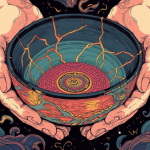
    He was angry and confused. He was in shock. I picked up my soup in the palms of my hands and said to him, “Grief is a big bowl to hold.”

    At any given time, without knowing why or how, grief can overcome us in a number of aching expressions.

    We get super pissed off. Or we want to hide. Or we push away those we love, and wall off. We want to numb the pain. Or cover it up.

    Seemingly insignificant annoyances trigger us. Perhaps a token, memory, or random happenstance wells us up.

    We all mourn in different ways, wanting more than anything for it all to end. And we sometimes pretend that it’s over when it’s not.

    Someone once told me that there is grief and frozen grief.

    Frozen grief is grief that got stuck like water passing from a liquid to a solid state—a cohesion of molecules holding together, resisting separation. Like a Coke in a freezer, it can burst.

    Warmth and equilibrium are what’s needed to nurture it. But there’s not a single temperature that can be considered to be the melting point of water.

    I read once that after suffering a great loss, it takes two years to heal—or at least have a sense that the trauma is now of the past, even if not “over.”

    At two years, I was doing better but I still wasn’t great. I worried then I was frozen.

    Cheryl Strayed wrote in Brave Enough:

    “When you recognize that you will thrive not in spite of your losses and sorrows, but because of them, that you would not have chosen the things that happen in your life, but you are grateful for them, that you will hold the empty bowls eternally in your hands, but you also have the capacity to fill them? The word for that is healing.”

    Cheryl Strayed knew about the bowl too.

    It took four years, and then one day, I saw the clouds disperse and the sun rise. I was frustrated it wasn’t two. It was four. But that’s how long it took me.

    In the grand scheme of things I can look back now and see all that I learned and how I grew. In my most broken hideous moments the most magical thing happened.

    I came to love my big, beautiful, messy self. I came to accept her like nothing else.

    As much as I missed my mother and father, the husband I loved, the babies I didn’t have, and the dog that replaced them, I came to a place of loving myself like my own parent, my own spouse, and my own child.

    I was all that was left. And if that was it, then by God I was going to love her.

    And what did loving myself really mean?

    It meant accepting myself enough to allow myself to be a mess.

    To not apologize 100 times for every single mistake, or kill myself over them.

    To humbly say to others and myself, this is it.

    And then, somehow, I started to accept others like myself. They got to be messes too. And my heart opened. And I could love again. And I let love into my big, beautiful bowl of lentil soup.

    Here are some tools to help you love yourself as you feel all that you’re feeling—the good and the bad.

    1. Accept feelings without judgment.

    Use this question:

    What if it didn’t matter if I felt ________ or not?

    Then, fill in the blank with whatever you’re judging yourself for. Give yourself permission to feel whatever it is.

    Let it be, without doing anything with it or trying to make sense of it, while holding a loving container for yourself and the people around it.

    2. When an emotion is carrying you away, identify the feeling by narrowing it down to one of these:

    • Anger
    • Fear
    • Sadness/Grief
    • Joy/Loving

    Our feelings are layered. Underneath anger is fear, under fear is sadness, and under sadness is our heart, where our joy and loving lies. 

    This formula can guide you in uncovering each of your emotional experiences to come to your heart more quickly.

    For example, after my mother died I was angry. I didn’t know why I felt so angry until I cleared through the layers.

    I discovered I was mad that she left me. But the anger wouldn’t have subsided until I identified the fear underneath it: I was terrified of living life without my mom, and I was shutting down my vulnerable feelings to protect myself.

    Of course, under the fear was tremendous sadness that she was gone. In order to heal, I needed to feel the tears rather than suppress them with anger and fear.

    Once I could touch the tender, fragile parts inside, my tears had permission to flow out whenever necessary.

    When my tears emptied, the sadness lifted and was replaced with enormous love, compassion, and gratitude for my mom. When I thought about her it didn’t come with pain anymore. I think of her now only with happiness and joy.

    3. Realize that spirals both descend and ascend.

    When we hit a particularly difficult downward spiral, we have the opportunity to focus on raising our frequency.

    In these times, I meditate more. I choose not to fuel the negativity by talking too much about it with friends. I clean up my diet. I go to yoga—whatever I can do to make a positive adjustment toward self-loving and self-care.

    I find something to ground me. It could be as easy as taking the garbage out (literally!), jumping into a creative project that fulfills me, or taking a walk in the sunshine—anything to find the scent of the roses.

    4. Know that after good experiences, “bad” things will happen.

    After expansion, we always contract. And that means nothing about us.

    Life brings us lemons so that we can discover how to go deeper and closer to our true selves. Once we’ve hit one level, there’s always another.

    We can have some good days where everything is great, and then WHOA, something steps in that challenges us to grow.

    I’ve come to accept that I will eventually lose momentum after being in the flow.

    The good news about feeling bad is that when we get thrown off course, each letdown strengthens our spirit when we find our way out.

    “Downtimes” are our ally. Without “bad,” “good” wouldn’t exist, and just like life, we learn to roll with it. What’s most important is how we acknowledge and validate our being human as truly enough.

  • Who Says We Have To Be Happy All the Time?

    Who Says We Have To Be Happy All the Time?

    Im Sad Be Happy

    “Develop a mind that is vast like the water, where experiences both pleasant and unpleasant can appear and disappear without conflict, struggle, or harm. Rest in a mind like vast water.” ~Buddha

    When I think about having to be happy all of the time, I feel a certain kind of pressure. Sure, it’s different now then it was. But that doesn’t mean there aren’t cycles when I question everything.

    Sometimes I can catch myself thinking that everything would magically fall into place if I had all the success I want in my career, the happily-ever-after relationship without any issues, or anything else I seemingly need.

    Happy enough that I didn’t care, I’d walk around like a beaming light where everyone saw my radiance and adored me.

    It’s a noble wish. I can envy those who seem happy all of the time and seemingly have it all together. The problem is, it’s a dream of perfection. On a day when I don’t feel happy or like a dark cloud is passing over my head, I can feel I’ve failed at life.

    The pressure to be happy actually makes me unhappy. And when I feel sorrow or pain or depression, I can fear it’ll never go away. I worry the prize of arriving to this Big Beautiful Happy Life isn’t mine to have in the first place.

    Here are three things I’ve learned to get through the lows that have helped me change the way I view my life and myself.

    1. Moments of real connection often stem from acknowledging our struggles.

    Sometimes when I was in the dumps, I wanted to hide and isolate myself. But shared moments of loving connection didn’t always have to happen when I was my happiest self. 

    When I look at my closest friendships, I realize what helped form them into solid, supportive relationships were through moments of shared vulnerability.

    True intimacy came when I revealed what I was feeling or what I was going through, opening up to a deeper emotional honesty.

    Not feeling afraid to share truthfully what was going on for me allowed another person in more profoundly. And because of this, others felt safer to be real with me. They didn’t worry I’d judge them for how they felt on any given day and I’d have compassion.

    It’s the heart where true connection lies, not just in times of laughter and shared happiness. And forming a loving bond through times of difficulty gave us more appreciation for the shared joys that did arise.

    I learned how to do this though without being in a victim mentality. If I shared what I was feeling with a sense of neediness or wanting the other to help me, fix me, save me, it was harder to be around me.

    But if I shared with a sense of 100% responsibility for my feelings and issues, others trusted I would take care of myself without having to do anything for me.

    I could say, “I’m having a difficult time and this is what I’m learning about myself.”

    My intention for self-awareness and an interest to solve my own problems with humility gave people space to be with me without feeling burdened.

    And this in return (although not expected) allowed reciprocity.

    2. Peaceful acceptance is more important, and more sustainable, than happiness.

    I can be hard on myself.

    This idea of a perfect life—to not be messy, mixed-up, afraid, and feeling small—makes those days when I’m down much harder.

    Now, I just let those dark days be. Or more than that, I know even though those times suck royally, I’m growing.

    Now, I focus on what can make me feel peaceful rather than happy. There’s a lot more room then to get stronger and bring back the fire that seems to have left me.

    I do grounded, simple things that bring me joy—like knitting, reading a good novel, seeing a play, or taking a long walk in a different neighborhood.

    These small moments of taking the day easy and allowing with grace brings me inner-balance, which I discovered is most needed in these kinds of down-and-outs.

    Just chilling out and taking the strain off helps me feel more present, alive, and clear. And that is far more sustaining than the elated, euphoric states I can have when something great does happen for me.

    Those super-over-the-top kind of happy moments are fleeting and transitory. They pass by quickly as I return to daily life.

    Creating peace rather than striving for constant happiness gets me off the hook. Free of drama, stress, and anxiety, I take it easy even if I still feel messed up. Then, I’m even keel and that’s a lovely feeling.

    It’s really kind of refreshing. In reality, I don’t have to do anything or get anything to be happy. I just get to be me.

    3. Periods of uncertainty do pass, but it’s how we hold them in the present that matters most.

    I’ve learned I can feel down when I’m not feeling on purpose or when I’m unsure of what’s next.

    Not knowing what’s going to happen, I can fear I’ll be stuck in the muck, unsafe, unlovable, and not enough.

    That in-between space is uncomfortable and disquieting. If I don’t feel on point, motivated, or like I’m getting what I want immediately, I can think I’ve failed in life.

    As an artist, I can worry my next creative project won’t come or fear I will never fall in love again.

    This kind of future thinking is the death to my happiness—because I can think there’s something wrong with me for not having it all figured out.

    What I do in these times is . . . nothing big.

    I focus on nurturing myself and find the easiest thing I can do. I apply what’s gentle, loving, and kind. I ask my spirit what it needs rather than my ego that’s striving for happiness.

    I accept it as a time to go within rather than seek pleasure without—a gentle time to restore and regenerate, giving myself space to prepare inwardly for the new.

    Truth is, there are sometimes slow moving streams and still pools, and I can’t force a river no matter how much I want to.

    My learning is not to flee from my sense of emptiness but to loosen my grip and relax into the gap. Like a trapeze artist letting go of one bar and reaching for the next, I trust it’s in this very space that the new is discovered.

    I try to honor the passages without forcing anything. As I take tender steps toward my endeavors, I allow the beauty of the next to arise according to its own timing.

    Somehow I’m freer even if I happen to be unhappy. I know it’s not really the truth of my being. And that’s a very cool thing.

    (Kinda’ something that makes me happy . . .)

    What gives you a sense of peaceful aliveness? In what ways can you connect more with others? How might you meet transition cultivating a sense of “easy”? And how might all of this give you more permission to be?

    Be happy image via Shutterstock

  • 10 Ways Creativity Can Completely Change Your Life

    10 Ways Creativity Can Completely Change Your Life

    “Life is a great big canvas. Throw all the paint you can on it.” ~Danny Kaye

    I’ve had those days when I felt like my life was in the doldrums. When I felt stuck in the same-old, same-old and wondered how to get a pick me up. When I wished I had more passion or purpose or maybe just a jolt of joy to shake things up.

    Sometimes there were things I thought might make me happy, but I couldn’t have them just because I wanted them. Like, I couldn’t just snap my fingers and meet the man who sweeps me off my feet or become a kazillionaire.

    But there is something that’s always at my (and your) fingertips. Something we always have that will instantaneously make us happy, right now in this moment.

    And that is (drum roll please…) our creativity.

    Creativity is not just for artists or making art. Creativity is life making. It’s anything we do that turns us on, invigorates us, or offers a simple moment of pure merriment.

    For me, I love to paint and write. I knit while watching my favorite movies. I have a blast cooking and sharing my recipes. I let myself go wild in dance class.

    All of us have something we enjoy doing. Or something we think we would enjoy but don’t do because the bigger, more major things in our daily lives take priority. We just don’t make the time for it.

    Or we judge it as “a little hobby” (like crafting, kickball, or learning magic tricks).

    Or we think it will never become something significant or important (like changing the world.)

    Or we deem it as just plain silly. (Why pick up singing when we don’t even know how to stay in harmony?)

    But the things we enjoy are far more important than we could ever realize and can make a significant impact on our lives.

    Here are ten reasons why (and there are so many more):

    1. Creativity makes us present.

    Because we’re doing something we like to do, we’re engaged in the moment. Time passes in an instant ‘cause we’re just having some good ol’ fun.

    When I paint, write, knit, dance, or cook it’s like active meditation. Being present with myself dials up my knob of attention and wakes me up.

    Creativity stimulates us to be more mindfully in tune with our overall lives. It also calms our nervous system, decreases anxiety, and helps restore balance.

    2. We better our relationships.

    Simply because we enjoy doing something we love, we connect to ourselves more intimately. We develop a profound relationship with our inner selves.

    The more we connect to ourselves, the more we’re able to connect to others and deepen all of our relationships. This secures healthier bonds.

    And because we’re more fulfilled, the less we need others to fulfill us and the more we have to share. Our happiness expands and others feel it too and want to spend more time with us.

    3. We’re playing again.

    As kids we could create anything and have fun with it without worrying about what other people thought.

    We could sing out loud in the car, turn a mud-pie into a monster, or let our stuffed animals have conversations. We were all free in one-way or another.

    Creativity returns us to the innocence of our childhoods. And giving ourselves a break from the pressures of adult responsibility, we become lighter and increase our sense of humor as we delight in the pleasure of our amusements.

    4. We’re led to new wonderful opportunities.

    The current of creativity is like a river finding its sea. It always leads us to bigger waters. So even a small creative project might open us to whole new possibilities. We never know where it might lead.

    On a whim I got this idea to make a board game. My friends loved to play it and soon, I was hosting game parties once a month at my house for up to thirty people. It became such a wonderful way to bring people together, a publisher picked it up and today everyone can play it.

    But we don’t do it for product. We do it for pure joy and interest.

    For sure with any kind of project, as our creative juices get flowing, there’s an infinite pool to draw from to keep our inventiveness growing.

    5. Depression is lifted.

    While doing the things we enjoy, even if it seems small or easy, the self-judgments we make (like we’re not enough, or bad, or we don’t matter) are suspended. We do it just because of the sheer delight of doing it.

    It’s the permission we give to ourselves to do what we love that makes us forget we’re in the slumps. The more we engage, the more our spirits fly.

    Doing something that is not demanding or to win is the antidote to any dreariness or blahs. My mood always uplifts when I’m creating something just for my own gratification.

    6. It’s always new.

    Every time we make stuff we’re embarking on fresh, unknown territory. Each time we begin and as we continue, we’re traversing on a new adventure.

    Creativity has this awesome way of always changing things up. Even if it seems “mundane” like stirring a soup, or knitting a loop, or moving my body, it always brings a different experience.

    A plus is it also initiates new perspectives.

    7. We get out of our own way.

    When doing something we enjoy, we’re focused on the act of doing it rather than self-ruminating. It immediately gets us out of our head.

    So much of our unhappiness is bred from being fixed and consumed by our thoughts and behaviors. We tend to observe our feelings, words, and actions far too often.

    But when we’re engaged creatively, we’re freed from any internal traps that say something about us, especially because it doesn’t have to be so serious.

    It’s also the #1 best replacement for any addictions.

    8. We become amazed by our intuition.

    We may wonder what gives us pleasure when we feel stuck. But there’s always something whispering to us.

    That’s the beauty of creativity. It might be telling us to take a pottery class, or sign up for a book club, or learn a new spiritual practice because it knows this will add some sparkle and enliven us.

    When we listen, we realize that we’re being led by something much greater than us. The more we listen, the more astounded we are by what lives inside us.

    9. We build character.

    As we attend to our creativity, we feel better about ourselves. This simple act of showing up serves our self-respect and confidence.

    The more we make pleasurable, creative acts a priority, the more we rejuvenate, strengthen, and grow.

    Each time I sit down to write and my fingers get moving, I feel proud of myself for meeting the blank page head on.

    The overall gain is a greater sense of gratitude.

    10. Love begets love.

    The more we cultivate what we love, the more love we accumulate. Our cup flows over.

    Clearly there are days we may show up to do something we enjoy and it isn’t always enjoyable. Sometimes the cake doesn’t rise, the paint spills, or my muscles are sore. But finding creative ways to solve the problems can be fun if we continue.

    When we don’t worry about how it turns out and we do it simply for the wonder of exploration, our heart expands and love abounds. And this spreads out into our entire life.

    So, what’s compelling you to create? What might creativity be telling you to do because it’s sure you’ll gain from it? What if you just said yes to your freedom, fun, and happiness?

  • 3 Steps to Making an Intimate Relationship Work

    3 Steps to Making an Intimate Relationship Work

    Couple Silhouette

    “True closeness respects each other’s space.” ~Angelica Hopes

    It was a Friday, the workweek had ended, and I was excited for my boyfriend to come home. (Okay, I’m talking about an ex-boyfriend—these steps took me time to implement…)

    I’d gone grocery shopping and had two steaks to grill, with asparagus and a bottle of wine chilled.

    I heard the garage door and the dog ran to meet him. I knew he would drop his briefcase and come to the kitchen to give me a hug. Then, he would take off his shoes and find the couch to decompress for a few minutes.

    But I couldn’t know prior what mood he’d be in—no way to predict before that ten-second greeting if he’d had a hard day and would need some space or if he was ready to be close.

    And vice versa. He could have found me cheerfully setting the table or on the couch instead, watching Housewives on Bravo, curled up in a blanket.

    I have to admit that I’ve had a lot to learn about relationships. And it’s all because at times I wanted to be close, and at times I needed distance.

    Depending on where I was within my own self-security, I could be terrified of entrapment or at times wanted to dissolve in another.

    We all want closeness in varying degrees. And depending on daily life circumstances, we want different things.

    Yet, at times we act out certain patterns in our various needs for security in our relationships:

    We can be anxious: We can cling, be needy and dependent, or complain. We grasp, wanting the other to relieve our fear of abandonment, loss, or rejection.

    We can be avoidant: We can push away, shut down, criticize, or refuse to communicate. We find other things to put our attention on to come between us and our relationships.

    We can be ambivalent: Depending on how we feel, we can flip between anxious or avoidant—all due to the uncertainties of intimacy. We either crave closeness and grip or cut off, perhaps unconsciously.

    And lastly, we are secure: We feel safe in closeness and also have loving boundaries when we need space for ourselves.

    Oh, how I’ve wished my MO were more secure at times. But in truth, it’s normal and natural in relationships to be anxious, avoidant, or ambivalent. We’re human. And it takes practice.

    There are also those wonderful, easy moments of self-security shared.

    I was having lunch with two friends of mine who are married. She was away on business a lot of the time. He was visiting her on one of her trips to New York City. It was understood that on some days she would be working and on the days she wasn’t, they’d be doing fun things together.

    They showed up to the lunch irritated. As a bystander, it was easier to observe.

    He was frustrated because as they were having coffee that morning, she was catching up on her social marketing on her phone. He wanted quality time with her. After all, he’d flown in to see her.

    She was frustrated because she felt like he wasn’t having compassion for the small things she still needed to do for her job. Besides, they’d just had two days together, touring around New York City.

    What I saw was the simple pattern: She needed some space. He wanted closeness.

    But then he said to her, “If I knew you were going to be on your phone, I would have gone to the gym instead.”

    It seemed he wished he had taken care of his own needs. He didn’t really mind that she needed to do some work—he was actually regretting not grabbing some time for himself.

    I learned so much from that lunch, watching them. It reminded me of times I wanted to be close and have some space after being close for a while, but didn’t know how to ask for it and how guilty I could feel about it.

    Here are the three steps to create a relationship that works:

    1. Recognize when space or closeness is needed either in yourself or in your partner.

    2. Gently communicate your needs and respect the other’s desire.

    3. Compromise by seeing the dance of space as an energy trade. If you pushed away last, perhaps you could make an attempt for closeness. Or if last time you asked for closeness, it’s your turn to offer space.

    It’s also important to realize that our partners may not be able to give what we need all the time and to accept that.

    I couldn’t depend on my ex-boyfriend to always come home from work relaxed, happy, and excited to see me. Nor could he depend on me either.

    But what I can depend on is being aware of my needs and communicating them, lovingly.

    Honey, I need closeness. 

    Babe, I need some space.

    Aside from communication, there’s also an inner responsibility:

    If we tend toward anxiousness, the trick is to rest in the discomfort of spaciousness without needing someone else to complete us and fill it with our own self-nurturing instead.

    If we lean toward the avoidant, the trick is to be aware of our fear of closeness and open. To take a risk to receive, soften our heart and let love in.

    Obviously, there are relationships where there is too much dependency or too wide of a gap—where the other is no longer present. When this happens, therapy is a good thing. (Haven’t I known it!) 

    There’s this story about a horse in a large field. He has his favorite place grazing in a corner. If you put a fence around him, nine times out of ten he bucks up. If you take the fence down, chances are you still find him peacefully chewing in his corner.

    The same goes with relationship.

    One two three, one two three, we waltz. You step forward. I step back. But in each other’s embrace we dance.

    How might you offer your beloved a sense of closeness or some space today? How might you get your needs met on your own regardless?

    Couple silhouette via Shutterstock

  • A Simple 3-Step Process for Reaching Your Dreams

    A Simple 3-Step Process for Reaching Your Dreams

    Girl Touching Stars

    “If one advances confidently in the direction of his dreams, and endeavors to live the life he has imagined, he will meet success unexpected in common hours.” ~Henry David Thoreau 

    I had dreams—dreams I thought could never be.

    The dream of wanting to publish but never thinking I was a good enough writer; of being a painter but not even knowing how to hold a brush; of running a business without an MBA.

    Too often in my past, I put these dreams off, waiting to feel like everything was “right”—the right timing, right environment, right preparation, right education, or right ideas.

    My enthusiasm would wane, my light would dim, and I didn’t know why. It’s because something was calling me over and over, but I kept it in a box on the top shelf of my closet.

    Why was this voice caviling at me to follow a dream when it knew I had too many other priorities? When it knew I wasn’t smart enough, or rich enough, or wasting my time?

    Because my dreams knew better than me.

    They knew more than I did the feeling of passion and bliss I would get from doing what I would love.

    They had my back.

    They knew my heart and what it wanted to express.

    They knew better than I ever could about what would give me joy and happiness.

    So, I made it my mission to listen, and I accomplished each of my dreams within only a few years step-by-step. 

    Any time I felt low or depressed I came to realize there was one primary reason: I was not on purpose. Or I questioned what my purpose was. Or it seemed impossible. And on really bad days, I believed my “purpose” was a load a crap.

    Purpose is directly correlated to our dreams. The more we follow our dreams the more we are on purpose.

    I thought I had to have the dream all mapped out—how I’d do it and what would happen.

    But, finally, rather than spend my time wondering if, when, or how it might happen, I came to realize I just needed to jump in.

    And a wild world of spontaneity, surprises, and curiosity opened up.

    If I took my dreams oh-so-seriously I could feel like a failure. But when there was more room to explore like on a fun adventure, I held them with a lighter hand. It could be fun, instead.

    But sometimes, my dreams would start to feel like a “hobby” or a whim. Something I just put my attention on sporadically. I still didn’t feel fully fulfilled.

    I discovered the reason why I was not making time for my dreams on an ongoing basis was because my mind was jutting out into the future, looking only at the outcome:

    “There’s no way I can write an entire novel—it’s going to take years…” 

    “I’d love to learn to draw, but all I can do is lousy little doodles…”

    “I’ve always wanted to start up my own business, but I don’t know where to begin…”

    If we’re standing on one side of a soccer field’s goal and want to kick the ball directly into the opposing goal, it would be impossible.

    But I learned if I dribbled the ball—one dribble at a time—I could reach my dreams and have a blast with it.

    Here’s a three-step guide to get your ball rolling and reach your dreams now.

    1. Begin.

    Simply ask yourself what is the easiest first step you can take.

    For me, it could be to simply:

    • Go to a number, pick up the phone, and make one call.
    • Walk over to the painting, pick up the brush, and paint the smallest thing I can on the paper.
    • Open up my journal and write for five minutes without stopping my hand.

    Usually, our dream is so thrilled to have our attention it’s just grateful for our willingness to meet it.

    It’s like, “Hi! I’ve been waiting for you! I’m so happy to see you!”

    Even if at first it feels like drudgery—somehow if we do that one step something inside wakes up.

    We feel good about ourselves in the simple act of beginning.

    Don’t put off a dream for any other moment. It’s calling you for a reason. It knows exactly how it will serve you. It absolutely knows what you need.

    Begin without putting any pressure on yourself:

    What if it didn’t have to be good or pretty or a bestseller or make a billion bucks?

    What if I didn’t have to know anything at first and I could learn as I go?

    What if no one had to know about it for now, and I kept it to myself?  

    Don’t worry about the outcome or the product when you begin. You can deal with that later. Just begin.

    2. Play.

    After beginning, continue with the essence of play. Do it it just because you dig it. For the sheer joy of doing it. ‘Cause it turns you on. It gives you juice.

    Play like a child again: Get your hands dirty, be messy, screw up—without having to know what you’re doing, how you’re doing it, or where it will it end.

    What if there’s nothing to lose? 

    What if it didn’t have to make sense?

    What if you could take risks?

    Have fun with it just like a kid.

    3. Repeat.

    After playing, return to step one and begin again.

    This is the most important step: It’s all about having permission to keep being a beginner. Over time, as you carry on you will become an expert.

    And even as experts, we’re always learning something new all the time. So in actuality, we’re always beginning—always being beginners.

    So, what if you still didn’t have to have it all figured out?

    If anything could happen next?

    You could continue to connect to your dream even if it’s only for a few minutes?

    Collected five minutes will not only give you energy and inspire you, but it’s amazing how much you can accomplish.

    I keep a painting on my wall at all times. Every day or so I’ll pick up a brush and add something. Just a stroke gets me going. And over a relative short amount of time—voila! A painting is finished.

    Putting our dreams into action is what makes us feel awesome.

    Keep showing up by following these three simple steps. If you continuously meet what is calling you, your dreams will naturally unfold with wonder and awe.

    What are your dreams calling out to you? Can you listen?

    Girl touching stars image via Shutterstock

  • 10 Things Happy People Do to Stay Happy

    10 Things Happy People Do to Stay Happy

    “Here’s a little song I wrote. You might want to sing it note for note. Don’t worry, be happy.” ~Bobby McFerrin 

    I was one of those people that when asked what they want in life, would say, “I just want to be happy…”

    In my past, I suffered from debilitating depression. There was a period when getting the dry-cleaning and buying toilet paper was difficult enough.

    So, I made it my mission to study what happy people do to stay happy, then I started doing what they were doing. And my happiness increased until I became one of those people I used to be envious of.

    Here’s a list I use now on a daily basis as a reminder to increase my happiness:

    1. Give yourself permission.

    Permission to be who you are; permission to laugh big, to cry when you need to, to fail brilliantly, to make stuff; permission to fall apart, breakdown, and get back up again; permission to be different and unique; permission to go too far and reach your dreams.

    2. Don’t take yourself so seriously.

    Hold yourself with a “light hand.” Laugh at your foibles with amusement.

    When things get tough or stress arises, lift your shoulders with an “oh well…” Know that it’s never as big or life devastating as your mind thinks.

    Happy people trust that whatever glitch happens will work itself out.

    They give a “Ha! Ha!” and a “So what? Who cares? Big Deal! Why not?” when met with resistances.

    3. Don’t self-ruminate.

    I remember a friend of mine from Mississippi saying, “Lynn, when are you gonna’ stop starin’ at your own belly button…?” (Insert: Southern drawl.)

    I learned happy people don’t fixate on themselves and their problems. They don’t over-analyze the issue du jour.

    When they start to get stuck on a problem or in their head, they put their attention on something else.

    I remind myself to not have to have it all figured out: Get outside. Go back to your work. Plan something fun.

    4. Don’t compare.

    Comparison has been compared to a little death. When we compare ourselves to others, we harm ourselves.

    Happy people know that they’re no better or less than another person. Someone will always be at a “more evolved place” and someone will always be “less-evolved.”

    Note to self: Be concerned with only how to do your best and that’s all.

    5. Make adjustments.

    When something isn’t going your way, when your mood dips, or when you feel “off,” stay curious and self-aware. Fine-tune the energy in your body by making adjustments.

    If you eat something that makes you feel poor, why eat it? Pay attention if that glass of wine the night before makes you feel crappy in the morning or that slice of pizza made you bloated or that ice cream caused you to crash, losing your focus and energy.

    When you’re feeling stuck or heavy, take a walk, do something different than your normal routine, meet up with a friend.

    If feeling anxious or stressed, tune-up with extra sleep, meditation/yoga or a hot bath…

    6. Be of service and know how to take care of yourself.

    Happy people want to give back. They have plenty to share. They volunteer, take time out to help a friend, offer to connect people to others for their betterment, and aren’t in need of getting anything back.

    Commit to service but also stay aware of how to take care of yourself. When your energy gets depleted, remember to not give away to the point that you lose focus on your own emotional/mental/physical/spiritual health.

    Have loving boundaries to care for yourself so that you have more to give.

    7. Choose uplifting friendships.

    When we have friendships and conversations that are uplifting, supportive, and loving, with people interested in our betterment, we are on a faster track to our own enlightenment.

    If you hang out with someone and don’t feel great afterward, see less of that person and seek out other friendships.

    Know which friends increase your happiness and nurture those relationships.

    8. Be less interested in being happy and more interested in your peace of mind.

    I used to think happiness was about being totally ecstatic. In order to balance out my feelings of hopelessness and depression, it seemed natural that my goal would be to be maximally blissed.

    But with all the highs there’s a low—we eventually come down from it.

    Remember not to get attached to the highs and focus more on experiencing peaceful aliveness.

    When your life is at peace, there’s a relaxed balance; and the chances of sustained happiness and contentment increases.

    9. Use your senses.

    As they say, the ordinary is extraordinary.

    Happy people receive pleasure from enjoying the simple joys in life, and usually they’re connected to our senses. This subtle awareness creates significant moments of happiness.

    I discovered the pleasures I receive in the:

    • Warmth of a teacup in my hands on a cold winter day
    • Taste of a square of dark chocolate melting on my tongue
    • Dance music in my cycle class that wakes me up
    • Smile of a stranger on the street
    • Aroma of my favorite essential oil and when people say, “You smell so good!”

    Continue to mark pleasant sense experiences in your mind and carry them throughout your day to increase your spirits.

    10. Don’t make your intimate relationships the end-all-be-all.

    I used to think the person I was in a relationship with was there to give me my happiness rather than increase it.

    Happy people understand that those they are in relationship with are an “addition to,” not a completion of them. They live full lives so that at the end of the day they have so much more to share.

    A loving reminder: Don’t rely on your partner to shift your moods, heal you, or fill your empty spaces. And remember it’s not your responsibility to do that for your partner either.

    Support is an important part of relationship. We’re there on the bad days with compassion and a loving embrace. We’re there on the good days to cheer them on.

    But mostly, we rely on ourselves to give that to ourselves. We trust that our partners can wrestle with their own demons. We offer space for them to discover their own happiness, while we focus on creating our own.

    What might you put your focus on to continue to increase your own happiness?

  • 4 Questions to Help You Let Go And Allow Life to Happen

    4 Questions to Help You Let Go And Allow Life to Happen

    “If you let go a little you will have a little happiness. If you let go a lot you will have a lot of happiness. If you let go completely you will be free.” ~Ajahn Chah 

    I’m a smart woman. And being smart gets me in trouble. I know how to cross my “T’s” and dot my “I’s”—to prepare for what might come. I know how to plan, to pack, to book tickets, to be the perfect tour guide.

    I know how to make lists—very well. I know how to calendar myself and how to produce events. I know how to assess situations and make them seemingly work out well.

    Or do they?

    Too often, I have everything planned and marked out, and life still happens without me.

    Six months ago, I decided I was ready to move from a house I owned with my ex-husband. We were divorced two years before, yet I needed the time to grieve.

    When I found my dream home, a sweet small cottage for lease in the Santa Monica canyon overlooking the sea, I thought it was meant to be.

    With tears filled with happiness and release, eagerly anticipating a new life for me, I sold my house and started to prepare for the move. Two days before the movers came, the owner of the cottage said she wanted to dissolve the lease.

    I was freaked out to say the least.

    Yet, I tightened my britches. I called the movers and asked them to store my belongings until I knew where I was going. I pressed my real-estate agent to find me another place to rent. At the time, it was a bad rental market in Los Angeles.

    The next morning, I ran into my lovely neighbor in front of my house.

    Seeing the “Sold” sign in my front yard, he asked me, “Where are you moving?”

    “I don’t know,” I said, discouragingly. “My lease fell through; I’m putting my stuff in storage.”

    Seeing the fear in my face, my neighbor said to me, “Lynn, when is the next time all of your stuff is in storage? When will be the next time you are not paying a mortgage? This is a perfect time to go somewhere fun for a while, especially after your divorce—how about the south of Spain? France?”

    That all seemed too crazy to me.

    But later that night, I thought to myself, “He’s right. If I wanted to experience some place else where might it be?”

    I didn’t get a clear answer.

    I called a friend and told her what my neighbor said to me. She reminded me, “Remember a year ago you said you were curious about New York City?”

    “Yes!” I said.

    And then it hit me.

    Don’t get me wrong—it was hell and back before I made it to New York. I was all over the place (emotionally and literally), crashing in too many friends’ homes and hotels for six weeks. I threw a rib out from the stress. But I finally arrived to New York City with two bags.

    And I learned a valuable lesson in regards to my practical, plan making:

    No matter how much I plan, it doesn’t always work out the way I think it will be.

    Here are four questions I contemplated since then about letting go and allowing life to happen:

    1. What if you stopped trying to do?

    So many times we think we have “to do” to make it all happen. It’s not that we should stop trying to be productive or to lose sight of our goals, desires, or needs; but sometimes “doing” overrides “allowing.”

    I often wonder what it would be like if I attempted to not do—to see what would happen next. Where I might end without all that effort.

    I see clearly now that something larger than me had a plan of its own: Another city on another coast. Who would have believed?

    2. What if you only focused on what is in front of you?

    It’s common sense that we cannot plan really, because we all know that even when we try, life can throw us a curve ball.

    So, what if we were to just focus on the object at hand? The one thing in front of us?

    For instance, right now, I’m selling a house. Right now, I’m renting a cottage. Right now, the cottage is no longer available. Right now, I am staying at a friend’s house. Right now I am going to New York City.

    Well, then life gets interesting!

    We get to be a part of the river, following its flow and sometimes being led somewhere better than we thought we could go.

    3. What if you don’t know?

    Too often, I think I know what is going to happen. Or at least, if I don’t know what will happen I have a back-up plan. (Or several. Or many.) I try to stay safe by predicting and preparing.

    And I realize now, that’s my ego speaking. It stops me from seeing that something other than what I think I want might be awaiting me.

    I learned from this experience the humility in the power of “I don’t know.”

    “I don’t know” keeps me fresh. It keeps me present. It keeps me alive. Then I don’t have to force things to be in the way I think they should be.

    Plus, I no longer have to pretend I have everything under control. Instead, I am free!

    For fun, try saying, “I don’t know” for a day to everything.

    Sit in the unknowing. It’s uncomfortable, for sure. This “spaciousness” is disconcerting. But great new and exciting territory lies in that unknown. And the mystery, ultimately directs us on its own.

    4. Can you handle changing directions?

    When I control, prepare, think things out, and think they are the right or the best course of action, lightening can still strike, causing me to go in a different direction.

    Rather than panic, (like I did) I can meet the current when it changes in front of me. Life has a funny way of showing the right path, eventually.

    Many times, my fear and panic is a messenger. showing me I am going in a direction that is not in alignment. That anxiety, as scary as it is, might be telling me something.

    If I pay attention, my fear might be offering me something good.

    In the end, New York City has brought me a plethora of wonderful new things. After being on the west coast for twenty-seven years, this was a huge surprise to me—a life experience I didn’t know was available.

    I’m curious now, more than ever, what will happen if I continue to ask these four questions. Perhaps, some unknown force is leading me. Perhaps, my willingness and intuition is guiding me. But when I let go, even if for a while, I find I am more happy and free.

    How do you feel asking yourself these questions? What might you be curious about if you let go and allowed life to happen?

  • When Life Feels Crazy: 6 Questions for Cracking Up & Breaking Through

    When Life Feels Crazy: 6 Questions for Cracking Up & Breaking Through

    Plant in dried cracked mud

    “Every really new idea looks crazy at first.” ~Abraham H. Maslow

    Once, when I was in a painting workshop, I hit a wall of resistance, totally stumped by what to paint next.

    My painting teacher came over to explore some questions that could help unblock me. But my “wall” was concrete, or industrial metal, or super-duper spy-movie-like with some computer-code contraption locking all security systems down.

    “What if a crazy woman came into the room?” she asked me. “What if the crazy woman painted for you? What would she do?”

    “She would explode everything up!” I answered.

    “What would she do on the painting?”

    “She would rip it up!”

    “If with respect for what you’ve already painted you allowed her to go crazy on the paper without covering what you already painted or ripping it up, what would she paint?”

    I looked at the painting. It was an image of me. “She would crack me into a hundred pieces…”

    “Great!” She said. “Paint that!”

    I took out a small brush and started drawing black cracks, as many cracks as I could, cracking the body into thousands of pieces. I felt high as I painted. Free. Without interpretation or need to understand what I was doing, I energetically painted cracks all through my body. I finished the painting with glee.

    A dear friend, who is a Jungian therapist, told me recently about the “Crazy Woman” archetype. The Mad Woman who likes to step in sometimes to shake our world, wake our reality. I told her I knew this woman. I had met her in my creativity.

    But secretly, I was coming to understand her beyond that. In my own life, things felt uncertain, chaotic, ungrounded. I was feeling somewhat like the crazy woman myself.

    I was living alone, a year after divorce in the house I lived in with my ex-husband in Venice Beach, CA. I never felt unsafe or in danger in my home or neighborhood. In fact, I felt the opposite; my home post-divorce had become my respite when everything else in my life seemed turned upside down.

    One random Saturday morning, I awoke to find a young woman, around 25 years old, coming off of some meth or heroin high in my back studio that I usually kept unlocked because the perimeter of my house was well gated.

    She was going through my cupboard filled with old wedding pictures.

    She wasn’t an archetype, but a real person. I had to double check twice to make sure I wasn’t hallucinating. I was in shock, yet typically, when in shock I knew I tended to act unusually calm and reasonable.

    I approached her. “Why are you here?” I asked.

    “I thought I lived here.” She said, seeming vulnerable and confused.

    “I have to call the police,” I said.

    “But I don’t want to go jail!”

    “I’m sorry I have to call…” I said to her.

    She picked up her backpack, and while I told 911 that I had an intruder, she lit a cigarette as she casually walked out the side yard gate and continued down the street away from my home.

    This wasn’t a dream. It really was happening. There was a stranger in my home when I awoke one random morning.

    She left her tennis shoes and socks behind, which I showed the two policemen when they arrived.

    “This happens all the time,” one of the cops said. “Just last weekend we had a squatter make dinner and take a shower in someone’s home around the corner from you. Welcome to Venice!”

    Well, no. Actually I had been living in Venice for ten years. This wasn’t a welcome but a warning sign to make sure my side gates were better protected. Though the young woman seemed fine when she walked away, I still felt shaken.

    After talking to my friends on the phone, telling them about my intruder, I was able to find my ground. 

    I saw the intruder as a reflection of what I had been feeling lately and told myself, “Sometimes it’s okay to see the Mad Woman and to accept her.”

    I knew I was physically safe. She didn’t steal anything either. That night, I put her shoes out on the street corner so she would have them to wear, and in the morning they were gone. Her intrusion woke me up and made me curious to explore deeper. 

    These were the questions upon her departure I contemplated: 

    1. What if I allowed myself to feel as “crazy” as I felt and let myself live the life I always wanted to live?

    How would I live it? (i.e. what would I paint?) Could I let myself crack?

    2. Would I let my controlled, safe little world open up to something new or daring?

    Was I ready to uproot the life I knew and create something totally different?

    3. What if nothing had to make sense?

    If the dots didn’t have to connect? If I didn’t have to know how my decisions would dictate my future? What would I do then?

    4. What if I didn’t have to live according to the rules and expectations I had put on myself and the conditionings put on me that I bought into?

    The ones that were based on how I was raised, my family’s expectations, or the beliefs I was taught to believe about myself?

    5. What if my life was about being fully me, filled up with me, and no one else?

    Not by a relationship or for my parents or my roles in society regardless if they thought my choices were “crazy”—what would I do differently?

    6. What would happen if I accepted feeling out of balance, in unknown territory, and stopped trying to be something other than me presently?

    What life choices might I make then?

    After asking these questions of myself, something told me it was time to take off into a new adventure.

    I thought about things I’d been afraid to do before or resisted: I feared skiing because of my weak ankles, but what if I tried again?

    New York was a place I had thought about living in—what if I went to explore a new city? Or what if I started a new career path? What would I want to create in my life then?

    As I asked these questions, I started to become interested, uncovering layers into exciting new territory.

    So I ask you, what if metaphorically you met your Inner-Mad Man or Woman? What message would he/she have for you? 

    Creating a life change isn’t actually “crazy.” It’s the most fulfilling and exhilarating thing we can do.

    What if you were to take a risk, jump into the unknown, shake up your world, leave your cautious mind and all that it says about you or about how you live your life and ask yourself, “If I were totally free, what would I do?”

    Even if you don’t plan to actually do it, I’d love to hear. Be crazy and just for the fun of it. You never know what can happen.

    Photo by Olearys

  • Dealing with Loss and Grief: Be Good to Yourself While You Heal

    Dealing with Loss and Grief: Be Good to Yourself While You Heal

    “To be happy with yourself, you’ve got to lose yourself now and then.” ~Bob Genovesi

    At a holiday party last December, I ran into a friend from college who I hadn’t seen in twenty years.

    “What’s going on with you? You look great!”

    “Oh, well… My mother passed away and my husband and I divorced.”

    “Oh Jeez! I’m so sorry,” he said. “That’s a lot! So, why do you look so great?”

    Perhaps it wasn’t the greatest party conversation, but I did with it smile.

    “It was the hardest year of my life, but I’m getting through it and that makes me feel good.”

    Sure, what he didn’t know was that I had spent many weeks with the blinds closed. I cried my way through back-to-back TV episodes on Netflix.

    I knitted three sweaters, two scarves, a winter hat, and a sweater coat.

    I had too many glasses of wine as I danced around in my living room to pop music, pretending I was still young enough to go to clubs.

    And at times it was hard to eat, but damn if I didn’t look good in those new retail-therapy skinny jeans.

    Another friend of mine lost his father last spring. When he returned from the East Coast, I knew he would be in shock at re-entry. I invited him over for a bowl of Italian lentil and sausage soup.

    As we ate in my kitchen nook, he spoke of the pain of the loss of his father, and even the anger at his friends who, in social situations, avoided talking to him directly about his loss.

    Looking down at my soup, I said, “Grief is a big bowl to hold. It takes so many formations, so many textures and colors. You never know how or when it will rear its head and take a hold of you. Sometimes you cry unfathomably, some days you feel guilty because you haven’t cried, and in other moments you are so angry or filled with anxiety you just don’t know what to do.”

    Grief is one of those emotions that have a life of their own. It carries every feeling within it and sometimes there’s no way to discern it. (more…)

  • Prescriptions for Peace: How to Combat Anxiety

    Prescriptions for Peace: How to Combat Anxiety

    “When the crowded refugee boats met with storms or pirates, if everyone panicked, all would be lost.  But if even one person on the boat remained calm and centered, it was enough. They showed the way for everyone to survive.” ~Thich Nhat Hanh

    Without realizing it, I spent the majority of my childhood in a constant state of anxiety. In my early twenties, after a break-up with a man I dearly loved (albeit a little obsessively) I tried to medicate my grief with too many cups of coffee, bottles of wine, and many cigarettes.

    I found myself one absurd sunny afternoon with shaky, sweaty hands, palpitations that felt like a heart attack, and an overwhelming sense that I was crazy. I called the emergency room and they informed me I was having a panic attack.

    Although I tended toward depression and struggled with not wanting to get out of bed, I didn’t realize depression and anxiety can go hand in hand.

    At one point, my doctor prescribed anti-anxiety medication, but it numbed me out to such a degree I could barely function. Realizing that this was not the answer for me, I made it a life-responsibility to care for and self-treat my anxiety.

    Back then, if someone suggested that I find “peace,” I would toss it away with a roll of my eyes thinking they were some sort of hippie trying to save the planet, or a born-again with a bumper sticker of a white-winged dove. What was peace anyway? I was just trying to survive my inner turmoil.

    Over time, I discovered more about what peace really meant for me. If I could be at peace, I knew then that I could better understand and have compassion for others. But I had to start small and stay simple in order to face the stressors of my life.

    I began with the basics and slowly built my foundation over the years. My pattern for so long was trying to build my ship out at sea. The realization was to learn how to build my mast on stable ground.

    Once I built a basic foundation, I got a little fancier: I kept journals to have a place to put my rapidly thinking mind. I learned how to meditate, slowly increasing from ten to forty-five minutes a day.

    I studied and read countless spiritual books before going to bed (sometimes an excellent remedy for sleep) and found time each week to be creative. I changed my eating habits, learned how to eat more vegetables, legumes, grains, and olive oil, and juiced delicious concoctions to ground me.

    Over a long period of time, I created a daily structure that would include all of the above and more, which solidly holds me and gives me inner-strength. Then, I could start thinking about the bigger things, like the views of the world and how to help make it a better place.

    Today, inner-peace is tangible and real for me. Even when the going gets tough, even when life slams me with loss and difficulties, I have my tried and true structure to come back to. (more…)

  • Aid for a No-Good, Terrible, Very Bad Day

    Aid for a No-Good, Terrible, Very Bad Day

    “The outer teacher is merely a milestone. It is only your inner teacher that will walk with you to the goal, for he is the goal.” ~Sri Nisargadatta Maharaj

    Recently, I had a very bad day. It was a day when certain life events made me so scared, so panicked I felt like I was floating in a dark void with no connection to anyone or anything, certainly not myself.

    It wasn’t one bad thing that happened, just an accumulation of family stresses, worries, questions, uncertainty, and self-doubt that flooded my spirit. I had been going-going for many days and lost touch with myself and it caught up with me—just like that. It spun me right off my center.

    Although I know as humans we are imperfect, I judged myself as a fraud.

    I’ve devoted myself to my inner-work for decades. I have a counseling psychology degree, published a self-help book and card deck set, and write articles with lessons about being peaceful, content, and happy.

    But on this day, I needed to figure out how to help myself.

    I tried to remember the amount of teachings spiritual, psychological, and creative I have collected in my toolbox over the many years.

    I thought about the great teachers of the world that offer incredible valuable assistance to one’s growth and discovery. And remembered that without the application of the teachings, we remain a head full of knowledge rather than a being who is at peace and free.

    I needed to be my own teacher in the moment, but I felt so weak and vulnerable I couldn’t connect to any of the teachings. This was a red flag of an emergency for me.

    Lying on my bed in a temporary freeze, I thought about common emergency instructions we are given in case of disaster. The building’s sign: “In case of fire, take the stairs not the elevator.” The flight attendants: “Cover your own mouth first, then your child’s.” When a tsunami hits: “Run to higher ground.” The tornado: “Open the windows so that they will not shatter” or “Go to the nearest shelter” Even for the addict, “Pick up the phone and call your sponsor.” (more…)

  • 4 Simple Ways to Experience Great Happiness and True Freedom

    4 Simple Ways to Experience Great Happiness and True Freedom

    “It takes courage to grow up and turn out to be who you really are.”  ~E.E. Cummings

    I love to write. For years I wrote in journals and kept them stacked in piles on my shelves.

    One rainy winter evening when I was 25, I walked into the Bourgeois Pig bookshop on Franklin Boulevard in Los Angeles and saw a book next to the cash register written by Natalie Goldberg called Wild Mind. I bought it and my life change forever.

    Natalie’s book was about writing practice. A Zen monk practitioner, she brings the fundamentals of Zen to the creative writing process. There were some simple rules she suggested. Some of them are:

    • Set a timer and write without stopping your pen—without crossing out or editing. Follow your mind without interruption and see where it leads you.
    • Be specific. Not tree, but cypress. Not a street, but Utica Avenue in Tulsa, Oklahoma. Not a fruit, but a ripe slice of juicy pineapple.
    • Go for the jugular—toward what might scare you. Meet your insides. Dive all the way in.

    Writing in personal journals was my sacred time just for myself, to have permission to go wild, reach my depths, and be truly free.

    As fate would have it, I ended up taking a workshop with Natalie in Taos, New Mexico and we become friends. At a time of major transition in my life she invited to move to New Mexico and immerse myself in a writing life with her.

    Looking back at the many journals I collected, I see the writing met me for that moment in time, but that once it came out of me onto the paper, it was no longer a part of “me.”

    It came through me but was not of me. It was an expression that had passed no longer fitting the current moment.

    Although the writings still hold energy, the person who wrote them seems unfamiliar. That Lynn is gone, in the past, over.

    If you write in journals and go back to re-read them are you surprised, perhaps interested, sometimes astonished by the person who wrote them?

    Discovering who we are is an ever-evolving process, always changing, expanding, and growing.

    We may think we have arrived, we think we can say that we know who we are now, and then in a snap of the fingers that moment is gone and something new arises—a new insight, a new awareness, a new interest or endeavor.

    This is why we humans are a creative process. And why perceiving ourselves as a process can bring great happiness and true freedom.

    Giving myself permission to just write without trying to be something, become something, make something out of it that defines me gives me incredible freedom.

    Letting go of the need to be labeled by a “noun,” I become more interested in the “verb.” For example, I am not a writer. I write. Now, I am free.

    Then, I have permission to revel in every moment my words move across the page for absolutely no reason except for the great happiness I receive from it. (more…)

  • Love the Adventure of Life: 3 Ways to Enjoy Everything More

    Love the Adventure of Life: 3 Ways to Enjoy Everything More

    “Life is either a daring adventure or nothing.” ~Helen Keller

    Ever since I can remember I liked to travel. It does something to me, something strange and oddly uncharacteristic: I am suddenly very laid back.

    When I travel I’ve got the right mind-set. I know I will stand in lines, have to schlep heavy bags, or perhaps have delays. I know that I will be eating at restaurants for the first time, without knowing if I will like them.

    At home, when I am stressed out and worried, my mind likes to give me lists of things to do that I can’t keep up with. It juts me way out into the future, compels me to question myself, and stops me from being present with the task at hand.

    The trick for me is to do one of the following:

    • Not believe my mind
    • Acknowledge it, and then put my attention on something else
    • Remember how much I like traveling

    When I travel, I expect the unexpected and have faith in the fact that things will not always go my way. This is part of the whole adventure.

    I often wonder when traveling with my husband if he thinks to himself, “Who the hell is this person?” He must wonder it because I wonder it myself.

    Travel is just the most obvious place for me to accept that I do not have control. I relax because I realize I never have control over anything anyway, so why not anticipate or even marvel at the ways my vacation may be going “wrong”? (more…)

  • 4 Key Questions to Feel Fully Fulfilled and Content

    4 Key Questions to Feel Fully Fulfilled and Content

    “The person who lives life fully, glowing with life’s energy, is the person who lives a successful life.” ~Daisaku Ikeda

    More often than not when we want to create something new or different in our lives, our true yearning is not about what we want to do on the outside that will make us feel fulfilled and content, but a certain way we want to feel in ourselves.

    That fancy car might give us a feeling of power, or esteem, or pride. That successful business might make us feel like we “arrived” or we are recognized. That trip to Nepal might make us feel like a world-class adventurer. Losing 10 pounds might make us feel more desired.

    But ultimately what we are really searching for is a certain experience we want to have on the inside.

    When I was younger, I wanted to be an actress. I wanted nothing more than to express my emotions on stage.

    Looking back, I realize I was trying to gain self-esteem through receiving applause. But inside, I really felt I didn’t matter. My true inner calling was to be able to freely express my feelings. Acting gave me a safe container to do just that.

    When I became a psychologist, I had a desire to help others through their emotional strife.

    The truth is I got a Counseling Psychology Masters degree to know myself more and understand the makings of my own psychology. I was able to help others and learn more about myself.

    The point is there is always an underlying reason why we want something. And the key to feeling fulfilled is to become aware of why we want that something in the first place.

    What are you really looking for? Meaning, what is the way you want to experience your being within? (more…)

  • 5 Steps to Push Through Fear

    5 Steps to Push Through Fear

    “Forget safety. Live where you fear to live. Destroy your reputation. Be notorious.” ~Rumi

    This summer, I drove up Highway 5 from Los Angeles on my way to Grass Valley to visit my friend Carol, a painting teacher, for a week of painting in her studio. I can’t remember the last time I hit the road on my own for an eight-hour drive to nature.

    I forgot what it was like to crank up the stereo listening to old tunes, straining my vocal cords to and singing full voice off key.

    On my right, I saw semi trucks making deliveries from central California farms. I watched onion peels from the truck beds flit through the air like white winged butterflies. I saw tons of bright yellow lemons piled high, Italian tomatoes toppling onto one another, and potted trees tacked down by enormous tarps waving through the speeding air.

    Passing Sacramento and getting off on Highway 49, I found myself driving on a straight two- lane road lined by dense tall cedar trees, into what seemed to be like the center of the earth. Carol calls this the “channel.” Hardly a store, restaurant, or gas station around. I couldn’t help but question my friend’s sudden move into such isolation.

    Our plan was to go deep into the painting process, just the two of us, and I was excited for the immersion. Because of the heat, Carol said we’d paint in the morning and the evening, but in the afternoon we would hike to cool down in the Yuba River.

    I’ve been a city girl for far too long and was embarrassed by my trepidation to go into the river.

    I remember when I was nine swimming across the Mississippi headwaters at Lake Itasca in Northern Minnesota. I also remember the picture of me on my Mother’s desk—I was five, at Robbers Cave State Park in Oklahoma, stripped of all my clothes and crouching in the running cascades over river rocks, with arms held wide into the air.

    I brought my bathing suit with me but Carol said I wouldn’t need it—it was Northern California after all.

    “Naked?” I yelped.

    “Yes, silly! No one but us will be there.” (more…)

  • 3 Questions to Help You Access Your Intuition

    3 Questions to Help You Access Your Intuition

    “Begin, be bold, and venture to be wise.” ~Horace

    During my second year at an arts conservatory, I took a detailed diagnostic test to determine the hemispheric dominance of my left and right brain.

    People who tend to lean toward the left are logical, reality-based, practical, and intellectual, when people who tend to lean toward the right are artistic, intuitive, feeling, and imaginative.

    On a horizontal linear scale from 1 to 10—1 being the farthest left and 10 being the farthest right—I tested 4.8. That means that I am basically balanced between both sides of my brain but lean .2 toward the left.

    Recently, I found a website that had a computer image of a ballerina spinning on her toe. If you saw the dancer spin clockwise, your brain dominance leaned toward the right; if anti-clockwise, left.

    A friend of mine (who was also in that class with me at arts school) had her four-year old son do the exercise. He was able to see the dancer go both ways, capable of switching at will.

    When she asked him how, he said, “I don’t know, Mommy. I am not my mind.” Jeez! I just want to hug this enlightened boy!

    When we identify with our mind it can be our worst enemy. It likes to cycle, obsess, tighten, and cut us off from experiencing our heart. It can prevent us from having real intimacy with others and ourselves.

    The mind says it wants something, yet sometimes we categorize, intellectualize, and analyze all because we are afraid to actually feel, open, and come to intimately know that thing beating in the center of our chest.

    I remember a night when I was sitting with my husband at our turquoise Moroccan table in our backyard, talking about how I desired to be physically closer to him.

    Life stresses, including four miscarriages and three-failed In-Vitro fertilizations had caused us so much grief, strife, and tension that we were burnt out, disheartened, and shut down.

    Yet, with all that talking, whining, and wishing we could be closer, it was easier for me to take the time to sit and talk about my needs than go up upstairs, cuddle with my husband, and create closeness. (more…)

  • 5 Questions to Ask Yourself When You Aren’t Sure What You Want in Life

    5 Questions to Ask Yourself When You Aren’t Sure What You Want in Life

    “The quality of your life is in direct proportion to the amount of uncertainty you can comfortably deal with.” ~Tony Robbins

    There are times in life when we just don’t know what we want. These are the awkward in-between places where we feel uncertain and unsure, and perhaps even question our purpose.

    There was a pivotal time in my life, after I got my Counseling Psychology Masters degree and had a private practice, when I knew I did not want to be a therapist.

    I left counseling to help my husband start his fashion business, even though this was not an interest of mine. My true desire was to write and publish books, but at the time I wasn’t sure what I wanted to write about.

    A year later, while riding my bike on a beautiful sunny day, I tried to pop a wheelie over a curb and fell, hitting the back of my head on a car bumper and then the road.

    The neurologist told me I had a moderate concussion and I needed to lie low for three months. I got migraines from simply walking around the block, so I had to stop completely.

    While I was sitting at the kitchen table one afternoon, I got the idea for my now published book and card deck set. It hit me harder than the fall off my bike. After helping my husband with his business for a year, without knowing what was next for me, I was ready to hit the ground running.

    These places where we are asked to be still and experience the unknown are as important to our journey as the times when we feel certain. An empty blank canvas permits the unanticipated and unexpected to appear.

    Like a trapeze artist letting go of one bar we suspend in a gap before the next bar comes swinging towards us. This space is the catalyst that creatively births us into new ways of being.

    Here are five key questions to experience relaxation, stillness, and peace while resting in the uncertainty of the unknown: (more…)

  • 6 Questions That Will Make You Feel Peaceful and Complete

    6 Questions That Will Make You Feel Peaceful and Complete

    Woman painting

    “The best place to find a helping hand is at the end of your own arm.” ~Swedish Proverb

    When I was in my mid-twenties an unhealthy relationship with an unhealthy guy sent me packing off to the corner of New Mexico to find myself. In a new age, self-discovery kind of world—a hubbub of a town filled with people in transition—I was graced to meet many powerful healers, gurus, shamans, and teachers.

    I became a workshop junkie. I went on Shamanic power journeys to spiritual centers around the world, chanted with Indian gurus, and became a certified yoga instructor and Reiki master.

    I got rolfed, (and got more intense body-work by thick-boned Maoris) and rebirthed with conscious breath work. I studied parapsychology and quantum dynamics, did past-life regressions, memorized mantras, unraveled koans, and collected crystals and tarot cards.

    I went on vision quests in the desert, called leading psychics, mapped my astrological chart, figured out my Enneagram number, dreamed lucidly for nights in an upright chair, and drew down the moon in Wiccan circles.

    I had psychic surgeries, soft-tissue chiropractic work, drank herbal tinctures and elixirs, bought every kind of healing essential oil, collected a library of self-help books, and did inner-child work, gestalt dialogues, and did loads of homework with several life coaches.

    I know. It’s crazy, huh?

    I was a perpetual seeker. Because of an innate sense that there was something wrong with me and a belief I picked up as a child that I was “bad,” I constantly looked outside of myself to find respite, feel loved, and to know my worth.

    Even though my unhealthy relationship was dysfunctional, that man gave me a gift that I wouldn’t discover for years. There was something he always said to me that would have saved me from grasping to know myself for so many years, if only I could have really heard it and made it my own.

    Whether he meant it or not, he would say: What’s not to love about you?

    If I could only for one minute stop and realize this truth, I could have found my peace, and not from a man or spiritual teacher or seminar. I would have been freed from a need to find something outside of me. I would have come to know my own heart. (more…)

  • 5 Immediate and Easy Ways to Silence Your Inner Critic

    5 Immediate and Easy Ways to Silence Your Inner Critic

    “There is nothing either good or bad, but thinking makes it so.” ~William Shakespeare

    I love to paint. I’m not a professional artist. I have no technique, and I am not trained. But I love how the brush feels as it dips into color and moves across a white page.

    Painting allows me to be free, to have fun and play. It also does something else: It shows me how I judge myself and how I can get in my own way. It reveals what I believe about myself that stops me from creating whatever I want.

    Even as I take joy in the process of painting I still hear the inner-critic in my head:

    “This flower is not pretty enough. It should be purple, not red.”

    “Make this face look good so others can recognize what a good painter you are.”

    “You can’t paint just for the sheer joy of it—you need to be doing more productive things with your time.”

    “It’s ugly, and when people see it, they’re going to think you’re weird.”

    The judge inside me likes to tell me how bad I am. He mocks me, teases me, and pushes me around. He’s mean, insensitive, and determined to hold me back.

    When we engage in a project, whether it is the beginning, the middle, or the end, the judge loves to get involved. Although the judge is very unoriginal and speaks to each of us very much the same, his judgments take on hundreds of forms.

    The judge is most definitely a thief, robbing us of our innate goodness, worth, talent, values, and ability. He makes us believe in illusions, wreaks havoc on our spirit, and causes chaos in our mind.

    He likes to break our ego and tell us we are not enough and bad. He likes to tell us we are not loved and not cared about—that we don’t matter.

    He even likes to stroke our ego and puff us up, telling us how good we are, how special and how unique. “Look how beautiful that purple flower is. Look how very talented you are. When people see this, they’re going to find you very special.”

    He loves to break us and stroke us. He loves to seduce us and tempt us. He loves to make us doubt ourselves.

    So how do we silence this inner critic and put him in his place? (more…)

  • 10 Simple Tips to Live Happy, Wild, and Free

    10 Simple Tips to Live Happy, Wild, and Free

    Happy vacation woman

    “If you spend your whole life waiting for the storm, you’ll never enjoy the sunshine.” -Morris West

    In the past I was not known as a happy, wild, and free person. (Okay, maybe wild. I had my moments…) In stuck phases peppered with depression, darkness, and hopelessness, I often wondered what it would be like to feel happy, wild, and free.

    I fantasized about living in Europe, writing in cafes like Hemingway, having wild crazy affairs with sexy men, or even moving to Hawaii and wearing nothing but sarongs and flip flops all day. But in truth, these fantasies were empty.

    I knew in my gut that fantasies of escape would not bring authentic happiness or true freedom. Maybe at the onset, but in the end trying to create happiness, wild moments, and freedom outside of myself is only temporary. I’m left with facing whatever is still present within me.

    Funny enough, I am most happy and free when attending my yearly meditation retreats. Yeah, I know, sitting in a dark room for hours at a time without moving doesn’t seem like the world’s wildest party.

    But when I relax, let go, juice up my heart, and get concentrated on the guarding point, my meditation practice takes me to unlimited expansion. There is nothing more that I need.

    While meditating I am content, sometimes wildly ecstatic and blissed-out, but most importantly, I am free. I realize then that my inner-crazy chick’s happiness and freedom exists in the simplest things.

    When I attune to the simple things that give me joy, my body and spirit ignites! I feel truly alive and wildly happy. I feel free of the heavier burdens, beliefs, and complicated constructs that kept me stuck by focusing only on the “storms” within me. (more…)