Author: Lara Charles

  • The God I Lost, the One I Found, and the Faith That Changed Me

    The God I Lost, the One I Found, and the Faith That Changed Me

    “I searched for God and found only myself. I searched for myself and found only God.” ~Rumi

    There’s a particular kind of heartbreak that happens when you realize some of your prayers are going nowhere.

    There’s a painful silence that follows unanswered calls. Yet, despite the ache, I can still feel the pull to pray to the God outside of myself—that old reflex to place faith in something bigger, some invisible force in the sky, who, apparently, can make things happen magically here on Earth.

    But it doesn’t always go that way, does it?

    I prayed my cancer would go away. It didn’t.

    I prayed the world would heal from climate change. It didn’t.

    I prayed my business would make enough to live on. It didn’t.

    I prayed my book would reach thousands. Still hasn’t.

    I prayed for peace in the world. It’s getting worse.

    So, I stopped. Stopped praying. Stopped hoping in that way where my heart is wide open and a little desperate.

    It didn’t feel brave. It felt hollow. But in the silence that followed, something shifted within me. When the noise of asking subsided, a quieter truth emerged.

    For a long time, I thought my discomfort came from out there. From God. From other people. From difficult situations. Blaming something outside myself gave me a sense of control—a story to hold onto. But no matter how convincing that story was, the ache inside remained.

    It took time, but eventually I saw it: the root of my suffering wasn’t external at all. It was internal.

    When I finally stopped waiting for life to bend to my will and turned inward, I came face-to-face with something uncomfortable—my attachment to control.

    What I discovered was a mind conditioned to grasp, to fix, to be right, to judge, to compare, to push. And most of the time, that’s where the struggle began—when reality didn’t match my expectations. I’d get caught in loops of thought, unable to see clearly, tangled in ego and forgetting the essence of my being—my heart.

    The heart is where our whole, compassionate selves live. We feel it. We recognize what Howard Thurman called the sound of the genuine. That’s who we are—at our core.

    So, it’s not that I lost faith entirely. It’s that I relocated it. I remembered the genuine within.

    Now, I have faith that life will unfold as it will, and sometimes, that’s painful. Life doesn’t often match the visions we hold. It burns plans to the ground. It humbles. It disappoints.

    And still, I have faith.

    I have faith in the goodness of the human heart. I have faith that we can hold grief in one hand—the image of the life we imagined—and, with the other, steady ourselves enough to rise and take the next step forward.

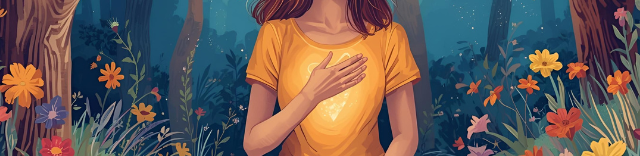
    I have faith in our ability to choose compassion over entitlement. To sit with discomfort and still reach for the just response. To place our hand on our chest, close our eyes and choose to respond—not from the head, but from the heart.

    And maybe, just maybe, that’s what God actually is.

    Not some white-bearded man in the sky. Not a distant savior. But the part of us that knows how to return—not to the mind’s spirals, but to the body. To the breath. To the quiet pulse of the heart.

    What if we—all of us, even world leaders—stopped looking to the God outside and, instead, returned to the one within?

    Because the God within doesn’t need to be right. The God within doesn’t dominate or divide. The God within creates peace. Is peace.

    And maybe that’s the kind of faith we need now.

    Because when faith in something outside of us falls away, what’s left?

    We are.

  • Freedom Is the Space Between Each Judgmental or Righteous Thought

    Freedom Is the Space Between Each Judgmental or Righteous Thought

    “It is inner stillness that will save and transform the world.” ~Eckhart Tolle

    Life is hard. Impenetrable at times. How can we use our spirituality to navigate through the density of life?

    That question inspired this piece of writing. And my navigation tool is almost effortless; I feel compelled to share it.

    When my mind is churning and burning with thoughts and fears and worries, I take myself off to a quiet place, get still, and watch my mind. I wait for the tiny gap between each thought. Bingo.

    That space, that little gap, is freedom in its truest, purest form. It is the birthplace of peace. And every time I enter that space, I am no longer at war with anything. Despite what madness may surround me, that place always remains untouched. It is like an infinite reservoir of strength and love—one that feels like, well, freedom.

    How I came to find that reservoir is a long and nuanced story (that’s why I wrote a whole book about it), but I’ll try and give you the nutshell version.

    Essentially, to even find it, I had to first get to the point where I was so disillusioned—with my cancer, with people, with the system, with the greed, with the house chores, with the destruction of the planet, with war, and with life full stop.

    Little did I know it then, but that disillusionment was freedom’s gateway.

    For so long, I looked to ‘the other’ as the source of my disillusionment.

    Sometimes ‘the other’ was a person, sometimes it was a situation—my cancer, the pandemic, the person who I believed had wronged me, the political party; anything or anyone that caused a disturbance to my happiness fell into this bucket.

    Of course, it felt good to blame cancer, that person, or the pandemic for my woes, at least on the surface. Yet the blaming was also the root of my suffering. The biggest wars I’ve had in my own life were when I was trying to get ‘the other’ to yield / change / admit they have it wrong so I could live in peace.

    But the true source of my disillusionment was never with them. When I stopped waiting for the situation to change and shifted my attention to my mind, I observed something that floored me at first: my own righteousness.

    Staring back in the mirror were my tendencies to be correct, envy, judge, complain, and win. That mirror revealed one simple truth: I was adding to the war I desperately wanted to end. I had arrived at the place where I was simply fed up—no longer fed up with life but rather fed up with the suffering caused by my very own mind.

    The challenges and hindrances of life may have taken you to a similar point—the point where you’ve had enough. Before freedom is even possible, this stage is necessary, essential even.

    The world is unsatisfying. So, now what? This is freedom’s front door. It is the opening to the very core of your being. When we have had enough of looking outside for contentment, only then do we look inward. This is where the rubber meets the road.

    But we have to go deeper—beyond the mind, beyond our thoughts about what is right vs. wrong, left vs. right—to our essential oneness.

    And, as a collective, I think we get there by asking ourselves one simple question: Do I want peace or war?

    If it is peace, we must start with the peace in our minds. In all the frenzy, it is possible to simply stop and enter into the space between every thought. Rest there for a few scared moments. Feel the ease wash over every cell of our being. Come home to that again and again. Life doesn’t need to be any different to enter that space.

    That space is freedom. And true freedom is not bound in any person or situation. Freedom is what sits underneath the war. It is found in the tiny gap between every righteous and non-righteous thought; it occurs through stillness.

    From this stillness, I’ve learned (yes, the hard way) that we can speak our truth, but now we speak it without the need to control any outcome.

    For example, rather than trying to force my husband to read a spiritual book instead of opting for Netflix—as if I know what’s right and best for him—I can respect him for where he is at in his inner journey. I still act. I still suggest books. But my happiness is not dependent on his choice.

    Instead of being angry at a friend who hurt me, I can step out of my righteousness and cultivate empathy for where she is at in her life. I still reach out. I still attempt resolution. But my peace is not dependent on her response.

    I throw my seeds of truth, dug up from the depths of my heart, out into my family and the world. Sometimes they land in the fertile soil of ‘the other,’ and sometimes they don’t. So be it. It is action without criticism, judgment, blame or control—without the war. I had found a place within where I could look at ‘the other’ and feel compassion and even love instead of anger and annoyance.

    Eckhart Tolle says, “It is inner stillness that will save and transform the world.”

    I couldn’t agree more. Because from that place, from the silent stillness within, war is not escalated but instead averted.

    So, to anyone feeling disenchanted, I want to honor you and say one thing: The freedom your soul is aching for is within arm’s reach. It is as close as your breath, as close as the space between each of your thoughts.

  • How I Find the Courage to Keep Jumping (Even Though the Net Never Catches Me)

    How I Find the Courage to Keep Jumping (Even Though the Net Never Catches Me)

    “The future never comes. Life is always now.” ~Eckhart Tolle

    “Jump, and the net will catch you.” “Leap, and the net will appear.”

    This piece of writing is to make a case for the following argument: there is NO net.

    Before I put forward my reasoning, please bear with me for a moment while my ego rattles off the times I have jumped (but the net never appeared).

    1. I quit my well-paid marketing role and traveled across the world to pursue a humanitarian dream job. I failed at the job interview and was jobless and in despair in a foreign land.
    2. I invested some of my savings into launching an online e-commerce site selling organic products but was diagnosed with blood cancer shortly after launch and had to give it up.
    3. I threw myself into the wellness industry in an attempt to heal my cancer. Nothing worked, and I ended up on the medication I was desperately trying to avoid.
    4. I poured my heart and soul into a memoir but have, so far, only received nice rejections from the publishing industry.

    Okay, I’m glad that is off my chest.

    Point number 4, my current life situation, has got me thinking about “the net.”

    The writing of my memoir felt different to points 1, 2 and 3. The writing process was one in which there was no outcome attached to it. I simply sat down to write the longings and yearnings and realizations that came from within. Four years of writing from that place flowed, quite naturally, into a book. There was no thought of a net. I just had to write.

    The net came later.

    The net came when I had finished my memoir, and people told me to publish it.

    The net came when I started researching the publishing industry and the how-tos and what-not-to-dos.

    My research began to form a perception. That perception started to develop a belief. A belief that said: to be signed by a literary agent and traditional publisher means you “have made it.” You are literary success. That belief grew stronger with every industry blog I read and podcast I listened to. The ropes of belief grew thicker and intertwined and formed what I perceived to be a net. A net in the form of a book deal from one of the top five publishers.

    My mind whirled and looped with the following thought: If I’m brave enough to share my story, if I jump, the net will catch me, I will get a book deal.

    I believed that thought. And I was brave. I put myself out there. I jumped.

    But, as I write, I have yet to be caught by any net.

    My ego looks back up at points 1 to 4 and screams, “FAILURE! The net never catches me. Stay small!”

    It is easy to get stuck in that stream of thought. That place is familiar. The is an almost comfort there. The ego blankets me with perceived safety—safety in the form of remaining small and quiet.

    But then I remember there is another aspect of myself. A place beyond the ego and beyond even thought. It is my core. My essence. The truest, most authentic part of me. When I carve out time for silence, I remember that place. I bring awareness into the present (without hanging on the past or projecting into the future) and get still. When I do that, the thought of a net dissipates.

    From this place, I see that the net was only a future concept. It was no more than a thought about something great that would happen in some distant time. The net was always only a thought about what success should look like: saving the world, a thriving business, healing from an incurable disease, and now a bestselling book.

    But freedom was found beyond the thoughts about how life should be. And every day, I come home to that place, home to myself. I get pulled into ego. I come back. I get pulled into thought. I remember.

    When my true nature aligns with the present moment, there is clarity in knowing what to do.

    Some moments my children want to play. And sometimes, I feel called to send a pitch off to a literary agent. There is a sense of surrendering to whatever is in front of me. When I’m flowing with life, there is no net. Or more, the net is no longer a result but rather a deep trust that everything will happen as it should.

    I have no idea how my book will be published. All I know is that if I keep coming back to the present moment, those seemingly minuscule steps pave the way for my soul to live out its true purpose: to bring awareness into the present and live life from that place.

    There is no net. There are only small awakened steps. Some steps are ordinary. Some ask us to be excruciatingly vulnerable. It is the latter that can feel like a leap of faith into the ether. But I no longer see those moments as a leap.

    Looking back, it was only ever one step, a simple stride on the path home to myself. Inch by vulnerable inch, moment by conscious moment, that is how I have come to feel whole. It is all perfect, even with a rejection letter to boot.

  • The Wind That Shakes Us: Why We Need Hard Times

    The Wind That Shakes Us: Why We Need Hard Times

    “The pessimist complains about the wind; the optimist expects it to change; the realist adjusts the sails.” ~William Arthur Ward

    I live in the windiest city in the world—Wellington, New Zealand. Perched between the North and South Island, this colorful little city gets hammered by wind. The winds from the south bring cold, and the winds from the northwest seem to blow forever. My body is regularly under assault. But amid all that blustering lies the answer to one of life’s great questions: How do we feel at home in the wind? Or better phrased, how do we live with the hard things that blow our way?

    This research can shed some light.

    The Biosphere 2 was a scientific experiment in the Arizona desert conducted in the eighties and nineties. A vast (and I mean massive) glass dome housed flora and fauna in a perfectly controlled environment. It held all of nature: trees, wetlands, deserts, rainforests. Animals, plants and people co-existed in what scientists thought was the perfect, optimal environment for life—purified air, purified water, healthy soil, filtered light.

    Everything thrived for a while.

    But after some time, the trees began to topple over. When the trees reached a certain height, they fell to the ground.

    This baffled the scientists at first. That is until they realized that their perfect environment had no wind, no stormy torrential weather. The trees had no resistance. The trees had no adversity.

    The scientists concluded that wind was needed to strengthen the trees’ roots, which in turn supported growth. The wind was the missing element—an essential component in the creation of tall, solid, and mighty trees.

    What can this science experiment teach us about real life?

    Everything.

    A life without storms is like the Biosphere 2. Sure, it sounds idyllic. But that’s just a perception. And I fell for it hook, line, and sinker.

    I thought a perfect life would make me happy. And it did, for a while. Good job, great husband, lovely home. But I knew deep down that something was missing. I always had a sense that life was incomplete. I longed for something; I just didn’t know what. It baffled me, just like it baffled the scientists.

    Without knowing it, I, too, had placed a biosphere around my heart. If any pain, any resistance, blew my way, my biosphere stopped it from penetrating. That is until I was diagnosed with blood cancer, and things began to crack. 

    Sitting in the office of a psychotherapist a few months after my diagnosis, nervously hunched and with hands under my thighs, I simply said, “I am really scared about my cancer.”

    That moment that I assumed was weakness turned out to be the exact moment my biosphere, my armor, began to crack.

    My diagnosis, my adversity, was nothing more than an opportunity to step outside of comfort and tell someone I’m scared. It jolted me enough to put me on an unexpected path of inner enquiry.

    Was it scary to open up? Hell yes! I wanted to stay in the biosphere. I really did. I kept searching for comfort within it, but I was unsatiated, and the wind crept in anyway and just grew stronger: I lost someone I loved to cancer, a close friend backstabbed me, my postpartum body broke, more wind, more pain, all while dripping in very small children. Just like those felled trees, I, too, toppled to the ground.

    When I could no longer withhold the wind, when I had to step out of the comfort of my biosphere and talk about my fears and look at my darkness, only then did I grow tall enough to find what I was looking for: I was longing to know the fullness of myself.

    I knew my old habits of perfecting and controlling life to avoid pain, numbing pain, or distracting myself from pain no longer worked. Those strategies did not lead me to the thing I wanted most: completeness. I had to go through the pain. Sit in it. Let it wash over and into me. I had to feel what it’s like to have cancer, be lonely, get hurt, lose someone I love, have a broken body. Only by going through it did I realize I could transcend it.

    Liberation was on the other side of pain. It existed outside of my biosphere. One therapy session at a time, one book at a time, one podcast at a time, one meditation at a time, one hard conversation at a time, slowly, things began to crack. Inch by vulnerable inch, eventually (like, years later), my biosphere crumbled to the ground.

    Brené Brown calls life outside the biosphere “living in the arena.” She said, “When we spend our lives waiting until we’re perfect or bulletproof before we walk into the arena, we ultimately sacrifice relationships and opportunities that may not be recoverable.”

    She also said, “I want to be in the arena. I want to be brave with my life. And when we make the choice to dare greatly, we sign up to get our asses kicked. We can choose courage or we can choose comfort, but we can’t have both. Not at the same time.”

    The courage to be vulnerable is the springboard out of the biosphere.

    If you’re in adversity right now—in lockdown, or the doctor’s office, or separated from a loved one— perhaps your biosphere, too, can no longer protect you from pain. COVID-19 has cracked open our collective armor and shown us how little control we have. It’s hard. It’s painful. But it is also an opportunity. When the outside world is crumbling, the only way is inward.

    When I look back, I see that pain or resistance only ever asked one thing of me—to look at it. It was a nudge (or a shove in my case) to look inward, get vulnerable, talk about my feelings, unpack my darkness, cry, unearth, read, listen, meditate, move forward in my awareness, expand my consciousness.

    And with time, I grew beyond the safety of the biosphere to a height that was inconceivable while I was in it. Without the wind, I would never have seen the height I could reach.   

    This process of unearthing all my fears and darkness eventually lead to a place of power. Now I have the awareness and power to choose when to act from fear and when to ignore it. The wind no longer rules me. I am at home in it—figuratively and literally.

    Living in the middle of Middle Earth has proven one thing: the wind is constant. We can’t avoid hardship any more than we can avoid day turning into night. The hard things in our life will keep on coming—more lockdowns, more sickness, more hurt—and the only way to be at home in the wind is not to fight it, to learn to live with it.

    We have a saying here in Wellington: You can’t beat Wellington on a good day. It’s true. When the sun is shining, Wellington is the most glorious city on earth. The wind has blown away the cobwebs, and majesty remains. The craggy coastlines glitter and the city’s heartbeat thumps and vibrates and enters the hearts of all who live here. On these days, the thrashing wind is forgiven, and we fall in love with our city again. And again. And again.

    Without the wind, there’d be nothing to forgive. There’d be no falling in love process. Life would exist on a flatline. Yes, there would be no gale. But we’d also miss out on awe. Life is both wind and sun, pain and beauty. By staying in the biosphere, we risk missing the magic that sits outside of it.

    I’m so glad I took that first vulnerable leap of faith all those years ago. Life outside the biosphere isn’t scary like I imagined. I didn’t remain on the ground like a rotting felled tree. I grew.

    I grew to a place where the air is clearer. I can breathe. Frustration or hurt or pain isn’t held onto for any sustained length of time. The waves of emotions come in, then go out. I observe it all without a sense of lasting entanglement. Fear is in the backseat. Pain is softened. Beauty is heightened. Love is everywhere, even in the wind.

    Deepak Chopra said, “The best way to get rid of the pain is to feel the pain. And when you feel the pain and go beyond it, you’ll see there’s a very intense love that is wanting to awaken itself.”

    That’s what is waiting for you outside the biosphere.