Author: Harriet Cabelly

  • How to Find Tiny Miracles, Even During Hard Times

    How to Find Tiny Miracles, Even During Hard Times

    “There are only two ways to live your life. One is as though nothing is a miracle. The other is as though everything is a miracle.” ~Albert Einstein

    In my cancer journey, miracles showed themselves every step of the way.  Large and small, some of more significance than others. But all amazing, leading me to heartfelt gratitude for each and every one.

    In my most trying times, I held on to the focus of what was going right. I was putting into practice my learnings from positive psychology. That’s not to say I wasn’t terrified of my cancer diagnosis and subsequent treatment, but I tried to be my own good student and apply some of my learnings.

    What went well today? What did I consider to be a miracle?

    After spending a pretty lousy all-night stay in the emergency room waiting for admission into the hospital, I was surprisingly rewarded with my own private room with a purple wall and window, with a view looking out to the Hudson River.

    How did they know I was a purple lover my whole life, and a lover of scenic water views?

    I got really spoiled with that good-feeling room, in a newly designed wing, created with healing and beauty in mind. I got it by chance, it being the one that was available at the time of my admission.

    Subsequently, the couple of times I had to be in a hospital room, I was put in the regular cancer unit, in a double room, hearing all the unpleasant noises and family visits of a roommate. But at least I had that room for my longest stay in the hospital! A purple win!

    Miraculous!

    One of my first concerns, embarrassingly expressed to my oncologist, was: “I’m terrified of nausea and vomiting throughout treatment. I’ve seen too many movies where the cancer patient has his head in the toilet all too often.”

    To which she replied, “If you stay ahead of the game and take the anti-nausea pill prophylactically, you should be okay.”

    And I was! Only barely vomited once. Miraculous!

    I am not a medicine person. I have to be really sick to take even a Tylenol. I don’t do well on most antibiotics. They upset my stomach, and to some I get outright allergic reactions of hives and joint pain, and once even got C. diff.

    I had to go on a regimen of numerous types of antibiotics for the duration of my treatment—anti-fungal, anti-viral, anti-bacterial—along with other medications. I suddenly had a pill cocktail of about five pills at a time.

    And lo and behold, my stomach handled them well—no bad tummy effects.

    Miraculous!

    Oh, and I didn’t say the real biggie, the most important one: My initially suspected horrific diagnosis, as seen by an ER radiologist, to which I said, “Just put me in hospice,” was upgraded to a new and better one: non-Hodgkin’s lymphoma—known to have a good outcome rate, and considered “one of the better cancers” (as long as I could get through the treatment).

    As a family member and initial consulting doctor said, “If you have to have a cancer, this is the one to get.”

    Hospice sentence averted!

    Not sure if this warrants a statement of miraculous, as a cancer diagnosis is an oxymoron with the word miraculous, but it was definitely a relief from the initial finding.

    There were many more miracles along the way of my treatment journey, but I don’t want to belabor the cancer part here. This is about opening ourselves up to seeing the miracles in our lives in general. In my case, looking for them and focusing on them helped me cope.

    Seeing what’s going well and finding the good points us in the direction of gratitude. And gratitude is a huge factor in living well and in our own well-being. It is also an important coping tool. It doesn’t take away the bad, but it makes it bearable.

    How do we build our ‘miracle’ muscle, our gratitude muscle, our muscle that can flex toward the things that are going well?

    Be present; focus on the here and now.

    We can’t see a miracle now if we’re worrying about the future, or the what-ifs. The flower is opening now to its full beauty; take that in and hold it.

    We miss out on the full now if we’re in the tomorrows. When we’re in the shower and focusing on the hot water feeling so good as it’s streaming down on us, we appreciate having it.

    Do a gratitude exercise of writing down a few things you’re grateful for to train your mind to bend toward a more positive bias. 

    It can be the seemingly smallest and most ordinary things: a mug of deliciously aromatic coffee or a conversation with a good friend. When seeing a rose, do you home in on the beautiful flower or the prickly thorns around it? They’re both real, but where do you find yourself focusing?

    Tune into your senses. 

    Focus on each one. Take a different route and notice what you see. Listen to a song and see if you can identify the instruments. Take in the smells of the market—the spices, the incense, the flowers. Try new foods for taste. Feel that velvety couch. Have a sensory party and create different things to try. Creative juices can flow here.

    Open up to the ordinary.

    It sounds counterintuitive, but this helps us realize more of the extraordinary.

    Seeing the expanse of the ocean and its horizon can bring out an awe of nature, as can listening to the sounds of the early morning birds upon arising. Feeling and hearing our own breath when sitting quietly or meditating can evoke an appreciation for our life. Dancing or exercising can connect us to the workings, flow, and beauty of our body.

    We work to build our muscles during the easier times so that we have them built up for those more trying times in our lives. Then you will be very grateful for your miracles—the ordinary and extraordinary ones—that you might have otherwise missed.

  • Forever Healing: 4 Things I Now Prioritize After Cancer

    Forever Healing: 4 Things I Now Prioritize After Cancer

    “I have come to believe that caring for myself is not self indulgent. Caring for myself is an act of survival.” ~Audre Lorde

    I’m a year out after completing chemo treatment for non-Hodgkin’s lymphoma and on my healing journey. Cancer is a nasty little thing and can rear its ugly head at any time again. So, to minimize those recurrent chances and to feel like I’m doing all that’s in my control, I’ve accepted that this healing path will be for the rest of my life.

    I originally thought I’d be spending this first year rebuilding myself. And I have. However, I now see that this is a forever life path. Healing is a daily intentional practice, and I am on its continuous road.

    Being proactive by incorporating healthy practices into one’s life isn’t a guarantee against illness, but it at least makes us feel like we’re taking charge and doing all that’s in our control to ward off disease and optimize our health and well-being.

    I began exercising more than thirty years ago when my ex-husband moved out to begin divorce proceedings. My friend Gloria came by one day and pushed me to go to the local gym. She said it would be good for me. “Okay, I’ll try it out,” I said, “but I don’t think it’s for me.”

    Well, fast forward… exercise became a life practice. Over the years my basement became home to a treadmill, stationary bike, free weights, a trampoline, bars, and a balance ball. The local gym is also my place of exercise, as is the boardwalk and nature trails. Like brushing your teeth and taking a shower, exercise is a daily living activity.

    Healing encompasses a lot of factors. Sometimes it can feel overwhelming. Good enough must become a mindset and motto so we don’t beat ourselves up over occasional off days.

    So what goes into a healing path?

    Exercise is a must and a biggie.

    Since that’s been a permanent structure in my life, I don’t have to work on that one. Like a tree trunk, it’s rooted deep in my ground. When the walking, biking, weightlifting, yoga postures, hoola hooping, or trampolining don’t take place for a few days, my body calls out, “Move me, twist me, stretch me, strengthen me.”

    I have now added a new piece to my exercise: HIIT (high intensity interval training). Twenty minutes of HIIT a few times a week is indicated as an anti-cancer workout. And my dream and goal of ballroom dancing is being realized once again, as I’ve excitedly resumed my lessons that I started shortly before I was diagnosed. Movement comes in many forms.

    Contemplative practices are inner forms of reflection and calming activities.

    Meditation and breathing exercises, journaling, and time in nature are all soothing and quiet activities, bringing us back to ourselves. We listen to and feel what’s inside, what may be bubbling up, what our gut is telling us. We put aside the external distractions to promote the engagement of our calming parasympathetic nervous system.

    For, as we all know and feel, as our anxiety levels have skyrocketed, we live on high alert all the time, fighting off the invisible tigers, as our fight-or-flight response is continuously engaged. We don’t have to be a guru meditator, but giving ourselves a few minutes a day to just be, sitting in quietude and breathing deeply, is a natural antidote to stress and a huge release of cortisol. And as we know, stress is a big contributing factor in illnesses.

    Our lives are lived in a state of perpetual busyness and hecticness as we push ourselves toward productivity and perfection; therefore, we must prioritize activities that counter that busyness and bring us back to our selves. We oftentimes want to drown out our pain with distractions and busyness, but it catches up with us one way or another.

    Eat to live becomes a mindset for a lifestyle of healthy eating.

    We are gifted with a body that requires food to function well. As I am not a nutritionist, I’m not dishing out dietary advice. My new level of healthy eating is nature’s foods and limiting inflammatory, processed foods and sugars.

    Before cancer, I had always been a big ‘nosher.’ Entenmann’s cakes, cookies, potato chips, Dr. Pepper soda, and ice cream were my after-dinner desserts. I cut most of this out years ago when I got ulcers and had reflux and irritable bowel.

    One of my best takeaways from my trip to the Amazon was our hiking guide in the jungle, who said, “The jungle is our supermarket and pharmacy.”

    The people there, as in many poorer countries, have very low rates of cancer and heart disease. Their food is plant-based, along with some fish and meat. And look at the Blue Zones, the places in the world where the people live the longest and healthiest. Those purple potatoes go a long way for them.

    Making intentional food choices becomes a habit, giving ourselves the good stuff to fuel our body. This can be a harder part of the lifestyle to keep up with, as food preparation and shopping become a focal point. And for someone like me who’d rather be anywhere but the kitchen, this is definitely more difficult. It is an ongoing process for me.

    The bigger purpose and mindset keep me on track. My guiding mindset is this: My body took care of me through my chemo treatment, and now it is my duty, in gratitude, to take care of it. I am paying it back for how it kept going and didn’t break down; it didn’t break me. So I look to feed it well.

    I’ve upped my healthy eating to another level. My one square of dark chocolate each day satisfies my chocolate craving, and it has no sugar. I’ve developed a taste for this 100% dark chocolate. Practice and repeat. And whereas I used to choke down one piece of broccoli or asparagus, I now eat many pieces with my meal. Yay to baby steps of becoming more of a vegetable eater!

    Inner psychological work is a new one for me.

    I’ve been to numerous therapists throughout my adult life to deal with different circumstances, but now my therapy has taken on a whole new level and direction. During my treatment, I knew I wanted some type of support but did not want to join any support group or go to regular therapy again. I found, on this site actually, a creative arts therapist with whom I’ve been doing therapy like never before.

    My goal, besides coping through the chemo treatments, was healing myself from the inside out. I had an intuitive sense that I needed to clear out my whole gut and center area of my body where the lymphoma had appeared. Get rid of the cobwebs that had taken root in there and work through past resentments, upset, anger, hurt, and all the rest of those toxicities.

    Art, instincts, and unconscious work were all at play in this therapy, and continues today; uncovering and working through stuff that I never looked at like this.

    This is my new life, beyond the simple wording of self-care. It’s focused and purposeful care of body, mind, heart, and soul.

    It’s work, but after a while it feels really good to be doing this with the big purpose of optimizing our well-being so we can live our best life.

  • How To Keep Moving Forward When You Feel Like Shutting Down

    How To Keep Moving Forward When You Feel Like Shutting Down

    “I can’t believe what I’m managing to get through.” ~Frank Bruni

    My worst fear was inflicted upon me three months ago: a cancer diagnosis—non-Hodgkin’s lymphoma. Out of nowhere!

    Truth be told though, lots of awful things that happen to us come suddenly out of nowhere—a car accident, suicide, heart attack, and yes, a diagnostic finding. We’re stopped in our tracks, seemingly paralyzed as we go into shock and dissociative mode.

    My world as I knew it stopped. It became enclosed in the universe of illness—tiny and limited. I became one-dimensional—a sick patient.

    And I went into shock. To the point where I didn’t feel. As a person who values mental health and understands the importance of emotions, I seemingly stayed away from the feeling part. It wasn’t intentional; it’s how I coped.

    I dealt by mindlessly and mindfully (yes, that seems like an oxymoron) putting one foot in front of the other and doing what needed to be done, like a good soldier, plowing through the open minefields.  Actions and intentional mindset were my strategies.

    My biggest fear was: Will I make it through the treatments? What if I don’t?

    So I started reigning myself in to not let myself think too far ahead, down into the rabbit hole of fear and anxiety. Being a small person with no extra weight, I was scared of the chemo crushing me. Terror would rear its head when I allowed these thoughts to enter my thin body. What if I shrivel up and die? What if I can’t do it?

    And so my mind work began. I became very intentional about putting up that stop sign in my head so as not to get ahead of myself and project into the unknown, scary future. I began taking everything one step at a time.

    I stop now and digress. I had been in the depths of despair and darkness when, many years ago, my middle daughter, Nava, was diagnosed with lifelong neurological disabilities.

    I had a noose of bitterness and anger pulled so tightly around my neck that I couldn’t even go to the park with her. My envy of the other babies who could sit up and start to climb out of their strollers was too much for me to bear; to the point where I stopped going to the playground.

    My therapy at the time was a life-saver and helped me move from the unanswerable “why me/why her?” questions to the “how” and “what”: how to carry on with a major disappointment and blow, toward creating new expectations and goals, and what to do with this to still build a good life.

    Changing the questions helped me cope and move forward. This has served me well in other challenges throughout the years, such as my divorce and Nava’s critical medical issues years later, for which she was hospitalized for a year.

    So with the cancer diagnosis, I went to the “how” and “what.” How can I deal with this in as best a way as possible? What can I do to optimize my coping skills? How can I minimize my anxiety and fear?

    Having studied positive psychology, resiliency-building, and mindfulness, I’ve gleaned some tools over the years that are serving me now through my personal medical crisis.

    Let’s look at a few.

    Anxiety and Staying Present

    We know anxiety is caused by worry of the future. So staying present is key. Working on our mind to be in the moment and not spiral outward is crucial. I know my PET scan is coming up, and I’m naturally anxious about the results. I tell myself to take today and make it as good as possible and not think about the end of the week. There’s a lot of intentional work that goes into controlling the mind.

    And when we spiral, as we humans naturally do, we allow for that too. “Permission to be human,” as positive psychologist Tal Ben-Shahar states. The important thing is bringing ourselves back. It’s not that we don’t go to dark places; it’s that we notice it and don’t linger and get sucked down into it. We recognize it and can pull ourselves out of it.

    Expansion

    Once the shock and horror of illness begins to settle and we see some pattern or predictability, we can look to expand our identity and role beyond a sick person, or in my case, a cancer/chemo patient. I begin to step outside myself, my illness, toward others and other things that are important to me.

    Connecting with who you are beyond your sickness opens you up and reminds you of the bigger You. We are more than our difficult circumstance.

    I always remember Morrie Schwartz in the book Tuesdays With Morrie—how he cried each morning (as he was dying from ALS) and was then available and present for all his visitors, to be of help and service to them.

    So I reach out to a couple of clients to offer sessions during my seemingly better weeks (in between treatments). I create some (generic) social media posts. I haven’t gone personal with this online, so this blog post is a big (public) deal.

    Meaning in Your Life

    Doing things that are meaningful, however small, and that make you feel good is a sure way to stay engaged and moving. It’s the ordinary things that keep us going. Since I love colors, I wake up and match up colorful clothing and makeup (unless I’m too weak), as that makes me feel good.

    Nature and beauty are my greatest sources of soothing and healing. When I feel okay, I go to a park, sit by the water/ocean, and visit gardens, just get outside and look at the expansive sky.

    I deal with my indoor and outdoor plants. I cut off the dead heads, water them, take some pictures, and check on the veges. This represents growth and beauty.

    I get inspiration and uplift from words, and love non-fiction books of people transcending their adversities. I read, underline, and reach out to authors.

    And I learn. I started a creativity class with someone I actually found on this site. I figure it’s a good time to incorporate creativity and natural healing.

    What infuses your life with meaning? What is important to you? What expands you? Who are you beyond your difficult situation?

    Response and Choice

    Viktor Frankl, psychiatrist, logotherapist (therapy of meaning and purpose), and author of the renowned book Man’s Search For Meaning, is instrumental in the foundational concept that it’s not our circumstances that define us but rather our response to our situations that determine who we are and who we become.

    “Everything can be taken from a man but one thing: the last of the human freedoms—to choose one’s attitude in any given set of circumstances, to choose one’s own way.”

    And another one: “Between stimulus and response there is a space. In that space is our power to choose our response. In our response lies our growth and our freedom.”

    These ideas have been life-changing for me and propel me to avoid an all-too-easy passive and victim-like mentality.

  • How to Reap the Benefits of Post-Traumatic Growth

    How to Reap the Benefits of Post-Traumatic Growth

    “The world breaks everyone and afterward many are strong in the broken places.” ~Hemingway

    We all know of post-traumatic stress (PTS) but how many of us know of post-traumatic growth (PTG), a very hopeful and attainable way of life beyond the loss, adversity, and trauma we’ve experienced? It’s a term that was coined in the 1990s and is becoming more popular now as positive psychology and the specific area of resiliency-building have gained momentum in our society.

    What is post-traumatic growth? It’s positive change and growth that comes about as a result of an adversity or loss. It is channeling our pain into something positive.

    It’s more than simply returning to the life we had before the negative event; it involves psychological shifts and changes in ourselves, our beliefs and attitudes, our actions, the meaning and purpose in our lives, our relationships, to an even greater level of functioning.

    This is not to say we don’t suffer and feel tremendous pain. In fact, we first need to allow ourselves to go through the painful and awful feelings that we’d prefer to squelch down. It’s similar to the grieving process where we have to go through it to come through it.

    It is only later on, as the intensity of our negative feelings lessens and softens, that some small bits of sunlight begin to push through the looming clouds and we begin, very slowly, to move forward and integrate the challenge into our lives. We rebuild a new normal.

    Without having a formal concept or name to put to it years ago, I went through my version of post-traumatic growth as an outcome of my daughter, Nava’s miracle: her survival and complete recovery from a near-fatal medical crisis.

    She was on a respirator in a drug-induced coma for four months and then in a rehab hospital for nine months, relearning and eventually, miraculously, regaining every motor and body function.

    Upon her return home from a year-long hospitalization and rehabilitation, I went back to work and resumed my life back home (as I had been living up at the rehab). Needless to say, I was thrilled to have witnessed this miracle—her survival and recovery—and I, as her mother, felt I had been given a second lease on life as well.

    As time went on, however, I felt uncomfortable inside—empty, bored, and filled with angst, feeling like this just wasn’t enough. And then I’d feel guilty over feeling this way; after all, I had our miracle, what more could I possibly want???

    Going back to life as before felt so small to me. I had just witnessed life at its most fragile, sitting by her bedside listening to every beep and bleep of machines that breathed for Nava and kept her alive, with tubes coming out of every opening in her body, on a bed that rotated in all directions.

    One minute she had been eating a blueberry muffin waiting for a procedure and the next she was on a ventilator fighting for her life. If this didn’t make me realize how our lives hang by the thinnest of threads, then nothing would. And I began to feel my inner stirrings and angst more and more. This was slowly becoming clear to me:

    I had just witnessed something miraculous. I had to do something to honor it. As people do things to honor a life that doesn’t survive, I felt a burning need to do something to honor the awesomeness of a life that did, against all odds. 

    It was clearly not enough to just resume, to pick up the pieces where I had left off. That would be like whitewashing away this most traumatic year in my life, not giving the miracle of life the respect and glory it warranted. Not to mention the miraculous complete recovery as she slowly began breathing and eating on her own after more than half a year with tubes and then a tracheostomy.

    And so began the struggle of what to do. I also felt a strong sense of urgency to do and not waste time on this earth where we’re given an unknown and unpredictable amount of time.

    In hindsight this was my angst to grow and push through. It was all percolating inside, and my frustration then became what to do…

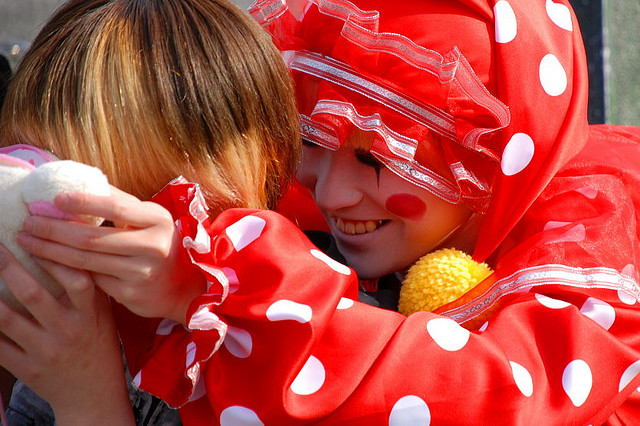
    I attempted many different things that I deemed meaningful: from clowning with Patch Adams to foster-raising a puppy for the disabled, to writing a book (which didn’t go anywhere at that point) and other smaller endeavors. I was in search of something big, though, the way some people start organizations and foundations out of their tragedy. But that didn’t happen.

    But what did happen beyond these random experiences of adventurous do-gooding, as I see so clearly now, is that it was all happening on the inside. So, while I was in frantic and frustrated search for that external something, I was living {and continue to do so} more richly engaged than ever. 

    As I stated above, a sense of urgency to doing what I set my mind to now, rather than putting it off, became my M.O.  When I saw a class in the city I was interested in, instead of waiting until the summer when I was off from my school job, I schlepped into the city once-a-week for the class during the school year. A friend of mine would say, “Whatever you say to Harriet, she’ll run with it, so be careful!”

    Now in all fairness I was always a doer and proactive. But this part of me took on a whole new level as I became much more intentional. My interests in various things soared, and I began to feel like there’s just so much out there to learn and do; the world became my oyster.

    Everything I was exploring had meaning to me, and what didn’t, I eventually threw by the wayside.

    After a few more years at my school job, I left, deciding to do what I truly wanted to do in my professional life: work with people going through grief and loss (in all areas) in a clinical setting—my practice—and support them on their journey in coping and eventual growth.

    As someone who was always interested and in awe of people who lived on well despite their hardships,  I developed and curated my own project of finding and interviewing people to learn and put out there for others to see, the qualities and coping tools that led them to grow and thrive beyond their challenges. This eventually became my book.

    And so post-traumatic growth was firing inside me. How can it work for you?

    Drs. Tedeschi and Calhoun, of the University of North Carolina, who coined this term of PTG have identified five main areas where we can experience post-traumatic growth as an outcome of our adversities:

    Relating to Others

    Increased closeness to others, increased compassion and empathy to those going through difficulties, greater authenticity, and connection.

    Connect with people on a deeper and more real level. Recognize where and with whom you feel more understood, connected, and supported. How are you responding to others in pain? Do you feel more sensitive to those suffering? Has your helping hand been extending more to those in need? Have your relationships taken on greater meaning in your life? Are you making more time for them?

    Appreciation of Life

    Awareness and gratitude for what we have, focus on beauty and goodness, living with more presence and intention; the absence of taking things for granted.

    Begin to take pleasure in the ordinary things of life, for it’s the everyday beauty and pleasures that call, nourish, and fill us.

    What are you noticing now that you rarely noticed before? What are you slowing down to really see? Are you being more mindful and reveling in the now? Awe is a positive emotion that fills us with wonder and boosts our well-being.

    What beauty calls out to you? Is it the mountains that give us a perspective of smallness and humility in their grandness; or the expansiveness of the star-filled sky; or the ocean with its ups and downs of the waves in their calmness and subsequent crashing; or the rise and set of the sun that we can always count on for appearing and then disappearing?

    New Possibilities

    Re-evaluating what’s important and what truly matters/priorities; stepping outside one’s comfort zone and taking risks; openness to new ways of living, to new experience,s and learning/taking on new endeavors.

    Take stock of your life and think about your top values and priorities. What now seems unimportant since your tragedy, trauma, or crisis?

    After processing your grief and emotional pain, what new opportunities are you interested in exploring? How are you looking to expand yourself?  What have you realized means more than anything? How can you better honor those things in your personal and/or professional life? How can you spend your time and energy in ways that reflect your values and what truly matters to you?

    Personal Strength

    Greater confidence and self-esteem, recognizing and appreciating one’s abilities and competence, self-pride, greater resilience, and coping abilities.

    Reflect upon your strengths and allow yourself to feel good that you got through your difficulty in ways you thought you never could.

    How did you cope with pain and hardship in healthy ways? What strengths did you use to help get you through the trauma/adversity? Recognizing those strengths, how can you continue to bring them forth in ways to enrich your life? There’s a very interesting free survey you can take here, that lists and puts your character strengths in order. What are your top five; how do they coincide with the way you see yourself?

    Spiritual Change

    Transcendence to things beyond ourselves, renewed purpose and meaning, questioning and searching as we reconfigure our newly designed tapestry. 

    Consider the existential questions of life on a more personal level. Instead of “what’s the meaning of life,” ask yourself, “What’s my purpose and meaning here, and how do I re-create that for myself? How do I connect to my meaning on a day-to-day basis?”

    How are you redefining success and living well? How do you want to spend your days on earth? What mark/impact do you want to leave/have? How has your perspective broadened beyond yourself? Are you more connected to a purpose?

    Once the bad circumstance(s) happen, growth can occur in the aftermath as we seek to create good, find new ways of living that can be enriching and meaningful, and develop and grow in any of the above areas.

    Creating new goals and finding positive ways to adjust to a new reality is the hope and potential for post-traumatic growth.

    Knowing this possibility for change and growth exists and that we’re not doomed to live out the misery of our challenges and losses can give us something to strive for. To some it comes more naturally, to others it’s something to work toward. Either way it points to a better way to live through and beyond our inevitable life challenges.

  • How to Rise Above Difficult Circumstances and Be Happy

    How to Rise Above Difficult Circumstances and Be Happy

    Rise Up

    “Everything can be taken from a man but one thing: the last of the human freedoms—to choose one’s attitude in any given set of circumstances, to choose one’s own way.” ~Viktor Frankl

    I first got wind of this transformative concept when I was a teenager reading Man’s Search For Meaning.

    It has played beautifully into what has become my life theme: how people transcend their adversities. I’ve forever been inspired by how (some) people can go through so much and yet be able to rise above and live well. I call it living well despite…

    It seems to boil down to something beyond circumstance and external situations. Because, as we all know, there are so many people who have gone through terrible situations and yet manage to be upbeat and strong, and push forward in their lives; and yet others who sink into perpetual disappointment and despair. It seems to be a natural tendency to go one way or the other.

    When I went through some of my darkest times—having a child born with disabilities and having the same child go through a year-long near-fatal medical crisis, whose outcome was nothing short of miraculous—it was Viktor Frankl’s concept of “man’s inner strength raising him above his outward fate” that I kept going back to, and that definitely helped me stay afloat and cope well.

    With my former dark time, I fell pretty deep into despair, and only with the intense help of a gifted therapist was I able to get through the initial grief and grow into my new reality.

    With the latter situation, I incorporated specific actions and thought patterns to help me along the terrifying year of my daughter’s life-threatening illness.

    What makes some become better and some bitter?

    I now have a new piece of fascinating information that ties in to my life theme.

    I recently completed a certificate program in positive psychology. There is much proven research on just how much we can do to give ourselves that meaningful and joyful life we all naturally want; or I should say, that happiness we are all after.

    Sonja Lyubomirsky, psychologist and researcher in the field of happiness and well-being, came up with a pie chart representation showing the three determinants of happiness. Lo and behold, circumstance is the smallest piece of the pie, at only a 10% contributor to our happiness.

    Our genes make up 50%. And here’s the most powerful and influential piece of the pie: our behavior, our intentional activities, make up 40% of our happiness. This can really be the make-or-break part.

    This means there’s a lot we can do to increase our life satisfaction, above and beyond our circumstances, negative as they may be.

    So yes, we can rise above our difficult situations and we can become better, by first and foremost recognizing and acknowledging that we are not victims but rather active players and creators of our playing field, and then by intentionally reconstructing our views.

    Purpose

    As Nietzsche wrote, “He who has why to live can bear almost any how.” We always need a reason to go on, especially when the road is slippery under our feet. It’s all too easy to fall and succumb. But just having this stick to hold onto to guide us can keep us on the path.

    When my daughter was in a rehab hospital for nine months, what got me up each and every morning was the explicit purpose of being by her side as a cheerleader, encouraging her on her tough fight and climb up the mountain of human functions—from lifting her finger to walking again. It was a very steep ascent, one that entailed lots of grueling work.

    Benefit-Finder

    It seems to be human nature to have a slant toward the negative. It’s very easy to spot the faults and issues in things. The good news is that even if we weren’t born a glass-half-full person, we can train ourselves to see more of the positive.

    It’s about what we focus on. What do you hone in on—the rose or the thorn? When we take in the beauty of the rose, we start to notice other beauty around us. More comes into our purview.

    Positive psychology professor, Tal Ben-Shahar states, “When you appreciate the good, the good appreciates.”

    Permission to be Human

    This means allowing ourselves to feel the gamut of emotions—the unpleasant ones that sometimes drive us to suppress them by numbing means, and the good ones.

    Restricting the flow of painful feelings impedes the flow of the positive ones, for human emotions all flow through the same pipeline. We are blessed with a rich emotional make-up. We need to give ourselves permission to feel. This helps create a rich, authentic life.

    Once we are aware of our feelings, we can then choose how we act and respond.

    Choose to Choose

    At every moment we have a choice. Are we even aware of this? We can choose to take things for granted or appreciate the good; we can choose to view failure as a catastrophe or as a learning opportunity; we can choose to succumb or make the best of what happens.

    We can walk in the street with our head down (in our phones) or look up and smile at people, which sends in and out positivity.

    “Things don’t necessarily happen for the best, but some people are able to make the best of things that happen.” ~Tal Ben-Shahar

    So, when the rough times come or the bad things happen, are we able to find or make some good? Can we find the silver lining? Can we look to make lemonade out of lemons?

    When adversity hits, we can become better; we can rise above; we can even grow beyond and do things we never thought we could. We now know it’s more in our power than we may like to believe.

    It may sometimes feel easier to be a victim, but it’s certainly not a role that leads to a fulfilling, satisfying, and meaningful life.

    Our choices, both concrete and attitudinal, make up this 40% of the pie, and this can make us better above and beyond the other half.

    Photo by Llima Orosa

  • When Painful Things Happen and You Can’t Stop Obsessing Over Why

    When Painful Things Happen and You Can’t Stop Obsessing Over Why

    We all have problems. The way we solve them is what makes us different.” ~Unknown

    I used to be a “why” person. Why, you ask? Because after receiving my middle daughter Nava’s diagnosis of a neurological condition, I got really hooked into “why me” mode, and it just ate away at every fiber of my core.

    I obsessed over “why.” Why did it happen? I needed to make sense out of a senseless fluke of nature.

    I was devastated and beside myself with the raging emotions of grief—the anger, bitterness, and resentment—and the dance in my head and the ache in my heart kept circling and banging into the graffitied wall of  WHY in big black letters.

    Here is where I remained for a long year of ranting and raving in a therapist’s office.

    I sought out lectures and classes on the famous theme of “why bad things happen to good people.” (As you may know, there’s a book by the same title.) I was totally stuck in this place.

    I felt so unwound and so out of control that I thought being able to wrap my head around a “real” reason would somehow help me in coping.

    I thought if I understood the “why,” I could deal with it better.

    I often say, and truly believe, that if I can understand where someone is coming from, I can more readily and easily accept our differences and disagreements; that this breeds tolerance and respect, and sets the stage to agree to disagree.

    I somehow thought this to be similar in my acutely grief-stricken situation—that if I could understand where this came from and why this happened to my baby, I could accept it more easily and therefore, cope with it.

    I was drowning in this “why me,” in the unfairness of it and the idea of bad things happening to good people.

    Then of course I went down the path of “what did I do wrong,” looking for that dose of self-recrimination.  And oh, I had plenty of arrows with which to shoot myself. We can all become our worst enemy when we look for that scapegoat. I was it for myself. 

    My therapist became my healer.

    He held my pain for months and months until it was able to wash through me and I could actually air it out. I came to understand and grasp the idea that these are the big unanswerables. There were no answers to the “whys.” (more…)

  • A Simple Prescription for Natural Healing

    A Simple Prescription for Natural Healing

    “Peace of mind is not the absence of conflict from life but the ability to cope with it.” -Unknown


    When my daughter, Nava, was critically ill, on a ventilator in a drug-induced coma for three months, one of the ICU doctors called me in after a couple of weeks to tell me that if she survives, it will be a long road.

    He started writing out a prescription for an anti-anxiety medication to “help” me through this horrific ordeal.  I certainly don’t fault him here as this was an extreme acute situation and he didn’t know if I could manage without falling apart.

    His offering of “the pill” was an awakening. 

    I realized I better start doing something to keep myself strong so I can function through this and be by Navi’s side. This was my impetus for gearing up into self-preservation mode.

    The next day I began my walking regime around the hospital streets. I started taking 30 minutes off from sitting by Navi’s bedside listening to every beep, bleep, and gurgle, to engage in my non-medicated self-prescription program.

    Truth be told, I’ve been a walker for the past 17 years, since my friend dragged to the gym the summer of my separation.  I guess I was ready because it didn’t take much coercion.  A bit of “c’mon get moving; it’ll do you good” was all I needed. I showed up, and have never stopped.

    It became a way of life, a grounding and healthy reprieve during my divorce, my working and going to school, and dealing with the illness and disabilities of Navi’s earlier years. I found something to hold to that I felt was keeping me healthy and strong, both psychologically and physically; and exercise was it.

     And so when Doctor S. pulled out his prescription pad from his pocket, I pulled my exercise tool from mine; two working legs and I was on my way. 

    I at least wanted to give it a shot. But mind over matter, I knew then I wasn’t starting with any pills. Side effects are a biggie with my sensitive gut.

    And that is how I functioned for the next year as I spent 12–15 hour days by her bedside and through her rehabilitation.  (more…)

  • How to Stop Being a Victim and Start Creating Your Life

    How to Stop Being a Victim and Start Creating Your Life

    “In the long run, we shape our lives, and we shape ourselves. The process never ends until we die.  And the choices we make are ultimately our own responsibility.”  ~Eleanor Roosevelt

    “They” say things happen at the “right” time. For me hearing a presentation, live, by Jack Canfield, came at the perfect time.

    I was in San Diego, the traveling babysitter for my precious 5-month old granddaughter, while my daughter attended a nutrition conference. It was an all around win-win situation—a new place to sightsee and of course spend quality (alone) time with baby Rachel and daughter Penina.

    When I found out Jack Canfield was the final key speaker, I jumped at the chance to attend. And the topic certainly resonated with me—“getting from where you are to where you want to be.” Now how’s that for someone in transition working to carve out a new path!

    There were a lot of takeaways, fabulous ideas to hold onto; so much so that I’ve been carrying around his book, The Success Principles, and studying it since I got home.

    One thing that really speaks to me is this idea of taking 100% responsibility for one’s life.

    As a society, we are so quick to assign blame and pull out all the excuses as to why something did or did not happen.

    All the “He made me, she made me….” finger pointing. There’s a reason why “the dog ate it” became such a classic excuse.

    We relinquish all power when we go there. Where are we in this? I know that by nature many of us are passive recipients of life and are at the mercy of what befalls us.

    In my workshops with parents on teaching responsibility, many are stuck or love acting in their role as helicopter parents, swooping down to save, rescue, and do all for their kids—all under the guise of, “The more I do for my child, the better parent I am.”

    And therefore what are we teaching our kids when they come in to class and tell the teacher, “My mom forgot to pack my lunch”?

    Then there’s the parent who comes ranting to school, “Don’t suspend my little Stevie for calling Andy names and hitting him in the playground; his sister does that to him at home, it’s no big deal.”

    We are facilitating the perpetuation of an entitled breed of human beings.

    In my practice as a therapist, clients would talk for years about being stuck because of what their dysfunctional nuclear families did to them.  “My mother did this, my father that…”

    And then of course there’s me. What comes all too naturally for me is my quick ability to find fault with others, to pass judgment and criticize.

    Who is to blame—why, my mother of course, queen of “judgmentalism.” I fight against these tendencies constantly.  But they do rear their ugly head often enough.  I guess it’s in my bloodstream. I’m aware of it; I work at it. I know where it comes from; therefore that explains it but it certainly does not excuse it.

    This is my problem, my issue. What matters is how I handle it and work to respond differently—to catch myself while it’s doing its internal dance before it parts from my lips.  (more…)

  • Stretching Yourself and Creating Smiles

    Stretching Yourself and Creating Smiles

    Clowning Around

    “Life begins at the end of your comfort zone.” ~Neale Walsh

    Have you ever thought about doing something way out there—and then done it?

    I became intrigued with Patch Adams and his philosophy of medicine and healing after seeing the movie about him, starring Robin Williams.

    This came on the heels of my daughter Nava’s miraculous survival and full recovery from a medical crisis that involved a year-long hospitalization. As her mother, I felt a renewed sense of life. Or, as I like to refer to it: I truly felt I had received a second lease on life.

    I was clearly looking to do something meaningful in gratitude for my family’s miracle.

    I found out that Patch Adams led clowning trips to different countries, visiting hospitals, orphanages, and hospices. This certainly sounded like something exciting and unique, and it connected with my recent experience with hospitals and illness.

    It was a real way to give back. Thankfully, it didn’t take much to get my husband on board.

    There were two criteria: pay your own way and be silly. No professional clowning experience needed. We were in. (more…)

  • Baby Steps: A Simple Guide to Doing Something New

    Baby Steps: A Simple Guide to Doing Something New

    “It is better to take many small steps in the right direction than to make a great leap forward only to stumble backward.” ~Proverb

    Two years ago, after hearing Gretchen Rubin of The Happiness Project, talk about setting up one’s own blog, I went home and did just that. It had been something I had thought of doing, one day, when I would get over my “fear” of technology and decide I can do this.

    Her talk made it sound so easy that I sat down and went for it. And I did it; I set up my own blog on blogpost. I was quite proud of myself. Within the next couple of weeks I wrote a couple of posts. And then I got stuck. I didn’t know where to go from there, what to focus on, what direction to take.

    Month after month went by and I didn’t post. I had only done three postings in total. It actually felt burdensome having it up there but feeling paralyzed about continuing to post.

    After about a year, I decided to get it taken down. I felt relieved that it was off. My leap into the blogging world had sent me springing backwards. I was not ready for this. It required a commitment of writing consistently and with a focus, neither of which I had at the time.

    But it was definitely something I wanted to come back to again, one day. I didn’t feel like I was barking up the wrong tree but rather I needed to backtrack and take more preliminary steps towards this goal. So I started reading lots of other blogs and posting comments on them, Tiny Buddha being one of them.

    I’d even get comments on my comments, which was exciting to me. That gave me a boost. I wrote a couple of online pieces for newsletters. That was a win for me. And then I noticed the submissions statement on Tiny Buddha and figured I’d give that a try. (more…)

  • How to Deal with Pain and Uncertainty

    How to Deal with Pain and Uncertainty

    “The human spirit is stronger than anything that can happen to it.” ~C.C. Scott

    A blueberry muffin, that’s the last thing we spoke about before she went under.

    I didn’t know it then, but it was to be the final conversation my (middle) daughter and I would have for a very long time. I was trying to distract Nava by talking about food; in this case, the promise of the rest of her muffin when she came back from the bronchoscopy.

    We were thrown a steep curve ball out of left field when Nava went for an exploratory procedure and ended up on a respirator in a drug-induced paralyzed coma. 

    Almost three months later, miraculously, she was slowly awakened, but not to any muffin; rather, to a  life that would require a strength of spirit, body, and soul unlike anything we could’ve ever imagined.

    Nava was in an uphill battle to rebuild her life, muscle by muscle, limb by limb, as she relearned and reclaimed each bodily function.

    Her spirit, attitude, and disposition carried her through this torturous climb and that carried me through, as well.  You could say I piggybacked on my daughter’s positive, brave, fighting spirit.

    What do you do when your feet are jello, the ground is mush, and you’re drowning in a dark abyss of unknowns, amidst horrific pain and suffering? How do you begin to grope along the edge and regain some sense of grounding? (more…)

  • How to Help Someone Without Saying a Thing

    How to Help Someone Without Saying a Thing

    “The greatest good you can do for another is not just to share your riches but to reveal to him his own.”  Benjamin Disraeli

    Listening. It’s a very powerful tool but unfortunately not well utilized.

    I propose that if we all learned to listen better, there would be less of a need for therapists. I myself am a social worker and have been providing counseling to clients for years.

    I have often felt that I was working as a well-paid or glorified listener; that if “lay” people could just listen better, there would be less of a need for professional listeners.

    Those clients who simply need a safe place to unload and vent would already have a space where what they say matters for that time period, where they feel heard and acknowledged.

    As human beings, we all have a universal need to feel heard and understood.

    I might be going out on a limb to say that I find many people to be quite self-centered in their conversation, or perhaps I should say in their monologue.

    They love to hear themselves talk, rarely ask the other questions, and when they finally allow the other person to speak, they quickly bring it right back to themselves.

    In the book The Art of Racing in the Rain by Garth Stein, there is a paragraph on this listening business.

    Narrated by a dog, it reads “I never deflect the course of the conversation with a comment of my own.  People, if you pay attention to them, change the direction of one another’s conversations constantly….  Pretend you are a dog like me and listen to other people rather than steal their stories.” (more…)

  • Make Now Count: How to Live a Fun Life Full of Possibilities

    Make Now Count: How to Live a Fun Life Full of Possibilities

    “Pain is inevitable.  Suffering is optional.” ~Unknown

    My daughter Nava suffered a medical crisis and was hospitalized for one year. She was in a drug-induced, paralyzed coma on a ventilator for three months, teetering on the seesaw of life and death, much closer to the death side.

    Miraculously surviving, she moved on to a rehab hospital for the next nine months where she had to relearn each and every body and motor function. Two miracles occurred: one, she survived; and two, she had a complete recovery, with her life back as before.

    Because I have my daughter back, whole and intact, I feel like I’ve been given a second lease on life.

    I live my life with zest, fervor, and a sense of urgency. There’s nothing like bearing witness to the fragility of life to make one live better.

    Despite the pain, hardship, adversity, and challenges that life dishes out, we have to find and create the good. (more…)