

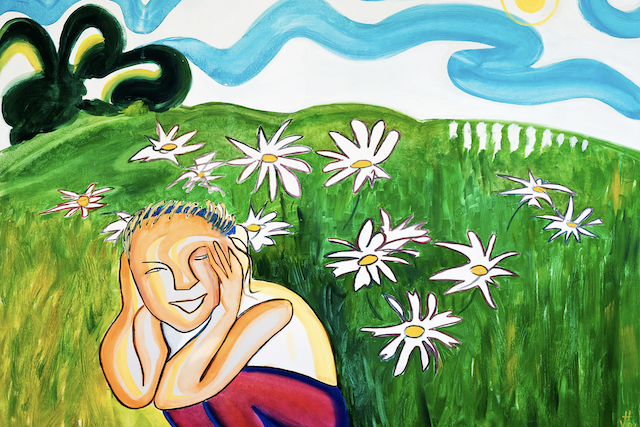
“Simplicity is the ultimate sophistication.” ~Leonardo da Vinci
There’s a funny thing with us humans.
We spend our lives trying desperately to find happiness, and yet we don’t even know what it is. We can’t explain, describe, or define it. We just know that we want it because it’ll make everything peachy. Time and time again, though, studies have shown that our never-ending quest for happiness is quite often the very thing that makes us miserable.
Trying to find happiness is an exercise in futility. This is a truth I did not easily come to realize. It took a succession of major depressive episodes, the sudden death of my father, a cross-country move, a broken heart, and countless hours reading airy-fairy, self-help nonsense for me to understand that instead of trying to find happiness, I should consciously take steps that let happiness find me.
Suffice it to say, you will no longer find me spinning my wheels, dejectedly searching for answers and chasing the abstract. You will no longer find me on a never-ending quest for happiness.
But given my endless fascination with the subject, my work as a coach, and my ever-present desire for more street cred, I recently found myself immersed in a year-long Psychology of Happiness certification program created by best-selling author and former Harvard professor Dr. Tal Ben-Shahar.
During the program, we were asked:
What was one of the happiest periods of your life?
What did you do during that period that made it so good?
How can you generate more happiness in your life?
I had a profoundly difficult time answering these questions, particularly the first two. But the more I scanned through my mental scrapbook, the more I kept thinking about the months between ninth and tenth grade—my last romp as a camper at the sleepaway camp I’d been going to for six consecutive summers.
It wasn’t so much what I did—or what we did—that made it so good. I think, perhaps, it was what we didn’t do.
There were no smartphones. So, there were no screens to stare at, no calls to make, no messages to check, no constant dinging notifications.
There was no social media. There were no Facebook rants, no Twitter trolls, no outlandishly phony Instagram influencers to drum up our insecurities.
We weren’t constantly comparing ourselves to others while looking at the carefully curated highlight reels from their lives.
No, we were making our own highlight reels in the middle of nowhere—or, more accurately, in the middle of northern Wisconsin. We hadn’t the slightest idea what anyone else was doing, and we didn’t care.
There were no dating apps, no heads to swipe on for hours at a time. There was no ghosting, no haunting, no orbiting, no zombieing, no submarining, no breadcrumbing, no roaching. These hyper-specific subtypes of appalling human behavior simply didn’t exist.
And despite our raging hormones, there was no palpable desperation. You either “hooked up” with someone the night before or you didn’t. Then, you moved on with your life.
Nobody gave a damn who was president, either. We just knew it was some old, white guy just like it was the year before, and the year before that, and the year before that. He sat in his office, and signed some papers, and maybe spoke to the country every few months and that was it.
There was nobody on the far left trying to ruin the life of anyone who’s ever made a mildly offensive quip. There was nobody on the far right trying to accelerate conflict and build some kind of white ethnostate. There were no conspiracy theorists trying to convince the world that celebrities run pedophile rings out of pizza parlors or that Jewish folks crisscross the country to start wildfires with space lasers.
Oh, but Tony, you might be saying to yourself. There were definitely people like that back then! And you get no argument from me.
But we never heard from them. They didn’t have public platforms. There were no 24/7/365 news channels, there were no online news magazines, and there was no YouTube; so, they just kind of kept their crazy crap to themselves.
It’s no wonder that one of the happiest periods of my life was the summer of 1997, in the middle of nowhere in northern Wisconsin. We spent all of our time in nature, laughing and singing and bonding and playing frisbee.
One could theorize that we were happier purely because we were kids, but I’m not so sure. From what I can tell, kids today are lost, distracted, and isolated. They spend most of their time indoors, glued to their devices. They are overstimulated, oversensitive, and overprotected. They are riddled with anxiety and depression as they deal with the psychological trappings of growing up in a technological world.
Twenty-five years ago, during the summer of 1997, life was just…simpler.
That’s what made it so good.
And I don’t think that life in general will ever be that simple again.
But every time I simplify my own life, even just a little bit, I’m a little bit happier.
Every time I de-clutter, I’m a little bit happier.
Every time I delete a dating app, I’m a little bit happier.
Every time I forgo watching the news or sign off social media, I’m a little bit happier.
Every time I turn my phone on Do Not Disturb, I’m a little bit happier.
Every time I have a real conversation in real life with a real person I really care about, I’m a little bit happier.
Every time I go outside and walk around and do nothing but look at the sky, and the trees, and the architecture, I’m a little bit happier.
Every time I sit in silence and meditate and let my thoughts pass by like the weather, I’m a little bit happier.
So, how can you generate more happiness in your life?
Well, I don’t have a whole lot of street cred. But if I had to take a stab at it: Stop doing the things that cause you unhappiness. Simplify, simplify, simplify. And maybe find a summer camp for adults.

About Tony Endelman
Tony Endelman is an author, blogger, humorist, certified transformational life coach, and certified happiness trainer. He currently lives in New Orleans. Catch up with Tony on his website.








 Though I run this site, it is not mine. It's ours. It's not about me. It's about us. Your stories and your wisdom are just as meaningful as mine.
Personally, I think happiness is the absence of depressive thoughts. Being free of that enough to enjoy a simple moment for what it is. Relaxation certainly helps, as does meditation, therapy and ensuring my needs are met.
Certainly, Helena. As I tried to convey in my post, I believe simplification can help keep those depressive thoughts at bay. When we are bombarded with negativity – from things like social media, dating apps, 24/7 news channels, or just plain clutter – that’s when those depressive thoughts (comparison, envy, anger, frustration, resentment) can start to creep in. And yes, meditation is hugely beneficial, and something I did mention as part of the simplification process. Thank you for commenting.
Cheers,
Tony
Thank you for your post. It makes allot of sense. I have been so stressed worrying about things that in the scheme of things mean nothing. Need to get out and smell the roses as they say.
AMEN! THIS is exactly why I use social media very minimally (although would like to cut it out altogether) and frequently lose my phone only to realize it an hour later. This is spot on. The thing that bums me out lately is that at least in my circle of friends/acquaintances this is kind of a lonely perspective on social media and pocket technology. 🙁
This is just the surface. But you overstate the value of disengaging from things like politics.
If no one cares who’s in office, we get the supreme court we’ve got and woman’s rights getting rolled back. We get global warming.
And we have responsibilities. I have two kids. Trying to teach them how to be good people, sometimes disciplining them is not fun. Should I stop doing it?
Happiness is more nuanced than you suggest. Disciplining my kids doesn’t make me happy but watching them grow into mature accomplished adults gives me pride and satisfaction.
I’ll give this a conditional pass. Yes, staying away from most of what makes us unhappy is probably a good idea. But still do your taxes, not doing them because doing them doesn’t make you happy us just a bad idea.
I don’t think the author is saying that nobody should care about anything just that this time in his life when he didn’t was simpler and happier. This emphasized the importance of simplifying his life. And everyone can simplify their life just a little even if it’s just putting down our phones for a couple hours or reading a book your enjoy instead of watching the news one evening.
I find that looking at my phone and the constant headlines and ads forced onto me when I scroll through apps or one bad take on Twitter can really start my day off on the wrong foot. I’ve deleted Twitter, deleted Facebook, I am more mindful of what I seek out on Instagram (I find nature photography is a lot better for my mind vs Influencers) and try to read news that is more interesting to me vs clicking on every horrible headline I see.
Minimizing distractions that take a cumulative toll on our happiness?
I’m all for that.