

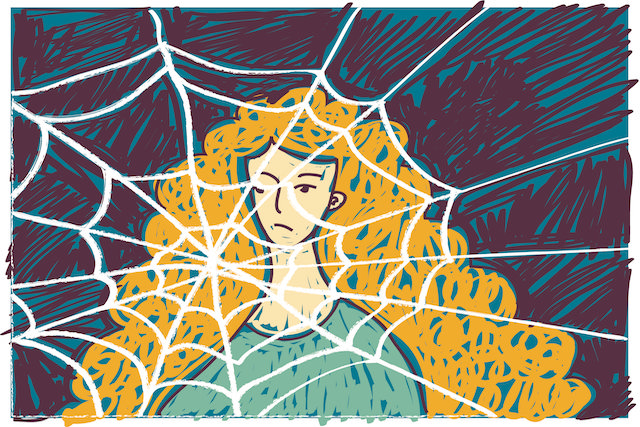
I grew up in a family of high-functioning addicts. We looked like the perfect family, but as we all know, looks can be deceiving. No one was addicted to drugs, so that obviously meant that we had no problems. Cigarettes, alcohol, food, and work don’t count, right?
I have come to realize that what we are addicted to is nowhere near as important as the admission that we’re addicted to something. When we try to make ourselves feel better by telling ourselves that gambling or porn or beer is nowhere near as bad as crack or heroin, we are merely lying to ourselves. In the recovery movement, we call this denial.
Denial was the foundation my life was built on. We did not speak of my grandfather’s abusive behavior and alcoholism. We did not question my grandmother’s chain-smoking habit. We did not mention my other grandfather’s drunken falls and injuries. We never tried to help my aunt who was eating anything she could get her hands on. No one questioned the countless hours my father spent working.
There were so many things we just never talked about. There were so many things that were secrets. Things I had to hide. The unspoken family rule.
I loved my family members. I still do. They were good people. They tried really hard. They just didn’t know how to look after themselves, to value themselves, to love themselves.
They did the best they could under the circumstances and with the lack of awareness, information, and support at the time, and I don’t think it’s ever fair to judge that from the outside.
I have gone through my stages of anger, judgment, and resentment and come out the other side. All that is left is sadness and love.
I loved my family members. I loved them so much and all I ever wanted, even as a little girl, was for them to be happy.
I wanted my granddad to not drink come 4pm so he would stay the lovely man that he was. I didn’t want to see him shout and cry and fall over. I didn’t want to be scared like that and watch my grandmother cry while helping him up and cleaning away the blood. He was a good man, but he had seen the worst of World War II and I don’t think he ever recovered from that.
Maybe he would have been an alcoholic without those experiences; I will never know, and it really doesn’t matter because he was not just that.
He was kind and generous. He played with me and made me laugh. He cuddled me in bed and told me story after story. We had so much fun together. Remembering those happy times will warm my heart for the rest of my life. I will be forever grateful for those happy memories and the time I had with him. I guess that he is the first addict I ever loved.
My grandmother was the kindest person I have ever met. In my eyes, she couldn’t have been any more perfect. I wish that she had lived longer so that I could have had the opportunity to get to know her as an adult.
What would I have seen? Would I have seen a woman who didn’t set any boundaries? Would I have seen someone who gave and gave without ever really getting anything back? I don’t know. I cannot say. But she was definitely the love of my life. And maybe that’s because she might have been codependent and treated me like a little princess, or maybe it is that she was just one of the kindest people the world has ever seen. It might even be both.
It doesn’t matter who it was and what they were addicted to, I loved them. I truly loved them. I loved them then and I love them now even though they are no longer alive and haven’t been for decades.
Addiction may change how they behaved at times, but it didn’t change the essence of them. And that’s what I have always loved. It doesn’t mean that I was blind to everything that was wrong. It doesn’t mean that I didn’t sense that something was terribly wrong.
Today, I love the addicts in my life from a greater distance. The pain of loving someone who doesn’t love themselves is too much to bear. We speak and we care, but there is an emotional depth we can never reach. A depth I craved then and I depth I will crave if I let myself forget who I am loving.
Because that’s what I found to be my solution for maintaining relationships with people I love but who struggle to love themselves:
I can love them, but I can only do so by accepting that there is an emotional distance I will never be able to bridge. I have to accept that the closeness I seek, I can never get. I may get a hint of it every now and then, but I can no longer allow myself to be lured into wishing and hoping that things will change how I want them to change.
I can love them and I can hold space for them, but I cannot change them. What I can do is remove my expectations and hopes and dreams for them and their relationship with me by accepting the reality of our situation.
This gives me freedom. It gives me freedom to love them while being true to myself and honest about my feelings.
It allows me to enjoy the contact and connection that exists while having healthy boundaries in place that protect me from sacrificing my own well-being and peace of mind in a misguided attempt to save them from themselves. It is that separation that finally allows us to connect.
It gives us space to respect our struggles and each other as individuals. As long as I failed to see that, I tried to change them, and that’s what stopped us from connecting.
And so. learning that I cannot change another person and that only they have the power to do so, opened me up to actually being able to love them.
I also learned that I cannot love another person into loving themselves. I used to believe that meant that my love wasn’t good enough—that I wasn’t enough—but I now know that the love they needed and the love they sought was the one that only comes from within.
Because if my love could have saved them, it would have. I loved them that much.
But love that comes from the outside needs to be able to connect with the love that’s on the inside, and that love, they just hadn’t connected with.
That love they never found during their lifetime.
And so, they couldn’t teach it to anyone else either. No one knew about it, and everyone just coped with their pain in the only way they knew how to.
I wanted them to look after themselves and be happy so very much. I wanted them to be healthy for me. I wanted them to stay alive for me. I didn’t understand that I couldn’t save them. I didn’t really comprehend that part for most of my life, which paradoxically has cost me a lot of my life.
I know the yearning and the craving. The wishful thinking. The rollercoaster of hope and crestfallen disappointment. The believing in them and cheering them on only to watch them fall again.
But I was always on the outside. It was never in my control. It never really had anything to do with me or meant anything about me.
I just happened to be born into my family and love them.
For most of my life I wondered if I did really love them or if I just loved what they did for me, but I can now say with absolute certainty that I loved them.
The things I loved doing with them, I haven’t done in decades and yet the love is still as strong as ever. As is the gratitude.
I am grateful for the kindness they’ve shown me and the lessons they’ve taught me. I am grateful for their perseverance and their endurance. I am grateful for the thousand things they were, because they were more than addicts.
They had dreams and aspirations when youth was on their side. They had things they liked and favorite clothes they wore. They had friends and social lives. They danced and they had fun. They kissed and made up. They tried really hard to be the best people they could be, and how could anyone ever say that that wasn’t good enough?
They never did anything to intentionally purposefully hurt or harm anyone because they were good people. Good people who never hurt or harmed anyone but themselves. And witnessing that was painful. Knowing that that is what happened and continues to happen is still painful.
It is a reality I wish wasn’t true. If there was something I could do to change that, I would. But I know I can’t. And that is the reason why I can love the addicts in my life.
When I thought that I could change them or save them, I couldn’t love them. Love accepts people as they are. It does not seek to change someone so they fit in with your idea of them. Love is inherently respectful. Trying to change someone isn’t.
I could never really control them or their substances, and I have lived with the panic of not being able to. But I have made friends with it. I now know how to soothe myself and in that way, I take care of myself. I have achieved what they never could.
I cannot control what my addicts do to themselves. I cannot control the choices they make. But I can control my choices.
And I choose health, growth, and love. I will not continue the family heirloom of addiction and self-abandonment.
Instead, I have learned to love in healthy ways. And that includes me. I have learned to take care of myself and dare I say it, like myself. But I couldn’t have done it if it wasn’t for my family.
While they provided me with my challenges and relational struggles, they also provided me with kindness, love, and strength. For some reason, they managed to love me enough to let know that there is another way of being because that is what has kept me going.
I always knew there was something wrong. I just didn’t know what it was. And I also always knew that there was a better life out there, and I was right. I just wish that my addicts could have also had that experience. I wish we could have had it together, and I don’t think that I will ever stop wishing that.
But I accept the reality that is and I will continue to do for myself what they could not do for themselves so my children will not share the struggles of the past. I focus on what I can control, and I take full responsibility for my own life. I look after myself how I wish they had looked after themselves. I do it for me. I do it for my children. And I do it to honor them.
Because I know that they would want for me what I wanted for them. The difference is that I am able to give it to them. And I do so with all my love.

About Marlena Tillhon
Marlena is a highly experienced psychotherapist and success coach specialising in healing inner trauma and breaking unhealthy patterns that stop her ambitious clients from having the success they know they can have in their lives, relationships, and careers. You can find her on Instagram or Facebook and receive her free training and gifts on her website.





 Though I run this site, it is not mine. It's ours. It's not about me. It's about us. Your stories and your wisdom are just as meaningful as mine.
This article really helped me to look at my situation in a completely different way. My partner is an alcoholic. I have been with him for over 30 years. I am thankful that I have come to a place in our relationship where I now have boundaries. We do not live in the same house . . . we do not sleep in the same bed . . . we continue to love each other but I have made it clear that I do not want to be around him when he is drunk.
I still love him dearly but yes . . . When you said that all that is left now is sadness and love . . . It felt so true. And yes . . . It does not change the essence of who he is. And when you said there is an emotional depth you cannot reach was liberating for me. And when you said the closeness you seek . . . you will never get helped me to truly understand that what is missing in this relationship I will never get has really helped me to truly understand the frustration i have felt and understand that I must let that go . . . realizing it will never happen. When you wrote” I have to accept that the closeness I seek, I can never get. I may get a hint of it every now and then, but I can no longer allow myself to be lured into wishing and hoping that things will change how I want them to change” made me look st the situation in a completely new and liberated way.
When you wrote this “I can love them and I can hold space for them, but I cannot change them. What I can do is remove my expectations and hopes and dreams for them and their relationship with me by accepting the reality of our situation” again was just what I needed to hear.
I guess I could go on writing about everything you said and how it had affected me but really all I need to say is : THANK YOU with all of my heart for posting this article on
This article was perfect for me. I am married to an alcoholic, my brother and 3 of his kids are drug addicts. I always wanted the perfect family and tried to make things better. after years of therapy, I understand and now realize they do not want to help themselves so there is nothing I can do. I love them from afar. I look out for my well being and peace. Thank you!!
Great article! Its such a bitter sweet place to be in, but then I think contentment is found in the bitter sweet.
When I read such posts the question that I wonder about is what is love and what does it mean to love unconditionally?
Unconditional Love in my observations is often a desire or even demand for unconditional allowing which I know misses the mark. It seems to me that Attributes of accountability, responsibility, meaning and purpose are aspects of Love. My own experience of being loved involved at the same time the experience of being seen, meaning and purpose.
Without getting to be held accountable for the good and the bad there can be no experience of meaning, purpose or love. Such boundaries then are an import attribute to the experience of loving and being loved.
When a person doesn’t get to be accountable or responsible at some level were saying that what and who they are, good or bad, does not matter and has no meaning or purpose.
I suspect that when we hold ourselves or others accountable the tendency to do so comes from having reached a breaking point so that we do so it comes from a place of frustration and or anger, which is not a place of love.
Allowing someone to be accountable and responsible for where they are while maintaining healthy bounders that protect both of you is Love and I would argue unconditional Love. A detachment that is not indifference, but an engagement detached from ego.
You said it much better 🙂
Having a family member with addiction is one thing…Having an intimate partner with addiction is a total nightmare…and it is hard to accept them as “who they are” when they cause so much damage…
Absolutely. I wrote this about my family of origin – attachments are strong and as children we don’t have a choice who we live with. As adults we do – even though doing what is ‘right’ and healthy for us can be a big challenge. Thanks for highlighting this! Kind regards, Marlena
Thank you! I too, was a child who has lived with addicts in my family. It’s hard for people to understand what the fuss is about when my father comes home every night and doesn’t get physically abusive (he’s addicted to collecting stamps/coins ) but the emotionally damage and drama is still there. You still have to feel that your father prefers to spend all his time with those stamps then with you. You still have to witness your family struggle with paying rent or buying groceries while watching your father sneak another batch of coins into the house. You still have to feel embarrassed and ashamed that your father has once again ruined another friendship because he “borrowed” money from them to buy more stamps. These are “quiet” abuses that still hurt and torment you for years to come. The recovery process is the same for both the parent and the child. Even as you “distant” yourself from your families, you’re still hurt and affected and you’ll realize the choices you make latter in life reflect that pain. THANK YOU for your article and I applaud you for seeing it for what it is and setting up boundaries and new expectations to make new connections with those addicts you love. Bravo!
I enjoy and understand the sentiment the author expresses. However, all the same words started running together. I love them! I love them! I get it. Yes, we’re responsible for our self, our process and path for taking ownership of our thoughts, feelings and behaviors. At some point people either take off the training wheels, dig in an do the work, or they make excuses and childishly put their tread marks on others. Somebody else will clean up behind me. Many of us know this becomes ingrained in family systems and can go on for generations. I really appreciate what Pieter wrote about accountability. My experience has been that a lot of addicts will surround their self with people that will not hold them accountable, which makes it a lot easier for them to remain irresponsible about their own healing, growth and maturity development. The truth is when someone is an addict; they’re not their self. While we’re responsible for choosing to “love” the lost soul they are, we’re not “loving” that person’s authentic self. It’s buried. While I have empathy, compassion and an ongoing understanding of addiction, I’m not a fan of remaining sentimental. Here’s the thing, western culture promotes individuality, and autonomy is vital for a person’s well being. However, we each affect other people and it takes a lot of intentional work to recognize the full scope of that. If a person/family/system does not separate the dysfunction from what is truly functional and start encouraging independent and systems maturity & development the dysfunction will be perpetuated. We can “love” the addicted person and maintain healthful boundaries and hold them accountable for their choices, by first holding our self accountable for our own.
I love this! My mom is an alcoholic and I’ve tried so hard to love her for years. I’m only just now having success. You are 100% right that it starts with acceptance. We really can’t change other people. Only the ways that we react to them and the boundaries we set. I’ve committed to having a relationship with my mother, but I’ll no longer be in her presence long enough for her to anger me. Sometimes we have to love them from afar. I’ve started a blog about being an ACOA and it’s giving me a lot of closure on the topic of my moms addiction. Every day is still hard though. http://www.millennial-michelle.com
That is wonderful, Marlena, that you are able to continue to love the people in your life with addiction issues, but still take care of yourself. People who are struggling need the love of their family members. It can often be so difficult because of the negative behavior. I know I was in denial for a time, but then realized the only way things will change is if I faced the reality of the situation. We can’t always get our loved ones to find recovery, but we can still live a happy life, have acceptance, and realize our loved ones are more than their addictions.
I am at the point of leaving my wonderful addicted hubby. Im tired of waiting and supporting him while he changes. But staying goes against my beliefs, values, and boundaries. I cant fix him i have enough to do with myself. Ive been thinking im crazy but its because i cant keep ignoring what i need in my life. I love him and this hurts!