

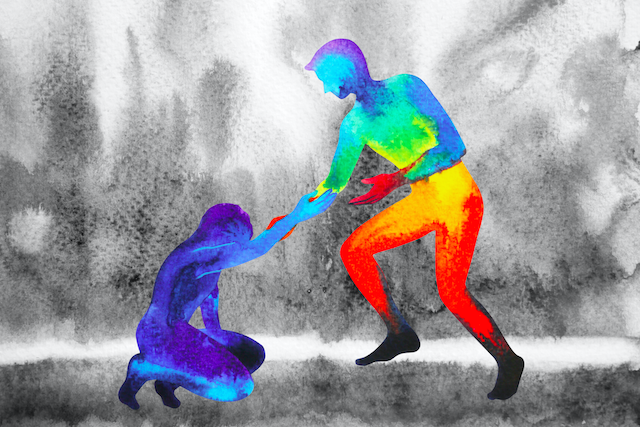
“The friend who can be silent with us in a moment of despair or confusion, who can stay with us in an hour of grief and bereavement, who can tolerate not knowing, not curing, not healing and face with us the reality of our powerlessness, that is a friend who cares.” ~Henri Nouwen
It’s hard to stand at the edge of someone else’s grief.
There’s the awkwardness. You always feel a little like an uninvited guest who arrived late and missed the first half of the conversation—a conversation that turns out to be a wrestle between another person and the deepest parts of their own soul.
What can you say when you realize you’ve barged in on an interaction so intimate, so personal that you just want to avert your eyes and slink quietly away?
Then there are the triggers.
Grief has a way of unsettling everyone in the proximity. It stirs up our own unhealed parts. Is it any wonder that we have the instinct to smooth over the other person’s emotions, to take everything back to normal, before it has the chance to stir up something inside us?
But here’s the thing: Your friends need you. Your family members need you. When we are grieving, we need our closest loved ones more than ever.
I’ve had moments of not knowing how to help too. That’s why I’m sharing my insights about what healed, and what hurt, when I lost my husband to cancer.
Don’t Say Nothing
It would be easier to say nothing. To bury that whisper inside that nudges you to reach out. To focus on the busyness of your own obligations—your life—instead of drawing closer to my dance with death.
I get it. But being on the other side?
It hurts.
It hurts to be this raw, and to have you look the other way.
Please don’t ignore me.
I know it’s a risk. You may get it all wrong. Or you may say all the textbook-right things, only to have me not receive them. My emotions are up and down and all over the place. Some days I’m hard to deal with.
But this risk, it’s the kind that matters. The kind that deepens relationships, cements love, and humanizes both giver and receiver. When we dance together, you and I, trying to figure out how to be in the presence of so much pain, something magical happens. We open ourselves to meaning and beauty and richness. To the purpose of it all.
In facing death, we embrace life.
Don’t Ask How I’m Doing
Sounds counter-intuitive, right?
I just told you not to ignore me. And asking, “How are you doing?” is the first thing we say in most situations to show concern.
The thing, is, answering this question when I’m grieving is painful. It’s so painful that immediately before and after my husband’s death from cancer, our daughters actively avoided going places where people might ask “How are you doing?”
That cut out a big chunk of their support system.
“How are you doing?” asked in passing, say by the clerk at the grocery store, isn’t the problem. It’s the soulful, “How are you doing,” said with words drawn out in long intonations, accompanied with deep pitying eyes, yet said in a rushed or crowded setting, that is tough. It’s tough because:
-Some days going deep enough to give you a genuine answer upsets the emotional balance that’s getting me through the task at hand. Even on a good day, there is so much feeling under the surface. It may be taking all that I have to hold it together. I know you mean well, but please realize it’s hard for me to answer this question honestly and also keep my composure when the setting calls for it.
-The immediate answer doesn’t mean much anyway. Emotions are fragile and unstable, especially in grief. How I’m doing may be different now than it was an hour ago than it will be in another hour. I’m fine and I’m not fine. Some days I’m really at a loss to explain it all.
-Both of us know the answer is messy and complicated and multilayered. When the setting is too crowded or the time is too short for a heartfelt conversation, we each feel the disconnect of a partially true response. It creates distance instead of intimacy between us.
Fortunately, there is a better way to bridge the space between us, and to communicate love and support.
What to Do Instead: Pretend I Already Answered You
You aren’t going to be satisfied by a cheerful “Fine!” when you ask how I’m doing.
You won’t believe me because you can see the grief behind my eyes, despite my smile. And even if you haven’t been through my experience, something deep down tells you that this is big. Too big to be neatly resolved and tucked away in the category of memory.
Trust yourself. You’re right.
So what would you say to me if we fast-forwarded past the “How are you doing?” stage? If I actually had the time and space and emotional stability to give you a full response, how would you answer?
Pretend I just told you that I’m trying in this moment to be strong, but I secretly I wonder if I’m too broken to ever be whole again. That I’m struggling, and it’s so hard. That last night I lay on the bathroom floor and screamed “no, no, no!” to the universe how many times? A hundred? A thousand? That I have to choose, moment by moment, to focus on life and hope. Except sometimes I’m not sure I want to live anyway. That loss is loneliness beyond words.
Pretend I told you that despite all that, there are moments of happiness. And that part of me feels guilty for that. But the other part grasps for any glimpse of joy and peace with the intensity of a drowning person struggling for breath. Pretend that I asked you to please, please not push me to dig deep if this is one of those rare lighter moments. Let me breathe air for a few minutes before I am submerged again by the grief.
What would you say?
Skip the question. Say that instead.
I have no words.
You’ve been on my mind.
I believe in you.
It’s good to see you.
I love you.
Or if you and I are close enough, say it with a hug.
And then, if you really want me to know that you care, schedule a bigger chunk of time for us to spend together. Maybe in that setting I’ll want to talk about the loss. Or maybe I’ll cherish the distraction of talking about something else.
Either way, I need you. Isn’t that what you were really wondering?
Don’t Tell Me That Time Heals All Wounds
Even if that were true, it still wouldn’t be helpful.
What I need is for you to see where I am now. To witness for me, and to share with me, this intensity. I want you to understand how raw, how immediate, how overwhelming the suffering is right now.
But it isn’t true that time heals wounds. At least not always.
Some pain lessens with time. Other pain festers and worsens. Some people grow from tragedy. They become deeper and stronger and more beautiful. Other people become a withered, gnarled caricature of what they used to be.
And it isn’t really time that makes the difference.
It’s heart and hope. It’s choice. It’s victory in this fight against despair and discouragement.
Don’t minimize my battle.
What to Do Instead: Stand with Me
Do you want to help me in the battle? Then stand with me.
In the center of my pain.
Don’t rush to hide it or fix it or silence it (you can’t anyway).
Be brave with me. Accept the discomfort of your own emotions bubbling up when you look at me.
Accept the helplessness of not being able to fix this. (It’s scary, isn’t it? This realization that you are also vulnerable.)
Be a witness to what is.
Choose to stand with me in this place I didn’t choose to stand.
Don’t Tell Me to Call If I Need Anything
Once again, I know this comes from a good place, but the reality is, I desperately need you right now. It’s not a matter of if.
The normal tasks of life are piling up undone around me. Which matter most? It’s hard to focus. To remember. To care.
Truthfully, I don’t even remember when I last ate.
I don’t know how to organize what I need when this grief is so large that it blocks my vision and squeezes against me until I can’t even breathe.
And if by some great effort I did articulate what I need, what if you said no?
What if I called to you, from this broken place, and you didn’t come?
The risk is too much, because even more than I need your practical help I need you. I need to believe that you would be there, if only I could say the words.
What to Do Instead: Help Me
Think of something you could do to bring sunshine, and offer it. The specifics of what you offer matter less than your willingness to reach out.
- Can I drop off food for you tonight?
- Can I come by and mow the lawn/walk the dog/change the oil this week?
- I have a gift card for you.
When you reach out in a tangible way, I come to trust your sincerity. I think that maybe I really could ask for your support when there is a specific challenge I need help solving.
Most of all, I feel you with me. And that was the biggest need all along.
Don’t Tell Me What to Feel
Everyone talks about stages of grief: denial, anger, bargaining, depression, acceptance.
The truth is messier.
There are cycles of grief. I cycle back and forth from one reaction to another, sometimes in the same day. All those feelings are part of the process. All are valid.
I cry. I yell. I laugh. I sink into sadness too deep for words.
It’s exhausting work, grieving.
Imagine wrestling a giant polar bear slicked down with Vaseline. Teeth and claws bear down on you as you struggle against an opponent many times your weight and muscle mass. When you try to get a hold, your fingers slide off and you find your hands empty.
That’s how it feels to grieve.
So don’t tell me to smile.
I will, when that is what my healing calls for. For now I’m doing my best against something terrifying and overwhelming.
Don’t tell me to be strong.
I already am. I am a warrior, and this is what battle looks like.
Don’t question me when I smile or laugh. Sometimes I need to stop and breathe during this intense work. When I do smile it doesn’t change the depth of my pain.
What to Do Instead: Believe in Me
Believe I can fight this fight.
Believe it with so much confidence that you don’t rush to fix what you can’t fix or to control a process you can’t control.
Believe it so completely that you aren’t threatened by my anger or terrified by my despair.
Believe that I can face the rawness of my life ripped open and gutted in front of me and rise again.
I will make it not because I am special or chosen or different than you.
I will heal not because of all the advice and reassurance you give—as much for yourself as for me.
I will heal because in touching the center of my pain, I have found my own strength.
You Will Heal Yourself as You Help Me Heal
You want to help.
Even though it’s hard, sharing this journey. Thank you for trying. I know it’s awkward and emotional and brings up feelings it would be easier not to feel.
But there’s something beyond altruism you might not have considered.
This journey is actually as much for you as it is for me.
Those broken pieces inside you, the ones that are triggered when you witness my pain? They can also be healed as you share in my journey.
I’m not saying it’s easy.
But as you sit with pain—mine or your own—you learn that in a way deeper than words that hope matters. That love prevails.
And as you feel the depth of those hardest emotions, you start to believe in a way raw and real that life is beautiful—even its shadowy underbelly.
Most of all, as you watch me stand naked and vulnerable—yet determined as a warrior—in the face of so much grief, you start to believe in me. Not the kind of faith that is padded and comfortable, insulated by layers of platitudes. A faith born in fire. Gritty. Pure. Powerful.
And as you believe in me, you also come to believe in yourself.

About Angie Schultz
Angie Schultz, MSW, loves to help people transform emotional pain into meaning, joy, and growth. When she’s not teaching college psychology classes, she blogs at The Becoming Place. You can follow her on Facebook or Twitter. Subscribe here for free insider updates.








 Though I run this site, it is not mine. It's ours. It's not about me. It's about us. Your stories and your wisdom are just as meaningful as mine.
At time when you have been hurt so much, you unconsciously or learned to hurt other people back with or no will on your own. I don’t regret not forgiving my father for his neglection and behavior, and there is no similar person I have ever known like him before, and still don’t. It must be very hard him and unfortunately I can’t say I let it go the past hurt although I think that I am able to forgive. Somehow it is very difficult to forget. Memories always stay with you.
This is a big help for me Angie, thank you for sharing your life experience. Because there are times when my partner is having hard times and I don’t really know how to comfort her or what to say. Thanks Angie.
I’m so glad you liked it @AnnLumbes@annlumbes:disqus
I wrote something very similar after loosing a baby to a medically necessary abortion. I agree with everything 100%!
@cambrienelson:disqus I have never read any of your writing. I would love to do that sometime.
Thank you for the wonderful insight on what to say and what not to. Boy, have I struggled with this (as you would know). Thank you for having the strength to write these beautiful, raw words with complete honesty!
This is the best piece written on this subject. Thank you.
Thank you, @disqus_3lFTrt1aMx:disqus . I think we all just wish we could say something to make it all better for our loved ones. It’s ironic that we often help the most when we finally realize that we can’t fix it all, and we are simply present.
That’s quite fine. It remind me how much I wanted this person to be here again by my side, and all I could have found was myself and nobody else. No pets, not a living thing, no one. How sad.
Angie you nailed it!!
This is a beautiful article, and struck home with many of your readers, but we are indeed all different, and some of us are pushed to the edge of suicide by terrible loss, so it’s not always wise for loving friends to “trust.” It can be useful to risk a lovingly meant status check. (And for whatever it says about me, when I was struggling in the depths, I think it would’ve felt odd/creepy to me if I had perceived that those who stood with me were viewing my suffering as an opportunity for their own healing.)
This is great. My struggle is when someone’s grief isn’t a close loved one, but it hurts nonetheless. Like, they still are functioning, but inside still hurting. My neighbor’s nephew was the little boy that died in the Gilroy Garlic Shooting. I’ve Brough dinner, flowers, dessert, drove her to the hospital for something else unrelated, but that was all in two days and I’m not sure what the next move is. I want to support, offer help if it’s needed, but I don’t want to assume they aren’t functioning because likely they are.. Just hurting. Particularly her son who just lost his cousin.
Camille, I can relate to this. I couldn’t overcome the reality that helping others is an unselfish act and we can’t expect something in return. And despite this haunting worry in mind, I can’t help to think how unfair and ungrateful it is to give a hand or to do too much and not expecting a smile in return. I grew up in such an hostile environment that I can hardly see myself otherwise.
Wow! Good article, but you were extremely brutal in your feelings, which is good by the way. In about a month, it will be 6 years since I lost my mother. We were very close and had all the time in the world to say goodbye and anything else we needed to. I do not actively grieve her. She is always in my heart, but I don’t wish she were here as much as I love her, she did such as good job as a mom I can cope with life without her. I do not fear death, I don’t wish for it, but I am at peace with it if makes sense. We are all different when it comes to dealing with matters such as this, so there is no “right way” to go forward.
A very good article, but it left out something that was very difficult for me when I was grieving for a husband and then, at different times, for three grandchildren:
Don’t tell me how it was for you when you were grieving.
I found that a lot of people think that empathy means telling someone about their similar experiences so that the other person will know that they too have struggled with grief. But grief is selfish and self-protective. Others’ grief experiences felt like diminishing mine. All I wanted to do was get away as fast as possible. It was too much to even hear.
What to do: Use your own grief experiences to help you remember what you wanted – and then give that to the grieving person.
I am sorry for the lost of your relatives, Adrienne. This is indeed a good article, very raw and straightforward. Reading it just brought back in tears the painful lost of my grandmother that happened 30 years ago! Then, recently I felt loss in a close relationship with a friend in a way that nobody can tell. We still exchange email and I keep grieving the loss of this friendship because of our incapacity to be together. I appreciate your being straightforward in telling us “what to do” and it is exactly what I found out in my recovery work in therapy. No words can explain it better than as you did.
Not to be mean but I found this to be yet another article, and I’ve read many, that tell me I’m failing as a human being trying to be helpful to someone experiencing grief. Grief is a singular experience and there is no one alive who can go through it “with us.” Let’s just start right there. I would never criticize ANYONE or think that someone wasn’t “doing it right” if he/she reached out to me in any way or in any manner when I was in the throes of my grief. The way different people choose to help is also individual and reflect who they are as a person. Nothing is going to take away my pain but to me it’s enough that someone wants to not matter what they say or do.
Feel like I do this for everyone, but no one does it for me.
I just lost my 20 yr old daughter and best friend. This is exactly how I feel.
Beautifully and wisely written.
I have read this whole article and i can say it is the most pure ,helpful and incredibly helpful …i don’t have words, i usually am not much of commenting stuff….i am just shaken and you just reopen myself to myself…it is just pure art pure life , i will start follow you , i need to learn more about who we are , what i am ..and i am so happy to know that i have so much more to rediscover and to discover …i don’t know what am i even talking anymore ..because of this big emotional impact …i wish people would study about this ,God i am kinda of awake ?