

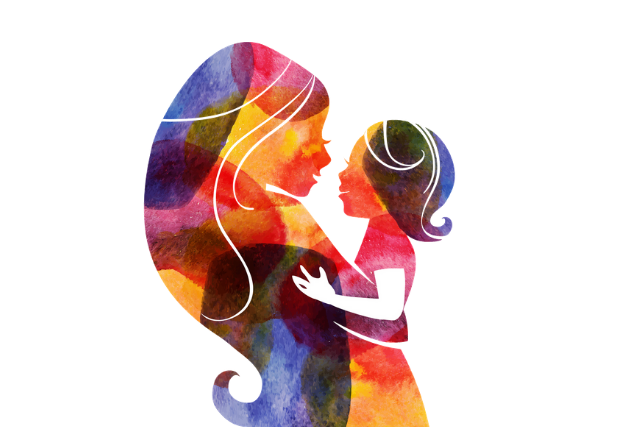
“Bless the daughters who sat carrying the trauma of mothers. Who sat asking for more love and not getting any, carried themselves to light. Bless the daughters who raised themselves.” ~Questions for Ada by Ijeoma Umebinyuo
“I failed you…”
My mother said this to me after I confronted her about my childhood.
That day, I had a clear image of the young girl I was, the girl I had tried to ignore in the hopes of moving forward. But pain shouts when it demands attention, and the suffering was palpable.
A memory flashed within my mind. I had tried telling my mother I was hurting somehow. All children have hurt they can’t quite explain, even if it turns out that it’s just an itch or a bruised feeling, but the need to have the boo-boo kissed means everything to the child.
That day I had found my mother occupied with something more pressing. And I, being the sensitive girl I was, figured that she hadn’t heard me or that I had disturbed her.
It seemed that I only existed to be cautious of the adults in my life who, at best, were preoccupied with a mysterious something and, at worst, cruel without reason. I existed in a world where children were things you spoke to. Tell them what to do, and they’ll simply do it, because what else are they there for?
The idea that children had inner lives, breakable hearts, and ideas of their own making was quite dangerous in my childhood. I’d soon learn that it was better to take a vow of silence and say very little. I was starved for the hunger all children have—the hunger to be seen.
Love requires attention.
It seems like the older we get, the more we have to reflect on those days when we were at our most vulnerable. We have to look back at the beliefs, habits, and people that shape us if we want to grow.
When I finally talked to my mother, I was attempting to grow out of a destructive habit I had learned in childhood: denial. If you don’t talk about a thing, or name a thing, then maybe the thing never happened. Perhaps it wasn’t that bad, or maybe it was just a dream.
I was no longer talking as a child in need of her mother’s attention; I was talking as a woman in need of the truth. I was now an adult who hoped to be a mother someday, and a healer committed to breaking the generational curse of mothers failing daughters, women failing women, and humans failing themselves.
I poured out the heart of that little girl over the phone. She had needed protection when she was called names, or when someone hit her, or when she was touched inappropriately. She needed to know that whether she was a child or a girl becoming a young woman, she had a right to her body, mind, and spirit.
My voice cracked through the phone, but I told her anyway. To me, you have never been trustworthy.
She took a long breath and then spoke almost rapidly, like her life and our fragile bond depended on it. “I’m human; I falter. I never said I was a great mother. I know I failed. It looks like I’ve failed you many times. Forgive me.”
The pus ball that had always festered in my soul—that sore that kept reddening with anguish—burst.
My mother revealed something that I think all parents fear showing their children: humanity. At least I know for her generation, showing children a semblance of an emotional life was secondary to putting food on the table, and when you’re not raised on showing your feelings, you forget you have them.
It’s scary to admit you’re full of contradictions, possibly wounded, and that raising a child, no matter what the circumstance, is difficult.
In that moment, I understood what the word “grace” meant. It’s such an elusive word, and much better to experience than explain, but I know that my heart broke, love flooded in, and a burden was lifted.
Her honesty freed me from having to second guess my existence, and it helped me understand the hardship of hers. The mirror I was looking through was no longer foggy. I could see my life clearly; it had texture, color, clearly defined lines, and a burst pus ball that needed cleaning.
I saw a clear picture of the precariousness in my childhood. It was like my spirit whispered in my ear and confirmed, Yes. It was terrifying.
So what do we do in the wake of failure?
My mother’s admission gave me a little taste of what it means to become a mother. You can love a thing and hurt a thing at the same time. I deeply love and adore my mother. I can only imagine the people and circumstances that failed her. I have a softness toward her and a softness for myself that has made my heart grow more space to hold the things I’ll never fully understand. Sometimes, it is what it is.
After ten years of doing what survivors of any trauma must do to clean their wounds—meditating, numbing, praying, therapy, journaling, blaming, finding community, practicing yoga, raging, and crying—I have come to accept the unacceptable.
We don’t tell our parents the truth about our experiences to condemn them; we tell them our experiences because we must contend with it. No matter how painful the purge, this raw material from living is the grist that reminds us to do better the next time around. And there’s always a next time around.
“I am a reflection of my mother’s secret poetry as well as of her hidden angers.” ~Audre Lorde
This is what I’ve learned.
Sometimes you must mother yourself. In the wreckage, you learn how to give yourself the love and affection you hungered for in your most powerless moments.
I adore the little girl I once was. She found worthwhile things to enjoy about life as the ground beneath her eroded. She sang, had her own dance parties, liked to play with balloons, and loved listening to Motown music.
She saved me, and now I get to take care of her.
This is my greatest lesson: I can accept complexity as a requisite for living. I can love the mother that gave me birth, be my own mother, and also know that there’s a higher power that loves and watches over both of us.
I can forgive while remaining protective of the little girl who was hurt too often, and too often ignored.
Redemption in the wake of failure is possible, though difficult, and yet, it beats continuing a wretched cycle of negation.
The more I reflect, the more I see that my mother and I, in many ways, are quite alike. It’s now my duty to be fiercely aware of my own demons and angels. If I am a reflection of my mother, what questions do I have to ask myself about who I have become? And what do I hope to pass on, to myself and others?
I believe my story speaks to generations of children, particularly women, who grew into adult bodies and are still searching for their mothers. The reality is that we are the caretakers and mothers we’ve been searching for.
The yearning I had as an adult for nurturing and recognition was my soul nudging me to show up for myself. Now you get to take care of you, and you must.
Mothering yourself is the sacred call to practice love. Here are a few things I did in my own self-mothering journey. I hope you find them useful for your own toolkit.
Get to know your inner child.
I started doing inner child work in therapy. My therapist gave me some great activities to get to know what that part of myself was thinking, and I still do the exercises to this day. My tried and true activity is writing in the voice of my inner child with my left hand and responding as an adult with my right. I’ve found this exercise revelatory and recommend it for anyone attempting to rekindle a relationship with their younger self.
Your inner child never leaves you, and I learned that mine had a lot to say. This helped me learn how to show up for myself emotionally and mother that part of myself that needed validation.
Meditate.
Meditation has helped me sharpen my awareness, and it keeps me present to what I’m feeling in my body. The health benefits are great too. Do whatever activity brings you a sense of stillness and focus (walking in nature, cooking, mindful exercise).
Practice unconditional love, starting with yourself.
Love is a practice, and in this world we’re taught to see love as transactional. You get love if you can prove that you’re lovable. Choose a different kind of love for yourself.
Start simply, perhaps by listing what you’ve come to appreciate about yourself and treating yourself with grace when you make mistakes. Find alignment with your values and get to know yourself. Become your own best friend.
Distance yourself if you need to save yourself.
Sometimes distance and time help heal and give perspective.
I’ve had to take myself out of situations where I knew I had to protect myself. At times this meant limited communication, geographic distance, or emotional distance. This can be tough, but trust that when it’s time to save yourself, you’ll know what to do for your highest good.
Reflect.
No one is a saint, and the truth is that we’ve all hurt people and will hurt people. And it’s true that if we do a personal inventory, we’ll see that we have unsavory habits and patterns that need to go. Reflecting helped me see where I would like to grow. I’m acknowledging my own tendencies to shut down, ice people out, and feed into negative stories when I’m feeling defensive or frightened. I see that these habits stem from fear. Reflection provides information. Now, I am choosing to practice more loving habits towards myself and others while honoring my need for comfort.
Finding a way to reflect is critical. I journal and make music to do this. It’s really helped me see how far I’ve come and where I still have gaps.
Create rituals.
Condition your hair on Sundays, or soak your feet in Epsom salts when you get back from work, or go for a swim, or draw before you go to bed, or cook yourself your favorite dinner on Saturdays. Go dance at Ecstatic Dance with your girls on a Saturday.
Finding rituals for yourself helps reestablish intimacy that you might not have had growing up. It also helps you get to know what you like and brings you peace. Find that for yourself.
Take care of yourself.
Did you eat? Shower? Brush your teeth? Did you take a jacket with you because it’s cold outside? Do you like your eggs scrambled or fried? Are eggs even good for your unique body type? Become your parent and look after yourself.
Don’t force forgiveness.
Forgiveness will come when it needs to, if it even needs to, and if it doesn’t, then it doesn’t make you any more or less enlightened than the rest of us. It just means this is your path and that you’re working on some intense stuff. Be easy.
I’ve found forgiveness to be a complicated process that takes time and a lot of honesty. Try to let yourself be where you are, and trust that it’s okay. Bypassing your emotions can feed into denial and numbing to your lived experience.
The point is not to rush to enlightenment; the hope is that feeling your emotions can help you become whole. Working with a professional and/or support group can help you in your process.
—
Learning how to become the caregiver you’ve always needed is not only a gift to yourself; it’s a gift to everyone you meet. I vowed to nurture myself because I wanted to send a message that redemption of the human spirit is always possible, no matter the trauma. My life is a testament to that.
Take what I say as an offering because you know yourself best, and the medicine that restores me might not be the ideal prescription for you. Feel free to add your own ideas of what makes you come alive to this list. At the end of the day, your experience is your teacher.

About Itoro Bassey
Itoro Bassey is a Nigerian-American writer, mindfulness practitioner and educator. She is the founder of the digital course, From Surviving to Thriving: Becoming Your Own Inner Author. This course uses writing and energy work to bring students into the present moment. She has been publishing on culture, identity, and healing for over ten years and now offers intuitive counseling sessions for those in need of support. Follow her on Instagram or contact her at itoroflower@gmail.com.








 Though I run this site, it is not mine. It's ours. It's not about me. It's about us. Your stories and your wisdom are just as meaningful as mine.
What a beautiful piece if writing. I have never been so moved and touched in so many places in my heart, soul and psych. It was insightful, genuine and full of wisdom.
Thank you for sharing your story. It has freed the inner child in me that’s been hurting for a very long time. Now I understand, accept and move forward to embracing it and truly have the tools to healing and nurturing myself for the rest of years.
Lot’s of love, Sally
Beautiful article. I definitely needed to read that today.
Beautiful.
reading this just dropped me to my knees. i loved my mother dearly. i cared for her myself the last ten years of her life while she had dementia. she also had schizophrenia and my emotional childhood needs went unmet. i forgave her a long time ago and am in awe of how good a mother she was in spite of her illness. but yes, the inner child in me is sobbing after reading this. i have a lot of work to do, i need to mother myself the way i was able to mother her… thank you itoro. from the bottom of my heart. just thank you.
Thank you.
Thank you so much for sharing your truth. You have spoken for me. Thank you.
“She took a long breath and then spoke almost rapidly, like her life and our fragile bond depended on it. “I’m human, I falter. I never said I was a great mother. I know I failed. It looks like I’ve failed you many times…./…”
How many parents give that kind of cop out excuse? Lots of therm when they do something wrong, they never admit to their mistakes and don’t even make an apology to their kids when they do something wrong. It is all about their stupid inflated ego and pride.
so thankful for your courage to be so open about your experiences, knowing that so many others might benefit from the encouragement & perspectives you shared.
It sounds like you started out knowing you were worthy of care right when you started inner child work (“I adore the little girl I once was.”) Congratulations! What if you HATE the kid you were… your inner child? It was supposed to be silent and unseen in order to survive, which it did as a child and again for the last 40 years so I could get on with my life. Starting last year, it began a series of tantrums and meltdowns that have manifested as emotional disregulation that has turned my life into a living nightmare. I hate it and I wish I could get rid of it. It’s not lovable (or else the person who was supposed to love it the most would have at least tried to care for it). It’s a banshee and a nuisance and a pain in the ass. It needs to either vanish or at least learn some manners again. I’m slowly becoming strong enough to ignore its outbursts, so as to not worry or frighten the people I love, but it’s a constant and Herculean effort. I want a pill to shut it up, or surgery to remove it. It sure as hell doesn’t deserve coddling. How do I either learn to accept it, or get rid of it?
Klsabin, I have not mastered my inner child work, by any means. I do have an observation though, when you hate her, you hate yourself – she is you. We cannot integrate the parts of ourself that we hate. She is screaming for your love and attention. Love doesn’t hold conditions, so we comfort those we love no matter the circumstances. What she needs exactly, is your coddling. We can still set boundaries with our inner child. I tell mine all the time, “Not at work, you can tell me later. ” Your post resonated with me because I used to hate the part of of me that was needy. I am getting better now that I know what she needs. She wants me to take as good of care of her as I did my real daughter. I’m taking baby steps.
There is no pill or surgery. There is only the courage it takes to confront it, find out where it came from and then deal with trying to maintain control of it. You can not do it alone, nor should you feel yourself a failure. Your issues are deep-seated and hope you seek some manner of help in order to begin your journey of healing.
Here’s what came to mind as I read your post; I only post this food for thought. (I had a similar childhood)
Is that silent, hurting kid finally doing the screaming, raging, and feeling that she had to deny herself?
Are you mad at her for being silent and hiding?
I was in my 40s before I felt anger at what happened to me – I had always been afraid of it and thought I was too wise and mature for it to bother me now. But the anger trickled in – and somehow I found it freeing and empowering because I finally was mad at the right person, instead of being angry and blaming myself.
I wonder if that is what is happening with you. That little kid might be melting down and tantruming in order for the truth to get out. Feeling angry and finally blaming the right person (my dad) was very helpful for me.
(although I wonder if I need to pay attention to my own little kid more)
I wish you well klsabin.
This is absolutely beautiful. Continued best wishes for you and little you on your healing journey.
Just what I needed. I have been learning that my inner child needs protecting in the last few weeks. I’m learning that my insecurities stem from my childhood not me as the person I am now.
I have huge hurdles to overcome to lessen in warranted insecurities and help my anxiety.
Thank you 😊
Beautiful, really needed to read this. Thank you! I have work to do for my own little one.
My mother is gone over 8 years now. I struggle with some of the wounds from my childhood at 50+ years. As a kid, I read a lot and felt a deep connections. I decided I wanted to become a writer. I wrote and wrote stories. At 15 I submitted a manuscript to a publisher which was denied. When I received the letter, I was heartbroken. My mother basically told me to give it up. It was so devastating that I can’t remember the exact words she used. I gave up on it over the years thinking she was right.
I was the victim of a sexual assault in my teenage years. This was a subject matter that was BARELY addressed. Even now, I feel so disappointed with how she handled the situation. She didnt know what to do about it and had me stay home for days. I was alone with my thoughts and PTSD. When I asked to see a therapist she was hesitant to take me but eventually I was able to go. And the therapist probably saved my life.
As an adult I feel more and more like she had her own issues and was unhappy with herself. She experienced the loss of her own mother as a young child. She never spoke about it so it is hard to tell how it affected her, but I know it had to.
I’m so sorry about what you experienced Nova. I had a mother who caused me so much pain and hurt. I wish that she had shared anything with me that could give me some insight into how she could be as damaging and abusive towards me as she was, but she did not share anything with anyone, including my father/her husband of approx. 60 years. It is hard to have had a broken mother.
I love how the article gives steps one can take to mother our wounded inner child. A lot of articles talk about the experience of childhood trauma or the insights gained from the trauma but do not provide practical steps to take to heal. I really loved that this article does provide tips. I will save this article and I hope I can move more quickly to change my daily routine to incorporate these or any other steps to assist in my healing. I really need to focus on that so much more!
This just made me cry, it somehow spoke to me. My life isn’t that strongly similar to yours but the way you spoked about love and forgiveness were so beautiful.Thank you.
Insightful and extremely helpful. I only wish I could talk to my mother now. I can imagine how healing that would be. The idea of being my own mother and nurturing my inner child sounds powerful. Thank you for sharing this.
I was molested, possibly raped when I was 4 by a 15 yr old cousin. That cousin is dead now but my mother speaks fondly of him. I’m 50 yrs old and the memories of what happened bled back into the forefront of my mind over the last 10 years. I feel sick every time she mentions him but I don’t know if I should confront her or keep my pain to myself. She knows he did something to me because I told her right after it happened and the rest of my childhood, he was kept away from me. It seems the greater good would be not to burden her with my pain, but how do I let go of my pain if she keeps saying his name??
I think you need to talk with someone about what happened. I wonder if the sick feelings you experience now, are not only the painful memory – but also betrayal that, while your mom kept him away from you in your later childhood, she’s not doing so now, and doesn’t seem realize the event is not water under the bridge.
You may not feel like it; but being able to protect yourself as an adult is a wonderful thing! You get to make the rules. You have the right to tell your mom to not mention his name in your presence. You have the right to disagree with any good opinions your mom may have about him.
If you speak the truth to your mom, and she is upset – that is not your fault. Only you know what you think and feel; you’re being driven to the state of feeling ill and you have the right to state your needs, make your own rules, and protect yourself.
As for protecting the greater good; the greater good is made up is individual parts – and you are one of them. If you aren’t taken care of; it weakens the entire structure. It’s like building a bridge with cracked logs.
You deserve to protect yourself.
My experience was different from yours since I was not molested but my mother and I had other issues that needed to be resolved. I held back telling her how I felt because I knew how much it would hurt her if I confronted her with how much some of her actions had emotionally wounded me. One day the dam burst and I couldn’t hold back the truth and I just let her have it – the unvarnished truth. It was painful to her but what she needed to hear and made a big difference in our relationship going forward. It started to sink in for her how much she had hurt me and she cried and said she was sorry. That apology meant the world to me and helped to mend our relationship somewhat.
The daughters who are now grown up are champions of their own life, they overcame huge struggles to shine, some are even the opposite of their failed mothers. God bless them all !
Thank you so much. I am my mother’s daughter and it frightens me sometimes. I even look exactly like her. I recently did the same with my mother and she shut down. Which is what I expected and it made it easier to accept.
Thank you for the support and now I have a deep understanding of my hurt.
Reading this article was like reading my own life as a child growing up but my journey to healing has been a very slow process. Fortunately I was able to speak with my mother as you did and heal from that broken relationship before she passed. I brought my mother into my home to watch over her before she passed so that I would get some sort of closure I felt I needed to mend that mother daughter relationship I always yearn from her. I found forgiveness and compassion for her because I knew what her childhood was also like. With all of her faults she was a strong woman to overcome what she had also experienced. As for me I’m still a work in progress and at the age of 65 I’m still trying to work and heal through my past.