

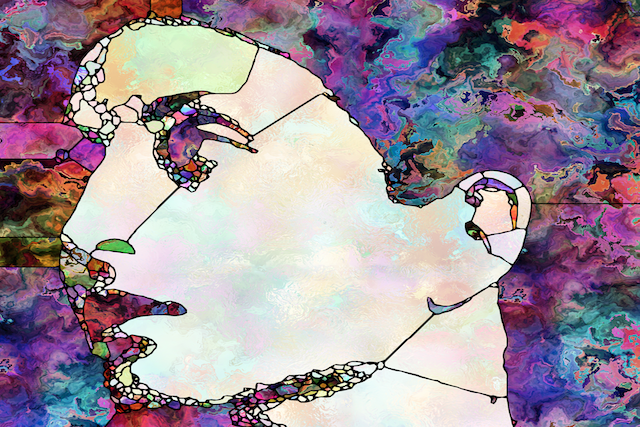
“Our deepest fear is not that we are inadequate. Our deepest fear is that we are powerful beyond measure.” ~Marianne Williamson
I used to have this secret habit of flipping through the DSM—The Diagnostic Statistical Manual for Mental Disorders—and diagnosing myself with every disorder in the book.
Reading over the criteria for borderline personality disorder, cigarette in hand and eyes wide open, I scanned the diagnosis criteria.
Frantic efforts to avoid abandonment? Check. Unstable and intense interpersonal relationships? Check. Unstable self-image? Check. Impulsivity that’s self-damaging? Check. Suicidal behaviour? Check. Unstable moods? Check. Chronic feelings of emptiness? Check. Inappropriate and intense anger? Check. Paranoia? Check.
Oh my god.
I thought that was an uncanny description of me, until I found antisocial personality disorder.
Failure to conform to social norms? Yup. Doing things that are grounds for arrest? Regularly. Deceitfulness? Impulsivity? Failure to plan ahead? Oh yes. Irritability? Aggression? Reckless disregard for safety? Lack of remorse?
Oh my god.
That seemed spot-on, but nothing, and I mean nothing, compared to when I first read about post-traumatic stress disorder.
Exposure to traumatic event? Yes. Recurrent, involuntary, and intrusive memories? Oh god, yes. Traumatic nightmares? All the time. Flashbacks? Yes. Avoidance of trauma-related stimuli? Yes! Feeling alienated from others? Persistent negative beliefs about self? Persistent negative emotions? Distorted memory and feelings of blame?
Oh my god.
After a few years, I added body dysmorphic disorder, substance use disorder, occasional episodes of manic disorder, and constant rotations between bulimia and EDNOS (eating disorder not otherwise classified).
Admittedly, some of those diagnoses should really have cancelled each other out, but I was more interested in collecting diagnoses like some would collect stamps than achieving medical accuracy.
All of my self-imposed labels gave me a strange kind of soothing feeling. They affirmed something I already believed, deeply, within me: I was broken. I was in a state of disorder. There was something wrong with me.
In my scourings, I avoided certain disorders like the plague. Anxiety, for example, and depression. Anxiety didn’t seem like a very “cool” thing to have and depression just didn’t seem plausible because I was so violently self-destructive, never stopping to rest for a moment unless I got infected with mono or West Nile meningitis (both of which actually happened).
To an onlooker, these things might have seemed like ploys for attention or misguided attempts at impersonating Hollywood. But, truly, these self-diagnoses stayed more private than many of my tortured war stories. They were something personal. They were just for me.
Looking back, I realize that the fuel behind my self-diagnosing was an obsessive, perpetual drive to find the answer to a question I couldn’t avoid for more than a few hours at a time: “What’s wrong with me?”
What was wrong with me, I liked to think, was childhood-trauma-induced permanent damage that, in mixing with my apparently high IQ, had created a sort of “Dr. House” complex within me, making me irreparably and irrevocably screwed up.
That was a nice story, but it didn’t satisfy the question. A question like “What’s wrong with me?” isn’t just some domestic house cat in the mind. It won’t sit quietly and patiently for most of the day, becoming vocal only if it isn’t fed for too long.
No, a question like that is a wild, ferocious, insatiable beast that rips into anything and everything in its path, killing simply for the sake of the kill, feeding constantly and ceaselessly on anything that smells like nourishment.
What was wrong with me?
By the time I made it to age twenty-three, there were so many answers.
What was wrong with me?
The stretch marks all over my body. The pimples on my skin, my back. The little hair growing an inch above my nipple. The moles on my upper back. The fat all over my body.
What was wrong with me?
The way I blushed at the drop of a hat. The way I wouldn’t be able to stop laughing when other people did. The way I made jokes that weren’t funny to anyone but me. The way my upper lip twitched when I was nervous.
What was wrong with me?
How I had absolutely zero ability to be sexy or act sexy without alcohol, feeling frozen and ugly if anyone ever saw me naked. How I had flashbacks, nightmares, and hallucinations I told close to no one about. How I drank alone.
How I just couldn’t seem to sustain happiness and, even when I tasted joy for a second, soon enough the drugs would wear off and I’d be right back where I started, wishing for a freedom I wasn’t sure was real.
All of my happiness, for about ten years, was induced by chemicals and co-dependence. I thought what was wrong with me was that I couldn’t feel happy without buying it or begging for it. I thought I was just that kind of person. I thought it would always be that way.
I’d love to tell you that I was afraid of being broken and damaged, afraid that past emotional trauma had rendered me dysfunctional, afraid that I was different from other people. Of course, that’s what I used to say and that’s a nice story, but I know now that it was all a big lie.
You know what I was really terrified of?
Deep inside of me, there was the awareness that, even if I fit every symptom in the book, I had no excuse to live half a life. Somewhere in there I knew I wasn’t really broken. I was terrified of what my responsibilities would be if I allowed myself to be, truly, whole.
When I was an addict, a victim, a diagnosis, I had no responsibility to anyone. If your neck is severed and bleeding, you can hardly be expected to open doors for people and make the world a better place.
Like this, I dodged the responsibility to discover my skills and talents, to serve people, to do something meaningful in the world—all by playing broken.
Of course, it wasn’t all a giant act. I had been abused. I had been raped. I had been an addict. I had horrible body image issues. I heard voices. I hated myself. Yes, those things were “wrong,” but so is a paper cut. And your body will do its best to heal the paper cut with no further intervention from you, if you let it.
Yes, I’d been broken, but I didn’t have to keep being broken. For fear of my own greatness, I put bandages on my wounds, letting them grow necrotic for lack of oxygen. I never wanted to get better; I just wanted to get pity, because I was too scared to ask for love. I kept myself sick for fear of my own health.
I’ll tell you right now that my fear wasn’t unjustified. Now that I’m not playing small anymore, I have more responsibilities than I ever have. I’m trusted with people’s most painful memories, with their deepest secrets, with the chance to support them when they’re on the brink of hurting themselves or others.
Yes, the responsibility is there, but it’s not the horror show I imagined it would be. I think the only reason I ran from it was because I was so weak from keeping myself broken that I couldn’t imagine how much energy I’d have to help people when I allowed myself to be whole.
I couldn’t have imagined how fulfilling it is to spread love, give love, be love instead of scrounging for tiny little pieces of approval and acceptance like a thief in the night.
From what I’ve seen of myself and of people, I believe, without condition, that no one is irreparably broken. In fact, no one is broken. Is having a paper cut broken? Of course not. From the moment you get a cut, you’re already healing.
And that’s what I believe. I believe we’re all already healing, no matter how great our pain or how serious the offenses against us. We’re built to heal, we’re already healing, and we can all experience this amazing life process—if only we’d get out of the way.

About Vironika Tugaleva
Vironika Tugaleva (also known as Vironika Wilde) is a poet, spoken word artist, activist, and award-winning author. Vironika believes in the medicinal power of honest words and tough truths. When Vironika isn't writing, she loves stargazing, singing, and eating pickles (sometimes, all at once). You’re welcome to follow her on Instagram (@vironikawilde), check out her latest book, Love & Gaslight, or get a free preview of The Art of Talking to Yourself.
- Web |
- More Posts






 Though I run this site, it is not mine. It's ours. It's not about me. It's about us. Your stories and your wisdom are just as meaningful as mine.
I needed this…what a beautiful way to start the day. I have been suffering from depersonalization/derealization (along with EXTREME anxiety and depression) for about 5 months now and have convinced myself I have had every diagnostic in the book from schizophrenia to disassociate identity disorder, as well as many others.
I need to realize no matter what “label” or problem I have that healing is possible and a very likely outcome, as long as I believe in myself. Sometimes the suicidal thoughts are very strong but I believe in love and happiness. I want to HEAL!
Thank you…hopefully this is the first step for me into wellness.
So happy that you’ve come to this amazing realization, Don. And, don’t forget, all the great geniuses of our time went through a period of “insanity” before their greatest revelations. I read an article once where a shaman from the East visited a mental asylum in the USA and walked out in tears saying, “In my country, they are prophets, they are healers, they go through this before they awaken.” I think mental distress is a gift, struggle is a gift, if we choose to unwrap it. Your mountain is waiting, so get on your way! 🙂
This is a lesson that I have to relearn everyday, sometimes multiples times. I’ve been dealing with similar issues all of my life, but it was only recently that I came to terms with the fact that I have to deal with it. We can push it off as long as we want, but our healing won’t truly begin until we let ourselves heal.
Your work is amazing. Never stop writing.
“Our healing won’t truly begin until we let ourselves heal.” – Yes! Thank you for your kind words and gratitude, Jake.
Great article. Thanks for sharing. It’s something I know well myself. And interestingly, for me the big shift happened when I learned that I’m playing the game of the 9 of Hearts with a a 7 of Clubs personality. It was this altogether different “diagnosis” that helped me actually relax and be myself in this life.
Self-awareness is an incredible tool for our journey, Alexander. I think we all shift when we realize what’s REALLY going on, and regardless of our vocabulary for it (or whether we agree on word usage, definitions, etc.), the most important thing is the feeling of understanding oneself, the experience of seeing what is there. Happy that this has happened for you!
This is wonderful and important. I can relate to relying on the pain as an excuse to not truly live. I let depression be my escape for years and am just in the last year finding that life is worth living. Worth putting self aside to truly find joy in the process. It’s an amazing transformation and I am grateful for you sharing your story and helping so many others.
Yes, it’s incredible what happens when we remove that mask we call “self” and find that there’s still something there, something much more powerful and beautiful than the false identity we’ve been keeping up for years! Happy have you on this journey, Nikki.
Happy to have you as well. Thank you greatly for sharing the space.
I could have written this about my own life…thank you so much for this truth. Saving this article to read again and again.
You are so welcome. Thank you for your kind words, engagement, and gratitude, Ryan.
I am crying right now reading you article.
Hugs to you. Sometimes tears must be shed to cleanse away the old dust that clouds our vision.
I had a counselor once who pointed out that I was a perfectionist. I was shocked. I was a perpetually ‘B average’ person…B student, B job, B looks, B socially. I would freeze up and avoid big projects…never quite achieving big goals, not completing things. Her observation helped me realize that I never allowed myself to try the ‘A’ game, or to complete something, out of fear of failure. See, if you don’t complete the project, then no one can criticize it, right? You can always be in a “Well, this isn’t done yet….” state. After this realization, I discovered that I had been using the same tactic with my depression. Almost like, “Well, you know, I’m not at 100% because of this depression thing…so you can’t really criticize me or expect me to be like that achiever over there…” (This is mostly a convo I had with myself, not others.) Once I realized what I was doing, I was able to fix it.
A helpful tidbit for those with ‘something wrong’ with them. Embrace your ‘wrong’. Trust me on this. It’s a beautiful part of you, even when it makes you puke, eat, cry, hate, scream, tantrum, basketcase, whatever. Listen to what I say. The only way you’re going to make it all stop is by loving that part of yourself and acknowledging everything it did for you – both good and bad. Only then can you kiss it on its little head and send it on its merry way. But you have to start with acceptance. Hope this helps someone.
Best of luck. 🙂
Love this! Yes, that’s very true. I felt that way about showing my true self to the world. I lived a lie behind a mask, and it hurt, but it didn’t hurt as much as the possible rejection of my real, true, authentic self. Even if people didn’t like the mask, then I could say, “Well, I’m not being authentic anyway.” What a way to live! Thank goodness we’ve both found our way now 🙂
This is a beautiful and powerful story…this is the version worth being told. Again and again.
Thank you, Stephen. 🙂
Hi Vironika
Thank you so much for such a great post and sharing your story and insights. I totally agree with you about no one ever being irreparably broken. We all certainly have our issues, and that is okay. We can always find a way to work with them, and sometimes eliminate them completely. But, that is not totally necessary to really make great strides in our life, though I think many believe that to be true, and feel discouraged that these ‘shadows’ will forever taint their experience.
All our ‘stuff’ can be a wonderful gift if we can learn to handle them more effectively because we can learn so much from these struggles, and they can actually be a catalyst for making amazing positive changes and helping others. Many healers for example, relay having had bad childhoods or overcoming very difficult circumstances. i imagine they wouldn’t have realized the capacity we have to heal ourselves had they not gone through all that themselves.
Great stuff!
Thanks Kelli! I agree with you that eliminating our issues isn’t necessary. It’s a bit of a dangerous goal too. I think it’s safer to focus on doing our best to take care of and love ourselves. The rest will take care of itself 🙂
I can relate to this so much right now. Over the past 2-3 years I have done a lot of soul searching to try and answer the question “What is wrong with me?” I realize now that I have been living with anxiety, depression, and EXTREMELY low self esteem (which, just my personal opinion, I think in part causes the anxiety) and using drugs and alcohol to deal with it since my late teens. Now that I’m 30, and the ‘party scene’ is just starting to seem sad, I feel lost. Like I’ve wasted my entire 20’s hiding from life. I’m at a loss as to the next step to take, but articles like this one make me feel so much better! Thank you!
You are welcome! And searching is the first part to finding. It’s never too late to realize you deserve more than your own mental abuse. Welcome to the journey 🙂
Great article Vironika, thanks for sharing, so familiar what you are describing. It is so easy to escape in drugs or whatnot to run away from yourself and finding excuses the blame the past for our current unhappiness. I too realised that I am scared of living my full potential and that is the real issue. Took me more than a decade of self destructive behaviour to realise and just now slowly I am starting to find my ways.
Good for you! And, yes, it’s easy in a way, but also the hardest, most resistant route in another way. Once you’re fully submerged in self-love, it’s almost stupidly simple, and what can you do but laugh at how hard you were making it for yourself?
I am working through my depression. I know exactly how you feel. I have trauma from my childhood, mainly from my father who was very abusive. And that in some way has affected me for most of my life. I keep thinking what is wrong with me, why am I not all together but I finally realized that no one has it all together. And it affects what I am going through now; thinking that I will never have an acting career nor find real love. Because I thought my father would be a real father.
But I can’t blame him, I have to move on, and I am moving on, its a day by day progress. Thank you for sharing your story.
Good for you for moving on 🙂 Yes, forgiveness is the way. And awareness that all of these “wrong with me” thoughts are just thoughts, and not based on any reality. Your thought processes might be foggy and toxic, but you aren’t. You’re incredible.
That’s an incredible post, Vironika! It’s commendable how you have been able to separate all those complicated, intertwined feelings to understand why you did what you did. It’s a very inspiring post, thank you!
You are so welcome, Swati. You know what they say… necessity is the mother of invention 😉
How often do we fall and crumble, citing our injuries and pointing with accusing fingers at others? Blessings, Vironika, for shining a light on wholeness and holiness without allowing the machinations of the ego or the victim condemnation of the social sphere to hold any ground.
Thank you for your well-versed gratitude!
I dont agree to this. We do at time like pity, no doubt but there are times you really need to look what are you making yourself. I thought this all my life , pushed myself to be happy to avoid it , but finally I lost my battle. Most people show apathy saying you are lazy or you like pity show , but trust me its not as straight. I was super depressed for reasons but people near by did not understand. I left the place finally , I walked out and I have now moved ahead. Better if not great. Id like to say if you have such thoughts or you are severe its important to not always tell people that you don’t fight. You need to sometimes let it go and walk out like a loser . And its ok as long as you choose yourself.
I agree with you completely, Meera. We do need to walk away sometimes. That doesn’t make us losers at all 🙂 As long as we’re in touch with our core, full of love for ourselves, we can make the right decisions for ourselves. Thanks for sharing!
Thank you for sharing. I hid myself for years in an overweight body. Now that I’ve”changed” to a smaller version of me, there was no more hiding from all these issues I’ve had, concernig my youth, my low self esteem, my marriage to the wrong man, etc.
Yep, I was broken. But while I still look for all the pieces, I’ve come to realize that my core is still intact, and that some parts of me are as hard as diamond. Diamond in the rough, and only I can see the real beauty. There will be a time that others may have a peek, but just not yet. I get to enjoy that first.
Love,
Manuella
Thank you for your courage to be so vulnerable.
This helps me to understand some people I know. I’m terrified of diagnoses. I always wanted to see myself as ‘not completely broken’, someone who could get better, and whenever I act or feel in a way I consider to be damaged I’m completely destroyed by it. I feel like it dooms me to be cast out – damaged goods – for the rest of my life, to stay stuck with damaged people, who live damaged lives, and where every day there is another issue and no one is ever just peaceful and happy and free. Being damaged, to me, suggests being forced to be with damaged people (the only ones that would accept me, I imagine), and being locked out of anything better and happier for the rest of my life. Most of the people I know are unhappy.
My friends (the ‘non-damaged/less-damaged’ ones all tell me I’m normal and I’m strong, but I fear that I am weak and that I will never be normal enough to feel comfortable with myself. For this reason, I shy away from the medical model, although I torture myself by reading theories and the DSM to ‘check’ I’m not crazy. Whenever I see something in them that sounds like me – even if it’s only one criteria – I feel bereft. Especially if the theory/disorder has anything to do with being weak (or what I think looks like weakness).
For these reasons, I’ve always had difficulty relating to people I talk to who give themselves diagnosis after diagnosis, or who seem more than ok with being broken. People with admittedly very difficult lives who will tell you about all their diagnoses and all their childhood stuff and those who report back gleefully that they told people about their hard lives and “everyone was shocked” and I think – how can you feel like that? How can you want to be pitied?
What I read in your article makes them make sense to me. I’m glad there is a way out for them. I need to do…what, the opposite? I dunno, I’m obviously just as bad but the opposite way around!
Thanks Vironika for the article. For so long I have believed that I am broken, it has been so painful to deal with every day life and try to realise my own potential. When there are so many people around you saying you’re amazing, that you’ll be OK and that you have the world at your feet it almost heightens the feeling of not being amazing and not being enough – I still look at photos of myself and wonder how this girl looking back at me can have so completely lost the faith in herself. It’s scary. I feel like I’m living in my shadow, too afraid to step outside of it for fear of really living and letting go. Asking people for love is the hardest thing, love or help one of the two. It seems easier to live in silence and say nothing about what goes on in my head. I hope that the first step is realising what the problem is to then be able to try and change it. Articles like these give me hope.
Thank you for this. I needed to read this today.
great article. as we get older, we tend to pull inward and away from people. maybe were tired of dealing with drama ..idk, but what kind of life is solitude and living to please yourself every day. I get more joy from helping and doing for others. thanks for the reminder. n
Well said. I quoted your piece in my blog post. http://dharmaonthefarm.tumblr.com/post/110610445871/fear-loathing-lower-back-pain
OMG thank you. You captured so perfectly my own struggles. I was raised to believe that I was broken. As an INFP, I didn’t fit into the ESTJ mold that in school and in American society was so overwhelmingly presented as THE only acceptable way to be. I have been going back to process the actual feelings I blocked and hated for so many years. To find the real me. You’ve helped. Thank you beyond words. ❤❤❤
You have no idea how much and how deeply I needed this. I have never before felt so identified with although people say that a lot. All those things are private and terrifying for me and I can’t articulate them. Thank you so much…. Thank you 🙏💕