

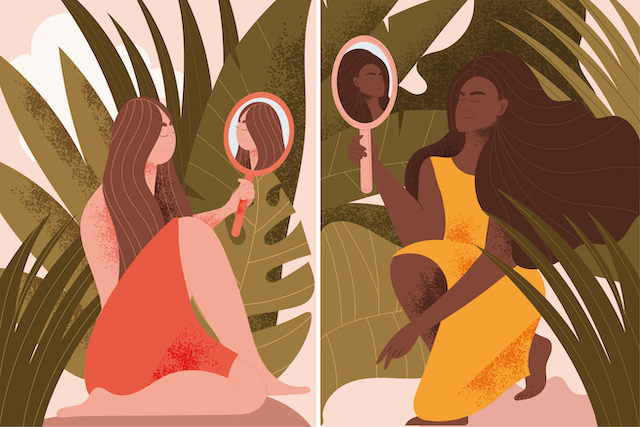
“Embrace and love your body. It is the most amazing thing you will ever own.” ~Unknown
The first time I made myself throw up to feel skinny, I was five years old. My grandmother still loves to tell this story—she thinks it’s funny.
The story goes like this: I tell my grandmother my stomach feels sick. She rubs my belly. I tell her it still hurts. She asks me if I want to try the “potion.” I say, “Yes.”
The “potion,” as I realized in an unrelated context in my early twenties, was syrup of Ipecac—a strong vomit inducer. I should mention this was back in the Ukraine. My grandmother uses no such potion now and neither does most of the populace—I hope.
So, there I go drinking a whole glass. I vomit. Ten minutes later, I’m in front of the mirror, hiking up my dress to look at my stomach, saying, “Don’t I look pretty? Don’t I look thin?”
My grandmother almost rolls onto the floor laughing. She’s laughing because this little kid pulled the wool over her eyes, because my stomach didn’t really hurt. Because I’d conned her.
How could this woman, who’s from the old country, who had to share a loaf of bread with nine of her siblings, possibly understand the reasoning or the danger of throwing up your food on purpose?
Fast forward ten years, I’ve got a full blown eating disorder. I just wonder what my grandmother would have said if she’d have walked in on me, sitting on my bedroom floor, at age fifteen, surfing a pro-mia website, shoving a salt-covered wooden spoon down my throat to see if it made me gag easier.
Never in a million years would she imagine what I’d been doing and why.
My mother, however, is a different story. And so am I.
I remember, when I was about four, my mom dropping me off on my grandmother’s step warning her not to feed me too much. That would have been the worst thing—if I gained weight. My mother took many precautions to make sure this did not happen.
Of course, my grandmother didn’t listen.
And so, the precautions turned to problems. My mother’s worst fear had become a reality.
I still remember the fury with which she scolded me when she found stashed food in my room, the anger in her eyes as she tried grabbed onto my fat and my senses, trying desperately to make me understand—she was trying to help me.
No one wants a fat girl.
I remember watching her go on and off diets. I remember watching from around the corner as she put on her makeup, her creams, her mask. I remember the way she’d talk about herself as if she were an old house that she was trying to renovate, although the wood had rotten and fallen through the cracks.
I found out later much later that, although my one grandmother wouldn’t know a thing about that kind of thinking, my late grandmother, my mom’s mom, was like my mother and me. She had learned the ways of self-loathing.
It was like something happened to the women on my mom’s side of the family that didn’t happen to my dad’s side, like a program had been downloaded into our heads that said: “No one likes a fat, ugly girl, and you are one.”
In her TED talk about lexicography, Erin McKean mentions something she calls “The Ham Butt Problem.”
The Ham Butt Problem goes something like this: a woman’s cooking a ham for her family and she cuts a huge piece of butt off and throws it out. Her son sees her doing it and asks, “Why do you do that?” She answers, “Well, I don’t know, I guess because my mother always did it this way.”
So, woman calls her mother and asks her, “Mom, why’d you cut the butt off the ham when you made it?” The mother says, “Well, I don’t know, my mother did it this way.” So, both women, full of curiosity now, call grandma and ask her the same question.
Grandma laughs and says, “My pan was too small.”
And so, I learned to put on makeup, fret over my blemishes, buy creams for my face, creams for my thighs, and creams for my arms.
I learned to go on and off diets. I learned to feel ugly all the time, except when I’d put on my mask and protect myself from my horrible, natural appearance. I did what I saw done. I cut the butt off my ham because my mother cut the butt off hers.
By the time I was twenty-three, I had dyed hair, dyed eyebrows, and a whole closet full of shape-altering clothes. I had problems with addiction, co-dependent relationships, anxiety, and self-hatred so serious that it ended me up hearing voices and feeling suicidal.
Cutting the butt off my ham almost killed me.
As I picked up the broken pieces of my life, trying to put them back together, I realized that everything was too broken to glue back together. I had to start over.
And as I looked at those broken pieces lying there, I realized suddenly that all of the pain and self-destruction I had brewed in my life for almost twenty years had the same source. It was that program—that self-loathing thinking that I’d inherited from at least two generations.
As I learned to see myself in a different light, I realized the pure ignorance of that kind of thinking. How ungrateful is it to say that nature doesn’t know how to make beauty? Doesn’t nature make sunsets and rainbows and beaches? Nature made me. How could I say that was ugly? Who was I to judge?
And so, I learned to fall deeply in love with my reflections, not because of my flaws and not despite them, but because this body is a gift, because beauty is the signature of all living thing, because I am a tiny piece of the universe; how can that not be beautiful?
The more I’ve liberated myself from this programming, the more I’ve looked around at the women in my generation and felt a deep yearning to heal their pain.
They, too, are carrying the burdens of this cultural programming on their shoulders, never realizing that they’re only suffering because they were taught to suffer. There is no good reason to hate our bodies, no matter how they look.
There is no reason to spend our lives in this kind of desperate, self-hating pain.
I think that self-acceptance is the modern-day revolution, because self-loathing is modern-day oppression. I honestly believe that each person who realizes his or her own beauty changes the world.
I already know I’ve changed the world. I know because, one day, I’ll have a daughter who will watch me looking at myself in the mirror. And when she spies on me from behind the corner, as I once spied on my mother, she will not learn to be upset at her backside and to nitpick at her blemishes. She’ll learn to smile, look in her eyes, and greet her best friend.
And that, more than anything else, is what really makes a difference.

About Vironika Tugaleva
Vironika Tugaleva (also known as Vironika Wilde) is a poet, spoken word artist, activist, and award-winning author. Vironika believes in the medicinal power of honest words and tough truths. When Vironika isn't writing, she loves stargazing, singing, and eating pickles (sometimes, all at once). You’re welcome to follow her on Instagram (@vironikawilde), check out her latest book, Love & Gaslight, or get a free preview of The Art of Talking to Yourself.
- Web |
- More Posts





 Though I run this site, it is not mine. It's ours. It's not about me. It's about us. Your stories and your wisdom are just as meaningful as mine.
This article really stuck with me. I am on my personal journey of self-love and sometimes all I can hear is the voice in my head telling me I’m not good enough. But your approach is so beautiful I cannot help but want to make a chance. Thank you.
Thank you for taking a chance. The willingness to do that is, I think, all we really need. Big hugs for you.
Self-loathing is a modern day epidemic of sorts. We have to start realizing that we are good enough just the way we are. Thanks for the post, Vironika.
So true, Lovelyn! Thank you for seeing that and for reading 🙂
🙂
🙂 right back at ya
I am going home for the holidays this year and have so much fear of judgment from my family about my weight. This has helped reframe it for me. I do not have to follow in the footsteps of my foremothers; I can choose to love who I am, no matter my weight or size, no matter what they say. Thank you for reminding me. <3
Yes! What a wonderful decision. You are a pioneer!
Fantastic article! Thank you for being so vulnerable, sharing your beautiful growth and perspective! 🙂 Congratulations, and you definitely should be proud to demonstrate such a healthy model for your future daughter…and even son! 🙂
Yes! So true. Thank you for reading 🙂
Great article, something I struggle with too as my mother outright told me that I would never be truly beautiful. As a result when I look in the mirror there is not one thing that I see as being good enough. Feeling like a walking bundle of inadequacies is not good for the soul especially when I have a daughter. It’s not going to be easy to change that voice in my head but it’ll be worth it for her.
So true – not easy, but so worth it! Thank you for walking this journey. It’s so important. For all of us.
We are made of stardust, we are all unique, nobody else has our dna, so be the very best of you that you can be. Thank you for this post, I have a daughter who was bullied at school for being ‘big’, so she learnt to win prizes for her brains, when all she wanted was to be beautiful. She was, and is, but she herself needs to believe this.I need to send her this article, maybe it will make her see what I could not show her.
I wish your daughter the best on her journey. I know that, one day, she will see her unconditional beauty – she will see herself as you see her. I am happy to help you do that. Thank you for reading, Tessa.
Thank you for writing this. I was made, well actually, still made to believe that I’m not beautiful because of my curly hair by both my parents. They used to straighten it when I was as young as 4 or 5. I used to be obsessed with keeping it straighten because I was taught that’s what beauty is. Now I’m in my 30s and have been wearing my hair curly for the past 10 years or so. They make comments on how bad it looks, especially my dad. I feel great with my curly hairstyle. I feel so beautiful, so it’s strange now to hear that I don’t. It actually sounds crazy to me. Lol!
Go you Jo_Stone with letting your curly hair be free! I grew up wanting straight hair. 20+ years ago I met my husband and he loved it curly. I learned to love what I have (and be proud to be different). Just keep being you and stand up for your natural hair! 🙂
I feel you, Jo! I used to straighten my hair every day and dye it. Now, I just leave it. People always ask me how I “do” my hair. I tell them I wash it once in a while 😉 Natural is always better. Thank you for knowing that, my beautiful friend.
Vironika, this article means a lot to me. Thank you for writing this. Although my parents never instigated or taught me self hatred at this scale, my peers unfortunately did. I have always veered towards the plumper side due to binge eating brought on by other issues and was bullied life long for being overweight. But I really began questioning the idea of self loathing and what I was being told when my boss’ wife in all her well meaning glory sat me down and asked me to shed kilos so that I could “find a man” to settle down with because “that’s what men like. Thin women”. I have watched her struggle with the way she eats food to minimum, and forces others to eat more and thinks nothing of publicly berating herself for being, “fat”. The thinking has spread to her daughter too who tends to be bitchy about women who are overweight. It was the most blatant way someone tried to teach me self hatred. And hate myself I did. For the past year, all I did was either binge, or eat nothing, and work out like a maniac. And now, I realised, if I want to be fit, and healthy, I need to love myself and all the excess weight will go away because bingeing is a form of self abuse too. One of the first things I have started doing is to cut out all people who try to teach me self hatred. And it feels good. 🙂
What a beautiful realization and a beautiful story, Sharada. I am so happy that you’ve replaced your self-judgment with self-love. What an amazing journey you’re on!
This is a great article!!
Thank you!
Thank you Vironika. My story is a bit different, but the impact on my life was as destructive. It wasn’t my mother. My mother was so beautiful and she knew she was. She never put make up on, never cared about the extra weight, not anything. She was living and loving life. For me, it was my father. He was the one always worried about my appearance, my weight, my pale face. His worries come from the fact that in the village where he comes from a girl is a weight on her parent’s shoulder and she has to be perfect or they wouldn’t be able to get rid of her by finding her a husband.
I always wanted to get his approval, so i was going from diet into another and trying every possible pill to lose weight.
Then after sexual abuse, I hated men and my way of pushing them away was by getting fat and ugly, so i started eating and gaining weight till i became obese. Now food is still my protection and i don’t know how to stop that
I now release all this excess; I nourish myself with love.
I now release all this excess; I protect myself with love.
Thank you for a deeply honest and revealing post- I love your epiphany that nature creates beauty- who are we to disagree? I am trying to reteach myself that humans are made up of much more than just their appearance- emotions, intelligence, humour, compassion, love. By focusing on just beauty, we are not giving other attributes their value. I looked at my friends and realised that I choose my friends and love my loved ones because of their kindness, or their loyalty, or their sense of humour- not because of what they look like. So why do I focus on what I look like? We all need to start self-loving from the inside!
Yes we do, Tori! Thank you for sharing your epiphany 🙂
Amazing post, thank you for sharing. I am struggling with an eating disorder and am wondering how you “did it”?!
Bless,
Mel
“I had a problem with the things I believed about myself, about people, about the past, about life. I didn’t need to change myself. I needed to learn to accept myself. I needed to heal.”
Peepsing your website, thank you for your bright light!