Tag: wisdom

  • The 2026 Tiny Buddha Day-to-Day Calendar is Now Available!

    The 2026 Tiny Buddha Day-to-Day Calendar is Now Available!

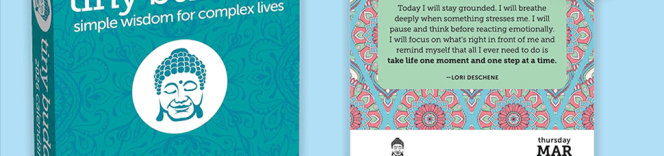
    Hi friends! I’m excited to share that the 2026 Tiny Buddha Day-to-Day Calendar is now available for purchase! And equally thrilling, I just found out my calendar was the number one bestseller in the Mind-Body-Spirit category for the last two years.

    Uplifting and comforting, this calendar offers daily reflections from me, Tiny Buddha contributors, and other authors whose quotes have inspired and encouraged me.

    Featuring colorful, patterned tear-off pages, the calendar is printed on FSC certified paper with soy-based ink. Topics include happiness, love, relationships, change, meaning, mindfulness, self-care, letting go, and more.

    Here’s what Amazon reviewers had to say about the 2025 calendar:

    “Love this tear off calendar because I actually look forward to reading a new quote each day. Some are very thought provoking, and I like that I can save some quotes to share with others or put on a bulletin board to read again.”

    “I love this calendar. I bought two extra this year for friends and family. There are many helpful and inspiring quotes. Some make me look in the mirror and try to make changes in my life and attitudes. I look forward to reading it daily. Love love love it!”

    “This is, by far, my favorite calendar! The wisdom imparted every day is useful to think about & reflect upon. I buy several of these every year, for the past few years, to share with friends as a Christmas gift. It is always appreciated.”

    “I love this tear-off daily calendar. I put it in my window and read the quote while making my coffee every morning. Great quotes, beautiful colors. Reasonable price. So glad I selected this one!”

    “Every Day this calendar makes me stop and think. My perspective is calmed and improved with a few minutes to become more conscious of my choices in my thoughts. I can’t wait for next year’s calendar.”

    Stay inspired, motivated, and encouraged through the year ahead—grab your copy here!

  • The Unexpected Way Jiu-Jitsu Brought Me Back to Myself

    The Unexpected Way Jiu-Jitsu Brought Me Back to Myself

    “You may encounter many defeats, but you must not be defeated. In fact, it may be necessary to encounter the defeats, so you can know who you are.” ~Maya Angelou

    There was a time in my life when everything felt heavy, like I was constantly carrying around a weight that no one else could see.

    I wasn’t in a crisis, exactly. I was functioning, showing up, doing what needed to be done. But inside, I was struggling to stay afloat—trapped in my own head, questioning my worth, and unsure how to move forward.

    One evening, I walked into a Brazilian Jiu-Jitsu class for the first time. I had no idea what I was doing. I didn’t know the rules, the language, or even how to tie the belt on my gi. But I was drawn to it—maybe because I was desperate for something to pull me out of my mental spiral. I needed structure. I needed challenge. I needed escape.

    What I didn’t expect was that BJJ would become more than a physical outlet. It became a form of therapy. A place where I could reconnect with my body when my mind felt like a battlefield.

    Finding Peace in the Pressure

    On the surface, BJJ looks intense—people grappling, sweating, fighting for control. But underneath, it’s a quiet game of survival. You breathe. You adjust. You adapt. You keep going.

    There were moments when I would be pinned, completely stuck, with someone twice my size on top of me. I’d panic. My breath would quicken; my thoughts would race. But then I’d hear my coach’s voice in the background: “Slow down. You’re okay. Just breathe.”

    That simple instruction saved me more than once—not just on the mat, but in life.

    Over time, I started to notice something: I was calmer outside of training. More patient. More aware. Jiu-Jitsu didn’t fix my mental health overnight, but it gave me tools to deal with the days when everything felt like too much.

    Losing It… and Finding It Again

    Of course, progress isn’t a straight line. After a few years of training, I got injured. Not once—multiple times. Each injury forced me to stop, rest, and reckon with the fear that maybe I wouldn’t return.

    Without Jiu-Jitsu, I felt lost again. That familiar darkness crept back in, and I realized how much I had come to rely on the practice to stay grounded. But eventually, I returned. Slower, more cautious, but more appreciative than ever.

    I realized it wasn’t about being the best or earning stripes. It was about showing up—for myself.

    What I’ve Learned

    I used to think healing meant getting rid of pain. Now I understand it’s more about learning to live with it—and learning how to move with it, not against it.

    Brazilian Jiu-Jitsu taught me resilience, yes. But more importantly, it taught me presence. You can’t be stuck in your head when someone’s trying to choke you out. You have to be here, now.

    That practice of presence changed how I approached everything else—relationships, work, rest. It helped me become someone who doesn’t give up so easily, even when things get hard.

    Why I’m Sharing This

    Maybe you’re not into martial arts. Maybe you’ve never set foot in a gym. That’s okay. This isn’t about Jiu-Jitsu—it’s about finding the thing that brings you back to yourself. That reminds you of your strength when you’ve forgotten it.

    It could be yoga, running, painting, journaling, hiking, music. It could be therapy. It doesn’t matter what it is, as long as it helps you come home to yourself.

    If you’re going through something right now, I want you to know: You’re not weak for struggling. You’re not broken. And you’re not alone.

    Find your mat—whatever that looks like for you. And when you do, keep showing up. You might be surprised at how strong you already are.

  • My Daughter Needed Me to Choose Better, So I Did

    My Daughter Needed Me to Choose Better, So I Did

    “Children learn more from what you are than what you teach.” ~W.E.B. Du Bois

    I was standing at the service bar, waiting for my drink order to be ready. The scent of steak fat clinging to my apron and infusing itself into my bra, while twenty-something servers around me whined about working on Mother’s Day… yet I was the only mother working that night.

    I’d barely slept because I’d closed the restaurant the night before.

    My nine-year-old daughter had just told me she wished she were dead.

    And here I was, pretending to care about side plates and drink refills when all I wanted was to be home holding her, telling her she mattered. Instead, I snapped—righteous and broken all at once—and stormed out to the alley behind the kitchen where I could cry without making a scene.

    That was the moment I knew: something had to change. Not for me. For her. Because if I stayed in this life, this marriage, this pattern, she would learn it too.

    Up until then, I thought I was protecting her. I fooled myself into thinking that there wasn’t too much harm, because the yelling wasn’t directed at her. That I could absorb the blows. That love was sacrifice. But kids don’t learn from what you say. They learn from what you model. And I was modeling self-betrayal.

    Her stepfather’s cruelty wasn’t new. Neither was the exhaustion I carried in my bones from trying to patch over the cracks with routine and denial. But watching her crumble under the same pressure I had normalized? That shattered something in me that couldn’t be glued back together.

    I married him because I saw a wonderful father for my daughter. I saw him get down to her level and play with her. They would giggle together. Be silly together. Be kids together.

    Well, that was all fine and dandy when she was three, four, five years old, but at some point, she began to outgrow him. While he sat stuck in his trauma, she matured. She was growing to be a strong little lady.

    He didn’t like that. So, when I wasn’t around, he would lash out and treat her like a slave, a whipping boy, but also whined and threw temper tantrums. She had now become the surrogate mother of a petulant child.

    She was nine. She should have been thinking about art projects or bike rides, not death.

    When I confronted my husband about how he spoke to her, it only made things worse. So she begged me never to mention it to him again and informed me that she would no longer confide in me. I hated myself for letting that happen. The very moment I thought I was being strong and standing up for my little girl, I was actually just prolonging her punishment.

    I was staying for stability, for financial security, for some misguided sense of loyalty. Those were the moments that provided her with a blueprint for her own suffering.

    There’s this narrative that mothers must be martyrs. That our suffering is noble, even necessary. But I don’t buy it anymore. Because what good is a self-sacrificing mother if all her child learns is how to silence themselves in order to survive?

    Leaving wasn’t brave. It was survival. I packed us up, found a small apartment, and started over with debt, doubt, and one hell of a broken heart. Not just from the marriage but from the years I’d spent disconnected from myself. My daughter didn’t need a perfect mother. She needed a peaceful one.

    It wasn’t a clean break. I cried in closets and called him at 2 a.m. and hated myself for the longing. I felt like I’d lost my mind. But I was beginning to find my voice. And slowly, she started to smile again. Her shoulders relaxed. We giggled like two girlfriends. We reinvigorated our “‘nuggling” tradition—Saturday nights with a big bowl of popcorn, snuggled up under a blanket together, watching a silly movie. Just the two of us. Just like it used to be. I knew we were going to be okay.

    Healing didn’t come in grand epiphanies or social media-worthy quotes. It came in late-night sobs and morning coffee. In resisting the urge to explain myself to people who would never get it. In learning to sit with discomfort instead of racing to fix it.

    I had to undo decades of believing that silence was safety. That if I didn’t rock the boat, we wouldn’t drown. But we were already drowning. And pretending otherwise was only teaching her how to hold her breath longer.

    I had to unlearn the idea that being needed was the same as being loved. That caretaking and contorting myself for approval was noble.

    I started showing her what boundaries look like. I started apologizing when I got it wrong. I started asking myself what I needed, not just what everyone else wanted from me.

    I also had to let go of the fantasy that he would change. That if I just loved him better, communicated differently, forgave more quickly, then things would improve. That fantasy had a chokehold on me for years. It’s humbling—and liberating—to realize you can love someone and still not be safe with them.

    Sometimes I wanted to go back, not because I believed things would be different, but because being alone with my thoughts was terrifying. I had to rebuild a relationship with myself that I didn’t even know was fractured.

    I started journaling, walking, making playlists that made me cry and heal in the same breath. I was slowly, painfully learning to mother myself.

    I watched her blossom with every ounce of peace we created. She didn’t flinch as much. She stopped asking me if something was wrong when I was having a moment of silence. She acted like a child again. I knew then that the mess I was wading through was already doing its work—not just in me, but in her.

    We learned new rituals. Morning cuddles before school. Singing in the car. Cooking meals together and dancing in the kitchen while things simmered on the stove. It wasn’t just healing. It was joy. Honest, simple, borrowed-from-the-mundane joy.

    I realized I didn’t have to keep waiting to feel safe. I could create it.

    And in every small moment, I chose something different. I chose gentleness. I chose boundaries. I chose to believe that we were worthy of more.

    There were still days I missed the chaos. That part of me that equated drama with passion, unpredictability with depth. But then I’d hear her talking to her stuffed animals in the next room or see her curled up in bed with her cat and remember: calm is not boring. It’s safe. And we deserve safe.

    Eventually, the grief became quieter. The ache dulled. I stopped needing to explain the past to anyone, including myself. And I started dreaming again—not just for her but for me. I wanted her to grow up seeing her mother whole, not just holding it together.

    Because one day, she would hit a wall of her own. She’d sit in a bathroom or an alley or a car, and she’d wonder how she got there. And I wanted her to remember that change is possible. That discomfort isn’t failure. That sometimes, being your own hero means walking away before the fire consumes you.

    Some days, I still think about standing in the doorway of her room, unable to move—but needing to leave—looking at my sweet little girl who just told me she wished she’d never been born. The day I realized that being a mother wasn’t just about protecting my child from harm. It was about protecting her from becoming the kind of woman who thought harm was normal.

    She didn’t need me to be unbreakable. She needed to see me break and still get up. So that’s what I did.

  • I Wanted Revenge; Here’s Why I Let It Be Instead

    I Wanted Revenge; Here’s Why I Let It Be Instead

    “To let go does not mean to get rid of. To let go means to let be.” ~Jack Kornfield

    I must admit right off the bat—as a serial entrepreneur, I’m a risk-taker. Throughout my twenties and thirties, I jumped at opportunities without always vetting the characters involved or asking what six months down the road might look like. I trusted, I leapt, I learned.

    At twenty-three, I launched my first real business with another partner—an upscale pet resort. We had climate-controlled suites, a beautiful play yard, and classical music playing softly in the background. An elaborate four-tier fountain greeted guests in the lobby, where you could also view the handcrafted “Catio” patio built by my father himself.

    Within a few months, it was already turning a profit. On the surface, it seemed like a dream come true. But something felt off.

    My partner, M, was in charge of the books. At first, I brushed off the small red flags. A check deposited here, a discrepancy there. But one night after the last guest was picked up, I went into the office, pulled the books, and began a deeper investigation. What I found left me cold.

    There were large withdrawals I hadn’t approved. Checks made out directly to M. While we had agreed on how much we would each take from the business, these amounts far exceeded our arrangement—and were happening far more often.

    I was sick with disbelief. I confronted her. She cried. She apologized. But she didn’t offer an explanation, only tears. I kept asking, “Why didn’t you just tell me?”

    The betrayal grew stranger. Tensions rose. Communication broke down. One day, I pulled into the parking lot, and someone was there—recording video because they believed I would become physically violent (huh? Me? I don’t even hurt bugs!) as they told me I was no longer allowed on the property.

    Wait, what?

    I was the president of the company. I had put up all the money. It was my vision. My energy. My debt.

    But here’s the thing—I had trusted M to handle the legal paperwork. And while I believed I was an equal owner, I never verified that the documents said so. I wasn’t listed as a shareholder. I had no legal stake.

    I was the president of a company I didn’t actually own.

    At thirty-three, I didn’t know what to look for. I had no real business background—just ambition, trust, and big dreams. And now I was being lied to, stolen from, and kicked out of the very place I built.

    The desire for revenge was overwhelming. I wanted to scream. I wanted to sue. I wanted justice.

    I met with attorneys. I weighed the options. And ultimately, I had to accept one of the hardest truths of my life: pursuing justice might bury me further. The legal costs, the emotional toll—it wasn’t a fight I could afford to win. So I let it be.

    This was the beginning of a long line of “Let it Be’s” with many entrepreneurial hardships, missteps, and mistrusts. It was just the first in what would become an incredibly wild journey over the next twenty years. I was wronged again and again—faced the pain of greed, anger, narcissism, and outright insanity—and I let it ALL be.

    And believe me, the devil on my shoulder had a full revenge script ready—dramatic, petty, borderline illegal. But I never acted on it.

    Every. Single. Time.

    And the truth of it all is taking the higher road isn’t easy. Letting things be is HARD.

    But it’s not weakness. It’s wisdom.

    Because here’s what I’ve learned: fighting fire with more fire only leaves you burned. And the more oxygen you give a flame, the bigger it gets. The longer you cling to betrayal, the more time you spend stuck in it.

    And time? It’s precious.

    Instead of plotting revenge, I began to rebuild. First, I crumbled. Then, brick by brick, I picked myself back up. I changed direction. I started over.

    Here’s what helped me through:

    • I got quiet. No grand social media posts, no smear campaigns. Just space. Silence gave me clarity.
    • I got help. From mentors, therapists, friends who spoke truth when I couldn’t see it.
    • I wrote everything down. The facts. The feelings. The fear. Putting it on paper helped me process it.
    • I took responsibility. Not for what M did, but for what I missed. I studied, I learned, I vowed never to be that uninformed again.

    Because I chose to let it be, I didn’t carry the weight of revenge, I moved forward with grace, and my integrity stayed intact.

    Yes, I lost money. I lost years. I lost a dream.

    But I didn’t lose myself.

    Letting it be doesn’t mean pretending it didn’t happen. It means choosing not to carry it forward. It means making peace with what you can’t control—and putting your energy where it counts.

    This was the first of a long line of experiences I’ve had throughout my entrepreneurial journey. After this event, I faced even more heartbreak and challenges. But every time, I have chosen to let it be.

    Sir Paul McCartney once shared how his mother visited him in a dream and told him the simple words: “Let it be.”

    Well, Mother Mary—you were right.

    This is the way to do it.

    So the next time you’re standing face-to-face with betrayal, I hope—for your sake—you let it be.

    We only get so much time here. Let’s not waste it on battles that don’t build us.

  • What If Growth Is About Removing, Not Adding More to Your Life?

    What If Growth Is About Removing, Not Adding More to Your Life?

    “Maybe the journey isn’t so much about becoming anything. Maybe it’s about un-becoming everything that isn’t really you, so you can be who you were meant to be in the first place.” ~Paulo Coelho

    For years, any time I felt sadness, insecurity, loneliness, or any of those “unwelcome” feelings, I jumped into action.

    I’d look for something new to take on: a class, a language, a project, a degree. Once, in the span of a single week, I signed up for language classes, researched getting certified in something I didn’t actually want to do, and convinced myself I needed to start training for a 10K.

    Because if I was doing something productive, I wouldn’t have to sit with what I was feeling. That was the pattern: uncomfortable emotion → frantic pursuit of something “more.”

    I became a master at staying busy. If I was chasing something, I didn’t have to face the ache underneath. But the relief was always temporary, and the crash afterward was always the same.

    Because deep down, I wasn’t looking for a new skill. I was looking for a way to feel like I was enough.

    I once heard someone say, “We can never get enough of what we don’t need.” I felt that in my bones.

    Looking back, I can see why. I spent a lot of my life trying to earn my place, not because anyone said I wasn’t enough, but because it never really felt safe to just be. There was a kind of emotional instability in my world growing up that made me hyperaware of how others were feeling and what they needed from me.

    I got really good at shape-shifting, staying useful, and keeping the peace, which eventually morphed into perfectionism, people-pleasing, and a chronic drive to prove myself. I didn’t know how to feel safe without performing. So, of course I kept chasing “more.” It was never about achievement. It was about survival.

    But no matter how much I accomplished, I never felt satisfied. Or safe. Or enough.

    It reminded me of something a nutritionist once told me: when your body isn’t properly absorbing nutrients, eating more food won’t fix the problem; it might even make things worse. You have to heal what’s interfering with absorption. The same is true emotionally.

    When we don’t feel grounded or whole, adding more—more goals, more healing, more striving—doesn’t solve the problem. We have to look at what’s blocking us from receiving what we already have. We have to heal the system first.

    We live in a culture that convinces us that growth is about accumulation.

    More insight. More advice. More goals. More tools. If you’re stuck, clearly you haven’t found the right “more” yet.

    So we reach for books, podcasts, frameworks, plans, certifications—anything to build ourselves into someone new.

    But here’s what I’ve learned from years of doing my own work: Real growth doesn’t come from becoming someone new. It comes from letting go of what no longer serves you so that you can make room for the version of you that’s trying to emerge.

    There’s a quote attributed to Michelangelo that says, “I saw the angel in the marble and carved until I set him free.”

    He believed his sculptures were already complete inside the stone; his job was simply to remove what wasn’t part of them.

    When I heard that, I realized: That’s exactly how real transformation works. Not more, not better, not shinier. Just… less in the way.

    But when people feel stuck, they react by piling on layer after layer of effort, advice, and activity until the thing they are actually looking for (peace, clarity, ease, joy) gets buried even deeper.

    When we feel inadequate or incomplete, our instinct is to reach outward for something to fill the space. But the real work is to turn inward and get curious about what that space is trying to show us.

    That might sound airy-fairy, but the truth is, identifying and transforming the parts of us that are carrying old stories isn’t passive. It’s not just a mindset shift or a nice thought on a coffee mug. It’s work.

    It’s learning how to sit with discomfort without immediately escaping into productivity.

    It’s noticing the parts of us that over-function, over-apologize, and over-control and asking where they learned to do that. It’s exploring the beliefs we’ve carried for years, like “I have to earn my worth” or “If I stop striving, I’ll disappear”—and getting curious about who they actually belong to and what they really need from us.

    This isn’t about erasing who you’ve been. It’s about honoring the roles you played to survive and choosing not to let them lead anymore.

    You don’t have to overhaul your personality or give up on ambition. This work is about clearing away what’s outdated and misaligned. The thoughts, roles, and behaviors that might have kept you safe once—but are now keeping you stuck.

    Here’s what that might look like:

    • Letting go of the belief that love must be earned.
    • Dismantling the habit of saying “yes” to avoid disappointing others.
    • Releasing the fear that setting boundaries will make you unlovable.
    • Recognizing that staying small isn’t humility, it’s protection.

    I’ve used every one of these tools myself. I began to notice when I was performing instead of connecting, fixing instead of feeling. I caught myself hustling for approval and validation and started asking: What am I afraid will happen if I stop? I practiced pausing. I gave myself permission to rest, to say no, to take up space. And slowly, I began to trust that I didn’t have to be more to be enough.

    This kind of letting go isn’t instant. It requires awareness, compassion, and support. It requires choosing to stop running and start listening… to yourself.

    Many of us are afraid to let go because we believe we’ll be left with less—less identity, less stability, less value. But in my experience, the opposite is true.

    When we stop performing and start unlearning, we uncover a version of ourselves that feels more whole than anything we could have constructed.

    Under the perfectionism? There’s peace.

    Under the overthinking? There’s clarity.

    Under the fear of being too much? There’s boldness.

    We are not lacking. We are hidden.

    If this resonates with you—if you’re tired of doing more and still feeling stuck, here are a few places to begin:

    Pause the performance. Notice when you’re trying to “fix” something about yourself. Ask what you’re feeling underneath the fixing.

    • Identify the beliefs you inherited. Were you taught you had to earn love? Be useful to be safe? Stay small to be accepted?
    • Get curious about your patterns. What roles do you play at work, in relationships, in your head? Where did they start?
    • Create space. That might mean working with a coach or therapist or simply setting time aside to be with yourself, without distraction.
    • Be gentle. You’re not broken. You’re patterned. And patterns can be unlearned.

    Here’s what I want you to know: what’s on the other side of the removal process isn’t emptiness. It’s clarity. Peace. Energy. Trust.

    That person you’re trying so hard to build? That person is already there, just waiting for you to set them free.

  • 6 Simple Things I Do When Life Feels Completely Overwhelming

    6 Simple Things I Do When Life Feels Completely Overwhelming

    “You can’t calm the storm, so stop trying. What you can do is calm yourself. The storm will pass.” ~Timber Hawkeye

    Overwhelm doesn’t always knock politely. Sometimes it crashes into my day like an unexpected storm—suddenly I can’t think straight, and everything feels urgent, impossible, and too loud. One minute I’m fine, the next I’m spiraling in my head, convinced I’m falling behind on everything and failing everyone.

    If you’ve ever sat frozen in your car in the grocery store parking lot, staring blankly at a to-do list that now feels like a personal attack, you’re not alone.

    Here are six things I turn to when I feel completely overwhelmed—none of them fix everything, but they all help me find my footing again.

    1. I stop trying to “figure it all out” right now.

    When I’m overwhelmed, my brain turns into a malfunctioning computer with eighty-seven tabs open and nothing loading. I immediately try to solve everything at once, like I can outthink the chaos if I just try hard enough.

    But thinking harder doesn’t fix it. It just fries my system.

    I’ve learned to pause and remind myself: I don’t need to fix my whole life in this exact moment. When I feel myself spiraling into “fix all the things” mode (shoutout to ADHD), I write down whatever I’m trying to remember or control. That way I’m not ignoring it—I’m just parking it somewhere so I can get through the thing I actually need to do right now.

    2. I pick one tiny thing I can do.

    Sometimes I stare at the mountain and forget I can just take one step. My brain immediately goes into “do it all right now or you’re failing” mode. And that’s when I end up doing absolutely nothing except overthinking and hating myself for not being productive.

    So I stop and ask: What’s the next five-minute task I can do without using my last brain cell?

    Not the whole kitchen—just get the dishes out of the sink. Not the whole inbox—just respond to the one email that’s been haunting me for days. One drawer. One phone call. One bill.

    It doesn’t feel glamorous, but it’s how I trick my brain into motion. Because five minutes of action beats two hours of beating myself up for not doing anything. Tiny progress is still progress. And sometimes, it’s the only kind that’s available.

    3. I ground myself in something sensory.

    When anxiety hits, it’s like my brain hijacks my whole body. Suddenly, I’m not just stressed and overwhelmed. No amount of logic works in that moment because my nervous system doesn’t care that everything’s technically fine.

    So instead of trying to think my way out of it (which never works), I shift focus to anything physical. I take a cool shower, drink a cold glass of water, light a candle, or put on my favorite scented lotion. I’ve held ice cubes before just to shock my brain back into my body.

    Sometimes I just sit with my cat and focus on the feel of his fur under my hand, like, “Okay, this is real. This is here. I’m not being chased by a bear.”

    Sensory grounding actually helps. It’s not deep or profound, but it’s basic anxiety relief. And honestly, that’s the vibe I’m going for when I’m spiraling: survive first, analyze later.

    4. I do a ten-minute reset (phone-free).

    I set a timer and do something quiet and simple—no phone, no news, no notifications. Just ten minutes without input. That alone feels like a luxury.

    I sit outside and zone out to whatever the wind is doing. Or I color like a bored kindergartener. Sometimes I wash the dishes really slowly, like I’m doing a meditative art form instead of basic hygiene. And occasionally, I just lie on the floor and stare at the ceiling like I’m rebooting my entire existence.

    It’s not about being productive or using the time well. It’s about giving my brain a break from having to be on all the time. Ten minutes of stillness doesn’t fix everything, but it gives me just enough space to breathe again—and sometimes, that’s all I need to keep going.

    5. I check my self-talk for cruelty.

    Overwhelm brings out the absolute worst inner dialogue. My brain turns into a mean girl with a megaphone. She says things like:

    “Why can’t you handle this?”

    “You’re behind—again.”

    “Everyone else is doing just fine. What’s your excuse?”

    It’s not helpful. It’s just self-bullying, dressed up as motivation.

    When I catch that voice spiraling, I try to pause and respond the way I would if a friend came to me in the same state—exhausted, anxious, and trying their best. I’d never say, “Wow, you’re really bad at life.” I’d say something like:

    You’re not failing. You’re overwhelmed. Let’s figure out what would actually help right now.

    That shift—from shame to support, from blame to curiosity—changes everything. It doesn’t magically make the stress disappear, but it keeps me from mentally kicking myself while I’m already down. And honestly, that’s a win.

    6. I let it be a “low power mode” day.

    Phones go into low power mode when they’re drained—and so do I. And on those days, I stop expecting myself to function like I’m fully charged.

    I do the bare minimum. I eat something simple (whatever takes zero brain power and maybe comes in a wrapper). I wear the comfiest clothes I can find, even if they don’t match and have questionable stains. I don’t force motivation to show up or try to “push through.” I let it be enough that I exist and made it out of bed.

    And I stop treating rest like something I must earn. I don’t need to check off five tasks or prove I’m productive before I’m allowed to take a breath. Sometimes, the most responsible thing I can do is shut everything down and reboot.

    Because being human is hard. Being sensitive, overstimulated, exhausted, or just done is part of it. And it’s okay to have days when I’m not okay. I don’t have to explain or justify it. Low power mode is still functioning—it just means I’m protecting my energy until I have enough to show up fully again.

    Final Thoughts

    Overwhelm doesn’t mean I’m broken. It usually means I’ve been running on empty for too long while trying to hold everything together without enough rest, support, or room to fall apart safely. It’s not weakness. It’s a warning light.

    These six things don’t magically fix the mess. They’re not a makeover or a glow-up. They’re a ladder. A gentle, scrappy, wobbly little ladder I’ve built over time that helps me climb out of the mental spiral one small rung at a time.

    If you’re feeling buried right now—under expectations, emotions, responsibilities, or just life in general—I hope something in this list reminds you:

    You don’t have to do it all. You don’t have to be productive to be worthy. You don’t have to perform your pain or prove how hard things are.

    You just have to come back to yourself. One breath. One step. One tiny act of care at a time.

    You’ve got this. And even if today, this just means brushing your teeth, replying to one text, or microwaving some sad leftovers—that still counts.

    You still count.

  • How Understanding Complex Trauma Deepened My Ability to Love Myself

    How Understanding Complex Trauma Deepened My Ability to Love Myself

    “Being present for your own life is the most radical act of self-compassion you can offer yourself.” ~Sylvia Boorstein

    In 2004, I experienced a powerful breakthrough in understanding what it meant to love myself. I could finally understand that self-love is about the relationship that you have with yourself, and that relationship is expressed in how you speak to yourself, treat yourself, and see yourself. I also understood that self-love is about knowing yourself and paying attention to what you need.

    These discoveries, and others, changed my life and led me into a new direction. But as the years went by, I began to feel exhausted by life. Despite all that I had learned, I could feel myself burning out. It became clear to me then that there was a depth of self-love and healing I still wasn’t able to reach.

    What I didn’t realize yet was that I had been living with complex trauma my entire life. It stemmed from a painful childhood, and it had created blind spots in how I saw myself and others. Because of complex trauma, I moved through life in a fog—feeling lost, disconnected from myself, and seeking self-worth through external validations.

    So, I continued on with life—struggling, yet still hoping to find my answers. Then one day the fog began to lift, and the healing process began. I couldn’t see it all at once, but little by little, it became clear what I needed to learn in order to reach a deeper level of self-love and healing. Here’s a glimpse into my journey.

    From 2011, I spent the next five years helping my dad take care of my mom because she had advanced Alzheimer’s disease. I was helping three to four days a week, even though I was dealing with chronic health issues and severe anxiety. This was an extremely difficult time that pushed me past my limits—yet it was a sacred time as well.

    Six months after my mom died in 2016, my health collapsed due to a serious fungal infection in my esophagus. I had never felt so broken—physically, mentally, and emotionally. I was desperately searching for ways to recover my health, I was grieving the death of my mom, and I was struggling with a lost sense of identity. Because of this, and more, the goals and dreams I once had for my life vanished—as if the grief had caused some kind of amnesia.

    A few years later, I had my first breakthrough. I was texting with a friend, and he was complaining to me about his ex-girlfriend, who has narcissistic personality traits.

    He told me about the gaslighting, manipulation, ghosting, lack of empathy, occasional love-bombing, devaluing, discarding, and her attempts to pull him back in without taking accountability for the ways that she had mistreated him.

    His description sounded oddly familiar. It reminded me of the dynamic I had with many of my family members in different variations. I had always sensed that something was off in the way my family treated me, but I was so conditioned to normalize their behavior that I couldn’t quite put my finger on what was wrong.

    Once I became aware of narcissistic personality traits, I started doing my own research by listening to narcissistic behavior experts such as Dr.Ramani Durvasula, and it was very liberating.

    I learned that parents who have narcissistic personality traits, often treat their children in ways that serve their own emotional needs instead of meeting the emotional needs of their children. And this can cause negative programming in the way those children think about themselves and others.

    For example, since my dad treated me like my emotional needs didn’t matter, this may have modeled to the rest of my family to treat me in the same way. And it most definitely taught me how to treat myself, especially when I was around my family.

    I also learned that narcissistic relationships can cause you to lose yourself, because they can systematically break down your identity, confidence, and state of reality.

    At the same time, I also learned that narcissistic behavior often stems from a deep sense of insecurity, usually rooted in a painful and abusive childhood. Recognizing this helped me to see my family members through a more compassionate lens—not to excuse their behavior, but to understand where it might be coming from.

    Learning about narcissistic personality traits has deepened my ability to love myself because of the clarity it has given me. I finally understand my family dynamic and how I used to abandon myself when I was around them.

    I would always give them my full and undivided attention, hoping it would be reciprocated, but it never was. Instead, in their presence, I became invisible—as if what I thought, felt, or needed didn’t matter. Around them, I learned to silence myself in order to stay connected, even if it meant disconnecting from myself.

    Understanding narcissistic patterns and the impact that they can have helped me to face reality. My family members were unlikely to ever change, and I would always need to protect my emotional well-being when I was around them.

    As I learned about narcissistic personality traits, I started to come across information about other related topics, such as complex trauma and how it can dysregulate the nervous system. Peter Levine and Gabor Maté are two of my favorite teachers on this subject.

    I discovered that many of my health issues—including inflammation of the stomach, panic attacks, chronic anxiety, chronic fatigue, depression, lowered immune function, pain, and chemical sensitivities—could be linked to a dysregulated nervous system.

    This can happen when the nervous system is chronically stuck in survival mode. In survival mode, the body deprioritizes functions like digestion in order to stay alert and survive. Over time, this can cause fatigue and other problems by draining energy and disrupting key systems needed for rest, repair, and vitality.

    Learning about complex trauma has deepened my ability to love myself because it has opened my understanding to why I might be chronically ill and always in a state of anxiety. Knowing this gives me clues in how I can help myself.

    I also learned that complex trauma is caused less by the traumatic events themselves and more by how those events are processed in the nervous system and in the mind.

    According to the experts, if you are not given context, connection, and choice during traumatic events—especially when those events occur repeatedly or over an extended period of time—it’s more likely to result in complex trauma.

    For example, if during my own childhood, it had been explained to me why my dad was always so angry and sometimes violent… and if I would have had someone to talk to about how his words and actions affected me and made me feel unsafe… and if I would have been given a choice in the matter and wasn’t stuck in harm’s way, then I would have been much less likely to have walked away with complex trauma.

    But since those needs were not met, I internalized the message that I wasn’t safe in the world, which caused my nervous system to become stuck in a state of dysregulation. As a result, constant fear became an undercurrent in my daily life—often stronger than I knew how to manage.

    When I wasn’t in school, I would often retreat into my wild imagination—daydreaming of a perfect fairy tale life one minute and scaring myself with worst-case scenario fears the next. Fortunately, my wild imagination also fueled my creativity and artistic expression, which was my greatest solace. To protect myself, I developed the ability to fawn and to people-please. All of these survival responses have been with me ever since.

    Before I learned about complex trauma, I was told that the only course of action you can take in regard to healing from past emotional abuse was to forgive those who have abused you. But that’s not correct. Forgiveness is fine if you feel like forgiving, but it doesn’t magically rewire years of complex trauma and nervous system dysregulation. The real course of action is to identify and to gently work on healing the damage that was caused by the abuse.

    As I explored the internet in search of ways to begin healing my dysregulated nervous system, I came across two insightful teachers, Deb Dana and Sarah Baldwin. They teach nervous system regulation using polyvagal theory, and I found their classes and Deb Dana’s books to be extremely informative.

    Polyvagal theory, developed by neuroscientist Dr. Stephen Porges, helps people to understand and befriend their nervous systems so they can create a sense of safety within themselves.

    Learning about polyvagal theory has deepened my ability to love myself by teaching me how my nervous system works and by helping me understand why I feel the way I feel. It also teaches exercises that help me to send signals of safety to my body, gently communicating to my nervous system that it doesn’t need to stay in survival mode all of the time.

    Nervous system rewiring is a slow process, and while I still have a long way to go before I get to where I want to be, I’m already feeling subtle shifts in the way I respond to stressful situations. This breakthrough has given me new hope for healing and has provided a new path forward.

    I also learned from complex trauma experts that fawning and people-pleasing can actually be trauma responses. These responses were the reason why I was so willing to sacrifice my health to help my dad take care of my mom. It was because I had been conditioned to always please my parents and to put their needs ahead of my own.

    Learning about how fawning and people-pleasing can be trauma responses has deepened my ability to love myself by giving me new insight into my own behavior. In the past, it had always bothered me if I thought anyone didn’t like me, and now I can understand why I felt that way. It was because those thoughts triggered old feelings of fear from childhood, when not pleasing my dad felt dangerous. This taught me to never say ‘no’ to people in order to always feel safe.

    By becoming aware of these trauma responses and wanting to reclaim my power, I have gained the ability to say ‘no’ with much more ease, and I’m much better at setting healthy boundaries. I’m also learning to accept that not everyone is going to like me or think well of me—and that’s okay.

    During the later years of my dad’s life, we developed a much better relationship. Both my mom and dad were grateful for the help I gave to them when my mom was sick.

    After my dad died in 2023, I no longer had the buffer of his presence to ease the stress of family visits. But I also no longer felt obligated to be around family members for the sake of pleasing my dad. So, a few months after his passing, when I received disturbing correspondence from a certain family member, I was able to make the difficult decision to go no contact. Spending time with family members had become too destabilizing for my nervous system—and to be completely honest with you, I had absolutely nothing left inside of me to give.

    At first, I felt a lot of guilt and shame for going no contact, being the people-pleaser and fawner that I have been. But then I learned from complex trauma experts that guilt and shame can also be trauma responses.

    When we are guilted and shamed in our childhoods for speaking up for ourselves, it can teach us that it’s not safe to go against the ideology of the family, that we should only do what is expected of us, and that our true voices and opinions don’t matter. This kind of programming is meant to keep us small—so that we are less likely to stand up for ourselves and more likely to remain convenient and free resources for the benefit of others.

    I experienced a lot of rumination and intrusive thoughts the first year of going no contact, but with time and support I was able to get through the hardest parts. Watching Facebook and Instagram reels from insightful teachers, such as Lorna Dougan, were incredibly helpful and kept me strong.

    A truth I had to keep reminding myself of was that my well-being was just as important as theirs, and that it was okay for me to prioritize my mental health—even if they could never understand.

    Giving myself permission to go no contact with family members has deepened my ability to love myself because it has allowed me to help myself in a way that I had never been able to do before.

    I now have a real chance to protect my mental health, to heal my nervous system, and to live the life that is most meaningful for me and for my husband. I no longer have to drain my last ounce of energy on family visits and then ruminate about how they treated me for the next 72 hours. It has also opened up my capacity to deal with other challenges in my life, like facing the new political landscape that is now emerging.

    In conclusion, it was only when I began to tend to my complex trauma and examine my family relationships that I was finally able to recognize and understand the blind spots that had obscured my ability to know and to love myself more deeply.

    Looking back on my journey, I’m grateful for how far I have come:

    I now know and understand myself better. I have a greater understanding of what I need in order to heal.

    I am able to think for myself and make decisions that align with my core values.

    I like myself again, and I know that I’m a good person. I no longer believe that I’m too much or too sensitive—I just need to be around people who are compatible.

    I am able to set healthy boundaries and to choose my own chosen family—people who treat me with genuine kindness and respect.

    And I feel more confident facing life’s challenges now that I know how to turn inward and support my nervous system with compassion and care.