Tag: thinking

  • When Negative Thoughts Keep You Down: How to Break the Addiction

    When Negative Thoughts Keep You Down: How to Break the Addiction

    We think we are our thinking, and we even take that thinking as utterly ‘true,’ which removes us at least two steps from reality itself.” ~Richard Rohr

    Do you frequently obsess over worst-case scenarios? Do you struggle to think well of yourself or others? Are you frequently stressed, anxious, or depressed? You may be suffering from an addiction to your negative thoughts.

    We all fall into patterns of negative thinking from time to time, often triggered by difficult circumstances or everyday stress. But when that pattern occurs over a long period of time, it can degrade our health in body, mind, and spirit.

    When bad things happen to us, we can feel incredibly helpless. Sometimes the way we fight back against this feeling is by making negative thinking a default way of life. It satisfies our deep need for a sense of control over our lives. It keeps us from being disappointed when disaster visits.

    We trade our own joy and happiness for certainty. It’s a huge price to pay for a bill of goods. Because in truth, the certainty we crave is an illusion.

    I’ve experienced the toxic effects of negative thinking in my own life. Growing up with a severe stutter meant that I was always on guard for negative comments from others about my condition.

    My peers in school constantly teased and mocked me. This was the crucible in which I formed the habit of thinking negatively about myself and others.

    Convinced I had nothing good to contribute to the world, I spoke very little and avoided people. Even after the bullying subsided, I deeply mistrusted the goodness of others. I was always looking for the worst in others rather than the best. My negative thinking became a compulsion.

    As I grew into adulthood, I realized how much my addiction was costing me, as my most important relationships suffered needlessly. I needed to break the addiction. Over the course of improving my own life, I learned some important lessons that helped me. If negative thinking is causing you to suffer, consider taking these steps:

    1. Own your negativity.

    Avoid blaming circumstances or other people for how you feel. When we blame, we surrender our power and ability to change our thoughts and feelings. We put ourselves at the mercy and whims of our environment and other people.

    The first critical step to overcoming any addiction is to acknowledge and own the problem. Understand that only you can choose how you react to your circumstances. Only you can challenge your negative thinking and change your life. Once I owned my reactions to people who teased me, I was ready to reclaim my power to choose a different response.

    2. Challenge all-or-nothing thinking.

    Many of us fall into the trap of all-or-nothing thinking. If things don’t go exactly according to our expectations, we immediately turn to the worst-case scenario. Such thinking is usually a distortion of reality. When we’re caught in this trap, we engage in faulty interpretations of the actions of others.

    If you’re waiting to hear back from someone, do you entertain thoughts such as: “She hates me” or “The answer must be no.” Instead of attaching yourself to these thoughts, immediately ask yourself, “What else could it be?” When you do this, you’ll probably come up with a list of other possibilities that can diffuse your negative thinking and may be actually closer to reality.

    For me, this meant challenging the belief that everyone I encountered was mocking my speech in their minds.

    3. Give people the benefit of the doubt.

    As we learn to entertain other options, the next important step is to choose those options that give people the benefit of the doubt.

    In her book Rising Strong, Brené Brown wrote about her arduous journey to discovering this ultimately freeing idea: “People are doing the best they can.” It’s hard for most of us to be this generous in our thinking, but it will free you from the mental trap of thinking negatively toward others.

    When the emails go unanswered, when your boss says no to your request, when someone says something that comes across as mildly offensive, choose to believe that people are doing the best they can. Choose to believe that they are not purposely trying to hurt you.

    4. Let go.

    Learning to give people the benefit of the doubt can open the door to forgiveness.

    For a long time, I deeply resented the people who mocked my stutter. This happened mostly in my childhood and adolescent years when my stutter was much more pronounced. Even now, an ill-conceived remark can transport me right back to those painful years. But I’ve since learned to let go of the hurt associated with these memories.

    Is a past hurt or painful memory fueling your negative thinking? Choose to let go of that memory every time it comes to mind. Say, “I choose to let go of this memory and to forgive the person associated with it.” Know that the process takes time. Know that there will be days when you won’t feel like letting go. But when you do, you’ll begin to experience inner freedom.

    5. Think big.

    Negative thinking allows us the “luxury” of not expecting too much from ourselves and others. If we always expect to be let down by others, we spare ourselves the pain of being let down.

    By allowing our negative thoughts to thrive, we create a safe and small space for ourselves—free of judgment, disappointment, disillusionment, and heartache. But if we’re honest with ourselves, we know that thinking small will likely not protect us from pain. And it will keep you from the joy that comes with personal growth.

    I struggled with the idea that my stutter meant that I should be silent—that I had nothing worthwhile to say anyway. Then I came across the famous “Our Greatest Fear” quote by Marianne Williamson.

    The line “Your playing small does not serve the world” struck a chord with me. I decided that I would not allow my stutter to silence me. I decided instead to think big by deciding to speak up. Allow yourself to think big, even when your inner monologue tells you not to.

    6. Expect failure and setbacks.

    Negative thinking often begins with the unrealistic expectations that the path should be clear for whatever you’re trying to accomplish. When things go off-script, as they often do, the negative mind will gladly use the event to reaffirm idea that you’re a failure or that you’re no good at anything.

    Instead of dreading or hastening failure through your negative thinking, expect it. When you’re tempted to entertain negative thoughts, smile or laugh. Take each challenge as a signal that you are working toward something worthwhile. Use setbacks as a chance to hone your skills rather than seeing them as a sign that you are no good. Decide to do this ahead of time don’t waver regardless of how you’re feeling.

    7. Practice meditation.

    One of the primary benefits of meditation is that you eventually realize that you are not your thoughts. Negative thinking addicts get a fix from their own thoughts and their way of thinking about the world. They fully identify themselves with those thoughts. So the thought “I am a failure” becomes all of who they are.

    By practicing meditation, you will be able to observe your own thoughts without identifying with them. Why? Because you are not your thoughts. Learn to observe them without judgment. Watch the thoughts come and go without clinging to them. Watch long enough and you’ll see that your negative thoughts have no power over you.

    8. Practice self-acceptance.

    We often discount the practice of self-acceptance because it feels too passive. At least when we’re actively engaging our negative thoughts, it feels like we’re doing something to control our circumstances when we feel most helpless.

    Morrie Schwartz, who taught the world how to practice acceptance in the face of death wrote, “Acceptance is not passive—you have to work at it by continually trying to face reality rather than thinking reality is something other than what it is.”

    Most of the time, our negative thoughts are anything but realistic. Self-acceptance allows us to acknowledge all aspects of ourselves without clinging or judgment. Instead of fixating on the bad, it means loving all of who we are. It means having the courage to correct any behaviors that are harmful without engaging in self-loathing.

    You Have What It Takes

    Want to break your addiction to negative thinking? Understand that your addiction is based on the illusion that you can avoid pain by experiencing negativity on your own terms.

    Yes, negative things will happen to us. And it will hurt. But you have what it takes to face the pain and negativity without becoming addicted to it. As sure as day follows night, know that the pain will eventually subside. Know that opportunities for happiness and joy will come knocking again. Let go of negativity so that you can fully embrace these opportunities when they come.

  • My Proactive 8-Part Plan for Beating Anxiety and Negativity

    My Proactive 8-Part Plan for Beating Anxiety and Negativity

    “Nothing can bring you peace but yourself.” ~Ralph Waldo Emerson

    I’m on a much needed and looked forward to vacation with family whom I love dearly, and yet I’m entering the belly of the whale. Perhaps it was triggered by my habit of making sure everyone is okay and having a good time. Perhaps it’s because the act of preparing for and traveling to Baja was exhausting and now I’m just tired.

    Whatever the cause, my anxiety starts as an uncertainty, an insecurity tickling the back of my skull. Then it attacks my ego, assigning me responsible for the self-created and the mostly non-existent negative body language that whoever is sitting next to me is giving off. The way you picked up your fork makes me think you’re angry. The look you flashed when I coughed causes me to cower.

    From there the insecurity spreads like a plague until it’s part of every thought, every action. At some point, it doesn’t even seem to originate in the brain anymore. It becomes a vibration within. A simmering under my skin that makes me jump at the smallest of noises. A discomfort that makes eggshells appear under my feet.

    Once here, it’s like I can’t do anything right. Every action is disappointing. Every thought is wrong thinking. The big picture comes crashing down making it hard to breathe. It settles onto my shoulders and around my throat, like an over-zealous travel pillow. Tears usually follow accompanied with sides of hopelessness and embarrassment.

    Anxiety attacks. No really. It attacks. It’s calculated, methodical, and unforgiving. It makes me think that it’s All. My. Fault. It’s exhausting and it can happen anytime, even on vacation.

    I’ve been dealing with anxiety since I was a kid, although I didn’t know what it was until I was well into my thirties, at which point I had to make a decision: to be a stressed-out, anxiety-ridden person, which also meant living with the idea that there was something wrong with me; or to accept the fact that I’m a person and all people have struggles.

    Anxiety and negative thinking are my struggles, and I choose to handle them in the same way I handle having seasonal allergies or a bad back.

    Let me explain. I live in a state of sleepy sneezes when things start blooming. In the months before spring arrives, I begin taking bee pollen daily so I’m less prone to lethargy and allergy attacks. I injured my back last week surfing, so I’m not going to lift heavy things and after a period of rest, I’ll start doing stretches and exercises to strengthen myself so I can get back in the water.

    I’m not going to wait to get to the point where I’m laid out and feeling sorry for myself, and I’m not going to jump into an activity that will exacerbate the situation. I am being proactive about my well-being.

    When I was about thirty-five, my anxiety got so bad that it led to a depressive state. I was panicked all of the time and I began to realize that the life choices I habitually made were feeding my negative state of mind.

    I wasn’t living a healthy life style. I didn’t find my job fulfilling. I was angry that I didn’t have what “you” had. Something was always missing and I was constantly reaching outward to fill the empty space.

    The problem was that nothing from outside myself was helping. I realized that drinking alcohol and eating poorly (i.e. binging on sugar), sitting in front of social media, smoking cigarettes. and watching hours of television were all the same type of abuse.

    I had been using all of these things to dull myself to, well, myself. I had been living un-happily for the majority of my life and so unhappy had become my default.

    I also had to admit that my discontented state was a direct product of living dishonestly. I hadn’t been communicating about the things that I knew would make me unhappy because I was only worried about what would make me look good to others.

    So, I acted based on the assumptions of what others thought I should do (without asking them, of course). Then I got pissed off when others didn’t act the way I wanted them to. The result was that I pushed away the people I loved and in turn, felt isolated and angry.

    When I started seeing all of these things that were making me unhappy, the natural question to ask myself was “Well, then, what the heck makes me happy?” The shocking answer was that I didn’t know. Something had to change.

    Drinking alcohol was the first thing to go. It was a raging red flag that had been waving for a few years. I finally decided to pay attention.

    Once I had a few months of sobriety, an odd thing happened: I started painting. It wasn’t a huge stretch for me, as art had always been in my life in some way, but painting had never been my favorite medium.

    But there it was, in all of its colors and shapes. Abstract painting. I didn’t really care what the painting looked like. That wasn’t the point. The point was the present state of mind that creating art brought me to. I didn’t think about my to do list, my sadness, or my insecurities. I was just painting.

    When I was a kid, I loved to make art. The art studio in my high school was where I was most comfortable. I loved getting my hands dirty in clay. I left spatterings of paint and ink on my clothes because I liked them there. I felt at home when I was doing art.

    At thirty-six years old, immersing myself in abstract painting reminded me of what it was like to actually feel like myself again.

    I had to come to terms with the fact that since I was thirteen years old, I had been living the life of a person that I thought I should be, not who I really was. I had to let go of all aspects of that person that wasn’t authentic to me and remove all of my masks in order to follow the life I want to live.

    I felt relieved to finally be exposed. I didn’t have to hide anymore. I admitted that sometimes I am more of an introvert than extrovert. That if all I’m doing is chasing a paycheck, I’m never going to be okay with a nine-to-five job, even if it comes with an impressive title. That I am not ever going to be like anyone else but me.

    I recently had a discussion with a friend regarding how to be the best and most useful person to the world. She was given the advice to follow her authentic passion, as following passion leads to happiness and a happy person is more useful to themselves and everyone around them.

    I don’t really remember how old I was when I started making art, but I’m pretty sure that it’s the first thing I found that felt good to my soul, and it was life-saving to be reminded of that. Now, having come full circle, I have four years of my authentic work under my belt. I have quit my day job and I’m pursuing my passion of being a professional artist (which is something that I deemed not possible very early on).

    I don’t know what prompted me to pick up a paintbrush four years ago, but I believe it was a gift from my Self to myself. The really cool thing is that I don’t want to be anyone but me anymore. I’m so interested in giving attention to this person that has always been there, but I ignored because I didn’t think she was good enough.

    It was difficult to grasp that the only one judging and bullying me was me, but I have to remain compassionate to that misguided part of myself as well. She was only doing the best she could.

    Anxiety is still a part of my life. I am not “cured.” But just like I treat allergies or an injured back, I have decided to be proactive in dealing with my anxiety.

    When I’m actively practicing the below, I’m better rested and less reactive. I am able to clearly see my options leading to less confusion and better decisions. Most importantly, I can feel when anxiety is welling up and I have the tools to tamper it down before it is out of control.

    When I am active in the following, my anxiety is manageable:

    1. Choose to live authentically. What moves me? What do I feel I am here to do? What is going to make me happy? Whatever it is, don’t judge it. Do it.

    2. Practice acceptance. We all have hard things to deal with. Every last one of us. That’s life.

    3. Meditation in the mornings sets my base line for the day and helps me sleep at night.

    4. Painting every day keeps my hands busy and creates an outlet for the mental energy that cannot be released otherwise.

    5. Exercising outside in nature, particularly surfing in the ocean every chance I get, allows me to see that the world is sooooo much bigger than me and all decisions are not mine for the making (see the above mentioned back injury).

    6. Reciting my gratitude list regularly, and telling the people I love that I’m grateful for them, helps me to see the positive side of life instead of focusing on the negative.

    7. Eating right and treating my body with respect keeps me feeling whole, healthy, and balanced.

    8. Reminding myself that this is a practice. I am not perfect. It’s okay not to be.

    It’s not always easy. When I started writing this, I was entering the belly of the whale. Now that I’m many paragraphs in, I already feel more at ease.

    By identifying and accepting this particular whale, I don’t have to be swallowed. Just by writing this, I have taken the unknown out of the scenario by calling the anxiety out for what it is. Once I have given it a name, it’s not quite so scary. It just is what it is. Some people have diabetes. I have anxiety.

    We cannot choose whether or not we have problems like anxiety. We all have our issues and that’s just part of being human. Rather than be at odds with anxiety all the time, we can choose to learn more about it and actually co-exist. We have a choice about how much say we allow anxiety to have in our lives.

    I find that I prefer to swim along-side my whale and learn more about it rather than being engulfed by it. Frankly, more and more, I’m finding that I’m just grateful to be able to go for a swim, and so I dive in. Deeper and deeper. Excited to find what else is beneath.

  • Whose Mind Is It Anyway? Get Out of Your Head & Into Your Life (Giveaway!)

    Whose Mind Is It Anyway? Get Out of Your Head & Into Your Life (Giveaway!)

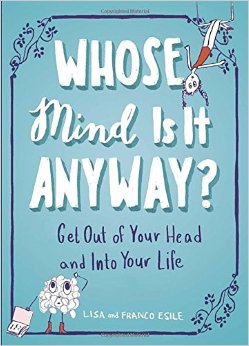
    Whose Mind Is It Anyway CoverNote – This winners for this giveaway have been chosen. They are:

    • Stephanie
    • Kait Husmann

    A few years back, Tiny Buddha contributor Lisa Esile wrote a post about negative thinking that was incredibly eye opening.

    Titled 3 Reasons to Stop Worrying About Your Negative Thoughts, her post suggested that instead of trying to suppress negative thoughts or replace them with positive ones—as conventional wisdom suggests—we should observe them, choose not to believe them, and let them naturally pass.

    Brilliant, I thought. Don’t feel bad about the thoughts that go through your head (which adds guilt on top of the stress that comes from constant judging, assuming, worrying, plotting, and controlling).

    Instead, create space between you and your thoughts. Stop fighting your mind and start understanding it.

    Stop struggling to let thoughts go and instead, let them be.

    Ah, instant relief.

    I know what you might be thinking: If we don’t listen to our thoughts, how will we know what to do? How will we solve problems? How will we figure out what we want and make a plan to get there?

    Lisa tackles all of this, and more, in her quirky new illustrated book Whose Mind Is It Anyway? Get Out of Your Head and Get into Your Life.

    Co-written by her husband, Franco Esile, Whose Mind Is It Anyway touches upon how our thoughts can drive us crazy, how our beliefs can sabotage us, and how easy it is to find calm—once we stop thinking our way through life.

    It’s a quick read, but don’t let that fool you: Within seven short, fun chapters, Lisa and Franco have succinctly explained how we can not only find peace from our thoughts, but also be at peace with ourselves.

    I’m a huge fan of Lisa’s work, and I couldn’t be more grateful that she sent me a copy of her book and offered two free copies for Tiny Buddha readers.

    Whether you win a copy or choose to grab one today, I recommend keeping it somewhere you’ll see it often and flipping through the pages whenever you’re getting stuck in a web of thoughts.

    Start paying attention to how your mind works and you’ll notice this happens a lot!

    THE GIVEAWAY

    To enter to win one of two free copies of Whose Mind Is It Anyway?:

    • Leave a comment below. You don’t need to write anything lengthy—“count me in!” is more than enough!
    • For en extra entry, share this post on one of your social media pages and include the link in your comment.

    Good luck!

    Want to grab a copy now? You can order Whose Mind Is It Anyway: Get Out of Your Head and Get into Your Life on Amazon here.

    FTC Disclosure: I receive complimentary books for reviews and interviews on tinybuddha.com, but I am not compensated for writing or obligated to write anything specific. I am an Amazon affiliate, meaning I earn a percentage of all books purchased through the links I provide on this site. 

  • 12 Ways to Turn Your Crippling Stress into Happiness

    12 Ways to Turn Your Crippling Stress into Happiness

    Happy Meditating Woman

    “More smiling, less worrying. More compassion, less judgment. More blessed, less stressed. More love, less hate.” ~Roy Bennett

    You are a slave to stress.

    I can relate. Stress crushed my life and dreams.

    I started a business and faced intense criticism over this decision.

    Everyone was sure I’d fail. My friends and family attacked me while I was combating my own self-doubt.

    My stress level was insanely high.

    Then the worst happened. My business failed and I lost all my savings. I was crushed.

    It took a long time to finally accept this failure.

    Today, whenever I work, stress still lingers in my body like the shadow of my dark past. But now I know how cope with it. Let me teach you how.

    1. Consider getting a pet.

    Sharing negative feelings with close friends can significantly reduce stress. Studies show that spending time with pets relieves stress in the same way. Also, when you’re accompanied by a pet in stressful situations, it prevents your stress level from rising.

    I have a cat. He was my only friend when nobody was supporting me. I’m grateful to have him by my side.

    If you don’t have a pet, consider getting one. It may change your life in surprising ways.

    2. Stop dwelling on your problems.

    Kant State University had an eye-opening discovery. Apparently, the more you talk about your problems, the more you’re likely to suffer from depression.

    Of course, it’s healthy to share what you’re going through. But when you’re mindlessly dwelling on your problems, it doesn’t solve anything.

    I never talk to anyone about my problems because no one supports me. This propels me to actively seek solutions instead of blindly mulling over things that could stress me out.

    If you’re fortunate to have supportive friends, do seek their support. What’s important is that you don’t just whine about your difficulties, but actually act.

    3. Shower yourself with gifts.

    You’re being brutally hard on yourself.

    You take success for granted. Worse, you exaggerate failure.

    When you’ve reached a goal, you move on nonchalantly. If you don’t, you torment yourself mentally. You scold, devalue, and deprive yourself.

    I’ve been there. I know this is self-destructive.

    Reward yourself for reaching goals. Research shows that when you’re rewarded for an action, you’re likely to repeat it. This is called a positive feedback loop. It’s much more effective than punishment.

    If you gain stress from failure, without happiness from success, the only outcome is stress.

    If you earn happiness from success, without stress from failure, the only outcome is happiness.

    4. Exploit bad habits to your advantage.

    I used to run away from problems. When stress hit, I’d instantly give up on whatever I was working on and resort to escapism.

    You may have experienced this too.

    Escapism may entail over-eating, indulging in unhealthy foods, TV, Internet, porn, smoking, and drinking. Over time, they form destructive habits.

    Exploit escapism by using it as an anchor.

    Pick healthy alternatives, such as meditation, stretching, listening to motivational talks, napping, or light exercises.

    Before you escape, do thirty seconds of an alternative first.

    Say you’re angry with your boyfriend. You think you need to eat some junk food to calm down. Before that, meditate for thirty seconds. Then you’re free to indulge.

    Do this for two months. Then increase good habit time weekly, until the good habit completely drowns out the bad.

    This way, I built new automatic responses to stress and broke my escapist habits completely. Now when I feel stress, I either take a short nap or move along to uplifting music.

    After a few minutes, I’m recharged and motivated to face new challenges.

    5. Unleash your anger (and cry yourself to sleep).

    Don’t always try to appear perfectly calm. You need to express difficult emotions—anger, for example.

    Discuss your frustration with friends. Journal your rage and analyze it objectively on paper. You can even confront the object of frustration assertively.

    Remember to release your anger under control. Don’t throw tantrums or yell impulsively. Express it as a means of problem solving.

    This applies to other difficult emotions, as well, like sadness. It’s healthy to express these “negative” emotions.

    6. Reach great heights by letting yourself suck big time.

    I’ve learned to accept my devastating failure. I have to. Otherwise, I’d be completely destroyed and discouraged from pursuing anything ever again.

    Some people cannot accept mistakes. Everything has to be perfect from the start. They think others will look down on them if they appear to be flawed.

    These people are frequently stressed.

    The happiest and most successful people focus on improvement. They love mistakes and flaws, because they see them as opportunities to grow.

    Learn from these people.

    Have lofty goals but have realistic standards. Don’t judge yourself based on the results of your actions. See them as feedback and seek improvement from there.

    7. Be shameless about not doing things.

    You don’t have the time and energy to do everything you want to do.

    Inevitably, things are left undone, and you beat yourself up. This creates stress.

    Consider what’s truly important to you. Kill the rest shamelessly.

    This way, you gain more time and control over your life while making more progress.

    I focus only on my career and my relationships. I’ve postponed other ambitions, like becoming a martial artist and a calligrapher, because they’re comparatively unimportant.

    8. Declare war on useless crap.

    I’m clearing up my apartment. It’s now clean and spacious. When I’m inside, I feel more relaxed, concentrated, and in control.

    Psychologists found that clutter competes for your attention and overloads your brain. This makes you stressed and even damages your ability to think.

    Trash this useless crap ruthlessly.

    Begin with discarding one item per day, for two months. It’s easy, and it trains you to detach emotionally from your possessions. Later, you can expand to junk more items daily.

    9. Learn how to use your body wisely.

    I always keep my back straight and try to appear confident.

    Why? Because posture has a direct relationship with your mood and behavior.

    When you position your body in a natural and comfortable way, you feel less stressed.

    Also, when you appear confident, you feel more powerful and in control. Confidence balances out stress.

    Read books on correct posture and body language. These skills not only reduce stress reliably, they also keep your body healthy.

    10. Extract everything from your overloaded head.

    When your mind is overloaded, you feel agitated, you malfunction, and then you collapse.

    Extract all your mind clutter in one place, out of your head.

    Observe your thoughts for five to fifteen minutes, and let information resurface from your mind.

    You’ll be surprised how much stuff pops up. Things you have to do, things you’re waiting to do, open loops, creative ideas, long-term plans, and many more.

    Write down everything as soon as they come up, no matter how trivial they may seem.

    This helps organize your life and clears even the smallest mind clutter. When you can see everything on paper, you’ll find them more actionable. Life becomes less overwhelming.

    I personally prefer pen and paper for this. A sophisticated to-do system works too, but avoid spending too much time on that. You might create stress in the process.

    11. Learn from the Chinese: the spectator’s eyes.

    Stressed people are masters at exaggeration. They magnify every little problem.

    You can’t see the big picture when you are caught up inside a problem. Then you begin to exaggerate and freak out.

    A Chinese saying goes, “The spectator’s eyes are always clear.

    Ask a friend for his honest opinion on your problems. This will likely help you recognize when something truly isn’t a big deal. Learn from spectators, and analyze your problems objectively. Then you can see problems as they are, and act wisely.

    12. Laugh: meet apocalypse with humor.

    I watch comedies a lot. They give me a brief escape from my stressors.

    One day I had a revelation.

    Visualize these scenarios: bombing a job interview, getting fired, being unemployed, getting robbed, getting sued, getting rejected by the opposite sex.

    Disasters. But they’re all funny in comedies. There’s something funny in every problem.

    Maybe you burned your food. Maybe you dropped your phone into the toilet. Have a laugh!

    Once you can do this, you’ll completely turn your perspective around. You’ll see the positive in every situation, and face problems happily.

    This Second, You Can Transform Stress Into Happiness

    It’s not impossible. Many people have done it.

    Pick one lesson that looks appealing to you, do some research on it, then act.

    You’ve let stress dominate you long enough. Now is the time to live differently.

    Do you want to stay crippled by stress? Or do you want to turn life into happiness?

    The choice is yours.

    Happy meditating woman image via Shutterstock

  • How Thoughts Can Lead to Emotional Explosions

    How Thoughts Can Lead to Emotional Explosions

    Exploding Head

    “Stay present. Stay conscious. Be the ever-alert guardian of your inner space.” ~Eckhart Tolle

    It was approximately 1:20 pm on a sunny Thursday afternoon, and I was halfway through my presentation at a high school, when I was interrupted by a loud automated female voice blowing through the intercom speakers.

    “Please secure your classroom. Please secure your classroom,” it said.

    I was extremely alarmed but mainly confused. I looked at the instructor for direction. His face had turned bright red and it was obvious he was holding back panic. He dashed to the front of the classroom to lock the door and turn off the lights.

    “Please secure your classroom. Please secure your classroom,” the robotic voice continued to blare out.

    In an authoritative voice, the instructor asked everyone to move to the right side of the classroom, away from the door, find a desk, and sit under it in silence.

    I didn’t budge. I was waiting for him to explain to me that this was a routine drill the school had scheduled and that there was nothing to worry about.

    The explanation never came. I did, however, get a stern look signaling me to follow directions.

    I found a spot near the teacher’s desk next to a boy who seemed to be frozen in fear. As I was beginning to wonder how serious the situation could be, my thoughts were interrupted by the sound of a group of students snickering and whispering.

    I turned to look at the teacher, who had gotten up from his hiding spot and looked extremely angry. In a loud, terrified whisper he said, “We could be on lockdown for up to four hours, and it’s very important that you don’t make a sound!”

    I tried to keep my cool, but after twenty minutes of dreadful silence, fear began to creep in. Could this be one of those shootings I’ve see on the news? What could possibly be happening out there? I’m in a prestigious neighborhood; could something really awful happen in a place like this?

    A million thoughts were bombarding my head when my mind flashed back to the speech I was just presenting before the lockdown.

    I had just been discussing details and examples from my own life to paint a picture of how persistent negative thoughts can lead to intense emotions. If left unresolved, those feelings can bubble up inside us and eventually cause us to burst emotionally.

    To illustrate this further, I had used a Coke bottle to prove my point.

    I had shaken the bottle for a few seconds, each shake representing one of life’s challenge. Then I opened the bottle, to represent our inability to hoard an overwhelming collection of negative, fearful thoughts. And of course, the soda explosion symbolized our emotional burst, caused by not properly dealing with the war zone within.

    My mind raced back to the present moment. If there did happen to be a gunman walking the school hallways, that person probably had a lot of negative thoughts and emotions they had not dealt with properly, which led up to this particular event.

    More than likely, he/she was not a happy person who woke up that day and just randomly decided to participate in such atrocity. A series of harmful thoughts and emotions had led them to potentially hurt innocent people.

    This is why it’s crucial to recognize and challenge harmful thoughts, and get help if we need it, I thought to myself.

    Our thoughts inspire our perspective, and our perspective is the number one indicator of how happy and peaceful we will feel in our lives.

    Our perspective determines how successful we will be, how happy our marriages are, and how much love and connection we feel toward ourselves. Our perspective is everything.

    Although not everyone’s boiling point will lead them to cause mass pain, it can be extremely detrimental to their own life.

    Not everyone will decide to terrorize a school, a movie theatre, or a mall. Perhaps not all emotional explosions will lead to suicide or self-harm, but they can all lead to adverse circumstances.

    The negative voice in our head can drive us to give up on losing weight or never achieve the financial freedom we crave. It can cause us to feel eternally stuck in a bad situation in life, or feel chronically unhappy and stressed.

    We regain our power when we realize the answer lies within ourselves.

    Becoming the ever-alert guardian of our mind is what will carry us forward.

    This means monitoring our thoughts and only accepting ideas and beliefs that align with strength, love, and grace. It means accepting that things don’t always go the way we hoped, but faithfully knowing that there is a better plan in store for our future.

    To change our reality we must first change our mind. We must consistently, concisely, and deliberately choose an empowering perspective. Then, and only then, will we begin to live a life fascinating beyond belief.

    As these thoughts poured into my brain I heard the instructor say that the lockdown had been lifted and we could all go back to the presentation.

    It turned out that the police were looking for a man who was on the run after committing a crime in the area, and to take extra precaution they asked that the school go on a secure lockdown.

    Whew!

    Thankfully, I had not been part of a ghastly school shooting, but that didn’t stop me from coming out from underneath the desk completely transformed.

    This experience had given my work a lot more meaning and value than I had previously placed on it.

    Sitting under a desk in that dark classroom, anticipating an emotional explosion, took the words of my presentation to another level because it gave me a glimpse of what an unguarded mind can lead a person to do.

    Our thoughts are the precursor to everything else we experience. We must guard them with our life.

    Exploding head image via Shutterstock

  • 10 Thinking Patterns That Can Fuel Depression

    10 Thinking Patterns That Can Fuel Depression

    Depressed

    “Nothing can harm you as much as your own thoughts unguarded.” ~Buddha

    You know the feeling …

    When out of the blue your mood switches.

    One moment you’re feeling upbeat and optimistic; next you’re feeling down in the dumps.

    You can’t think clearly and struggle to put things into perspective. The bright outlook on life of a moment ago has vanished, and in its place now resides an intense longing for its return.

    You feel disconnected, lost, and confused, and everything around you looks and feels dark and bleak. And even though you have no reason to feel this way, it feels all too real to you.

    And you know where that leads. You’ve been there many times before and don’t want to go back.

    I know the feeling too.

    Recovery is such an illusory term.

    It implies that once recovered, the depression is gone. But those who have recovered know this is false.

    Recovering from Depression Is Not the End of the Battle

    Having spent half of my life depressed, two years after recovery, I still find myself waging the battle of relapse. A battle that at times seems harder to fight than the recovery—just as you tasted the sweetness of the non-depressed life, you never again want to taste the bitterness of depression.

    On the surface, a mood swing looks like “having a bad day.” The kind everyone experiences and snaps out of quickly. But for those with depression, the consequences of mood swings can be severe and lasting.

    First, there’s the sudden change in mood, the one that is more than “feeling-down-soon-will-snap-out-of-it,” followed by a drastic change in outlook. One moment you’re looking at life through clean lenses, and now dirty ones blur your vision.

    Then the inevitable guests start showing up—low self-confidence, paralyzed will, self-loathing, and the most dreaded of all, inertia.

    Not getting completely trapped in the spell of this depressed mood is key in preventing relapse, which is not always easy to do.

    How to Keep Depression from Disrupting Your Life

    I used to believe depression was about “feelings,” so my focus was on understanding and managing my emotions. An approach that not always kept me from relapse—until I learned about the connection between thoughts-feelings-behaviors and about mastering one’s mood, which gave me a new perspective on depression.

    We think. We feel. We behave.

    “It is an obvious neurological fact that before you can experience any event, you must process it with your mind and give it meaning. You must understand what is happening to you before you feel it.” ~David D. Burns, M.D.

    So, how do you master your mood? Well, it’s not that hard. It involves the following:

    1. Detecting the mood change, its severity, and duration.

    For me, the most severe of mood changes, when I’m most vulnerable to relapse, is when it lasts more than a couple of days.

    2. Knowing the consequences of giving in to the depressed mood, as this is key in forcing you to take action.

    In my case, it always leads to the vicious cycle of procrastination, guilt, regret, and self-loathing. A cycle that, once started, is difficult to break.

    3. Taking action to keep the depressed mood from lasting too long.

    The longer it lasts, the more debilitating it becomes, and the harder it is to get back to normal.

    One of the things I used to do as soon as my mood changed was write about how I felt, a strategy that didn’t always keep me from relapse. But when I came across Feeling Good by Dr. David D. Burns and learned about the thinking patterns of depression, I found a new way to battle it.

    The 10 Thinking Patterns You Need to Recognize to Prevent Relapse

    A few weeks ago, I found myself close to relapse after having completed a major project—one I’d been working on for a while that needed to be done—which put all other work on hold. When it was done, I felt pretty good, but the feeling didn’t last long, and I soon found my mood changing.

    One moment I was feeling happy and proud of what I’d accomplished; next I was miserable and beating myself down.

    I had no reason for feeling the way I did, and this was confirmed when I put the thoughts behind the feelings to the test using the ten thinking patterns of depression to challenge them.

    1. All-or-nothing.

    At the core of perfectionism is the tendency to evaluate ourselves in terms of absolutes and nothing in between—good or bad, winner or loser, smart or dumb. In this situation, not being able to do both—complete my project and keep up with other work—pointed to not having achieved the “perfect situation.”

    2. Overgeneralization.

    Believing that if something bad happened once, it will happen over and over and over. “I did it again,” the thoughts that reinforced the belief it will always be this way—unable to manage and prioritize my work.

    3. Mental filter.

    The tendency to focus on one negative aspect of a situation while ignoring all other positive evidence. In spite of having completed the project, my focus was solely on “how behind I was.”

    4. Disqualifying the positive.

    More destructive than mind-filtering, this involves taking a positive experience and turning it into a completely negative one. With all the distorted thinking already stewing in my head, the sense of achievement from this moment was replaced by a sense of failure for not being able to keep up with everything else.

    5. Jumping to conclusions.

    Automatically jumping to negative conclusions without any basis for it. The immediate assumption here was that “I’ll never be able to catch up,” even though I always have in similar past circumstances.

    6. Magnification and minimization.

    The tendency to magnify our mistakes and weaknesses while minimizing our successes and strengths. The heightened sense of failure for not being able to keep up obscured my abilities and skills to overcome this and any other challenges.

    7. Emotional reasoning.

    Looking at life through painful eyes where everything looks bleak and dark. Once the wheels of distorted thinking were set in motion, everything I needed to do to get caught up appeared daunting and impossible.

    8. Should statements.

    The useless mind-noise resulting from being disappointed with ourselves and the world, reminding us of what we could’ve, should’ve, or would’ve done differently. “I should’ve tried harder to keep up.” “I must do all of this to catch up.” These were the thoughts that began popping into my head.

    9. Labeling and mislabeling.

    The constant labeling and mislabeling of ourselves in a self-deprecating manner. Once trapped in this way of thinking, the usual self-loathing terms to devalue myself showed up—loser, not smart enough, can’t do anything right.

    10. Personalization.

    Feeling responsible and guilty when there’s no reason for it. Even though I had a valid reason to do what I did (postpone other work), I blamed myself and felt horrible for finding myself in the situation I was in.

    Everyone thinks in this manner at one time or another.

    But for those with depression, it’s a way of life, with each distortion feeding and supporting the others, keeping us in a constant state of emotional turmoil.

    Transforming the Distorted Thinking of Depression

    Giving the insane thinking of the depressed mind a name, an identity, takes away its power to make us depressed. A power that lies in its obscure nature and that, once exposed, can be seen and defeated.

    This new way of understanding how the depressed mind thinks revealed how most (if not all) of the time when I’m depressed, it has nothing to do with what’s going on in my life but rather the result of distorted thinking.

    Today, armed with this knowledge, whenever I feel the depressed mood coming on, I immediately start jotting down the thoughts that pop into my head. I give them form by labeling them, and then I replace them with rational ones by questioning their validity.

    In this situation, the negative thoughtsI am so behind, and I’ll never catch up” kept me from acknowledging the positive aspects of having completed a major project. A form of mind-filtering, they persisted, making me feel overwhelmed, guilty, and anxious, all potentially leading to relapse.

    On the surface, “falling behind” was true. However, the underlying assumption—that I intentionally procrastinated—was wrong.

    When I realized this, the distorted thoughts lost their validity giving way to a more accurate and rational way of thinking: That this was a major project that needed to be completed and required all my attention. And that “putting everything else on hold” was a conscious choice made and not due to procrastination.

    Master Your Mood and Stop Being Victimized by Depression

    One by one, I challenged and transformed every distorted thought until there were none. As a result, my mood improved, and I went back to relishing the joy and pride the moment warranted for having completed the project.

    You can do it too.

    Master the mood of depression so it doesn’t take over your life.

    Learn to master it, and never again feel the fear of relapse.

    Break the chains of its prison by giving form to its formless thinking, and free yourself once and for all.

    And never allow depression to keep you from fully and uninterruptedly savoring the joy that life brings!

    *This post represents one woman’s unique experience of preventing a depression relapse. If you’re struggling with depression and nothing seems to help, you may want to contact a professional. 

    Depressed image via Shutterstock

  • Let Go of Your Unhelpful Story: Accept, Surrender, and Move On

    Let Go of Your Unhelpful Story: Accept, Surrender, and Move On

    Man in Lotus Position

    “The primary cause of unhappiness is never the situation but your thoughts about it.” ~Eckhart Tolle

    I recently discovered just how powerful our thoughts can be. I learned that it doesn’t take time for us to accept our current situation; it simply takes a shift in our perceptions and a change in the stories we tell ourselves.

    The catalyst for this realization was sent to me, in a small envelope placed under the windscreen wipers of my car. Yes, it came in the form of a parking ticket.

    At first I was shocked and quite disappointed in myself for getting a parking ticket.

    As I drove home, I found myself building a story in my head: It’s so unfair. I didn’t realize it was rear-to-curb parking only. Other people were parked the same way and they didn’t have tickets. Why me?

    I saw the parking ticket as an attack against me personally, as an indicator that I wasn’t good enough. I was beating myself up and couldn’t understand why I had been fined.

    But then I stopped. I dug a little deeper and tried to unravel why I was feeling so upset. I realized I was making something insignificant into a really big deal.

    I was building a story that did not serve me at all. I was too attached to the current situation.

    The parking attendant didn’t know me personally; he was just doing his job. There was no one else that I could blame for the ticket; I had parked incorrectly and it was only fair that I received a ticket for doing so.

    Once I realized this, I was able to take a step back, and I thought to myself, You know what? It doesn’t matter what story I create. I’m still going to have to pay this fine. I may as well accept it and move on.

    There was no need for me to be so upset, and the only way to move past how unhappy I felt was to change my thoughts.

    In the last few years, as I’ve delved into self-study and spiritual enquiry, I’ve read a lot about the power of non-attachment and our ability to create our reality through our thoughts.

    Hundreds of articles, books, presentations, and videos all encouraged me to become aware of my thoughts, and to watch whether the stories in my mind serve me or take me further away from where I want to be.

    But I had never really put it into practice. At least not until the day I received my first parking ticket.

    As I drove home, I paid very little attention to the road in front of me because I was so caught up in my story about how unfair the whole situation was. Then suddenly a switch flicked inside my mind.

    It was probably the first time that I have truly been aware of my thoughts. I felt like an observer, watching my mind race and witnessing the birth of a new story.

    This sense of awareness made me realize how frequently I create stories in my head and how often I take something insignificant and turn it into something huge. I’ve learned how frequently I create drama and complications in my life.

    It’s certainly true that we can’t always control the situations we find ourselves in and we definitely can’t always control what happens to us. But it’s also true that we can control how we react. 

    When I realized just how petty my reaction was, I was able to shift my train of thought completely.

    I learned that we don’t have to waste twenty minutes or a whole day (or longer) creating stories that get us nowhere. We don’t have to turn a minor annoyance into a huge drama.

    Things can be so much simpler. We can accept what happens, even if we don’t like it.

    We can just watch as something happens, without making it into a personal problem that needs to be solved.

    We can be humbled by our errors rather than trying to shift the blame and pass off any consequences.

    We can accept, surrender, and move on. We don’t have to attach our happiness or sense of self to everything that happens in our lives. 

    The next time (and I know there will be a next time) something I don’t like happens, I will do my best to not take it personally.

    I will bring awareness to my thoughts and I will stop myself from creating a useless and unhelpful story. I will accept the situation, as it is, and I will try to keep my reaction cool, calm, and collected.

    I will react in a way that doesn’t cause undue stress or unhappiness.

    You too have the power to control how you react to the situations that unfold around you. You can bring awareness to your thoughts and to the stories your mind creates. And you can uncover a new sense of awareness and non-attachment without first needing to pay a fine.

    Man in lotus position image via Shutterstock

  • How to Stop Overthinking and Start Living: 10 Helpful Tips

    How to Stop Overthinking and Start Living: 10 Helpful Tips

    “Thinking has, many a time, made me sad, darling; but doing never did in all my life….My precept is, do something, my sister, do good if you can; but at any rate, do something.” ~Elizabeth Gaskell

    Problems. We all face them.

    Some are frivolous; some are life changing. Some force us to draw from within us our greatest mental potential. Many cause nothing more than stress.

    Whatever issues life presents us, whether small or big, we think about them.

    We think about what to do, what not to do, and what would be “best” for us and for everyone around us.

    But how often do we think about our thinking? When do we stop to question why we over-think, whether it’s productive, and how to overcome it?

    The first time a true bout of over-thinking grappled me was when I graduated from college.

    For many, this time comes as a quarter-life crisis, and the event often repeats itself later in life. It’s the time to decide what we will do with our lives, and what careers we will pursue.

    We want to make a true difference, help society, and live well. Although acquiring a comfortable desk job may be easier, it doesn’t have such a gripping appeal.

    And so begins a rare human trait that we would surely benefit from evolving out of: rumination.

    Sleepless nights came more regularly than I ever could have predicted. Confusion was my norm. Indecisiveness became expected. Uncertainty was my only certainty.

    Fortunately, however, I didn’t drive myself nuts (or so I believe). Underlying the distress was an organic curiosity, and this led me to question my approach. What I came to learn truly changed my life.

    I managed to collate a number of strategies for effectively reducing over-thinking. Below are some of my favorite simple and easy-to-implement insights and strategies:

    1. Remember that over-thinking does not lead to insight.

    You want an understanding of which decision will be best. For this, you need a level of insight into what each decision will lead to. Thinking this through, however, is futile.

    Why? Because you never, ever know what something will be like until you experience it.

    School, college, moving home, getting married, ending a relationship, changing career paths. However much you imagine what these change will be like, you will be surprised by what you discover when you actually engage in these activities.

    Knowing this, you can move forward with a true understanding of what would be best. Acting, therefore, leads to clarity. Thought doesn’t.

    2. Know that your decision will never be final.

    Over-thinking often comes from the notion that you will make a grand finale decision that will never change and must be correct.

    It won’t happen. And that’s a good thing. If you could predict with complete accuracy the entirety of your future, would you want to experience it?

    To me, that removes all the spice of life. You must be aware that however much critical thinking you apply to a decision, you may be wrong.

    Being comfortable with being wrong, and knowing that your opinions and knowledge of a situation will change with time, brings a sense of true inner freedom and peace.

    3. Learn the reasons why over-thinking is harmful and let it motivate you.

    Studies have shown rumination to be strongly linked to depression, anxiety, binge eating, binge drinking, and self-harm.

    In one study, 32,827 people from 172 countries showed that life events were the largest predictors of stress, followed by family history, income and education, relationship status, and social inclusion.

    However, the study also showed that stress only occurred if the individual engaged in negative over-thinking about the events, and it showed that people who did not do this did not become as stressed or depressed, “even if they’d experienced many negative events in their lives.”

    So, worry about your problems if you wish. But don’t say no one warned you!

    4. Keep active throughout the day and tire the body out.

    Do you want to know one of the main reasons you over-think?

    It’s because you have the time to.

    Not one day can be fruitful if more time than necessary is allowed for aimless thinking. A mind rests well at night knowing its day has been directed toward worthy goals.

    So consider daily exercise—any physical activity that raises heart rate and improves health.

    Walking is exercise. Sports, Pilates, and playing with the dog are too. It doesn’t have to be training for the next Olympics. Just get moving, and get tired.

    5. Become the ultimate skeptic.

    If you think about what causes thinking to be so stressful and tiring, it’s often our personal convictions that our thoughts are actually true.

    Let’s look at an example.

    If someone you know does something you consider hurtful, but you don’t discuss the issue with the person, negativity can arise with certain thoughts about why the person acted that way.

    But once you can pinpoint which thoughts are causing the upset, one golden question will release all negativity:

    “Can I be 100% sure this is true?”

    By seeing the inherent lack of truth in your beliefs, you will naturally find yourself much more relaxed in all situations, and you won’t over-think things that are based on predictions and assumptions.

    6. Seek social support, but don’t vent.

    Better than confining your decisions to your own biases, perspectives, and mental filters, commit to seeking support from loved ones.

    Research has long shown the powerful impact of social support in the reduction of stress.

    But even better than that is getting a fresh, new angle on the topic.

    For me, this has always—on every occasion—led me to learn something I had never considered before. This is how you grow, emotionally and spiritually.

    7. Develop the skill of forgiveness.

    It’s no surprise that having the misfortune of being treated undesirably leads people to suppress and repress anger toward other people.

    Forgiveness is of the highest of human virtues. Not because it is morally correct, spiritually mature, or deemed a commendable personality trait.

    It’s special because it, single-handedly, can induce the ultimate peace in people.

    Forgiveness has also been shown on many occasions to help develop positive self-esteem, improve mood, and dramatically improve health. It’s a predictor of relationship well-being and marital length, and it has even been shown to increase longevity.

    8. Plan for conscious distraction.

    When do you ruminate the most? Have you ever thought about it? For me, I ruminated at night.

    When you know the time of day rumination will begin, you can plan to remove that spare time with an activity that engages your full faculties.

    It could be Sudoku, a board game with family, a meal out, yoga, or writing letters of gratitude to long-unseen friends.

    A note of warning: there is some research to suggest that doing this with negatively reinforcing behaviors, such as toxic eating patterns, can lead to harmful long-term results.

    Therefore, be picky about what you distract yourself with, and make sure it fosters positive emotion and psychological wellbeing.

    9. Solve another person’s problem first, and get perspective.

    “Serve first, seek second” should be the motto for anyone currently distressed by their perceived problems.

    Your issue at hand can become so consuming that others may look at you like you’re living in your own mental world. And it takes something to break you out of it.

    Helping others puts your issues in order by reminding you that we all go through tough times, some much more than you ever will.

    That’s not to discount the struggles you’re going through, but helping others will restore balance and harmony in your life.

    10. Remember that a perfect decision is never a bold one, so get started.

    When your final years are approaching, you will not worry about how well you thought through your decisions, or how thoroughly and accurately you approached life’s forks in the road.

    You will rest happily knowing you lived true to yourself, acted with confidence, and stood up for what you believed in.

    So don’t worry about the perfection of your decisions. Be swift to move forward, even if it is in the wrong direction. Boldness is respectable; carefulness has never changed the world.

  • How To Change The Past By Changing Your Thinking

    How To Change The Past By Changing Your Thinking

    “The most positive action we can take about the past is to change our perception of it.” ~Deepak Chopra

    Death didn’t happen quickly like in the movies.

    A compassionate nurse set the tone and gently guided us through the ordeal. Mom, Dad, my other brother, and I spread out so that one of us held each of Chris’ hands and feet with a person at his head. Time passed in slow motion.

    In horror, I watched for more than an hour as his breathing abated, with the pauses in between his raspy, strained breaths becoming longer and longer. I fervently sent him love and light and wished him peace as I watched the scene unfold through my tears.

    Chris’ lips were chapped and cracked from breathing oxygen through a mask for weeks. A piece of skin on his upper lip fluttered with each breath, but in the prolonged pauses between breaths, it lay still. Each time the skin went inert, I thought, “This is it.”

    But he would take another shallow breath one more time until the flap was frozen and his chest motionless forever. Putting a stethoscope over his heart, the nurse said, “It’s awfully quiet in there.”

    It was New Year’s Eve 1995. After two years of rapidly declining health, Chris, my brother with the wicked sense of humor, flawless taste, and the ability to make me believe he was invincible, succumbed to AIDs at the age of thirty-three.

    In the years following his death, I numbly went on with my life, like I was supposed to, like I had to. Being the mother of two beautiful, energetic young boys, there was plenty to be happy about and thankful for, but I only grew more depressed as the gruesome scenes of Chris’ sickness and death played on an endless loop in my head.

    As time passed, Chris became a distant memory, like a book I knew I’d read once but couldn’t quite recall. I knew how the story ended, but the details were blurred behind a cloud of hurt.

    Over the years, the highlights reel of the ugliness from my eighteen-year marriage and divorce got equal mental airtime along with the drama from a subsequent tumultuous three-year relationship.

    Eleven years after that New Year’s Eve in the hospital, I found myself a depressed, divorced, single mother with no idea who I was or why I was here.

    I couldn’t find anything resembling the strong, smart, feisty sister Chris had loved. In a pill-popping stunt, I tried to commit suicide, which only made things worse—much worse—resulting in a serious brain injury and losing custody of my boys.

    While healing from the suicide attempt, I realized that I had been torturing myself with the painful memories. I was doing it to myself! While this point may be apparent to some, it was a huge “aha” for me, and I also realized that if I was doing it, I could stop it.

    Yes, Chris died and went through a horrible illness. Yes, there were many messy times from my marriage, and hurts from the following relationship. All of it really did happen—no denying that—but I was the one keeping the pain alive and bringing it into the present.

    It really boiled down to making the decision not to do this to myself anymore.

    Because of neuroplasticity, the scientifically proven ability of our brains to change form and function based on repeated behaviors, emotions, and thoughts, the more I dwelled on the sad memories, the more I reinforced them.   

    “Neurons that fire together, wire together.” This saying, from the work of Donald Hebb, means that synapses, the connections between neurons, get more sensitive and new neurons grow when activated repeatedly together.

    Our brains also add a subjective tint to our memories by subconsciously factoring in who you are and what you believe and feel at the time of the recollection. The act of remembering changes a memory. So, as I became more depressed and hopeless, the memories became darker.

    But the good news is that the reverse is also true. Neural connections that are relatively inactive wither away, and a person can consciously influence the process in a positive, healthier way. I made the memories stronger and more painful, and I could make them weaker and more loving.

    Through mindfulness and meditation, I learned to become aware of and take control of my thoughts and mind. By realizing my subconscious influences and consciously choosing which ones I allowed to have impact and intentionally inserting new ones, I changed my past.

    Not literally, of course. But by pairing more positive thoughts and emotions with negative memories and feelings and modifying my perspective about past events, I changed their role in my present, which, in turn, altered my brain and life for the better.

    The goal is not to resist painful memories or experiences and grasp at or try to force positive ones instead. That’s almost impossible and leads to its own kind of suffering.

    In his book, Buddha’s Brain: The Practical Neuroscience of Happiness, Love, and Wisdom, Rick Hanson writes:

    To gradually replace negative implicit memories with positive ones, just make the positive aspects prominent and relatively intense in the foreground of your awareness while simultaneously placing the negative material in the background….

    Because of all the ways your brain changes its structure, your experience matters beyond its momentary, subjective impact. It makes enduring changes in the physical tissues of your brain which affect your well-being, functioning and relationships.  

    If your head is filled with painful memories of the past, I want you to know that you can change this! I did.

    I certainly still remember Chris’ tragic illness and death, but I choose to focus on the times we laughed so hard that we got the “gigglesnorts.” I prefer to see him on the dance floor working up a sweat. I recall how much he loved me and that adored feeling I had when I was with him.

    I even view his death differently now. Instead of feeling the horror and shock of that night, I can now feel the love and support for him and one another in that hospital room.

    In any life, past and present, there’s always going to be pain, joy, and everything in between. Your experience of your life and your brain are shaped by what you choose to focus on. You can torture yourself with the past or choose better feeling thoughts and memories.

    It really is that simple. Simple, but not easy.

  • When Positive Thinking Doesn’t Help

    When Positive Thinking Doesn’t Help

    Sad girl

    “The best way out is always through.” ~Robert Frost

    Earlier this year my partner, our son, and I all moved to Santa Barbara from Oregon. People move all the time, but for us it was a huge step.

    My partner had a new exciting dream job, and we were eager to experience the sunshine of California. But our son was only six months old at the time, and we were leaving both our families and all of our friends. On top of that, I was leaving my successful private practice in Chinese Medicine to become a stay-at-home-mom.

    I knew it was going to be hard, but I was determined to turn the move into a positive new opportunity for myself. It was a chance to renew my commitment to blogging, perhaps work on that book I’ve been talking about writing, maybe start a coaching practice?

    We arrived in January, excited to find sunny skies and mild weather, while our friends and family were complaining about the rain. We both started a cleanse, determined to start the New Year off to a healthy start. We walked more, took our son out for strolls.

    My partner went off to work, and I was determined to dive into re-inventing my business. All I needed was determination, the right attitude, and everything would just come flowing my way, right?

    Friends would call and ask me how I was: “GREAT!” I would answer, determined to keep a smile on my face.But it wasn’t great. Nothing was working. In the few spare minutes I had between chasing a six-month-old, I would try and write. But I was stuck and I couldn’t figure out why.

    I even hired a life coach, thinking all I needed was someone to point me in the right direction. The first thing she said was “You are back at square one, it’s not time to be making plans.” I burst into tears.

    She explained how I had to take the time to grieve my old life. I had to grieve the loss of my career, my identity, friends, family, even the loss of my favorite grocery store if that is what it took.

    No wonder nothing was working! I was so determined to think positively about my new transition I didn’t even take time to feel sad.

    It was like I hadn’t even landed in my new home; I was just walking around about a foot off the ground in a bubble of “everything is fine,” when really, I wasn’t fine; I was sad.

    I took her advice and it made all the difference. Here is what I learned about when positive thinking can actually slow you down:

    Feel your feelings; just don’t attach meaning to them.

    I was so afraid to feel sad because I thought I would be blocking myself from positive experiences. The trick was letting myself feel the sadness without attaching a story to it. Like, “I will never find friends” or “I will never get my practice started.” It was the negative stories that weren’t helpful, not my feelings.

    Feelings are just like the weather; they can’t be controlled and they are always changing. I found that if I just let myself be in the sadness, it passed so much quicker.

    Take the time you need for yourself.

    Shortly after this realization I took some time just for myself. I quit blogging, quit planning, quit putting so much pressure on myself, and just let myself be sad. I cried. I napped when my son napped.

    Planning and being busy were just another way for me to avoid how I was feeling. I needed time to turn inward, not expand outward.

    Even in grief there is room for gratitude.

    This was a hard one because I wanted to blame my unhappiness on our new home. But as hard as I tried, the beauty and charm of our new home won me over.

    As I took time for myself, I made sure to be grateful that we had landed in such a beautiful spot. Having something to be grateful for really helped me keep my head above water.

    The time for dreaming will come again.

    At one point I thought it was never going to shift, but then it did. Little by little, I began being excited by life here. I stopped feeling like I was missing something so much. With that shift came new friendships, new business opportunities, even a renewed sense of fun and adventure in my relationship.

    This was the magic I was looking for; it had to come from a place of true, grounded joy, not hollow optimism that I thought I had to fake.

    There is nothing wrong with trying to keep a positive attitude, but it can’t come at the expense of your true feelings.

    Only by allowing yourself to be present with more difficult emotions can you begin to move through them and create space for a new experience. Real happiness comes only when the positive thoughts in your head are aligned with the true joy in your heart.

    Man under raincloud image via Shutterstock

  • How to Keep Our Thoughts from Making Us Miserable

    How to Keep Our Thoughts from Making Us Miserable

    Dark Clouds

    “Nothing is either good or bad but thinking makes it so.” ~William Shakespeare

    I thought I knew what happiness was. I experienced it, and did so for a while—that is, what I thought was happiness.

    What I was calling happiness was merely an emotion. Emotions, feelings that arise in the body, come into existence when we have thoughts related to them.

    When I have certain thoughts having to do with anger, then I will feel, actually physically feel, angry. When I have thoughts that are positive, then I will feel the feeling, or emotion, that we call happiness.

    In the past, whenever I felt that feeling, I thought, well I am happy. And how sweet it was. The world seemed perfect, in harmony; nothing needed to change. And I felt it most of the time. When I did, everything was good. But then the feeling would leave. The world wouldn’t seem so balanced or peaceful anymore.

    The feeling would be gone, and I wouldn’t know why.

    I would be able to guess why—maybe I had spent a lot of money recently and didn’t have much left, or a relationship with a woman I liked a lot ended, or maybe I was feeling fearful of the future for whatever reason. I would guess that things like these were the reasons for my lack of happiness.

    I looked closely at my mind. I tried to figure out the patterns. But they weren’t so clear-cut. Sometimes, good things were happening in my life, yet I didn’t feel happy. And then sometimes when things weren’t go so well for some reason, I felt that everything was all right.

    It didn’t make sense. To add to the mess, I couldn’t always control if things were going well or not. Sometimes, I did everything I could, the same things I did when I was happy, and yet the feeling of happiness would escape me. The patterns escaped me until I read an article that told me to look toward thought.

    I looked at what impact my thinking had on my happiness. The article suggested that the thoughts arising in my head were only thoughts and to let them quiet softly.

    I practiced this and new patterns emerged.

    This time, the patterns were easy to see. Every time I was down, it was because I was thinking so much. The voice in my head would ramble uncontrollably, and I would listen to everything as if it were fact.

    The thoughts would pressure me to live and act in a way that would benefit me in the future. They would focus on things I needed to do, things that I wanted, things that would make me happy if I did or attained them.

    They would tell me that I was uncomfortable, to change this, to change that; when I was driving, to drive fast so I could hurry up and get to where I was going; when somebody said something mean, the thoughts would be about how awful this person was.

    But sometimes I would meditate. I’d become aware that thoughts are only thoughts and let them quiet.

    I set time to meditate, but also I tried to do it when I was amongst the regular activities of my life. When I would do this, there would be a period of time when my thoughts became slower, less loud, and they didn’t seem so important that I needed to listen and obey them at all costs.

    Those were the times when I was happiest.

    But then again there were some times in my life when things were going really well. I was on fire. I was killing it in my career; I had good relationships with friends and a woman I came to love. Everything was great. When things went well, I would feel happy for sure.

    I had a hunch, however, that I shouldn’t get too happy just because things were going well. I knew that they could easily change, and they would often; and when things weren’t going great, I would feel miserable. I didn’t want my happiness to become dependent on the circumstances of my life.

    Still, it was hard. The way things were going made me feel happy or didn’t. I couldn’t help it. They would bring about the way I felt.

    When I looked closely, I saw that this was because my thoughts reflected how I was doing. I realized that however I was doing, if I let go of the thoughts about the circumstances of my life, the feelings would go away. I tried to do this even when things were going well and I felt happy.

    I did this because I felt that the happiness that came from the times when I quieted and slowed my thoughts was deeper and more complete than happiness based on my circumstances. It felt more real and less easily shaken.

    And so that brings us to the present. I still struggle to stay centered and avoid becoming connected to my thoughts.

    I try not to focus my energy on making sure things are going well, but I still struggle with this too. When things do go well, I feel happy, but I try not to get too excited about that happiness. I have seen circumstances change in my life so often that it seems silly to be too caught up in them.

    I see others who seem to be going through the same cycles. They seem to get wrapped up in their thoughts, which affects their moods. I see friends whose normal states of mind I know, but when they get caught up in what is going on in their lives and start thinking about it too much, they seem to morph into different people.

    We are all in the same boat. We all have this struggle to stay centered instead of responding emotionally to life in a way that pulls us from the present moment.

    But if we can try to remember that our thoughts are just thoughts, they will fade away and grow silent, and we’ll be filled with a deep feeling of peace and joyousness.

    Photo by Visit Greenland

  • 5 Surprising Things I Learned During a Year of Silence

    5 Surprising Things I Learned During a Year of Silence

    “Freedom is instantaneous the moment we accept things as they are.” ~Karen Maezen Miller

    Four years ago I spent the better part of a year being silent.

    A friend had told me that in silence, the bits of you that need healing heal themselves. He was talking about the bits of me that had pushed me until I was sick and depressed, too anxious to answer the door.

    I call it my year of silence, but it was more like a year of “doing nothing” because I wasn’t silently reading a book or silently reorganizing my cutlery drawer; I was just sitting. The not doing was the really challenging part.

    Much of what I learned from that year was different to what I’d expected. Five things that surprised me the most were:

    1. A unique meditation

    My brief going in was “The less you do, the better.” Things I’d considered useful and productive—reading, writing, talking, cooking, and even cleaning—were now distractions. “Let your thoughts run,” my friend said. “Notice them if you want to, but leave them to themselves.”

    And so, I just sat.

    After five days I called and said, “I feel like I used to when I meditated.”

    I didn’t get it. Meditation is when you focus on one thing; I was letting my mind leap about. But when you sit without distractions you start to see your thoughts for what they are, just thoughts, and as you do, you reconnect with the you beneath your thoughts.

    It felt like meditation because it was meditation.

    I saw a poster recently that said, “I missed meditation today, which makes seven years in a row.” That’s pretty much how I used to feel too.

    Now I know that every time I just sit, without distraction, even if it’s for half an hour, it’s meditation.

    2. The din of silence

    Being silent sounds peaceful, right?

    It’s not.

    It’s like pulling up a chair with your harshest, most foul-mouthed critic and saying, “Okay, tell me what you really think?”

    And while there were some “I’m connected to all things” times, there were also the “I want to stab myself” times. (I’m only half kidding.)

    Think of your mind as a spoiled child indulged with toys and shiny objects its whole life— books to read, things to watch, goals to work toward, scrabble.

    When you do nothing, there are no toys.

    Here’s a poem I wrote in one of my sneaky, writing moments.

    Having a Knees Up
    The only place my
    head wants to be, is
    under the covers
    close to my knees.

    There is no uplifting message to this point; just wanted to say, it can get gnarly.

    3. A year of minutes

    Your mind is a doing things junkie. It almost doesn’t care what you do.

    It’s like a heroin addict. No heroin? I’ll take crack. Finished the last episode of Walking Dead; I’ll take the video of the cat in a shark suit.

    I began this not doing lark for just one day, but I carried on because, for the first time in a long time, it felt right. My mind, however, thought I was a loser. It said things like:

    “How are you going to get anywhere like this?!”
    “Let’s start a blog and write about this.”
    “Elizabeth Gilbert went to India. You should go to India.”
    “Oh, learn Māori. You’ve always wanted to do that.”

    The urge to do was gargantuan. It was also epic. Mighty. And colossal. Thank you thesaurus, I think we’ve made our point.

    And it was made worse by all the cool ideas I was having. Silence does that. And a few of them were actually cool.

    My mind was relentless.

    Early on I realized the challenge wasn’t doing this for a year, but hanging-in until lunchtime.

    The only way through was minute by minute. Not in thinking how awesomely silent I’d been the day before—nice thought—or thinking about what lay ahead, but by being present in the moment.

    As time went on it got easier. My mind got tired of being ignored and stopped talking so much.

    4. The wrong guy for the job

    There is nothing like watching your mind to really get to know it.

    I hadn’t realized how bossy it was. How much it worried. Or that it’s so terrified of change it’ll do anything to maintain the status quo, even when the status quo is you being too anxious to answer the door, or whatever hole/habit you might be stuck in.

    I began to understand my mind’s basic nature. And how the most important thing to the mind is to be alert for danger.

    I realized that the problem wasn’t my mind—it was me. I’d given it the wrong job. I’d mistakenly put it in charge of my life.

    When my body told me to rest, my mind said, “No, try harder,” so I did.

    When I had an idea to do something, my mind said, “But no one else does it like that.” And so I didn’t either.

    I constantly allowed my mind to overrule deeper wisdom and natural desire. I didn’t allow the rhythm and energy of life to flow through me; I tried to control it.

    Letting your mind rule your life is like asking your inner eight year old to organize the next presidential campaign; she doesn’t know how and spends most of her time trying to look good in front of her friends. 

    5. The holy grail—acceptance

    Silence helps you find balance.

    Silence comes in different shapes. Silence is meditation. Silence is doing nothing. Silence can be standing in line without checking your phone.

    Silence helps you see your mind is just one part of you. Silence helps you hear your wise inner voice.

    But I also learned something far deeper and even more important; the cat inside the shark suit…

    Human beings try hard. At everything. For instance, at one stage I tried so hard at doing nothing that I became phobic. (Yep.) And you might be thinking, if I were silent for a year I could be as calm and relaxed as Lisa is.

    Firstly, ha ha about me feeling calm all the time. Secondly, that’s your mind talking.

    The key to feeling self-assured and peaceful doesn’t come from some arduous journey, like being silent for a year, but in living life day to day.

    People often ask me, but how do I feel calm and “positive” all the time? The answer: you don’t. Stop trying to. And when you do, gradually the moments that feel good start to expand and the ones that don’t start to recede.

    When you have a clear moment, you have a clear moment. But those other non-clear moments, they’re perfectly fine too.

    When you have a positive, life-affirming thought, this is fine, but so are all those cranky not so life-affirming thoughts.

    Practicing acceptance is the master key.

  • Finding Peace: Take Power Away from Your Thoughts and Emotions

    Finding Peace: Take Power Away from Your Thoughts and Emotions

    Sitting in Stillness

    “Slow down and everything you are chasing will come around and catch you.” ~John De Paola

    My almost three year old, Willow, is obsessed with playing doctor.

    She lies on the couch, hands down at her sides. She hands me a small flashlight and a toy frying pan (which I’m told to pretend is a stethoscope) and orders, “Check me out, Doctor Mommy!”

    She methodically points out every scratch, scrape, bruise, and freckle on her body. She tells me how much snot she feels in her nose and how many times she coughed, sneezed, and hiccupped that day so that I can give her the most comprehensive treatment possible.

    After I go through the doctor motions to her satisfaction, she wants to know how her scratches, bruises, and hiccups will really go away. Since we’re only playing and mommy is not a real doctor, how will her perfect health be restored?

    I tell her there is nothing she has to do. Her natural state is perfect health. Her body will tend to return there with no effort on her part.

    That’s often, but not always, true of the physical body. Bodies always attempt to heal, but they don’t always return to how they once were. A body is a machine with a roughly 80-year warranty. It is amazing and largely self-correcting, but it’s not foolproof.

    Minds, on the other hand, are different. I believe mental health and mental clarity are present in all of us, all of the time.

    Sometimes we experience mental health and clarity and sometimes we don’t, just like sometimes we experience sun and sometimes we don’t. The sun is always there behind the clouds. Mental clarity and wisdom are always there, behind our thoughts.

    Just like the clouds will always part to reveal the sun, thoughts roll in and thoughts roll out.

    Your healthy mind will always return to a state of well-being if you don’t interfere. 

    As it turns out, not interfering is easier said than done. (more…)

  • The Real Secret About the Power of the Mind

    The Real Secret About the Power of the Mind

    “What we are today comes from our thoughts of yesterday, and our present thoughts build our life of tomorrow: Our life is the creation of our mind.”  ~Buddha

    Unless you spent the last decade in a Tibetan monastery or under a rock, you probably know about Rhonda Byrne’s book/DVD The Secret.

    This 2006 self-help volume, highly endorsed by the likes of Oprah Winfrey, erroneously educated readers on “The Law Of Attraction,” a hypothesis that suggests we have the power to influence events and circumstances of our live in three simple steps:

    1.Ask the Universe for what you want.” In essence, get your desires very clear in your mind. (Do not limit yourself to any possibility.)

    2. Believe. “Act, speak, and think as though you have already received what you’ve asked for.” When you emit the frequency of having received it, the law of attraction moves people, events, and circumstances for you to receive.

    3. Receive. “Feel the way you will feel once your desire has manifested.” Feeling good now puts you on the frequency of what you want.

    The general public accepted this get-thin/rich/famous/talented-quick scheme and ate it up like a bowl of Cherry Garcia ice-cream.

    One interesting characteristic about people who believe anything they’re told without the benefits of research is that they tend to have a very fickle belief system. So countless people believed The Secret, then slumped into devastated depressions when asking the Universe to make them skinny didn’t actually make those size two skinny jeans glide on and button up.

    But instead of people blaming the gurus who presented this misinformation, they took it personally, given they’d also been told that if their wishes weren’t quickly granted, it was because the wisher just wasn’t wishing hard enough. (more…)

  • Your Thoughts Create Your World: Patrol Your Mind

    Your Thoughts Create Your World: Patrol Your Mind

    “Since you alone are responsible for your thoughts, only you can change them.” ~Paramahansa Yogananda

    In my second year of residency, I went through my internal medicine rotation. I had just been assigned to a particular patient and was responsible for his care during that part of his stay. His medical chart stated he had multiple systemic issues, including more than one terminal condition.

    He had been admitted to the hospital numerous times, but this was our first encounter. As I entered his room, I wasn’t sure what to expect. After all, this was a man with a limited amount of time left.

    In the past, I’d had a few patients turn their anger toward me simply because I came into their space. Others were indifferent. Who could blame them? They were facing difficult circumstances—some of them potentially fatal. I just assumed this gentleman would fall into one of the two categories.

    I was wrong.

    When I walked in, I was met with a heartwarming smile and genuine welcome. This soft-spoken gentleman greeted me in the way one would a friend. I immediately felt a warmth and connection to him, and over the next few days he became the highlight of my day.

    Looking back, I had to wonder what made this man face his situation in a completely different manner than others. He was able to keep the most pleasant disposition despite the fact that his body was slowly shutting down under the strain of his multiple ailments.

    I understand now that he simply made a choice.

    He could have easily chosen to think that life was unfair. He could have chosen to think he had a right to have a nasty attitude. He could have chosen to die bitter and broken.

    He didn’t. He chose to think differently of circumstances most of us would consider dire. He chose not to dwell on the negative but instead made an effort to create positivity around him. If he had the power to choose a higher thought about his situation, it stands to reason that we all do.  (more…)

  • Non-Dual Thinking: There Are Things We Don’t Know

    Non-Dual Thinking: There Are Things We Don’t Know

    “Nothing is either good or bad but thinking makes it so.” ~Shakespeare

    It is not possible to grasp the infinite from a position that is finite. Seems like a good place to start.

    “Dual” thinking, as I understand it, is the idea that something has to be “either/or.” That it’s either good or bad. Right or wrong.

    Here’s another way describing it: The concept of up and down seems to make sense from an earthly or gravitational perspective, but if you are somewhere out in space, it suddenly makes no sense at all. There is no up or down.

    The list of these polar opposites goes on and on, but they all have one thing in common—they are often laced with judgment, and the need for resolution.

    I find myself doing it all the time—making judgments or assumptions about the people I come into contact with on a daily basis.

    The waiter who doesn’t treat me as I deserve to be treated. The inconsiderate driver who cuts me off in traffic. The rude person on the phone that is completely unreasonable. My wife who has her own way of navigating through life.

    Why don’t they see things my way, the way they are?

    The fact is that dual thinking has become integrated in how I process things, and it is rooted in fear—fear of what I don’t know, fear of what I don’t understand, and fear of what I can’t control. A feeling of lack. Being right seems to quiet the screaming monkeys, at least temporarily.

    And when I think in black and white, I miss all the shades of grey in between. Someone has to be wrong for me to be right. My relationships have suffered because they are stuck in “defending a position” mode.

    I am so concerned about being right, of making sure that my viewpoint is heard, that I miss all the magic, learning, wisdom, and connection that are waiting to be discovered.

    And if my relationships are based in this “either/or” way of thinking, is it any wonder that I continue to feel separate and isolated, from myself and others?

    How can dual thinking represent “truth” when something can be right for one person, but wrong for another?

    Truth is simply a matter of perspective, and no one person can be the judge and jury on that.

    It is a very narrow, disrespectful, arrogant, and un-evolved way of thinking that I know does not serve me, or any of us.  (more…)

  • When Thoughts Cause Stress: Steps on the Path to Mindfulness

    When Thoughts Cause Stress: Steps on the Path to Mindfulness

    “Life is 10% what happens to you and 90% how you react to it.” ~Charles Swindoll

    The notion that how we feel is directly caused by events around us, or directly involving us, is a scourge of our modern times. To believe that the external world and its perceived relationship to us is the major determinative factor in how we feel (“I can’t believe he/she said that to me—that’s so outrageous!”) is disempowering and self-destructive.

    We impose our “shoulds” on what we perceive as “the world out there,” and then when it fails to live up to our arbitrary and abstract standards, we pout, mope, grumble, and complain that it “should” have been different.

    Rather than tweaking our perception, we demand that the thing we perceive should tweak itself!

    When people fail to conform to our whimsy, we often fall into yet another error avoided by the mindful: we replay upsetting events (events that we perceived as upsetting) and our emotional responses to them in our heads over and over, further upsetting ourselves.

    Many people like to imagine how they would have responded differently to an unpleasant scenario—perhaps with some pithy and scathing repartee to put the aggressor in their place, or some supremely composed nonchalance in the face of adversity.

    But these mental rehashings and rehearsals have various detrimental effects. For one, they further worsen your state of mind, which, if sustained, simply serves to draw more people and events to you that correspond to your bad mood.

    The remedy?

    First, we need to drop our “shoulds” in the moment, adopt a more “go with the flow” mindset, and accept that there will always be things that crop up that we won’t necessarily be overjoyed about.

    Believe that that is okay (and that it may ultimately be in your best interest), and, as Niebuhr said, try to cultivate the serenity to accept the things you cannot change.

    Next, we need to learn not to RE-act unconsciously to stimuli, rehashing our established habitual response to some perceived stressor. (“I can’t believe you’re doing this to me again!”)

    Instead, we need to develop a modicum of detachment and learn to observe what is occurring without identifying with it. That goes for both external processes and internal thought processes.

    People forget that no matter what happens, there is always a multitude of angles to view it from, all of them complimentary. Too easily do we adopt the idea that our own personal viewing angle trumps any other. (more…)

  • Change Your Attitude, Change Your Life

    Change Your Attitude, Change Your Life

    “Our greatness lies not so much in being able to remake the world as being able to remake ourselves.” ~Gandhi

    It was 1999 and my life stunk. I had failed miserably as a missionary for my church, I’d been sent to a mental hospital and diagnosed with bipolar disorder, and I was in the process of losing the woman I thought I was going to marry.

    I was in bad shape, and didn’t have a clue as to how I could right the ship, so to speak.

    Now, 13 years later, I have a great job that provides for me and my family. I have a beautiful wife, two lovely children (with another on the way!), and plenty of free time to pursue the hobbies I enjoy. I have a roof over my head, food to eat, and thanks to a few tiny little pills I take every day, I also enjoy good physical and mental health.

    I don’t want to leave you with the impression that everything changed completely overnight. It didn’t.

    To deal with the loss of my girlfriend I did some therapy; I put myself back on the market and did a lot of dating; I consciously chose to let go of what I thought should happen and accept what had happened. Slowly, I healed until one day I realized that I was open to loving fully again.

    Dealing with my mental illness is a challenge that continues to this day. I’ve put in place the foundation for good mental health by accepting the fact that I will need to be medicated for the rest of my life.

    After making that choice, there has still been an endless parade of medications as we try to find the right cocktail for me. And even with the medications, I still have good times and bad. The medication, I’ve found, is a tool and not a panacea.

    Making these outward choices has really helped, but there is one thing that really changed everything for me: I changed my attitude.

    What caused that change? I read a book called Man’s Search for Meaning by Victor Frankl.

    Frankl was a neurologist and psychiatrist who was imprisoned in a Nazi concentration camp during World War II. He was forced to work as a slave laborer and watch as many of his peers died slow, miserable deaths.

    He was separated from his own wife, mother, and father, and lost them all before the war ended. But what did Frankl learn from his time in the concentration camp? Here’s what he had to say:

    “Everything can be taken from a man or a woman but one thing: the last of human freedoms to choose one’s attitude in any given set of circumstances…”

    When I read those words, something clicked inside of me. I intuitively knew that they were true, and I knew that I needed to learn how to give myself an attitude adjustment if I wanted to have any measure of peace in this world. So I began to study. (more…)