Tag: relationships

  • Dealing with Toxic Relationships and Finding Emotional Freedom

    Dealing with Toxic Relationships and Finding Emotional Freedom

    Arguing

    “We would do ourselves a tremendous favor by letting go of the people who poison our spirit.” ~Unknown

    My husband and I both have living grandparents. My daughter has met the grandparents on my husband’s side, but she hasn’t met mine. Some think I’m cruel for not taking her to meet my grandmother because I had an excellent relationship with my great grandparents.

    Some ask why I haven’t contacted her in the two years since my only child was born. I could give a long drawn-out response and try to explain why I gave up on a relationship with my maternal grandmother. But most don’t understand, and I choose to spend my time in more productive ways.

    Instead, I keep the answer short and simple: She’s toxic.

    That’s it. She is a toxic person, and I’m done letting her eat away at my soul bit by bit just because she shares a fraction of my DNA.

    There is a lot of advice out there about how to distance yourself from toxic people and relationships, but it’s never as easy as it sounds. I had a lot of mixed feelings about ending my relationship with my grandmother. She had always been a part of my life, albeit a mostly negative part.

    The truth is, removing toxicity from any area of your life is a process. There is a certain amount of mourning that goes into cutting ties with someone. It’s almost as if the person has died, except you have to resist the urge to resurrect her because that option is still there.

    When I first began the process, I felt conflicted. Suddenly, all the bad didn’t seem so bad anymore. I started remembering the good times.

    I remembered exploring with my cousins on the acres of my grandmother’s land. I remembered taking my pick from her complete library of animated Disney movies. I remembered playing hide and seek in her huge garden amongst the fully grown stalks of corn.

    But then I realized something. None of those memories directly involved my grandmother. And the memories that did involve her still leave a sour taste in my mouth.

    I remember the time she forced me to sit at the dinner table for hours after everyone else had finished because I didn’t like her spaghetti. I also remember the time I drew a picture for her, and she told me it was ugly. And I can’t forget when she let our family cat die while my family was on vacation because she didn’t feel like feeding her.

    If you are grappling with the prospect of removing a toxic person from your life, ask yourself these questions:

    What positives does this person bring to my life?

    How does this person make me feel?

    Is the relationship mutually beneficial?

    Do I dread interactions with this person?

    If your answers to these questions are mostly negative or you realize you are trying to convince yourself that “it’s not that bad,” it is time to take a step back from the relationship.

    In many cases, removing toxicity does not require ending the relationship. You may simply need to take time away and set the appropriate boundaries before allowing this person back into your life.

    However, as was the case with my grandmother, the person may be so toxic and the resentment may run so deep that it is necessary to completely end contact with the person. You can choose to do this all at once or make it a gradual fading-out. Either way, you must cut off the relationship for the sake of your emotional (and sometimes physical) health.

    I made the decision to cut my grandmother out of my life when I pictured my daughter having experiences similar to mine. I couldn’t bear to see my precious child treated the same way my grandmother had treated me and the rest of her grandchildren. I realized that I have the power to keep that from happening.

    I decided that the cycle of emotional abuse and toxic behavior would end with me. My grandmother wouldn’t be given the opportunity to hurt my child like she had hurt me, my mother, and so many others in her life.

    It’s true that we will be hurt. Our children will be hurt. But this hurt shouldn’t come from the people we are supposed to trust and claim to care for us.

    When I realized this, suddenly the process wasn’t so painful anymore. The possible negative consequences for keeping my grandmother in my life were worse than any positives she might bring to the table.

    Instead of keeping someone around based on biological ties or perceived obligation, choose to put your well-being first and free yourself from the toxicity.

    Choose to surround yourself with love, support, and safety and embrace your emotional freedom.

    Arguing image via Shutterstock
  • Finding Love Now Without Searching for It

    Finding Love Now Without Searching for It

    Find Love

    “Even in the loneliest moments I have been there for myself.” ~Sanober Khan

    My life coach once suggested I give myself the love I needed, which saddened me profoundly. Was that not supposed to be the job of “the love of my life,” whom I would find one day? In fact, I had not met anyone who completely gave up on the idea of finding love, no matter how long they had been single.

    Why though?

    I myself was happily single for years and yet deep down, there was still that expectation of finding love one day.

    Recollecting my moments of loneliness and longing, I came to a rather selfish conclusion—it would have been so much easier to deal with my life problems and negative bouts of emotions if I had had someone that could make me believe “all is okay as long as we have each other.”

    I felt alone all my life—in my family, among friends, and even in the long-term relationship I once had. That was probably why I always secretly yearned for that special someone who would understand me at the deepest level and love me the way I would like to be loved. Someone who would take away my loneliness…

    I knew love was also about the joy of giving and being there for another person. However, my need for love was ultimately a desire for support and assurance. After all, being single never bothered me when life felt great in every way!

    It suddenly struck me, what if I went through the rest of my life never meeting this perfect someone? Could I somehow give myself the support and assurance needed?

    Finding love was an exhausted topic. However, while the concept of love was broad, when it came to finding love, people almost exclusively meant love for and from another being. When we felt the desire for love, we therefore naturally sought it out of ourselves.

    What if, by finding enough love from within, we no longer felt the need for that special someone?

    Empowering, but scary, I found.

    It was easier to ignore my problems believing that the solutions to them were already out there in the form of this great love that I, like most people, would eventually find.

    It was comforting to think that once this love was found, life would suddenly become better without me having to work anything out. The perfect partner would halve the weight of my life responsibilities, take away my moments of fears, and increase my happiness tenfold—so I hoped.

    If I stopped counting on that special person to “fix” my life, I alone would become the solution to all my problems. And that was not exactly a comfortable thought. As Erica Jong put it, “Take your life in your own hands and what happens? A terrible thing: no one to blame!”

    The hope for a magical solution someday took away the pressure of this moment, but with it went the power to impact my own life today. Rather than the perfect man, what I really needed was courage to face my own life’s struggles, I finally decided.

    Then, as if to test my resolve to find love and courage from within, life threw me a month of inner turmoil. My fears, doubt, and confusion were so consuming that for weeks I felt physically weak.

    I had given myself twelve months to freely learn and develop, taking the risks I would not have considered in my previous corporate life. In the spirit of embracing the unknown, I had been going wherever passion and opportunities took me. It had been a wonderful journey but now that the “allocated” time ran out, my sense of identity came into question.

    What if I did not have what it took to build a career on my own terms? What if the impact I wanted to make in the world was no more than an indulgent dream? Did I just let my ego take over when rejecting outright the idea of going back to full-time employment? Had I abandoned my responsibilities to myself and my family in this heady place of living a passion?

    Alone in what seemed like a fight for sanity, I desperately searched for a way to give myself the support needed.

    I knew that while my feelings were associated with unresolved problems, I could feel differently without anything being resolved.

    The emotions were a result of me being caught in a spiral of destructive thoughts and perceptions. If I could somehow shift my focus away from being “a failure with no future” and inhabit a new perspective on my current situation, I would be relieved of the overwhelming feelings.

    However, there was no good forcing positive thoughts through because my emotions had by then become a physical felt sense that would just stay there in my body even when my mind was far from my worries.

    Every day went by with me increasingly aware of something heavy constantly choking my throat and pressing down on my heart. Tears would stream out in random moments for no apparent reason.

    It was in that state that I attended a session called kindfulness—mindfulness practice with kindness. When I mentioned to the teacher about my usual problem of being distracted by thoughts in meditation and my fear of being even more aware of my heavy feeling while focusing on the present moment, I was told to welcome and be with whatever came.

    As I turned my attention to what was happening around me and within me, I was acutely aware of my distracting negative thoughts and that heavy felt sense. However, I was also drawn to the soothing sight of leaves shimmering in the breeze under the sun outside. Just like that, my focus swiftly and freely moved from one thing to another.

    For ten minutes, I sat there observing and accepting. Unlike with my other attempts to meditate, I for once did not mind the fact that I was doing it badly.

    To my amazement, my heavy felt sense virtually disappeared after the session. Just to make sure I was not fooling myself, I turned my mind to the unsolved issues. They were still there, only, I no longer felt them the way I had.

    I realized that it was probably the first time I gave myself a gesture of gentle kindness. There were no must, should, need to in those ten minutes. Neither was there a familiar inner voice telling me that this quiet time was a rare treat and I would have to work hard to earn it again. Like a true friend, I simply gave myself the tenderness of acceptance and companionship.

    So it was by chance on a random Sunday afternoon that I found the love I needed—not in the courage that I had thought I would have to build, but in the softness of newly-found kindness for myself.

    When I drift into thoughts of being in a relationship these days, I find that my former neediness has now been replaced by simple curiosity. Without expectations of support and assurance from a partner, I wonder what my new experience of romance would be like. I find myself smiling mischievously at the thought.

    When destructive emotions take over, we are often overwhelmed by a sense of helplessness that sends us looking for support in others.

    It is great when such external support can be found in a loved one, but it is also immensely liberating to know that with a little self-compassion, you alone can be the solution to what seems like your greatest struggle. After all, as it is often said, we cannot expect from others what we cannot give ourselves.

    Find love image via Shutterstock
  • Take the Love Pledge (You Could Win a Copy of Tiny Buddha’s New Love Book)

    Take the Love Pledge (You Could Win a Copy of Tiny Buddha’s New Love Book)

    Happy Thanksgiving to those of you who celebrate it! Today is a perfect day to take the Tiny Buddha love pledge if you haven’t already. Over 1,200 people have taken it over the last ten days.

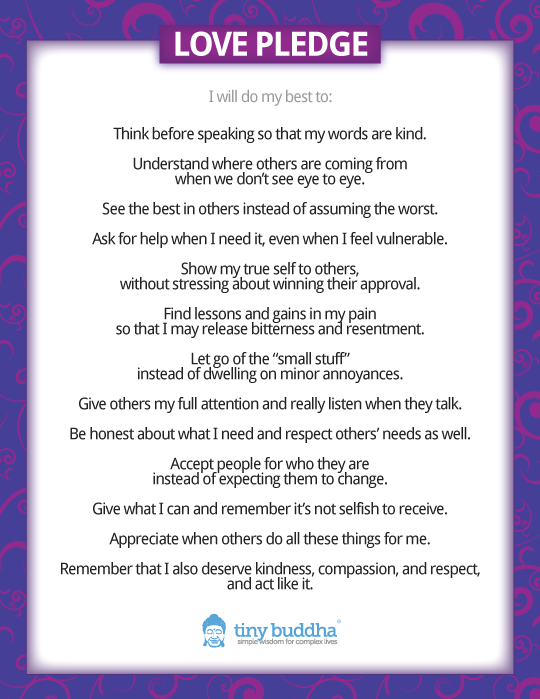
    I created this pledge to help us all be more loving, to others and ourselves. After you take the pledge by entering your email address here, you’ll be entered to win one of three free copies of Tiny Buddha’s 365 Tiny Love Challenges, which includes stories and daily activities to help us all give and receive more love.

    Tiny efforts can make a huge difference. And a tiny bit of love from each of us can make the world a far better place!

    If, like me, you value your relationships, take the Tiny Buddha love pledge here.

    tb-love-pledge540

    You can take the pledge until Monday, November 30th. The giveaway winners will be notified then.

    “What a terrific resource! This book provides so many thought-provoking ideas for simple, fun ‘challenges’ to help us live happier, more loving lives.” — Gretchen Rubin, author of The Happiness Project

    Want the book now? Grab a copy of Tiny Buddha’s 365 Tiny Love Challenges here.

  • How Non-Attachment Can Benefit Your Relationship

    How Non-Attachment Can Benefit Your Relationship

    “You only lose what you cling to.” ~Buddha

    I remember one of my first mindfulness classes that pertained to impermanence. I went home in a bit of a slump.

    Nothing is permanent; everything ends; “This too shall pass.” It was quite a shock to the system.

    After getting over what, on a surface level, seemed to be incredibly dire, I realized that this could be incredibly liberating.

    Enter the principle of non-attachment, a notion that has the potential to aid in the evolving nature of day-to-day life.

    Rather than clinging to things—relationships, jobs, material goods—hoping that they will last forever, or being fearful that the uncomfortable parts of our lives will never change, we learn to deal with the moments as they arise.

    There is power in knowing that our moments can, and will, inevitably shift.

    Knowing the good won’t last forever gives us permission to embrace the moment fully without clinging or depending on it.

    Acknowledging that the bad won’t last forever gives us strength to move forward instead of being caught up in helplessness and insight to make shifts and changes if need be.

    Impermanence is a blessing in disguise. And non-attachment is the only way to truly forgive and love another person.

    Sounds counterintuitive, doesn’t it? How can non-attachment possibly lead to a happy, fulfilled relationship?

    Here’s how.

    In my last relationship, I prided myself on being honest and open. I didn’t want to play games, because that’s not the sort of person I am, nor the sort of man I wanted to attract into my life.

    I wanted a guarantee that he would stick around and that our relationship was progressing. I wanted to know that he wasn’t going to just disappear from my life, a dialogue from my past that prickled at my defense mechanisms and inevitably pushed him away, too.

    This made me fearful and scared, and I shut down intermittently. This invisible pressure burdened both of us.

    The hard truth is that there are no guarantees.

    Of course, there were other factors in our relationship. The point here is that there was also an unhealthy attachment present; I became dependent on him, and I clung.

    I was like a child who was holding onto a baby animal, who was so scared of it running away that I held it tightly, suffocating it.

    Non-attachment means that you are able to live your life outside of the other person; it ultimately takes pressure off and allows you to be without depending on anything or anyone to feed your soul.

    Clinging onto things—relationships, jobs, materials goods—simply does not make sense considering their evolving nature.

    These things add to your life, but they are not your life. You’re all that’s guaranteed, and even you grow and change, physically, emotionally, and spiritually.

    This doesn’t mean that past lessons or past behaviors can’t or won’t guide your present actions or that future goals aren’t important. Instead, it means that you can live out your moments naturally and organically, with appreciation and/or awareness, because you aren’t leaning on something that might change or shift.

    Non-attachment in relationships is not indifference or apathy to another person. It’s an absence of fear. Fear and clinginess come from a sense of impending loss.

    However, if we go into a relationship or exist in a relationship already knowing that things may change or shift (for better or worse), we rid ourselves of pressure and burdening expectations. We can approach the relationship and issues with an open heart and simply see what unfolds naturally.

    Relinquishing (some) control is scary, but not impossible.

    This is not to be confused with blind acceptance of things that aren’t satisfying.

    Existing in the unattached present moment acknowledges what is actually happening now and gives us the power and capacity to shift or change a situation, which is also applicable to a relationship that isn’t what you want, need, or deserve.

    I know many couples who are staying together, even if it hasn’t been working for years and years, because it was “so good long ago.”

    I’m an advocate for working through things, but ultimately, the present is all that is relevant.

    As far as relationships go, I was once told that some people you simply get for a season, some people appear in your life intermittently, and some people stay around for longer and forever, if you’re lucky.

    The catch is that you ultimately don’t know which category the person you’re dating or in a relationship with is or will be in, and red flags aside, there is no way to know.

    However, being unattached, open, and aware is a key ingredient to experiencing a relationship organically and observing what may unfold.

  • Breaking the Pattern of Painful, Unhealthy Relationships

    Breaking the Pattern of Painful, Unhealthy Relationships

    Torn Paper

    “Do you want to meet the love of your life? Look in the mirror.” ~Byron Katie

    As I was listening to other women talking in my support group for battered women, I had a life changing moment.

    I caught a glimpse of myself and where I was at in life. It was a defining moment that turned around how I felt about myself and changed the cycle of my relationship with men.

    “I played a role in my abusive marriage; my ex-husband was treating me how I was treating myself.”

    His anger and how he showed it belonged to him; we are never responsible for someone else’s behavior and how they treat us, ever. However, we are responsible for how we treat ourselves and how we allow others to treat us. At the time, I didn’t really love myself.

    My confidence was non-existent. And I thought I deserved to be treated this way. I had a belief that life was meant to be suffered. I know, nuts!

    So, as I was sitting there in the support group, I realized how I had given my power away to someone else and that I had to take responsibility for neglecting myself.

    I didn’t put blame on myself to feel guilty. I owned up to my part in this whole situation. I looked in the mirror and got real honest so I could change this crazy pattern.

    If I had stayed in the victim role, I would have continually attracted the same kind of guy, who in reality would just be reflecting back what I felt about myself.

    Not at all what I wanted anymore, that was clear.

    It was time to break the pattern, and break the pattern I did.

    I started to really take care of my needs.

    I gave myself the love that I was looking for, the attention I was craving, and permission to feel happy and have an awesome life.

    It didn’t happen overnight, and it’s been quite the journey, but it amazes me that since I’ve raised the bar, the people that show up in my life are on a much higher level.

    It’s a situation no one should be in. The first step is getting out and getting help. And know the cycle can be broken.

    Breaking The Pattern of Unhealthy Relationships

    1. Practice self-love.

    I can’t say this enough. At the time the concept of self-love was foreign to me. Louise Hay’s book You Can Heal Your Life awakened me.

    I was looking for love in outside places, wanting others to validate that yes, I could be loved. When I started giving myself what I was craving, I gained more confidence, got clearer on what I wanted, and started treating myself with respect.

    Pay attention to your internal dialogue about yourself. Look at yourself in the mirror every day and say “I love you.” Believe it. Really embody how you want to feel right now.

    2. Change your mindset.

    There’s no going around it, what you think will become your reality.

    We all picked up beliefs from well-intentioned people around us while growing up, and they form most of our internal dialogue. Some of these beliefs might serve us, but some might be quite detrimental.

    Take an inventory of the top negative beliefs that you have on repeat in your mind. Then re-write these beliefs in a positive way and create a plan to act on them.

    This is about more than just saying affirmations; it’s about being consistent, setting your intention, and taking action.

    Example: Old belief: I’m not good enough, and I can’t be happy.

    New belief: I am good enough, and happiness is my birthright.

    After flipping your negative belief, say the new belief with emotion, and write it down and display it in places where you’ll see it regularly.

    Next, visualize what being good enough means to you. How does it make you feel? Have a clear image.

    Lastly, take action. How does a person who is good enough act? Act as that person now, and aim to do this consistently.

    3. Look for the lesson in everything so that you can heal and move on.

    We’ve all had experiences where the same thing keeps happening over and over with different people and situations. That’s a message that something needs to be done on our part.

    Once the lesson is learned we can break the pattern.

    4. Know what you want.

    In a nutshell, don’t settle—period! What is it you want? What qualities are you looking for? How do you want to be treated? Want to know what the trick is to actually get it? Be all of those things. Others are mirrors to us.

    5. Own it.

    The best way to make any change is to take responsibility for where your life is right now, owning it so you can improve it on your terms. When we do this, we go from waiting for change to happen to starting with ourselves, because that’s where any real change can ever take place.

    We’re back in the driver’s seat, creating our life, versus reacting to life situations.

    6. Receive.

    I did attract lots of nice guys too, but I would break up with them or find them too boring. Now I see I wasn’t comfortable with someone treating me kindly and with respect. I wasn’t in the right state of mind to receive this kind of love because I couldn’t give it to myself.

    Once you start giving it to yourself, you too will be able to receive it.

    The most important relationship we’ll ever have is the one with ourselves. Making this a priority doesn’t take anything away but just adds more happiness and confidence to our lives.

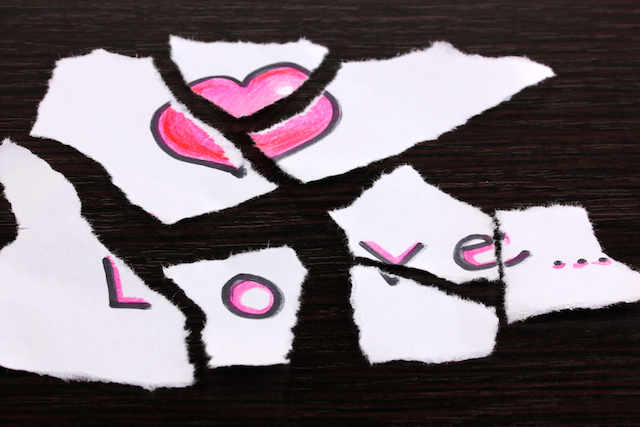
    Torn paper image via Shutterstock
  • How Self-Awareness Can Help Us Love People Just as They Are

    How Self-Awareness Can Help Us Love People Just as They Are

    Woman with Heart

    “Everything that irritates us about others can lead us to an understanding of ourselves.” ~C.G. Jung

    We were visiting my parents’ place in the woods for the weekend. I unlocked the door to the cabin and flipped the switch. The lights didn’t come on, so I began rapidly flipping other switches. I hollered at my husband to come have a look.

    He walked to the breaker box in the back. I heard popping as he flipped them on and off. He shouted every so often, “Try the front room!” I reported back, “Nope.”

    “Try the bedroom!” I reported back again, “Nope.”

    We did this for a few moments, then he came around the corner and said, “It’s a bad breaker. They’ll need an electrician.”

    He walked out the front door and bent over to put his boots back on. I asked, “So it’s not something you can fix?”

    He looked over his shoulder and replied, “I’m scared of two things—snakes and electricity.”

    Then he pulled the leg of his jeans down over his right boot. I jokingly said, “There are only two? Aren’t you scared of me?” and I playfully patted his rear end.

    He slid his left boot on, straightened his other pant leg, and stood up. He looked me square in the eye and said without smiling, “Yes, you too, when we aren’t meeting your expectations and doing things the way you like them done.”

    The grin slid from my face and my shoulders slumped forward. His feelings were still hurt from my reprimand the night before. I made big sad eyes and dropped the corners of my mouth to look pitiful. He held his ground, “Hey, you poke at me sometimes; I’m just poking you back.”

    Indeed, his words were like a hot fire poker rearranging embers in my gut. A flame caught and my fiery ego snidely replied, “I only do it in your best interest.” In his eyes I could see the wall going up. He sensed a lecture coming and turned and walked away.

    I stood there alone in my pride. “Yes, I do push my husband and son to be better. So?” But in that moment my heart asked, “Better than what? They are already the very best gifts in my life.”

    Some time passed. I decided a walk might clear my head and heal the hurt.

    As I stretched, I heard my dad complaining in the distance. He was upset that someone had not done something the way he wanted it done.

    He lectured my ten-year-old son about being irresponsible. My son wasn’t the culprit, but he still got a sermon about doing things “the wrong way.”

    I assumed my dad had the good intention of teaching my son something, but his rebuke roused the mama bear in me. I growled, “Why is he putting his ridiculous expectations on my cub?”

    Before I went to strike, I noticed the burden had an eerie familiarity. I suddenly realized that I was not upset with my dad; I was upset with myself. “That’s how I sound sometimes,” my heart reminded me. And I could see clearly what my husband was poking at.

    I closed my eyes and turned my shame toward the sun.

    I let my shoulder blades fall gently down my back to open my chest. I took in a deep breath of Leance and held it for a moment. I exhaled guilt. I inhaled forgiveness and let go of control.

    In the stillness I acknowledged that I am broken, but I am not beyond repair. I can apologize for expecting my boys to be different than they already beautifully are. And I can take note of how I am hard wired and ask to be transformed by love.

    We all have blind spots that impair our relationships. I’ve realized that the best way to gain insight is to pause and really listen when someone shares his or her frustrations with us. If we humble our egos and limit our lips, our eyes will often open wide and so will our hearts.

    One way we can wake up to our blind spots is to begin noticing the situations that repeatedly make us mad. A situation won’t give us a charge unless it connects deeply to something inside of us. It’s our work to determine what exactly our anger is connecting to and why.

    Once we have noticed what aggravates us, we can look within. “Where in my life do I potentially do something similar to this?”

    If disrespect makes you disgruntled, where in your life are you possibly disrespecting yourself or someone else?

    If being controlled makes you cross, where in your life are you potentially being overly controlling?

    If injustice infuriates you, where in your own life are being even the slightest bit unjust?

    Our world-changing work begins by looking within. It is from this place of self-awareness and authenticity that we can begin to truly heal our own hurts and learn to honestly love others just as they are.

    Woman with heart image via Shutterstock

  • How Expectations Undermine Our Relationships and Happiness

    How Expectations Undermine Our Relationships and Happiness

    “I’m not in this world to live up to your expectations and you’re not in this world to live up to mine.” ~Bruce Lee

    A few years ago, my husband was away from me for a few weeks, working in another town. It was summer, and we were living close to the beach at the time, so I often spent my Saturday nights walking along the ocean at sunset, enjoying the colors and sounds.

    One Saturday night I was in a simply glorious mood. The beach was filled with happy families and couples, the Atlantic was a particularly lovely shade of aquamarine, and life felt just about perfect.

    When I got back to my car I looked at my cell phone and saw that I had missed a call from my husband. I called him back and quickly realized his mood was not nearly as buoyant as my own: He wasn’t particularly chatty, and seemed pretty negative about the work he was doing.

    I took this extremely personally and turned cold and quiet almost immediately, eventually taking the very juvenile step of hanging up on him. How dare he ruin my perfect summer evening!?

    About ten minutes later, in the parking lot of a grocery store, I had a huge epiphany: He hadn’t ruined anything. It was all me, as my negative feelings were entirely created by my expectations of how he should have behaved.

    I had been anticipating that he would be in the same great mood I was, and when he wasn’t, I took it personally. I became upset that he wasn’t acting as I expected. I became angry because he wasn’t meeting the standards I had set.

    In other words, I was completely responsible for my deflated mood.

    This was the very first time I realized how having expectations of how other people should act was causing unnecessary pain and suffering in my life. Once I started looking around, though, I saw many other examples.

    For instance, I once had the expectation that a new acquaintance would quickly respond to my text and agree that she, too, had a nice time hanging out with me.

    When she didn’t, I ended up spending more than twenty-four hours wondering if she liked me, feeling pretty bad about myself. (She did eventually respond with a very nice text; she’s just a busy person who doesn’t respond to texts immediately!)

    I expected an automatic response, and not getting one undermined my happiness.

    Another example is the time I was seventeen and gave my dad a Father’s Day card I thought he’d find really funny, and he barely even responded to it at all.

    I had built up a vision of him having a really warm and amused reception to this card, and when there was almost zero reaction, I was crushed. Again, my expectations, and the beliefs about what it meant if they weren’t met, were causing pain.

    Before you think that I’m suggesting you lower your expectations of other people and never, ask anything of anyone, let me clarify a bit.

    Telling a friend about a tough situation at home and expecting you’ll get some words of wisdom is wonderful. Hoping the guy whose eye you’ve been trying to catch will smile at you today can be fun and rewarding.

    Hoping for the outcome you desire is one thing, trying to force it and being overrun with negative thoughts and feelings when it doesn’t work out is another.

    You can’t control the way people think, feel, or react. Ever. You may try to, you may want to, but ultimately, how they act is up to them.

    And when you base your feelings of happiness, worth, or confidence on the actions or reactions of other people, you’re setting yourself up for many moments (or days or even years) of avoidable misery.

    There are a few ways to keep hoping for positive interactions with other people, but not get sucked down into the mud and muck when they don’t go as you expect.

    1. Stop expecting other people to act exactly as you would like them to—it’s a game you’re guaranteed to lose. Instead, try being open to any and all reactions from others.

    If, on that gorgeous night back in 2012, I had opened my mind and heart to my husband with no preconceived notions of what his mood should be, my evening could have remained joyful and I may have even improved his evening, too.

    Back when I was seventeen, if I had realized that my dad’s lack of reaction had nothing to do with me, but was about his own problems with expressing emotions, I would have felt far less hurt. I couldn’t make him react the way I wanted, and assuming he would do what would make me happy led to a sad experience for me.

    2. Start building up your own happiness and confidence on something you do have power over: your thoughts and beliefs.

    When someone does the unexpected and it disappoints you, it’s always because you had a belief about what they were supposed to do.

    You believe that your mother should have been proud when you won the essay contest, and when she wasn’t, you were sad. If, on the other hand, you lean in to the truth that your mother can react however she wants to, but still believe you are a wonderful writer anyway, your pain won’t be so great.

    You believe your son should have gotten better grades, but when he brings home a poor report card, you feel angry and guilty. When you stop believing that your son’s grades are a reflection on you as a parent, and start believing that you’re doing the best you can and letting go of guilt, you suffer less.

    3. Stay in the moment as often as you can.

    Stay present with your thoughts, and see if you’re holding onto expectations of how other people should behave.

    It’s when you slip out of being in the now that you are truly disappointed. When this happens, you’re letting your thoughts and stories about what the other person should have done, or what will happen now because of this perceived slight, or why you deserve to be angry, take you out of the now and down a path that is full of rejection and fear.

    The bottom line is that you will not find peace if you’re always expecting other people to give it to you with their actions or words or even love. The only way to find it is to drop your expectations of others, let go of what you think they should or shouldn’t do, and allow yourself to create your own happiness.

  • 7 Vital Choices for Happy Relationships

    7 Vital Choices for Happy Relationships

    Happy Couple Jumping

    “Being deeply loved by someone gives you strength, while loving someone deeply gives you courage.” ~Lao Tzu

    A little over a decade ago I thought I was going to marry my college sweetheart and become a young bride, which made it all the more devastating when happily ever after didn’t pan out. When we broke up, I felt literally like I lost a limb, complete with phantom sensations of his hand in mine.

    It didn’t take long for a dark guilt to bubble up—a constant festering reminder of all the mistakes I’d made. I was highly unstable and insecure back then, and most of my relationships revolved around holding me up.

    In the ruins of that romance, I didn’t know what scared me more—that someone else might hurt me again, or that I might hurt them enough first to deserve it.

    I simultaneously felt an aching need to fill in the hole where he’d been and an overwhelming sense of nausea at the thought of being with someone else. (more…)

  • Are You Settling for Less Than You Deserve in Your Relationship?

    Are You Settling for Less Than You Deserve in Your Relationship?

    Couple Facing Each Other

    “When one door closes, another opens; but we often look so long and so regretfully upon the closed door that we do not see the one which has opened for us.” ~Alexander Graham Bell

    It was around six years ago that I faced the moment of truth. I was sitting on my meditation pillow, having spent the last few moments in deep contemplation about my current state of affairs. I was satisfied with practically every area of my life except for the one that meant the most to me—my love life.

    About five months prior, my relationship with my boyfriend of almost four years (who I had been certain was “the one”) had ended. Why? Well, let’s just say that we discovered that we wanted different things at the moment. I wanted the walk down the aisle and white picket fence, while he wanted to continue life as a single person (and all that entailed, to put it as delicately as I can).

    Actually, to say the relationship had ended isn’t exactly true. Although we had supposedly “broken up,” we were still in contact with one another. Quite a bit.

    In my desire to be a mature, spiritual, well-adjusted woman, I had decided that maintaining a friendship was the “adult” thing to do. After all, it’s not like I hated the guy—at some point I had actually thought he was “the one.” Why couldn’t we be friends?

    That five-month “friendship” actually turned into five months of emotional turmoil for me, since the “benefits” weren’t as beneficial as I’d hoped they’d be.

    At times I found myself hating him. At other times, I wished that we had never broken up. At times I felt jealous when I found out that he had gone on a date. Then, I would feel like I was being immature for being jealous because I felt like I should have been “bigger” than that. At times I wanted nothing to do with him. At other times, I stalked his Facebook page.

    Still, during this “friendship” period, I couldn’t help but to have the feeling in the pit of my stomach that while he was having his cake and eating it too, I was left with crumbs. (And I’m gluten-sensitive, so cake crumbs are totally not good for me).

    I was taking what I could get because I didn’t know whether I would find another relationship again.

    Finally, that day on my meditation pillow, after months of tears, self-reflection, and praying for my ideal relationship, I had a huge “aha” moment.

    There I was, hoping for the relationship of my dreams, yet at the same time, I was keeping myself anchored to the past. How could I possibly get myself in the mindset of meeting someone new who shared my life goals, when I was spending far too much energy clinging to something that was simply not what I wanted?

    So, I listened to my gut and cut it off.

    I told him that while he would always hold a special place in my heart, I had to let him go fully.

    I told him I wasn’t sure if it would be forever, but I knew that the current state of affairs just wasn’t healthy for me.

    I told him I needed to clear my head entirely so I could understand why I wasn’t moving on like I knew I should.

    I told him I was going to make space for what I really wanted in my life.

    I was taking a stand for myself, knowing I deserved more.

    And thirty-three days later, I connected with my now-husband. (But even if I hadn’t, I know I would be just fine).

    If you’ve ever been in a committed relationship, you know that it can sometimes feel like a pretty courageous act. Think about it—you make yourself vulnerable to another person by putting your trust in him or her. You open yourself up by sharing your hopes, dreams, and worries. And, you do all of this without any sort of guarantee that things will work out in the long run.

    When a relationship just isn’t working out, the thought of letting go of the known yet unsatisfying can feel pretty daunting. But, if like me, you are clinging to something that you know is less than you deserve, I encourage you to draw on that sense of courage to make some changes.

    Whether it’s having the confidence to ask for what you really want, engaging in the character-building work of improving your relationship, or moving on, take a stand for yourself, knowing that you are worthy of happiness and getting exactly what you want.

    Take it from me, being courageous during these moment-of-truth decision points can make all the difference in your quality of life.

    As Zig Ziglar said, “When the wrong people leave your life the right things start to happen.” Are there any wrong people in your life you need to clear out?

    Couple silhouette via Shutterstock

  • When Someone Shows You Who They Are, Believe Them

    When Someone Shows You Who They Are, Believe Them

    Quarreling Couple

    “When someone shows you who they are, believe them the first time.” ~Maya Angelou

    I remember first hearing these words in my early twenties. I heard them. I just didn’t follow them. Hence, I brought myself a whole lot of painful lessons and needless suffering because I always wanted to give people a second chance, and a third, and a fourth … You get the picture.

    I was the girl who always saw the “potential” in people. The person they “could” be, with a little love and nurturing from yours truly. I considered myself to be one of the most loving, loyal, and big-hearted people out there. And besides, there were very few things I truly wanted that I went after and didn’t get.

    I suffered many disappointments and even more heartbreaks because of this, both in friendships and romantic relationships.

    I expected people to change just because I thought they should be or feel a certain way. But at that point in my spiritual journey, I hadn’t yet learned that everyone is on their own path, and sometimes their soul just isn’t in alignment with yours.

    When I fell for some guy and had it made up in my mind that he was “it,” I made a lot of excuses for his behavior, which was never in alignment with what I was looking for. Well-meaning friends would warn me in the beginning: “He doesn’t sound like a good match for you. His behavior seems a little sketchy.” Did I listen?

    No. My ego was way too big. Sure, I saw the behavior. I even saw the red flags. But I thought I was “different.” I was so special that I felt I could change that person… just by being wonderful, amazing me.

    NOTE TO SELF: When people show you who they are, believe them the first time!

    I married someone after seeing all the red flags in the very beginning. Behavior that didn’t add up to what I was being told, behavior in past relationships that was not filled with integrity. But there was so much about him that was good and pure, and the love and passion we had for each other was real and intense.

    I truly believed that people could change. And they can. But more importantly I believed I was different, and that behavior would never exist again now that he was with me.

    It should be no surprise that the marriage ended and was the most devastating and painful loss of my life. But that was the moment I started to live by Maya Angelou’s mantra.

    The dating world after divorce is a lot of things—exciting, fun, scary, sometimes horrible, but most of all, a test. How much have you learned from your previous relationships? And what are you going to do differently this time around?

    For me, I learned a lot, but I have blind spots. And comfort zones I fall into. I keep gravitating toward men that feel “like home,” except that home never made me feel good or secure in it and it was definitely a place I shouldn’t consider settling in long term.

    Some warning signs I’ve finally learned to look for and walk away from:

    • Lack of commitment to anything especially in relationships
    • Not a great communicator
    • Not being emotive with feelings
    • History of cheating in past relationships
    • Always looking for the “next best thing”

    These are my red flags. Someone else’s may be completely different. But they are things I know just won’t work for me and will eventually lead to heartbreak.

    What I tell friends when I see them falling into the same trap I often do is to ask themselves some key questions and to be rigorously honest:

    • Is this person someone who embodies all the things that are important to you, or are you convincing yourself that you can change them? You can never change someone. Walk away.
    • Are you attracting the same type of person you always do (the one who never works out for you and always leads to heartbreak)? If so, walk away.
    • Does this person have all of the things that are on your “Essentials” List? Those are the things that are your “must haves” and are non-negotiable. For me, those are trustworthy, spiritual, a great communicator, and someone who is affectionate, loving, and expressive with their emotions. If this person doesn’t have your essentials, walk away.

    The best advice I got just this week was from a friend who knows my journey well. He said, “You know what. Just recognize that you are finally learning what your heart truly wants and moving closer to that every day. You’re walking away from people who aren’t in alignment with your core values anymore.”

    So yes, I’m learning. And I still have a ways to go. But I trust that the right one, the one who steals my heart for good, will show me how amazing he is for me…. the first time.

    Quarreling couple image via Shutterstock
  • When We Hold onto Relationships That Hurt Us

    When We Hold onto Relationships That Hurt Us

    “Relationships are like glass. Sometimes it’s better to leave them broken than hurt yourself trying to put it back together.” ~Unknown

    Human beings are genetically programmed to desire love. Embraces are as important to us as food and water.

    Perhaps that’s why when we find someone—the wrong someone—we’re often too blind to see it.

    We feel it and yet we hide it away, write it off as an odd case of commitment phobia or just a hiccup in our new relationship, oblivious to the fact that were heading into a future of sleepless nights, constant worrying, and consistent phone checking.

    Even when every hidden fiber within us tells us to walk away, we stay.

    I recently experienced something similar. We first met back in high school, different people from completely different worlds. He was the guy that had all the friends; I was shy and quiet.

    Fast forward five years and we meet again. This time he’s in pre-law and I’m a writer trying to figure out her calling.

    We meet for drinks, coffee, a movie here and there, and before you know it we’re walking hand in hand. I’ve met his friends, his parents, even his grandparents. To someone on the outside, this looks like something every healthy couple would do, except we weren’t healthy—far from it.

    He always had his phone, and yet my texts remained unanswered. He only wanted to hang out on occasional evenings, routinely made plans without following through on them, was never where he said he was, yet still referred to me as his girlfriend when we met someone he knew.

    He was a guy that sucked at communicating, and I was the girl that needed it.

    He was physical, I emotional. He wanted convenience; I wanted something that swept me off my feet.

    It was a relationship doomed from the start; I was just too stubborn to see it.

    I would find myself constantly asking for advice, yet always heard the same thing over and over. Get out of there. Leave. My excuses remained the same. He works all day. He’s busy. I just wasn’t ready to admit the truth to myself. Ignorance at its finest.

    Even when I had the courage to bring up the things that bothered me, somehow he’d challenge all my worries. “I’m just not a texter,” he’d say. “I prefer conversations face to face.” Of course, there’s nothing wrong with that response. It was the dishonesty I felt behind it.

    I didn’t feel like I was in a relationship, yet he’d confirm that we were. He seemed to know exactly what to say to get me to stay.

    I couldn’t see that I was the only one putting in the effort. I made sure I was always there for him when he needed me, listened to him, even surprised him at work with coffee, putting myself out there, hoping that he would one day reciprocate.

    He only talked about himself during our conversations, and when it came time for me to share, he seemed distant and uninterested in what came out of my mouth.

    He was bound to a different city in the fall, and with his lack of communicating there was a deep nagging feeling that it was only a short time before I had my heart broken again.

    I had wanted a relationship to work out so bad that I had chosen to ignore all the warning signs that this one wasn’t right.

    Even when he left for a month and I suspected he’d cheat on me, I still stayed. Why? I could only draw one conclusion: I had been treated like that so many times before, I expected it. And I believed it was all I had to look forward to.

    Though I tried to explain to myself that I deserved so much better, I wasn’t willing to hear it.

    But one day I surprised myself. I became more independent. I began to pull away from him. His texts would go unanswered for hours; my obedience to go to him whenever he called began to wane.

    I stopped initiating conversations and instead sat back and began to enjoy all the things I had ignored. I made a list of things I had always wanted to do and did them. It kept my mind off things and opened my eyes to the truth.

    As the time passed, I would like to think, he became the one that needed me; he had just realized it too late.

    I questioned whether or not he had treated me that way because he knew I would always be there for him; then, when I no longer was, he wanted that same caring person back. Had I been nothing but a convenience for him the entire time? I couldn’t wrap my head around it.

    When it came time for me to explain, my answer was simple: My gut knew it wasn’t going to work from day one, but falling head over heels for him at first, I chose to ignore it.

    I guess I just wanted so badly for things to work out I didn’t bother to think about how unhappy I was; I chose to mask all hurt with a small smile and laughter.

    Life can be confusing and cruel sometimes, but a fantasy can’t hide the truth, no matter how badly you want it to.

    No one deserves to be pushed to sidelines, to feel like second best. If there’s something telling you to stay away, if even the smallest of your radars begin to go off, walk away.

    Leave knowing that you dodged a barrage of emotional bullets instead of realizing you had to fight to keep your head afloat to keep from drowning.

    If someone wants to be in your life, you shouldn’t have to change anything about yourself to keep them.

    If they are willing to get to know you, they will. Period. All the wrong people may step into your life, and each one will no doubt leave their own emotional scars, but when the right one comes? You’ll know. You’ll feel it.

    I was lucky enough to have a best friend who stuck by me even when I chose to ignore all her warnings. When I finally realized my mistake, she simply smiled and asked if I wanted to watch the newest horror movie.

    Friends like that are so important to have in your life. Coming from a hopeless romantic who prefers books and writing to real people, this was hard to admit.

    I can only say that when another man comes around I’ll be taking it slow.

    For all the friends out there, even if you don’t agree, just be with them for every upsetting phone call and annoyed text. Your non-judgmental support might just be the reason they realize they could have something better.

    We all need to learn for ourselves in order to truly grow. Even as much as we would like to save someone from the heartache they will no doubt experience, we need to take a step back, wait, and console them when they need it.

    To the boys and or girls reading, realize what you have while you have it, because there’s nothing worse than finding out when it’s too late.

  • 9 Tips for Anyone Who Dates Emotionally Unavailable People

    9 Tips for Anyone Who Dates Emotionally Unavailable People

    “When someone tells you who they are, believe them.” ~Maya Angelou

    After having been a rebound girl the summer of 2013, I swore I would never get involved with another emotionally unavailable man who had baggage and was a poor communicator.

    I thought I was a pro at all of the tell tale signs. Until I met X in 2015.

    He came on very strong in the beginning, telling me he deleted his dating app after our first date, that he turned down other dates because he didn’t want to waste time with other girls, and showed me in more ways than one that I was his priority.

    Things were too good to be true.

    Things were at the height of our relationship, and I use this word loosely because it really wasn’t a relationship.

    After a heavy night of drinking he confessed that he was scared to get into another relationship because he associates them with pain and feeling trapped. He admitted that he puts up walls, shuts down, and he just couldn’t bear to go through another breakup again.

    We hadn’t even made it official and he was talking about breaking up. He told me he didn’t want to lose me, nor did he want his baggage to ruin what we had. He would give this a try.

    This lasted for all of about twenty-four hours when he ended it. Poof. Gone.

    Sucker punch to the gut.

    How can someone do a 180 overnight? It dawned on me that he probably had one foot out the door the entire time. Why did I, yet again, get ahead of myself and trust someone that I barely knew?

    When I saw him on a dating site six weeks after the split (after him telling me earlier that he didn’t want to see other people; he just wasn’t ready for a relationship), I panicked.

    I confronted him about it and he took no accountability for ending things the way he did. He has convinced himself that he is being honest with me. He became hostile and angry that I contacted him.

    I came to realize he will find another awesome girl and do the same thing to her to fill his void of being alone

    Lather. Rinse. Repeat

    I sent myself in to a six-week black hole, and I will never get those six weeks back. I always thought of myself as someone who had high self-esteem, but I began questioning why I was upset over someone who shut me out so intensely and quickly.

    Why was I upset about someone whose opinion of me, quite frankly, doesn’t matter? The people whose opinions matter are the ones who have actually stood by me through thick and thin.

    Here’s what I learned through my pain:

    1. Don’t put someone on a pedestal.

    They are not perfect and you will always be disappointed if you continue to do so.

    2. Take time to get to know someone before jumping to conclusions about your future.

    It’s through tough times when you get to know someone the most, not when things are good.

    3. Trust your gut instincts.

    Even if he or she seems to be doing everything “right,” sometimes you need to trust your gut and use your head.

    4. You will be okay.

    I have gone through this before, and I will go through heartache again. Each time I pick up the pieces of my broken heart I learn a little bit more about who I am, what I deserve, and what I am capable of giving someone. I can rest my head each night knowing I stayed true to myself, and you can too.

    5. You can’t fix anyone.

    I have learned this many times, the hard way. Trying to fix someone else chips away at your soul. Worry about yourself and let them figure themselves out when they are ready.

    6. Just because a romantic relationship failed, that doesn’t mean you are a failure.

    I look at the many healthy relationships I have in my life with friends, family, and coworkers, who choose to be in my life and are always there for me. I don’t want to be in anyone’s life that doesn’t want me in it.

    7. Don’t apologize for having feelings.

    I truly believe being able to express emotions is a sign of strength, not weakness. Anyone who is incapable of accepting or reciprocating feelings is missing out on one of the most rewarding gifts in life.

    8. Don’t ignore red flags.

    Looking back, I saw the flags and never raised questions because my heart was in too deep. I would have saved myself a lot of time if I had the confidence to speak up.

    9. Be upfront early on about what you want.

    If the other person is intimidated or scared and runs away, better early on then months or years down the road. Don’t assume they feel the same way as you do.

    I have so much to offer, and you do too. But some people just aren’t open to receiving it. So long as we’re willing to acknowledge that and move on, we’ll find the love we’re looking for.

  • Authenticity May Feel Risky But It’s Worth It

    Authenticity May Feel Risky But It’s Worth It

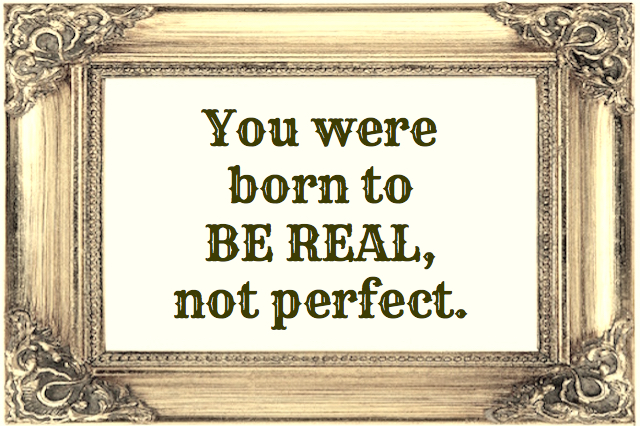
    You Were Born to Be Real

    “Authenticity is the daily practice of letting go of who we think we’re supposed to be and embracing who we are.” ~Brené Brown

    Growing up I experienced a rollercoaster of emotions. One minute I would be on top of the world and the next I felt overwhelmed by anxiety. I didn’t know how to share my difficult emotions in a healthy way with my friends and family, so I started suppressing them instead.

    I realized early on that it felt safe to hide my feelings, because no one could judge me if I kept them to myself. I believed that emotions were a sign of weakness, and there was a reward for keeping it together—I never rocked the boat, and everything around me remained peaceful.

    But I learned that you can’t trade authenticity for safety and expect to stay true to who you are at the core.

    Although it seemed like I was protecting myself, suppressing everything erected walls around my heart and reinforced the belief that it was not safe to share my genuine feelings with anyone else.

    As a result, I started having issues with food, and it soon turned into an eating disorder and resulted in anxiety and depression.

    Rather than being truly authentic with others, I became strategic; everything I said or did was a thought-out plan to gain acceptance. Being truly authentic with others was just too risky.

    I’ve since learned that we cannot truly experience the benefits of a relationship if we are not authentic. To fully feel the love and connection we all yearn for, we have to show people who we really are.

    As I let go of what others thought I should be, feel, and say, I started becoming more authentic with those I trusted most. And as I shared feelings that felt risky to expose, the people who truly cared about me received them with love rather than judgment, and those relationships got stronger.

    Other times, I shared my true feelings and learned I couldn’t trust certain people with them. I had to let go of some relationships because they were holding me back from being my true self. Although not easy, this was necessary in order for me to evolve and grow.

    Authenticity connects us. It is a great gift we give to another person when we let them see behind any masks or the walls of emotional armor.

    Even more so, authenticity is a priceless gift we give to ourselves.

    How do we become authentic in our relationships?

    Begin practicing authenticity with someone who will not judge you, advise you, or try to interrupt your process.

    This person can be a dear friend, family member, mentor, coach, or counselor, who will receive the gift of your authenticity with compassion.

    For me, it started with owning my own story and starting to share it with others. One of the first things I did was write a letter to one of my dearest friends telling her about my struggles, and she embraced all of it with love.

    Develop rituals.

    Rituals teach us to be disciplined and deliberate. Develop rituals that you will use daily to practice authenticity and let go of shame and guilt.

    The first two hours of each day are for me. I exercise, journal, and on a good day, get some meditation in too.

    It allows me to set my intentions for the day, and to say thank you. It allows me to be exactly who I am with myself so that I can be the most authentic person with others. I love my time in the morning and ever since I started consistently doing this, my life has changed.

    Trust your intuition.

    That feeling in your gut that tells you what is right and wrong. Not always easy to do when you’re fighting against the naysayers and those who can’t handle the most authentic you. Trust and follow it anyway.

    This has been a practice for me. I have not always been good at listening to my intuition for fear of standing up, rocking the boat, and being judged. I have learned that my gut is never wrong, and I now listen and trust.

    Forgive yourself.

    If you are holding onto something that isn’t allowing you to move forward, forgive yourself and let it go. Not forgiving yourself will keep you swimming in a swamp filled with your gremlins, and unable to experience healthy and happy relationships.

    I have made many mistakes in life. I followed the wrong crowd, I didn’t always do the right thing, and I held on to that guilt and shame for many years. It didn’t serve me.

    It wasn’t until I was able to forgive myself that I was finally free to move past the mistakes I had made. I was finally able to move forward and become my true authentic self and tell my story.

    Respect and value who you are.

    When you do, you set the standard for how others treat you. You have permission to be you—unapologetically and authentically you. To have strengths and weaknesses and know that those are what make you unique and amazing.

    The truth is that others will treat you with the same respect you show yourself. I didn’t believe I was worthy of having healthy relationships with people who valued who I was, because I didn’t know how to value and love myself. I often sabotaged friendships and relationships with good people.

    When I started my healing journey and practiced self-love, meditation, and positive affirmations, I then started to believe that I was worthy of healthy relationships.

    Know that you are valued and needed by others.

    People need you, and the right people will value who you are and what you stand for when you are authentically you. The world needs to hear your story.

    My healing process started when I shared my story and spoke my truth.

    I learned that it was okay to be vulnerable and authentic. There are people who related to what I had gone through and were inspired and grateful that I could share. It allowed them to be okay with sharing their story and start their own healing journey.

    Just like most skills in life, with practice your ability to recognize and tolerate emotions and be authentically you will improve. Increased self-awareness is the key to having successful, long-lasting, authentic relationships.

  • Why You Might Feel Like You’re Always the Victim in Relationships

    Why You Might Feel Like You’re Always the Victim in Relationships

    Angry Couple

    “Your relationship to yourself is and always will be directly reflected in all your relationships with others.” ~Vironika Tugaleva

    Have you ever heard someone say, “I don’t know why this is happening to me?” or, “My ex is really crazy”? I have said myself, “It’s not my fault he’s a jerk.”

    It can be so easy to play the victim. Surely some of us are indeed victimized, but being a victim is a whole new ball game. Pointing the finger was an art for me. Thing is, one finger was pointing at you and three were pointing back at me.

    I wasn’t aware that all the things in my life were about me. Any friend, relationship, or job I landed was a direct result of how I viewed myself.

    How I interacted with others and the dynamics of my romantic encounters were directly correlated to the deep wounds I developed in childhood. All my core beliefs were distorted, and I had no idea.

    I believed that being in a relationship, no matter how painful, made me connected, alive, and whole.

    I believed I had little self-worth and value, because my father taught me I just didn’t matter. I thought my sole purpose in life was having a man to love—showering him with admiration and adoration.  

    I didn’t love myself. I lacked a sense of self and I had no purpose or meaning outside of a cure-all relationship.

    I subconsciously attracted into my life exactly what I believed I deserved. I didn’t know I was picking what I was picking.

    I had a fear of abandonment, so I attracted a man who would leave me because the belief that I’d be abandoned had to be confirmed.

    I believed I was in charge and all knowing, so I attracted friends who I could dominate and teach.

    I thought men were not trustworthy and abusive, so I found jobs where my direct managers were men who were unjust and tyrannical.

    I assumed my value, love, and worth were tied into someone else loving me, so I attracted someone who felt the same way about himself, and a toxic dance ensued. Neither of us met our own needs, but looked to the other to mask the wound.

    I had no sense of self, so I enmeshed with you, and I adopted your life so I didn’t have to build my own.

    These old beliefs were extremely difficult to unravel and rebuild. I suffered greatly in so doing.

    The only way up and out was to shatter my old self, work to change distorted beliefs, and to begin living life in the darkness.

    I felt like a child locked in a dark hallway, and all doors leading out were shut. I stood there all alone and threw temper tantrums, not knowing how to unlock the door. Slowly, gradually, the door began to creek open.

    What I projected was simple. I projected all my feelings about myself onto you. I attracted into my life whatever I believed about myself, and because I suffered great internal pain growing up, I drew in painful relationships and circumstances as an adult.

    We don’t have to suffer and stay in unhealthy relationships. There is a way out.

    After recognizing my unhealthy cycle, I contacted a well known cognitive behavioral therapist that a dear mentor recommended to me and made an appointment.

    Through our work together and my willingness to get better, I began to change behaviors and old distorted beliefs. I extricated myself from that tumultuous relationship, but not before embarking on another one. They both ended in 2013.

    A bottom came, and the real work began. Learning to be with myself and not attaching to someone who would love me was the key to beginning to heal. Processing my childhood was also an integral part of my growth.

    Today, I have a new sense of self. I have value and self-worth. I have a relationship with myself.

    Nothing outside of me is filling the hole. I am meeting all my own needs. I am not living out of codependence and fear. I don’t believe today that I can be abandoned. Children can be abandoned, but adults can take care of themselves.

    I know now that some men are trustworthy and have my best interests in mind.

    I am creative and learning to build a life of my own around my likes and interests. Some days are difficult still, but I try to remember that anyone I picked to make me happy in the past had the opposite effect. I wasn’t happy to begin with, so I didn’t pick partners who could contribute to my happiness.

    As adults, we choose people and relationships that are familiar, in that they reflect our experience within our family of origin.

    The people and events in your life bring with them lessons. My greatest lessons involved great pain. But my darkest days have brought me the brightest light. My soul mates were not men I was meant to marry or have children with, but were men who helped me see how I had to change.

    No matter how many men cheated on me, left me, or somehow wronged me, I played a part. Sometimes it was simply participating in the dance.

    As I changed my inner self, developed new beliefs, and found courage to stand on my own, I discovered that without these experiences that brought me to my knees, I wouldn’t be where I am today. I am better; I am more whole and more aware of what I want simply by experiencing what I don’t want.

    If you too have found yourself in a pattern of dysfunctional, unhealthy relationships, ask yourself: What’s my part? Why am I drawn to these same relationships over and over again? What’s the lesson? And how can I use these experiences to heal and make myself whole?

    Angry couple image via Shutterstock
  • When You’ve Fallen for Someone Who Isn’t Right for You Right Now

    When You’ve Fallen for Someone Who Isn’t Right for You Right Now

    “You have to learn to get up from the table when love is not being served.” ~Nina Simone

    I completely fell for someone.

    It was one of those instantaneous connections, the kind that movies are made of. That’s how it was in my head, at least.

    But it didn’t matter, as I was moving to another city, traveling, and exploring by this point. There was no way anything was going to happen, because there was no space in either of our lives for it.

    Almost a year later, we found our way back to each other. It was fireworks. Long conversations, physical connection, honesty. We carved out places for ourselves. I found that I didn’t have to play games, that I could be completely open with him.

    I decided to make space for him in my life, no matter what.

    There came a point when I asked him whether we were working toward anything more substantial, and though he admitted to feelings for me, he said that he didn’t have the capacity for anything serious.

    It stung, yet how could I let go of someone who made me feel this way? The highs were so high.

    We tiptoed around a relationship that stemmed from something real, yet became based on addiction and longing. It was a dangerous cycle of feeling broken when he left and high when he re-entered my life.

    I knew he was working through his demons, too, and though I believe he cared for me on some level, he didn’t have the ability or desire to give me what I needed—his consistent presence, and the foundation for something healthy and meaningful outside of the honeymoon and infatuation stages.

    I was taking what was offered to me, even though it wasn’t enough.

    Whenever he’d come back into my life, I’d cling to him emotionally and our connection would be as strong as ever, yet I’d return home in tears, knowing that it would be a long time between ‘hits.’

    I felt myself shatter and became prickly toward him when we saw each other, unwilling to properly communicate my discontent, since it came at the risk of one of us finally walking away.

    We could both see I was getting hurt and that he felt stifled by expectation, yet neither of us had the capacity to shift our desires or leave, so we’d find our way back to each other again.

    It was the perfect storm. Eventually, we had to hit a wall.

    When we ended, it was not because I’d stopped caring, but because we were unwilling to shift what we wanted or could offer one another.

    There was no drama of hurtful words—he had not lied to me or cheated, and I hadn’t been anything but upfront about how I felt or what I wanted. We just weren’t on the same page.

    Even though the split felt counter-intuitive, we were in an uncomfortable stalemate. The only option was to walk away. I learned some important lessons, however.

    Remember what you are willing to accept, and be honest with yourself about it.

    At first, I merely wanted to know he had space for me in his life. I thought I could accept our off/on dynamic because I was in a place in my life where I was focusing on what I wanted to achieve outside of intimate relationships. But the more I was around him, the more I wanted something meaningful.

    I began to strongly believe that we could be in a healthy and functional relationship; however, my belief didn’t change the present reality, which was only hurting me.

    While it’s good to see how things unfold, if someone doesn’t treat you the way you want to be treated and the whole situation is bringing you down, you are doing a disservice to yourself by staying.

    You need to take care of yourself before you allow anyone else in your life. No one is there to ‘fix’ you.

    Because we had such an intense connection, I lit up around him. I felt like I was the best version of myself. Though he was someone I genuinely cared about, he inadvertently became an easy way for me to feel better and worthwhile, and I came to rely on that validation.

    We were on shaky ground already, and my dependence on his fluctuating presence made the way I perceived myself even more tumultuous.

    It’s difficult to have a healthy relationship if someone is filling a void instead of just adding to the great person that you are. The first step, however, is to believe you’re worthy outside of that connection.

    I needed to learn to be happy with myself and my decisions without someone reassuring me. For me, that occurred by exploring the things I craved to my core: writing, traveling, reading, and meeting new people.

    I committed myself to nourishing experiences, recognizing my own thoughts and habits, and behaving in a way that was kind to myself.

    You can’t pry someone’s heart open, nor might you be enough to change them.

    If someone doesn’t want to be with you, or doesn’t have the capacity to be with you, then there is nothing left for you to do but respect that decision and try to reassemble your life without them.

    Both people need to be willing to make an effort and come to the table with open hearts and open minds. You can’t fight for something if it’s not on offer.

    If it’s meant to be, it’ll happen. But if it can’t now, you have to move forward.

    There is a time to fight and sometimes, a time when you need to walk away. Instead of frantically searching for a resolution, sometimes we just need to get off the emotional roller coaster.

    Whether that means taking time apart or splitting for good, there is opportunity in learning to live your life as best you can outside of your relationship. You never know what might happen down the line, but unless a shift occurs for the both of you, it is impractical to entertain the possibility of a reunion.

    I’d love to say that my feelings have subsided completely, that I don’t feel a sting in my chest when I think of him, but that isn’t the case. However, I have enough self-awareness to know that we couldn’t continue that cycle, that I needed someone to be on the same page as me, and that I needed to grow and heal before I could be in a relationship—with him or anyone else.

    Everything in our life is a reflection of the choices we have made, and once we’ve exhausted all possibilities, we need to start making new decisions.

    Though it can feel counterintuitive, letting go of a love that isn’t good for you right now is an act of kindness to yourself.

  • 3 Questions to Ask Yourself When You Feel Unsupported in Relationships

    3 Questions to Ask Yourself When You Feel Unsupported in Relationships

    “A community of friends supporting each other can make a world of difference.” ~Unknown

    Many of us feel we’re not getting the support we want or deserve in relationships.

    Maybe we’ve never felt supported by our friends or family. Maybe we don’t feel supported by our peers or co-workers. Maybe we don’t even feel supported by our partner.

    This can leave us feeling drained, tired, and unhappy, like we’re moving through life without much fuel to keep going.

    During my adolescence and early adulthood, this was a huge struggle for me. I rarely found a place or group of friends where I felt like I “belonged” and, therefore, I didn’t feel supported. When I did feel supported by others, it only lasted for a few days or weeks before it dissipated.

    Today, this has shifted. I feel much more supported in my current relationships and don’t feel nearly as drained as I once did.

    There are still moments when I feel like I did growing up, but I’ve realized that opening up to support is a life-long journey. It’s an ongoing process of healing old wounds and allowing ourselves to become something new.

    There are three questions that always help me realize what needs to be healed and how I need to shift my perception. If you don’t feel supported in your relationships, ask yourself:

    1. Is my story preventing me from receiving support?

    Do you tell yourself stories like “Nobody understands me,” “He can’t understand me because he hasn’t experienced what I’ve experienced,” or “I always have to take care of others and nobody can take care of me”?

    Or, do you repeatedly tell yourself, “I am never supported in my relationships”?

    Whatever your specific story is, it blocks you from receiving the support you desire.

    Some other stories that prevent you from receiving support include: “If I tell others about my problems, it will cause them more stress,” “If I share this with others, they will judge me,” “I need to give to others in order to be loved,” and “If I want something from others, I won’t be loved.”

    Formerly, I told myself the story “I will be a burden to others if I seek help and support.”

    I’d think this at work when I needed extra help or a day off, so I’d feel hesitant to communicate this to coworkers. I’d also think this when going through tough times, which made me feel scared to open up to friends, so none of them would know what I was feeling.

    When we acknowledge our stories, we are then able to shift our perception and open ourselves to receiving support from others.

    2. Am I reaching out to others for support?

    Often when we feel like we are not receiving what we desire from others it’s because we are not open to receiving. It’s as if we have a little shop set up for business, but we have all the doors locked!

    Be sure to tell others when you are going through a difficult time. Ask people for help rather than to try to figure it all out on your own.

    By letting people know that we are seeking support, we’re much more likely to receive it.

    3. Am I supporting myself?

    What we experience outside of ourselves is often a reflection of whatever we are experiencing within ourselves. If we are not feeling supported by others, then it is likely true that we may not be supporting ourselves.

    The key to shifting this is to find ways to feel full and supported within ourselves instead of focusing solely on what we want from others.

    This was something I needed to do when dealing with various health issues. For a few years, I failed to address my health problems, which meant others couldn’t support me either.

    I would not stay committed to diet and lifestyle changes that I knew would help me. This meant others didn’t have the opportunity to support me because my actions did not show that improving my health was important to me.

    Ask yourself: Am I supporting my body when it’s sick or tired by letting it rest? Do I support myself by finding time to do the things that I love to do? Do I give myself the things I know I need—like going to doctor’s appointments when I’m sick or finding a therapist when I’m going through a difficult time?

    Then take it a step further and ask yourself: Am I really “myself” when around others? Am I putting myself in relationships with people who truly accept me for who I am? Do I allow myself to share my authentic truth with others?

    If we want to be fully supported in all aspects of ourselves, we need to choose to be in relationships where we feel free to be our authentic selves.

    This might mean letting go of some relationships and releasing expectations that certain people will suddenly change and be supportive. By being in relationships with others who fully accept us, we are supporting ourselves.

    In order to experience the highest degree of love and support in our relationships, we have to really love and support ourselves. So look within and become the master of your own self-care and self-love.

  • How Emotional Pain Can Cause Us to Act “Crazy” in Relationships

    How Emotional Pain Can Cause Us to Act “Crazy” in Relationships

    Couple Fighting

    “We all exist in our own personal reality of craziness.” ~Alejandro Jodorowsky 

    Most of us have heard stories of “crazy” women (and sometimes men) and psycho exes. They are our friends, boyfriends’ exes, family members, and sometimes they can even be us.

    Often people (including ourselves) are quick to judge these people. We write them off as emotional wrecks. We label them. We shame them. It’s hard not to judge when we are not equipped with the tools to deal with behaviors we don’t understand.

    It’s even harder to feel empathy when we experience suffocation and feel our boundaries are being violated.

    But “crazy” behavior might not always be what we think. Sometimes crazy behavior is a symptom of trauma and pain. A lot of times crazy behavior hides deeper issues.

    From the moment we are born we start to develop a sense of self and belonging. We start to develop an idea of whom we are, how others feel about us, and where we fit in the world.

    Our first feelings and ideas of self come from the relationship we have with our parents.

    Generally speaking, if children have healthy parents and feel loved and secure at home, they will grow up secure and will have secure adult relationships.

    But if children come from homes where there is any type of trauma, abuse, or abandonment, where they don’t learn to build a secure sense of self, then they will grow up anxious and insecure and will have difficulty trusting others and themselves.

    Most of the time, people who act “crazy” are subconsciously playing out their childhood wounds. These wounds need to be worked through; otherwise, they continue to manifest over and over again with every new relationship.

    Craziness is simply pain turned outward.

    For as long as I can remember I have felt pain and fear of being alone. My father’s abandonment made every relationship a search for a part of me I felt was missing, but I didn’t quite know what it was.

    I have always had long and fulfilling friendships with both women and men, but for as long as I can remember I have a hard time with romantic relationships. Don’t get me wrong. I absolutely love men. I just didn’t know how to relate to them until recently.

    My romantic relationships have always been somewhat like this:

    “Hi. I am Brisa. I think I love you. Please complete me and fulfill every part of my life that is in need of fulfillment. Allow me to focus obsessively on your life to subconsciously avoid fixing all that is wrong with mine. And let me suffocate you with my love because I don’t think I am worthy of yours, and because I am terrified of you leaving.”

    Not surprisingly, men kept leaving.

    And when they left, my crazy behavior kicked in full force. I couldn’t handle the abandonment. I would chase and beg and humiliate myself in every city and every country we would be in. I didn’t care.

    The thought of being alone again, abandoned by yet another male, would consume every rational thought in my brain, and before I knew it only the irrational ones were left.

    The ones that kept screaming “Go to his house! Show up half naked and with flowers. I am sure that’s exactly what he wants right now!” Didn’t work? “Go to his work. Show up uninvited and beg him to take you back!”

    If you can think of any crazy behavior, I have probably done it. And I have probably done it more than once. I threw away my dignity and destroyed my reputation. All fueled by fear and pain, and in the name of love.

    I knew my behavior was unhealthy, but I couldn’t stop. It felt as if I was trapped inside my own body and had no control over my actions. I could see what I was doing. I could even despise my actions. But I couldn’t stop.

    The pain and fear of being alone was so intense that it would overpower my desire to overcome my destructive patterns.

    It’s hard to see clearly when we are caught up in the cycle of unhealthy relationships and denial.

    Many of us choose partners that will play the specific role we want them to play so that we can continue to relive our past with the hope of having a different outcome, thereby healing our old wounds. But subconsciously, we all know that’s not possible.

    Some of us just choose to continue to act in the same ways because we know that if we were in a healthy relationship and in drama-free life, we would have no other option but to spend our time actually dealing with our pain and wounds.

    Wounded people keep creating drama to keep avoiding themselves.

    It took years, countless tears, and major loss for me to realize there was something in me that needed to change. It took to years to accept my wounds and my need to look deeper into myself.

    I could no longer live with the reality I had carelessly (but repetitively) crafted for myself.

    I couldn’t stand others thinking I was crazy.

    I couldn’t stand that to his friends (and everyone he met) I was the crazy ex girlfriend he couldn’t get rid of.

    I couldn’t stand who I had become, even though I knew that’s not who I was.

    And most importantly, I was tired of playing victim. I knew I could no longer let the ghost of my father ruin my future relationships.

    When we spend years thinking of ourselves as victims of a sad childhood, bad people, and bad luck, it becomes part of our identity. I had to learn to take responsibilities for my actions and had to learn to rewire my brain into accepting my role in every circumstance of my life.

    Maybe some of the people we date are self-absorbed narcissists not worthy of our love, but that does not make them responsible for the way we act and the way we choose to live our lives.

    It’s possible that, like us, they are just less than perfect souls with their own traumas and wounds to heal. They are not responsible for our crazy behavior. And they are definitely not responsible for saving or “fixing” us.

    At some point we have to accept our past, our less than perfect childhoods, and we need to seek help so we can heal the wounds that haunt our adult lives.

    For me, that help came through friendships, meditation, and writing.

    My friends helped me through the nights I couldn’t bear spending alone, while meditation helped me during the times when all I wanted was to be alone but didn’t know how. And writing helped me organize my thoughts and all the erratic emotions that consumed my daily life.

    I was never taught how to be alone. The thought of having to sit with myself and work on what was really hurting me was terrifying. But once I took that first step toward healing, the journey became addicting.

    As I learned to control my impulses and erratic behavior, I felt my inner strength for the first time.

    I could literally feel my muscles getting stronger each time I overpowered my urge to text, to call, or to get involved with other unhealthy men just to fill the void, and to continue the emotional roller coaster I was so used to riding.

    Waking up is hard. It requires us to look deep into ourselves and confront our darkness.

    Coming to terms with our shortcomings and flaws is brutal. But to some, like myself, the realization that we can’t go on as usual doesn’t come until we are drowning in our own self-created problems and we have no other option but to dig ourselves out before it kills us.

    And I am glad I did.

    The disruptive storm I created for myself throughout the years ultimately propelled me out of the dark and crazy hole of fear, and into the sane, consciously aware world of self-acceptance and self-love.

    Fighting couple image via Shutterstock
  • How to Stop Trying to Fit In and Finally Belong

    How to Stop Trying to Fit In and Finally Belong

    Puzzle People

    “Perhaps home is not a place, but simply an irrevocable condition.” ~James Baldwin

    It’s normal, isn’t it?

    Wanting to be accepted. Longing to feel at home. Hoping for that reassuring up-nod from the universe that says, “You’re one of us. And you get to stay.”

    So you try to fit in wherever it feels right. You get the job everyone approves of. You marry the person you’re supposed to. You say yes most of the time. And you’re as good as you’re supposed to be.

    You’ve jumped through every hoop and worn all the right masks, but it seems that all your efforts still aren’t good enough. You’re sick of trying to fit in. You just want to feel like you belong the way you truly are.

    I know what it’s like to ache for belonging.

    After six years in a convent as a teenager, I decided it was time to try life on my own. But when I stepped off the plane back home in Memphis, I didn’t feel like I was “home” at all. I was a complete stranger. Nothing seemed to fit.

    I was no longer the girl of fourteen my parents had sent away. But I certainly wasn’t the competent woman in her twenties that I now appeared to be, either.

    The convent where I had spent my youth never thought to give me a transition plan. They didn’t give me medical coverage. Nor did they give me a housing allowance or an education voucher. All they gave me was an orange sweater and a pair of jeans that were too big for me. I set out and had to wing it all on my own.

    Nothing could prepare me to rejoin a world I had never lived in. But even though I was short on book smarts, I picked up pretty quickly on all I needed to know to fit in. I learned that people don’t like you using their stuff. I discovered that men like a woman who’s up for anything. And I found that I got prettier when I drank.

    Acting how I thought I had to be only left me cheated and mistreated, with no friends and way too many hangovers.

    All I wanted was for things to go back to the way they were. To land on something familiar. To get my bearings. To feel at home.

    I had a long way to go . . . but I finally got there. Not to the address I left when I was fourteen, but at home with myself, which is where I always belonged.

    What Does It Take to Truly Belong

    Everybody tries to fit in because they desperately want to feel at home wherever they are. But fitting in will never get you home. Fitting in is about trying to adapt to a world that’s not your own. You don’t belong there.

    Belonging is about inhabiting the world as the real you. And the hard reality is that you’ll never fit in where you don’t belong. Here’s what it actually takes to truly belong where you’re meant to be—even if you don’t seem to fit in anywhere.

    1. You have to rock the boat.

    For the longest time, I hid the fact that I’d been in a convent. It was a complete embarrassment to me. I thought I would never be accepted if I led off with, “Hi, I’m Anne. I was in a convent.” It was scary being the black sheep, so I kept it a secret.

    But living like my whole life never happened became exhausting for me. I finally just rocked the boat and talked about it.

    Nothing shocked me more than the reactions I got. People thought I was trying to convert them. Or worse, recruit them! They stopped using profanity every time they saw me. They retorted with stories about crusty, old nuns hitting them with rulers in school. One guy even told me, “You’ll never be nasty enough to be with me.”

    When I rocked the boat, some people who were on board fell out. Surprisingly, though, the people who loved me never went away. And at last I felt completely at home in my own skin.

    Trying to fit in only molds you into what you think other people want to see. Stop trying to force yourself into someone else’s skin. Only when you can truly be the person you enjoy being can you finally belong where you’re meant to be.

    2. You have to build your dreams, not someone else’s.

    My first job out of the convent was typesetting at a print shop for $7.25 an hour. I was ecstatic. But I quickly learned that career climbing the “right way” meant I had to make more money. So I settled for being an executive assistant, a biologist, an editor, a music teacher, an environmental educator, and a whole lot more besides. I was rich, but I wasn’t doing what I truly wanted to do.

    I love to write. And inspire. And empower people. I can get a salary anywhere, but I don’t feel at home unless I’m doing what I love.

    Fitting in makes you an expert at doing what other people want. Stop trying to be accepted where you’re not allowed to fulfill your own desires. Belonging is all about actualizing your potential. You will always belong where you can follow the dreams of your heart.

    3. You have to forget the “cool people” and find your people.

    I was a bit of a good-time girl when I got home from the convent. Not because I was having such a great time, but because I was trying to fit in with the ones who thought they were. They were the cool people, and the cool people needed me.

    I felt worthwhile when they needed me to be their arm candy. I felt accepted when they needed me to bring the party favors. And I felt necessary when they needed me to be the designated driver.

    Funny thing, though. They didn’t need me when I wanted to be alone. They didn’t need me when I hung out with insightful people. But more and more, the insightful people started feeling like my people. They didn’t want a thing from me. They didn’t need me.

    They already treated me like I was important and acceptable. They convinced me that I was already necessary and worthwhile. They simply wanted me to grow and thrive. And I felt right at home with them.

    When you try to fit in with everybody who wants a piece of you, you open the floodgates to drama and neediness and negativity. And that stuff consumes you. Stop hanging out with people who consume you. You belong where people support and nourish the better parts of you.

    4. You have to make “me first” your mantra.

    I started out as a crowd-pleaser. It was so much easier to follow along and tell people what they wanted to hear. I fit in best when I said, “You come first.” It was all about them—whatever they wanted to hear and whatever they wanted to do.

    But fitting in with the crowd only made me lose myself. I finally got tired of bending over backwards for everybody else. I got sick of putting myself last.

    I knew I had opinions. I knew I had a voice and my own preferences. I knew that I mattered. So I began living that way.

    Fitting in makes you lose yourself to please the crowd. Stop putting everyone else before you. Belonging means that you matter just as much as anybody else does. Only when you know that you count enough to come first will you finally feel at home.

    5. You have to know that you’re already okay.

    When I got home from the convent, dating was a nightmare. I felt like I had to keep moving forward just to keep pace with everybody, like I was in some kind of race I never signed up for.

    “You’ve got a boyfriend! When are you getting married?” So I got married.

    Then it was, “You’ve been married three whole months! When are you having kids?” So I tried to have kids. But I couldn’t. Then all I heard was, “When are you visiting your doctor again?”

    In reality, I was done. I wanted kids, but after six years of untreated health conditions I was unable to. And I was devastated by this. I felt like I should keep trying because everyone was pressuring me to. But living like everybody thought I should only made me believe that my life was empty.

    So I decided to fill myself up with what I wanted. I mentored kids in foster care. I tutored young adults in math and science. I ran a music program for mentally challenged high-schoolers. After a while, I didn’t even need to get pregnant. There was no need to run that race. My life was full. I already had the prize.

    When you try to fit in, you let imaginary standards measure when you’ve arrived. And you never, ever get there. Stop looking outside yourself to see if you’re pretty enough, smart enough, thin enough, or rich enough. You will always belong where you know that you already are enough.

    Time to Feel Completely at Home

    Want to know the truth about belonging?

    It takes courage to belong. It takes bravery to show up in your own skin.

    It’s easy to fit in. It’s easy to blend in and hide your outrageousness.

    And it’s also the easiest way to lose the precious parts of you.

    You deserve to be seen. You deserve to be heard. You deserve to be known for the real deal that you are.

    Stop taking the easy way out. Stop trying to fit in.

    The best place in life is where you’re already okay.

    Come home to you. It’s where you belong.

    Puzzle people image via Shutterstock
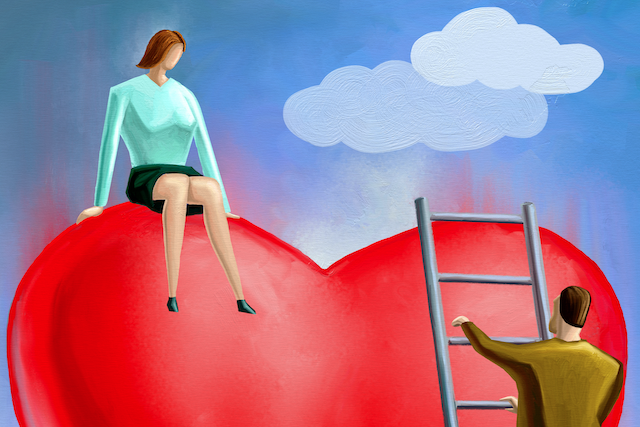
  • How to Foster Better Relationships Just by Being Present

    How to Foster Better Relationships Just by Being Present

    Couple Doing Yoga

    “When you love someone, the best thing you can offer is your presence. How can you love if you are not there?” ~Thich Nhat Hanh

    I love to pose a question in my journal and watch carefully for the myriad responses from The Universe. I always know how much attention something needs based on the quantity and clarity of the answers I receive.

    Lately I’ve been pondering the question: How can I be a better sister, daughter, and friend? The Universe has been responding with a metric truckload of answers.

    The common theme?

    Get present.

    With our busy lives, we’re always ticking boxes off a long list and thinking about the next thing we have to get done. We’re constantly in doing mode.

    Sometimes it can feel like a burden or an annoyance to have to stop, even momentarily, for the people we love.

    It seems a little backward, don’t you think?

    Getting present requires a certain level of self-awareness.

    It is about putting aside your own thoughts, worries, fears, and insecurities and genuinely taking an interest in what that person is saying.

    When you press pause—physically and mentally—and hold a space for a person to express themselves fully, that person feels valued, heard, seen, and loved.

    And that’s all any of us ever really want.

    So how can we bring more presence to our relationships?

    Intention

    Start with setting an intention to be more present.

    It sounds so simple. And it is. Yet many of us enter our relationships with a nonchalant air and very little intent.

    As you begin to engage with the people you love, the intention to be more present acts as a reminder, anchoring you into the present.

    You become aware of those times when you are most present and those times when you are not. And you’ll notice what distracts you from the present moment. Phone calls, to-do lists, busyness overload, social media—whatever it is.

    When you become aware of this stuff, you can work with it or eliminate it so it doesn’t keep distracting you.

    Intention is where it starts.

    Support Yourself

    I support others by supporting myself.

    Next time you’re engaging with someone, take a moment to check in with where you’re at and ask if you’re supporting yourself.

    By this I mean, are you centered, confident, and calm? Or, are you up in your head? Is there a story running?

    I’ll give you an example. I have a tendency to overcompensate when I meet someone new, someone I potentially want to be friends with. I’m overly nice to the point where it’s almost awkward and uncomfortable. Why do I do this?

    At some point, I stop supporting myself and I retreat into my head.

    Here, there is a story running: “What if I say the wrong thing? What if she doesn’t like me? Have I got something in my teeth? Did I put deodorant on this morning? What if I have nothing to say in response to what she’s telling me?” And on and on it goes.

    Yup. As I write this, I see how ridiculous it all sounds. But this is what happens. I stop supporting myself and let my mind run away with the show.

    The result? I lose my presence.

    The same can be said for interacting with people I know well, like family members and good friends. The story is not necessarily the same, but the outcome most certainly is.

    When I support myself, I am connected and grounded. I easily retain the finer details of the conversation. And later, I remember to follow up to see if the person is feeling better/got that job/went on that second date.

    I speak from my heart rather than from my head, bringing value to the conversation. I set adequate boundaries. It actually makes me a better sister, daughter, and friend.

    Supporting yourself is essential to supporting those around you.

    This doesn’t have to be difficult. It might look like:

    • Clearing your busy schedule and creating some space just for yourself
    • Saying no
    • Focusing on your breath
    • Learning to meditate
    • Exploring the stories that are running in your head (journaling and kinesiology are my favorite mechanisms for self-exploration)

    How does presence influence your relationships? Have you noticed the dynamics of the relationships change? Can you feel the connections strengthen with your presence?

    Couple doing yoga image via Shutterstock